air filter Hyundai Equus 2010 User Guide
[x] Cancel search | Manufacturer: HYUNDAI, Model Year: 2010, Model line: Equus, Model: Hyundai Equus 2010Pages: 374, PDF Size: 41.29 MB
Page 316 of 374
725
Maintenance
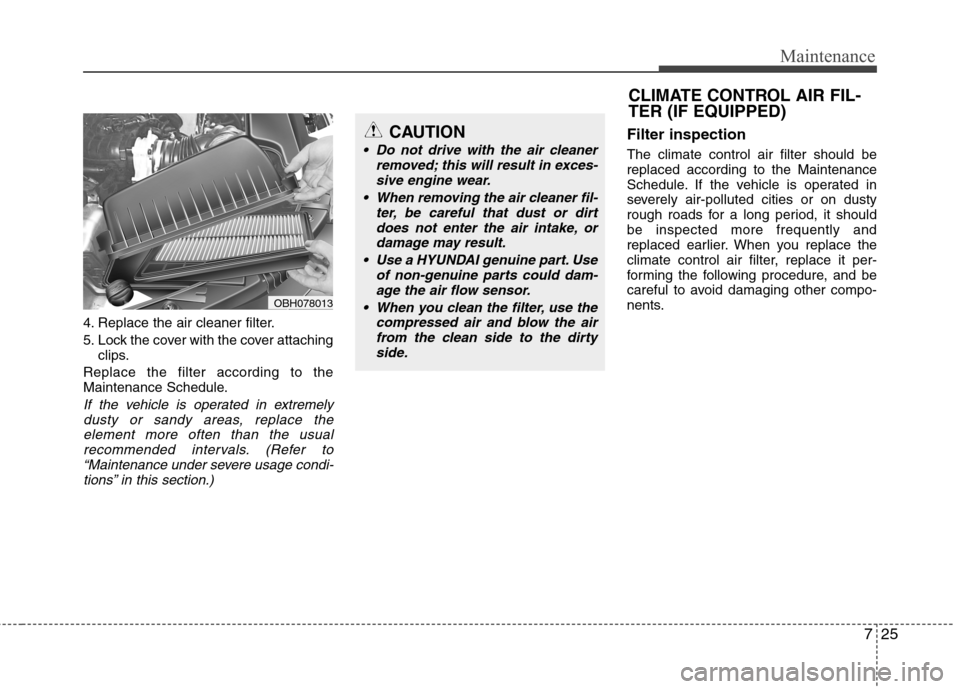
4. Replace the air cleaner filter.
5. Lock the cover with the cover attachingclips.
Replace the filter according to the
Maintenance Schedule.
If the vehicle is operated in extremely dusty or sandy areas, replace the element more often than the usual
recommended intervals. (Refer to“Maintenance under severe usage condi- tions” in this section.)
Filter inspection The climate control air filter should be replaced according to the Maintenance
Schedule. If the vehicle is operated in
severely air-polluted cities or on dusty
rough roads for a long period, it shouldbe inspected more frequently and
replaced earlier. When you replace the
climate control air filter, replace it per-
forming the following procedure, and be
careful to avoid damaging other compo-
nents.
OBH078013
CAUTION
Do not drive with the air cleaner removed; this will result in exces-
sive engine wear.
When removing the air cleaner fil- ter, be careful that dust or dirtdoes not enter the air intake, or
damage may result.
Use a HYUNDAI genuine part. Use of non-genuine parts could dam-age the air flow sensor.
When you clean the filter, use the compressed air and blow the air
from the clean side to the dirty side.
CLIMATE CONTROL AIR FIL-
TER (IF EQUIPPED)
Page 317 of 374
Maintenance
26
7
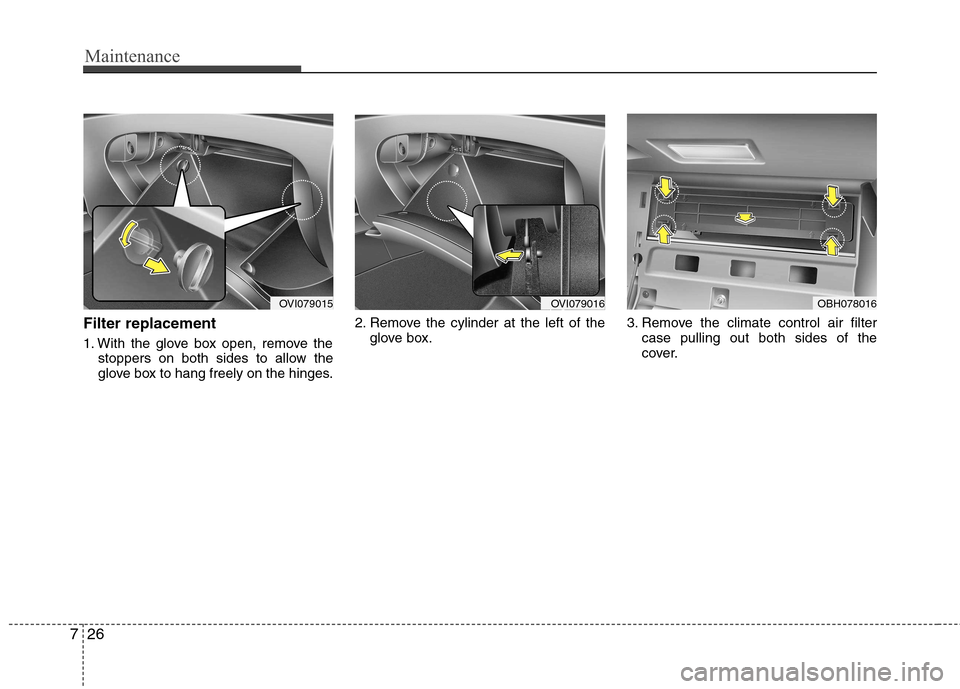
Filter replacement
1. With the glove box open, remove the
stoppers on both sides to allow the
glove box to hang freely on the hinges. 2. Remove the cylinder at the left of the
glove box. 3. Remove the climate control air filter
case pulling out both sides of the
cover.
OVI079015OBH078016OVI079016
Page 318 of 374
727
Maintenance
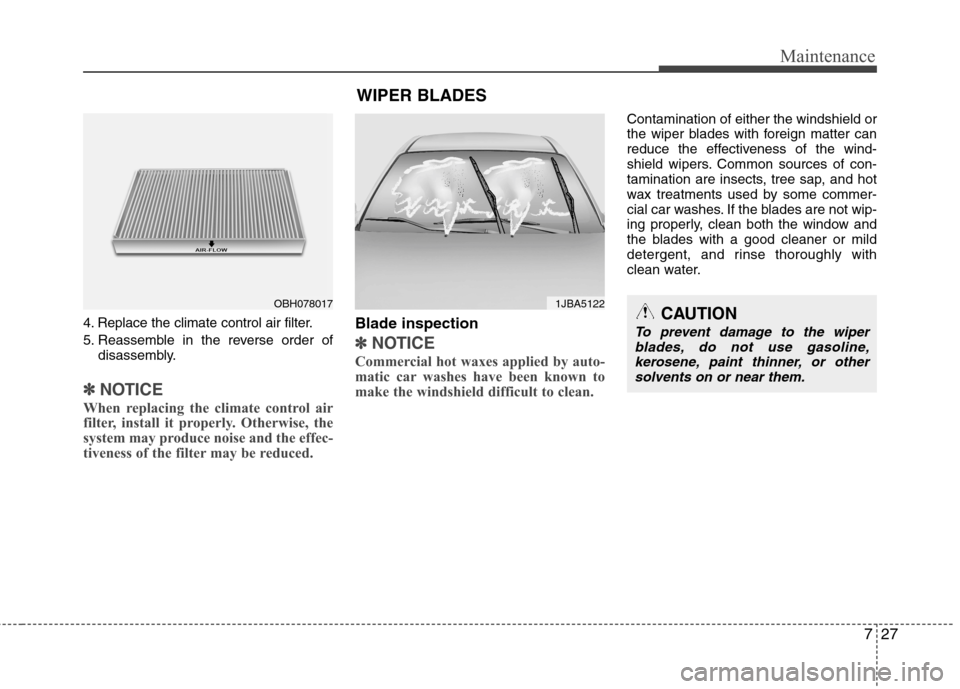
4. Replace the climate control air filter.
5. Reassemble in the reverse order ofdisassembly.
✽✽ NOTICE
When replacing the climate control air
filter, install it properly. Otherwise, the
system may produce noise and the effec-
tiveness of the filter may be reduced.
Blade inspection
✽✽ NOTICE
Commercial hot waxes applied by auto-
matic car washes have been known to
make the windshield difficult to clean.
Contamination of either the windshield or
the wiper blades with foreign matter can
reduce the effectiveness of the wind-
shield wipers. Common sources of con-
tamination are insects, tree sap, and hot
wax treatments used by some commer-
cial car washes. If the blades are not wip-
ing properly, clean both the window and
the blades with a good cleaner or mild
detergent, and rinse thoroughly with
clean water.
OBH078017 WIPER BLADESCAUTION
To prevent damage to the wiper
blades, do not use gasoline,kerosene, paint thinner, or other
solvents on or near them.
1JBA5122
Page 361 of 374
Maintenance
70
7
EMISSION CONTROL SYSTEM (IF EQUIPPED)
The emission control system of your
vehicle is covered by a written limited
warranty. Please see the warranty infor-
mation contained in the Service Passport
in your vehicle.
Your vehicle is equipped with an emis-
sion control system to meet all applicable
emission regulations. There are three emission control sys-
tems, as follows.
(1) Crankcase emission control system
(2) Evaporative emission control system(3) Exhaust emission control system In order to assure the proper function of
the emission control systems, it is rec-
ommended that you have your car
inspected and maintained by an author-
ized HYUNDAI dealer in accordance with
the maintenance schedule in this manu-al. Caution for the Inspection and
Maintenance Test (With Electronic
Stability Program (ESP) system)
To prevent the vehicle from misfir-
ing during dynamometer testing,
turn the Electronic Stability
Program (ESP) system off by press-
ing the ESP switch.
After dynamometer testing is com- pleted, turn the ESP system back on
by pressing the ESP switch again. 1. Crankcase emission control
system
The positive crankcase ventilation sys-
tem is employed to prevent air pollution
caused by blow-by gases being emitted
from the crankcase. This system supplies
fresh filtered air to the crankcase through
the air intake hose. Inside the crankcase,
the fresh air mixes with blow-by gases,
which then pass through the PCV valveinto the induction system.
2. Evaporative emission control system
The Evaporative Emission Control
System is designed to prevent fuel
vapors from escaping into the atmos-
phere.
Page 372 of 374
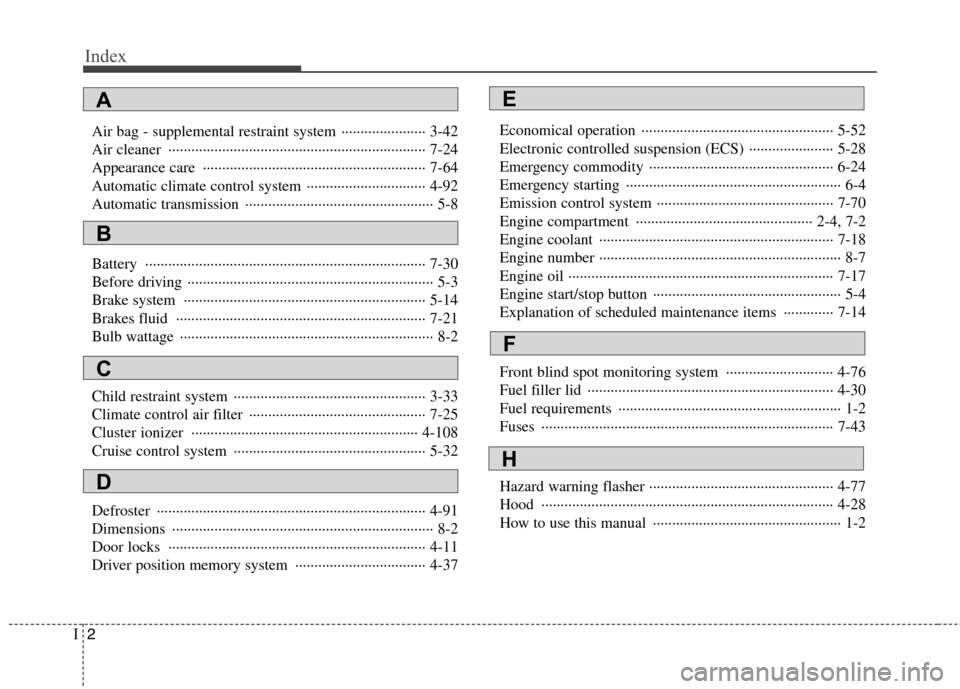
Index
2
I
Air bag - supplemental restraint system ······················ 3-42
Air cleaner ··································································· 7-24
Appearance care ·························································· 7-64
Automatic climate control system ······························· 4-92
Automatic transmission ················································· 5-8
Battery ········································································· 7-30
Before driving ································································ 5-3
Brake system ······························································· 5-14
Brakes fluid ································································· 7-21
Bulb wattage ·································································· 8-2
Child restraint system ·················································· 3-33
Climate control air filter ·············································· 7-25
Cluster ionizer ··························································· 4-108
Cruise control system ·················································· 5-32
Defroster ······································································ 4-91
Dimensions ···································································· 8-2
Door locks ··································································· 4-11
Driver position memory system ·································· 4-37 Economical operation ·················································· 5-52
Electronic controlled suspension (ECS) ······················ 5-28
Emergency commodity ················································ 6-24
Emergency starting ························································ 6-4
Emission control system ·············································· 7-70
Engine compartment ·············································· 2-4, 7-2
Engine coolant ····························································· 7-18
Engine number ······························································· 8-7
Engine oil ····································································· 7-17
Engine start/stop button ················································· 5-4
Explanation of scheduled maintenance items ············· 7-14
Front blind spot monitoring system ···························· 4-76
Fuel filler lid ································································ 4-30
Fuel requirements ·························································· 1-2
Fuses ············································································ 7-43
Hazard warning flasher ················································ 4-77
Hood ············································································ 4-28
How to use this manual ················································· 1-2
A
B
C
D
E
F
H