fuel Hyundai Equus 2010 Owner's Guide
[x] Cancel search | Manufacturer: HYUNDAI, Model Year: 2010, Model line: Equus, Model: Hyundai Equus 2010Pages: 374, PDF Size: 41.29 MB
Page 306 of 374
715
Maintenance
Vapor hose and fuel filler cap
The vapor hose and fuel filler cap should
be inspected at those intervals specified
in the maintenance schedule. Make sure
that a new vapor hose or fuel filler cap iscorrectly replaced.
Vacuum crankcase ventilation hoses (if equipped)
Inspect the surface of hoses for evidence
of heat and/or mechanical damage. Hard
and brittle rubber, cracking, tears, cuts,
abrasions, and excessive swelling indi-
cate deterioration. Particular attention
should be paid to examine those hose
surfaces nearest to high heat sources,
such as the exhaust manifold. Inspect the hose routing to assure that the hoses do not come in contact with
any heat source, sharp edges or movingcomponent which might cause heat dam-
age or mechanical wear. Inspect all hose
connections, such as clamps and cou-
plings, to make sure they are secure, and
that no leaks are present. Hoses should
be replaced immediately if there is any
evidence of deterioration or damage.Air cleaner filter
A Genuine HYUNDAI air cleaner filter is recommended when the filter isreplaced. Spark plugs
Make sure to install new spark plugs of
the correct heat range.
Valve clearance (3.8L)
Inspect excessive valve noise and/or
engine vibration and adjust if necessary.
An authorized HYUNDAI dealer should
perform the operation. Cooling system
Check cooling system components, such
as radiator, coolant reservoir, hoses and
connections for leakage and damage.
Replace any damaged parts.
Coolant The coolant should be changed at the
intervals specified in the maintenance
schedule. Brake hoses and lines
Visually check for proper installation,
chafing, cracks, deterioration and any
leakage. Replace any deteriorated or
damaged parts immediately. Brake fluid
Check brake fluid level in the brake fluid
reservoir. The level should be between
“MIN” and “MAX” marks on the side of
the reservoir. Use only hydraulic brake
fluid conforming to DOT 3 or DOT 4specification.
Page 324 of 374
733
Maintenance
CAUTION
Underinflation also results inexcessive wear, poor handlingand reduced fuel economy. Wheel deformation also ispossible. Keep your tire pres-sures at the proper levels. If a tire frequently needs refilling,have it checked by an author-ized HYUNDAI dealer.
Overinflation produces a harsh ride, excessive wear atthe center of the tire tread, anda greater possibility of dam-age from road hazards.
TIRES AND WHEELS
Tire care
For proper maintenance, safety, and
maximum fuel economy, you must
always maintain recommended tire
inflation pressures and stay within
the load limits and weight distribution
recommended for your vehicle. Recommended cold tire inflation pressures All tire pressures (including the
spare) should be checked when the
tires are cold. “Cold Tires” means the
vehicle has not been driven for at
least three hours or driven less than1.6 km (one mile).
Recommended pressures must be
maintained for the best ride, top vehi-
cle handling, and minimum tire wear.
For recommended inflation pressure,
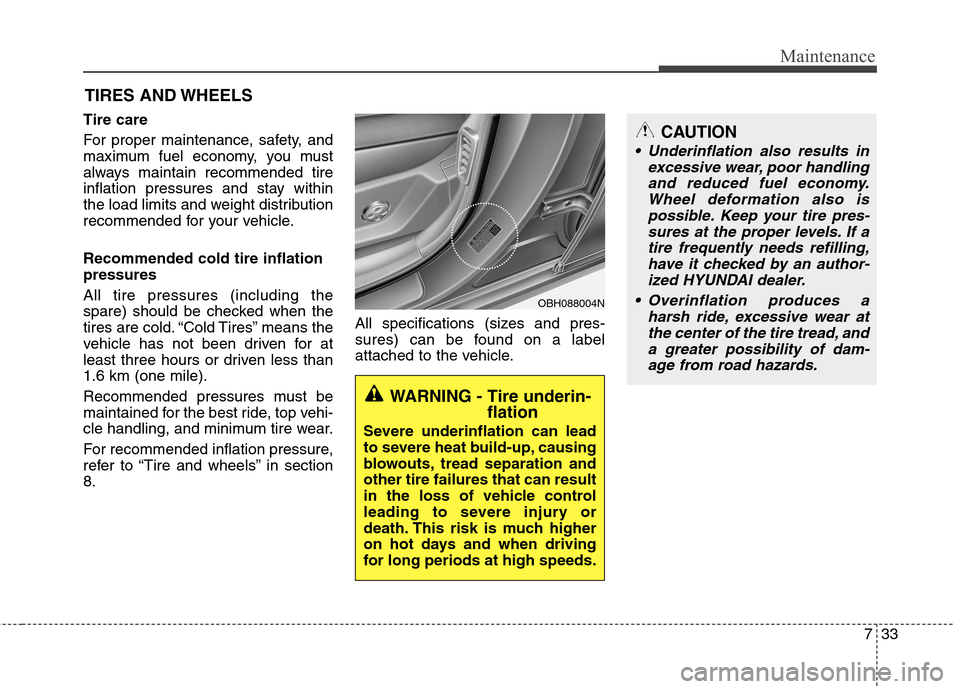
refer to “Tire and wheels” in section8. All specifications (sizes and pres-
sures) can be found on a label
attached to the vehicle.
WARNING - Tire underin-
flation
Severe underinflation can lead
to severe heat build-up, causing
blowouts, tread separation andother tire failures that can result
in the loss of vehicle control
leading to severe injury or
death. This risk is much higher
on hot days and when driving
for long periods at high speeds.
OBH088004N
Page 340 of 374
749
Maintenance
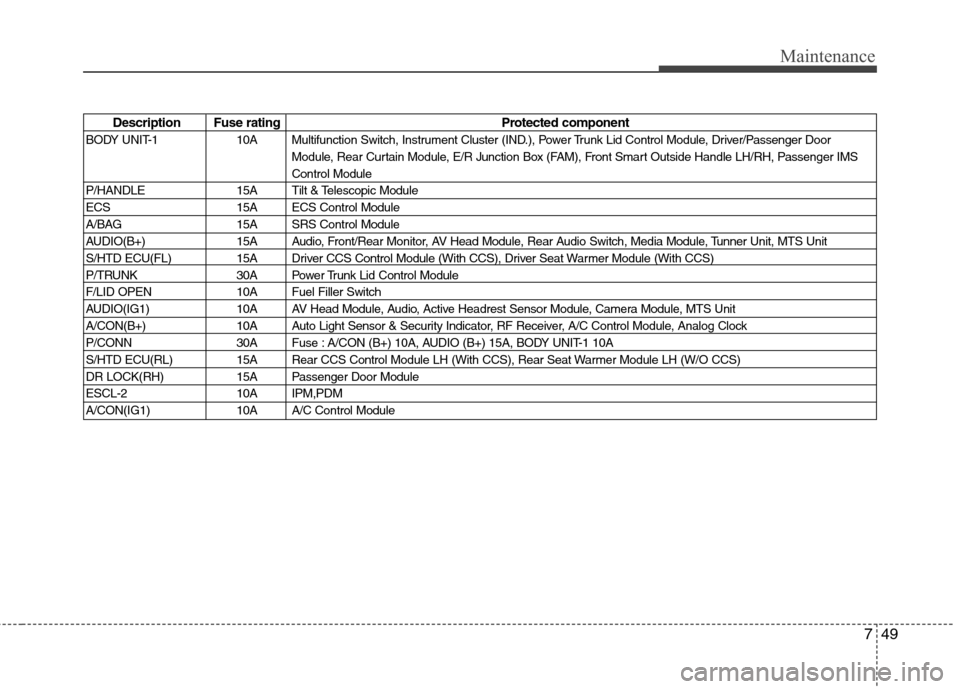
Description Fuse ratingProtected component
BODY UNIT-1 10A Multifunction Switch, Instrument Cluster (IND.), Power Trunk Lid Control Module, Driver/Passenger Door Module, Rear Curtain Module, E/R Junction Box (FAM), Front Smart Outside Handle LH/RH, Passenger IMS Control Module
P/HANDLE 15A Tilt & Telescopic Module
ECS 15A ECS Control Module
A/BAG 15A SRS Control Module
AUDIO(B+) 15A Audio, Front/Rear Monitor, AV Head Module, Rear Audio Switch, Media Module, Tunner Unit, MTS Unit
S/HTD ECU(FL) 15A Driver CCS Control Module (With CCS), Driver Seat Warmer Module (With CCS)
P/TRUNK 30A Power Trunk Lid Control Module
F/LID OPEN 10A Fuel Filler Switch
AUDIO(IG1) 10A AV Head Module, Audio, Active Headrest Sensor Module, Camera Module, MTS Unit
A/CON(B+) 10A Auto Light Sensor & Security Indicator, RF Receiver, A/C Control Module, Analog Clock
P/CONN 30A Fuse : A/CON (B+) 10A, AUDIO (B+) 15A, BODY UNIT-1 10A
S/HTD ECU(RL) 15A Rear CCS Control Module LH (With CCS), Rear Seat Warmer Module LH (W/O CCS)
DR LOCK(RH) 15A Passenger Door Module
ESCL-2 10A IPM,PDM
A/CON(IG1) 10A A/C Control Module
Page 343 of 374
Maintenance
52
7
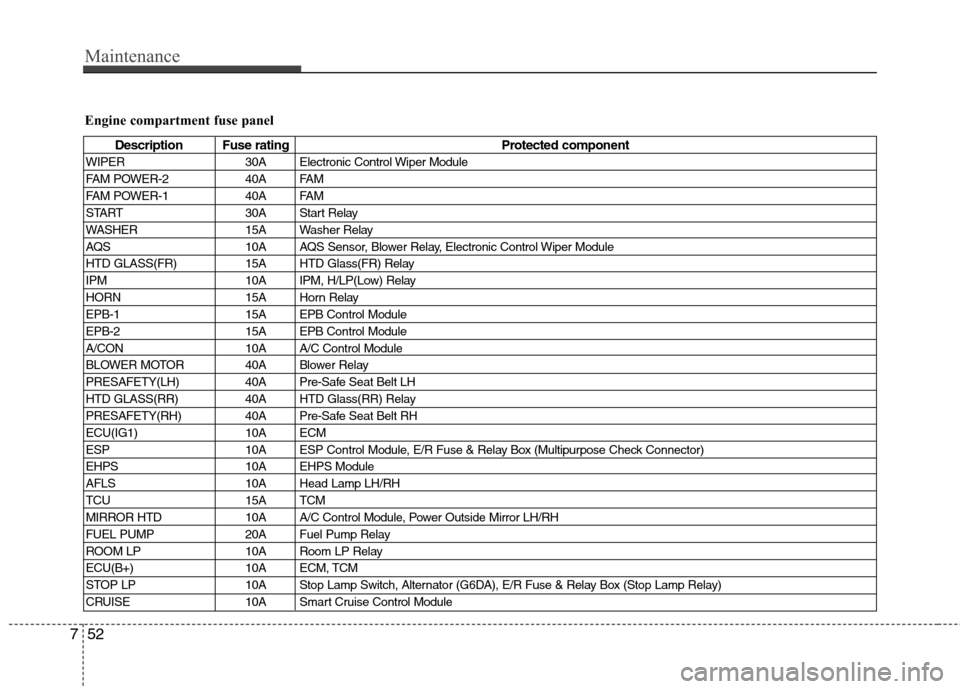
Engine compartment fuse panel
Description Fuse rating Protected component
WIPER 30A Electronic Control Wiper Module
FAM POWER-2 40A FAM
FAM POWER-1 40A FAM
START 30A Start Relay
WASHER 15A Washer Relay
AQS 10A AQS Sensor, Blower Relay, Electronic Control Wiper Module
HTD GLASS(FR) 15A HTD Glass(FR) Relay
IPM 10A IPM, H/LP(Low) Relay
HORN 15A Horn Relay
EPB-1 15A EPB Control Module
EPB-2 15A EPB Control Module
A/CON 10A A/C Control Module
BLOWER MOTOR 40A Blower Relay
PRESAFETY(LH) 40A Pre-Safe Seat Belt LH
HTD GLASS(RR) 40A HTD Glass(RR) Relay
PRESAFETY(RH) 40A Pre-Safe Seat Belt RH
ECU(IG1) 10A ECM
ESP 10A ESP Control Module, E/R Fuse & Relay Box (Multipurpose Check Connector)
EHPS 10A EHPS Module
AFLS 10A Head Lamp LH/RH
TCU 15A TCM
MIRROR HTD 10A A/C Control Module, Power Outside Mirror LH/RH
FUEL PUMP 20A Fuel Pump Relay
ROOM LP 10A Room LP Relay
ECU(B+) 10A ECM, TCM
STOP LP 10A Stop Lamp Switch, Alternator (G6DA), E/R Fuse & Relay Box (Stop Lamp Relay)
CRUISE 10A Smart Cruise Control Module
Page 344 of 374
753
Maintenance
Description Fuse rating Protected component
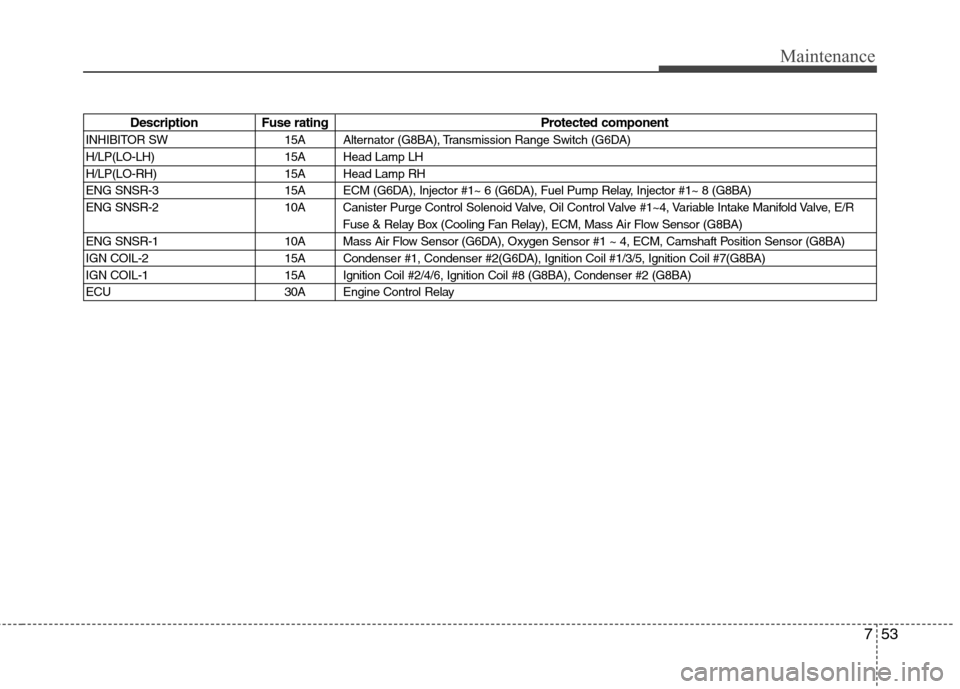
INHIBITOR SW 15A Alternator (G8BA), Transmission Range Switch (G6DA)
H/LP(LO-LH) 15A Head Lamp LH
H/LP(LO-RH) 15A Head Lamp RH
ENG SNSR-3 15A ECM (G6DA), Injector #1~ 6 (G6DA), Fuel Pump Relay, Injector #1~ 8 (G8BA)
ENG SNSR-2 10A Canister Purge Control Solenoid Valve, Oil Control Valve #1~4, Variable Intake Manifold Valve, E/R Fuse & Relay Box (Cooling Fan Relay), ECM, Mass Air Flow Sensor (G8BA)
ENG SNSR-1 10A Mass Air Flow Sensor (G6DA), Oxygen Sensor #1 ~ 4, ECM, Camshaft Position Sensor (G8BA)
IGN COIL-2 15A Condenser #1, Condenser #2(G6DA), Ignition Coil #1/3/5, Ignition Coil #7(G8BA)
IGN COIL-1 15A Ignition Coil #2/4/6, Ignition Coil #8 (G8BA), Condenser #2 (G8BA)
ECU 30A Engine Control Relay
Page 357 of 374
Maintenance
66
7
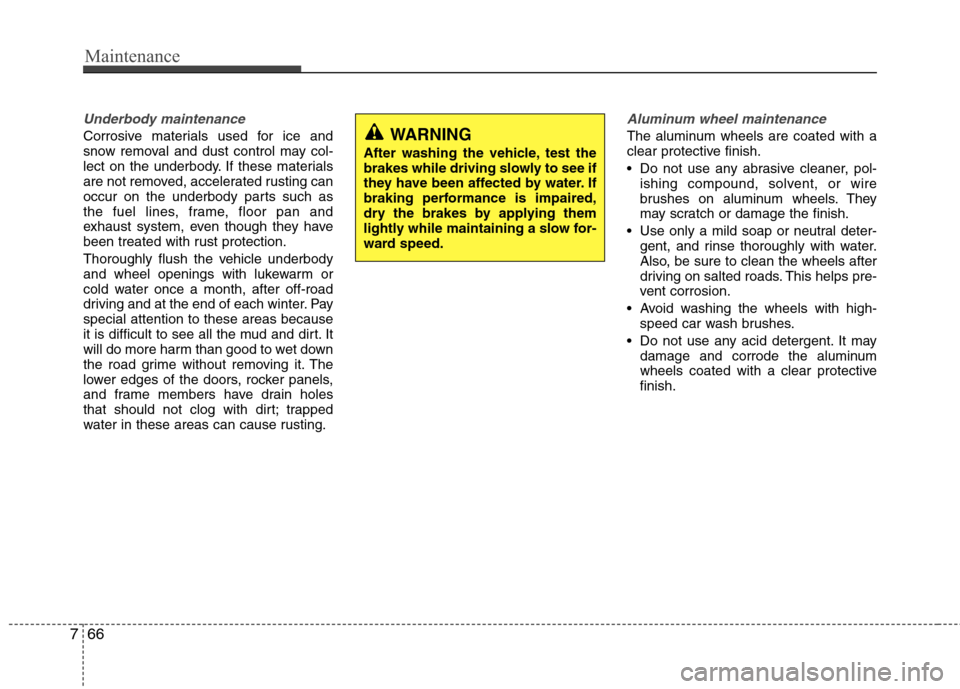
Underbody maintenance
Corrosive materials used for ice and
snow removal and dust control may col-
lect on the underbody. If these materials
are not removed, accelerated rusting can
occur on the underbody parts such as
the fuel lines, frame, floor pan and
exhaust system, even though they have
been treated with rust protection.
Thoroughly flush the vehicle underbody
and wheel openings with lukewarm or
cold water once a month, after off-road
driving and at the end of each winter. Payspecial attention to these areas because
it is difficult to see all the mud and dirt. It
will do more harm than good to wet down
the road grime without removing it. The
lower edges of the doors, rocker panels,
and frame members have drain holes
that should not clog with dirt; trapped
water in these areas can cause rusting.
Aluminum wheel maintenance
The aluminum wheels are coated with a
clear protective finish.
Do not use any abrasive cleaner, pol-
ishing compound, solvent, or wire
brushes on aluminum wheels. They
may scratch or damage the finish.
Use only a mild soap or neutral deter- gent, and rinse thoroughly with water.
Also, be sure to clean the wheels after
driving on salted roads. This helps pre-
vent corrosion.
Avoid washing the wheels with high- speed car wash brushes.
Do not use any acid detergent. It may damage and corrode the aluminum
wheels coated with a clear protectivefinish.WARNING
After washing the vehicle, test the
brakes while driving slowly to see if
they have been affected by water. If
braking performance is impaired,
dry the brakes by applying them
lightly while maintaining a slow for-
ward speed.
Page 361 of 374
Maintenance
70
7
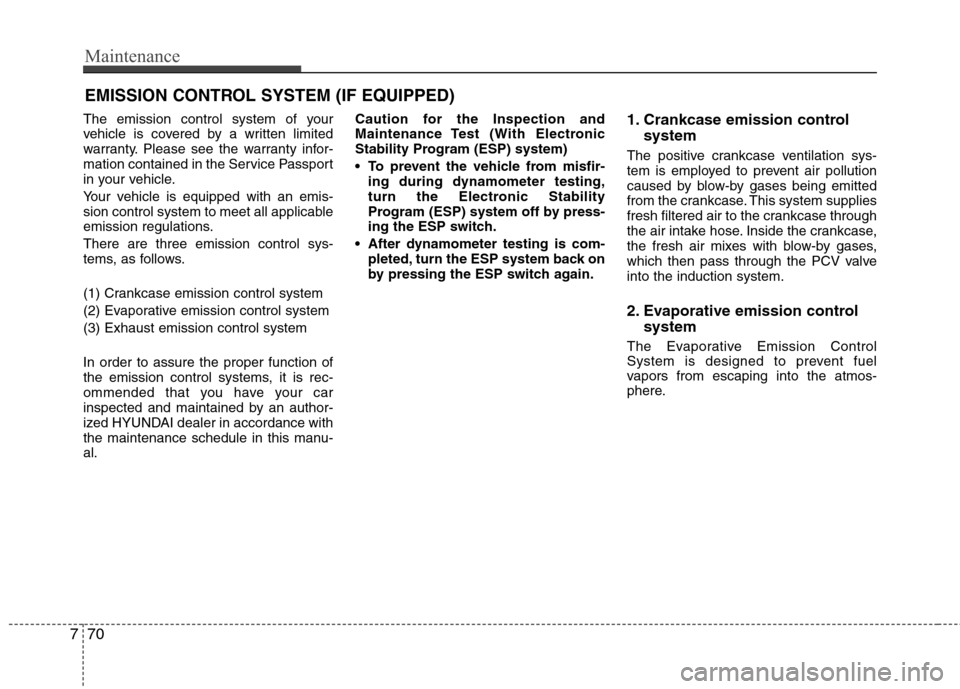
EMISSION CONTROL SYSTEM (IF EQUIPPED)
The emission control system of your
vehicle is covered by a written limited
warranty. Please see the warranty infor-
mation contained in the Service Passport
in your vehicle.
Your vehicle is equipped with an emis-
sion control system to meet all applicable
emission regulations. There are three emission control sys-
tems, as follows.
(1) Crankcase emission control system
(2) Evaporative emission control system(3) Exhaust emission control system In order to assure the proper function of
the emission control systems, it is rec-
ommended that you have your car
inspected and maintained by an author-
ized HYUNDAI dealer in accordance with
the maintenance schedule in this manu-al. Caution for the Inspection and
Maintenance Test (With Electronic
Stability Program (ESP) system)
To prevent the vehicle from misfir-
ing during dynamometer testing,
turn the Electronic Stability
Program (ESP) system off by press-
ing the ESP switch.
After dynamometer testing is com- pleted, turn the ESP system back on
by pressing the ESP switch again. 1. Crankcase emission control
system
The positive crankcase ventilation sys-
tem is employed to prevent air pollution
caused by blow-by gases being emitted
from the crankcase. This system supplies
fresh filtered air to the crankcase through
the air intake hose. Inside the crankcase,
the fresh air mixes with blow-by gases,
which then pass through the PCV valveinto the induction system.
2. Evaporative emission control system
The Evaporative Emission Control
System is designed to prevent fuel
vapors from escaping into the atmos-
phere.
Page 362 of 374
771
Maintenance
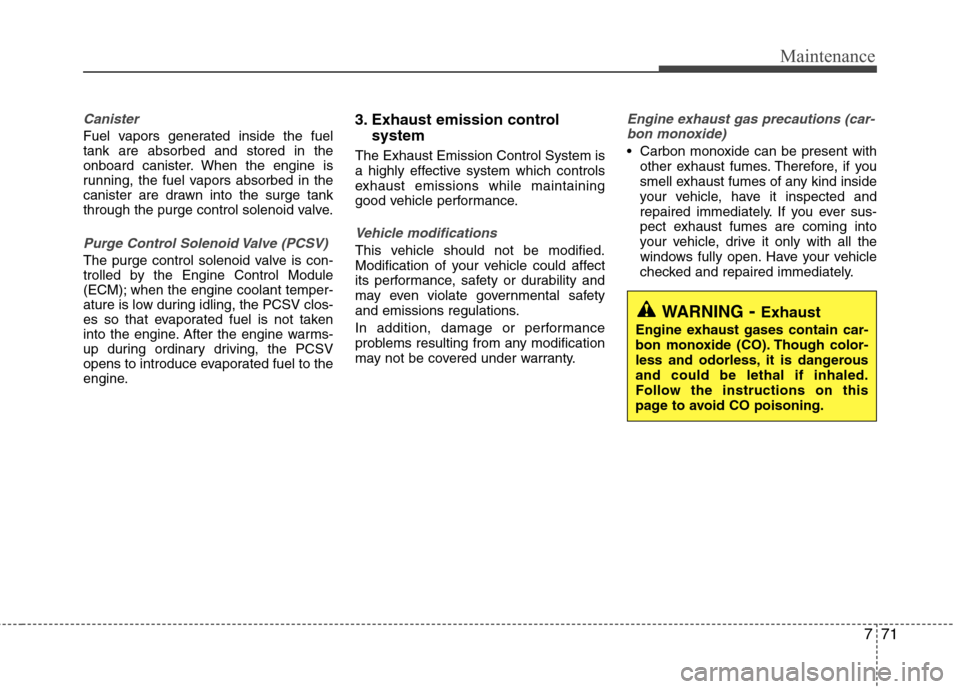
Canister
Fuel vapors generated inside the fuel tank are absorbed and stored in the
onboard canister. When the engine is
running, the fuel vapors absorbed in the
canister are drawn into the surge tank
through the purge control solenoid valve.
Purge Control Solenoid Valve (PCSV)
The purge control solenoid valve is con-
trolled by the Engine Control Module
(ECM); when the engine coolant temper-
ature is low during idling, the PCSV clos-
es so that evaporated fuel is not taken
into the engine. After the engine warms-
up during ordinary driving, the PCSV
opens to introduce evaporated fuel to the
engine.3. Exhaust emission control
system
The Exhaust Emission Control System is
a highly effective system which controls
exhaust emissions while maintaining
good vehicle performance.
Vehicle modifications
This vehicle should not be modified.
Modification of your vehicle could affect
its performance, safety or durability and
may even violate governmental safety
and emissions regulations.
In addition, damage or performance
problems resulting from any modification
may not be covered under warranty.
Engine exhaust gas precautions (car- bon monoxide)
Carbon monoxide can be present with other exhaust fumes. Therefore, if you
smell exhaust fumes of any kind inside
your vehicle, have it inspected and
repaired immediately. If you ever sus-
pect exhaust fumes are coming into
your vehicle, drive it only with all the
windows fully open. Have your vehicle
checked and repaired immediately.
WARNING - Exhaust
Engine exhaust gases contain car-
bon monoxide (CO). Though color-
less and odorless, it is dangerousand could be lethal if inhaled.
Follow the instructions on this
page to avoid CO poisoning.
Page 363 of 374
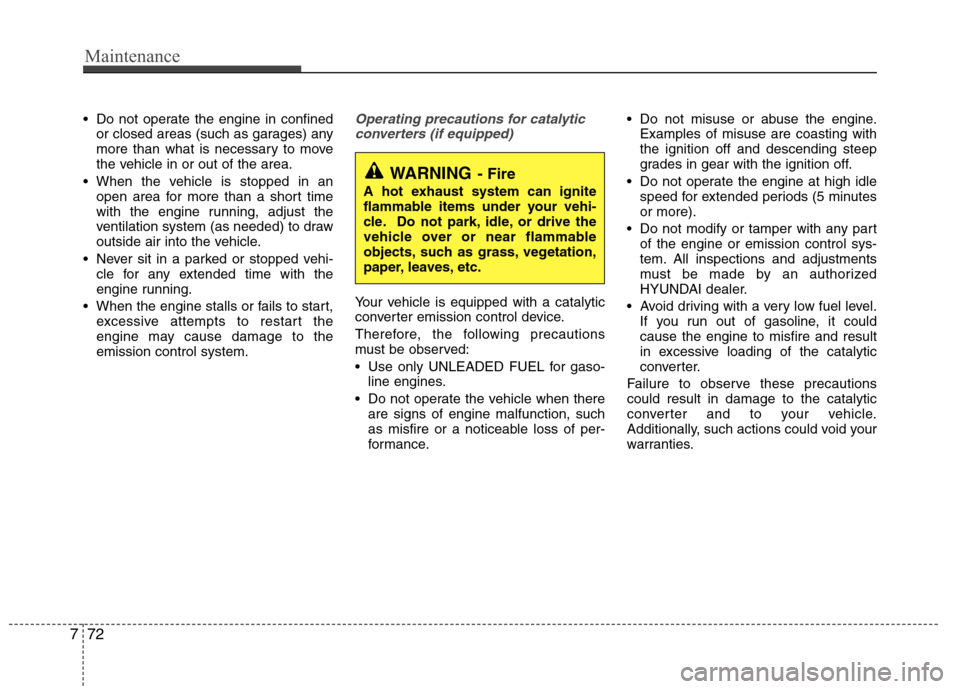
Maintenance
72
7
Do not operate the engine in confined
or closed areas (such as garages) any
more than what is necessary to move
the vehicle in or out of the area.
When the vehicle is stopped in an open area for more than a short time
with the engine running, adjust the
ventilation system (as needed) to draw
outside air into the vehicle.
Never sit in a parked or stopped vehi- cle for any extended time with the
engine running.
When the engine stalls or fails to start, excessive attempts to restart the
engine may cause damage to theemission control system.Operating precautions for catalytic
converters (if equipped)
Your vehicle is equipped with a catalytic
converter emission control device.
Therefore, the following precautions
must be observed:
Use only UNLEADED FUEL for gaso- line engines.
Do not operate the vehicle when there are signs of engine malfunction, such
as misfire or a noticeable loss of per-
formance. Do not misuse or abuse the engine.
Examples of misuse are coasting withthe ignition off and descending steep
grades in gear with the ignition off.
Do not operate the engine at high idle speed for extended periods (5 minutesor more).
Do not modify or tamper with any part of the engine or emission control sys-
tem. All inspections and adjustments
must be made by an authorized
HYUNDAI dealer.
Avoid driving with a very low fuel level. If you run out of gasoline, it couldcause the engine to misfire and result
in excessive loading of the catalytic
converter.
Failure to observe these precautionscould result in damage to the catalytic
converter and to your vehicle.
Additionally, such actions could void your
warranties.
WARNING - Fire
A hot exhaust system can ignite
flammable items under your vehi-
cle. Do not park, idle, or drive the
vehicle over or near flammable
objects, such as grass, vegetation,
paper, leaves, etc.
Page 367 of 374
Specifications & Consumer information
4
8
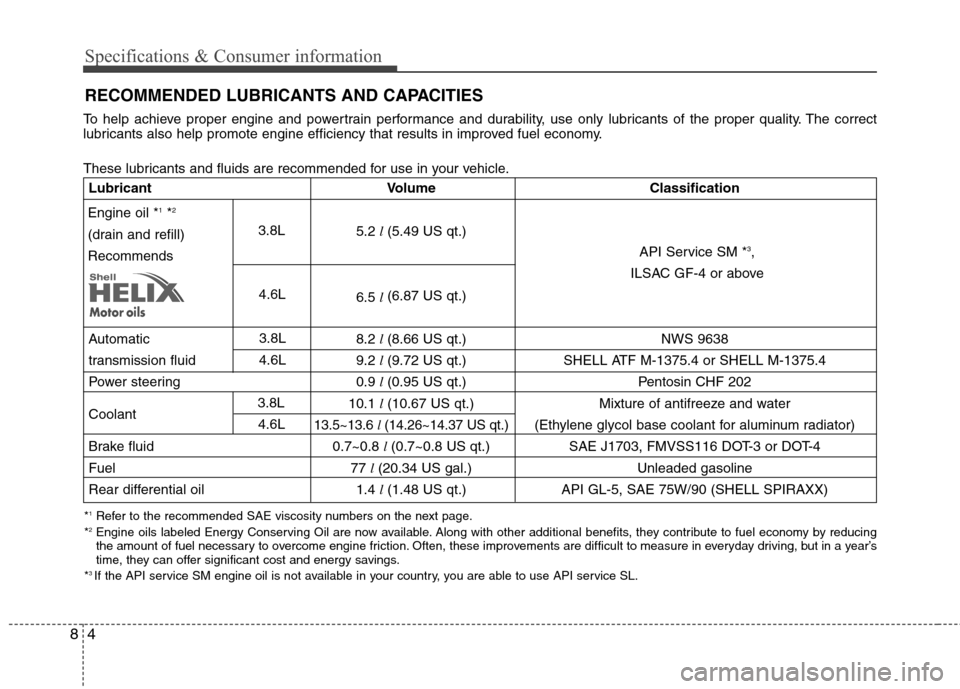
RECOMMENDED LUBRICANTS AND CAPACITIES
To help achieve proper engine and powertrain performance and durability, use only lubricants of the proper quality. The correct
lubricants also help promote engine efficiency that results in improved fuel economy.
These lubricants and fluids are recommended for use in your vehicle.
* 1
Refer to the recommended SAE viscosity numbers on the next page.
* 2
Engine oils labeled Energy Conserving Oil are now available. Along with other additional benefits, they contribute to fuel econo my by reducing
the amount of fuel necessary to overcome engine friction. Often, these improvements are difficult to measure in everyday driving, but in a year’s
time, they can offer significant cost and energy savings.
* 3
If the API service SM engine oil is not available in your country, you are able to use API service SL.
Lubricant Volume Classification
5.2 l (5.49 US qt.)
6.5 l (6.87 US qt.)
Automatic 8.2 l (8.66 US qt.) NWS 9638
transmission fluid 9.2 l (9.72 US qt.) SHELL ATF M-1375.4 or SHELL M-1375.4
Power steering 0.9 l (0.95 US qt.) Pentosin CHF 202
Coolant 10.1
l (10.67 US qt.) Mixture of antifreeze and water
13.5~13.6 l (14.26~14.37 US qt.)(Ethylene glycol base coolant for aluminum radiator)
Brake fluid 0.7~0.8 l (0.7~0.8 US qt.) SAE J1703, FMVSS116 DOT-3 or DOT-4
Fuel 77 l (20.34 US gal.) Unleaded gasoline
Rear differential oil 1.4 l (1.48 US qt.) API GL-5, SAE 75W/90 (SHELL SPIRAXX)
Engine oil * 1
*2
(drain and refill) Recommends 3.8L
3.8L4.6L
4.6L
3.8L 4.6L API Service SM *
3
,
ILSAC GF-4 or above