light Hyundai Equus 2010 Manual Online
[x] Cancel search | Manufacturer: HYUNDAI, Model Year: 2010, Model line: Equus, Model: Hyundai Equus 2010Pages: 374, PDF Size: 41.29 MB
Page 239 of 374
535
Driving your vehicle
Operating the EPB switch. Do notoperate the parking brake while driving
except in an emergency situation.
Each of these actions will cancel cruise
control operation (the SET indicator light
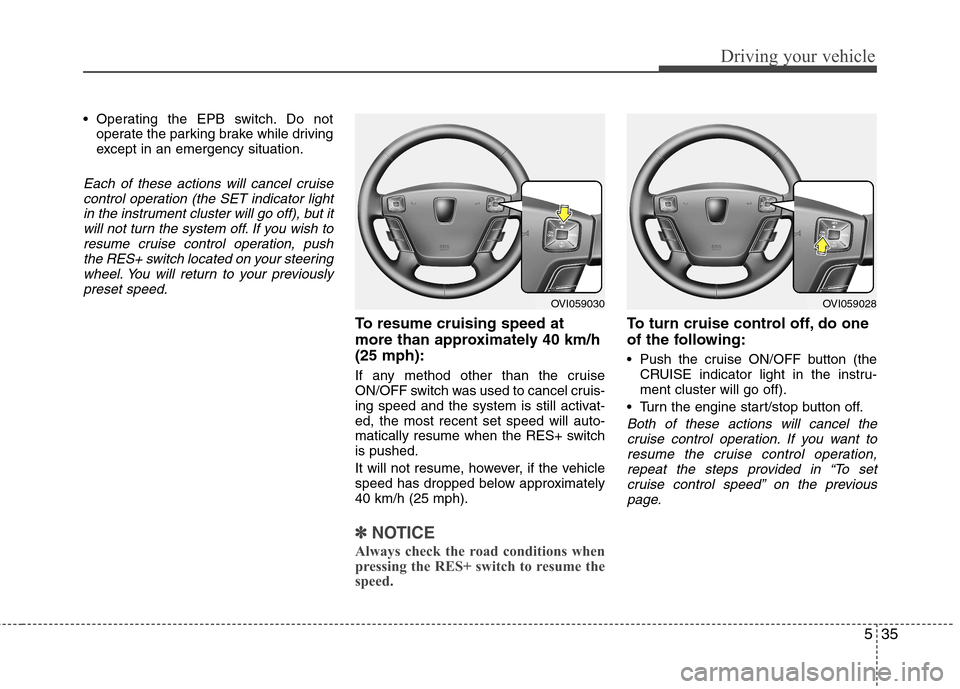
in the instrument cluster will go off), but itwill not turn the system off. If you wish toresume cruise control operation, push
the RES+ switch located on your steering wheel. You will return to your previouslypreset speed.
To resume cruising speed at
more than approximately 40 km/h(25 mph):
If any method other than the cruise
ON/OFF switch was used to cancel cruis-
ing speed and the system is still activat-ed, the most recent set speed will auto-
matically resume when the RES+ switchis pushed.
It will not resume, however, if the vehicle
speed has dropped below approximately40 km/h (25 mph).
✽✽ NOTICE
Always check the road conditions when
pressing the RES+ switch to resume the
speed.
To turn cruise control off, do one
of the following:
Push the cruise ON/OFF button (the CRUISE indicator light in the instru- ment cluster will go off).
Turn the engine start/stop button off.
Both of these actions will cancel the cruise control operation. If you want to resume the cruise control operation,repeat the steps provided in “To set
cruise control speed” on the previouspage.
OVI059030OVI059028
Page 240 of 374
Driving your vehicle
36
5
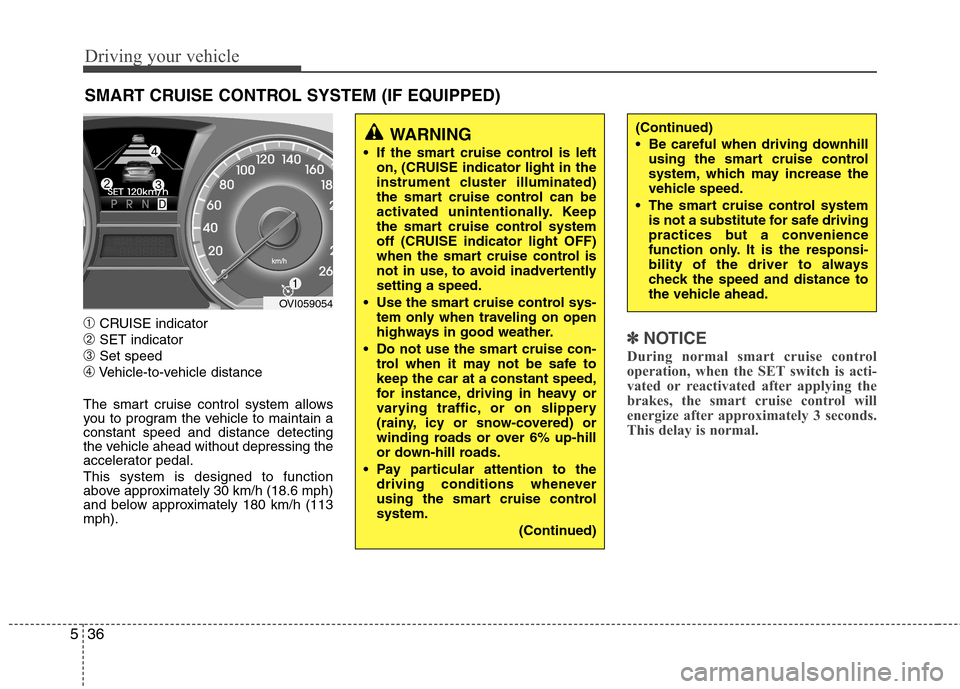
➀ CRUISE indicator
➁ SET indicator
➂ Set speed
➃ Vehicle-to-vehicle distance
The smart cruise control system allows
you to program the vehicle to maintain aconstant speed and distance detecting
the vehicle ahead without depressing the
accelerator pedal. This system is designed to function
above approximately 30 km/h (18.6 mph)
and below approximately 180 km/h (113mph).
✽✽ NOTICE
During normal smart cruise control
operation, when the SET switch is acti-
vated or reactivated after applying the
brakes, the smart cruise control will
energize after approximately 3 seconds.
This delay is normal.
SMART CRUISE CONTROL SYSTEM (IF EQUIPPED)
WARNING
If the smart cruise control is left on, (CRUISE indicator light in the
instrument cluster illuminated)
the smart cruise control can be
activated unintentionally. Keep
the smart cruise control system
off (CRUISE indicator light OFF)
when the smart cruise control is
not in use, to avoid inadvertentlysetting a speed.
Use the smart cruise control sys- tem only when traveling on open
highways in good weather.
Do not use the smart cruise con- trol when it may not be safe tokeep the car at a constant speed,
for instance, driving in heavy or
varying traffic, or on slippery
(rainy, icy or snow-covered) or
winding roads or over 6% up-hill
or down-hill roads.
Pay particular attention to the driving conditions whenever
using the smart cruise controlsystem.
(Continued)(Continued)
Be careful when driving downhillusing the smart cruise control
system, which may increase the
vehicle speed.
The smart cruise control system is not a substitute for safe driving
practices but a convenience
function only. It is the responsi-
bility of the driver to always
check the speed and distance to
the vehicle ahead.
OVI059054
Page 241 of 374
537
Driving your vehicle
To set cruise control speed:
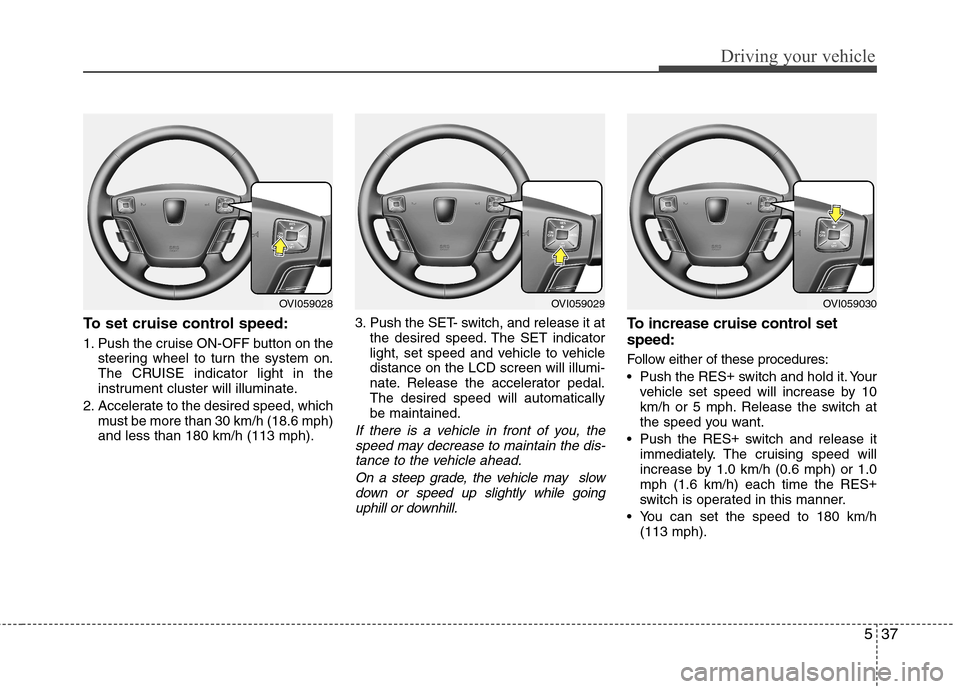
1. Push the cruise ON-OFF button on thesteering wheel to turn the system on.
The CRUISE indicator light in the
instrument cluster will illuminate.
2. Accelerate to the desired speed, which must be more than 30 km/h (18.6 mph)and less than 180 km/h (113 mph). 3. Push the SET- switch, and release it at
the desired speed. The SET indicator
light, set speed and vehicle to vehicledistance on the LCD screen will illumi-
nate. Release the accelerator pedal.The desired speed will automaticallybe maintained.
If there is a vehicle in front of you, the
speed may decrease to maintain the dis-tance to the vehicle ahead.
On a steep grade, the vehicle may slowdown or speed up slightly while goinguphill or downhill.
To increase cruise control set speed:
Follow either of these procedures:
Push the RES +
switch and hold it. Your
vehicle set speed will increase by 10
km/h or 5 mph. Release the switch at
the speed you want.
Push the RES +
switch and release it
immediately. The cruising speed will
increase by 1.0 km/h (0.6 mph) or 1.0mph (1.6 km/h) each time the RES +
switch is operated in this manner.
You can set the speed to 180 km/h (113 mph).
OVI059029OVI059030OVI059028
Page 243 of 374

539
Driving your vehicle
Decreasing the vehicle speed to lessthan approximately 10km/h (6.2mph)
as the vehicle in front of you.
Accelerating the vehicle speed to more than approximately 180km/h(113mph).
The ESP is turned off.
The sensor or the cover is stained with foreign matter.
Each of these actions will cancel smart
cruise control operation (the SET indica-
tor light, set speed and vehicle to vehicledistance on the LCD screen will go out),but it will not turn the system off. If youwish to resume smart cruise control
operation, push the RES+ switch locatedon your steering wheel. You will return toyour previously preset speed.
To resume cruising speed at
more than approximately 10 km/h(6.2 mph):
If any method other than the cruise
ON/OFF switch was used to cancel cruis-
ing speed and the system is still activat-ed, the most recent set speed will auto-
matically resume when the RES+ switchis pushed.
It will not resume, however, if the vehicle
speed has dropped below approximately10 km/h (6.2 mph) when the sensor
detects the vehicle ahead or if the vehicle
speed has dropped below approximately30 km/h (18.6 mph) when there is no
vehicle in front of your vehicle.
✽✽ NOTICE
Always check the road conditions when
pressing the RES+ switch to resume the
speed.
To turn cruise control off, do one
of the following:
Push the cruise ON/OFF button (the CRUISE indicator light in the instru- ment cluster will go out).
Turn the engine off.
Both of these actions cancel smart cruise control operation. If you want to resume smart cruise control operation, repeat
the steps provided in “To set cruise con- trol speed” on the previous page.OVI059030
CAUTION
If the sensor cover is dirty orobstructed, the smart cruise control
operation will cancel automatically.
Page 246 of 374
Driving your vehicle
42
5
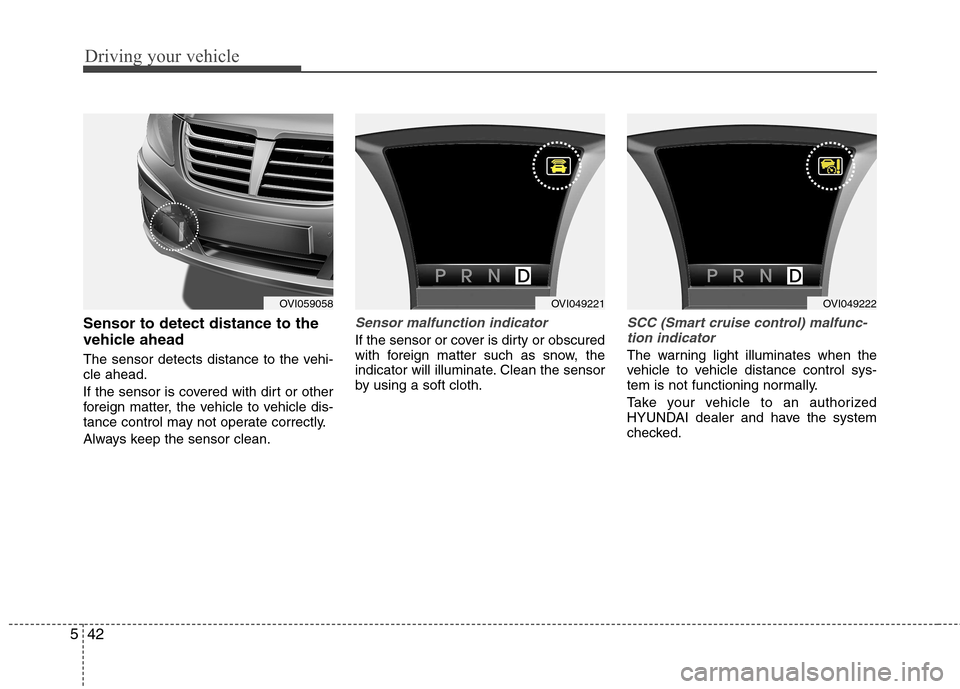
Sensor to detect distance to the
vehicle ahead
The sensor detects distance to the vehi- cle ahead.
If the sensor is covered with dirt or other
foreign matter, the vehicle to vehicle dis-
tance control may not operate correctly.
Always keep the sensor clean.Sensor malfunction indicator
If the sensor or cover is dirty or obscured
with foreign matter such as snow, the
indicator will illuminate. Clean the sensor
by using a soft cloth.
SCC (Smart cruise control) malfunc-
tion indicator
The warning light illuminates when the
vehicle to vehicle distance control sys-
tem is not functioning normally.
Take your vehicle to an authorized
HYUNDAI dealer and have the system
checked.
OVI059058OVI049221OVI049222
Page 247 of 374
543
Driving your vehicle
Limitations of the system
The smart cruise control system may
have limits to its ability to detect distance
to the vehicle ahead due to road and traf-
fic conditions.
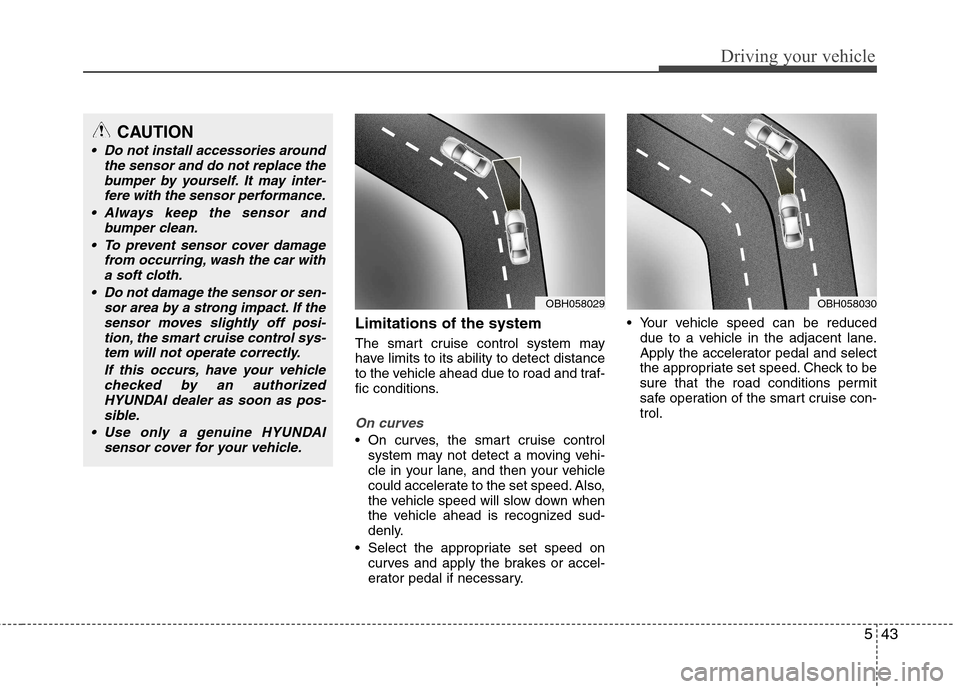
On curves
On curves, the smart cruise controlsystem may not detect a moving vehi-
cle in your lane, and then your vehicle
could accelerate to the set speed. Also,
the vehicle speed will slow down when
the vehicle ahead is recognized sud-
denly.
Select the appropriate set speed on curves and apply the brakes or accel-
erator pedal if necessary. Your vehicle speed can be reduced
due to a vehicle in the adjacent lane.
Apply the accelerator pedal and select
the appropriate set speed. Check to be
sure that the road conditions permit
safe operation of the smart cruise con-trol.
OBH058030OBH058029
CAUTION
Do not install accessories around
the sensor and do not replace the
bumper by yourself. It may inter-fere with the sensor performance.
Always keep the sensor and bumper clean.
To prevent sensor cover damage from occurring, wash the car witha soft cloth.
Do not damage the sensor or sen- sor area by a strong impact. If thesensor moves slightly off posi-
tion, the smart cruise control sys-tem will not operate correctly.
If this occurs, have your vehiclechecked by an authorizedHYUNDAI dealer as soon as pos-
sible.
Use only a genuine HYUNDAI sensor cover for your vehicle.
Page 250 of 374

Driving your vehicle
46
5
This system detects the lane with the
sensor at the front windshield and warns
you when your vehicle leaves the lane. To operate the LDWS, pull the switch or
press the switch with the engine
start/stop button in the ON position. The
indicator illuminates on the cluster. To
cancel the LDWS, pull the switch or
press the switch again.
LANE DEPARTURE WARNING SYSTEM (LDWS) (IF EQUIPPED)
OVI059012
OVI059013
WARNING
The LDWS does not make the vehicle change lanes. It is driver's
responsibility to always check
the road conditions.
Do not turn the steering wheel suddenly, when the LDWS warns
that your vehicle leaving the lane.
If the sensor can not detect the lane or if the vehicle speed does
not exceed 60km/h, the LDWS
won't warn you even though vehi-
cle leaves the lane.
If your vehicle has window tint or other types of coating on the
front windshield, the LDWS may
not work properly.
Prevent the LDWS sensor from water or any liquid.
Do not remove the LDWS parts and do not affect the sensor by a
strong impact.
Do not put objects that reflect light on the dash board.
Always check the road conditions because you may not hear the
warning chime because of audio,
and external conditions.
OVI059062L
Type AType B
Page 252 of 374
Driving your vehicle
48
5
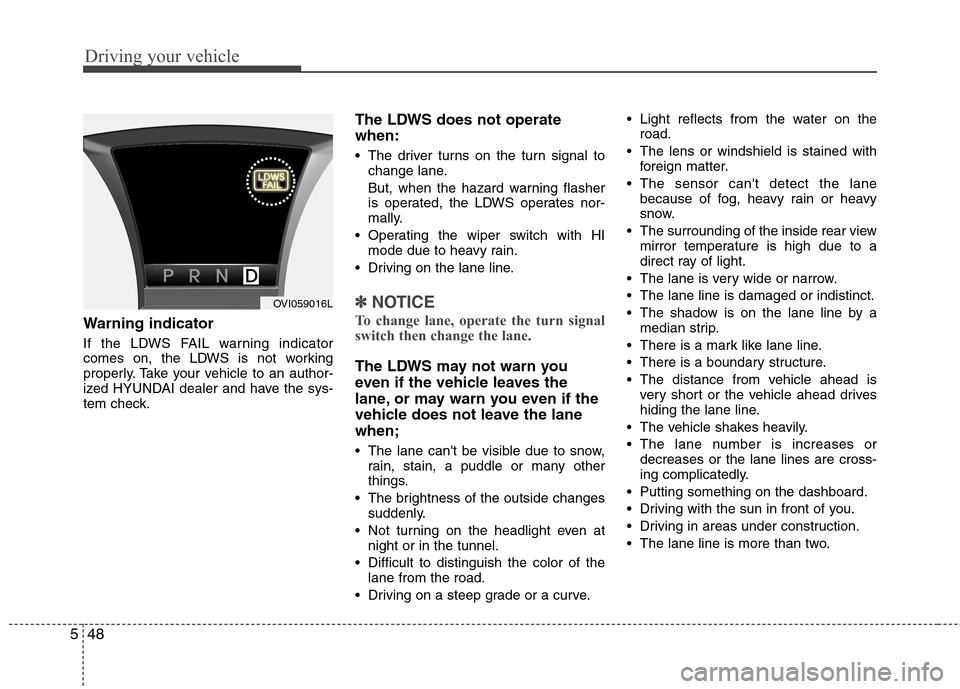
Warning indicator
If the LDWS FAIL warning indicator
comes on, the LDWS is not working
properly. Take your vehicle to an author-
ized HYUNDAI dealer and have the sys-
tem check. The LDWS does not operate when:
The driver turns on the turn signal to
change lane.
But, when the hazard warning flasher
is operated, the LDWS operates nor-
mally.
Operating the wiper switch with HI mode due to heavy rain.
Driving on the lane line.
✽✽ NOTICE
To change lane, operate the turn signal
switch then change the lane.
The LDWS may not warn you
even if the vehicle leaves the
lane, or may warn you even if the
vehicle does not leave the lanewhen;
The lane can't be visible due to snow, rain, stain, a puddle or many other
things.
The brightness of the outside changes suddenly.
Not turning on the headlight even at night or in the tunnel.
Difficult to distinguish the color of the lane from the road.
Driving on a steep grade or a curve. Light reflects from the water on the
road.
The lens or windshield is stained with foreign matter.
The sensor can't detect the lane because of fog, heavy rain or heavy
snow.
The surrounding of the inside rear view mirror temperature is high due to a
direct ray of light.
The lane is very wide or narrow.
The lane line is damaged or indistinct.
The shadow is on the lane line by a median strip.
There is a mark like lane line.
There is a boundary structure.
The distance from vehicle ahead is very short or the vehicle ahead drives
hiding the lane line.
The vehicle shakes heavily.
The lane number is increases or decreases or the lane lines are cross-
ing complicatedly.
Putting something on the dashboard.
Driving with the sun in front of you.
Driving in areas under construction.
The lane line is more than two.
OVI059016L
Page 253 of 374
549
Driving your vehicle
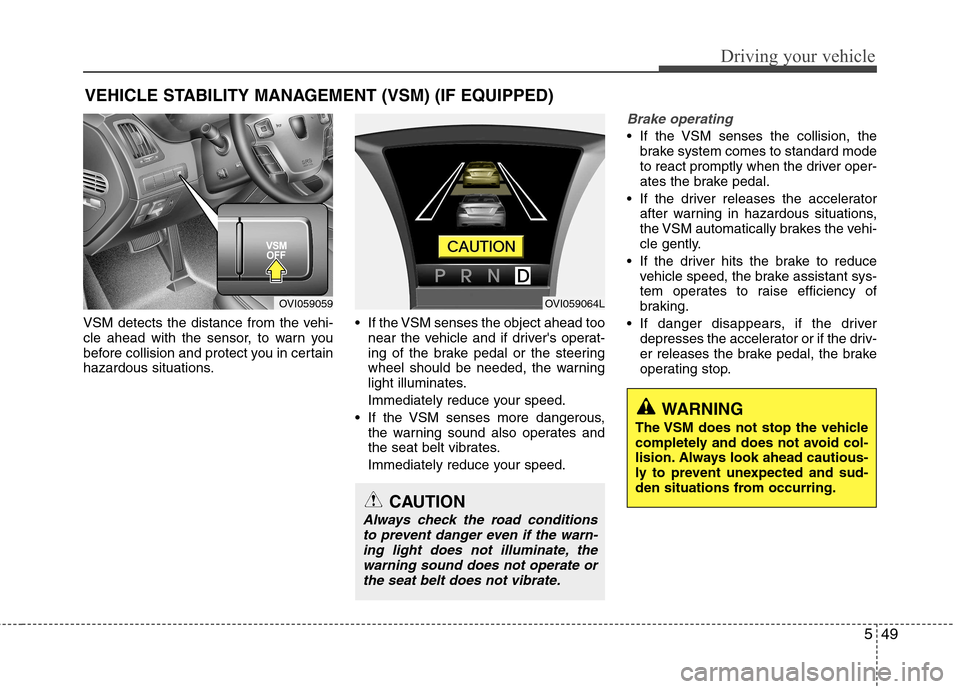
VSM detects the distance from the vehi-
cle ahead with the sensor, to warn you
before collision and protect you in certain
hazardous situations. If the VSM senses the object ahead too
near the vehicle and if driver's operat-
ing of the brake pedal or the steering
wheel should be needed, the warning
light illuminates.
Immediately reduce your speed.
If the VSM senses more dangerous, the warning sound also operates and
the seat belt vibrates.
Immediately reduce your speed.
Brake operating
If the VSM senses the collision, thebrake system comes to standard mode
to react promptly when the driver oper-
ates the brake pedal.
If the driver releases the accelerator after warning in hazardous situations,
the VSM automatically brakes the vehi-
cle gently.
If the driver hits the brake to reduce vehicle speed, the brake assistant sys-
tem operates to raise efficiency of
braking.
If danger disappears, if the driver depresses the accelerator or if the driv-
er releases the brake pedal, the brake
operating stop.
VEHICLE STABILITY MANAGEMENT (VSM) (IF EQUIPPED)
CAUTION
Always check the road conditions
to prevent danger even if the warn-ing light does not illuminate, the
warning sound does not operate or the seat belt does not vibrate.
OVI059059OVI059064L
WARNING
The VSM does not stop the vehicle
completely and does not avoid col-
lision. Always look ahead cautious-
ly to prevent unexpected and sud-
den situations from occurring.
Page 256 of 374
Driving your vehicle
52
5
Your vehicle's fuel economy depends
mainly on your style of driving, where you
drive and when you drive.
Each of these factors affects how many
miles (kilometers) you can get from a gal-
lon (liter) of fuel. To operate your vehicle
as economically as possible, use the fol-
lowing driving suggestions to help save
money in both fuel and repairs:
Drive smoothly. Accelerate at a moder-
ate rate. Don't make "jack-rabbit" starts or full-throttle shifts and maintain a
steady cruising speed. Don't race
between stoplights. Try to adjust your
speed to that of the other traffic so you
don't have to change speeds unneces-
sarily. Avoid heavy traffic whenever
possible. Always maintain a safe dis-
tance from other vehicles so you can
avoid unnecessary braking. This also
reduces brake wear.
Drive at a moderate speed. The faster you drive, the more fuel your car uses.
Driving at a moderate speed, especial-
ly on the highway, is one of the most
effective ways to reduce fuel consump-tion. Don't "ride" the brake pedal. This can
increase fuel consumption and also
increase wear on these components.
In addition, driving with your foot rest-
ing on the brake pedal may cause the
brakes to overheat, which reduces
their effectiveness and may lead to
more serious consequences.
Take care of your tires. Keep them inflated to the recommended pressure.
Incorrect inflation, either too much or
too little, results in unnecessary tire
wear. Check the tire pressures at leastonce a month.
Be sure that the wheels are aligned correctly. Improper alignment can
result from hitting curbs or driving too
fast over irregular surfaces. Poor align-
ment causes faster tire wear and may
also result in other problems as well as
greater fuel consumption. Keep your car in good condition. For
better fuel economy and reduced
maintenance costs, maintain your carin accordance with the maintenance
schedule in section 7. If you drive your
car in severe conditions, more frequentmaintenance is required (see section 7
for details).
Keep your car clean. For maximum service, your vehicle should be kept
clean and free of corrosive materials. It
is especially important that mud, dirt,
ice, etc. not be allowed to accumulate
on the underside of the car. This extra
weight can result in increased fuel con-
sumption and also contribute to corro-sion.
Travel lightly. Don't carry unnecessary weight in your car. Weight reduces fuel
economy.
Don't let the engine idle longer than necessary. If you are waiting (and not
in traffic), turn off your engine and
restart only when you're ready to go.
ECONOMICAL OPERATION