back up Hyundai Equus 2011 User Guide
[x] Cancel search | Manufacturer: HYUNDAI, Model Year: 2011, Model line: Equus, Model: Hyundai Equus 2011Pages: 385, PDF Size: 10.67 MB
Page 34 of 385
315
Safety features of your vehicle
Leg support
(for rear right passenger’s seat)
(if equipped)
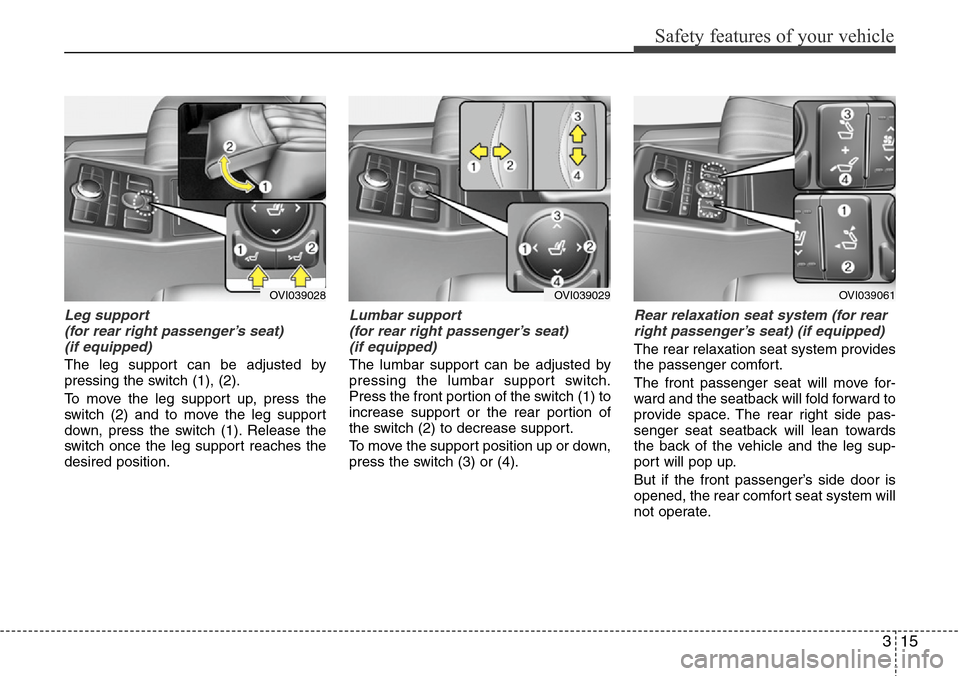
The leg support can be adjusted by
pressing the switch (1), (2).
To move the leg support up, press the
switch (2) and to move the leg support
down, press the switch (1). Release the
switch once the leg support reaches the
desired position.
Lumbar support
(for rear right passenger’s seat)
(if equipped)
The lumbar support can be adjusted by
pressing the lumbar support switch.
Press the front portion of the switch (1) to
increase support or the rear portion of
the switch (2) to decrease support.
To move the support position up or down,
press the switch (3) or (4).
Rear relaxation seat system (for rear
right passenger’s seat) (if equipped)
The rear relaxation seat system provides
the passenger comfort.
The front passenger seat will move for-
ward and the seatback will fold forward to
provide space. The rear right side pas-
senger seat seatback will lean towards
the back of the vehicle and the leg sup-
port will pop up.
But if the front passenger’s side door is
opened, the rear comfort seat system will
not operate.
OVI039029OVI039061OVI039028
Page 35 of 385
Safety features of your vehicle
16 3
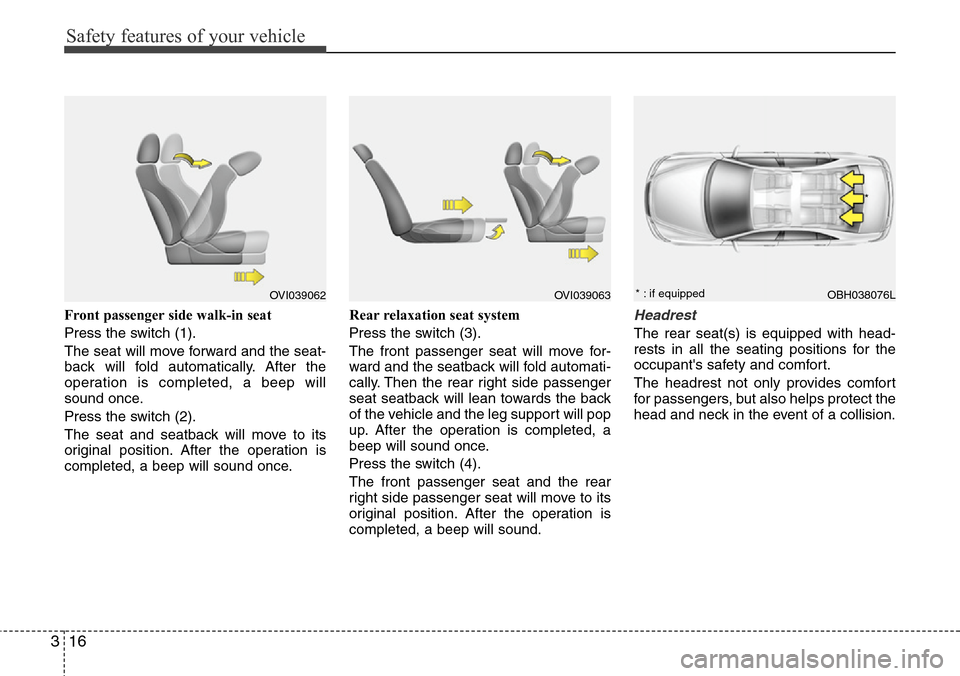
Front passenger side walk-in seat
Press the switch (1).
The seat will move forward and the seat-
back will fold automatically. After the
operation is completed, a beep will
sound once.
Press the switch (2).
The seat and seatback will move to its
original position. After the operation is
completed, a beep will sound once.Rear relaxation seat system
Press the switch (3).
The front passenger seat will move for-
ward and the seatback will fold automati-
cally. Then the rear right side passenger
seat seatback will lean towards the back
of the vehicle and the leg support will pop
up. After the operation is completed, a
beep will sound once.
Press the switch (4).
The front passenger seat and the rear
right side passenger seat will move to its
original position. After the operation is
completed, a beep will sound.Headrest
The rear seat(s) is equipped with head-
rests in all the seating positions for the
occupant's safety and comfort.
The headrest not only provides comfort
for passengers, but also helps protect the
head and neck in the event of a collision.
OVI039062OVI039063OBH038076L * : if equipped*
Page 36 of 385
317
Safety features of your vehicle
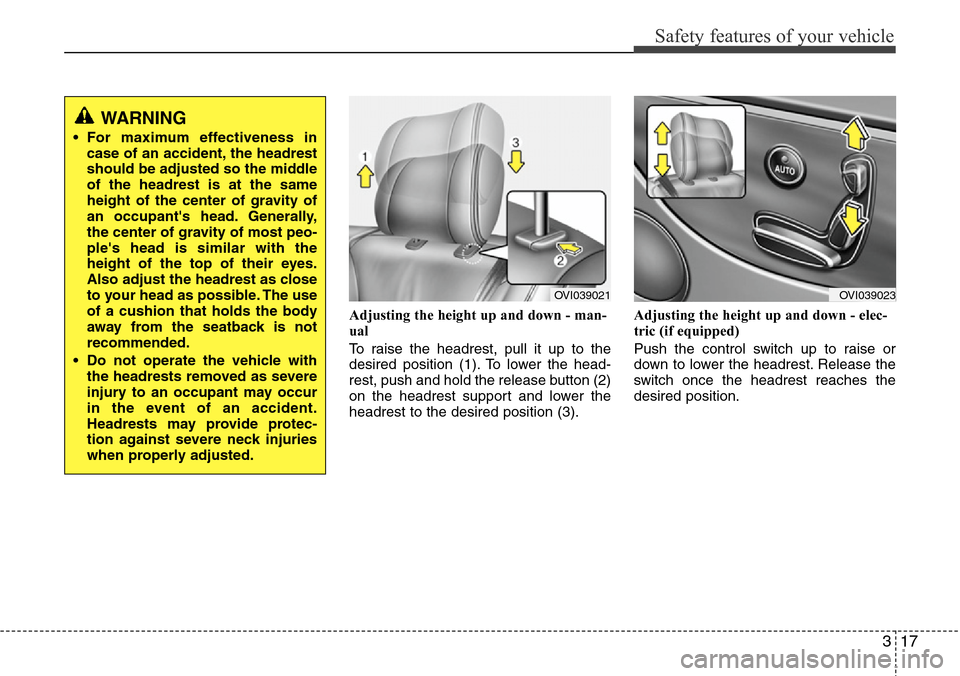
Adjusting the height up and down - man-
ual
To raise the headrest, pull it up to the
desired position (1). To lower the head-
rest, push and hold the release button (2)
on the headrest support and lower the
headrest to the desired position (3).Adjusting the height up and down - elec-
tric (if equipped)
Push the control switch up to raise or
down to lower the headrest. Release the
switch once the headrest reaches the
desired position.
WARNING
• For maximum effectiveness in
case of an accident, the headrest
should be adjusted so the middle
of the headrest is at the same
height of the center of gravity of
an occupant's head. Generally,
the center of gravity of most peo-
ple's head is similar with the
height of the top of their eyes.
Also adjust the headrest as close
to your head as possible. The use
of a cushion that holds the body
away from the seatback is not
recommended.
• Do not operate the vehicle with
the headrests removed as severe
injury to an occupant may occur
in the event of an accident.
Headrests may provide protec-
tion against severe neck injuries
when properly adjusted.
OVI039021OVI039023
Page 38 of 385
319
Safety features of your vehicle
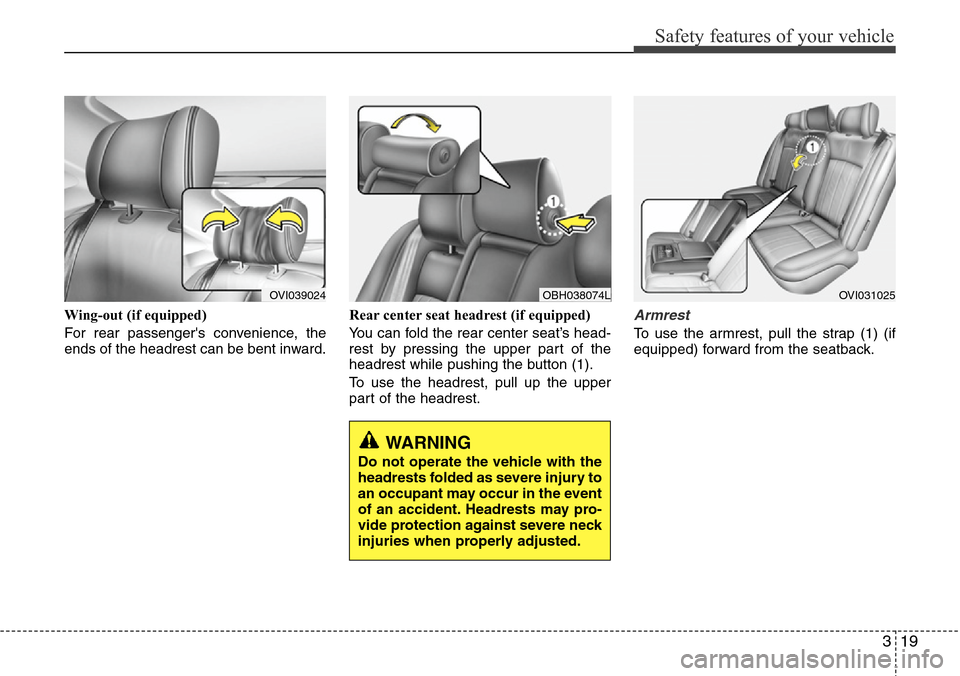
Wing-out (if equipped)
For rear passenger's convenience, the
ends of the headrest can be bent inward.Rear center seat headrest (if equipped)
You can fold the rear center seat’s head-
rest by pressing the upper part of the
headrest while pushing the button (1).
To use the headrest, pull up the upper
part of the headrest.Armrest
To use the armrest, pull the strap (1) (if
equipped) forward from the seatback.
OVI039024OVI031025
WARNING
Do not operate the vehicle with the
headrests folded as severe injury to
an occupant may occur in the event
of an accident. Headrests may pro-
vide protection against severe neck
injuries when properly adjusted.
OBH038074L
Page 41 of 385
Safety features of your vehicle
22 3
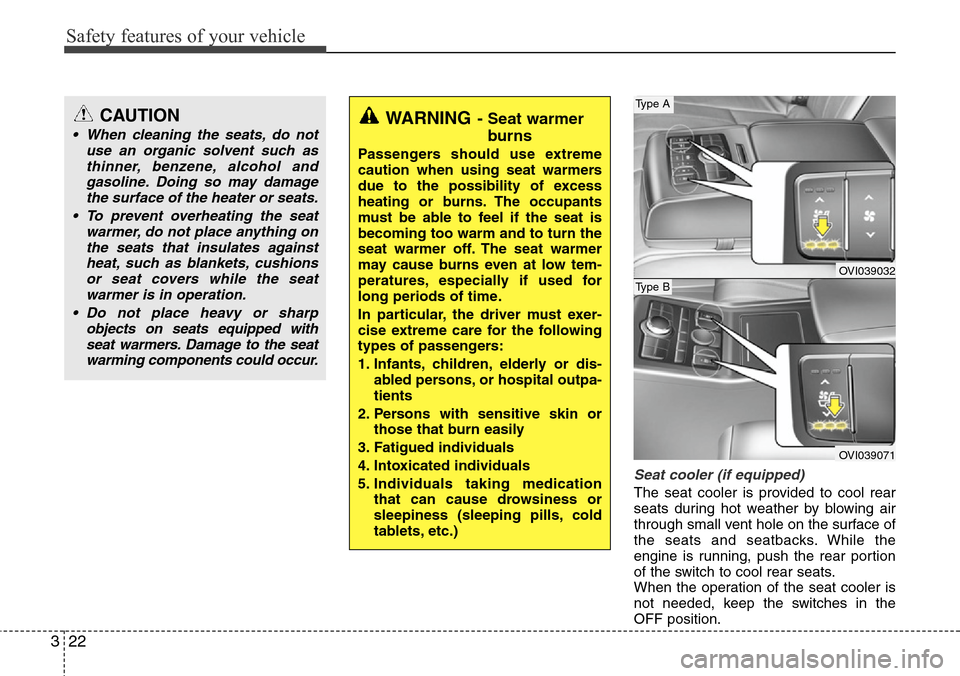
Seat cooler (if equipped)
The seat cooler is provided to cool rear
seats during hot weather by blowing air
through small vent hole on the surface of
the seats and seatbacks. While the
engine is running, push the rear portion
of the switch to cool rear seats.
When the operation of the seat cooler is
not needed, keep the switches in the
OFF position.
OVI039032
OVI039071
Type B
Type ACAUTION
• When cleaning the seats, do not
use an organic solvent such as
thinner, benzene, alcohol and
gasoline. Doing so may damage
the surface of the heater or seats.
• To prevent overheating the seat
warmer, do not place anything on
the seats that insulates against
heat, such as blankets, cushions
or seat covers while the seat
warmer is in operation.
• Do not place heavy or sharp
objects on seats equipped with
seat warmers. Damage to the seat
warming components could occur.WARNING- Seat warmer
burns
Passengers should use extreme
caution when using seat warmers
due to the possibility of excess
heating or burns. The occupants
must be able to feel if the seat is
becoming too warm and to turn the
seat warmer off. The seat warmer
may cause burns even at low tem-
peratures, especially if used for
long periods of time.
In particular, the driver must exer-
cise extreme care for the following
types of passengers:
1. Infants, children, elderly or dis-
abled persons, or hospital outpa-
tients
2. Persons with sensitive skin or
those that burn easily
3. Fatigued individuals
4. Intoxicated individuals
5. Individuals taking medication
that can cause drowsiness or
sleepiness (sleeping pills, cold
tablets, etc.)
Page 42 of 385
323
Safety features of your vehicle
• Each time you push the button, the air-
flow is changed as follows:
• When pressing the switch for more
than 1.5 seconds with the seat cooler
operating, the seat cooler will turn
OFF.
• The seat cooler defaults to the OFF
position whenever the engine start/
stop button is turned on.
OFF→HIGH( )→MIDDLE( )→LOW( )
→
CAUTION
• The seat cooler is a supplemen-
tary cooling system. Use the cli-
mate control seat when the cli-
mate control system is on. Using
the climate control seat for pro-
longed periods of time with the
climate control system off could
cause the climate control seat
performance to impair.
• When cleaning the seats, do not
use an organic solvent such as
thinner, benzene, alcohol and
gasoline. Doing so may damage
the surface of the seats.
• Do not spill liquid such as water
or beverages on the surface of
the front seats and seatbacks, or
the air vent holes may be blocked
and prevented from working
properly.
• Do not place materials such as
plastic bags or newspapers under
the seats. The air vent may not
work properly as the air intake
can be blocked.
• When the air vent does not oper-
ate, restart the vehicle. If there is
no change, have your vehicle
inspected by an authorized
HYUNDAI dealer.
Page 43 of 385
Safety features of your vehicle
24 3
Seat belt restraint system
SEAT BELTS
WARNING
• For maximum restraint system
protection, the seat belts must
always be used whenever the car
is moving.
• Seat belts are most effective
when seatbacks are in the
upright position.
• Children age 12 and under must
always be properly restrained in
the rear seat. Never allow chil-
dren to ride in the front passen-
ger seat. If a child over 12 must
be seated in the front seat, he/she
must be properly belted and the
seat should be moved as far back
as possible.
• Never wear the shoulder belt
under your arm or behind your
back. An improperly positioned
shoulder belt can cause serious
injuries in a crash. The shoulder
belt should be positioned midway
over your shoulder across your
collarbone.
(Continued)
WARNING
Seat belts are designed to bear
upon the bony structure of the
body, and should be worn low
across the front of the pelvis or the
pelvis, chest and shoulders, as
applicable; wearing the lap section
of the belt across the abdominal
area must be avoided.
Seat belts should be adjusted as
firmly as possible, consistent with
comfort, to provide the protection
for which they have been designed.
A slack belt will greatly reduce the
protection afforded to the wearer.
(Continued)
(Continued)
Care should be taken to avoid con-
tamination of the webbing with pol-
ishes, oils and chemicals, and par-
ticularly battery acid. Cleaning may
safely be carried out using mild
soap and water. The belt should be
replaced if webbing becomes
frayed, contaminated or damaged.
It is essential to replace the entire
assembly after it has been worn in
a severe impact even if damage to
the assembly is not obvious. Belts
should not be worn with straps
twisted. Each belt assembly must
only be used by one occupant; it is
dangerous to put a belt around a
child being carried on the occu-
pant's lap.(Continued)
• Avoid wearing twisted seat belts.
A twisted belt can't do its job as
well. In a collision, it could even
cut into you. Be sure the belt
webbing is straight and not twist-
ed.
• Be careful not to damage the belt
webbing or hardware. If the belt
webbing or hardware is dam-
aged, replace it.
Page 46 of 385
327
Safety features of your vehicle
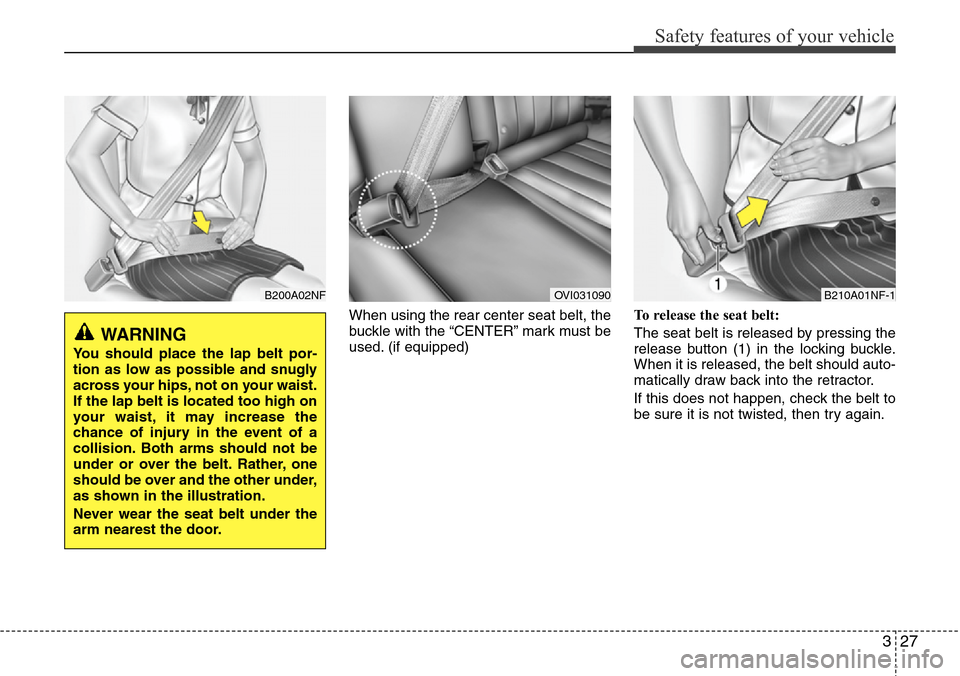
When using the rear center seat belt, the
buckle with the “CENTER” mark must be
used. (if equipped)To release the seat belt:
The seat belt is released by pressing the
release button (1) in the locking buckle.
When it is released, the belt should auto-
matically draw back into the retractor.
If this does not happen, check the belt to
be sure it is not twisted, then try again.
B200A02NF
WARNING
You should place the lap belt por-
tion as low as possible and snugly
across your hips, not on your waist.
If the lap belt is located too high on
your waist, it may increase the
chance of injury in the event of a
collision. Both arms should not be
under or over the belt. Rather, one
should be over and the other under,
as shown in the illustration.
Never wear the seat belt under the
arm nearest the door.
B210A01NF-1OVI031090
Page 54 of 385
335
Safety features of your vehicle
One person per belt
Two people (including children) should
never attempt to use a single seat belt.
This could increase the severity of
injuries in case of an accident.
Do not lie down
To reduce the chance of injuries in the
event of an accident and to achieve max-
imum effectiveness of the restraint sys-
tem, all passengers should be sitting up
and the front and rear seats should be in
an upright position when the car is mov-
ing. A seat belt cannot provide proper
protection if the person is lying down in
the rear seat or if the front and rear seats
are in a reclined position.
Care of seat belts
Seat belt systems should never be disas-
sembled or modified. In addition, care
should be taken to assure that seat belts
and belt hardware are not damaged by
seat hinges, doors or other abuse.
Periodic inspection
All seat belts should be inspected peri-
odically for wear or damage of any kind.
Any damaged parts should be replaced
as soon as possible.
Keep belts clean and dry
Seat belts should be kept clean and dry.
If belts become dirty, they can be
cleaned by using a mild soap solution
and warm water. Bleach, dye, strong
detergents or abrasives should not be
used because they may damage and
weaken the fabric.
When to replace seat belts
Entire in-use seat belt assembly or
assemblies should be replaced if the
vehicle has been involved in an accident.
This should be done even if no damage
is visible. Additional questions concern-
ing seat belt operation should be directed
to an authorized HYUNDAI dealer.
WARNING
Riding with a reclined seatback
increases your chance of serious
or fatal injuries in the event of a col-
lision or sudden stop. The protec-
tion of your restraint system (seat
belts and air bags) is greatly
reduced by reclining your seat.
Seat belts must be snug against
your hips and chest to work proper-
ly. The more the seatback is
reclined, the greater the chance
that an occupant's hips will slide
under the lap belt causing serious
internal injuries or the occupant's
neck could strike the shoulder belt.
Drivers and passengers should
always sit well back in their seats,
properly belted, and with the seat-
backs upright.
Page 56 of 385
337
Safety features of your vehicle
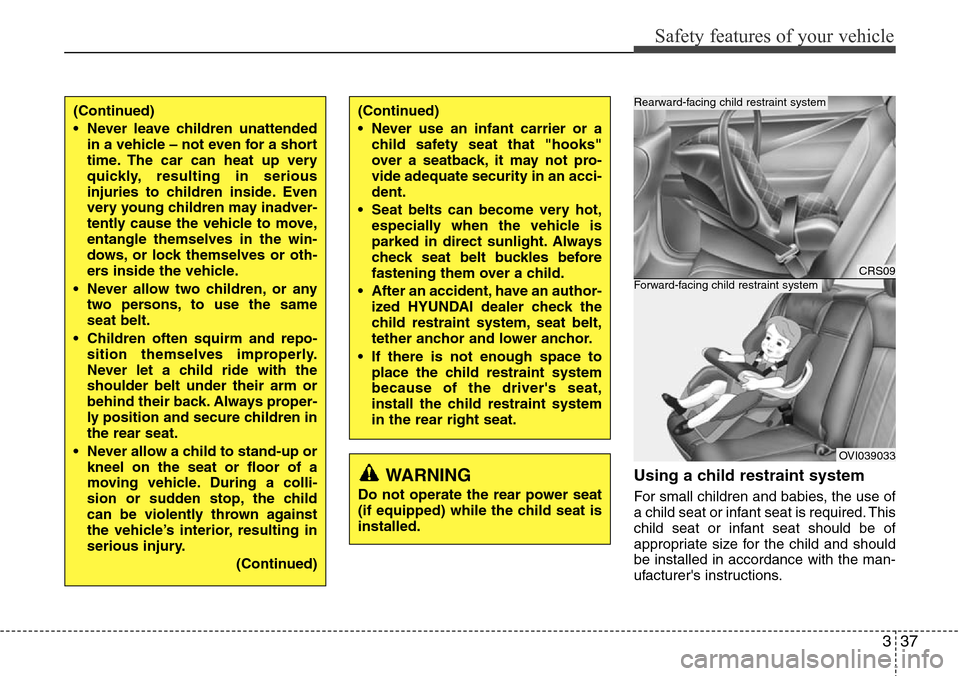
Using a child restraint system
For small children and babies, the use of
a child seat or infant seat is required. This
child seat or infant seat should be of
appropriate size for the child and should
be installed in accordance with the man-
ufacturer's instructions.
(Continued)
• Never use an infant carrier or a
child safety seat that "hooks"
over a seatback, it may not pro-
vide adequate security in an acci-
dent.
• Seat belts can become very hot,
especially when the vehicle is
parked in direct sunlight. Always
check seat belt buckles before
fastening them over a child.
• After an accident, have an author-
ized HYUNDAI dealer check the
child restraint system, seat belt,
tether anchor and lower anchor.
• If there is not enough space to
place the child restraint system
because of the driver's seat,
install the child restraint system
in the rear right seat.
CRS09
OVI039033
Forward-facing child restraint system
Rearward-facing child restraint system(Continued)
• Never leave children unattended
in a vehicle – not even for a short
time. The car can heat up very
quickly, resulting in serious
injuries to children inside. Even
very young children may inadver-
tently cause the vehicle to move,
entangle themselves in the win-
dows, or lock themselves or oth-
ers inside the vehicle.
• Never allow two children, or any
two persons, to use the same
seat belt.
• Children often squirm and repo-
sition themselves improperly.
Never let a child ride with the
shoulder belt under their arm or
behind their back. Always proper-
ly position and secure children in
the rear seat.
• Never allow a child to stand-up or
kneel on the seat or floor of a
moving vehicle. During a colli-
sion or sudden stop, the child
can be violently thrown against
the vehicle’s interior, resulting in
serious injury.
(Continued)
WARNING
Do not operate the rear power seat
(if equipped) while the child seat is
installed.