headlight Hyundai Equus 2012 User Guide
[x] Cancel search | Manufacturer: HYUNDAI, Model Year: 2012, Model line: Equus, Model: Hyundai Equus 2012Pages: 385, PDF Size: 10.67 MB
Page 261 of 385
Driving your vehicle
48 5
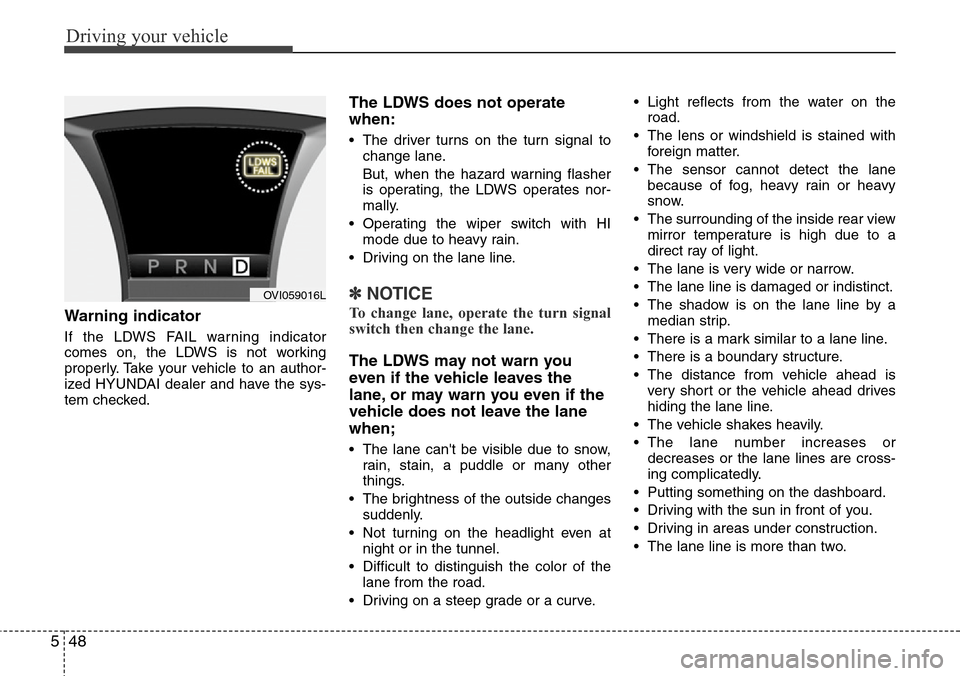
Warning indicator
If the LDWS FAIL warning indicator
comes on, the LDWS is not working
properly. Take your vehicle to an author-
ized HYUNDAI dealer and have the sys-
tem checked.
The LDWS does not operate
when:
• The driver turns on the turn signal to
change lane.
But, when the hazard warning flasher
is operating, the LDWS operates nor-
mally.
• Operating the wiper switch with HI
mode due to heavy rain.
• Driving on the lane line.
✽NOTICE
To change lane, operate the turn signal
switch then change the lane.
The LDWS may not warn you
even if the vehicle leaves the
lane, or may warn you even if the
vehicle does not leave the lane
when;
• The lane can't be visible due to snow,
rain, stain, a puddle or many other
things.
• The brightness of the outside changes
suddenly.
• Not turning on the headlight even at
night or in the tunnel.
• Difficult to distinguish the color of the
lane from the road.
• Driving on a steep grade or a curve.• Light reflects from the water on the
road.
• The lens or windshield is stained with
foreign matter.
• The sensor cannot detect the lane
because of fog, heavy rain or heavy
snow.
• The surrounding of the inside rear view
mirror temperature is high due to a
direct ray of light.
• The lane is very wide or narrow.
• The lane line is damaged or indistinct.
• The shadow is on the lane line by a
median strip.
• There is a mark similar to a lane line.
• There is a boundary structure.
• The distance from vehicle ahead is
very short or the vehicle ahead drives
hiding the lane line.
• The vehicle shakes heavily.
• The lane number increases or
decreases or the lane lines are cross-
ing complicatedly.
• Putting something on the dashboard.
• Driving with the sun in front of you.
• Driving in areas under construction.
• The lane line is more than two.
OVI059016L
Page 271 of 385
Driving your vehicle
58 5
• Adjust your mirrors to reduce the glare
from other driver's headlights.
• Keep your headlights clean and prop-
erly aimed on vehicles not equipped
with the automatic headlight aiming
feature. Dirty or improperly aimed
headlights will make it much more diffi-
cult to see at night.
• Avoid staring directly at the headlights
of oncoming vehicles. You could be
temporarily blinded, and it will take
several seconds for your eyes to read-
just to the darkness.
Driving in the rain
Rain and wet roads can make driving
dangerous, especially if you’re not pre-
pared for the slick pavement. Here are a
few things to consider when driving in the
rain:
• A heavy rainfall will make it harder to
see and will increase the distance
needed to stop your vehicle, so slow
down.
• Keep your windshield wiping equip-
ment in good shape. Replace your
windshield wiper blades when they
show signs of streaking or missing
areas on the windshield.• If your tires are not in good condition,
making a quick stop on wet pavement
can cause a skid and possibly lead to
an accident. Be sure your tires are in
good shape.
• Turn on your headlights to make it eas-
ier for others to see you.
• Driving too fast through large puddles
can affect your brakes. If you must go
through puddles, try to drive through
them slowly.
• If you believe you may have gotten
your brakes wet, apply them lightly
while driving until normal braking oper-
ation returns.
OVI059046L
Page 309 of 385
77
Maintenance
While operating your vehicle:
• Note any changes in the sound of the
exhaust or any smell of exhaust fumes
in the vehicle.
• Check for vibrations in the steering
wheel. Notice any increased steering
effort or looseness in the steering
wheel, or change in its straight-ahead
position.
• Notice if your vehicle constantly turns
slightly or “pulls” to one side when trav-
eling on smooth, level road.
• When stopping, listen and check for
unusual sounds, pulling to one side,
increased brake pedal travel or “hard-
to-push” brake pedal.
• If any slipping or changes in the oper-
ation of your transmission occurs,
check the transmission fluid level.
• Check automatic transmission P (Park)
function.
• Check parking brake.
• Check for fluid leaks under your vehicle
(water dripping from the air condition-
ing system during or after use is nor-
mal).
At least monthly:
• Check coolant level in the engine
coolant reservoir.
• Check the operation of all exterior
lights, including the stoplights, turn sig-
nals and hazard warning flashers.
• Check the inflation pressures of all
tires including the spare.
At least twice a year
(i.e., every Spring and Fall):
• Check radiator, heater and air condi-
tioning hoses for leaks or damage.
• Check windshield washer spray and
wiper operation. Clean wiper blades
with clean cloth dampened with wash-
er fluid.
• Check headlight alignment.
• Check muffler, exhaust pipes, shields
and clamps.
• Check the lap/shoulder belts for wear
and function.
• Check for worn tires and loose wheel
lug nuts.
Page 336 of 385
Maintenance
34 7
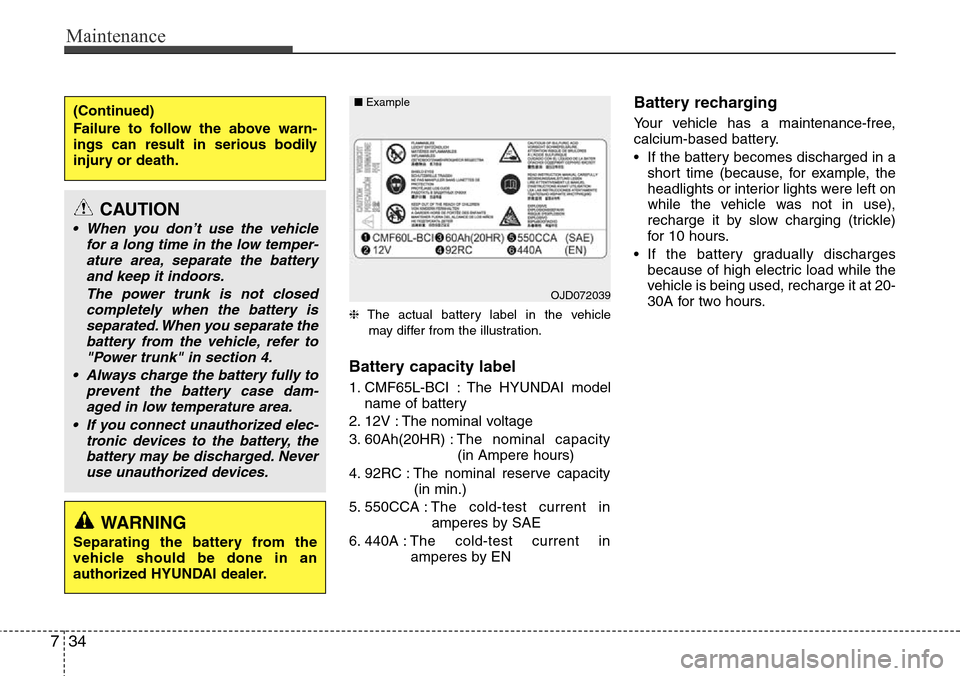
❈The actual battery label in the vehicle
may differ from the illustration.
Battery capacity label
1. CMF65L-BCI : The HYUNDAI model
name of battery
2. 12V : The nominal voltage
3. 60Ah(20HR) :The nominal capacity
(in Ampere hours)
4. 92RC : The nominal reserve capacity
(in min.)
5. 550CCA :The cold-test current in
amperes by SAE
6. 440A :The cold-test current in
amperes by EN
Battery recharging
Your vehicle has a maintenance-free,
calcium-based battery.
• If the battery becomes discharged in a
short time (because, for example, the
headlights or interior lights were left on
while the vehicle was not in use),
recharge it by slow charging (trickle)
for 10 hours.
• If the battery gradually discharges
because of high electric load while the
vehicle is being used, recharge it at 20-
30A for two hours.(Continued)
Failure to follow the above warn-
ings can result in serious bodily
injury or death.
CAUTION
• When you don’t use the vehicle
for a long time in the low temper-
ature area, separate the battery
and keep it indoors.
The power trunk is not closed
completely when the battery is
separated. When you separate the
battery from the vehicle, refer to
"Power trunk" in section 4.
• Always charge the battery fully to
prevent the battery case dam-
aged in low temperature area.
• If you connect unauthorized elec-
tronic devices to the battery, the
battery may be discharged. Never
use unauthorized devices.
WARNING
Separating the battery from the
vehicle should be done in an
authorized HYUNDAI dealer.
OJD072039 ■Example
Page 343 of 385
741
Maintenance
Wheel replacement
When replacing the metal wheels for
any reason, make sure the new
wheels are equivalent to the original
factory units in diameter, rim width
and offset.Tire traction
Tire traction can be reduced if you
drive on worn tires, tires that are
improperly inflated or on slippery
road surfaces. Tires should be
replaced when tread wear indicators
appear. Slow down whenever there
is rain, snow or ice on the road, to
reduce the possibility of losing con-
trol of the vehicle.Tire maintenance
In addition to proper inflation, correct
wheel alignment helps to decrease
tire wear. If you find a tire is worn
unevenly, have your dealer check the
wheel alignment.
When you have new tires installed,
make sure they are balanced. This
will increase vehicle ride comfort and
tire life. Additionally, a tire should
always be rebalanced if it is removed
from the wheel.
WARNING
A wheel that is not the correct
size may adversely affect wheel
and bearing life, braking and
stopping abilities, handling
characteristics, ground clear-
ance, body-to-tire clearance,
snow chain clearance,
speedometer and odometer cal-
ibration, headlight aim and
bumper height.
Page 350 of 385
Maintenance
48 7
If the headlights or other electrical com-
ponents do not work and the fuses are
OK, check the fuse panel in the engine
compartment. If a fuse is blown, it must
be replaced.
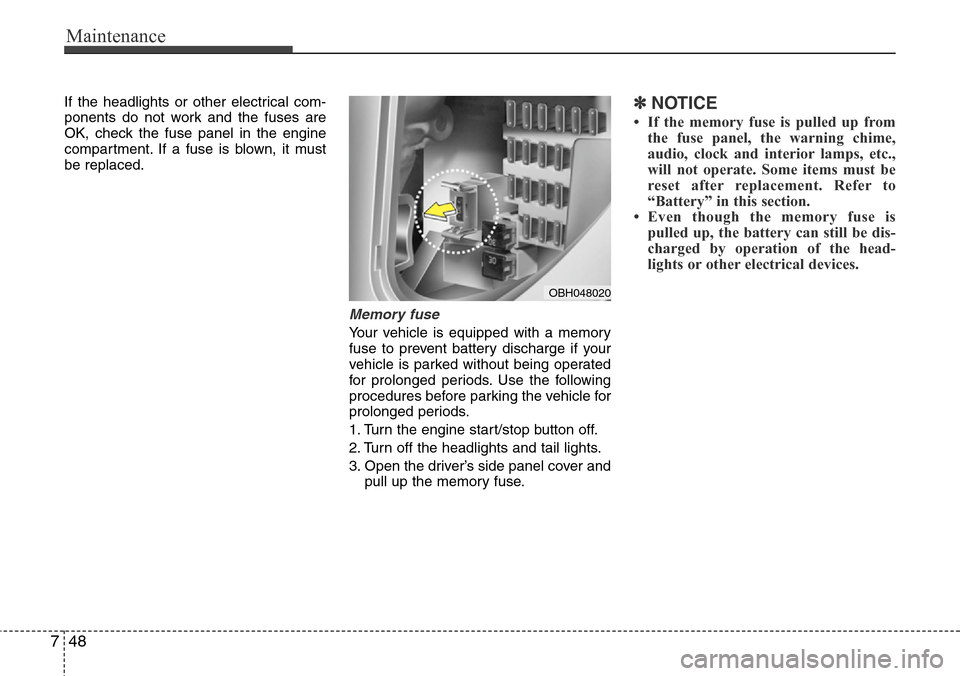
Memory fuse
Your vehicle is equipped with a memory
fuse to prevent battery discharge if your
vehicle is parked without being operated
for prolonged periods. Use the following
procedures before parking the vehicle for
prolonged periods.
1. Turn the engine start/stop button off.
2. Turn off the headlights and tail lights.
3. Open the driver’s side panel cover and
pull up the memory fuse.
✽NOTICE
• If the memory fuse is pulled up from
the fuse panel, the warning chime,
audio, clock and interior lamps, etc.,
will not operate. Some items must be
reset after replacement. Refer to
“Battery” in this section.
• Even though the memory fuse is
pulled up, the battery can still be dis-
charged by operation of the head-
lights or other electrical devices.
OBH048020
Page 359 of 385
757
Maintenance
LIGHT BULBS
Use only the bulbs of the specified
wattage.
✽NOTICE
After heavy, driving rain or washing,
headlight and taillight lenses could
appear frosty. This condition is caused by
the temperature difference between the
lamp inside and outside. This is similar
to the condensation on your windows
inside your vehicle during the rain and
doesn’t indicate a problem with your
vehicle. If the water leaks into the lamp
bulb circuitry, have the vehicle checked
by an authorized HYUNDAI dealer.
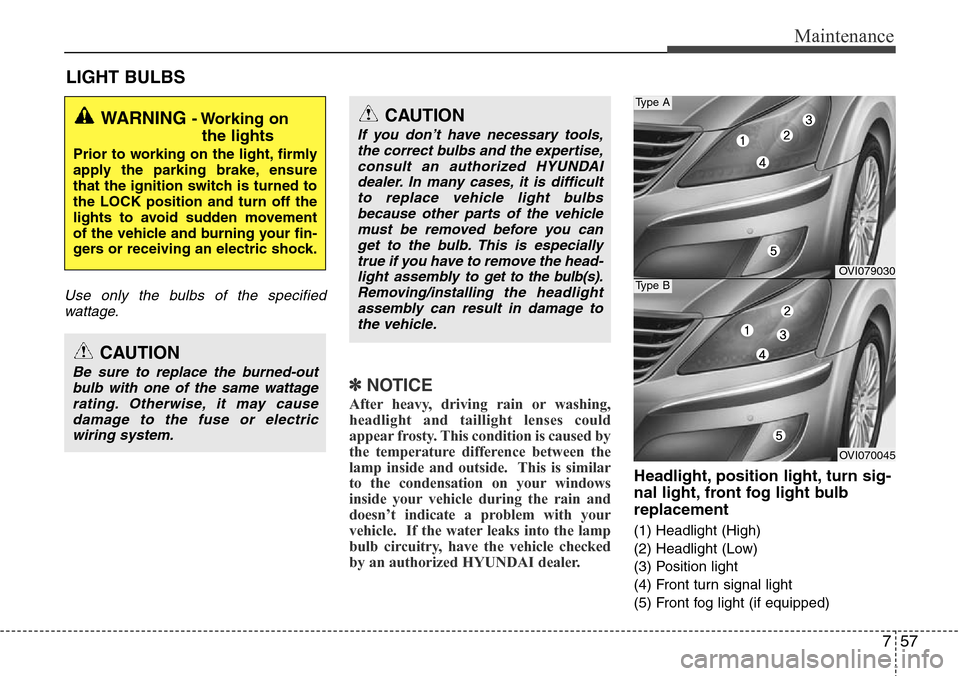
Headlight, position light, turn sig-
nal light, front fog light bulb
replacement
(1) Headlight (High)
(2) Headlight (Low)
(3) Position light
(4) Front turn signal light
(5) Front fog light (if equipped)
WARNING - Working on
the lights
Prior to working on the light, firmly
apply the parking brake, ensure
that the ignition switch is turned to
the LOCK position and turn off the
lights to avoid sudden movement
of the vehicle and burning your fin-
gers or receiving an electric shock.
CAUTION
Be sure to replace the burned-out
bulb with one of the same wattage
rating. Otherwise, it may cause
damage to the fuse or electric
wiring system.
CAUTION
If you don’t have necessary tools,
the correct bulbs and the expertise,
consult an authorized HYUNDAI
dealer. In many cases, it is difficult
to replace vehicle light bulbs
because other parts of the vehicle
must be removed before you can
get to the bulb. This is especially
true if you have to remove the head-
light assembly to
get to the bulb(s).
Removing/installingthe headlight
assembly can result in damage to
the vehicle.
OVI079030
OVI070045
Type A
Type B
Page 362 of 385
Maintenance
60 7
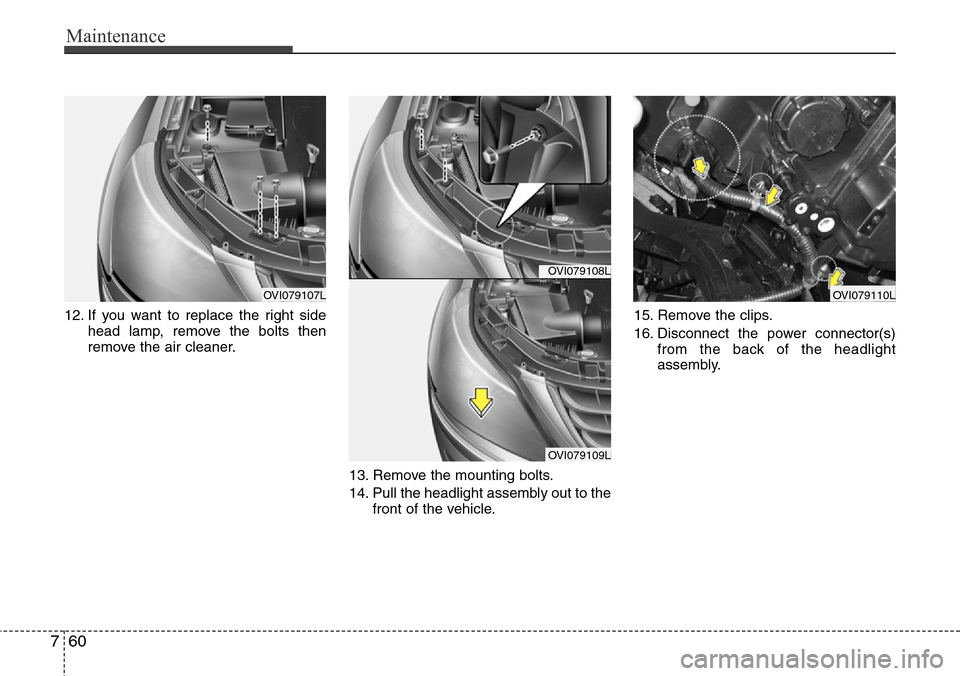
12. If you want to replace the right side
head lamp, remove the bolts then
remove the air cleaner.
13. Remove the mounting bolts.
14. Pull the headlight assembly out to the
front of the vehicle.15. Remove the clips.
16. Disconnect the power connector(s)
from the back of the headlight
assembly.
OVI079107L
OVI079108L
OVI079109L
OVI079110L
Page 363 of 385
761
Maintenance
Headlight (HID/LED type) bulb
replacement
If the light bulb is not operating, have the
vehicle checked by an authorized
HYUNDAI dealer.
✽NOTICE
HID/LED lamps have superior per-
formance vs. halogen bulbs. HID/LED
lamps are estimated by the manufactur-
er to last twice as long or longer than
halogen bulbs depending on their fre-
quency of use. They will probably
require replacement at some point in the
life of the vehicle. Cycling the head-
lamps on and off more than typical use
will shorten HID/LED lamps life. HID/
LED lamps do not fail in the same man-
ner as halogen incandescent lamps. If a
headlamp goes out after a period of
operation but will immediately relight
when the headlamp switch is cycled it is
likely the HID/LED lamp needs to be
replaced. HID/LED lighting compo-
nents are more complex than conven-
tional halogen bulbs thus have higher
replacement cost.
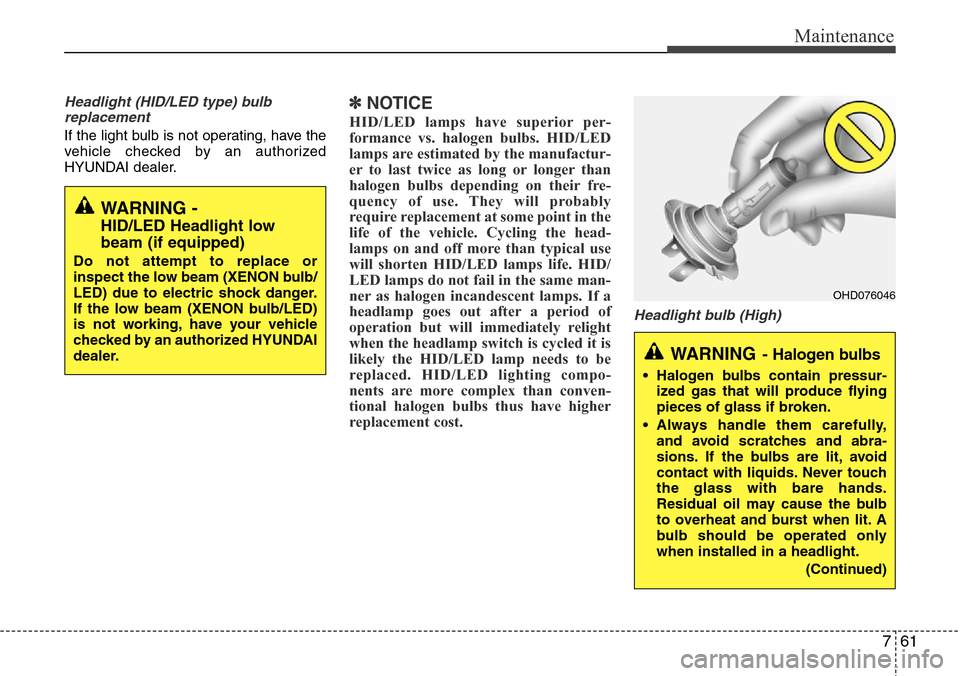
Headlight bulb (High)
OHD076046
WARNING- Halogen bulbs
• Halogen bulbs contain pressur-
ized gas that will produce flying
pieces of glass if broken.
• Always handle them carefully,
and avoid scratches and abra-
sions. If the bulbs are lit, avoid
contact with liquids. Never touch
the glass with bare hands.
Residual oil may cause the bulb
to overheat and burst when lit. A
bulb should be operated only
when installed in a headlight.
(Continued)
WARNING -
HID/LED Headlight low
beam (if equipped)
Do not attempt to replace or
inspect the low beam (XENON bulb/
LED) due to electric shock danger.
If the low beam (XENON bulb/LED)
is not working, have your vehicle
checked by an authorized HYUNDAI
dealer.
Page 364 of 385
Maintenance
62 7
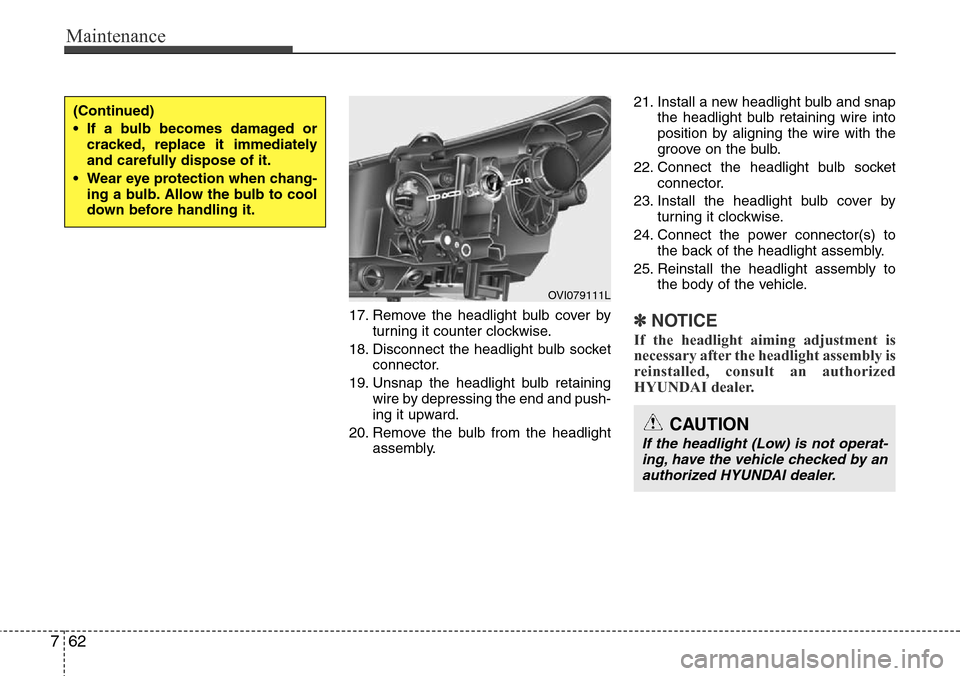
17. Remove the headlight bulb cover by
turning it counter clockwise.
18. Disconnect the headlight bulb socket
connector.
19. Unsnap the headlight bulb retaining
wire by depressing the end and push-
ing it upward.
20. Remove the bulb from the headlight
assembly.21. Install a new headlight bulb and snap
the headlight bulb retaining wire into
position by aligning the wire with the
groove on the bulb.
22. Connect the headlight bulb socket
connector.
23. Install the headlight bulb cover by
turning it clockwise.
24. Connect the power connector(s) to
the back of the headlight assembly.
25. Reinstall the headlight assembly to
the body of the vehicle.✽NOTICE
If the headlight aiming adjustment is
necessary after the headlight assembly is
reinstalled, consult an authorized
HYUNDAI dealer.
OVI079111L
(Continued)
• If a bulb becomes damaged or
cracked, replace it immediately
and carefully dispose of it.
• Wear eye protection when chang-
ing a bulb. Allow the bulb to cool
down before handling it.
CAUTION
If the headlight (Low) is not operat-
ing, have the vehicle checked by an
authorized HYUNDAI dealer.