warning light Hyundai Equus 2012 Repair Manual
[x] Cancel search | Manufacturer: HYUNDAI, Model Year: 2012, Model line: Equus, Model: Hyundai Equus 2012Pages: 385, PDF Size: 10.67 MB
Page 239 of 385
Driving your vehicle
26 5
Good braking practices• Check to be sure the parking brake is
not engaged and that the parking
brake indicator light is out before driv-
ing away.
• Driving through water may get the
brakes wet. They can also get wet
when the vehicle is washed. Wet
brakes can be dangerous! Your car will
not stop as quickly if the brakes are
wet. Wet brakes may cause the vehicle
to pull to one side.
To dry the brakes, apply the brakes
lightly until the braking action returns to
normal, taking care to keep the car
under control at all times. If the braking
action does not return to normal, stop
as soon as it is safe to do so and call
an authorized HYUNDAI dealer for
assistance.
WARNING
Never press the ESP OFF button
while ESP is operating.
If the ESP is turned off while ESP is
operating, the vehicle may go out of
control.
To turn ESP off while driving, press
the ESP OFF button while driving
on a flat road surface.WARNING
• Whenever leaving vehicle or
parking, always set the parking
brake and fully engage the vehi-
cle's transmission into the P
(Park) position. Vehicles not fully
engaged in park with the parking
brake set are at risk for moving
inadvertently and injuring your-
self or others.
• All vehicles should always have
the parking brake fully engaged
when parking to avoid inadver-
tent movement of the vehicle
which can injure occupants or
pedestrians.
Page 243 of 385
Driving your vehicle
30 5
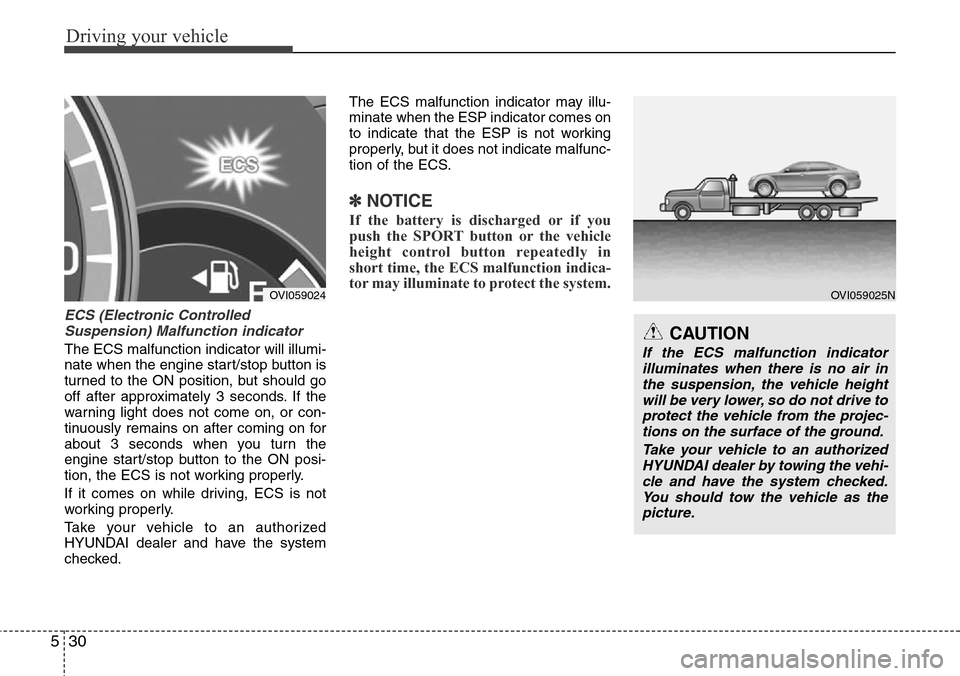
ECS (Electronic Controlled
Suspension) Malfunction indicator
The ECS malfunction indicator will illumi-
nate when the engine start/stop button is
turned to the ON position, but should go
off after approximately 3 seconds. If the
warning light does not come on, or con-
tinuously remains on after coming on for
about 3 seconds when you turn the
engine start/stop button to the ON posi-
tion, the ECS is not working properly.
If it comes on while driving, ECS is not
working properly.
Take your vehicle to an authorized
HYUNDAI dealer and have the system
checked.The ECS malfunction indicator may illu-
minate when the ESP indicator comes on
to indicate that the ESP is not working
properly, but it does not indicate malfunc-
tion of the ECS.
✽NOTICE
If the battery is discharged or if you
push the SPORT button or the vehicle
height control button repeatedly in
short time, the ECS malfunction indica-
tor may illuminate to protect the system.
CAUTION
If the ECS malfunction indicator
illuminates when there is no air in
the suspension, the vehicle height
will be very lower, so do not drive to
protect the vehicle from the projec-
tions on the surface of the ground.
Take your vehicle to an authorized
HYUNDAI dealer by towing the vehi-
cle and have the system checked.
You should tow the vehicle as the
picture.
OVI059025NOVI059024
Page 245 of 385
Driving your vehicle
32 5
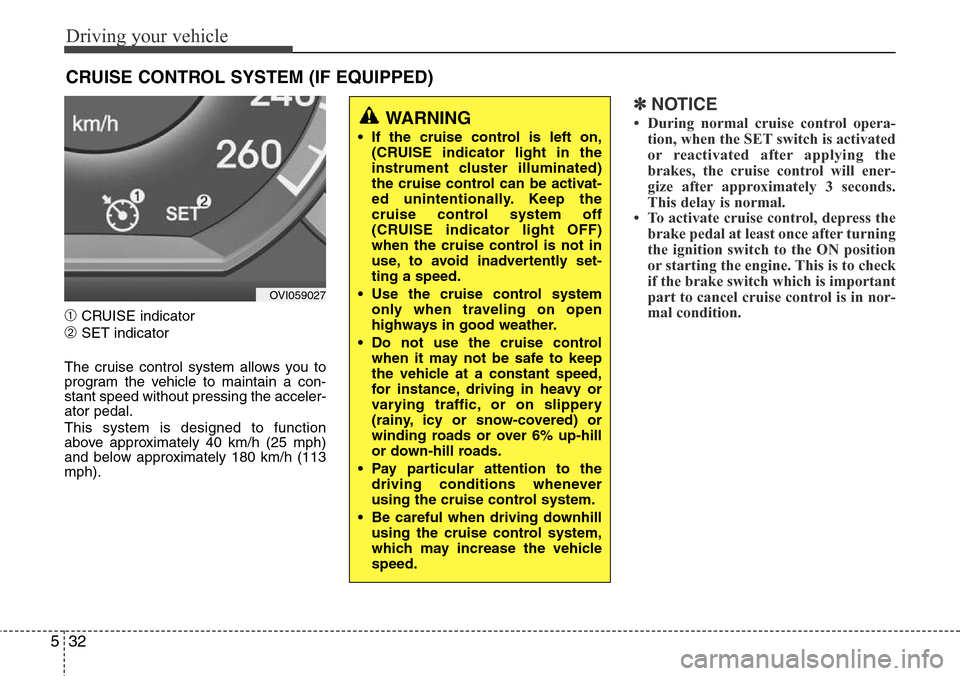
➀CRUISE indicator
➁SET indicator
The cruise control system allows you to
program the vehicle to maintain a con-
stant speed without pressing the acceler-
ator pedal.
This system is designed to function
above approximately 40 km/h (25 mph)
and below approximately 180 km/h (113
mph).
✽NOTICE
• During normal cruise control opera-
tion, when the SET switch is activated
or reactivated after applying the
brakes, the cruise control will ener-
gize after approximately 3 seconds.
This delay is normal.
• To activate cruise control, depress the
brake pedal at least once after turning
the ignition switch to the ON position
or starting the engine. This is to check
if the brake switch which is important
part to cancel cruise control is in nor-
mal condition.
CRUISE CONTROL SYSTEM (IF EQUIPPED)
WARNING
• If the cruise control is left on,
(CRUISE indicator light in the
instrument cluster illuminated)
the cruise control can be activat-
ed unintentionally. Keep the
cruise control system off
(CRUISE indicator light OFF)
when the cruise control is not in
use, to avoid inadvertently set-
ting a speed.
• Use the cruise control system
only when traveling on open
highways in good weather.
• Do not use the cruise control
when it may not be safe to keep
the vehicle at a constant speed,
for instance, driving in heavy or
varying traffic, or on slippery
(rainy, icy or snow-covered) or
winding roads or over 6% up-hill
or down-hill roads.
• Pay particular attention to the
driving conditions whenever
using the cruise control system.
• Be careful when driving downhill
using the cruise control system,
which may increase the vehicle
speed.
OVI059027
Page 249 of 385
Driving your vehicle
36 5
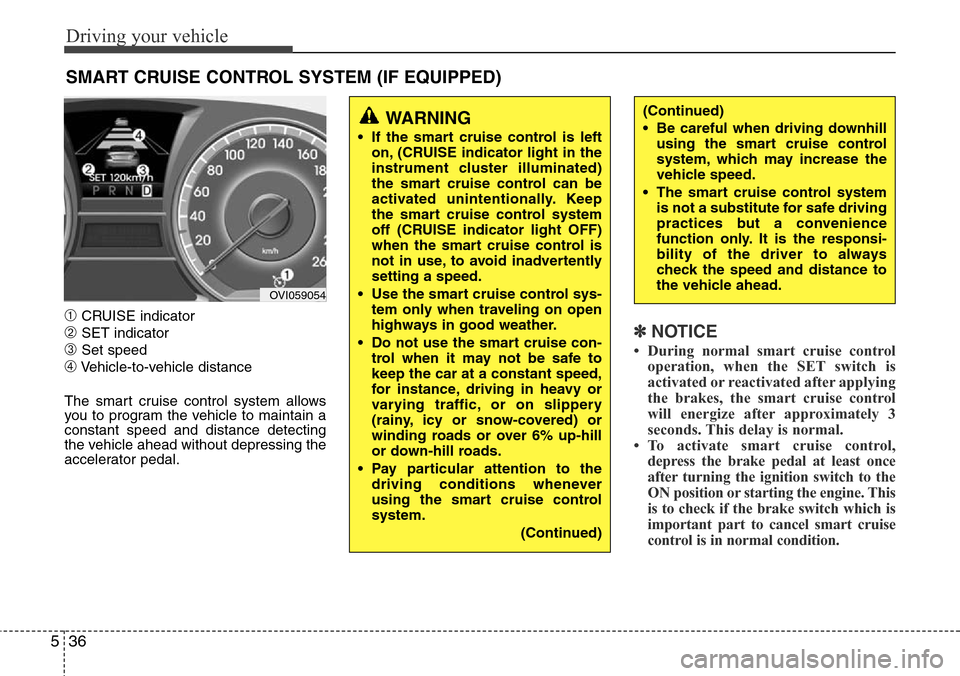
➀CRUISE indicator
➁SET indicator
➂Set speed
➃Vehicle-to-vehicle distance
The smart cruise control system allows
you to program the vehicle to maintain a
constant speed and distance detecting
the vehicle ahead without depressing the
accelerator pedal.
✽NOTICE
• During normal smart cruise control
operation, when the SET switch is
activated or reactivated after applying
the brakes, the smart cruise control
will energize after approximately 3
seconds. This delay is normal.
• To activate smart cruise control,
depress the brake pedal at least once
after turning the ignition switch to the
ON position or starting the engine. This
is to check if the brake switch which is
important part to cancel smart cruise
control is in normal condition.
SMART CRUISE CONTROL SYSTEM (IF EQUIPPED)
WARNING
• If the smart cruise control is left
on, (CRUISE indicator light in the
instrument cluster illuminated)
the smart cruise control can be
activated unintentionally. Keep
the smart cruise control system
off (CRUISE indicator light OFF)
when the smart cruise control is
not in use, to avoid inadvertently
setting a speed.
• Use the smart cruise control sys-
tem only when traveling on open
highways in good weather.
• Do not use the smart cruise con-
trol when it may not be safe to
keep the car at a constant speed,
for instance, driving in heavy or
varying traffic, or on slippery
(rainy, icy or snow-covered) or
winding roads or over 6% up-hill
or down-hill roads.
• Pay particular attention to the
driving conditions whenever
using the smart cruise control
system.
(Continued)
(Continued)
• Be careful when driving downhill
using the smart cruise control
system, which may increase the
vehicle speed.
• The smart cruise control system
is not a substitute for safe driving
practices but a convenience
function only. It is the responsi-
bility of the driver to always
check the speed and distance to
the vehicle ahead.
OVI059054
Page 255 of 385
Driving your vehicle
42 5
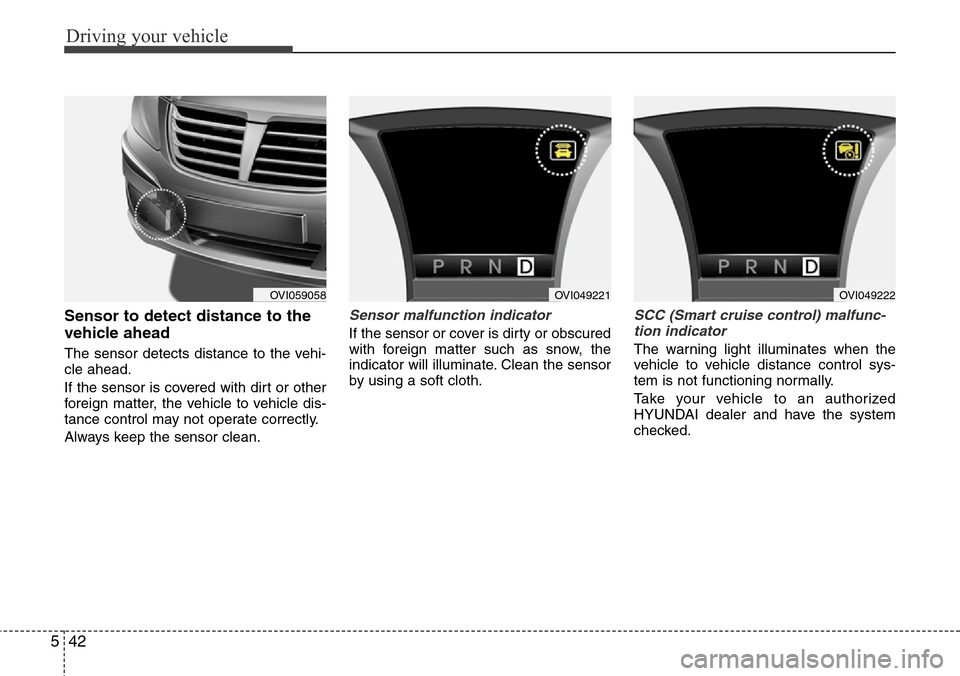
Sensor to detect distance to the
vehicle ahead
The sensor detects distance to the vehi-
cle ahead.
If the sensor is covered with dirt or other
foreign matter, the vehicle to vehicle dis-
tance control may not operate correctly.
Always keep the sensor clean.
Sensor malfunction indicator
If the sensor or cover is dirty or obscured
with foreign matter such as snow, the
indicator will illuminate. Clean the sensor
by using a soft cloth.
SCC (Smart cruise control) malfunc-
tion indicator
The warning light illuminates when the
vehicle to vehicle distance control sys-
tem is not functioning normally.
Take your vehicle to an authorized
HYUNDAI dealer and have the system
checked.
OVI059058OVI049221OVI049222
Page 259 of 385
Driving your vehicle
46 5
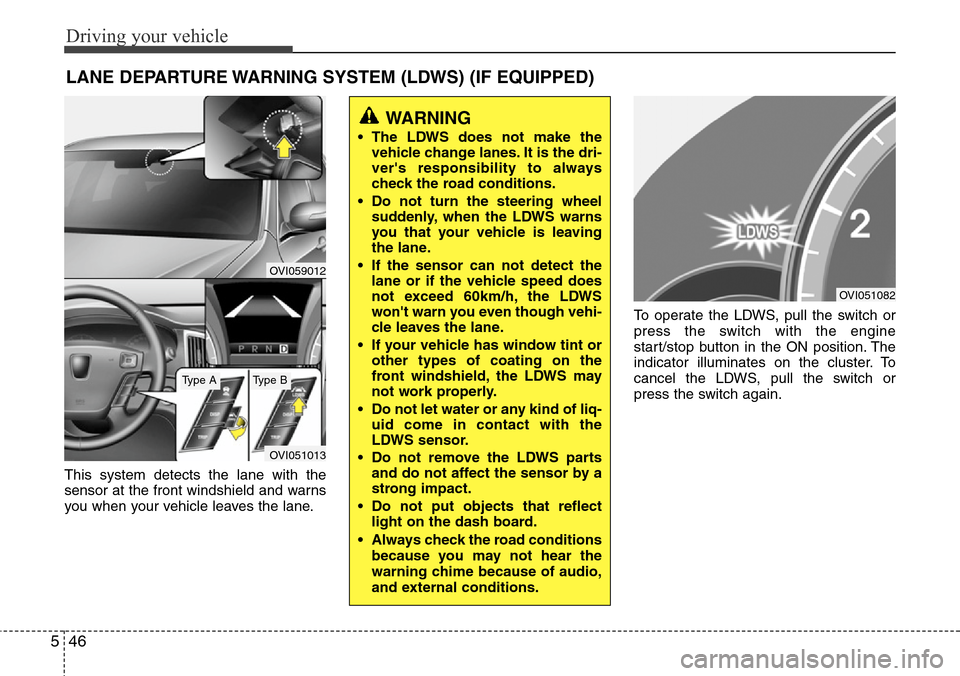
This system detects the lane with the
sensor at the front windshield and warns
you when your vehicle leaves the lane.To operate the LDWS, pull the switch or
press the switch with the engine
start/stop button in the ON position. The
indicator illuminates on the cluster. To
cancel the LDWS, pull the switch or
press the switch again.
LANE DEPARTURE WARNING SYSTEM (LDWS) (IF EQUIPPED)
OVI059012
OVI051013
WARNING
• The LDWS does not make the
vehicle change lanes. It is the dri-
ver's responsibility to always
check the road conditions.
• Do not turn the steering wheel
suddenly, when the LDWS warns
you that your vehicle is leaving
the lane.
• If the sensor can not detect the
lane or if the vehicle speed does
not exceed 60km/h, the LDWS
won't warn you even though vehi-
cle leaves the lane.
• If your vehicle has window tint or
other types of coating on the
front windshield, the LDWS may
not work properly.
• Do not let water or any kind of liq-
uid come in contact with the
LDWS sensor.
• Do not remove the LDWS parts
and do not affect the sensor by a
strong impact.
• Do not put objects that reflect
light on the dash board.
• Always check the road conditions
because you may not hear the
warning chime because of audio,
and external conditions.
OVI051082
Type AType B
Page 261 of 385
Driving your vehicle
48 5
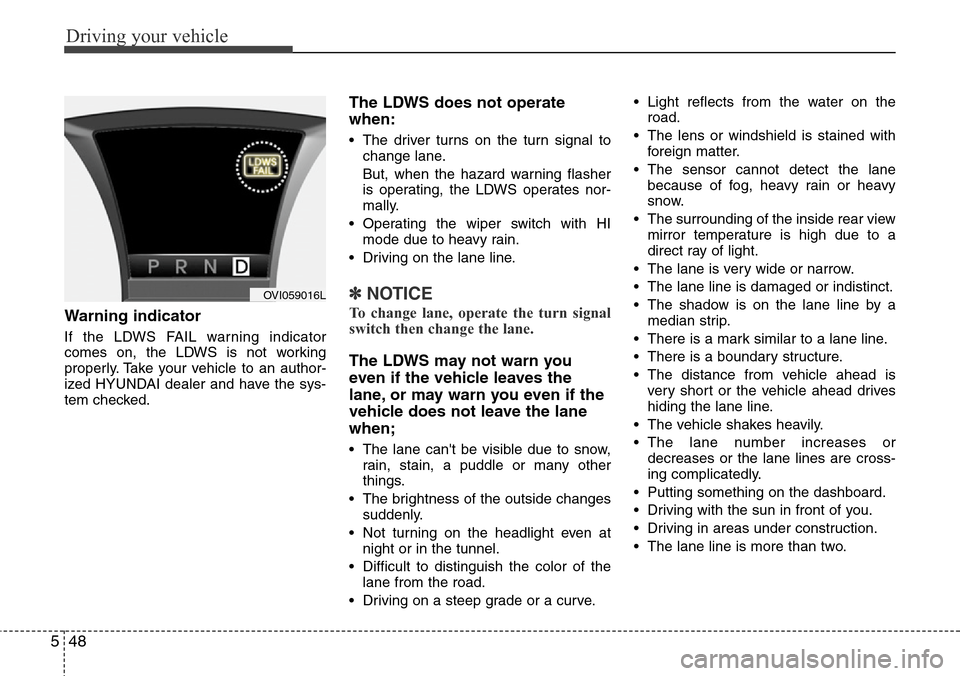
Warning indicator
If the LDWS FAIL warning indicator
comes on, the LDWS is not working
properly. Take your vehicle to an author-
ized HYUNDAI dealer and have the sys-
tem checked.
The LDWS does not operate
when:
• The driver turns on the turn signal to
change lane.
But, when the hazard warning flasher
is operating, the LDWS operates nor-
mally.
• Operating the wiper switch with HI
mode due to heavy rain.
• Driving on the lane line.
✽NOTICE
To change lane, operate the turn signal
switch then change the lane.
The LDWS may not warn you
even if the vehicle leaves the
lane, or may warn you even if the
vehicle does not leave the lane
when;
• The lane can't be visible due to snow,
rain, stain, a puddle or many other
things.
• The brightness of the outside changes
suddenly.
• Not turning on the headlight even at
night or in the tunnel.
• Difficult to distinguish the color of the
lane from the road.
• Driving on a steep grade or a curve.• Light reflects from the water on the
road.
• The lens or windshield is stained with
foreign matter.
• The sensor cannot detect the lane
because of fog, heavy rain or heavy
snow.
• The surrounding of the inside rear view
mirror temperature is high due to a
direct ray of light.
• The lane is very wide or narrow.
• The lane line is damaged or indistinct.
• The shadow is on the lane line by a
median strip.
• There is a mark similar to a lane line.
• There is a boundary structure.
• The distance from vehicle ahead is
very short or the vehicle ahead drives
hiding the lane line.
• The vehicle shakes heavily.
• The lane number increases or
decreases or the lane lines are cross-
ing complicatedly.
• Putting something on the dashboard.
• Driving with the sun in front of you.
• Driving in areas under construction.
• The lane line is more than two.
OVI059016L
Page 262 of 385
549
Driving your vehicle
For your safety, the intelligent accelerator
pedal operates as follows:
• The accelerator pedal vibrates when
the lane departure warning system (if
equipped) detects the vehicle has
moved out of its lane.
• The reactive force of the accelerator
pedal increases when the fuel efficien-
cy is low.
The intelligent accelerator pedal function
is available for use in vehicles equipped
with lane departure warning system
(LDWS), vehicle stability management
(VSM) system or ECO driving mode.
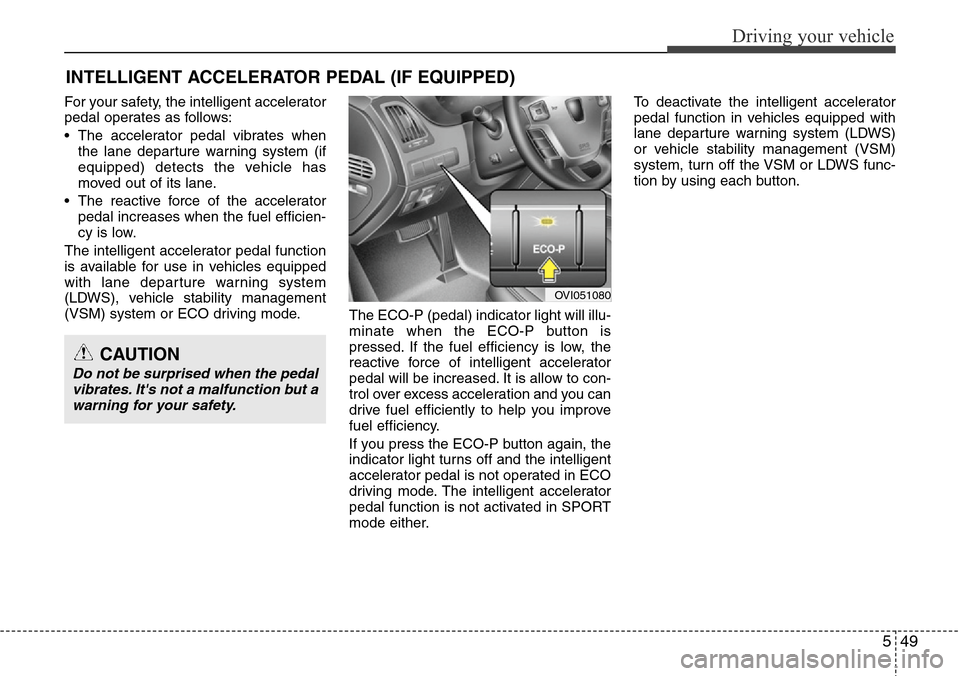
The ECO-P (pedal) indicator light will illu-
minate when the ECO-P button is
pressed. If the fuel efficiency is low, the
reactive force of intelligent accelerator
pedal will be increased. It is allow to con-
trol over excess acceleration and you can
drive fuel efficiently to help you improve
fuel efficiency.
If you press the ECO-P button again, the
indicator light turns off and the intelligent
accelerator pedal is not operated in ECO
driving mode. The intelligent accelerator
pedal function is not activated in SPORT
mode either.To deactivate the intelligent accelerator
pedal function in vehicles equipped with
lane departure warning system (LDWS)
or vehicle stability management (VSM)
system, turn off the VSM or LDWS func-
tion by using each button.
INTELLIGENT ACCELERATOR PEDAL (IF EQUIPPED)
OVI051080
CAUTION
Do not be surprised when the pedal
vibrates. It's not a malfunction but a
warning for your safety.
Page 263 of 385
Driving your vehicle
50 5
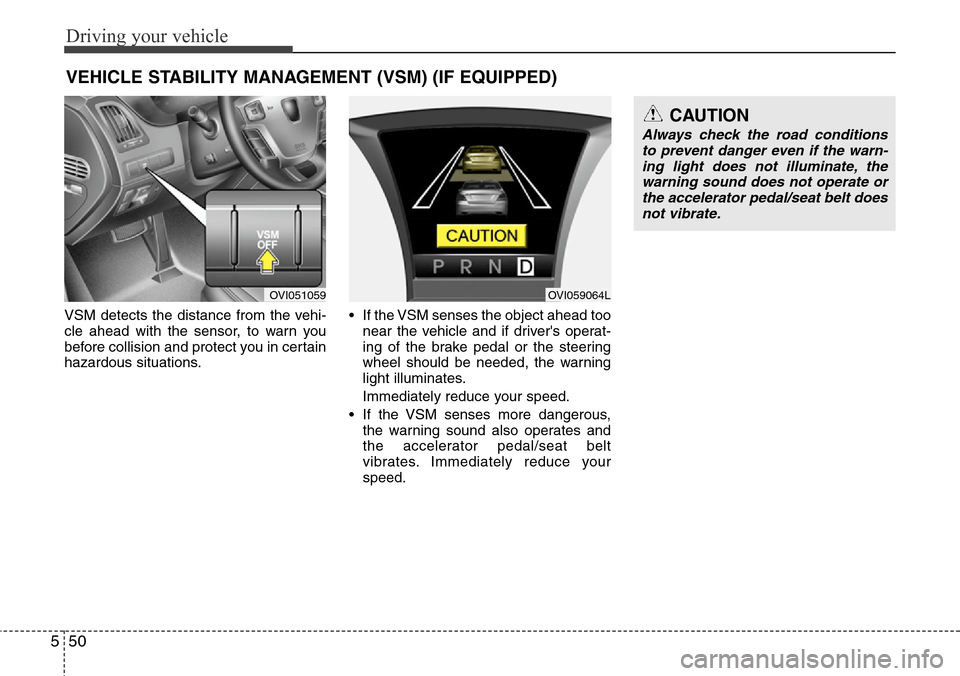
VSM detects the distance from the vehi-
cle ahead with the sensor, to warn you
before collision and protect you in certain
hazardous situations.• If the VSM senses the object ahead too
near the vehicle and if driver's operat-
ing of the brake pedal or the steering
wheel should be needed, the warning
light illuminates.
Immediately reduce your speed.
• If the VSM senses more dangerous,
the warning sound also operates and
the accelerator pedal/seat belt
vibrates. Immediately reduce your
speed.
VEHICLE STABILITY MANAGEMENT (VSM) (IF EQUIPPED)
CAUTION
Always check the road conditions
to prevent danger even if the warn-
ing light does not illuminate, the
warning sound does not operate or
the accelerator pedal/seat belt does
not vibrate.
OVI051059OVI059064L
Page 270 of 385
557
Driving your vehicle
✽NOTICE
The ESP system should be turned OFF
prior to rocking the vehicle.
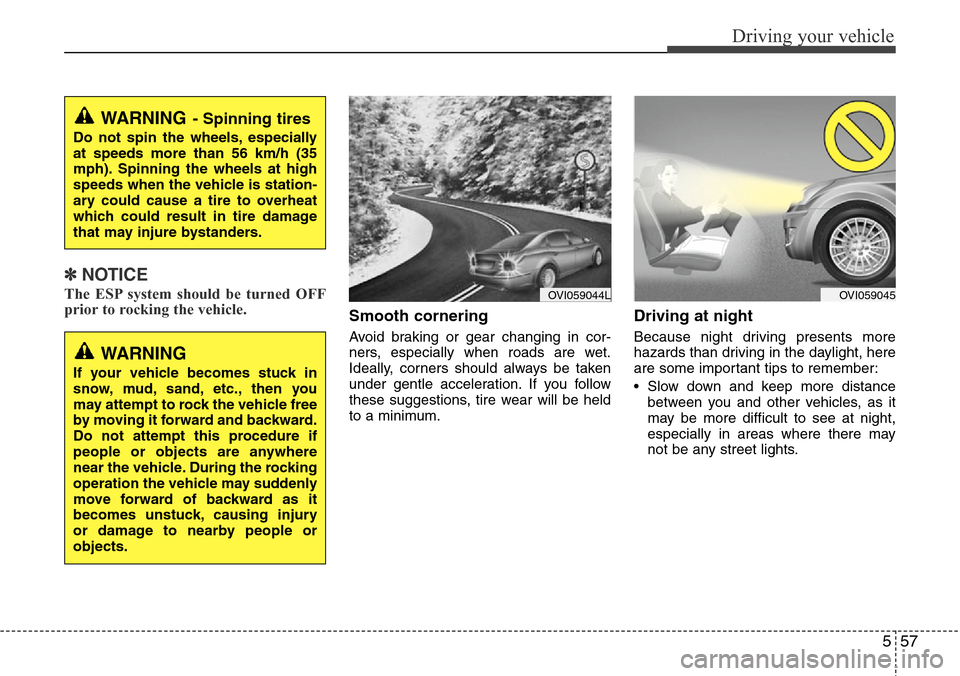
Smooth cornering
Avoid braking or gear changing in cor-
ners, especially when roads are wet.
Ideally, corners should always be taken
under gentle acceleration. If you follow
these suggestions, tire wear will be held
to a minimum.
Driving at night
Because night driving presents more
hazards than driving in the daylight, here
are some important tips to remember:
• Slow down and keep more distance
between you and other vehicles, as it
may be more difficult to see at night,
especially in areas where there may
not be any street lights.
WARNING- Spinning tires
Do not spin the wheels, especially
at speeds more than 56 km/h (35
mph). Spinning the wheels at high
speeds when the vehicle is station-
ary could cause a tire to overheat
which could result in tire damage
that may injure bystanders.
OVI059045
WARNING
If your vehicle becomes stuck in
snow, mud, sand, etc., then you
may attempt to rock the vehicle free
by moving it forward and backward.
Do not attempt this procedure if
people or objects are anywhere
near the vehicle. During the rocking
operation the vehicle may suddenly
move forward of backward as it
becomes unstuck, causing injury
or damage to nearby people or
objects.
OVI059044L