eas Hyundai Equus 2013 Owner's Manual
[x] Cancel search | Manufacturer: HYUNDAI, Model Year: 2013, Model line: Equus, Model: Hyundai Equus 2013Pages: 479, PDF Size: 10.15 MB
Page 370 of 479
615
What to do in an emergency
IF YOU HAVE A FLAT TIRE
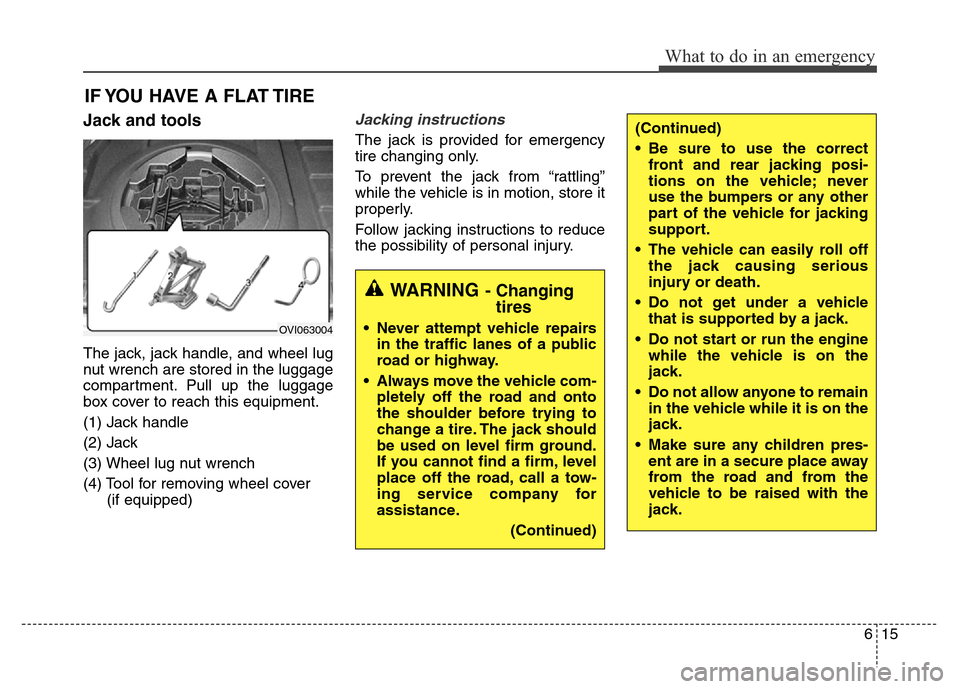
Jack and tools
The jack, jack handle, and wheel lug
nut wrench are stored in the luggage
compartment. Pull up the luggage
box cover to reach this equipment.
(1) Jack handle
(2) Jack
(3) Wheel lug nut wrench
(4) Tool for removing wheel cover
(if equipped)
Jacking instructions
The jack is provided for emergency
tire changing only.
To prevent the jack from “rattling”
while the vehicle is in motion, store it
properly.
Follow jacking instructions to reduce
the possibility of personal injury.
OVI063004
(Continued)
• Be sure to use the correct
front and rear jacking posi-
tions on the vehicle; never
use the bumpers or any other
part of the vehicle for jacking
support.
• The vehicle can easily roll off
the jack causing serious
injury or death.
• Do not get under a vehicle
that is supported by a jack.
• Do not start or run the engine
while the vehicle is on the
jack.
• Do not allow anyone to remain
in the vehicle while it is on the
jack.
• Make sure any children pres-
ent are in a secure place away
from the road and from the
vehicle to be raised with the
jack.
WARNING- Changing
tires
• Never attempt vehicle repairs
in the traffic lanes of a public
road or highway.
• Always move the vehicle com-
pletely off the road and onto
the shoulder before trying to
change a tire. The jack should
be used on level firm ground.
If you cannot find a firm, level
place off the road, call a tow-
ing service company for
assistance.
(Continued)
Page 371 of 479
What to do in an emergency
16 6
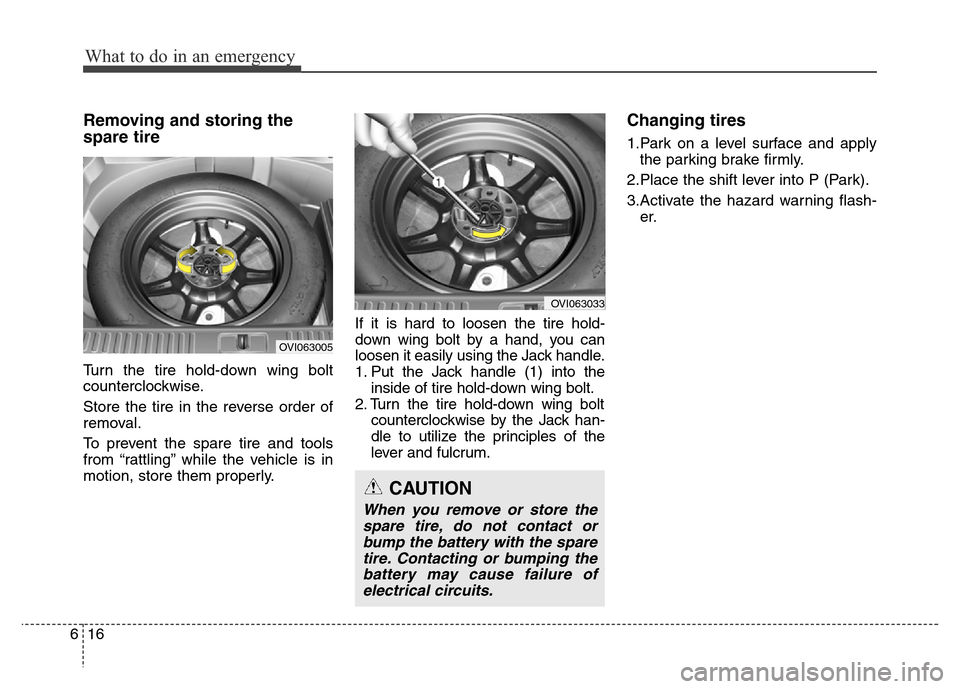
Removing and storing the
spare tire
Turn the tire hold-down wing bolt
counterclockwise.
Store the tire in the reverse order of
removal.
To prevent the spare tire and tools
from “rattling” while the vehicle is in
motion, store them properly.If it is hard to loosen the tire hold-
down wing bolt by a hand, you can
loosen it easily using the Jack handle.
1. Put the Jack handle (1) into the
inside of tire hold-down wing bolt.
2. Turn the tire hold-down wing bolt
counterclockwise by the Jack han-
dle to utilize the principles of the
lever and fulcrum.
Changing tires
1.Park on a level surface and apply
the parking brake firmly.
2.Place the shift lever into P (Park).
3.Activate the hazard warning flash-
er.
OVI063005
CAUTION
When you remove or store the
spare tire, do not contact or
bump the battery with the spare
tire. Contacting or bumping the
battery may cause failure of
electrical circuits.
OVI063033
Page 373 of 479
What to do in an emergency
18 6
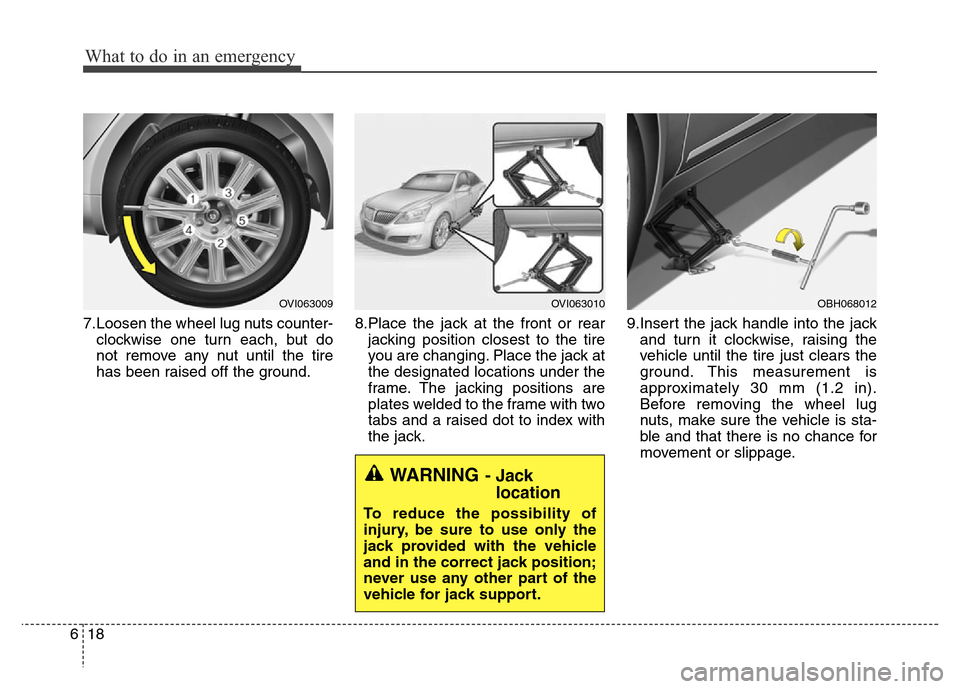
7.Loosen the wheel lug nuts counter-
clockwise one turn each, but do
not remove any nut until the tire
has been raised off the ground.8.Place the jack at the front or rear
jacking position closest to the tire
you are changing. Place the jack at
the designated locations under the
frame. The jacking positions are
plates welded to the frame with two
tabs and a raised dot to index with
the jack.9.Insert the jack handle into the jack
and turn it clockwise, raising the
vehicle until the tire just clears the
ground. This measurement is
approximately 30 mm (1.2 in).
Before removing the wheel lug
nuts, make sure the vehicle is sta-
ble and that there is no chance for
movement or slippage.
WARNING- Jack
location
To reduce the possibility of
injury, be sure to use only the
jack provided with the vehicle
and in the correct jack position;
never use any other part of the
vehicle for jack support.
OVI063010OBH068012OVI063009
Page 380 of 479
625
What to do in an emergency
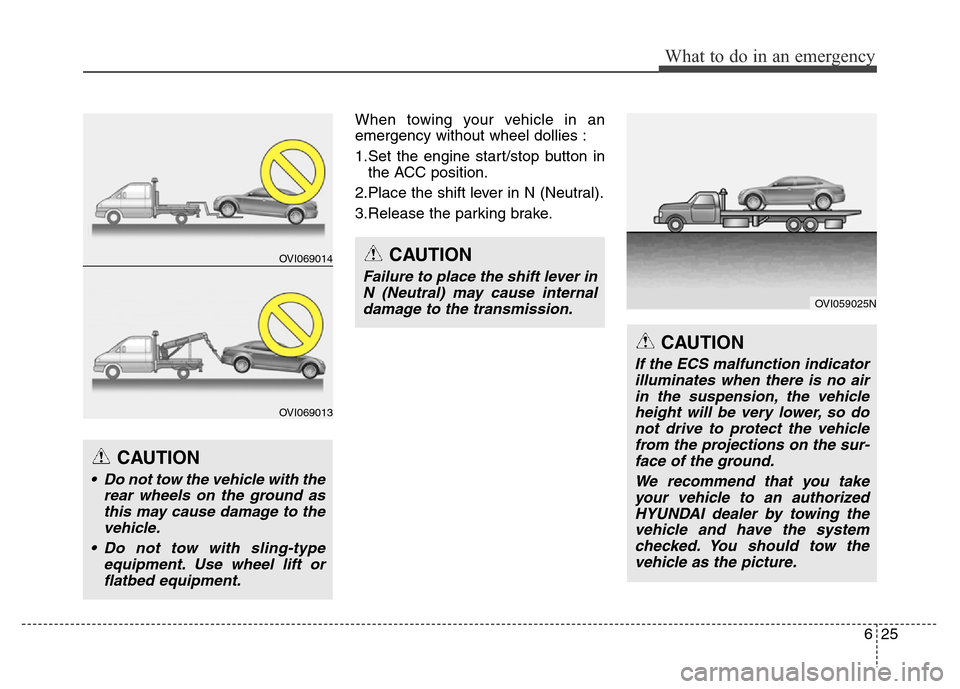
When towing your vehicle in an
emergency without wheel dollies :
1.Set the engine start/stop button in
the ACC position.
2.Place the shift lever in N (Neutral).
3.Release the parking brake.
OVI069014
OVI069013
CAUTION
• Do not tow the vehicle with the
rear wheels on the ground as
this may cause damage to the
vehicle.
• Do not tow with sling-type
equipment. Use wheel lift or
flatbed equipment.
CAUTION
Failure to place the shift lever in
N (Neutral) may cause internal
damage to the transmission.
CAUTION
If the ECS malfunction indicator
illuminates when there is no air
in the suspension, the vehicle
height will be very lower, so do
not drive to protect the vehicle
from the projections on the sur-
face of the ground.
We recommend that you take
your vehicle to an authorized
HYUNDAI dealer by towing the
vehicle and have the system
checked. You should tow the
vehicle as the picture.
OVI059025N
Page 383 of 479
What to do in an emergency
28 6
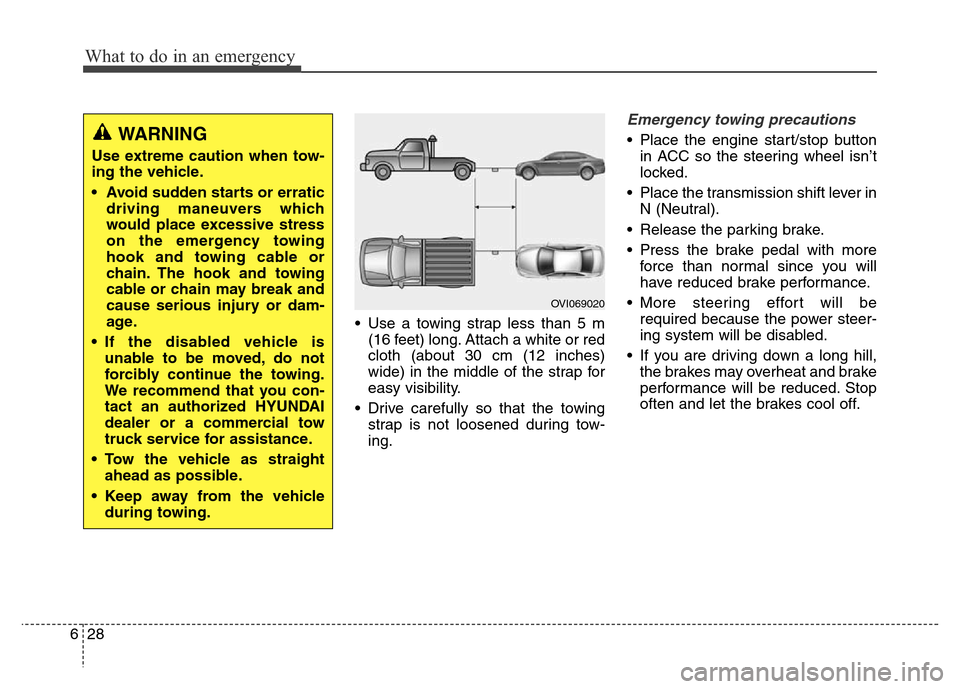
• Use a towing strap less than 5 m
(16 feet) long. Attach a white or red
cloth (about 30 cm (12 inches)
wide) in the middle of the strap for
easy visibility.
• Drive carefully so that the towing
strap is not loosened during tow-
ing.
Emergency towing precautions
• Place the engine start/stop button
in ACC so the steering wheel isn’t
locked.
• Place the transmission shift lever in
N (Neutral).
• Release the parking brake.
• Press the brake pedal with more
force than normal since you will
have reduced brake performance.
• More steering effort will be
required because the power steer-
ing system will be disabled.
• If you are driving down a long hill,
the brakes may overheat and brake
performance will be reduced. Stop
often and let the brakes cool off.WARNING
Use extreme caution when tow-
ing the vehicle.
• Avoid sudden starts or erratic
driving maneuvers which
would place excessive stress
on the emergency towing
hook and towing cable or
chain. The hook and towing
cable or chain may break and
cause serious injury or dam-
age.
• If the disabled vehicle is
unable to be moved, do not
forcibly continue the towing.
We recommend that you con-
tact an authorized HYUNDAI
dealer or a commercial tow
truck service for assistance.
• Tow the vehicle as straight
ahead as possible.
• Keep away from the vehicle
during towing.
OVI069020
Page 385 of 479
What to do in an emergency
30 6
EMERGENCY COMMODITY (IF EQUIPPED)
There are some emergency com-
modities in the vehicle to help you
respond to the emergency situation.
Fire extinguisher
If there is small fire and you know
how to use the fire extinguisher, take
the following steps carefully.
1.Pull the pin at the top of the extin-
guisher that keeps the handle from
being accidentally pressed.
2.Aim the nozzle toward the base of
the fire.
3.Stand approximately 2.5 m (8 ft)
away from the fire and squeeze the
handle to discharge the extinguish-
er. If you release the handle, the
discharge will stop.
4.Sweep the nozzle back and forth at
the base of the fire. After the fire
appears to be out, watch it careful-
ly since it may re-ignite.
First aid kit
There are some items such as scis-
sors, bandage and adhesive tape
and etc. in the kit to give first aid to
an injured person.
Triangle reflector
Place the triangle reflector on the
road to warn oncoming vehicles dur-
ing emergencies, such as when the
vehicle is parked by the roadside due
to any problems.
Tire pressure gauge
(If equipped)
Tires normally lose some air in day-
to-day use, and you may have to add
a few pounds of air periodically and it
is not usually a sign of a leaking tire,
but of normal wear. Always check tire
pressure when the tires are cold
because tire pressure increases with
temperature.To check the tire pressure, take the
following steps;
1.Unscrew the inflation valve cap
that is located on the rim of the tire.
2.Press and hold the gauge against
the tire valve. Some air will escape
as you begin and more will escape
if you don't press the gauge in firm-
ly.
3.A firm non-leaking push will acti-
vate the gauge.
4.Read the tire pressure on the
gauge to know whether the tire
pressure is low or high.
5.Adjust the tire pressures to the
specified pressure. Refer to “Tires
and wheels” in section 8.
6.Reinstall the inflation valve cap.
Page 390 of 479
75
Maintenance
MAINTENANCE SERVICES
You should exercise the utmost care
to prevent damage to your vehicle
and injury to yourself whenever per-
forming any maintenance or inspec-
tion procedures.
Inadequate, incomplete or insuffi-
cient servicing may result in opera-
tional problems with your vehicle that
could lead to vehicle damage, an
accident, or personal injury.Owner’s responsibility
✽NOTICE
Maintenance Service and Record
Retention are the owner's responsi-
bility.
We recommend in general that you
have your vehicle serviced by an
authorized HYUNDAI dealer.
You should retain documents that
show proper maintenance has been
performed on your vehicle in accor-
dance with the scheduled mainte-
nance service charts shown on the
following pages. You need this infor-
mation to establish your compliance
with the servicing and maintenance
requirements of your vehicle war-
ranties.
Detailed warranty information is pro-
vided in your Service Passport.
Repairs and adjustments required as
a result of improper maintenance or
a lack of required maintenance are
not covered when your vehicle is
covered by warranty.
Owner maintenance precau-
tions
Improper or incomplete service may
result in problems. This section gives
instructions only for the maintenance
items that are easy to perform.
✽NOTICE
Improper owner maintenance dur-
ing the warranty period may affect
warranty coverage. For details, read
the separate Service Passport pro-
vided with the vehicle. If you're
unsure about any servicing or main-
tenance procedure, we recommend
that the system be seviced by an
authorized HYUNDAIdealer.
Page 392 of 479
77
Maintenance
OWNER MAINTENANCE
The following lists are vehicle checks
and inspections that should be per-
formed at the frequencies indicated
to help ensure safe, dependable
operation of your vehicle.
Any adverse conditions should be
brought to the attention of your deal-
er as soon as possible.
These Owner Maintenance Checks
are generally not covered by war-
ranties and you may be charged for
labor, parts and lubricants used.Owner maintenance schedule
When you stop for fuel:
• Check the engine oil level.
• Check coolant level in coolant
reservoir.
• Check the windshield washer fluid
level.
• Look for low or under-inflated tires.
While operating your vehicle:
• Note any changes in the sound of
the exhaust or any smell of
exhaust fumes in the vehicle.
• Check for vibrations in the steering
wheel. Notice any increased steer-
ing effort or looseness in the steer-
ing wheel, or change in its straight-
ahead position.
• Notice if your vehicle constantly
turns slightly or “pulls” to one side
when traveling on smooth, level
road.
• When stopping, listen and check
for unusual sounds, pulling to one
side, increased brake pedal travel
or “hard-to-push” brake pedal.
• If any slipping or changes in the
operation of your transmission
occurs, check the transmission
fluid level.
• Check automatic transmission P
(Park) function.
• Check parking brake.
• Check for fluid leaks under your
vehicle (water dripping from the air
conditioning system during or after
use is normal).
WARNING
Be careful when checking your
engine coolant level when the
engine is hot. Scalding hot
coolant and steam may blow
out under pressure. This could
cause burns or other serious
injury.
Page 393 of 479
Maintenance
8 7
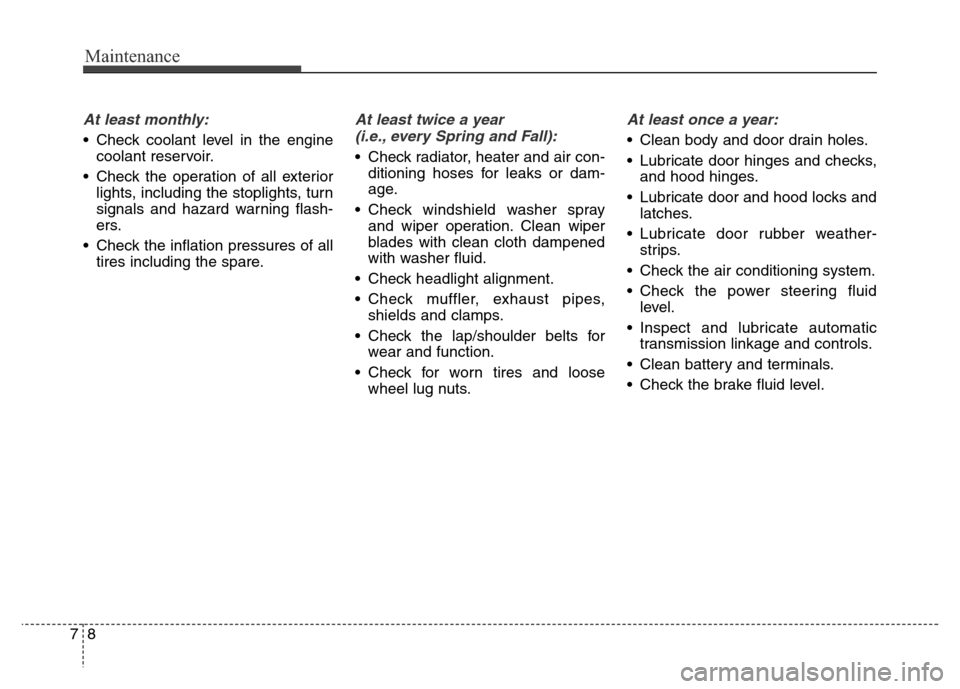
At least monthly:
• Check coolant level in the engine
coolant reservoir.
• Check the operation of all exterior
lights, including the stoplights, turn
signals and hazard warning flash-
ers.
• Check the inflation pressures of all
tires including the spare.
At least twice a year
(i.e., every Spring and Fall):
• Check radiator, heater and air con-
ditioning hoses for leaks or dam-
age.
• Check windshield washer spray
and wiper operation. Clean wiper
blades with clean cloth dampened
with washer fluid.
• Check headlight alignment.
• Check muffler, exhaust pipes,
shields and clamps.
• Check the lap/shoulder belts for
wear and function.
• Check for worn tires and loose
wheel lug nuts.
At least once a year:
• Clean body and door drain holes.
• Lubricate door hinges and checks,
and hood hinges.
• Lubricate door and hood locks and
latches.
• Lubricate door rubber weather-
strips.
• Check the air conditioning system.
• Check the power steering fluid
level.
• Inspect and lubricate automatic
transmission linkage and controls.
• Clean battery and terminals.
• Check the brake fluid level.
Page 394 of 479
79
Maintenance
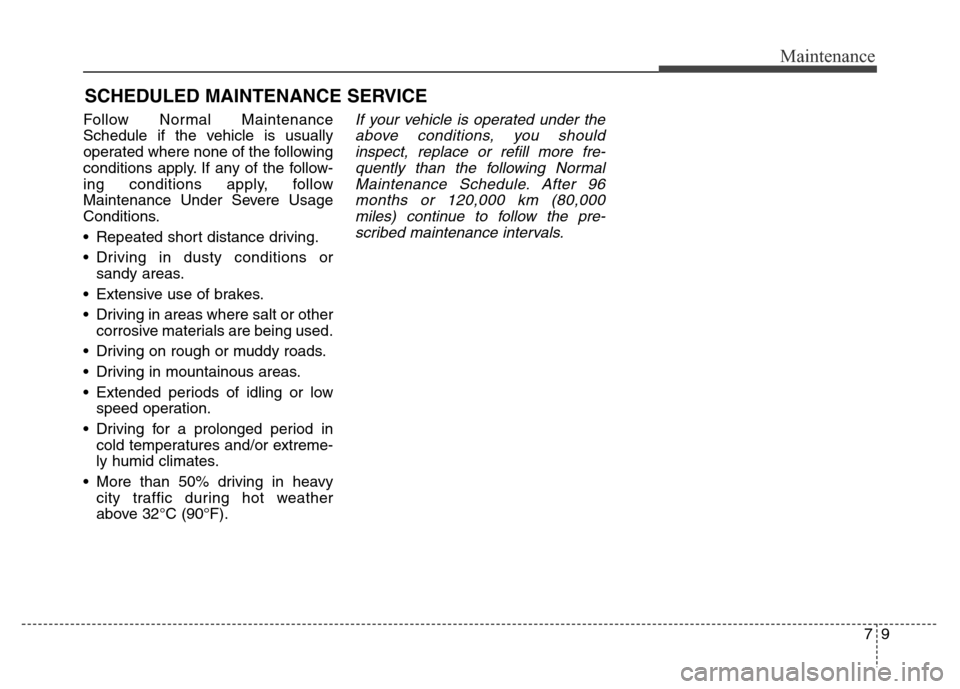
SCHEDULED MAINTENANCE SERVICE
Follow Normal Maintenance
Schedule if the vehicle is usually
operated where none of the following
conditions apply. If any of the follow-
ing conditions apply, follow
Maintenance Under Severe Usage
Conditions.
• Repeated short distance driving.
• Driving in dusty conditions or
sandy areas.
• Extensive use of brakes.
• Driving in areas where salt or other
corrosive materials are being used.
• Driving on rough or muddy roads.
• Driving in mountainous areas.
• Extended periods of idling or low
speed operation.
• Driving for a prolonged period in
cold temperatures and/or extreme-
ly humid climates.
• More than 50% driving in heavy
city traffic during hot weather
above 32°C (90°F).If your vehicle is operated under the
above conditions, you should
inspect, replace or refill more fre-
quently than the following Normal
Maintenance Schedule. After 96
months or 120,000 km (80,000
miles) continue to follow the pre-
scribed maintenance intervals.