eas Hyundai Equus 2013 Owner's Manual
[x] Cancel search | Manufacturer: HYUNDAI, Model Year: 2013, Model line: Equus, Model: Hyundai Equus 2013Pages: 479, PDF Size: 10.15 MB
Page 395 of 479
Maintenance
10 7
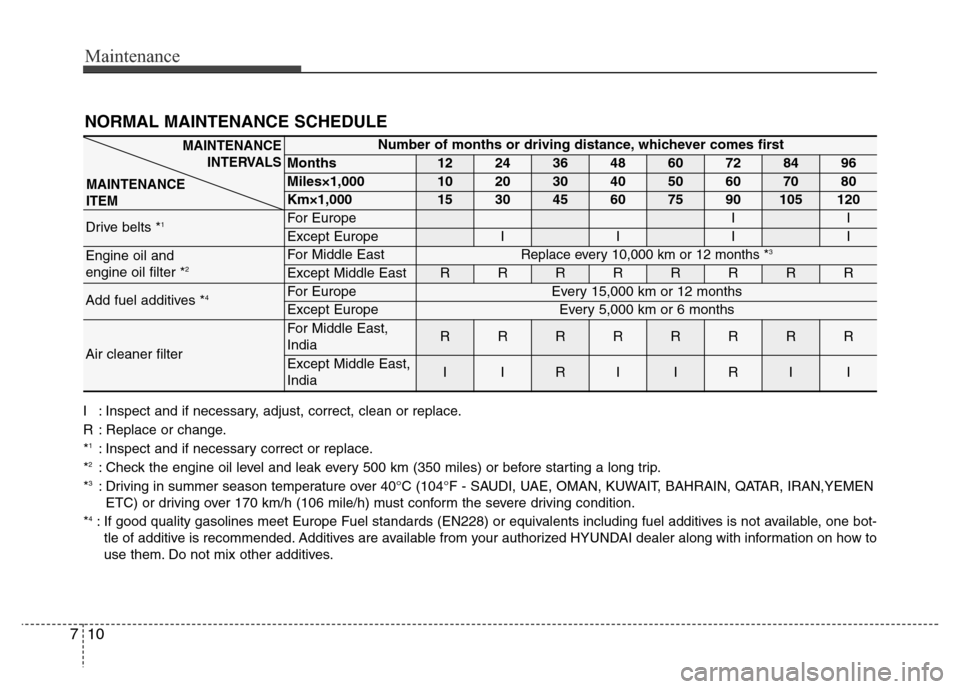
NORMAL MAINTENANCE SCHEDULE
I : Inspect and if necessary, adjust, correct, clean or replace.
R : Replace or change.
*
1: Inspect and if necessary correct or replace.
*2: Check the engine oil level and leak every 500 km (350 miles) or before starting a long trip.
*3: Driving in summer season temperature over 40°C (104°F - SAUDI, UAE, OMAN, KUWAIT, BAHRAIN, QATAR, IRAN,YEMEN
ETC) or driving over 170 km/h (106 mile/h) must conform the severe driving condition.
*
4: If good quality gasolines meet Europe Fuel standards (EN228) or equivalents including fuel additives is not available, one bot-
tle of additive is recommended. Additives are available from your authorized HYUNDAI dealer along with information on how to
use them. Do not mix other additives.
Number of months or driving distance, whichever comes first
Months1224364860728496
Miles×1,0001020304050607080
Km×1,000153045607590105120
Drive belts *1For EuropeII
Except EuropeIIII
Engine oil and
engine oil filter *2For Middle EastReplace every 10,000 km or 12 months *3
Except Middle EastRRRRRRRR
Add fuel additives *4For EuropeEvery 15,000 km or 12 months
Except EuropeEvery 5,000 km or 6 months
Air cleaner filter
For Middle East,
IndiaRRRRRRRR
Except Middle East,
IndiaIIRIIRII
MAINTENANCE
INTERVALS
MAINTENANCE
ITEM
Page 399 of 479
Maintenance
14 7
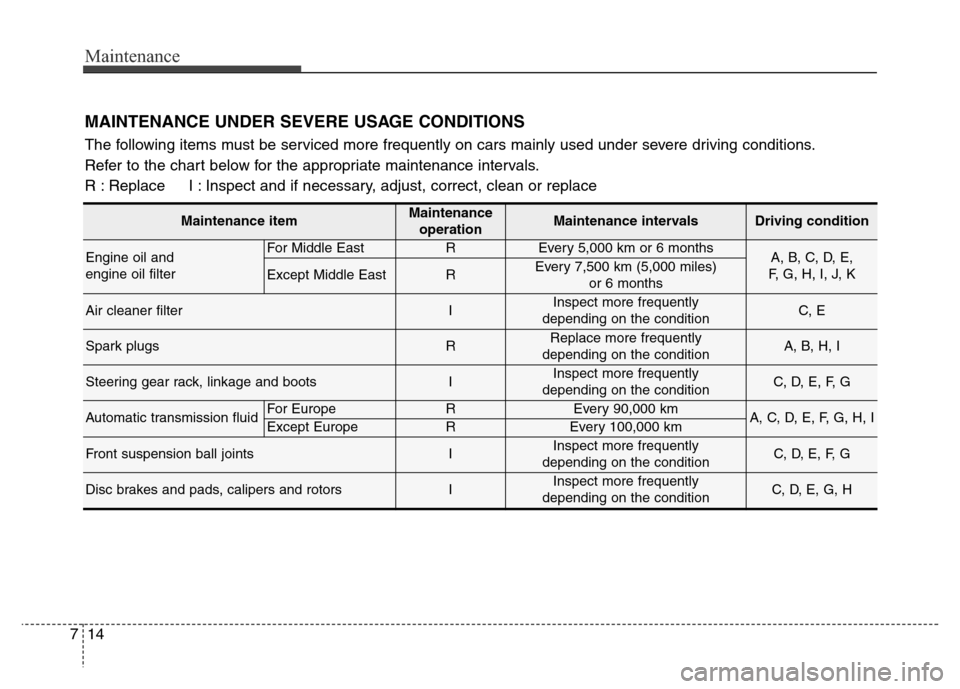
Maintenance itemMaintenance
operationMaintenance intervalsDriving condition
Engine oil and
engine oil filterFor Middle EastREvery 5,000 km or 6 monthsA, B, C, D, E,
F, G, H, I, J, K
Except Middle EastREvery 7,500 km (5,000 miles)
or 6 months
Air cleaner filterIInspect more frequently
depending on the conditionC, E
Spark plugs RReplace more frequently
depending on the conditionA, B, H, I
Steering gear rack, linkage and bootsIInspect more frequently
depending on the conditionC, D, E, F, G
Automatic transmission fluidFor EuropeREvery 90,000 kmA, C, D, E, F, G, H, IExcept EuropeREvery 100,000 km
Front suspension ball jointsIInspect more frequently
depending on the conditionC, D, E, F, G
Disc brakes and pads, calipers and rotorsIInspect more frequently
depending on the conditionC, D, E, G, H
MAINTENANCE UNDER SEVERE USAGE CONDITIONS
The following items must be serviced more frequently on cars mainly used under severe driving conditions.
Refer to the chart below for the appropriate maintenance intervals.
R : Replace I : Inspect and if necessary, adjust, correct, clean or replace
Page 400 of 479
715
Maintenance
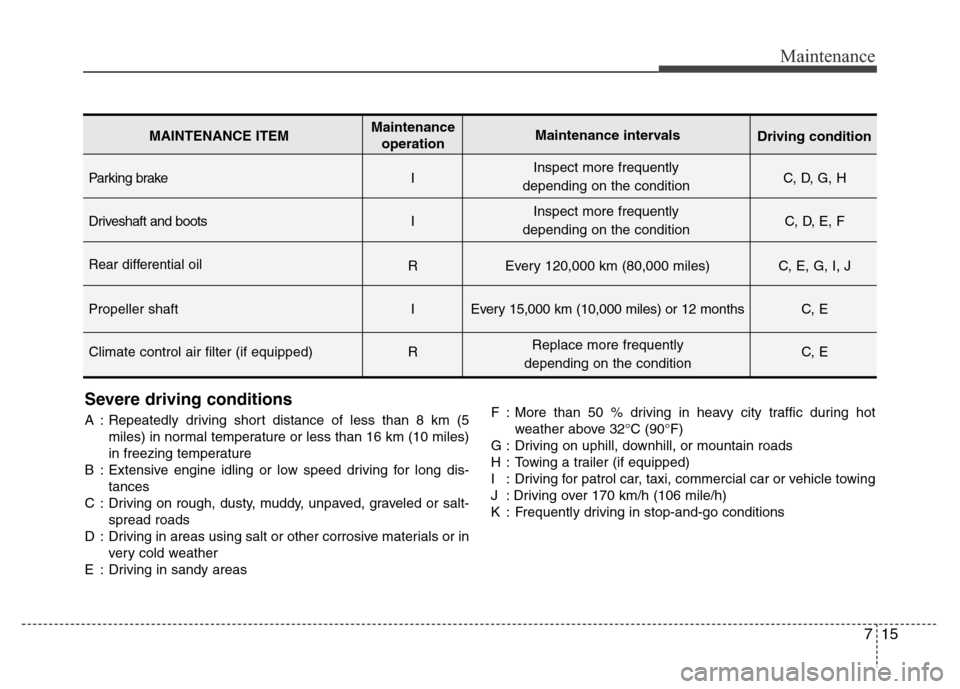
Parking brake I C, D, G, H
Driveshaft and boots I C, D, E, F
Rear differential oilR Every 120,000 km (80,000 miles) C, E, G, I, J
Propeller shaft I
Every 15,000 km (10,000 miles) or 12 monthsC, E
Climate control air filter (if equipped) R C, E
MAINTENANCE ITEMMaintenance
operationMaintenance intervals
Driving condition
Inspect more frequently
depending on the condition
Inspect more frequently
depending on the condition
Replace more frequently
depending on the condition
Severe driving conditions
A : Repeatedly driving short distance of less than 8 km (5
miles) in normal temperature or less than 16 km (10 miles)
in freezing temperature
B : Extensive engine idling or low speed driving for long dis-
tances
C : Driving on rough, dusty, muddy, unpaved, graveled or salt-
spread roads
D : Driving in areas using salt or other corrosive materials or in
very cold weather
E : Driving in sandy areasF : More than 50 % driving in heavy city traffic during hot
weather above 32°C (90°F)
G : Driving on uphill, downhill, or mountain roads
H : Towing a trailer (if equipped)
I : Driving for patrol car, taxi, commercial car or vehicle towing
J : Driving over 170 km/h (106 mile/h)
K : Frequently driving in stop-and-go conditions
Page 403 of 479
Maintenance
18 7
Brake hoses and lines
Visually check for proper installation,
chafing, cracks, deterioration and
any leakage. Replace any deteriorat-
ed or damaged parts immediately.
Brake fluid
Check brake fluid level in the brake
fluid reservoir. The level should be
between “MIN” and “MAX” marks on
the side of the reservoir. Use only
hydraulic brake fluid conforming to
DOT 3 or DOT 4 specification.
Steering gear box, linkage &
boots/lower arm ball joint
With the vehicle stopped and engine
off, check for excessive free-play in
the steering wheel.
Check the linkage for bends or dam-
age. Check the dust boots and ball
joints for deterioration, cracks, or
damage. Replace any damaged
parts.
Power steering pump, belt and
hoses
Check the power steering pump and
hoses for leakage and damage.
Replace any damaged or leaking
parts immediately. Inspect the power
steering belt (or drive belt) for evi-
dence of cuts, cracks, excessive
wear, oiliness and proper tension.
Replace or adjust it if necessary.
Drive shafts and boots
Check the drive shafts, boots and
clamps for cracks, deterioration, or
damage. Replace any damaged
parts and, if necessary, repack the
grease.
Air conditioning refrigerant
(if equipped)
Check the air conditioning lines and
connections for leakage and dam-
age.
Brake discs, pads, calipers
and rotors
Check the pads for excessive wear,
discs for run out and wear, and
calipers for fluid leakage.
For more information on checking
the pads or lining wear limit, refer to
the Hyundai web site.
(http://brakeman
ual.hmc.co.kr)
Suspension mounting bolts
Check the suspension connections
for looseness or damage. Retighten
to the specified torque.
Page 406 of 479
721
Maintenance
ENGINE COOLANT
The high-pressure cooling system
has a reservoir filled with year-round
antifreeze coolant. The reservoir is
filled at the factory.
Check the antifreeze protection and
coolant level at least once a year, at
the beginning of the winter season,
and before traveling to a colder cli-
mate.Checking the coolant level
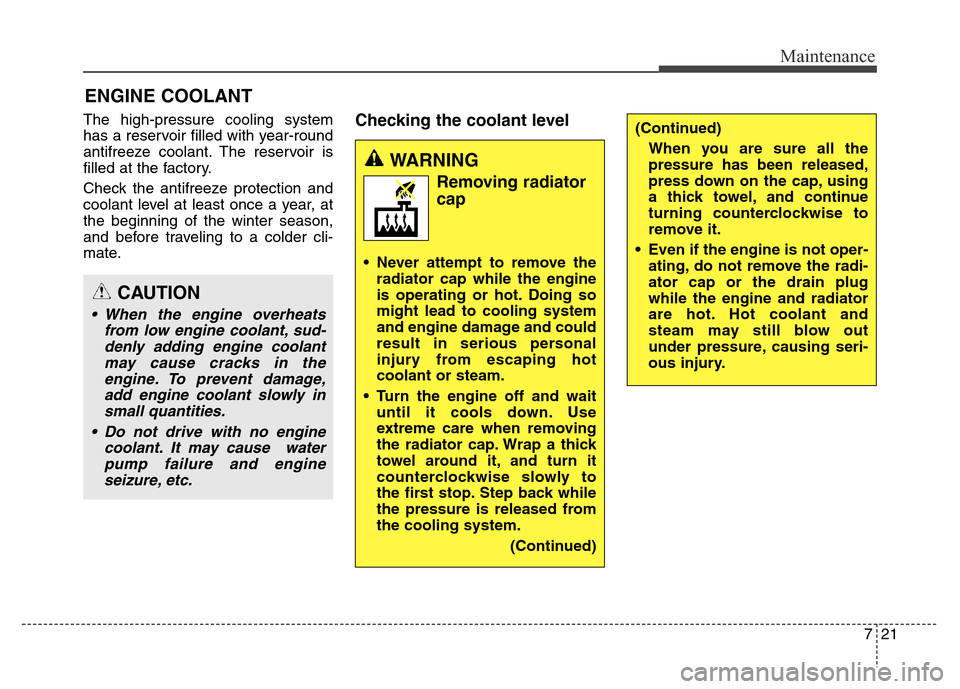
WARNING
Removing radiator
cap
• Never attempt to remove the
radiator cap while the engine
is operating or hot. Doing so
might lead to cooling system
and engine damage and could
result in serious personal
injury from escaping hot
coolant or steam.
• Turn the engine off and wait
until it cools down. Use
extreme care when removing
the radiator cap. Wrap a thick
towel around it, and turn it
counterclockwise slowly to
the first stop. Step back while
the pressure is released from
the cooling system.
(Continued)
(Continued)
When you are sure all the
pressure has been released,
press down on the cap, using
a thick towel, and continue
turning counterclockwise to
remove it.
• Even if the engine is not oper-
ating, do not remove the radi-
ator cap or the drain plug
while the engine and radiator
are hot. Hot coolant and
steam may still blow out
under pressure, causing seri-
ous injury.
CAUTION
• When the engine overheats
from low engine coolant, sud-
denly adding engine coolant
may cause cracks in the
engine. To prevent damage,
add engine coolant slowly in
small quantities.
• Do not drive with no engine
coolant. It may cause water
pump failure and engine
seizure, etc.
Page 407 of 479
Maintenance
22 7
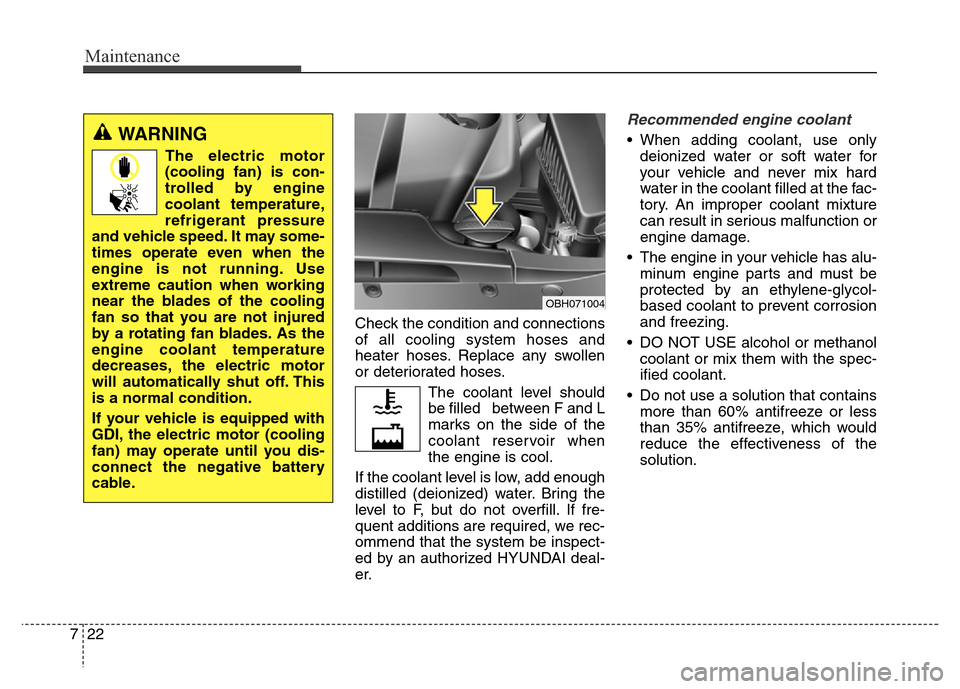
Check the condition and connections
of all cooling system hoses and
heater hoses. Replace any swollen
or deteriorated hoses.
The coolant level should
be filled between F and L
marks on the side of the
coolant reservoir when
the engine is cool.
If the coolant level is low, add enough
distilled (deionized) water. Bring the
level to F, but do not overfill. If fre-
quent additions are required, we rec-
ommend that the system be inspect-
ed by an authorized HYUNDAI deal-
er.
Recommended engine coolant
• When adding coolant, use only
deionized water or soft water for
your vehicle and never mix hard
water in the coolant filled at the fac-
tory. An improper coolant mixture
can result in serious malfunction or
engine damage.
• The engine in your vehicle has alu-
minum engine parts and must be
protected by an ethylene-glycol-
based coolant to prevent corrosion
and freezing.
• DO NOT USE alcohol or methanol
coolant or mix them with the spec-
ified coolant.
• Do not use a solution that contains
more than 60% antifreeze or less
than 35% antifreeze, which would
reduce the effectiveness of the
solution.
OBH071004
WARNING
The electric motor
(cooling fan) is con-
trolled by engine
coolant temperature,
refrigerant pressure
and vehicle speed. It may some-
times operate even when the
engine is not running. Use
extreme caution when working
near the blades of the cooling
fan so that you are not injured
by a rotating fan blades. As the
engine coolant temperature
decreases, the electric motor
will automatically shut off. This
is a normal condition.
If your vehicle is equipped with
GDI, the electric motor (cooling
fan) may operate until you dis-
connect the negative battery
cable.
Page 410 of 479
725
Maintenance
POWER STEERING FLUID
Checking the power steering
fluid level
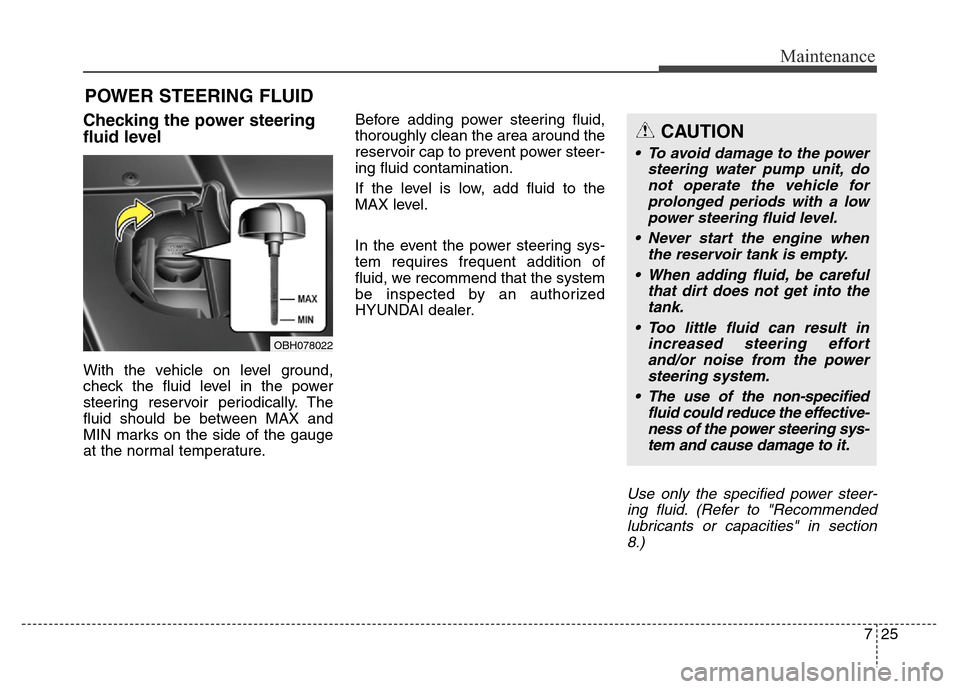
With the vehicle on level ground,
check the fluid level in the power
steering reservoir periodically. The
fluid should be between MAX and
MIN marks on the side of the gauge
at the normal temperature.Before adding power steering fluid,
thoroughly clean the area around the
reservoir cap to prevent power steer-
ing fluid contamination.
If the level is low, add fluid to the
MAX level.
In the event the power steering sys-
tem requires frequent addition of
fluid, we recommend that the system
be inspected by an authorized
HYUNDAI dealer.
Use only the specified power steer-
ing fluid. (Refer to "Recommended
lubricants or capacities" in section
8.)
CAUTION
• To avoid damage to the power
steering water pump unit, do
not operate the vehicle for
prolonged periods with a low
power steering fluid level.
• Never start the engine when
the reservoir tank is empty.
• When adding fluid, be careful
that dirt does not get into the
tank.
• Too little fluid can result in
increased steering effort
and/or noise from the power
steering system.
• The use of the non-specified
fluid could reduce the effective-
ness of the power steering sys-
tem and cause damage to it.
OBH078022
Page 413 of 479
Maintenance
28 7
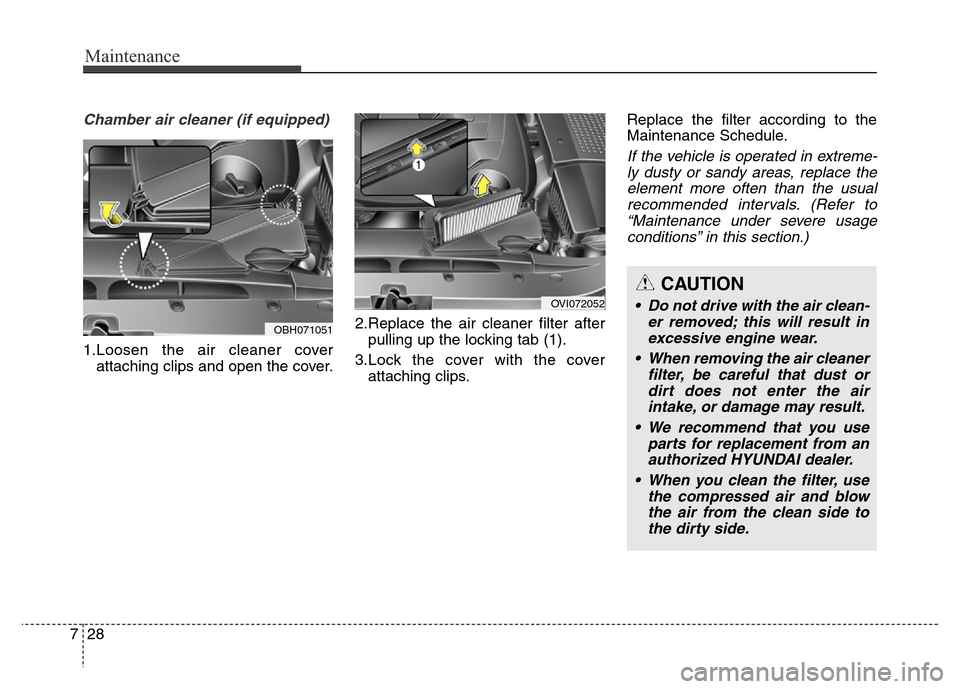
Chamber air cleaner (if equipped)
1.Loosen the air cleaner cover
attaching clips and open the cover.2.Replace the air cleaner filter after
pulling up the locking tab (1).
3.Lock the cover with the cover
attaching clips.Replace the filter according to the
Maintenance Schedule.
If the vehicle is operated in extreme-
ly dusty or sandy areas, replace the
element more often than the usual
recommended intervals. (Refer to
“Maintenance under severe usage
conditions” in this section.)
OBH071051
OVI072052
CAUTION
• Do not drive with the air clean-
er removed; this will result in
excessive engine wear.
• When removing the air cleaner
filter, be careful that dust or
dirt does not enter the air
intake, or damage may result.
• We recommend that you use
parts for replacement from an
authorized HYUNDAI dealer.
• When you clean the filter, use
the compressed air and blow
the air from the clean side to
the dirty side.
Page 415 of 479
Maintenance
30 7
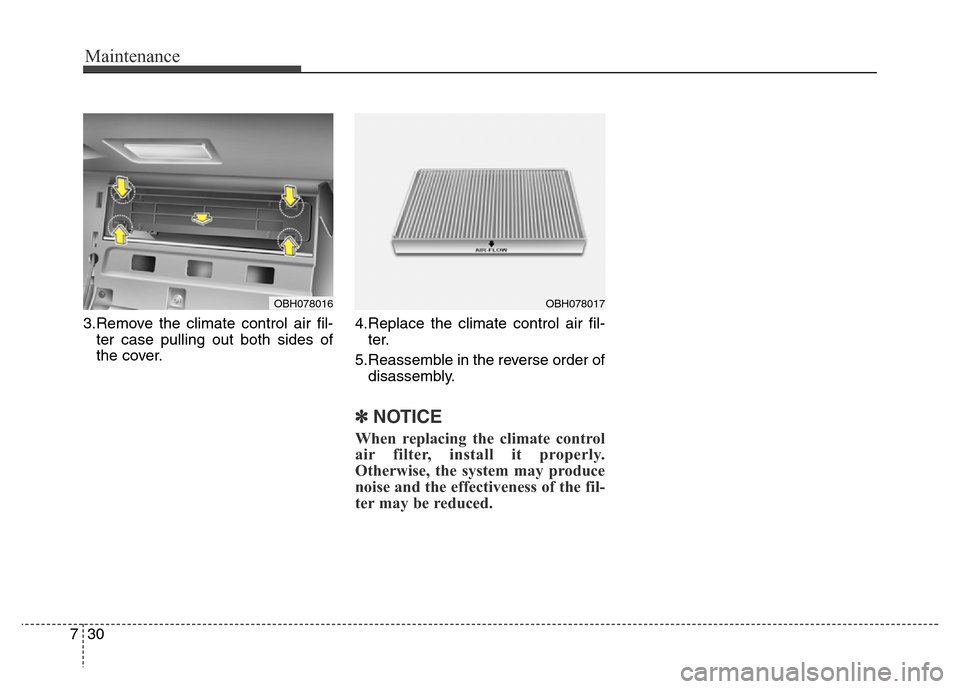
3.Remove the climate control air fil-
ter case pulling out both sides of
the cover.4.Replace the climate control air fil-
ter.
5.Reassemble in the reverse order of
disassembly.
✽NOTICE
When replacing the climate control
air filter, install it properly.
Otherwise, the system may produce
noise and the effectiveness of the fil-
ter may be reduced.
OBH078016OBH078017
Page 420 of 479
735
Maintenance
For best battery service
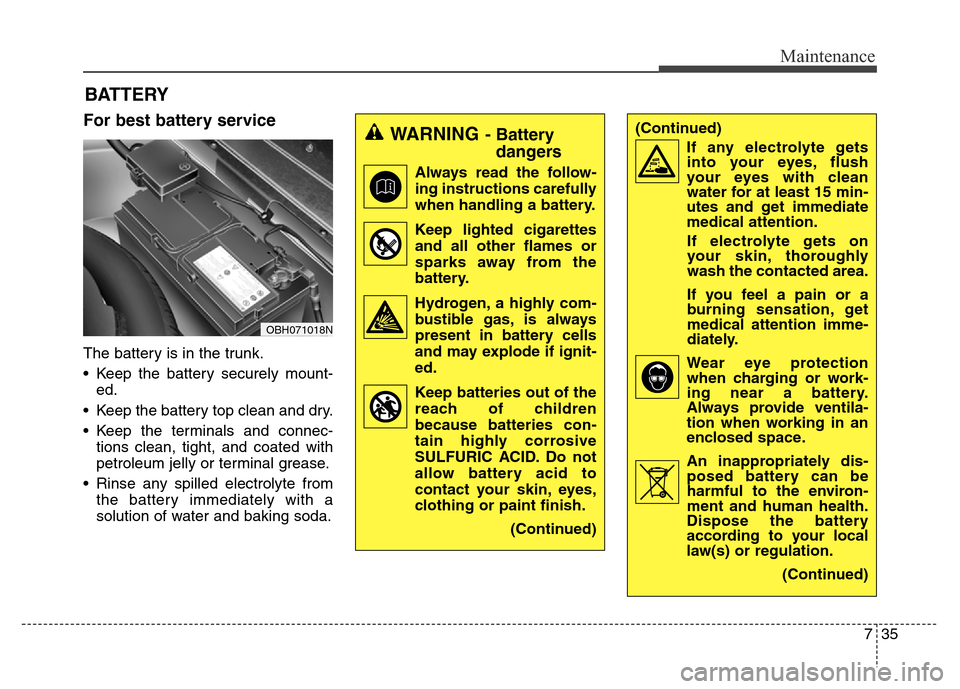
The battery is in the trunk.
• Keep the battery securely mount-
ed.
• Keep the battery top clean and dry.
• Keep the terminals and connec-
tions clean, tight, and coated with
petroleum jelly or terminal grease.
• Rinse any spilled electrolyte from
the battery immediately with a
solution of water and baking soda.
BATTERY
OBH071018N
WARNING- Battery
dangers
Always read the follow-
ing instructions carefully
when handling a battery.
Keep lighted cigarettes
and all other flames or
sparks away from the
battery.
Hydrogen, a highly com-
bustible gas, is always
present in battery cells
and may explode if ignit-
ed.
Keep batteries out of the
reach of children
because batteries con-
tain highly corrosive
SULFURIC ACID. Do not
allow battery acid to
contact your skin, eyes,
clothing or paint finish.
(Continued)
(Continued)
If any electrolyte gets
into your eyes, flush
your eyes with clean
water for at least 15 min-
utes and get immediate
medical attention.
If electrolyte gets on
your skin, thoroughly
wash the contacted area.
If you feel a pain or a
burning sensation, get
medical attention imme-
diately.
Wear eye protection
when charging or work-
ing near a battery.
Always provide ventila-
tion when working in an
enclosed space.
An inappropriately dis-
posed battery can be
harmful to the environ-
ment and human health.
Dispose the battery
according to your local
law(s) or regulation.
(Continued)