driver seat Hyundai Equus 2013 User Guide
[x] Cancel search | Manufacturer: HYUNDAI, Model Year: 2013, Model line: Equus, Model: Hyundai Equus 2013Pages: 479, PDF Size: 10.15 MB
Page 32 of 479
313
Safety features of your vehicle
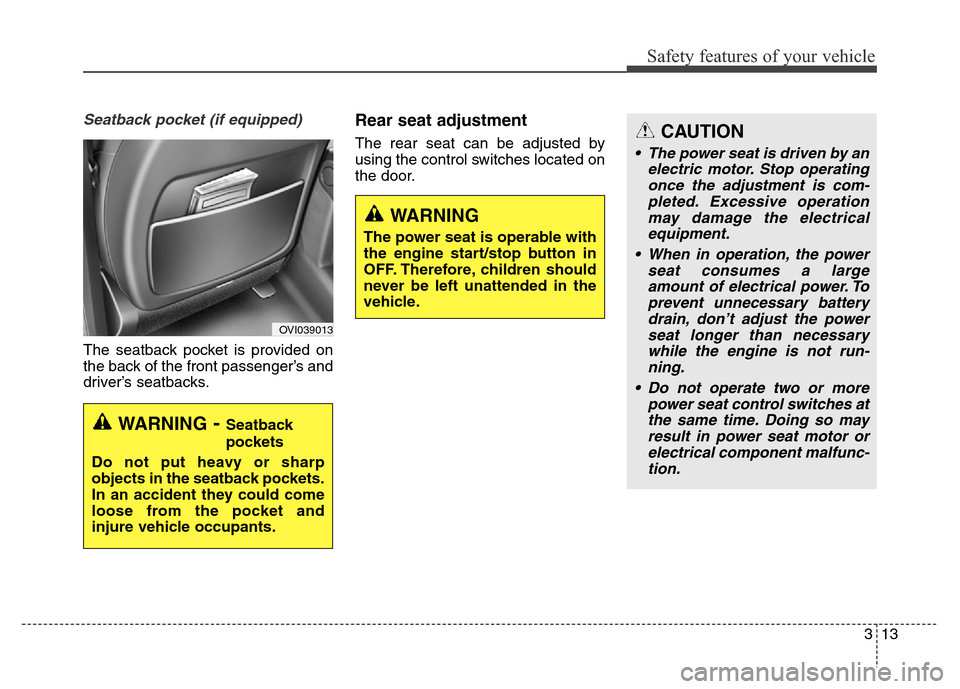
Seatback pocket (if equipped)
The seatback pocket is provided on
the back of the front passenger’s and
driver’s seatbacks.
Rear seat adjustment
The rear seat can be adjusted by
using the control switches located on
the door.
WARNING- Seatback
pockets
Do not put heavy or sharp
objects in the seatback pockets.
In an accident they could come
loose from the pocket and
injure vehicle occupants.
OVI039013
WARNING
The power seat is operable with
the engine start/stop button in
OFF. Therefore, children should
never be left unattended in the
vehicle.
CAUTION
• The power seat is driven by an
electric motor. Stop operating
once the adjustment is com-
pleted. Excessive operation
may damage the electrical
equipment.
• When in operation, the power
seat consumes a large
amount of electrical power. To
prevent unnecessary battery
drain, don’t adjust the power
seat longer than necessary
while the engine is not run-
ning.
• Do not operate two or more
power seat control switches at
the same time. Doing so may
result in power seat motor or
electrical component malfunc-
tion.
Page 44 of 479
325
Safety features of your vehicle
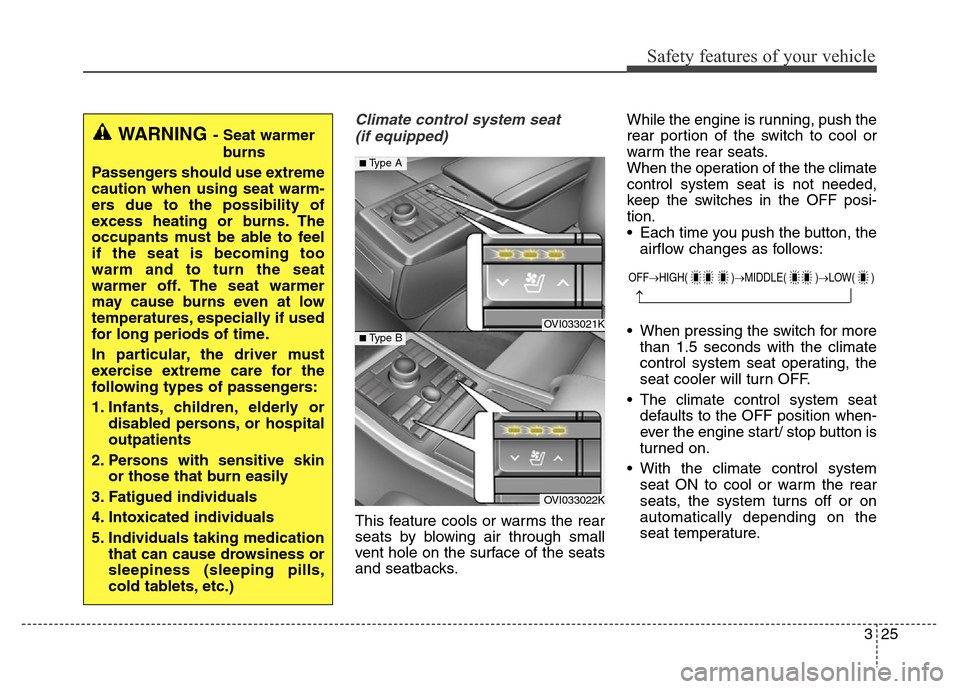
Climate control system seat
(if equipped)
This feature cools or warms the rear
seats by blowing air through small
vent hole on the surface of the seats
and seatbacks.While the engine is running, push the
rear portion of the switch to cool or
warm the rear seats.
When the operation of the the climate
control system seat is not needed,
keep the switches in the OFF posi-
tion.
• Each time you push the button, the
airflow changes as follows:
• When pressing the switch for more
than 1.5 seconds with the climate
control system seat operating, the
seat cooler will turn OFF.
• The climate control system seat
defaults to the OFF position when-
ever the engine start/ stop button is
turned on.
• With the climate control system
seat ON to cool or warm the rear
seats, the system turns off or on
automatically depending on the
seat temperature.
WARNING- Seat warmer
burns
Passengers should use extreme
caution when using seat warm-
ers due to the possibility of
excess heating or burns. The
occupants must be able to feel
if the seat is becoming too
warm and to turn the seat
warmer off. The seat warmer
may cause burns even at low
temperatures, especially if used
for long periods of time.
In particular, the driver must
exercise extreme care for the
following types of passengers:
1. Infants, children, elderly or
disabled persons, or hospital
outpatients
2. Persons with sensitive skin
or those that burn easily
3. Fatigued individuals
4. Intoxicated individuals
5. Individuals taking medication
that can cause drowsiness or
sleepiness (sleeping pills,
cold tablets, etc.)
OVI033021K
OVI033022K
■Type A
■ Type B
OFF→HIGH( )→MIDDLE( )→LOW( )
→
Page 48 of 479
329
Safety features of your vehicle
Seat belt warning
Seat belt warning light
As a reminder to the driver, the seat
belt warning light will blink for
approximately 6 seconds each time
you turn the engine start/stop button
ON regardless of belt fastening.
If the driver’s seat belt is unfastened
after the engine start/stop button is
ON, the seat belt warning light blinks
again for approximately 6 seconds.Seat belt warning chime
If the driver's seat belt is not fastened
when the engine start/stop button is
turned ON, the seat belt warning
chime will sound for approximately 6
seconds. At this time, if the seat belt
is fastened, the chime will stop at
once.
Lap/shoulder belt
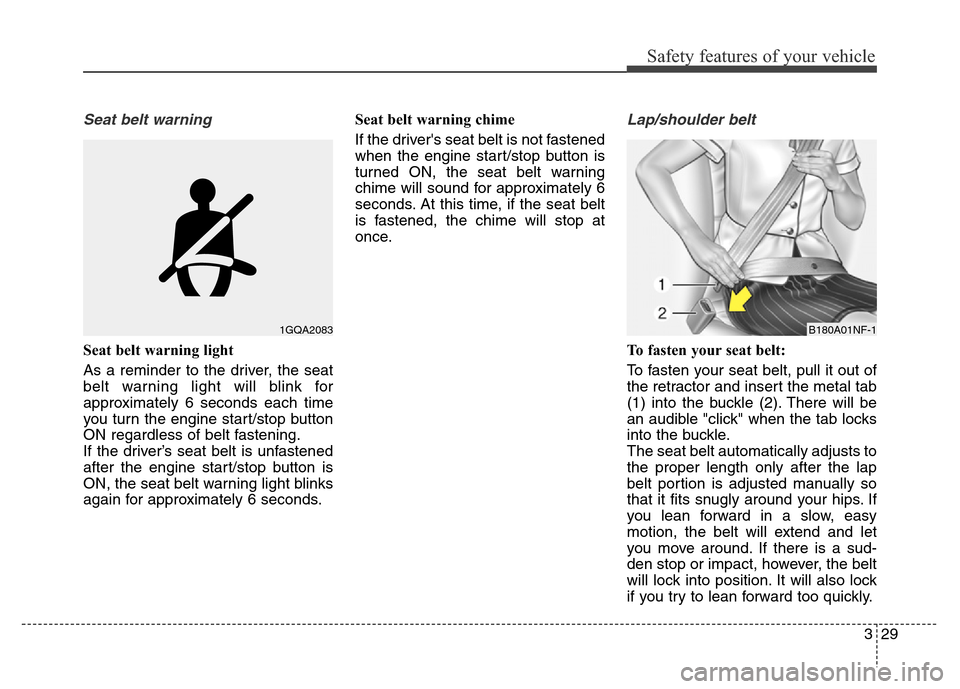
To fasten your seat belt:
To fasten your seat belt, pull it out of
the retractor and insert the metal tab
(1) into the buckle (2). There will be
an audible "click" when the tab locks
into the buckle.
The seat belt automatically adjusts to
the proper length only after the lap
belt portion is adjusted manually so
that it fits snugly around your hips. If
you lean forward in a slow, easy
motion, the belt will extend and let
you move around. If there is a sud-
den stop or impact, however, the belt
will lock into position. It will also lock
if you try to lean forward too quickly.
1GQA2083B180A01NF-1
Page 52 of 479
333
Safety features of your vehicle
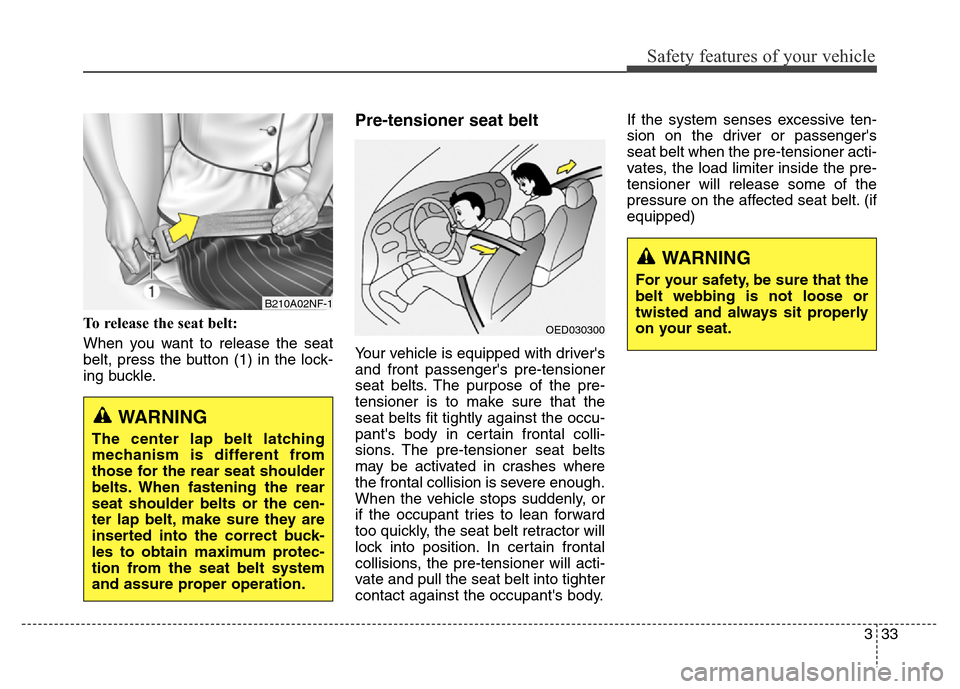
To release the seat belt:
When you want to release the seat
belt, press the button (1) in the lock-
ing buckle.
Pre-tensioner seat belt
Your vehicle is equipped with driver's
and front passenger's pre-tensioner
seat belts. The purpose of the pre-
tensioner is to make sure that the
seat belts fit tightly against the occu-
pant's body in certain frontal colli-
sions. The pre-tensioner seat belts
may be activated in crashes where
the frontal collision is severe enough.
When the vehicle stops suddenly, or
if the occupant tries to lean forward
too quickly, the seat belt retractor will
lock into position. In certain frontal
collisions, the pre-tensioner will acti-
vate and pull the seat belt into tighter
contact against the occupant's body.If the system senses excessive ten-
sion on the driver or passenger's
seat belt when the pre-tensioner acti-
vates, the load limiter inside the pre-
tensioner will release some of the
pressure on the affected seat belt. (if
equipped)
B210A02NF-1
WARNING
The center lap belt latching
mechanism is different from
those for the rear seat shoulder
belts. When fastening the rear
seat shoulder belts or the cen-
ter lap belt, make sure they are
inserted into the correct buck-
les to obtain maximum protec-
tion from the seat belt system
and assure proper operation.
OED030300
WARNING
For your safety, be sure that the
belt webbing is not loose or
twisted and always sit properly
on your seat.
Page 53 of 479
Safety features of your vehicle
34 3
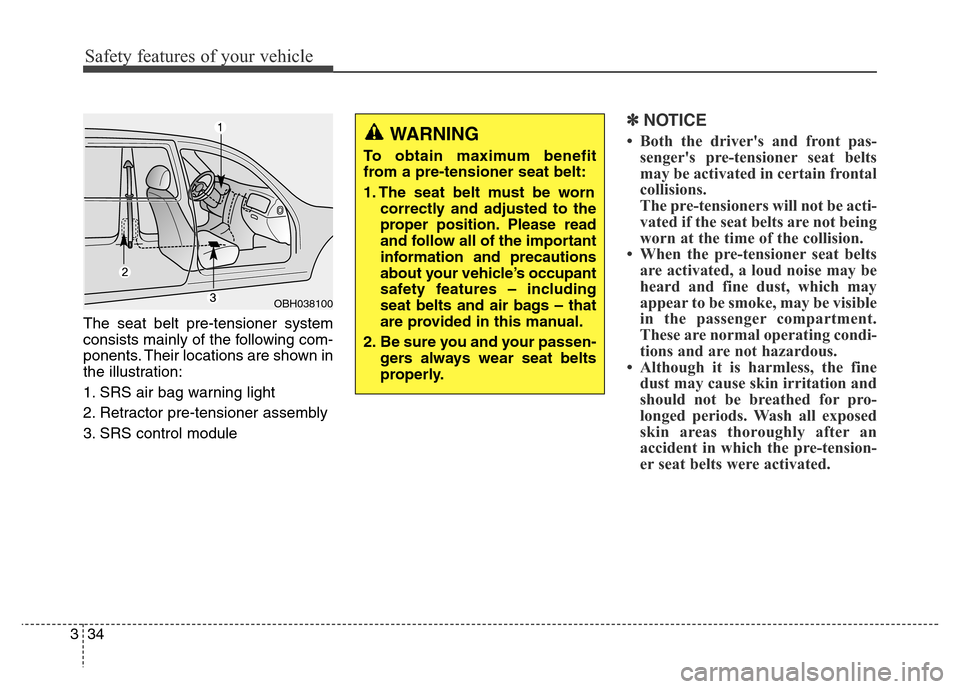
The seat belt pre-tensioner system
consists mainly of the following com-
ponents. Their locations are shown in
the illustration:
1. SRS air bag warning light
2. Retractor pre-tensioner assembly
3. SRS control module
✽NOTICE
• Both the driver's and front pas-
senger's pre-tensioner seat belts
may be activated in certain frontal
collisions.
The pre-tensioners will not be acti-
vated if the seat belts are not being
worn at the time of the collision.
• When the pre-tensioner seat belts
are activated, a loud noise may be
heard and fine dust, which may
appear to be smoke, may be visible
in the passenger compartment.
These are normal operating condi-
tions and are not hazardous.
• Although it is harmless, the fine
dust may cause skin irritation and
should not be breathed for pro-
longed periods. Wash all exposed
skin areas thoroughly after an
accident in which the pre-tension-
er seat belts were activated.
OBH038100
WARNING
To obtain maximum benefit
from a pre-tensioner seat belt:
1. The seat belt must be worn
correctly and adjusted to the
proper position. Please read
and follow all of the important
information and precautions
about your vehicle’s occupant
safety features – including
seat belts and air bags – that
are provided in this manual.
2. Be sure you and your passen-
gers always wear seat belts
properly.
Page 58 of 479
339
Safety features of your vehicle
Do not lie down
To reduce the chance of injuries in
the event of an accident and to
achieve maximum effectiveness of
the restraint system, all passengers
should be sitting up and the front and
rear seats should be in an upright
position when the car is moving. A
seat belt cannot provide proper pro-
tection if the person is lying down in
the rear seat or if the front and rear
seats are in a reclined position.
Care of seat belts
Seat belt systems should never be
disassembled or modified. In addi-
tion, care should be taken to assure
that seat belts and belt hardware are
not damaged by seat hinges, doors
or other abuse.
Periodic inspection
All seat belts should be inspected
periodically for wear or damage of
any kind. Any damaged parts should
be replaced as soon as possible.
Keep belts clean and dry
Seat belts should be kept clean and
dry. If belts become dirty, they can be
cleaned by using a mild soap solu-
tion and warm water. Bleach, dye,
strong detergents or abrasives
should not be used because they
may damage and weaken the fabric.
When to replace seat belts
Entire in-use seat belt assembly or
assemblies should be replaced if the
vehicle has been involved in an acci-
dent. This should be done even if no
damage is visible. We recommend
that you consult an authorized
HYUNDAI dealer.
WARNING
Riding with a reclined seatback
increases your chance of seri-
ous or fatal injuries in the event
of a collision or sudden stop.
The protection of your restraint
system (seat belts and air bags)
is greatly reduced by reclining
your seat. Seat belts must be
snug against your hips and
chest to work properly.
(Continued)
(Continued)
The more the seatback is
reclined, the greater the chance
that an occupant's hips will
slide under the lap belt causing
serious internal injuries or the
occupant's neck could strike
the shoulder belt. Drivers and
passengers should always sit
well back in their seats, proper-
ly belted, and with the seat-
backs upright.
Page 61 of 479
Safety features of your vehicle
42 3
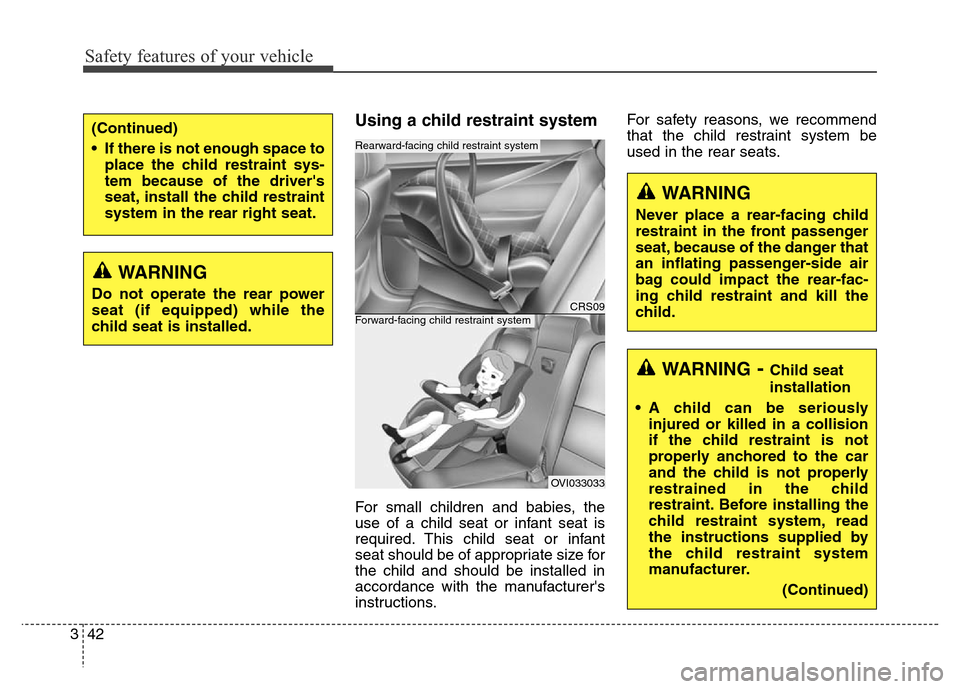
Using a child restraint system
For small children and babies, the
use of a child seat or infant seat is
required. This child seat or infant
seat should be of appropriate size for
the child and should be installed in
accordance with the manufacturer's
instructions.For safety reasons, we recommend
that the child restraint system be
used in the rear seats.
CRS09
OVI033033
Forward-facing child restraint system
Rearward-facing child restraint system
WARNING
Do not operate the rear power
seat (if equipped) while the
child seat is installed.
WARNING
Never place a rear-facing child
restraint in the front passenger
seat, because of the danger that
an inflating passenger-side air
bag could impact the rear-fac-
ing child restraint and kill the
child.
(Continued)
• If there is not enough space to
place the child restraint sys-
tem because of the driver's
seat, install the child restraint
system in the rear right seat.
WARNING- Child seat
installation
• A child can be seriously
injured or killed in a collision
if the child restraint is not
properly anchored to the car
and the child is not properly
restrained in the child
restraint. Before installing the
child restraint system, read
the instructions supplied by
the child restraint system
manufacturer.
(Continued)
Page 68 of 479
349
Safety features of your vehicle
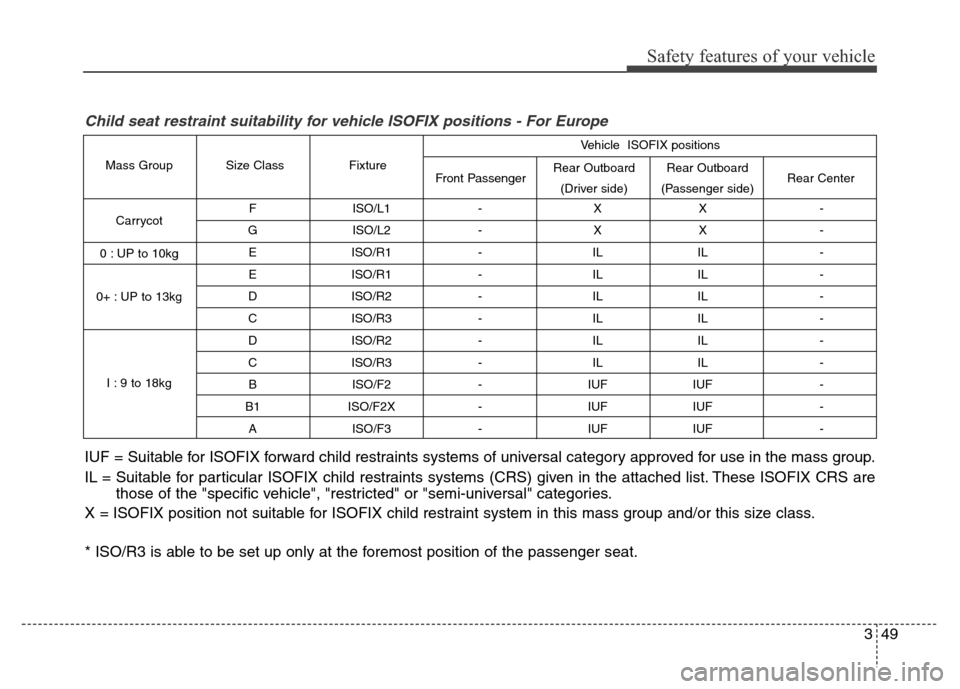
F ISO/L1 - X X -
G ISO/L2 - X X -
E ISO/R1 - IL IL -
E ISO/R1 - IL IL -
D ISO/R2 - IL IL -
C ISO/R3 - IL IL -
D ISO/R2 - IL IL -
C ISO/R3 - IL IL -
B ISO/F2 - IUF IUF -
B1 ISO/F2X - IUF IUF -
A ISO/F3 - IUF IUF -
Rear Outboard
(Passenger side) Rear Outboard
(Driver side) Front Passenger Fixture Size Class Mass Group
Carrycot
0 : UP to 10kg
0+ : UP to 13kg
I : 9 to 18kgRear Center Vehicle ISOFIX positions
IUF = Suitable for ISOFIX forward child restraints systems of universal category approved for use in the mass group.
IL = Suitable for particular ISOFIX child restraints systems (CRS) given in the attached list. These ISOFIX CRS are
those of the "specific vehicle", "restricted" or "semi-universal" categories.
X = ISOFIX position not suitable for ISOFIX child restraint system in this mass group and/or this size class.
* ISO/R3 is able to be set up only at the foremost position of the passenger seat.
Child seat restraint suitability for vehicle ISOFIX positions - For Europe
Page 70 of 479
351
Safety features of your vehicle
How does the air bag system
operate
• Air bags are activated (able to
inflate if necessary) only when the
engine start/stop button is turned
to the ON or START position.
• Air bags inflate instantly in the
event of a serious frontal collision
or side collision in order to help
protect the occupants from serious
physical injury.
• There is no single speed at which
the air bags will inflate.
Generally, air bags are designed to
inflate based upon the severity of a
collision and its direction. These
two factors determine whether the
sensors produce an electronic
deployment/ inflation signal.
• Air bag deployment depends on a
number of factors including vehicle
speed, angles of impact and the
density and stiffness of the vehi-
cles or objects which your vehicle
hits in the collision. The determin-
ing factors are not limited to those
mentioned above.• The front air bags will completely
inflate and deflate in an instant.
It is virtually impossible for you to
see the air bags inflate during an
accident.
It is much more likely that you will
simply see the deflated air bags
hanging out of their storage com-
partments after the collision.
• In order to help provide protection
in a severe collision, the air bags
must inflate rapidly. The speed of
air bag inflation is a consequence
of the extremely short time in which
a collision occurs and the need to
inflate the air bag between the
occupant and the vehicle structures
before the occupant impacts those
structures. This speed of inflation
reduces the risk of serious or life-
threatening injuries in a severe col-
lision and is thus a necessary part
of air bag design.
However, air bag inflation can also
cause injuries which can include
facial abrasions, bruises and bro-
ken bones because the inflation
speed also causes the air bags to
expand with a great deal of force.• There are even circumstances
under which contact with the
steering wheel air bag can cause
fatal injuries, especially if the
occupant is positioned exces-
sively close to the steering wheel.
WARNING
• To avoid severe personal
injury or death caused by
deploying air bags in a colli-
sion, the driver should sit as
far back from the steering
wheel air bag as possible (at
least 250 mm (10 inches)
away). The front passengers
should always move their
seats as far back as possible
and sit back in their seat.
• Air bags inflate instantly in the
event of collision, and passen-
gers may be injured by the air
bag expansion force if they are
not in a proper position.
• Air bag inflation may cause
injuries including facial or
bodily abrasions, injuries
from broken glasses or burns.
Page 73 of 479
Safety features of your vehicle
54 3
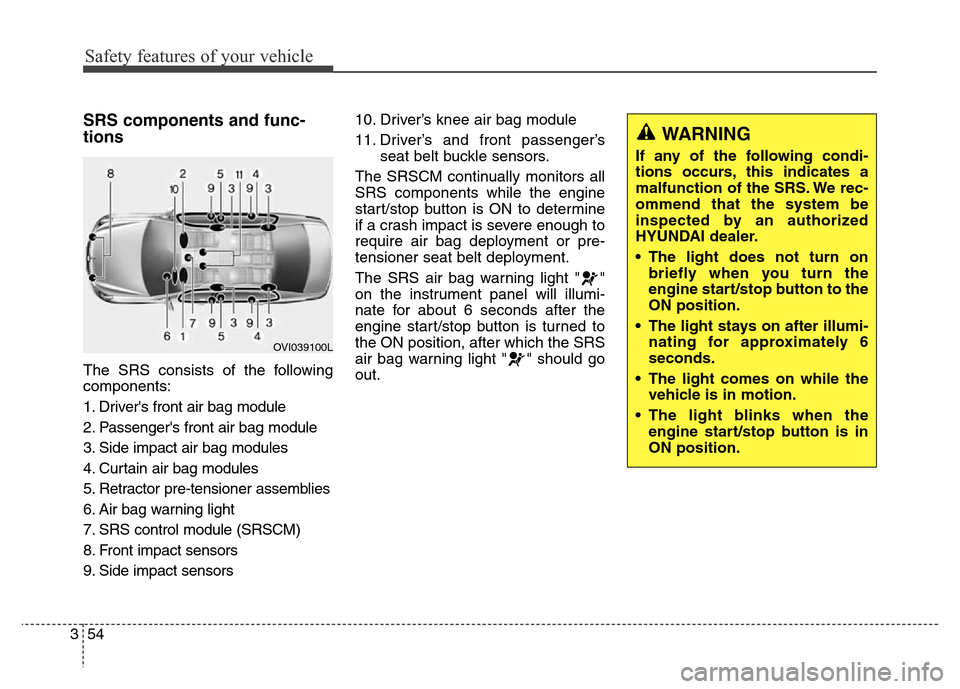
SRS components and func-
tions
The SRS consists of the following
components:
1. Driver's front air bag module
2. Passenger's front air bag module
3. Side impact air bag modules
4. Curtain air bag modules
5. Retractor pre-tensioner assemblies
6. Air bag warning light
7. SRS control module (SRSCM)
8. Front impact sensors
9. Side impact sensors10. Driver’s knee air bag module
11. Driver’s and front passenger’s
seat belt buckle sensors.
The SRSCM continually monitors all
SRS components while the engine
start/stop button is ON to determine
if a crash impact is severe enough to
require air bag deployment or pre-
tensioner seat belt deployment.
The SRS air bag warning light " "
on the instrument panel will illumi-
nate for about 6 seconds after the
engine start/stop button is turned to
the ON position, after which the SRS
air bag warning light " " should go
out.
OVI039100L
WARNING
If any of the following condi-
tions occurs, this indicates a
malfunction of the SRS. We rec-
ommend that the system be
inspected by an authorized
HYUNDAI dealer.
• The light does not turn on
briefly when you turn the
engine start/stop button to the
ON position.
• The light stays on after illumi-
nating for approximately 6
seconds.
• The light comes on while the
vehicle is in motion.
• The light blinks when the
engine start/stop button is in
ON position.