transmission Hyundai Equus 2013 User Guide
[x] Cancel search | Manufacturer: HYUNDAI, Model Year: 2013, Model line: Equus, Model: Hyundai Equus 2013Pages: 479, PDF Size: 10.15 MB
Page 273 of 479
Driving your vehicle
16 5
✽NOTICE
• In manaul mode, the driver must
execute upshifts in accordance
with road conditions, taking care
to keep the engine speed below the
red zone.
• In manaul mode, only the 8 for-
ward gears can be selected. To
reverse or park the vehicle, move
the shift lever to the R (Reverse)
or P (Park) position as required.
• In manaul mode, downshifts are
made automatically when the
vehicle slows down. When the
vehicle stops, 1st gear is automati-
cally selected.
• In manaul mode, when the engine
rpm approaches the red zone shift
points are varied to upshift auto-
matically.
• To maintain the required levels of
vehicle performance and safety,
the system may not execute cer-
tain gearshifts when the shift lever
is operated.
(Continued)(Continued)
• When driving on a slippery road,
push the shift lever forward into
the +(up) position. This causes the
transmission to shift into the 2nd
gear which is better for smooth
driving on a slippery road. Push
the shift lever to the -(down) side
to shift back to the 1st gear.
Shift lock system (if equipped)
For your safety, the automatic trans-
mission has a shift lock system
which prevents shifting the transmis-
sion from P (Park) into R (Reverse)
unless the brake pedal is depressed.
To shift the transmission from P
(Park) into R (Reverse) or D (Drive) :
1. Depress and hold the brake pedal.
2. Start the engine or turn the ignition
switch to the ON position.
3. Move the shift lever to R (Reverse)
or D (Drive) with pressing
[UNLOCK] button.
If the brake pedal is repeatedly
depressed and released with the
shift lever in the P (Park) position, a
chattering noise near the shift lever
may be heard. This is a normal con-
dition.
Page 274 of 479
![Hyundai Equus 2013 User Guide 517
Driving your vehicle
■When the battery is dis-
charged:
When the battery is discharged, the
automatic transmission (shift by wire)
is not shifted.
In emergency, if you want to shift into
[N], fo](/img/35/14642/w960_14642-273.png "Hyundai Equus 2013 User Guide 517
Driving your vehicle
■When the battery is dis-
charged:
When the battery is discharged, the
automatic transmission (shift by wire)
is not shifted.
In emergency, if you want to shift into
[N], fo")
517
Driving your vehicle
■When the battery is dis-
charged:
When the battery is discharged, the
automatic transmission (shift by wire)
is not shifted.
In emergency, if you want to shift into
[N], follow actions;
You can shift into [N] by using the
driver if the jump starting is impossi-
ble to do.
Insert the screwdriver (-) to service
hole (1) as direction of clockwise 10
times. The shifting is changed to [N]
from [P] position. If you want to shift
to [P] position, turn the driver count-
er-clockwise.
OVI053108E
CAUTION
If the electric parking brake is
not released, we recommend
that the vehicle is towed as flat-
bed towing.
WARNING
Always fully depress the brake
pedal before and while shifting
out of the P (Park) position into
another position to avoid inad-
vertent motion of the vehicle
which could injure persons in
or around the car.
Page 275 of 479
Driving your vehicle
18 5
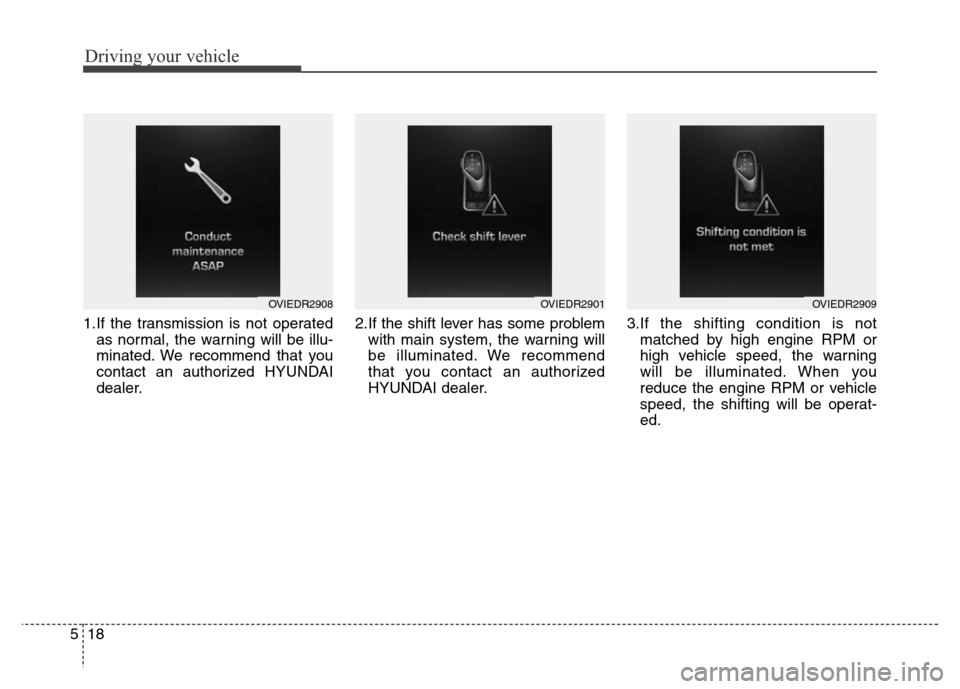
1.If the transmission is not operated
as normal, the warning will be illu-
minated. We recommend that you
contact an authorized HYUNDAI
dealer.2.If the shift lever has some problem
with main system, the warning will
be illuminated. We recommend
that you contact an authorized
HYUNDAI dealer.3.If the shifting condition is not
matched by high engine RPM or
high vehicle speed, the warning
will be illuminated. When you
reduce the engine RPM or vehicle
speed, the shifting will be operat-
ed.
OVIEDR2908OVIEDR2901OVIEDR2909
Page 276 of 479
![Hyundai Equus 2013 User Guide 519
Driving your vehicle
4.When you shift the transmission, if
you do not depress the brake
pedal, the warning will be illuminat-
ed.5.When you shift into [P], if the vehi-
cle speed is high, warning](/img/35/14642/w960_14642-275.png "Hyundai Equus 2013 User Guide 519
Driving your vehicle
4.When you shift the transmission, if
you do not depress the brake
pedal, the warning will be illuminat-
ed.5.When you shift into [P], if the vehi-
cle speed is high, warning")
519
Driving your vehicle
4.When you shift the transmission, if
you do not depress the brake
pedal, the warning will be illuminat-
ed.5.When you shift into [P], if the vehi-
cle speed is high, warning will be
illuminated. Stop the vehicle at
safe area and shift into [P].6.When the transmission is fixed on
[M], the warning will be illuminated.
OVIEDR2902OVIEDR2903OVIEDR2904
Page 282 of 479
525
Driving your vehicle
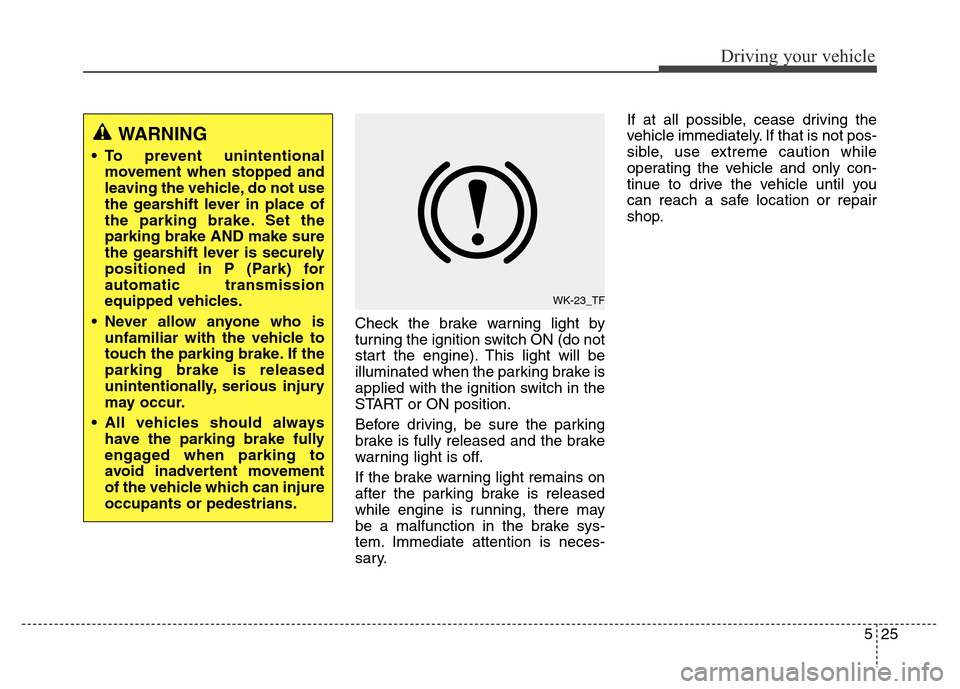
Check the brake warning light by
turning the ignition switch ON (do not
start the engine). This light will be
illuminated when the parking brake is
applied with the ignition switch in the
START or ON position.
Before driving, be sure the parking
brake is fully released and the brake
warning light is off.
If the brake warning light remains on
after the parking brake is released
while engine is running, there may
be a malfunction in the brake sys-
tem. Immediate attention is neces-
sary.If at all possible, cease driving the
vehicle immediately. If that is not pos-
sible, use extreme caution while
operating the vehicle and only con-
tinue to drive the vehicle until you
can reach a safe location or repair
shop.
WARNING
• To prevent unintentional
movement when stopped and
leaving the vehicle, do not use
the gearshift lever in place of
the parking brake. Set the
parking brake AND make sure
the gearshift lever is securely
positioned in P (Park) for
automatic transmission
equipped vehicles.
• Never allow anyone who is
unfamiliar with the vehicle to
touch the parking brake. If the
parking brake is released
unintentionally, serious injury
may occur.
• All vehicles should always
have the parking brake fully
engaged when parking to
avoid inadvertent movement
of the vehicle which can injure
occupants or pedestrians.
WK-23_TF
Page 299 of 479
Driving your vehicle
42 5
Good braking practices• Check to be sure the parking brake
is not engaged and that the park-
ing brake indicator light is out
before driving away.
• Driving through water may get the
brakes wet. They can also get wet
when the vehicle is washed. Wet
brakes can be dangerous! Your car
will not stop as quickly if the brakes
are wet. Wet brakes may cause the
vehicle to pull to one side.
To dry the brakes, apply the brakes
lightly until the braking action
returns to normal, taking care to
keep the car under control at all
times. If the braking action does
not return to normal, stop as soon
as it is safe to do so and call an
authorized HYUNDAI dealer for
assistance.CAUTION
The Emergency Stop Signal
(ESS) system will not work if the
hazard warning flasher is
already on.WARNING
• Whenever leaving vehicle or
parking, always set the park-
ing brake and fully engage the
vehicle's transmission into
the P (Park) position. Vehicles
not fully engaged in park with
the parking brake set are at
risk for moving inadvertently
and injuring yourself or oth-
ers.
• All vehicles should always
have the parking brake fully
engaged when parking to
avoid inadvertent movement
of the vehicle which can injure
occupants or pedestrians.
Page 300 of 479
543
Driving your vehicle
• Don't coast down hills with the
vehicle out of gear. This is extreme-
ly hazardous. Keep the car in gear
at all times, use the brakes to slow
down, then shift to a lower gear so
that engine braking will help you
maintain a safe speed.
• Don't "ride" the brake pedal.
Resting your foot on the brake
pedal while driving can be danger-
ous because it can result in the
brakes overheating and losing their
effectiveness. It also increases the
wear of the brake components.
• If a tire goes flat while you are driv-
ing, apply the brakes gently and
keep the car pointed straight
ahead while you slow down. When
you are moving slowly enough for it
to be safe to do so, pull off the road
and stop in a safe place.• If your vehicle is equipped with an
automatic transmission, don't let
your car creep forward. To avoid
creeping forward, keep your foot
firmly on the brake pedal when the
car is stopped.
• Be caution when parking on a hill.
Firmly engage the parking brake
and place the shift lever in P. If your
vehicle is facing downhill, turn the
front wheels into the curb to help
keep the vehicle from rolling. If
your vehicle is facing uphill, turn
the front wheels away from the
curb to help keep the vehicle from
rolling. If there is no curb or if it is
required by other conditions to
keep the vehicle from rolling, block
the wheels.• Under some conditions your park-
ing brake can freeze in the
engaged position. This is most like-
ly to happen when there is an
accumulation of snow or ice
around or near the rear brakes or if
the brakes are wet. If there is a risk
that the parking brake may freeze,
apply it only temporarily while you
put the shift lever in P and block
the rear wheels so the car cannot
roll. Then release the parking
brake.
• Do not hold the vehicle on the
upgrade with the accelerator
pedal. This can cause the trans-
mission to overheat. Always use
the brake pedal or parking brake.
Page 343 of 479
Driving your vehicle
86 5
Hazardous driving conditions
When hazardous driving conditions
are encountered such as water,
snow, ice, mud, sand, or similar haz-
ards, follow these suggestions:
• Drive cautiously and allow extra
distance for braking.
• Avoid sudden movements in brak-
ing or steering.• If stalled in snow, mud, or sand,
use second gear. Accelerate slow-
ly to avoid spinning the drive
wheels.
• Use sand, rock salt, tire chains, or
other non-slip material under the
drive wheels to provide traction
when stalled in ice, snow, or mud.
Rocking the vehicle
If it is necessary to rock the vehicle
to free it from snow, sand, or mud,
first turn the steering wheel right and
left to clear the area around your
drive wheels. Then, shift back and
forth between R (Reverse) and any
forward gear in vehicles equipped
with an automatic transmission. Do
not race the engine, and spin the
wheels as little as possible. If you are
still stuck after a few tries, have the
vehicle pulled out by a tow vehicle to
avoid engine overheating and possi-
ble damage to the transmission.
SPECIAL DRIVING CONDITIONS
OVI053043
WARNING- ABS
Do not pump the brake pedal on
a vehicle equipped with ABS.
WARNING
- Downshifting
Downshifting with an automatic
transmission, while driving on
slippery surfaces can cause an
accident. The sudden change in
tire speed could cause the tires
to skid. Be careful when down-
shifting on slippery surfaces.
CAUTION
Prolonged rocking may cause
engine over-heating, transmis-
sion damage or failure, and tire
damage.
Page 362 of 479
67
What to do in an emergency
5.Start the engine of the vehicle with
the booster battery and let it run at
2,000 rpm, then start the engine of
the vehicle with the discharged
battery.
If the cause of your battery discharg-
ing is not apparent, we recommend
that you have your vehicle checked
by an authorized HYUNDAI dealer.
Push-starting
Vehicles equipped with automatic
transmission cannot be push-start-
ed.
Follow the directions in this section
for jump-starting.CAUTION - Battery
cables
If you jump start the discharged
battery in the trunk compart-
ment, do not connect the
jumper cable from the negative
terminal of the booster battery
to the negative terminal of the
discharged battery. This can
cause the discharged battery to
overheat and crack, releasing
battery acid.
Connect the jumper cable from
the negative terminal of the
booster battery to a solid, sta-
tionary or metallic point away
from the discharged battery.
Page 377 of 479
What to do in an emergency
22 6
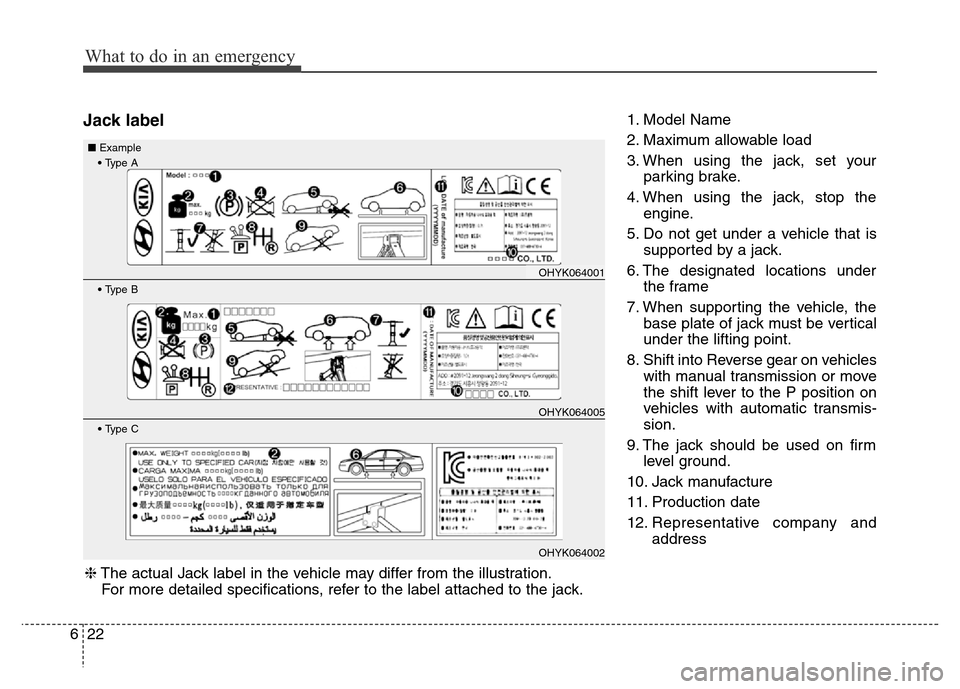
Jack label1. Model Name
2. Maximum allowable load
3. When using the jack, set your
parking brake.
4. When using the jack, stop the
engine.
5. Do not get under a vehicle that is
supported by a jack.
6. The designated locations under
the frame
7. When supporting the vehicle, the
base plate of jack must be vertical
under the lifting point.
8. Shift into Reverse gear on vehicles
with manual transmission or move
the shift lever to the P position on
vehicles with automatic transmis-
sion.
9. The jack should be used on firm
level ground.
10. Jack manufacture
11. Production date
12. Representative company and
address
❈The actual Jack label in the vehicle may differ from the illustration.
For more detailed specifications, refer to the label attached to the jack.
• Type A ■Example
• Type B
• Type C
OHYK064001
OHYK064005
OHYK064002