stop start Hyundai Equus 2014 Owner's Manual
[x] Cancel search | Manufacturer: HYUNDAI, Model Year: 2014, Model line: Equus, Model: Hyundai Equus 2014Pages: 479, PDF Size: 10.15 MB
Page 364 of 479
69
What to do in an emergency
TIRE PRESSURE MONITORING SYSTEM (TPMS) (IF EQUIPPED)
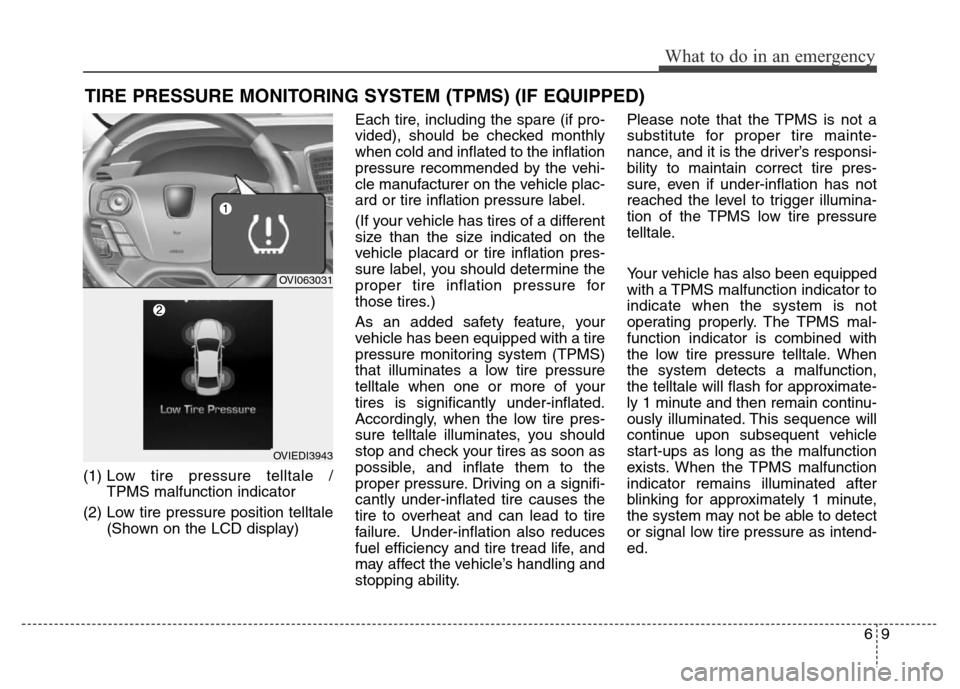
(1) Low tire pressure telltale /
TPMS malfunction indicator
(2) Low tire pressure position telltale
(Shown on the LCD display)Each tire, including the spare (if pro-
vided), should be checked monthly
when cold and inflated to the inflation
pressure recommended by the vehi-
cle manufacturer on the vehicle plac-
ard or tire inflation pressure label.
(If your vehicle has tires of a different
size than the size indicated on the
vehicle placard or tire inflation pres-
sure label, you should determine the
proper tire inflation pressure for
those tires.)
As an added safety feature, your
vehicle has been equipped with a tire
pressure monitoring system (TPMS)
that illuminates a low tire pressure
telltale when one or more of your
tires is significantly under-inflated.
Accordingly, when the low tire pres-
sure telltale illuminates, you should
stop and check your tires as soon as
possible, and inflate them to the
proper pressure. Driving on a signifi-
cantly under-inflated tire causes the
tire to overheat and can lead to tire
failure. Under-inflation also reduces
fuel efficiency and tire tread life, and
may affect the vehicle’s handling and
stopping ability.Please note that the TPMS is not a
substitute for proper tire mainte-
nance, and it is the driver’s responsi-
bility to maintain correct tire pres-
sure, even if under-inflation has not
reached the level to trigger illumina-
tion of the TPMS low tire pressure
telltale.
Your vehicle has also been equipped
with a TPMS malfunction indicator to
indicate when the system is not
operating properly. The TPMS mal-
function indicator is combined with
the low tire pressure telltale. When
the system detects a malfunction,
the telltale will flash for approximate-
ly 1 minute and then remain continu-
ously illuminated. This sequence will
continue upon subsequent vehicle
start-ups as long as the malfunction
exists. When the TPMS malfunction
indicator remains illuminated after
blinking for approximately 1 minute,
the system may not be able to detect
or signal low tire pressure as intend-
ed.
OVI063031
OVIEDI3943
Page 380 of 479
625
What to do in an emergency
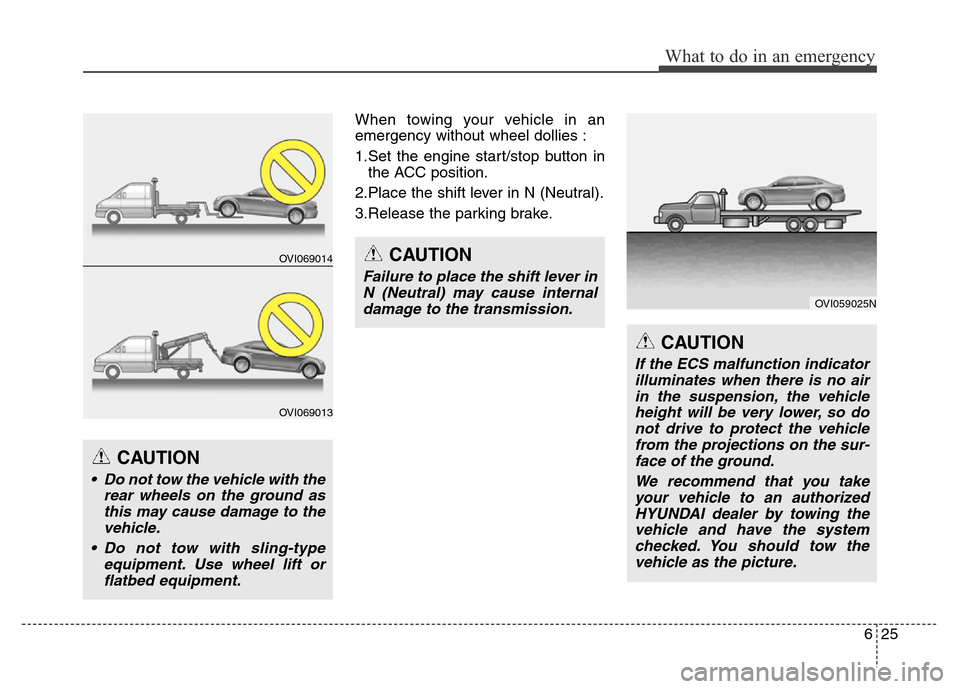
When towing your vehicle in an
emergency without wheel dollies :
1.Set the engine start/stop button in
the ACC position.
2.Place the shift lever in N (Neutral).
3.Release the parking brake.
OVI069014
OVI069013
CAUTION
• Do not tow the vehicle with the
rear wheels on the ground as
this may cause damage to the
vehicle.
• Do not tow with sling-type
equipment. Use wheel lift or
flatbed equipment.
CAUTION
Failure to place the shift lever in
N (Neutral) may cause internal
damage to the transmission.
CAUTION
If the ECS malfunction indicator
illuminates when there is no air
in the suspension, the vehicle
height will be very lower, so do
not drive to protect the vehicle
from the projections on the sur-
face of the ground.
We recommend that you take
your vehicle to an authorized
HYUNDAI dealer by towing the
vehicle and have the system
checked. You should tow the
vehicle as the picture.
OVI059025N
Page 383 of 479
What to do in an emergency
28 6
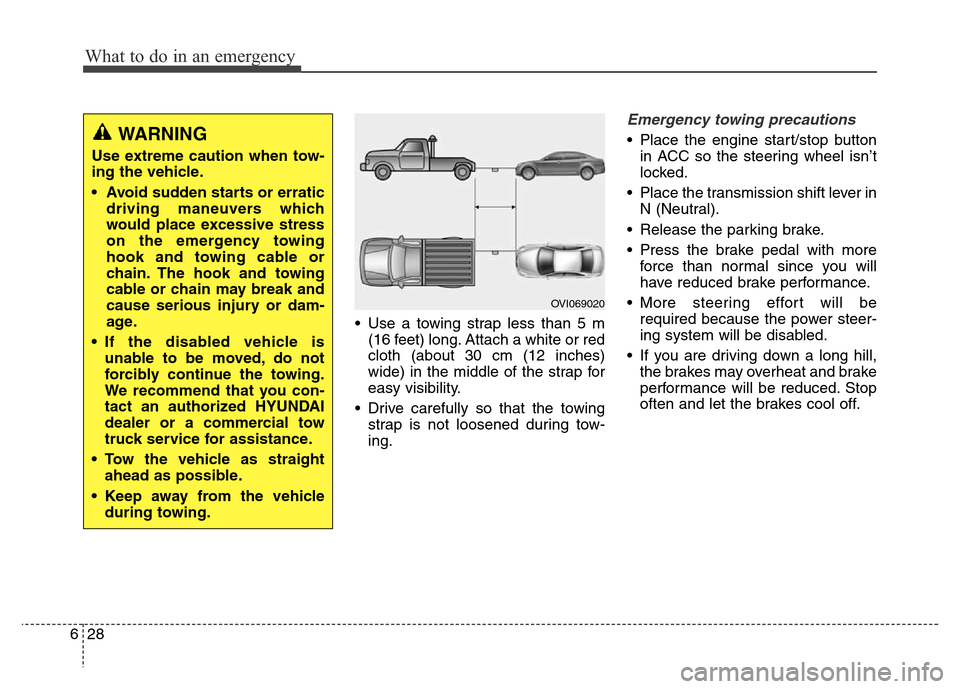
• Use a towing strap less than 5 m
(16 feet) long. Attach a white or red
cloth (about 30 cm (12 inches)
wide) in the middle of the strap for
easy visibility.
• Drive carefully so that the towing
strap is not loosened during tow-
ing.
Emergency towing precautions
• Place the engine start/stop button
in ACC so the steering wheel isn’t
locked.
• Place the transmission shift lever in
N (Neutral).
• Release the parking brake.
• Press the brake pedal with more
force than normal since you will
have reduced brake performance.
• More steering effort will be
required because the power steer-
ing system will be disabled.
• If you are driving down a long hill,
the brakes may overheat and brake
performance will be reduced. Stop
often and let the brakes cool off.WARNING
Use extreme caution when tow-
ing the vehicle.
• Avoid sudden starts or erratic
driving maneuvers which
would place excessive stress
on the emergency towing
hook and towing cable or
chain. The hook and towing
cable or chain may break and
cause serious injury or dam-
age.
• If the disabled vehicle is
unable to be moved, do not
forcibly continue the towing.
We recommend that you con-
tact an authorized HYUNDAI
dealer or a commercial tow
truck service for assistance.
• Tow the vehicle as straight
ahead as possible.
• Keep away from the vehicle
during towing.
OVI069020
Page 401 of 479
Maintenance
16 7
EXPLANATION OF SCHEDULED MAINTENANCE ITEMS
Engine oil and filter
The engine oil and filter should be
changed at the intervals specified in
the maintenance schedule. If the car
is being driven in severe conditions,
more frequent oil and filter changes
are required.
Drive belts
Inspect all drive belts for evidence of
cuts, cracks, excessive wear or oil
saturation and replace if necessary.
Fuel filter
A clogged filter can limit the speed at
which the vehicle may be driven,
damage the emission system and
cause multiple issues such as hard
starting. If an excessive amount of
foreign matter accumulates in the
fuel tank, the filter may require
replacement more frequently.
After installing a new filter, run the
engine for several minutes, and
check for leaks at the connections.
We recommend that the fuel filter be
replaced by an authorized HYUNDAI
dealer.
Fuel lines, fuel hoses and con-
nections
Check the fuel lines, fuel hoses and
connections for leakage and dam-
age. We recommend that the fuel
lines, fuel hoses and connections be
replaced by an authorized HYUNDAI
dealer.
Vapor hose and fuel filler cap
The vapor hose and fuel filler cap
should be inspected at those intervals
specified in the maintenance sched-
ule. Make sure that a new vapor hose
or fuel filler cap is correctly replaced.
Vacuum crankcase ventilation
hoses (if equipped)
Inspect the surface of hoses for evi-
dence of heat and/or mechanical
damage. Hard and brittle rubber,
cracking, tears, cuts, abrasions, and
excessive swelling indicate deterio-
ration. Particular attention should be
paid to examine those hose surfaces
nearest to high heat sources, such
as the exhaust manifold.
Inspect the hose routing to assure
that the hoses do not come in con-
tact with any heat source, sharp
edges or moving component which
might cause heat damage or
mechanical wear. Inspect all hose
connections, such as clamps and
couplings, to make sure they are
secure, and that no leaks are pres-
ent. Hoses should be replaced
immediately if there is any evidence
of deterioration or damage.
CAUTION
When you are inspecting the
belt, press the engine start/stop
button to the OFF or ACC posi-
tion.
Page 417 of 479
Maintenance
32 7
Front windshield wiper blade
For your convenience, move the
windshield wiper blades to the serv-
ice position as follows;
Turn the engine start/stop button off.
Move the wiper switch to the single
wiping (MIST/ ) position within 20
seconds and hold the switch until the
wiper blade is in the fully up position.
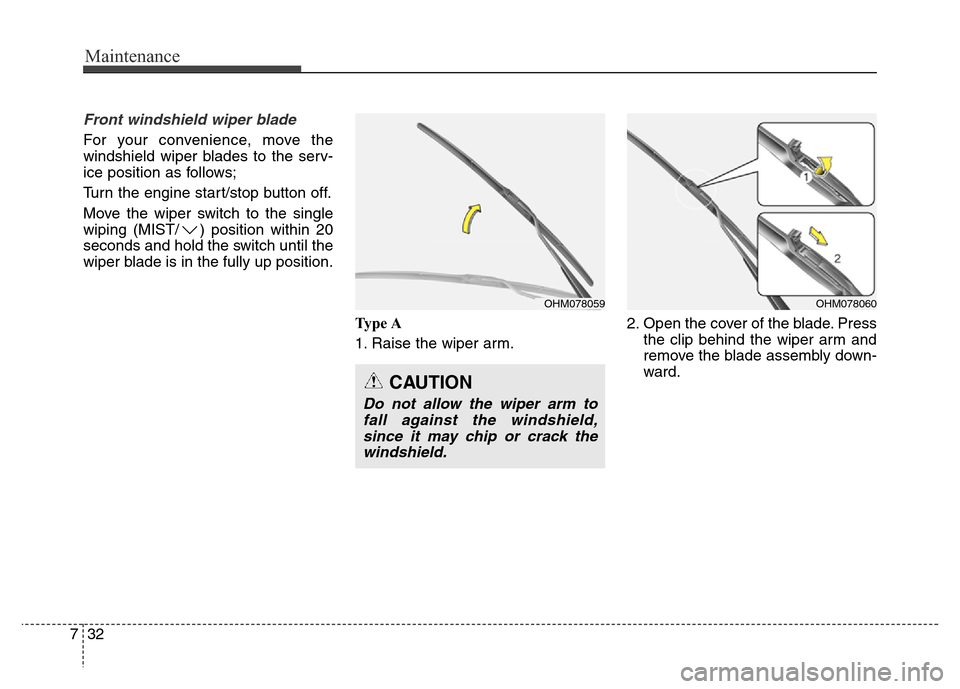
Ty p e A
1. Raise the wiper arm.2. Open the cover of the blade. Press
the clip behind the wiper arm and
remove the blade assembly down-
ward.
OHM078059
CAUTION
Do not allow the wiper arm to
fall against the windshield,
since it may chip or crack the
windshield.
OHM078060
Page 435 of 479
Maintenance
50 7
Instrument panel fuse replace-
ment
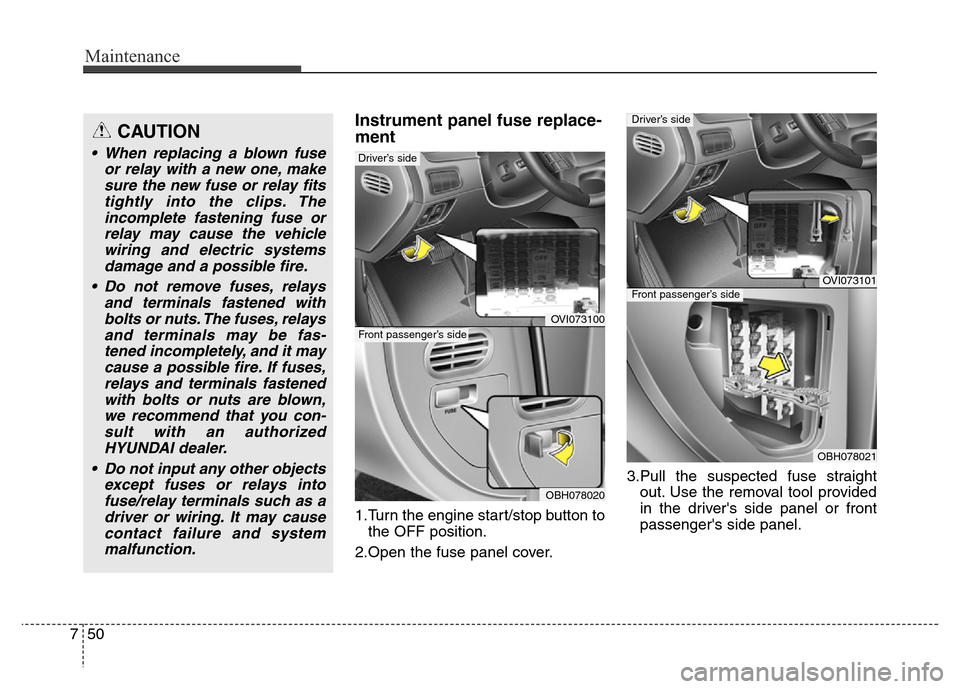
1.Turn the engine start/stop button to
the OFF position.
2.Open the fuse panel cover.3.Pull the suspected fuse straight
out. Use the removal tool provided
in the driver's side panel or front
passenger's side panel.
OVI073100
OBH078020
Front passenger’s side
Driver’s side
CAUTION
• When replacing a blown fuse
or relay with a new one, make
sure the new fuse or relay fits
tightly into the clips. The
incomplete fastening fuse or
relay may cause the vehicle
wiring and electric systems
damage and a possible fire.
• Do not remove fuses, relays
and terminals fastened with
bolts or nuts. The fuses, relays
and terminals may be fas-
tened incompletely, and it may
cause a possible fire. If fuses,
relays and terminals fastened
with bolts or nuts are blown,
we recommend that you con-
sult with an authorized
HYUNDAI dealer.
• Do not input any other objects
except fuses or relays into
fuse/relay terminals such as a
driver or wiring. It may cause
contact failure and system
malfunction.
OVI073101
OBH078021
Driver’s side
Front passenger’s side
Page 437 of 479
Maintenance
52 7
Engine compartment fuse
replacement
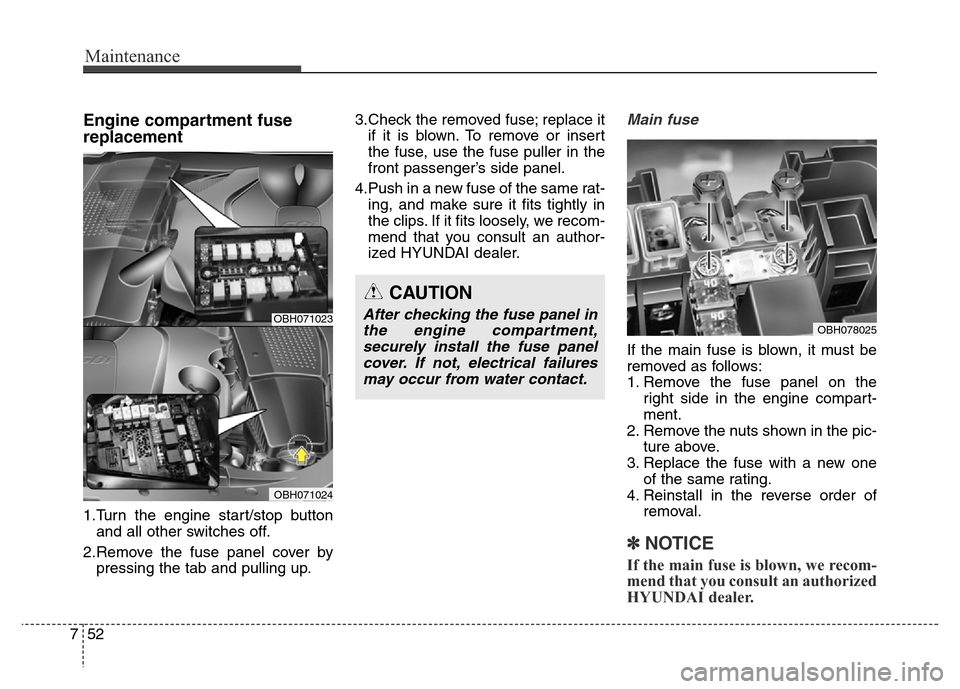
1.Turn the engine start/stop button
and all other switches off.
2.Remove the fuse panel cover by
pressing the tab and pulling up.3.Check the removed fuse; replace it
if it is blown. To remove or insert
the fuse, use the fuse puller in the
front passenger’s side panel.
4.Push in a new fuse of the same rat-
ing, and make sure it fits tightly in
the clips. If it fits loosely, we recom-
mend that you consult an author-
ized HYUNDAI dealer.
Main fuse
If the main fuse is blown, it must be
removed as follows:
1. Remove the fuse panel on the
right side in the engine compart-
ment.
2. Remove the nuts shown in the pic-
ture above.
3. Replace the fuse with a new one
of the same rating.
4. Reinstall in the reverse order of
removal.
✽NOTICE
If the main fuse is blown, we recom-
mend that you consult an authorized
HYUNDAI dealer.
CAUTION
After checking the fuse panel in
the engine compartment,
securely install the fuse panel
cover. If not, electrical failures
may occur from water contact.OBH078025OBH071023
OBH071024
Page 439 of 479
Maintenance
54 7
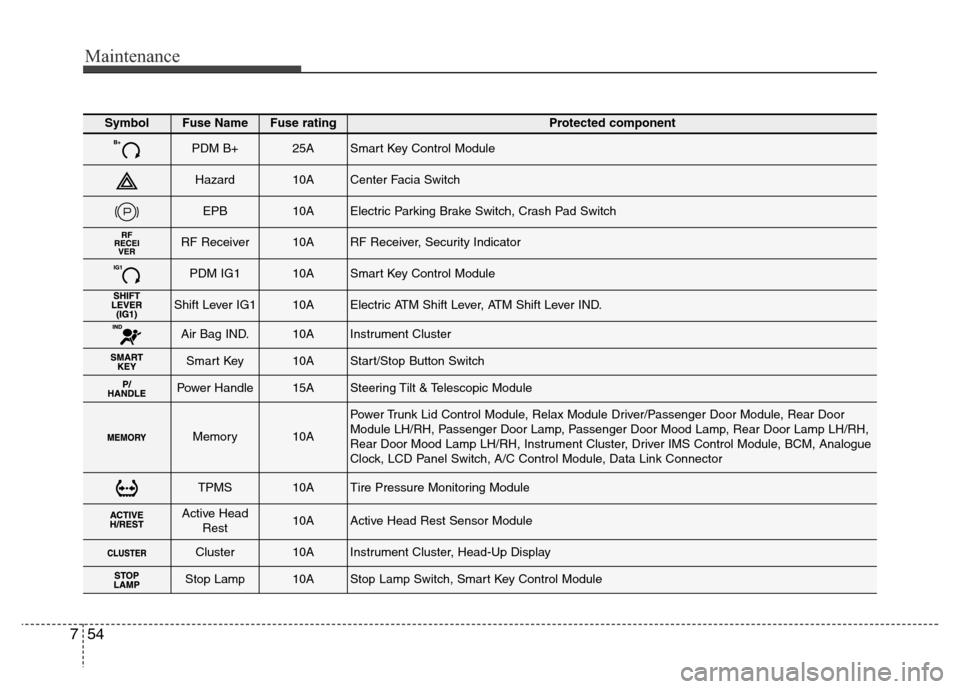
SymbolFuse NameFuse ratingProtected component
PDM B+25ASmart Key Control Module
Hazard10ACenter Facia Switch
EPB10AElectric Parking Brake Switch, Crash Pad Switch
RF Receiver10ARF Receiver, Security Indicator
PDM IG110ASmart Key Control Module
Shift Lever IG110AElectric ATM Shift Lever, ATM Shift Lever IND.
Air Bag IND.10AInstrument Cluster
Smart Key10AStart/Stop Button Switch
Power Handle15ASteering Tilt & Telescopic Module
Memory10A
Power Trunk Lid Control Module, Relax Module Driver/Passenger Door Module, Rear Door
Module LH/RH, Passenger Door Lamp, Passenger Door Mood Lamp, Rear Door Lamp LH/RH,
Rear Door Mood Lamp LH/RH, Instrument Cluster, Driver IMS Control Module, BCM, Analogue
Clock, LCD Panel Switch, A/C Control Module, Data Link Connector
TPMS10ATire Pressure Monitoring Module
Active Head
Rest10AActive Head Rest Sensor Module
Cluster10AInstrument Cluster, Head-Up Display
Stop Lamp10AStop Lamp Switch, Smart Key Control Module
Page 469 of 479
Maintenance
84 7
• Do not operate the engine in con-
fined or closed areas (such as
garages) any more than what is
necessary to move the vehicle in or
out of the area.
• When the vehicle is stopped in an
open area for more than a short
time with the engine running,
adjust the ventilation system (as
needed) to draw outside air into the
vehicle.
• Never sit in a parked or stopped
vehicle for any extended time with
the engine running.
• When the engine stalls or fails to
start, excessive attempts to restart
the engine may cause damage to
the emission control system.Operating precautions for catalyt-
ic converters (if equipped)Your vehicle is equipped with a cat-
alytic converter emission control
device.
Therefore, the following precautions
must be observed:
• Make sure to refuel your vehicle
according to the "Fuel require-
ments" suggested in section 1.
• Do not operate the vehicle when
there are signs of engine malfunc-
tion, such as misfire or a noticeable
loss of performance.
• Do not misuse or abuse the
engine. Examples of misuse are
coasting with the ignition off and
descending steep grades in gear
with the ignition off.
• Do not operate the engine at high
idle speed for extended periods (5
minutes or more).
• Do not modify or tamper with any
part of the engine or emission con-
trol system. All inspections and
adjustments must be made by an
authorized HYUNDAI dealer.
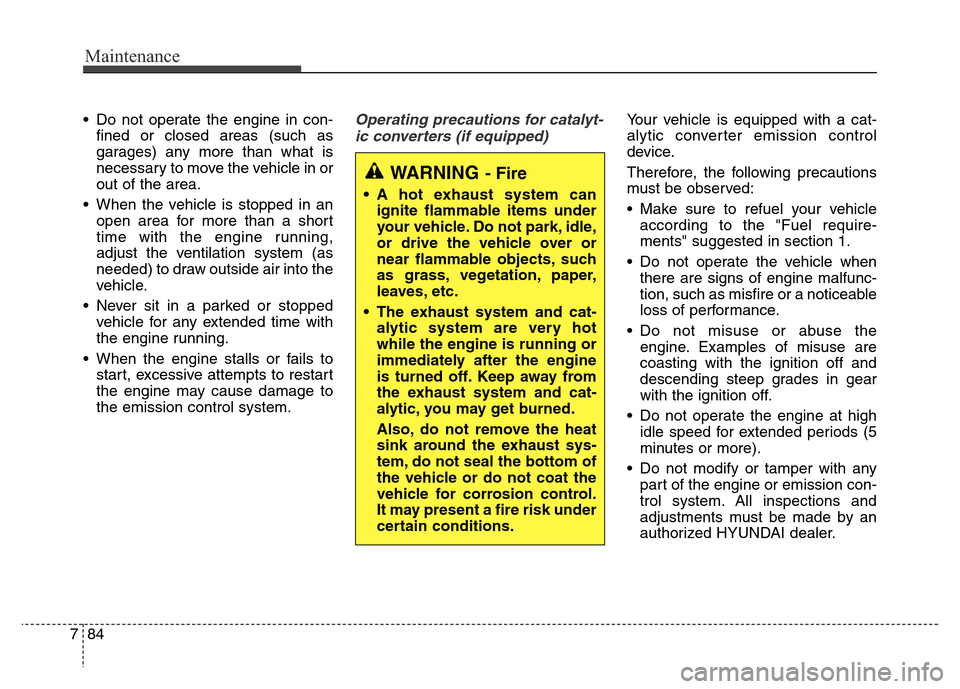
WARNING- Fire
• A hot exhaust system can
ignite flammable items under
your vehicle. Do not park, idle,
or drive the vehicle over or
near flammable objects, such
as grass, vegetation, paper,
leaves, etc.
• The exhaust system and cat-
alytic system are very hot
while the engine is running or
immediately after the engine
is turned off. Keep away from
the exhaust system and cat-
alytic, you may get burned.
Also, do not remove the heat
sink around the exhaust sys-
tem, do not seal the bottom of
the vehicle or do not coat the
vehicle for corrosion control.
It may present a fire risk under
certain conditions.