warning Hyundai Equus 2014 User Guide
[x] Cancel search | Manufacturer: HYUNDAI, Model Year: 2014, Model line: Equus, Model: Hyundai Equus 2014Pages: 479, PDF Size: 10.15 MB
Page 30 of 479
311
Safety features of your vehicle
Climate control system seat
(if equipped)
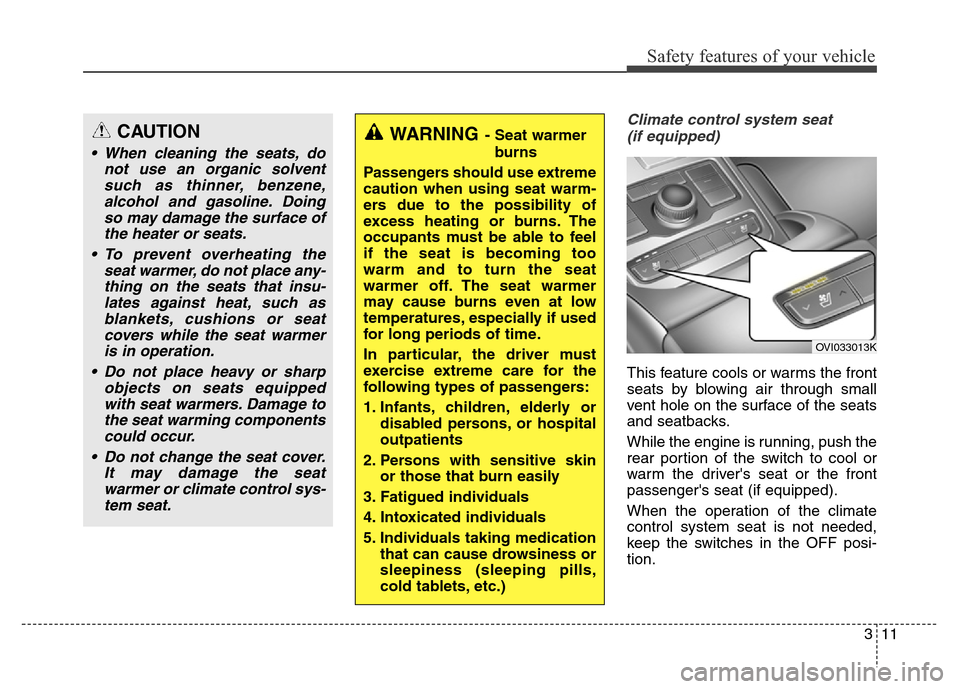
This feature cools or warms the front
seats by blowing air through small
vent hole on the surface of the seats
and seatbacks.
While the engine is running, push the
rear portion of the switch to cool or
warm the driver's seat or the front
passenger's seat (if equipped).
When the operation of the climate
control system seat is not needed,
keep the switches in the OFF posi-
tion.
CAUTION
• When cleaning the seats, do
not use an organic solvent
such as thinner, benzene,
alcohol and gasoline. Doing
so may damage the surface of
the heater or seats.
• To prevent overheating the
seat warmer, do not place any-
thing on the seats that insu-
lates against heat, such as
blankets, cushions or seat
covers while the seat warmer
is in operation.
• Do not place heavy or sharp
objects on seats equipped
with seat warmers. Damage to
the seat warming components
could occur.
• Do not change the seat cover.
It may damage the seat
warmer or climate control sys-
tem seat.
WARNING- Seat warmer
burns
Passengers should use extreme
caution when using seat warm-
ers due to the possibility of
excess heating or burns. The
occupants must be able to feel
if the seat is becoming too
warm and to turn the seat
warmer off. The seat warmer
may cause burns even at low
temperatures, especially if used
for long periods of time.
In particular, the driver must
exercise extreme care for the
following types of passengers:
1. Infants, children, elderly or
disabled persons, or hospital
outpatients
2. Persons with sensitive skin
or those that burn easily
3. Fatigued individuals
4. Intoxicated individuals
5. Individuals taking medication
that can cause drowsiness or
sleepiness (sleeping pills,
cold tablets, etc.)
OVI033013K
Page 32 of 479
313
Safety features of your vehicle
Seatback pocket (if equipped)
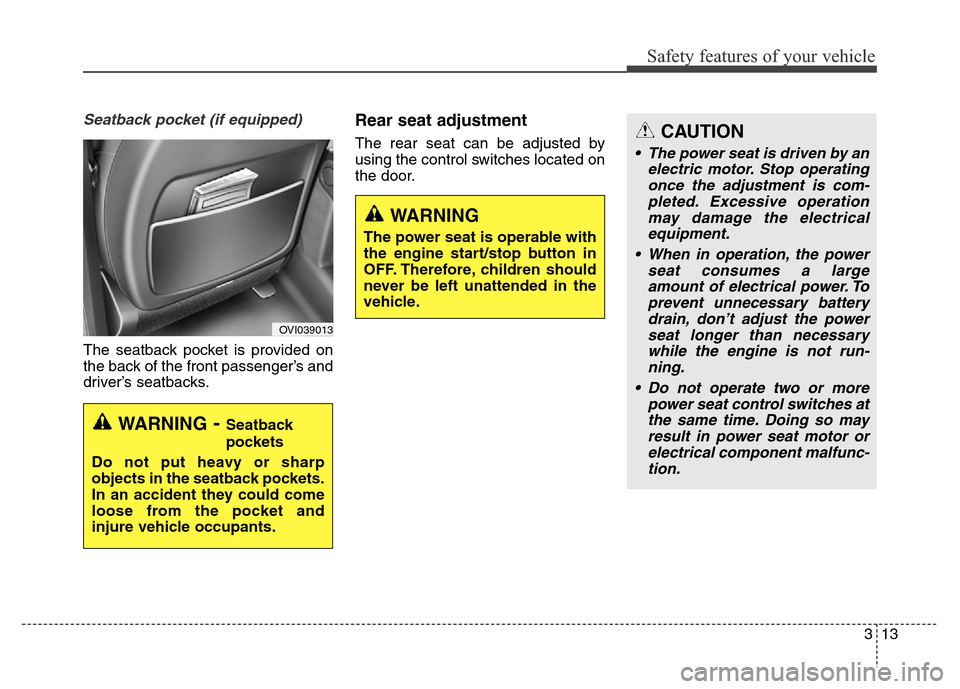
The seatback pocket is provided on
the back of the front passenger’s and
driver’s seatbacks.
Rear seat adjustment
The rear seat can be adjusted by
using the control switches located on
the door.
WARNING- Seatback
pockets
Do not put heavy or sharp
objects in the seatback pockets.
In an accident they could come
loose from the pocket and
injure vehicle occupants.
OVI039013
WARNING
The power seat is operable with
the engine start/stop button in
OFF. Therefore, children should
never be left unattended in the
vehicle.
CAUTION
• The power seat is driven by an
electric motor. Stop operating
once the adjustment is com-
pleted. Excessive operation
may damage the electrical
equipment.
• When in operation, the power
seat consumes a large
amount of electrical power. To
prevent unnecessary battery
drain, don’t adjust the power
seat longer than necessary
while the engine is not run-
ning.
• Do not operate two or more
power seat control switches at
the same time. Doing so may
result in power seat motor or
electrical component malfunc-
tion.
Page 33 of 479
Safety features of your vehicle
14 3
Forward, backward and seatback
angle
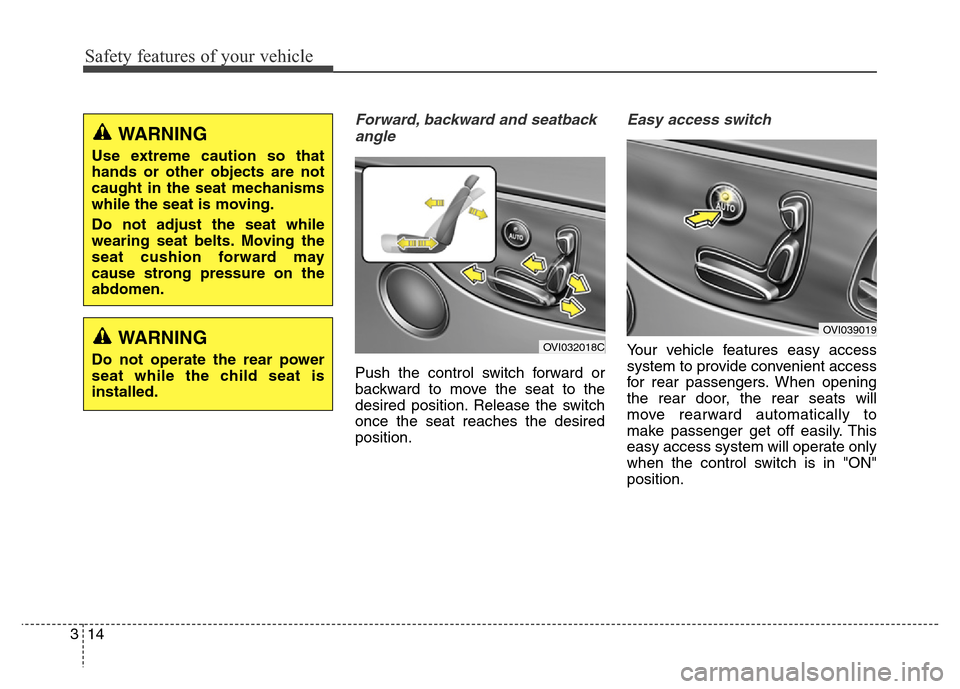
Push the control switch forward or
backward to move the seat to the
desired position. Release the switch
once the seat reaches the desired
position.
Easy access switch
Your vehicle features easy access
system to provide convenient access
for rear passengers. When opening
the rear door, the rear seats will
move rearward automatically to
make passenger get off easily. This
easy access system will operate only
when the control switch is in "ON"
position.
WARNING
Use extreme caution so that
hands or other objects are not
caught in the seat mechanisms
while the seat is moving.
Do not adjust the seat while
wearing seat belts. Moving the
seat cushion forward may
cause strong pressure on the
abdomen.
WARNING
Do not operate the rear power
seat while the child seat is
installed.OVI032018C
OVI039019
Page 39 of 479
Safety features of your vehicle
20 3
Headrest
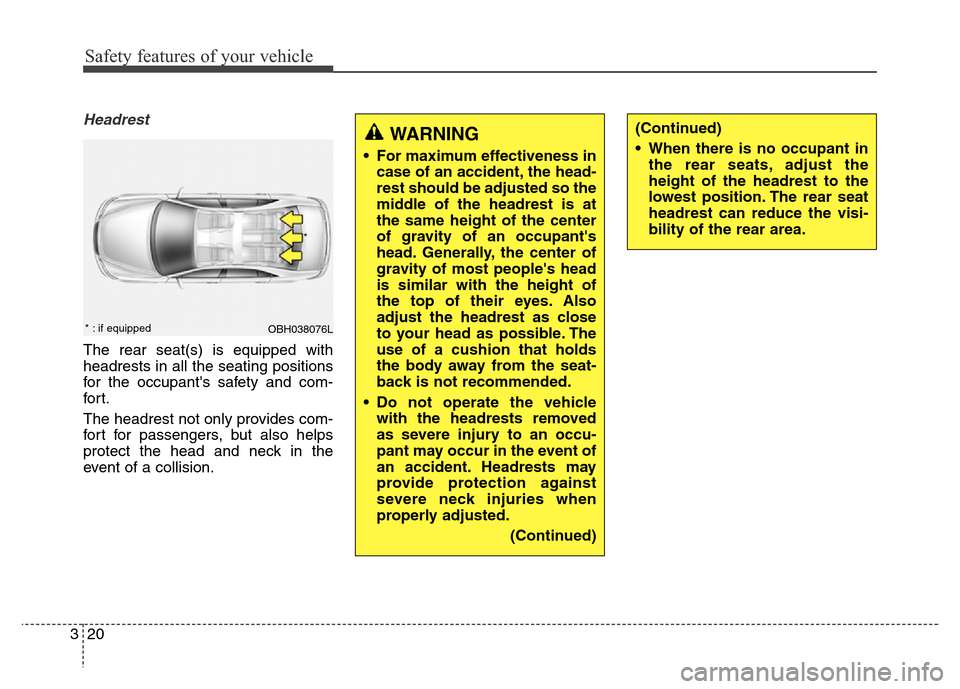
The rear seat(s) is equipped with
headrests in all the seating positions
for the occupant's safety and com-
for t.
The headrest not only provides com-
fort for passengers, but also helps
protect the head and neck in the
event of a collision.
OBH038076L * : if equipped*
WARNING
• For maximum effectiveness in
case of an accident, the head-
rest should be adjusted so the
middle of the headrest is at
the same height of the center
of gravity of an occupant's
head. Generally, the center of
gravity of most people's head
is similar with the height of
the top of their eyes. Also
adjust the headrest as close
to your head as possible. The
use of a cushion that holds
the body away from the seat-
back is not recommended.
• Do not operate the vehicle
with the headrests removed
as severe injury to an occu-
pant may occur in the event of
an accident. Headrests may
provide protection against
severe neck injuries when
properly adjusted.
(Continued)
(Continued)
• When there is no occupant in
the rear seats, adjust the
height of the headrest to the
lowest position. The rear seat
headrest can reduce the visi-
bility of the rear area.
Page 40 of 479
321
Safety features of your vehicle
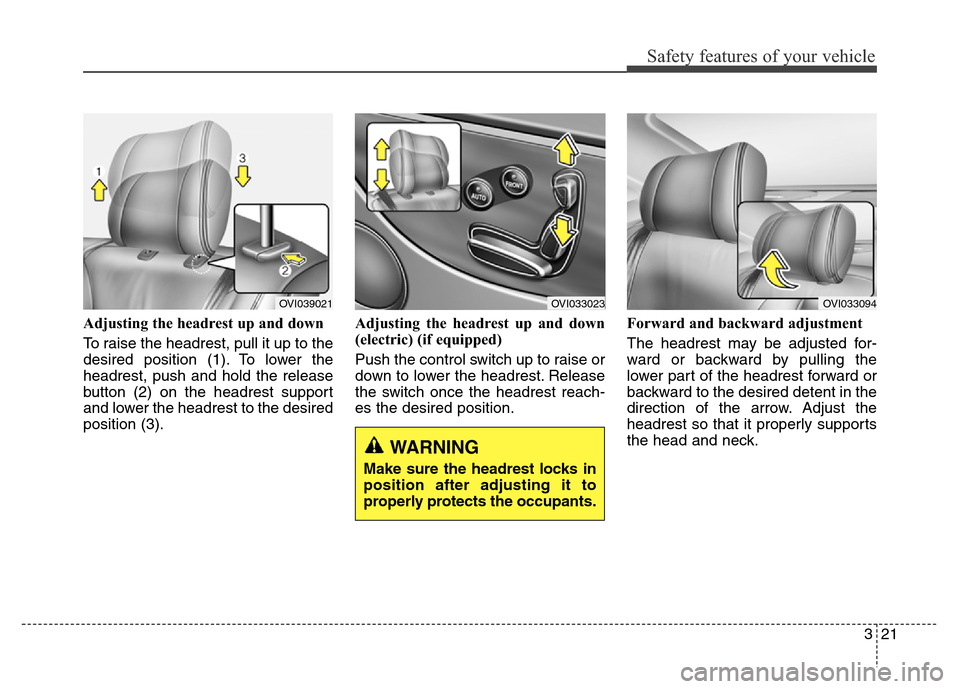
Adjusting the headrest up and down
To raise the headrest, pull it up to the
desired position (1). To lower the
headrest, push and hold the release
button (2) on the headrest support
and lower the headrest to the desired
position (3).Adjusting the headrest up and down
(electric) (if equipped)
Push the control switch up to raise or
down to lower the headrest. Release
the switch once the headrest reach-
es the desired position.Forward and backward adjustment
The headrest may be adjusted for-
ward or backward by pulling the
lower part of the headrest forward or
backward to the desired detent in the
direction of the arrow. Adjust the
headrest so that it properly supports
the head and neck.
OVI033094OVI033023
WARNING
Make sure the headrest locks in
position after adjusting it to
properly protects the occupants.
OVI039021
Page 42 of 479
323
Safety features of your vehicle
WARNING
• To reduce the risk of injury in
an accident or sudden stop,
always keep the tower console
storage closed while driving.
• Close this lower and upper lid
while the vehicle is moving.
Failure to observe this instruc-
tion could cause death or seri-
ous injury.
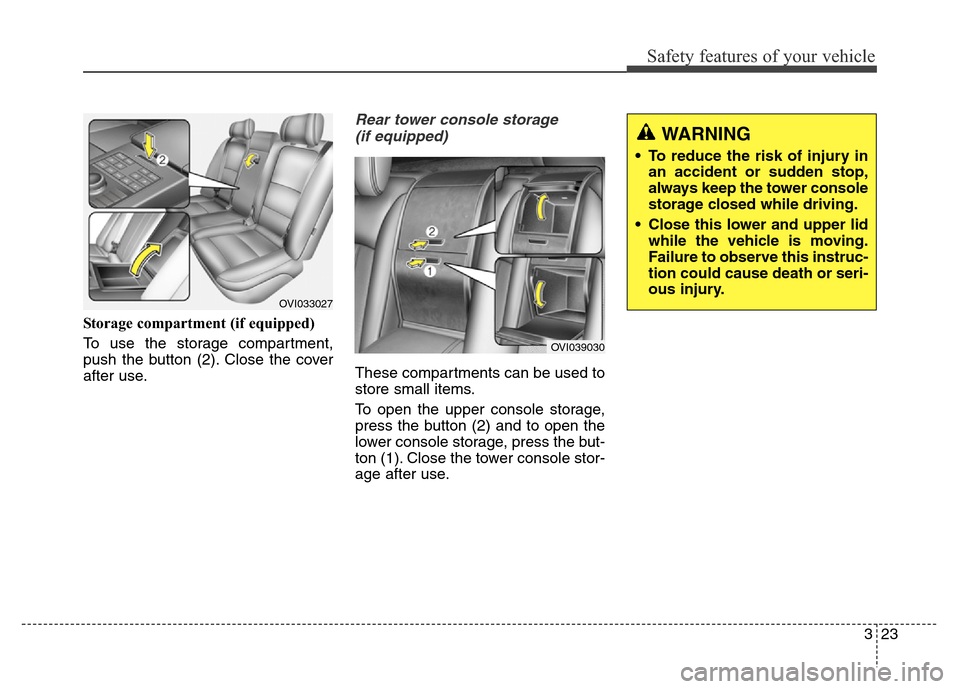
Storage compartment (if equipped)
To use the storage compartment,
push the button (2). Close the cover
after use.
Rear tower console storage
(if equipped)
These compartments can be used to
store small items.
To open the upper console storage,
press the button (2) and to open the
lower console storage, press the but-
ton (1). Close the tower console stor-
age after use.
OVI033027
OVI039030
Page 44 of 479
325
Safety features of your vehicle
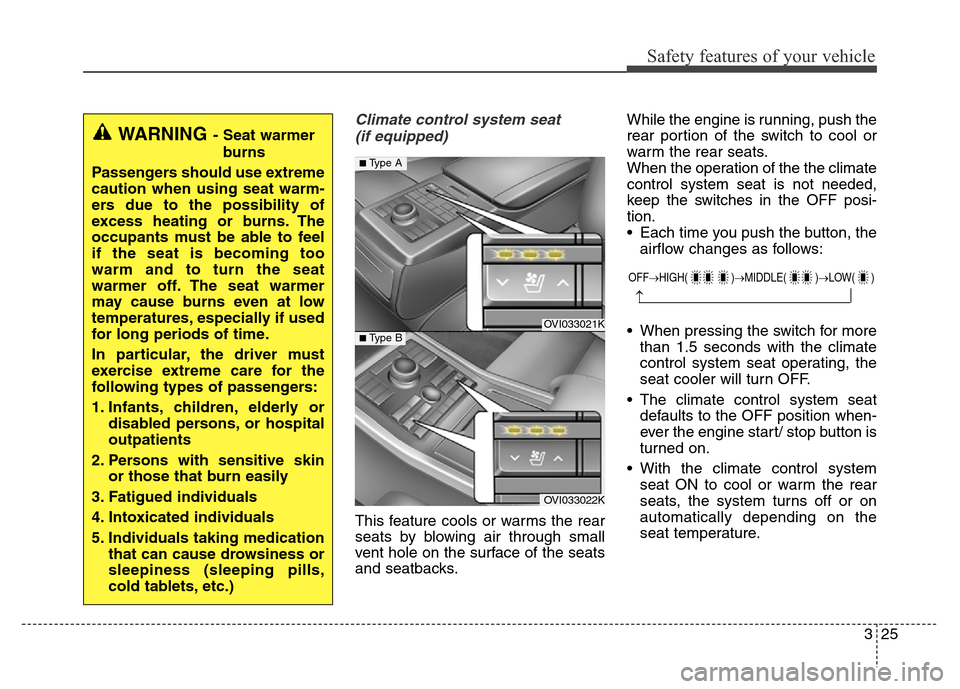
Climate control system seat
(if equipped)
This feature cools or warms the rear
seats by blowing air through small
vent hole on the surface of the seats
and seatbacks.While the engine is running, push the
rear portion of the switch to cool or
warm the rear seats.
When the operation of the the climate
control system seat is not needed,
keep the switches in the OFF posi-
tion.
• Each time you push the button, the
airflow changes as follows:
• When pressing the switch for more
than 1.5 seconds with the climate
control system seat operating, the
seat cooler will turn OFF.
• The climate control system seat
defaults to the OFF position when-
ever the engine start/ stop button is
turned on.
• With the climate control system
seat ON to cool or warm the rear
seats, the system turns off or on
automatically depending on the
seat temperature.
WARNING- Seat warmer
burns
Passengers should use extreme
caution when using seat warm-
ers due to the possibility of
excess heating or burns. The
occupants must be able to feel
if the seat is becoming too
warm and to turn the seat
warmer off. The seat warmer
may cause burns even at low
temperatures, especially if used
for long periods of time.
In particular, the driver must
exercise extreme care for the
following types of passengers:
1. Infants, children, elderly or
disabled persons, or hospital
outpatients
2. Persons with sensitive skin
or those that burn easily
3. Fatigued individuals
4. Intoxicated individuals
5. Individuals taking medication
that can cause drowsiness or
sleepiness (sleeping pills,
cold tablets, etc.)
OVI033021K
OVI033022K
■Type A
■ Type B
OFF→HIGH( )→MIDDLE( )→LOW( )
→
Page 46 of 479
327
Safety features of your vehicle
Seat belt restraint system
SEAT BELTS
WARNING
• For maximum restraint sys-
tem protection, the seat belts
must always be used whenev-
er the car is moving.
• Seat belts are most effective
when seatbacks are in the
upright position.
• Children age 12 and under
must always be properly
restrained in the rear seat.
Never allow children to ride in
the front passenger seat. If a
child over 12 must be seated
in the front seat, he/she must
be properly belted and the
seat should be moved as far
back as possible.
(Continued)
WARNING
Seat belts are designed to bear
upon the bony structure of the
body, and should be worn low
across the front of the pelvis or
the pelvis, chest and shoulders,
as applicable; wearing the lap
section of the belt across the
abdominal area must be avoided.
Seat belts should be adjusted
as firmly as possible, consis-
tent with comfort, to provide the
protection for which they have
been designed.
A slack belt will greatly reduce
the protection afforded to the
wearer.
(Continued)
(Continued)
• Never wear the shoulder belt
under your arm or behind
your back. An improperly
positioned shoulder belt can
cause serious injuries in a
crash. The shoulder belt
should be positioned midway
over your shoulder across
your collarbone.
• Never wear a seat belt over
fragile objects. If there is a
sudden stop or impact, the
seat belt can damage it.
• Avoid wearing twisted seat
belts. A twisted belt can't do
its job as well. In a collision, it
could even cut into you. Be
sure the belt webbing is
straight and not twisted.
• Be careful not to damage the
belt webbing or hardware. If
the belt webbing or hardware
is damaged, replace it.
Page 47 of 479
Safety features of your vehicle
28 3
(Continued)
Care should be taken to avoid
contamination of the webbing
with polishes, oils and chemi-
cals, and particularly battery
acid. Cleaning may safely be
carried out using mild soap and
water. The belt should be
replaced if webbing becomes
frayed, contaminated or dam-
aged. It is essential to replace
the entire assembly after it has
been worn in a severe impact
even if damage to the assembly
is not obvious. Belts should not
be worn with straps twisted.
Each belt assembly must only
be used by one occupant; it is
dangerous to put a belt around
a child being carried on the
occupant's lap.WARNING
• No modifications or additions
should be made by the user
which will either prevent the
seat belt adjusting devices
from operating to remove
slack, or prevent the seat belt
assembly from being adjusted
to remove slack.
• When you fasten the seat belt,
be careful not to latch the seat
belt in buckles of other seat. It's
very dangerous and you may
not be protected by the seat
belt properly.
• Do not unfasten the seat belt
and do not fasten and unfas-
ten the seat belt repeatedly
while driving. This could
result in loss of control, and
an accident causing death,
serious injury, or property
damage.
(Continued)
(Continued)
• When fastening the seat belt,
make sure that the seat belt
does not pass over objects that
are hard or can break easily.
• Make sure there is nothing in
the buckle. The seat belt may
not be fastened securely.
Page 48 of 479
329
Safety features of your vehicle
Seat belt warning
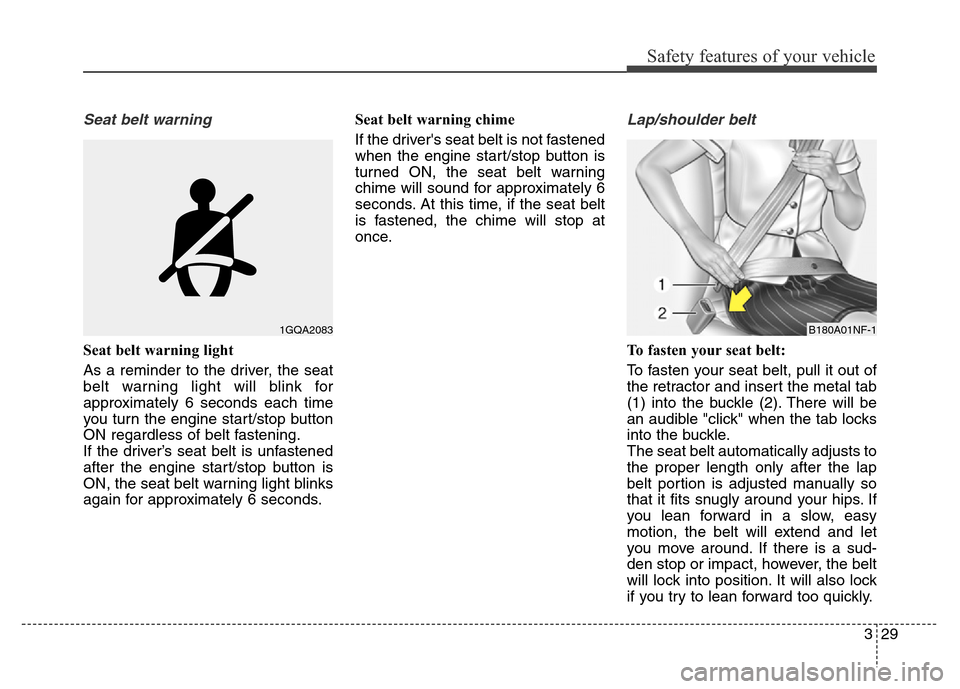
Seat belt warning light
As a reminder to the driver, the seat
belt warning light will blink for
approximately 6 seconds each time
you turn the engine start/stop button
ON regardless of belt fastening.
If the driver’s seat belt is unfastened
after the engine start/stop button is
ON, the seat belt warning light blinks
again for approximately 6 seconds.Seat belt warning chime
If the driver's seat belt is not fastened
when the engine start/stop button is
turned ON, the seat belt warning
chime will sound for approximately 6
seconds. At this time, if the seat belt
is fastened, the chime will stop at
once.
Lap/shoulder belt
To fasten your seat belt:
To fasten your seat belt, pull it out of
the retractor and insert the metal tab
(1) into the buckle (2). There will be
an audible "click" when the tab locks
into the buckle.
The seat belt automatically adjusts to
the proper length only after the lap
belt portion is adjusted manually so
that it fits snugly around your hips. If
you lean forward in a slow, easy
motion, the belt will extend and let
you move around. If there is a sud-
den stop or impact, however, the belt
will lock into position. It will also lock
if you try to lean forward too quickly.
1GQA2083B180A01NF-1