Maintenance
46 7
3. Checking tire life (TIN : Tire
Identification Number)
Any tires that are over 6 years old,
based on the manufacturing date,
(including the spare tire) should be
replaced by new ones. You can find
the manufacturing date on the tire
sidewall (possibly on the inside of the
wheel), displaying the DOT Code.
The DOT Code is a series of num-
bers on a tire consisting of numbers
and English letters. The manufactur-
ing date is designated by the last four
digits (characters) of the DOT code.
DOT : XXXX XXXX OOOO
The front part of the DOT means a
plant code number, tire size and
tread pattern and the last four num-
bers indicate week and year manu-
factured.
For example:
DOT XXXX XXXX 1614 represents
that the tire was produced in the 16th
week of 2014.
4. Tire ply composition and mate-
rial
The number of layers or plies of rub-
ber-coated fabric in the tire. Tire
manufacturers also must indicate the
materials in the tire, which include
steel, nylon, polyester, and others.
The letter "R" means radial ply con-
struction; the letter "D" means diago-
nal or bias ply construction; and the
letter "B" means belted-bias ply con-
struction.
5. Maximum permissible inflation
pressure
This number is the greatest amount
of air pressure that should be put in
the tire. Do not exceed the maximum
permissible inflation pressure. Refer
to the Tire and Loading Information
label for recommended inflation
pressure.
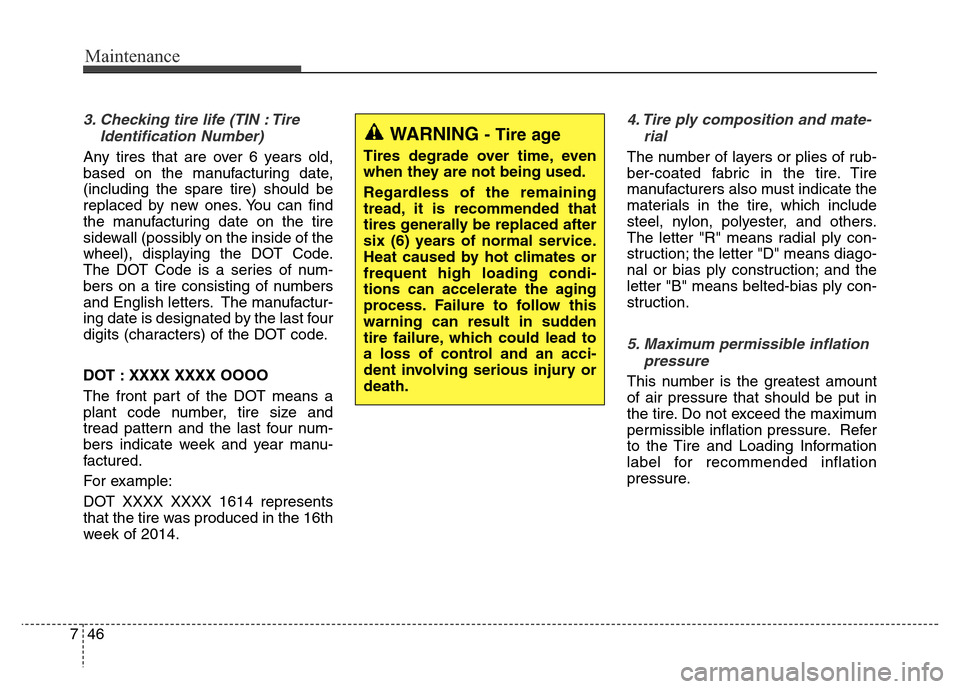
WARNING - Tire age
Tires degrade over time, even
when they are not being used.
Regardless of the remaining
tread, it is recommended that
tires generally be replaced after
six (6) years of normal service.
Heat caused by hot climates or
frequent high loading condi-
tions can accelerate the aging
process. Failure to follow this
warning can result in sudden
tire failure, which could lead to
a loss of control and an acci-
dent involving serious injury or
death.
3
Specifications & Consumer information
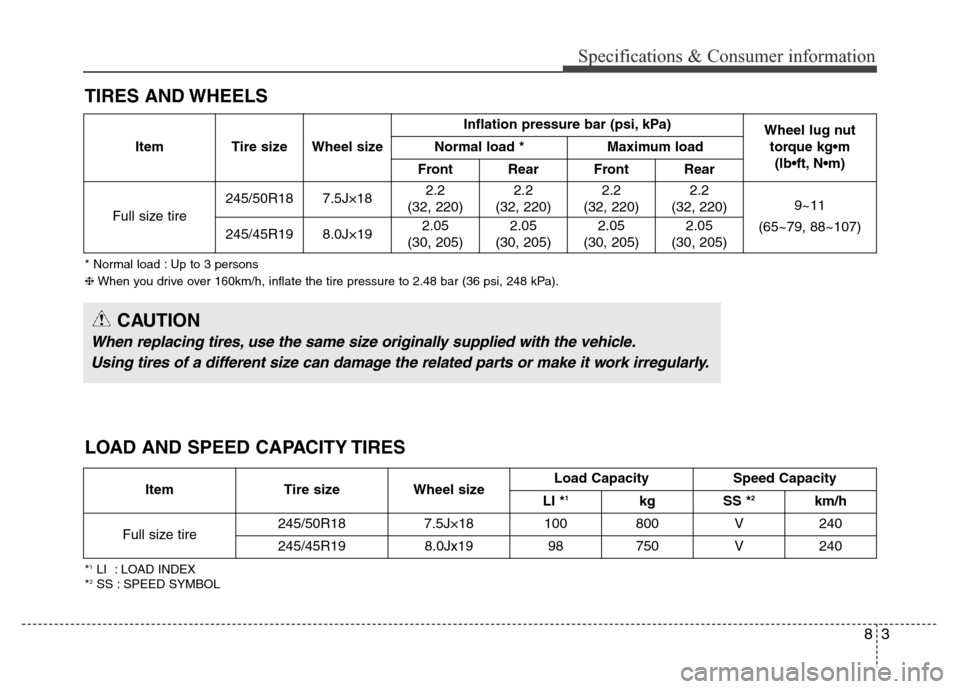
TIRES AND WHEELS
* Normal load : Up to 3 persons
❈When you drive over 160km/h, inflate the tire pressure to 2.48 bar (36 psi, 248 kPa).
Item Tire size Wheel sizeInflation pressure bar (psi, kPa)
Wheel lug nut
torque kg•m
(lb•ft, N•m) Normal load * Maximum load
Front Rear Front Rear
Full size tire245/50R18 7.5J×182.2
(32, 220)2.2
(32, 220)2.2
(32, 220)2.2
(32, 220)9~11
(65~79, 88~107)
245/45R19 8.0J×192.05
(30, 205)2.05
(30, 205)2.05
(30, 205)2.05
(30, 205)
CAUTION
When replacing tires, use the same size originally supplied with the vehicle.
Using tires of a different size can damage the related parts or make it work irregularly.
8
*1LI : LOAD INDEX
*2SS : SPEED SYMBOL
Item Tire size Wheel sizeLoad Capacity Speed Capacity
LI *1kg SS *2km/h
Full size tire245/50R18 7.5J×18 100 800 V 240
245/45R19 8.0Jx19 98 750 V 240
LOAD AND SPEED CAPACITY TIRES