Battery Hyundai Equus 2014 Workshop Manual
[x] Cancel search | Manufacturer: HYUNDAI, Model Year: 2014, Model line: Equus, Model: Hyundai Equus 2014Pages: 479, PDF Size: 10.15 MB
Page 421 of 479
Maintenance
36 7
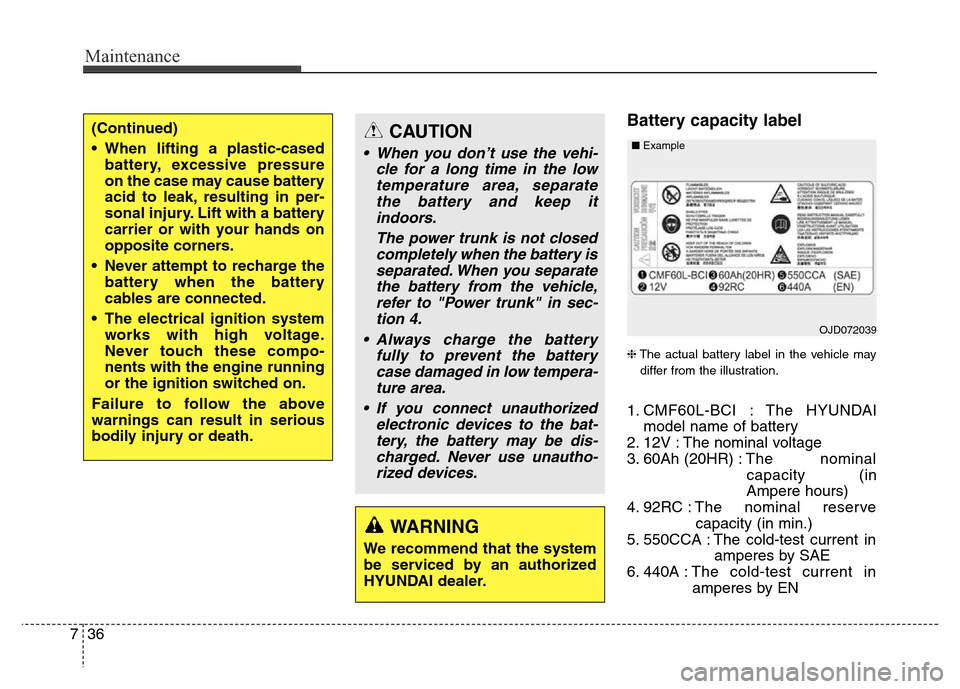
Battery capacity label
❈The actual battery label in the vehicle may
differ from the illustration.
1. CMF60L-BCI : The HYUNDAI
model name of battery
2. 12V : The nominal voltage
3. 60Ah (20HR) :The nominal
capacity (in
Ampere hours)
4. 92RC :The nominal reserve
capacity (in min.)
5. 550CCA : The cold-test current in
amperes by SAE
6. 440A :The cold-test current in
amperes by EN
(Continued)
• When lifting a plastic-cased
battery, excessive pressure
on the case may cause battery
acid to leak, resulting in per-
sonal injury. Lift with a battery
carrier or with your hands on
opposite corners.
• Never attempt to recharge the
battery when the battery
cables are connected.
• The electrical ignition system
works with high voltage.
Never touch these compo-
nents with the engine running
or the ignition switched on.
Failure to follow the above
warnings can result in serious
bodily injury or death.CAUTION
• When you don’t use the vehi-
cle for a long time in the low
temperature area, separate
the battery and keep it
indoors.
The power trunk is not closed
completely when the battery is
separated. When you separate
the battery from the vehicle,
refer to "Power trunk" in sec-
tion 4.
• Always charge the battery
fully to prevent the battery
case damaged in low tempera-
ture area.
• If you connect unauthorized
electronic devices to the bat-
tery, the battery may be dis-
charged. Never use unautho-
rized devices.
WARNING
We recommend that the system
be serviced by an authorized
HYUNDAI dealer.
OJD072039 ■Example
Page 422 of 479
737
Maintenance
Battery recharging
Your vehicle has a maintenance-free,
calcium-based battery.
• If the battery becomes discharged
in a short time (because, for exam-
ple, the headlights or interior lights
were left on while the vehicle was
not in use), recharge it by slow
charging (trickle) for 10 hours.
• If the battery gradually discharges
because of high electric load while
the vehicle is being used, recharge
it at 20-30A for two hours.(Continued)
1. Turn off the battery charger
main switch.
2. Unhook the negative clamp
from the negative battery ter-
minal.
3. Unhook the positive clamp
from the positive battery ter-
minal.WARNING- Recharging
battery
When recharging the battery,
observe the following precau-
tions:
• The battery must be removed
from the vehicle and placed in
an area with good ventilation.
• Do not allow cigarettes,
sparks, or flame near the bat-
tery.
• Watch the battery during
charging, and stop or reduce
the charging rate if the battery
cells begin gassing (boiling)
violently or if the temperature
of the electrolyte of any cell
exceeds 49°C (120°F).
• Wear eye protection when
checking the battery during
charging.
• Disconnect the battery charg-
er in the following order.
(Continued)
Page 423 of 479
Maintenance
38 7
Reset items
Items should be reset after the bat-
tery has been discharged or the bat-
tery has been disconnected.
• Power trunk (See section 4)
• Sunroof (See section 4)
• Trip computer (See section 4)
• Climate control system
(See section 4)
• Clock (See DIS manual)
• Audio (See DIS manual)
• Auto up/down window
(See section 4)
• Driver position memory system
(See section 4)
CAUTION
• Keep the battery away from
water or any liquid.
• The battery is in the trunk, so
you should be careful when
you load a container filled with
liquid into the trunk.
• For your safety, use the
authenticity by approved
authorized HYUNDAI dealer,
when you replace the battery.
WARNING
• Before performing mainte-
nance or recharging the bat-
tery, turn off all accessories
and stop the engine.
• The negative battery cable
must be removed first and
installed last when the battery
is disconnected.
• Operation related to the bat-
tery should be done in an
authorized HYUNDAI dealer.
Page 434 of 479
749
Maintenance
FUSES
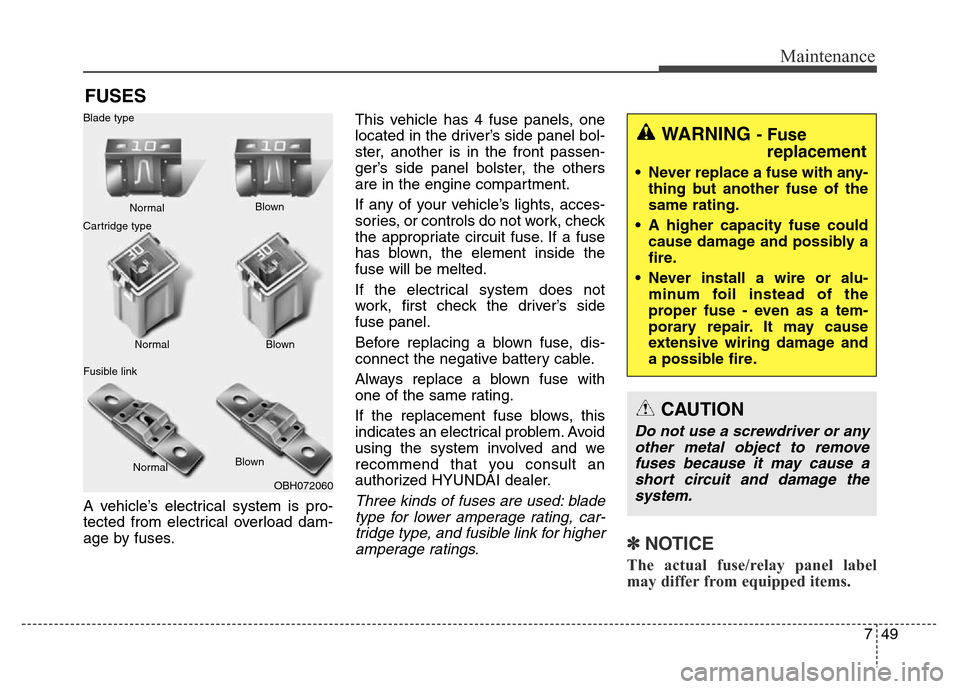
A vehicle’s electrical system is pro-
tected from electrical overload dam-
age by fuses.This vehicle has 4 fuse panels, one
located in the driver’s side panel bol-
ster, another is in the front passen-
ger’s side panel bolster, the others
are in the engine compartment.
If any of your vehicle’s lights, acces-
sories, or controls do not work, check
the appropriate circuit fuse. If a fuse
has blown, the element inside the
fuse will be melted.
If the electrical system does not
work, first check the driver’s side
fuse panel.
Before replacing a blown fuse, dis-
connect the negative battery cable.
Always replace a blown fuse with
one of the same rating.
If the replacement fuse blows, this
indicates an electrical problem. Avoid
using the system involved and we
recommend that you consult an
authorized HYUNDAI dealer.Three kinds of fuses are used: blade
type for lower amperage rating, car-
tridge type, and fusible link for higher
amperage ratings.
✽NOTICE
The actual fuse/relay panel label
may differ from equipped items.
WARNING - Fuse
replacement
• Never replace a fuse with any-
thing but another fuse of the
same rating.
• A higher capacity fuse could
cause damage and possibly a
fire.
• Never install a wire or alu-
minum foil instead of the
proper fuse - even as a tem-
porary repair. It may cause
extensive wiring damage and
a possible fire.
CAUTION
Do not use a screwdriver or any
other metal object to remove
fuses because it may cause a
short circuit and damage the
system.
OBH072060 Normal Normal Blade type
Cartridge type
Fusible linkBlown
Blown
NormalBlown
Page 451 of 479
Maintenance
66 7
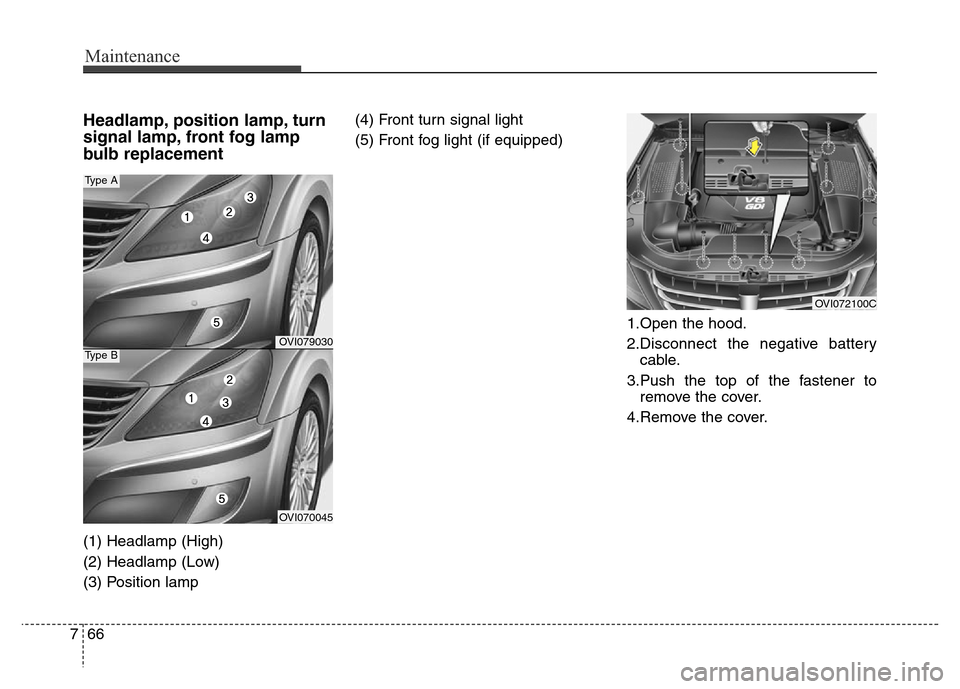
Headlamp, position lamp, turn
signal lamp, front fog lamp
bulb replacement
(1) Headlamp (High)
(2) Headlamp (Low)
(3) Position lamp(4) Front turn signal light
(5) Front fog light (if equipped)
1.Open the hood.
2.Disconnect the negative battery
cable.
3.Push the top of the fastener to
remove the cover.
4.Remove the cover.
OVI072100C
OVI079030
OVI070045
Type A
Type B
Page 468 of 479
783
Maintenance
Canister
Fuel vapors generated inside the fuel
tank are absorbed and stored in the
onboard canister. When the engine is
running, the fuel vapors absorbed in
the canister are drawn into the surge
tank through the purge control sole-
noid valve.
Purge Control Solenoid Valve
(PCSV)
The purge control solenoid valve is
controlled by the Engine Control
Module (ECM); when the engine
coolant temperature is low during
idling, the PCSV closes so that evap-
orated fuel is not taken into the
engine. After the engine warms-up
during ordinary driving, the PCSV
opens to introduce evaporated fuel to
the engine.3. Exhaust emission control
system
The Exhaust Emission Control
System is a highly effective system
which controls exhaust emissions
while maintaining good vehicle per-
formance.
Vehicle modifications
• This vehicle should not be modi-
fied. Modification of your vehicle
could affect its performance, safety
or durability and may even violate
governmental safety and emis-
sions regulations.
In addition, damage or perform-
ance problems resulting from any
modification may not be covered
under warranty.
• If you use unauthorized electronic
devices, it may cause the vehicle to
operate abnormally, wire damage,
battery discharge and fire. For your
safety, do not use unauthorized
electronic devices.
Engine exhaust gas precautions
(carbon monoxide)
• Carbon monoxide can be present
with other exhaust fumes.
Therefore, if you smell exhaust
fumes of any kind inside your vehi-
cle, have it inspected and repaired
immediately. If you ever suspect
exhaust fumes are coming into
your vehicle, drive it only with all
the windows fully open. Have your
vehicle checked and repaired
immediately.
WARNING - Exhaust
Engine exhaust gases contain
carbon monoxide (CO). Though
colorless and odorless, it is
dangerous and could be lethal if
inhaled. Follow the instructions
on this page to avoid CO poi-
soning.