Gas Hyundai Equus 2014 Owner's Manual
[x] Cancel search | Manufacturer: HYUNDAI, Model Year: 2014, Model line: Equus, Model: Hyundai Equus 2014Pages: 479, PDF Size: 10.15 MB
Page 8 of 479
Introduction
How to use this manual . . . . . . . . . . . . . . . . . . . . . . 1-2
Fuel requirements . . . . . . . . . . . . . . . . . . . . . . . . . . 1-3
• Gasoline engine . . . . . . . . . . . . . . . . . . . . . . . . . . . . . . . 1-3
Vehicle break-in process . . . . . . . . . . . . . . . . . . . . . 1-5
1
Page 10 of 479
13
Introduction
Gasoline engine
Unleaded
For Europe
For the optimal vehicle performance,
we recommend you use unleaded
gasoline which has an octane rating
of RON (Research Octane Number)
95 / AKI (Anti Knock Index) 91 or
higher. (Do not use methanol blend-
ed fuels.)
You may use unleaded gasoline with
an octane rating of RON 91~94/AKI
87~90 but it may result in slight per-
formance reduction of the vehicle.
Except Europe
Your new Hyundai vehicle is
designed to use only unleaded fuel
having an Octane Rating of RON
(Research Octane Number) 91 / AKI
(Anti-Knock Index) 87 or higher. (Do
not use methanol blended fuels.)
Your new vehicle is designed to
obtain maximum performance with
UNLEADED FUEL, as well as mini-
mize exhaust emissions and spark
plug fouling.
FUEL REQUIREMENTS
WARNING
• Do not "top off" after the noz-
zle automatically shuts off
when refueling.
• Always check that the fuel cap
is installed securely to pre-
vent fuel spillage in the event
of an accident.
CAUTION
NEVER USE LEADED FUEL. The
use of leaded fuel is detrimental
to the catalytic converter and
will damage the engine control
system’s oxygen sensor and
affect emission control.
Never add any fuel system
cleaning agents to the fuel tank
other than what has been speci-
fied. (Consult an authorized
HYUNDAI dealer for details.)
Page 11 of 479
Introduction
4 1
Gasoline containing alcohol and
methanol
Gasohol, a mixture of gasoline and
ethanol (also known as grain alcohol),
and gasoline or gasohol containing
methanol (also known as wood alco-
hol) are being marketed along with or
instead of leaded gasoline.
Do not use gasohol containing more
than 10% ethanol, and do not use
gasoline or gasohol containing any
methanol. Either of these fuels may
cause drivability problems and dam-
age to the fuel system, engine control
system and emission control system.
Discontinue using gasohol of any
kind if drivability problems occur.
Vehicle damage or drivability prob-
lems may not be covered by the
manufacturer’s warranty if they result
from the use of:
1. Gasohol containing more than
10% ethanol.
2. Gasoline or gasohol containing
methanol.
3. Leaded fuel or leaded gasohol.
Other fuels
Using fuels such as;
- Silicone (Si) contained fuel,
- MMT (Manganese, Mn) contained
fuel,
- Ferrocene (Fe) contained fuel, and
- Other metallic additives contained
fuels,
may cause vehicle and engine dam-
age. Also, the Malfunction Indicator
Lamp (MIL) may illuminate or cause
plugging, misfiring, poor acceleration,
engine stalling, catalyst melting,
abnormal corrosion, life cycle reduc-
tion, etc.
Use of MTBE
HYUNDAI recommends avoiding
fuels containing MTBE (Methyl
Tertiary Butyl Ether) over 15.0% vol.
(Oxygen Content 2.7% weight) in
your vehicle.
Fuel containing MTBE over 15.0%
vol. (Oxygen Content 2.7% weight)
may reduce vehicle performance and
produce vapor lock or hard starting.
CAUTION
Your New Vehicle Limited
Warranty may not cover damage
to the fuel system and any per-
formance problems that are
caused by the use of fuels con-
taining methanol or fuels con-
taining MTBE (Methyl Tertiary
Butyl Ether) over 15.0% vol.
(Oxygen Content 2.7% weight.)
CAUTION
Never use gasohol which con-
tains methanol. Discontinue use
of any gasohol product which
impairs drivability.
Page 12 of 479
15
Introduction
Do not use methanol
Fuels containing methanol (wood
alcohol) should not be used in your
vehicle. This type of fuel can reduce
vehicle performance and damage
components of the fuel system,
engine control system and emission
control system.
Fuel Additives
HYUNDAI recommends that you use
unleaded gasoline which has an
octane rating of RON (Research
Octane Number) 95 / AKI (Anti Knock
Index) 91 or higher (for Europe) or
Octane Rating of RON (Research
Octane Number) 91 / AKI (Anti-Knock
Index) 87 or higher (except Europe).
For customers who do not use good
quality gasoline including fuel addi-
tives regularly, and have problems
starting or the engine does not run
smoothly, one bottle of additives
added to the fuel tank at every
15,000km (for Europe)/5,000km
(except Europe). Additives are avail-
able from your authorized HYUNDAI
dealer along with information on how
to use them.
Operation in foreign countries
If you are going to drive your vehicle
in another country, be sure to:
• Observe all regulations regarding
registration and insurance.
• Determine that acceptable fuel is
available.No special break-in period is need-
ed. By following a few simple precau-
tions for the first 1,000 km (600 miles)
you may add to the performance,
economy and life of your vehicle.
• Do not race the engine.
• While driving, keep your engine
speed (rpm, or revolutions per
minute) between 2,000 rpm and
4,000 rpm.
• Do not maintain a single speed for
long periods of time, either fast or
slow. Varying engine speed is
needed to properly break-in the
engine.
• Avoid hard stops, except in emer-
gencies, to allow the brakes to seat
properly.
• Don't tow a trailer during the first
2,000 km (1,200 miles) of opera-
tion.
VEHICLE BREAK-IN
PROCESS
Page 23 of 479
Safety features of your vehicle
4 3
Front seat adjustment
The front seat can be adjusted by
using the control switch located on
the doors. Before driving, adjust the
seat to the proper position so as to
easily control the steering wheel,
pedals and switches on the instru-
ment panel.WARNING
• Do not adjust the seat while
wearing seat belts. Moving the
seat cushion forward may
cause strong pressure on the
abdomen.
• Use extreme caution so that
hands or other objects are not
caught in the seat mechanisms
while the seat is moving.
• Do not put a cigarette lighter
on the floor or seat. When you
operate the seat, gas may gush
out of the lighter and cause
fire.
• Use extreme caution when
picking small objects trapped
under the seats or between the
seat and the center console.
Your hands might be cut or
injured by the sharp edges of
the seat mechanism.
• If there are occupants in the
rear seats, be careful while
adjusting the front seat posi-
tion.
(Continued)
• Do not allow anything to inter-
fere with the normal position
of the seatback. Storing items
against a seatback or in any
other way interfering with
proper locking of a seatback
could result in serious or fatal
injury in a sudden stop or col-
lision.
• Always drive and ride with
your seatback upright and the
lap portion of the seat belt
snug and low across the hips.
This is the best position to
protect you in case of an acci-
dent.
• In order to avoid unnecessary
and perhaps severe air bag
injuries, always sit as far back
as possible from the steering
wheel while maintaining com-
fortable control of the vehicle.
We recommend that your
chest be at least 250 mm (10
inches) away from the steer-
ing wheel.
WARNING
The power seat is operable with
the engine start/stop button in
OFF.
Therefore, children should never
be left unattended in the vehicle.
Page 30 of 479
311
Safety features of your vehicle
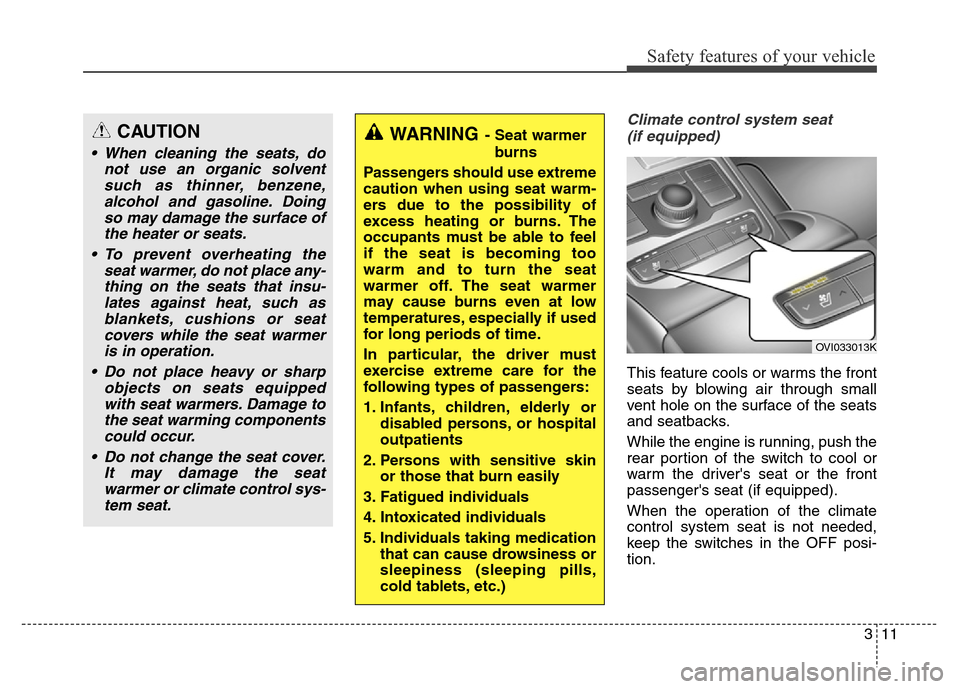
Climate control system seat
(if equipped)
This feature cools or warms the front
seats by blowing air through small
vent hole on the surface of the seats
and seatbacks.
While the engine is running, push the
rear portion of the switch to cool or
warm the driver's seat or the front
passenger's seat (if equipped).
When the operation of the climate
control system seat is not needed,
keep the switches in the OFF posi-
tion.
CAUTION
• When cleaning the seats, do
not use an organic solvent
such as thinner, benzene,
alcohol and gasoline. Doing
so may damage the surface of
the heater or seats.
• To prevent overheating the
seat warmer, do not place any-
thing on the seats that insu-
lates against heat, such as
blankets, cushions or seat
covers while the seat warmer
is in operation.
• Do not place heavy or sharp
objects on seats equipped
with seat warmers. Damage to
the seat warming components
could occur.
• Do not change the seat cover.
It may damage the seat
warmer or climate control sys-
tem seat.
WARNING- Seat warmer
burns
Passengers should use extreme
caution when using seat warm-
ers due to the possibility of
excess heating or burns. The
occupants must be able to feel
if the seat is becoming too
warm and to turn the seat
warmer off. The seat warmer
may cause burns even at low
temperatures, especially if used
for long periods of time.
In particular, the driver must
exercise extreme care for the
following types of passengers:
1. Infants, children, elderly or
disabled persons, or hospital
outpatients
2. Persons with sensitive skin
or those that burn easily
3. Fatigued individuals
4. Intoxicated individuals
5. Individuals taking medication
that can cause drowsiness or
sleepiness (sleeping pills,
cold tablets, etc.)
OVI033013K
Page 31 of 479
Safety features of your vehicle
12 3
(Continued)
• Do not place materials such
as plastic bags or newspapers
under the seats. The air vent
may not work properly as the
air intake can be blocked.
• Do not change the seat cover.
It may damage the seat
warmer or climate control sys-
tem seat.
• When the air vent does not
operate, restart the vehicle. If
there is no change, we recom-
mend that the system be
inspected by an authorized
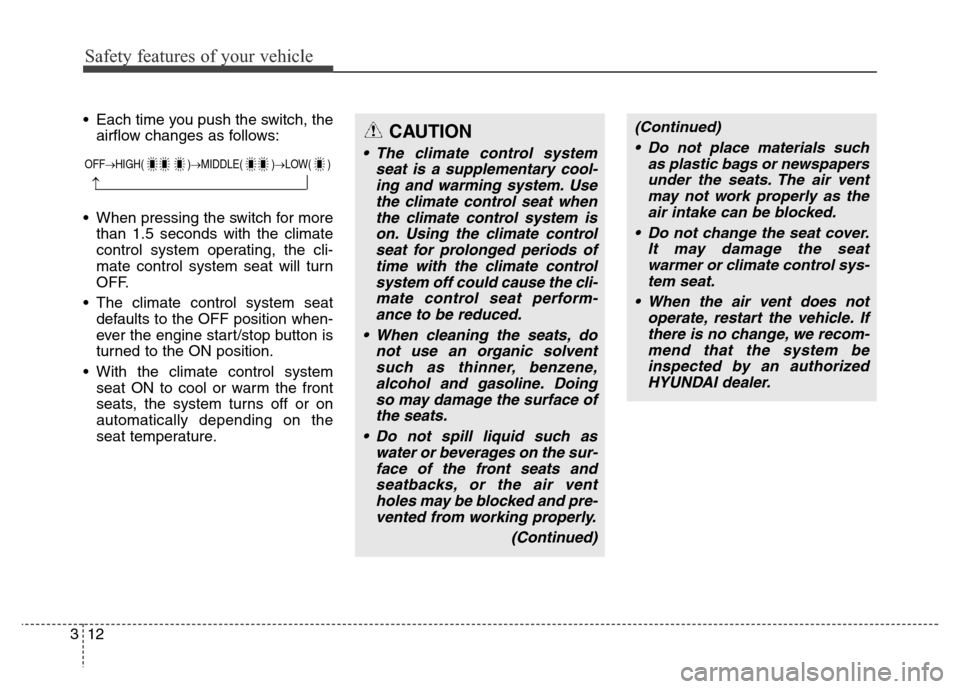
HYUNDAI dealer.• Each time you push the switch, the
airflow changes as follows:
• When pressing the switch for more
than 1.5 seconds with the climate
control system operating, the cli-
mate control system seat will turn
OFF.
• The climate control system seat
defaults to the OFF position when-
ever the engine start/stop button is
turned to the ON position.
• With the climate control system
seat ON to cool or warm the front
seats, the system turns off or on
automatically depending on the
seat temperature.
OFF→HIGH( )→MIDDLE( )→LOW( )
→
CAUTION
• The climate control system
seat is a supplementary cool-
ing and warming system. Use
the climate control seat when
the climate control system is
on. Using the climate control
seat for prolonged periods of
time with the climate control
system off could cause the cli-
mate control seat perform-
ance to be reduced.
• When cleaning the seats, do
not use an organic solvent
such as thinner, benzene,
alcohol and gasoline. Doing
so may damage the surface of
the seats.
• Do not spill liquid such as
water or beverages on the sur-
face of the front seats and
seatbacks, or the air vent
holes may be blocked and pre-
vented from working properly.
(Continued)
Page 43 of 479
Safety features of your vehicle
24 3
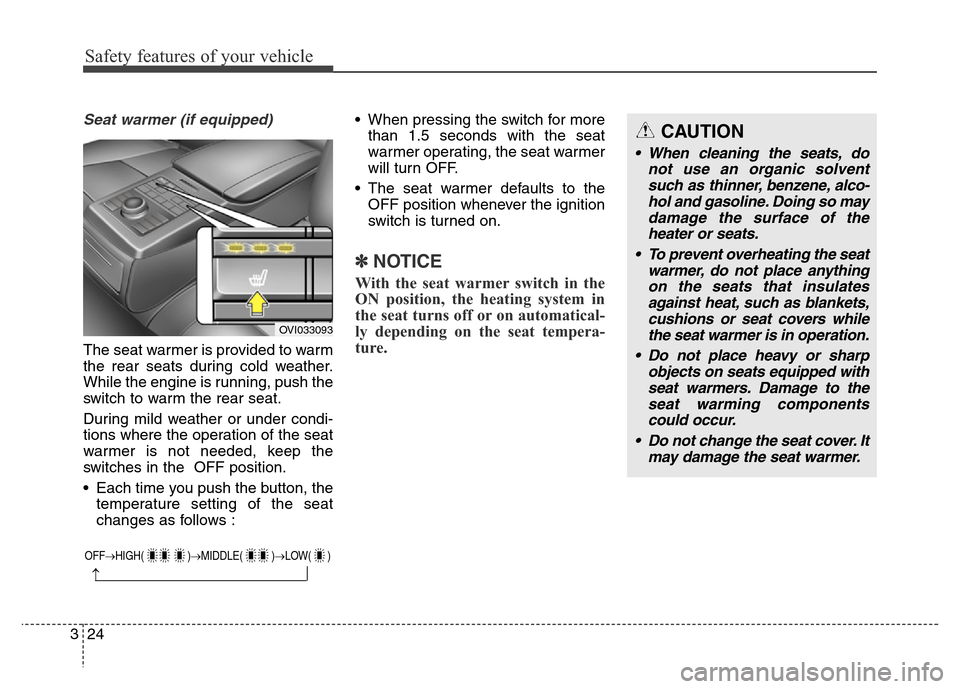
Seat warmer (if equipped)
The seat warmer is provided to warm
the rear seats during cold weather.
While the engine is running, push the
switch to warm the rear seat.
During mild weather or under condi-
tions where the operation of the seat
warmer is not needed, keep the
switches in the OFF position.
• Each time you push the button, the
temperature setting of the seat
changes as follows :• When pressing the switch for more
than 1.5 seconds with the seat
warmer operating, the seat warmer
will turn OFF.
• The seat warmer defaults to the
OFF position whenever the ignition
switch is turned on.
✽NOTICE
With the seat warmer switch in the
ON position, the heating system in
the seat turns off or on automatical-
ly depending on the seat tempera-
ture.
OFF→HIGH( )→MIDDLE( )→LOW( )
→
OVI033093
CAUTION
• When cleaning the seats, do
not use an organic solvent
such as thinner, benzene, alco-
hol and gasoline. Doing so may
damage the surface of the
heater or seats.
• To prevent overheating the seat
warmer, do not place anything
on the seats that insulates
against heat, such as blankets,
cushions or seat covers while
the seat warmer is in operation.
• Do not place heavy or sharp
objects on seats equipped with
seat warmers. Damage to the
seat warming components
could occur.
• Do not change the seat cover. It
may damage the seat warmer.
Page 45 of 479
Safety features of your vehicle
26 3
CAUTION
• The climate control system
seat is a supplementary cool-
ing and warming system. Use
the climate control seat when
the climate control system is
on. Using the climate control
seat for prolonged periods of
time with the climate control
system off could cause the cli-
mate control seat perform-
ance to be reduced.
• When cleaning the seats, do
not use an organic solvent
such as thinner, benzene,
alcohol and gasoline. Doing
so may damage the surface of
the seats.
• Do not spill liquid such as
water or beverages on the sur-
face of the front seats and
seatbacks, or the air vent
holes may be blocked and pre-
vented from working properly.
(Continued)
(Continued)
• Do not place materials such
as plastic bags or newspapers
under the seats. The air vent
may not work properly as the
air intake can be blocked.
• Do not change the seat cover. It
may damage the climate control
system seat.
• When the air vent does not
operate, restart the vehicle. If
there is no change, we recom-
mend that the system be
inspected by an authorized
HYUNDAI dealer.
Page 110 of 479
421
Features of your vehicle
Closing the trunk
To close the trunk, lower the trunk lid,
then press down it until it locks. To be
sure the trunk lid is securely fas-
tened, always check by trying to pull
it up again.
Power trunk (if equipped)
The power trunk can be opened or
closed automatically with the smart
key, the power trunk main control
button, the open button, or the close
button on the trunk lid.
If you depress the power trunk main
control button, open button, or close
button while operating the power
trunk, you could stop operating the
power trunk.
If that happens, to operate the power
trunk again, push any button.
CAUTION
Make certain that you close the
trunk before driving your vehi-
cle. Possible damage may occur
to the trunk lift cylinders and
attached hardware if the trunk is
not closed prior to driving.
WARNING
The trunk swings upward. Make
sure no objects or people are
near the rear of the vehicle
when opening the trunk.
WARNING
The trunk lid should be always
kept completely closed while
the vehicle is in motion. If it is
left open or ajar, poisonous
exhaust gases may enter the
vehicle and serious illness or
death may result.
CAUTION
For your safety, do not leave the
power trunk open for a long
time, it could also to prevent
unnecessary charging system
drain.