rear Hyundai Equus 2015 Owner's Guide
[x] Cancel search | Manufacturer: HYUNDAI, Model Year: 2015, Model line: Equus, Model: Hyundai Equus 2015Pages: 483, PDF Size: 13.26 MB
Page 60 of 483
341
Safety features of your vehicle
WARNING
To reduce the chance of serious
or fatal injuries:
• Children of all ages are safer
when restrained in the rear
seat. A child riding in the
front passenger seat can be
forcefully struck by an inflat-
ing air bag resulting in seri-
ous or fatal injuries.
• Always follow the child
restraint system manufactur-
er’s instructions for installa-
tion and use of the child
restraint.
• Always make sure the child
seat is secured properly in the
vehicle and your child is
securely restrained in the
child seat.
• Never hold a child in your
arms or lap when riding in a
vehicle. The violent forces cre-
ated during a crash will tear
the child from your arms and
throw the child against the
vehicle’s interior.
(Continued)
(Continued)
Always properly position and
secure children in the rear
seat.
• Never allow a child to stand-
up or kneel on the seat or
floor of a moving vehicle.
During a collision or sudden
stop, the child can be violent-
ly thrown against the vehicle’s
interior, resulting in serious
injury.
• Never use an infant carrier or
a child safety seat that
"hooks" over a seatback, it
may not provide adequate
security in an accident.
• Seat belts can become very
hot, especially when the vehi-
cle is parked in direct sun-
light. Always check seat belt
buckles before fastening them
over a child.
• After an accident, we recom-
mend that the system be
checked by an authorized
HYUNDAI dealer.
(Continued)(Continued)
• Never put a seat belt over
yourself and a child. During a
crash, the belt could press
deep into the child causing
serious internal injuries.
• Never leave children unat-
tended in a vehicle – not even
for a short time. The car can
heat up very quickly, resulting
in serious injuries to children
inside. Even very young chil-
dren may inadvertently cause
the vehicle to move, entangle
themselves in the windows, or
lock themselves or others
inside the vehicle.
• Never allow two children, or
any two persons, to use the
same seat belt.
• Children often squirm and
reposition themselves
improperly. Never let a child
ride with the shoulder belt
under their arm or behind
their back.
(Continued)
Page 61 of 483
Safety features of your vehicle
42 3
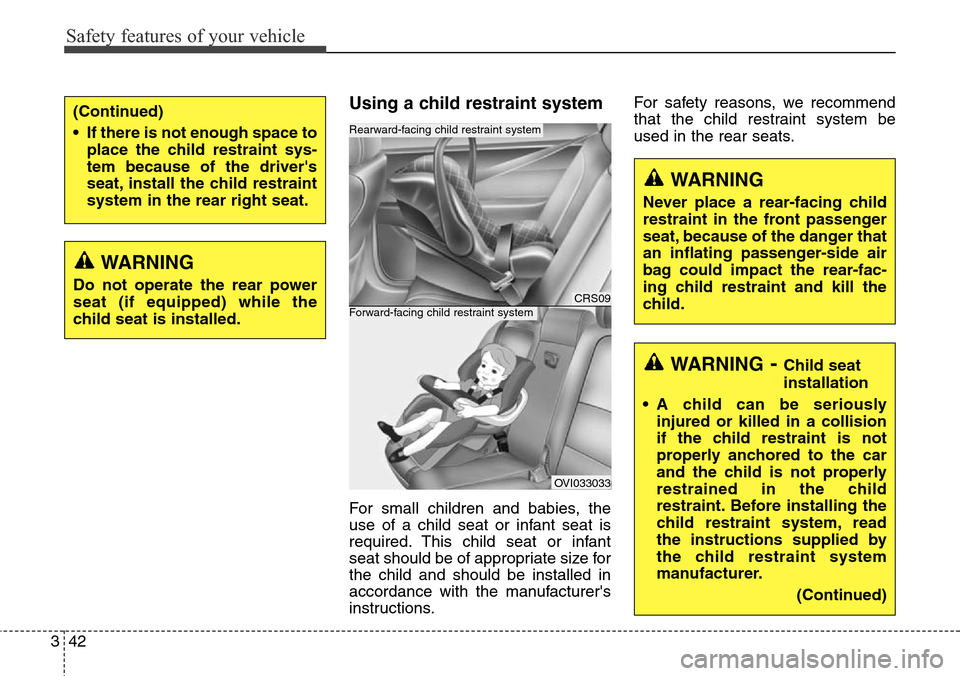
Using a child restraint system
For small children and babies, the
use of a child seat or infant seat is
required. This child seat or infant
seat should be of appropriate size for
the child and should be installed in
accordance with the manufacturer's
instructions.For safety reasons, we recommend
that the child restraint system be
used in the rear seats.
CRS09
OVI033033
Forward-facing child restraint system
Rearward-facing child restraint system
WARNING
Do not operate the rear power
seat (if equipped) while the
child seat is installed.
WARNING
Never place a rear-facing child
restraint in the front passenger
seat, because of the danger that
an inflating passenger-side air
bag could impact the rear-fac-
ing child restraint and kill the
child.
(Continued)
• If there is not enough space to
place the child restraint sys-
tem because of the driver's
seat, install the child restraint
system in the rear right seat.
WARNING- Child seat
installation
• A child can be seriously
injured or killed in a collision
if the child restraint is not
properly anchored to the car
and the child is not properly
restrained in the child
restraint. Before installing the
child restraint system, read
the instructions supplied by
the child restraint system
manufacturer.
(Continued)
Page 62 of 483
343
Safety features of your vehicle
Installing a child restraint system
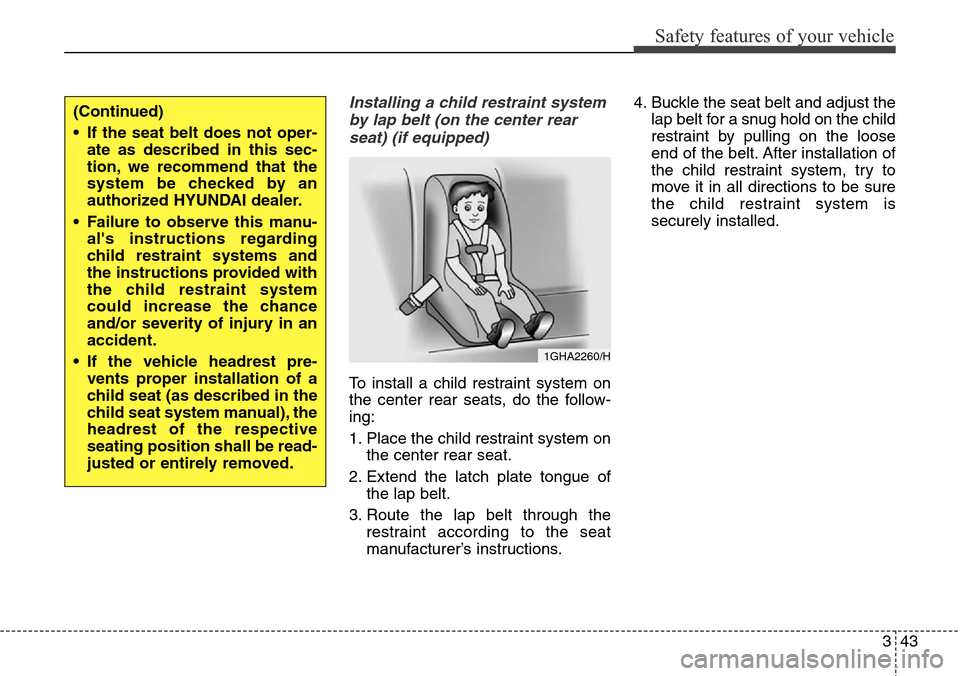
by lap belt (on the center rear
seat) (if equipped)
To install a child restraint system on
the center rear seats, do the follow-
ing:
1. Place the child restraint system on
the center rear seat.
2. Extend the latch plate tongue of
the lap belt.
3. Route the lap belt through the
restraint according to the seat
manufacturer’s instructions.4. Buckle the seat belt and adjust the
lap belt for a snug hold on the child
restraint by pulling on the loose
end of the belt. After installation of
the child restraint system, try to
move it in all directions to be sure
the child restraint system is
securely installed.
1GHA2260/H
(Continued)
• If the seat belt does not oper-
ate as described in this sec-
tion, we recommend that the
system be checked by an
authorized HYUNDAI dealer.
• Failure to observe this manu-
al's instructions regarding
child restraint systems and
the instructions provided with
the child restraint system
could increase the chance
and/or severity of injury in an
accident.
• If the vehicle headrest pre-
vents proper installation of a
child seat (as described in the
child seat system manual), the
headrest of the respective
seating position shall be read-
justed or entirely removed.
Page 63 of 483
Safety features of your vehicle
44 3
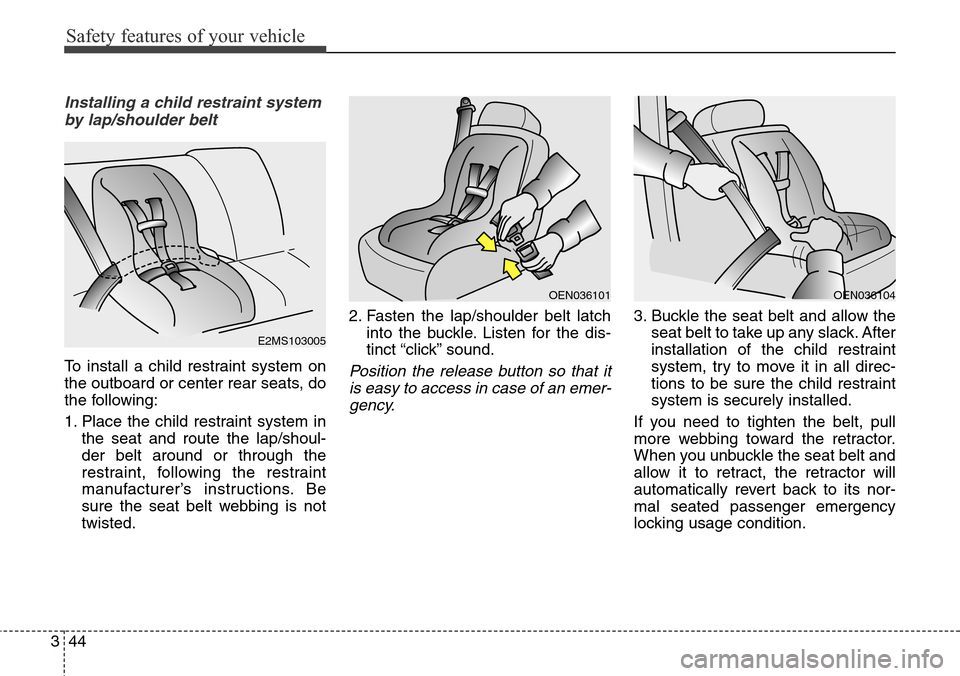
Installing a child restraint system
by lap/shoulder belt
To install a child restraint system on
the outboard or center rear seats, do
the following:
1. Place the child restraint system in
the seat and route the lap/shoul-
der belt around or through the
restraint, following the restraint
manufacturer’s instructions. Be
sure the seat belt webbing is not
twisted.2. Fasten the lap/shoulder belt latch
into the buckle. Listen for the dis-
tinct “click” sound.Position the release button so that it
is easy to access in case of an emer-
gency.
3. Buckle the seat belt and allow the
seat belt to take up any slack. After
installation of the child restraint
system, try to move it in all direc-
tions to be sure the child restraint
system is securely installed.
If you need to tighten the belt, pull
more webbing toward the retractor.
When you unbuckle the seat belt and
allow it to retract, the retractor will
automatically revert back to its nor-
mal seated passenger emergency
locking usage condition.
OEN036101OEN036104
E2MS103005
Page 64 of 483
345
Safety features of your vehicle
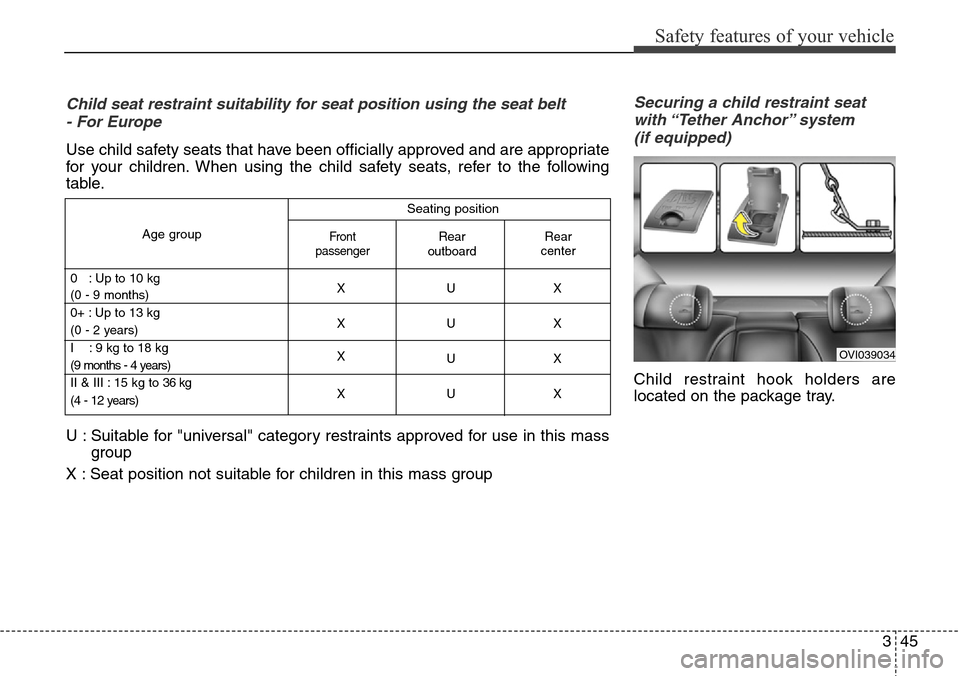
Securing a child restraint seat
with “Tether Anchor” system
(if equipped)
Child restraint hook holders are
located on the package tray.
Seating position
Age group
0 : Up to 10 kg
XUX
(0 - 9 months)
0+ : Up to 13 kg
XUX
(0 - 2 years)
I : 9 kg to 18 kg
X
UX(9 months - 4 years)
II & III : 15 kg to 36 kg
XUX
(4 - 12 years)
Front
passengerRear
outboardRear
center
Child seat restraint suitability for seat position using the seat belt
- For Europe
Use child safety seats that have been officially approved and are appropriate
for your children. When using the child safety seats, refer to the following
table.
OVI039034
U : Suitable for "universal" category restraints approved for use in this mass
group
X : Seat position not suitable for children in this mass group
Page 66 of 483
347
Safety features of your vehicle
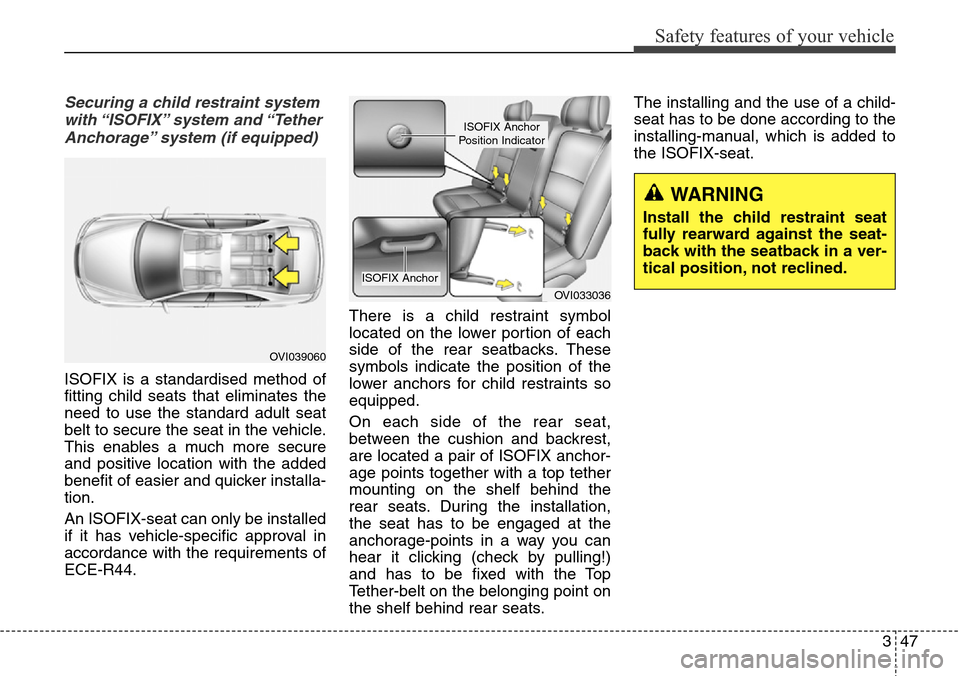
Securing a child restraint system
with “ISOFIX” system and “Tether
Anchorage” system (if equipped)
ISOFIX is a standardised method of
fitting child seats that eliminates the
need to use the standard adult seat
belt to secure the seat in the vehicle.
This enables a much more secure
and positive location with the added
benefit of easier and quicker installa-
tion.
An ISOFIX-seat can only be installed
if it has vehicle-specific approval in
accordance with the requirements of
ECE-R44.There is a child restraint symbol
located on the lower portion of each
side of the rear seatbacks. These
symbols indicate the position of the
lower anchors for child restraints so
equipped.
On each side of the rear seat,
between the cushion and backrest,
are located a pair of ISOFIX anchor-
age points together with a top tether
mounting on the shelf behind the
rear seats. During the installation,
the seat has to be engaged at the
anchorage-points in a way you can
hear it clicking (check by pulling!)
and has to be fixed with the Top
Tether-belt on the belonging point on
the shelf behind rear seats.The installing and the use of a child-
seat has to be done according to the
installing-manual, which is added to
the ISOFIX-seat.
OVI039060
OVI033036
ISOFIX Anchor
ISOFIX Anchor
Position Indicator
WARNING
Install the child restraint seat
fully rearward against the seat-
back with the seatback in a ver-
tical position, not reclined.
Page 67 of 483
Safety features of your vehicle
48 3
To secure the child restraint seat
1. To engage the child restraint seat
to the ISOFIX anchor, insert the
child restraint seat latch into the
ISOFIX anchor. Listen for the audi-
ble “click” sound.
2. Connect the tether strap hook to
the child restraint hook holder and
tighten to secure the seat. (Refer
to the previous page.)
WARNING
• When using the vehicle's
"ISOFIX" system to install a
child restraint system in the
rear seat, all unused vehicle
rear seat belt metal latch
plates or tabs must be latched
securely in their seat belt
buckles and the seat belt web-
bing must be retracted behind
the child restraint to prevent
the child from reaching and
taking hold of unretracted
seat belts. Unlatched metal
latch plates or tabs may allow
the child to reach the unre-
tracted seat belts which may
result in strangulation and a
serious injury or death to the
child in the child restraint.
• Do not place anything around
the lower anchors. Also make
sure that the seat belt is not
caught in the lower anchors.
CAUTION
Do not allow the rear seat belt
webbing to get scratched or
pinched by the ISOFIX-seat
latch and ISOFIX anchor during
the installation.
(Continued)
Do not misuse the ISOFIX
anchors by attempting to
attach a child restraint seat in
the middle of the rear seat to
the ISOFIX anchors. In a crash,
the child restraint seat ISOFIX
attachments may not be strong
enough to secure the child
restraint seat properly in the
center of the rear seat and may
break, causing serious injury
or death.
• Do not mount more than one
child restraint to a child
restraint lower anchorage
point. The improper increased
load may cause the anchorage
points or tether anchor to
break, causing serious injury
or death.
• Attach the ISOFIX or ISOFIX-
compatible child restraint seat
only to the appropriate loca-
tions shown in the illustration.
• Always follow the installation
and use instructions provided
by the manufacturer of the
child restraint.
WARNING
• Do not install a child restraint
seat at the center of the rear
seat using the vehicle's ISOFIX
anchors. The ISOFIX anchors
are only provided for the left
and right outboard rear seating
positions.
(Continued)
Page 68 of 483
349
Safety features of your vehicle
F ISO/L1 - X X -
G ISO/L2 - X X -
E ISO/R1 - IL IL -
E ISO/R1 - IL IL -
D ISO/R2 - IL IL -
C ISO/R3 - IL IL -
D ISO/R2 - IL IL -
C ISO/R3 - IL IL -
B ISO/F2 - IUF IUF -
B1 ISO/F2X - IUF IUF -
A ISO/F3 - IUF IUF -
Rear Outboard
(Passenger side) Rear Outboard
(Driver side) Front Passenger Fixture Size Class Mass Group
Carrycot
0 : UP to 10kg
0+ : UP to 13kg
I : 9 to 18kgRear Center Vehicle ISOFIX positions
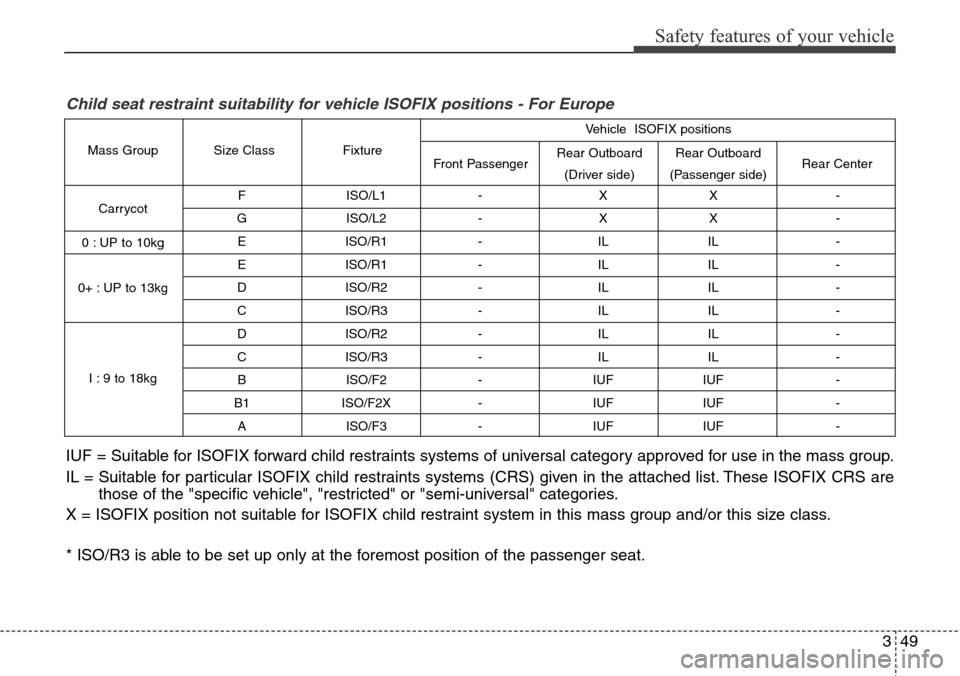
IUF = Suitable for ISOFIX forward child restraints systems of universal category approved for use in the mass group.
IL = Suitable for particular ISOFIX child restraints systems (CRS) given in the attached list. These ISOFIX CRS are
those of the "specific vehicle", "restricted" or "semi-universal" categories.
X = ISOFIX position not suitable for ISOFIX child restraint system in this mass group and/or this size class.
* ISO/R3 is able to be set up only at the foremost position of the passenger seat.
Child seat restraint suitability for vehicle ISOFIX positions - For Europe
Page 71 of 483
Safety features of your vehicle
52 3
Noise and smoke
When the air bags inflate, they make
a loud noise and they leave smoke
and powder in the air inside of the
vehicle. This is normal and is a result
of the ignition of the air bag inflator.
After the air bag inflates, you may
feel substantial discomfort in breath-
ing due to the contact of your chest
with both the seat belt and the air
bag, as well as from breathing the
smoke and powder.Open your
doors and/or windows as soon as
possible after impact in order to
reduce discomfort and prevent
prolonged exposure to the smoke
and powder.
Though the smoke and powder are
non-toxic, they may cause irritation
to the skin (eyes, nose and throat,
etc). If this is the case, wash and
rinse with cold water immediately
and consult a doctor if the symptom
persists.
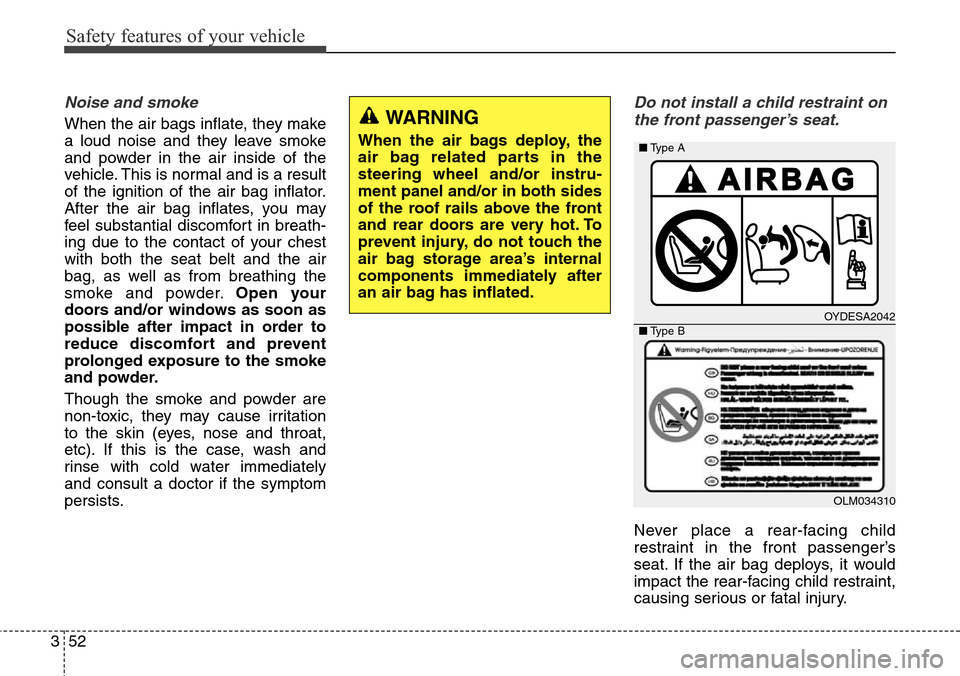
Do not install a child restraint on
the front passenger’s seat.
Never place a rear-facing child
restraint in the front passenger’s
seat. If the air bag deploys, it would
impact the rear-facing child restraint,
causing serious or fatal injury.
WARNING
When the air bags deploy, the
air bag related parts in the
steering wheel and/or instru-
ment panel and/or in both sides
of the roof rails above the front
and rear doors are very hot. To
prevent injury, do not touch the
air bag storage area’s internal
components immediately after
an air bag has inflated.
OYDESA2042
OLM034310 ■Type A
■Type B
Page 72 of 483
353
Safety features of your vehicle
In addition, do not place front-facing
child restraints in the front passen-
ger’s seat either. If the front passen-
ger air bag inflates, it could cause
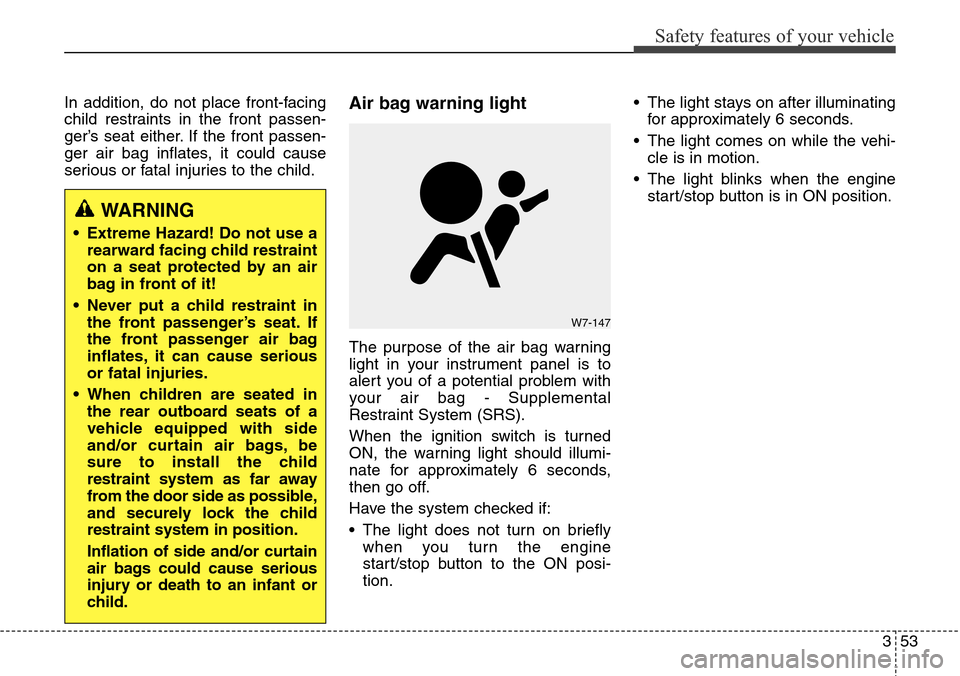
serious or fatal injuries to the child.Air bag warning light
The purpose of the air bag warning
light in your instrument panel is to
alert you of a potential problem with
your air bag - Supplemental
Restraint System (SRS).
When the ignition switch is turned
ON, the warning light should illumi-
nate for approximately 6 seconds,
then go off.
Have the system checked if:
• The light does not turn on briefly
when you turn the engine
start/stop button to the ON posi-
tion.• The light stays on after illuminating
for approximately 6 seconds.
• The light comes on while the vehi-
cle is in motion.
• The light blinks when the engine
start/stop button is in ON position.
WARNING
• Extreme Hazard! Do not use a
rearward facing child restraint
on a seat protected by an air
bag in front of it!
• Never put a child restraint in
the front passenger’s seat. If
the front passenger air bag
inflates, it can cause serious
or fatal injuries.
• When children are seated in
the rear outboard seats of a
vehicle equipped with side
and/or curtain air bags, be
sure to install the child
restraint system as far away
from the door side as possible,
and securely lock the child
restraint system in position.
Inflation of side and/or curtain
air bags could cause serious
injury or death to an infant or
child.
W7-147