Seat Hyundai Equus 2015 Owner's Manual
[x] Cancel search | Manufacturer: HYUNDAI, Model Year: 2015, Model line: Equus, Model: Hyundai Equus 2015Pages: 483, PDF Size: 13.26 MB
Page 12 of 483
15
Introduction
Do not use methanol
Fuels containing methanol (wood
alcohol) should not be used in your
vehicle. This type of fuel can reduce
vehicle performance and damage
components of the fuel system,
engine control system and emission
control system.
Fuel Additives
HYUNDAI recommends that you use
unleaded gasoline which has an
octane rating of RON (Research
Octane Number) 95 / AKI (Anti Knock
Index) 91 or higher (for Europe) or
Octane Rating of RON (Research
Octane Number) 91 / AKI (Anti-Knock
Index) 87 or higher (except Europe).
For customers who do not use good
quality gasoline including fuel addi-
tives regularly, and have problems
starting or the engine does not run
smoothly, one bottle of additives
added to the fuel tank at every
15,000km (for Europe)/5,000km
(except Europe). Additives are avail-
able from your authorized HYUNDAI
dealer along with information on how
to use them.
Operation in foreign countries
If you are going to drive your vehicle
in another country, be sure to:
• Observe all regulations regarding
registration and insurance.
• Determine that acceptable fuel is
available.No special break-in period is need-
ed. By following a few simple precau-
tions for the first 1,000 km (600 miles)
you may add to the performance,
economy and life of your vehicle.
• Do not race the engine.
• While driving, keep your engine
speed (rpm, or revolutions per
minute) between 2,000 rpm and
4,000 rpm.
• Do not maintain a single speed for
long periods of time, either fast or
slow. Varying engine speed is
needed to properly break-in the
engine.
• Avoid hard stops, except in emer-
gencies, to allow the brakes to seat
properly.
• Don't tow a trailer during the first
2,000 km (1,200 miles) of opera-
tion.
VEHICLE BREAK-IN
PROCESS
Page 16 of 483
Your vehicle at a glance
4 2
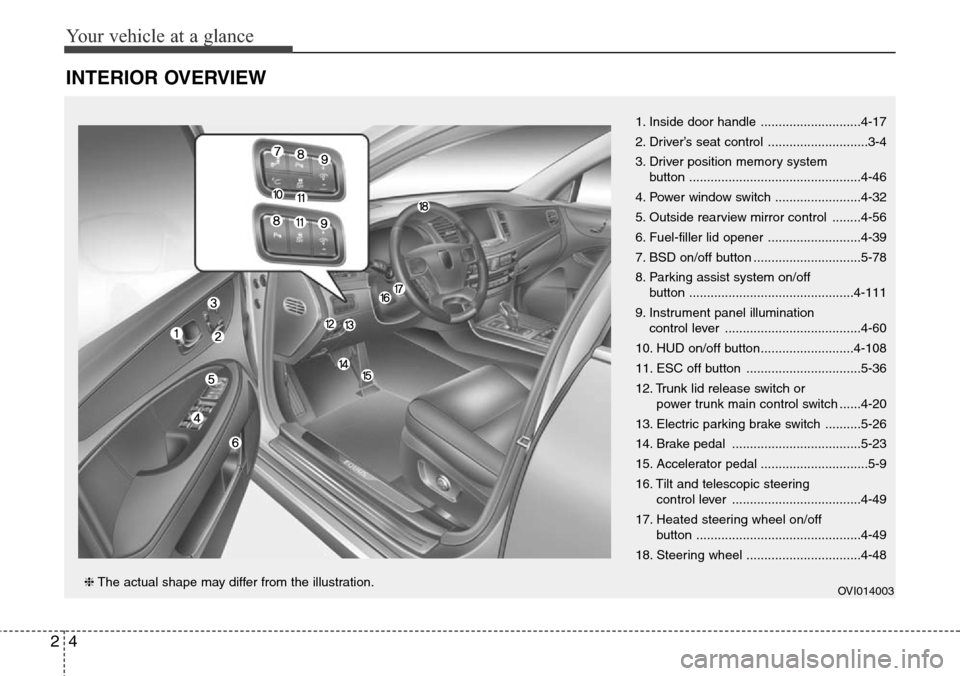
INTERIOR OVERVIEW
1. Inside door handle ............................4-17
2. Driver’s seat control ............................3-4
3. Driver position memory system
button ................................................4-46
4. Power window switch ........................4-32
5. Outside rearview mirror control ........4-56
6. Fuel-filler lid opener ..........................4-39
7. BSD on/off button ..............................5-78
8. Parking assist system on/off
button ..............................................4-111
9. Instrument panel illumination
control lever ......................................4-60
10. HUD on/off button..........................4-108
11. ESC off button ................................5-36
12. Trunk lid release switch or
power trunk main control switch ......4-20
13. Electric parking brake switch ..........5-26
14. Brake pedal ....................................5-23
15. Accelerator pedal ..............................5-9
16. Tilt and telescopic steering
control lever ....................................4-49
17. Heated steering wheel on/off
button ..............................................4-49
18. Steering wheel ................................4-48
OVI014003❈The actual shape may differ from the illustration.
Page 17 of 483
25
Your vehicle at a glance
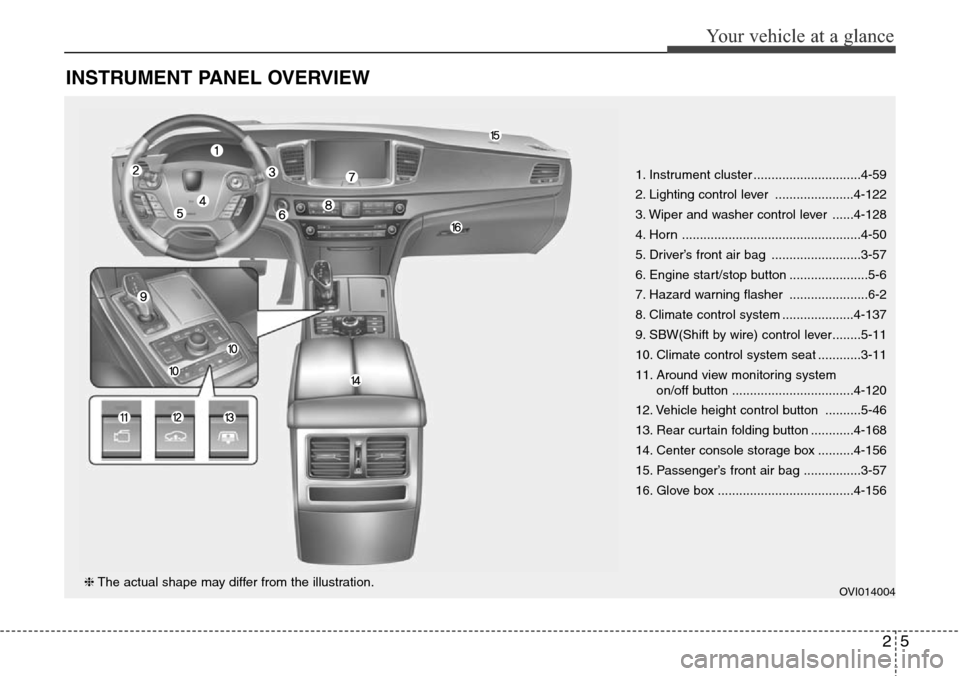
INSTRUMENT PANEL OVERVIEW
1. Instrument cluster ..............................4-59
2. Lighting control lever ......................4-122
3. Wiper and washer control lever ......4-128
4. Horn ..................................................4-50
5. Driver’s front air bag .........................3-57
6. Engine start/stop button ......................5-6
7. Hazard warning flasher ......................6-2
8. Climate control system ....................4-137
9. SBW(Shift by wire) control lever........5-11
10. Climate control system seat ............3-11
11. Around view monitoring system
on/off button ..................................4-120
12. Vehicle height control button ..........5-46
13. Rear curtain folding button ............4-168
14. Center console storage box ..........4-156
15. Passenger’s front air bag ................3-57
16. Glove box ......................................4-156
OVI014004❈The actual shape may differ from the illustration.
Page 20 of 483
Safety features of your vehicle
Seats . . . . . . . . . . . . . . . . . . . . . . . . . . . . . . . . . . . . . 3-2
• Front seat adjustment . . . . . . . . . . . . . . . . . . . . . . . . . . 3-4
• Rear seat adjustment . . . . . . . . . . . . . . . . . . . . . . . . . 3-13
Seat belts . . . . . . . . . . . . . . . . . . . . . . . . . . . . . . . . . 3-27
• Seat belt restraint system . . . . . . . . . . . . . . . . . . . . . . 3-27
• Pre-tensioner seat belt . . . . . . . . . . . . . . . . . . . . . . . . 3-33
• Pre-Safe Seat belt (PSB) . . . . . . . . . . . . . . . . . . . . . . . 3-36
• Seat belt precautions . . . . . . . . . . . . . . . . . . . . . . . . . . 3-37
• Care of seat belts . . . . . . . . . . . . . . . . . . . . . . . . . . . . . 3-39
Child restraint system . . . . . . . . . . . . . . . . . . . . . . 3-40
• Using a child restraint system . . . . . . . . . . . . . . . . . . 3-42
Air bag - supplemental restraint system . . . . . . . 3-50
• How does the air bag system operate . . . . . . . . . . . . 3-51
• Air bag warning light . . . . . . . . . . . . . . . . . . . . . . . . . 3-53
• SRS components and functions . . . . . . . . . . . . . . . . . 3-54
• Driver's and passenger's front air bag . . . . . . . . . . . 3-57
• Side impact air bag . . . . . . . . . . . . . . . . . . . . . . . . . . 3-60
• Curtain air bag . . . . . . . . . . . . . . . . . . . . . . . . . . . . . . 3-62
• SRS Care . . . . . . . . . . . . . . . . . . . . . . . . . . . . . . . . . . . 3-68
• Air bag warning label . . . . . . . . . . . . . . . . . . . . . . . . . 3-70
3
Page 21 of 483
Safety features of your vehicle
2 3
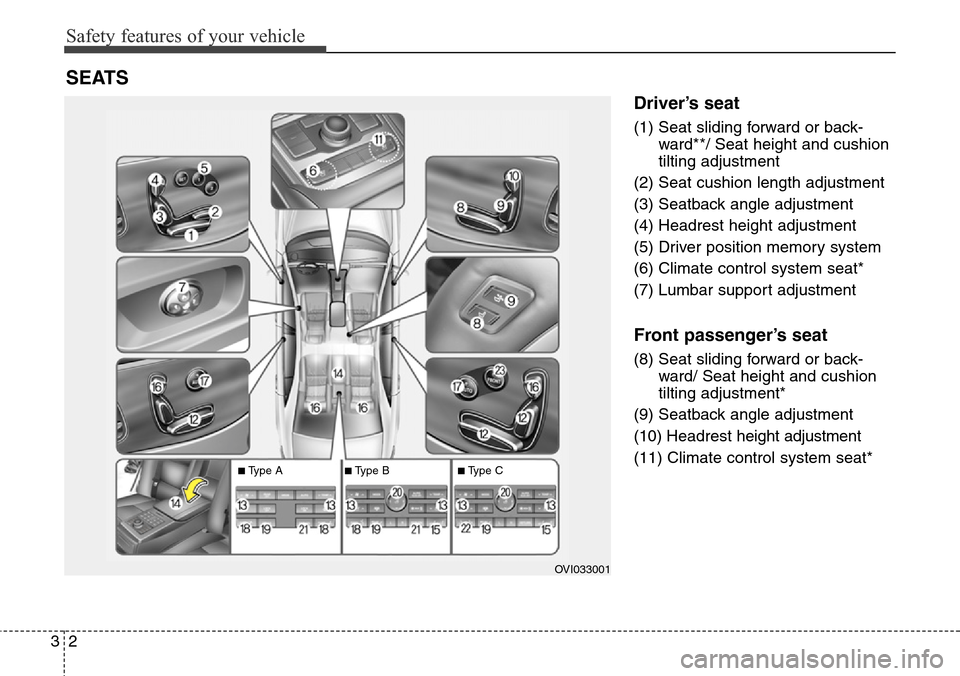
Driver’s seat
(1) Seat sliding forward or back-
ward**/ Seat height and cushion
tilting adjustment
(2) Seat cushion length adjustment
(3) Seatback angle adjustment
(4) Headrest height adjustment
(5) Driver position memory system
(6) Climate control system seat*
(7) Lumbar support adjustment
Front passenger’s seat
(8) Seat sliding forward or back-
ward/ Seat height and cushion
tilting adjustment*
(9) Seatback angle adjustment
(10) Headrestheight adjustment
(11) Climate control system seat*
SEATS
OVI033001
■Type A■Type B■Type C
Page 22 of 483
33
Safety features of your vehicle
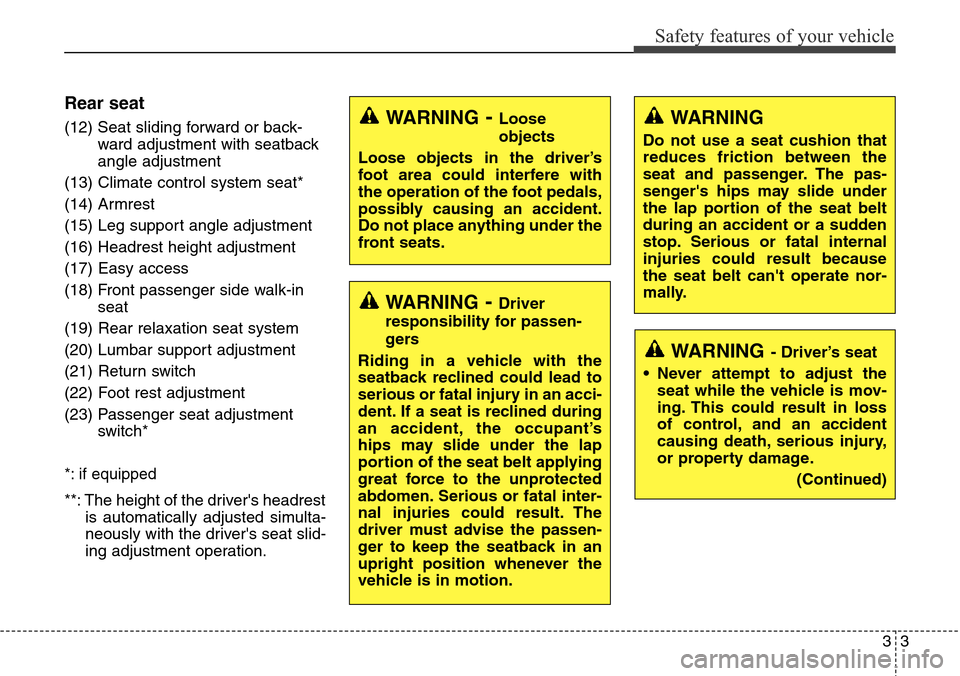
Rear seat
(12) Seat sliding forward or back-
ward adjustment with seatback
angle adjustment
(13) Climate control system seat*
(14) Armrest
(15) Leg support angle adjustment
(16) Headrest height adjustment
(17) Easy access
(18) Front passenger side walk-in
seat
(19) Rear relaxation seat system
(20) Lumbar support adjustment
(21) Return switch
(22) Foot rest adjustment
(23) Passenger seat adjustment
switch*
*: if equipped
**: The height of the driver's headrest
is automatically adjusted simulta-
neously with the driver's seat slid-
ing adjustment operation.
WARNING- Loose
objects
Loose objects in the driver’s
foot area could interfere with
the operation of the foot pedals,
possibly causing an accident.
Do not place anything under the
front seats.
WARNING- Driver
responsibility for passen-
gers
Riding in a vehicle with the
seatback reclined could lead to
serious or fatal injury in an acci-
dent. If a seat is reclined during
an accident, the occupant’s
hips may slide under the lap
portion of the seat belt applying
great force to the unprotected
abdomen. Serious or fatal inter-
nal injuries could result. The
driver must advise the passen-
ger to keep the seatback in an
upright position whenever the
vehicle is in motion.
WARNING
Do not use a seat cushion that
reduces friction between the
seat and passenger. The pas-
senger's hips may slide under
the lap portion of the seat belt
during an accident or a sudden
stop. Serious or fatal internal
injuries could result because
the seat belt can't operate nor-
mally.
WARNING- Driver’s seat
• Never attempt to adjust the
seat while the vehicle is mov-
ing. This could result in loss
of control, and an accident
causing death, serious injury,
or property damage.
(Continued)
Page 23 of 483
Safety features of your vehicle
4 3
Front seat adjustment
The front seat can be adjusted by
using the control switch located on
the doors. Before driving, adjust the
seat to the proper position so as to
easily control the steering wheel,
pedals and switches on the instru-
ment panel.WARNING
• Do not adjust the seat while
wearing seat belts. Moving the
seat cushion forward may
cause strong pressure on the
abdomen.
• Use extreme caution so that
hands or other objects are not
caught in the seat mechanisms
while the seat is moving.
• Do not put a cigarette lighter
on the floor or seat. When you
operate the seat, gas may gush
out of the lighter and cause
fire.
• Use extreme caution when
picking small objects trapped
under the seats or between the
seat and the center console.
Your hands might be cut or
injured by the sharp edges of
the seat mechanism.
• If there are occupants in the
rear seats, be careful while
adjusting the front seat posi-
tion.
(Continued)
• Do not allow anything to inter-
fere with the normal position
of the seatback. Storing items
against a seatback or in any
other way interfering with
proper locking of a seatback
could result in serious or fatal
injury in a sudden stop or col-
lision.
• Always drive and ride with
your seatback upright and the
lap portion of the seat belt
snug and low across the hips.
This is the best position to
protect you in case of an acci-
dent.
• In order to avoid unnecessary
and perhaps severe air bag
injuries, always sit as far back
as possible from the steering
wheel while maintaining com-
fortable control of the vehicle.
We recommend that your
chest be at least 250 mm (10
inches) away from the steer-
ing wheel.
WARNING
The power seat is operable with
the engine start/stop button in
OFF.
Therefore, children should never
be left unattended in the vehicle.
Page 24 of 483
35
Safety features of your vehicle
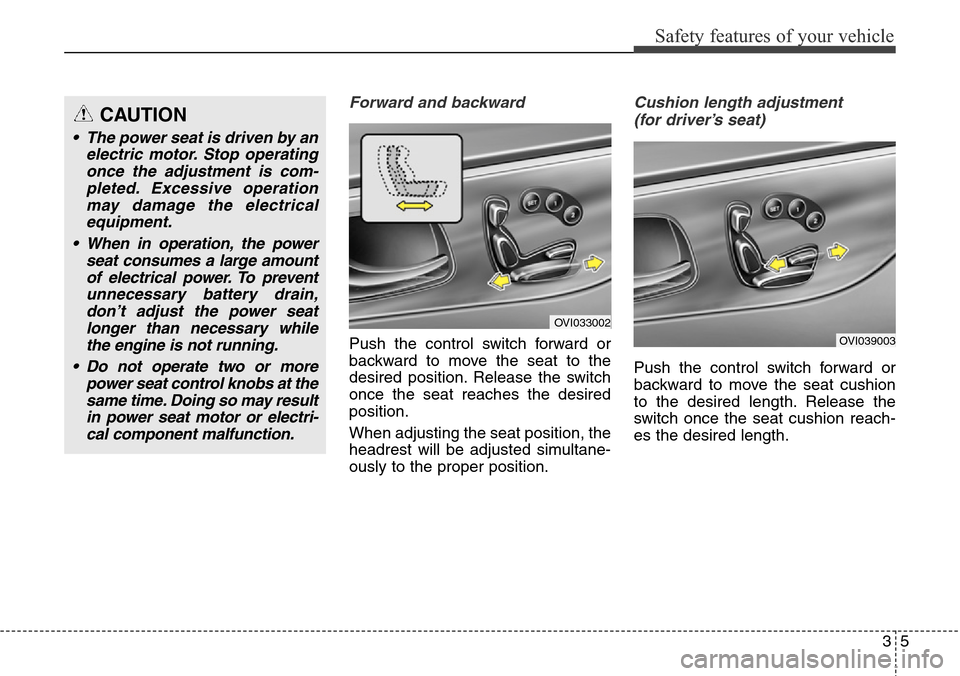
Forward and backward
Push the control switch forward or
backward to move the seat to the
desired position. Release the switch
once the seat reaches the desired
position.
When adjusting the seat position, the
headrest will be adjusted simultane-
ously to the proper position.
Cushion length adjustment
(for driver’s seat)
Push the control switch forward or
backward to move the seat cushion
to the desired length. Release the
switch once the seat cushion reach-
es the desired length.
CAUTION
• The power seat is driven by an
electric motor. Stop operating
once the adjustment is com-
pleted. Excessive operation
may damage the electrical
equipment.
• When in operation, the power
seat consumes a large amount
of electrical power. To prevent
unnecessary battery drain,
don’t adjust the power seat
longer than necessary while
the engine is not running.
• Do not operate two or more
power seat control knobs at the
same time. Doing so may result
in power seat motor or electri-
cal component malfunction.
OVI033002
OVI039003
Page 25 of 483
Safety features of your vehicle
6 3
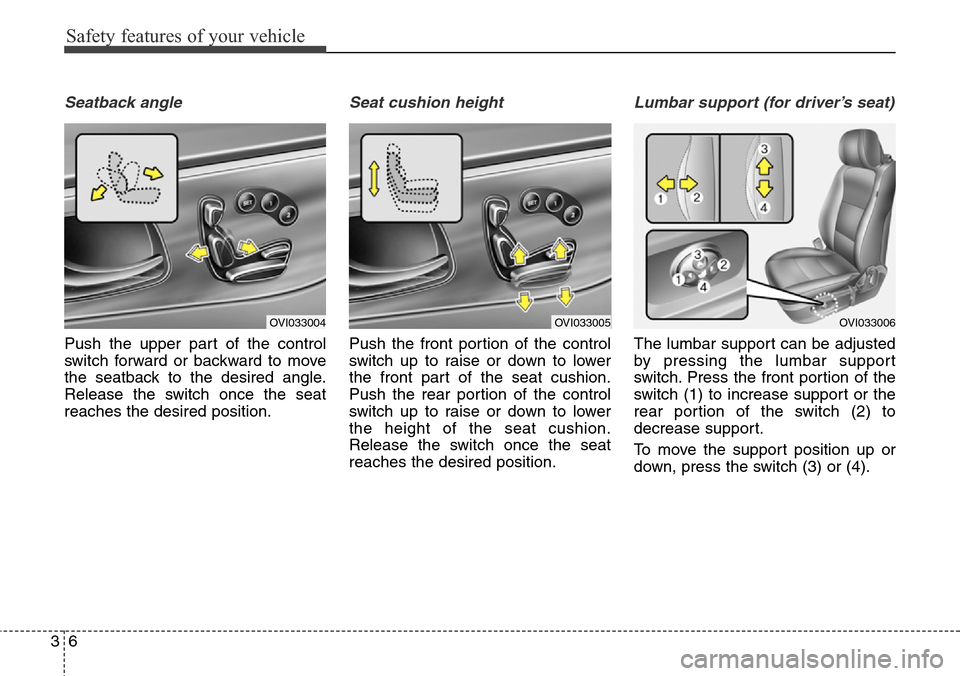
Seatback angle
Push the upper part of the control
switch forward or backward to move
the seatback to the desired angle.
Release the switch once the seat
reaches the desired position.
Seat cushion height
Push the front portion of the control
switch up to raise or down to lower
the front part of the seat cushion.
Push the rear portion of the control
switch up to raise or down to lower
the height of the seat cushion.
Release the switch once the seat
reaches the desired position.
Lumbar support (for driver’s seat)
The lumbar support can be adjusted
by pressing the lumbar support
switch. Press the front portion of the
switch (1) to increase support or the
rear portion of the switch (2) to
decrease support.
To move the support position up or
down, press the switch (3) or (4).
OVI033004OVI033005OVI033006
Page 26 of 483
37
Safety features of your vehicle
Headrest
The driver's and front passenger's
seats are equipped with a headrest
for the occupant's safety and com-
for t.
The headrest not only provides com-
fort for the driver and front passen-
ger, but also helps to protect the
head and neck in the event of a colli-
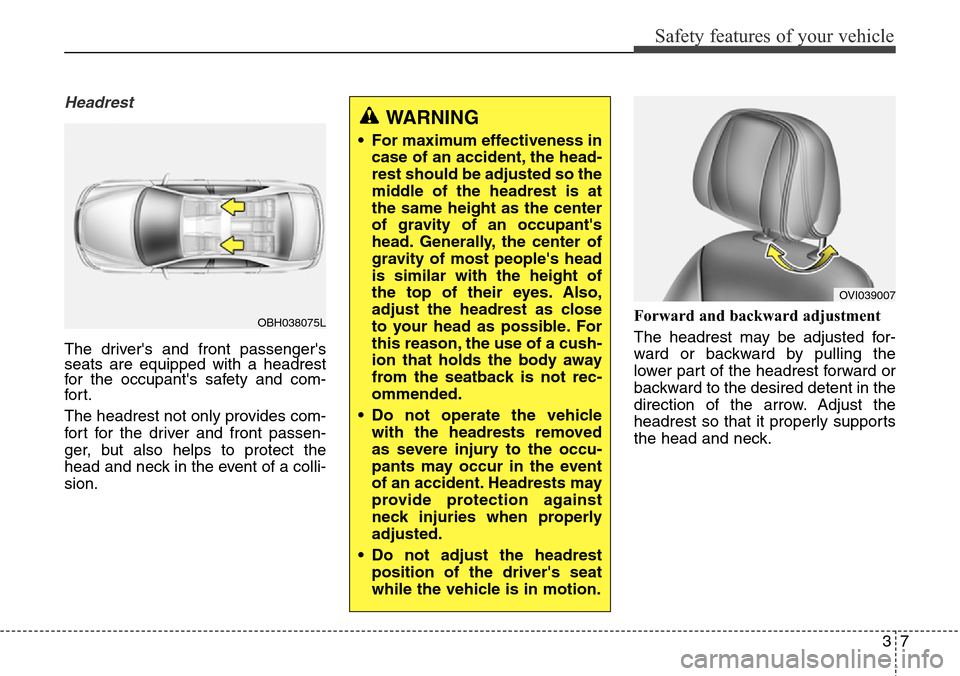
sion.Forward and backward adjustment
The headrest may be adjusted for-
ward or backward by pulling the
lower part of the headrest forward or
backward to the desired detent in the
direction of the arrow. Adjust the
headrest so that it properly supports
the head and neck.
OBH038075L
WARNING
• For maximum effectiveness in
case of an accident, the head-
rest should be adjusted so the
middle of the headrest is at
the same height as the center
of gravity of an occupant's
head. Generally, the center of
gravity of most people's head
is similar with the height of
the top of their eyes. Also,
adjust the headrest as close
to your head as possible. For
this reason, the use of a cush-
ion that holds the body away
from the seatback is not rec-
ommended.
• Do not operate the vehicle
with the headrests removed
as severe injury to the occu-
pants may occur in the event
of an accident. Headrests may
provide protection against
neck injuries when properly
adjusted.
• Do not adjust the headrest
position of the driver's seat
while the vehicle is in motion.
OVI039007