maintenance Hyundai Equus 2016 Owners Manual
[x] Cancel search | Manufacturer: HYUNDAI, Model Year: 2016, Model line: Equus, Model: Hyundai Equus 2016Pages: 477, PDF Size: 16.25 MB
Page 438 of 477
7-81
Maintenance07
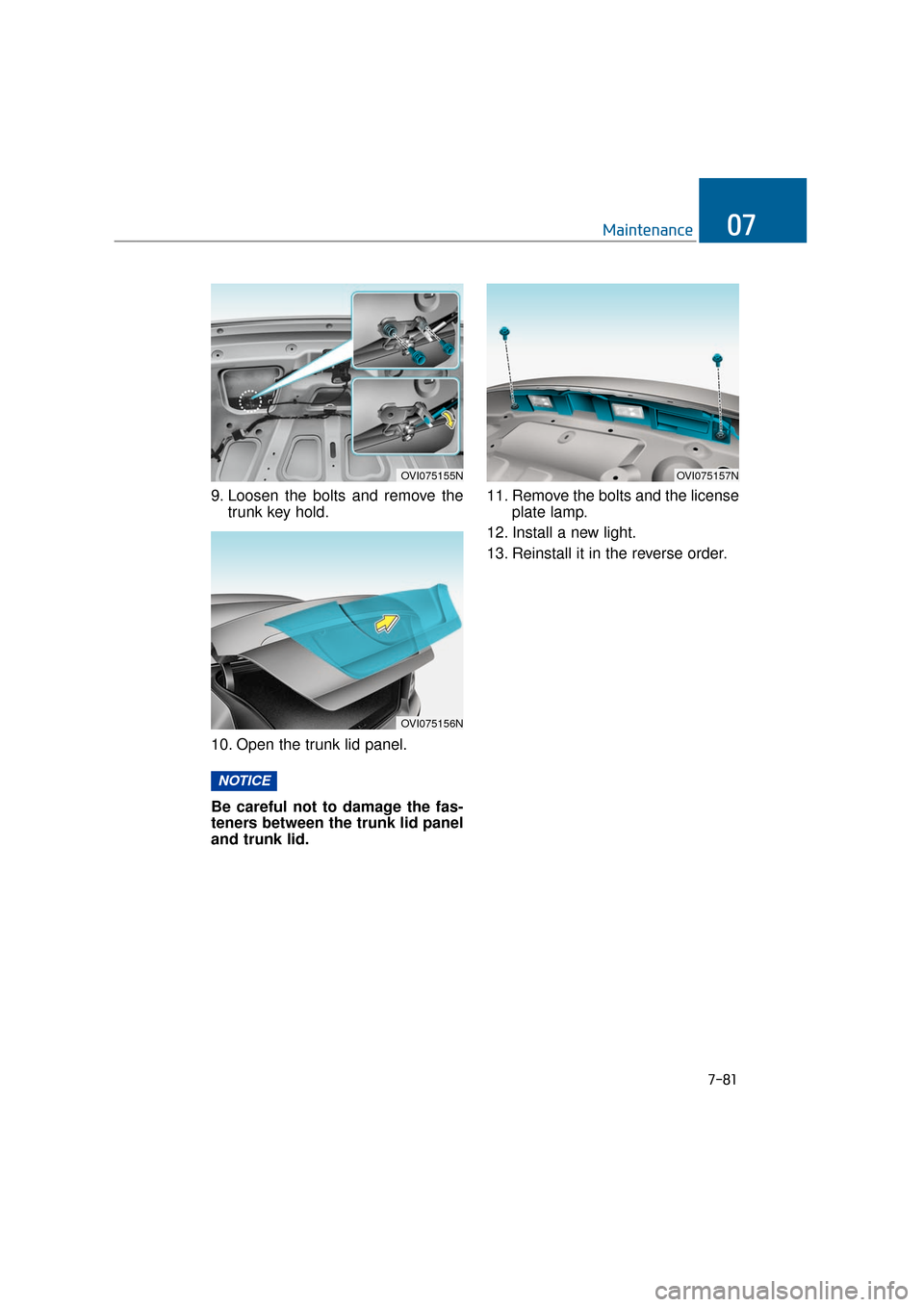
9. Loosen the bolts and remove thetrunk key hold.
10. Open the trunk lid panel.
Be careful not to damage the fas-
teners between the trunk lid panel
and trunk lid. 11. Remove the bolts and the license
plate lamp.
12. Install a new light.
13. Reinstall it in the reverse order.
NOTICE
OVI075155N
OVI075156N
OVI075157N
Page 439 of 477
7-82
Maintenance
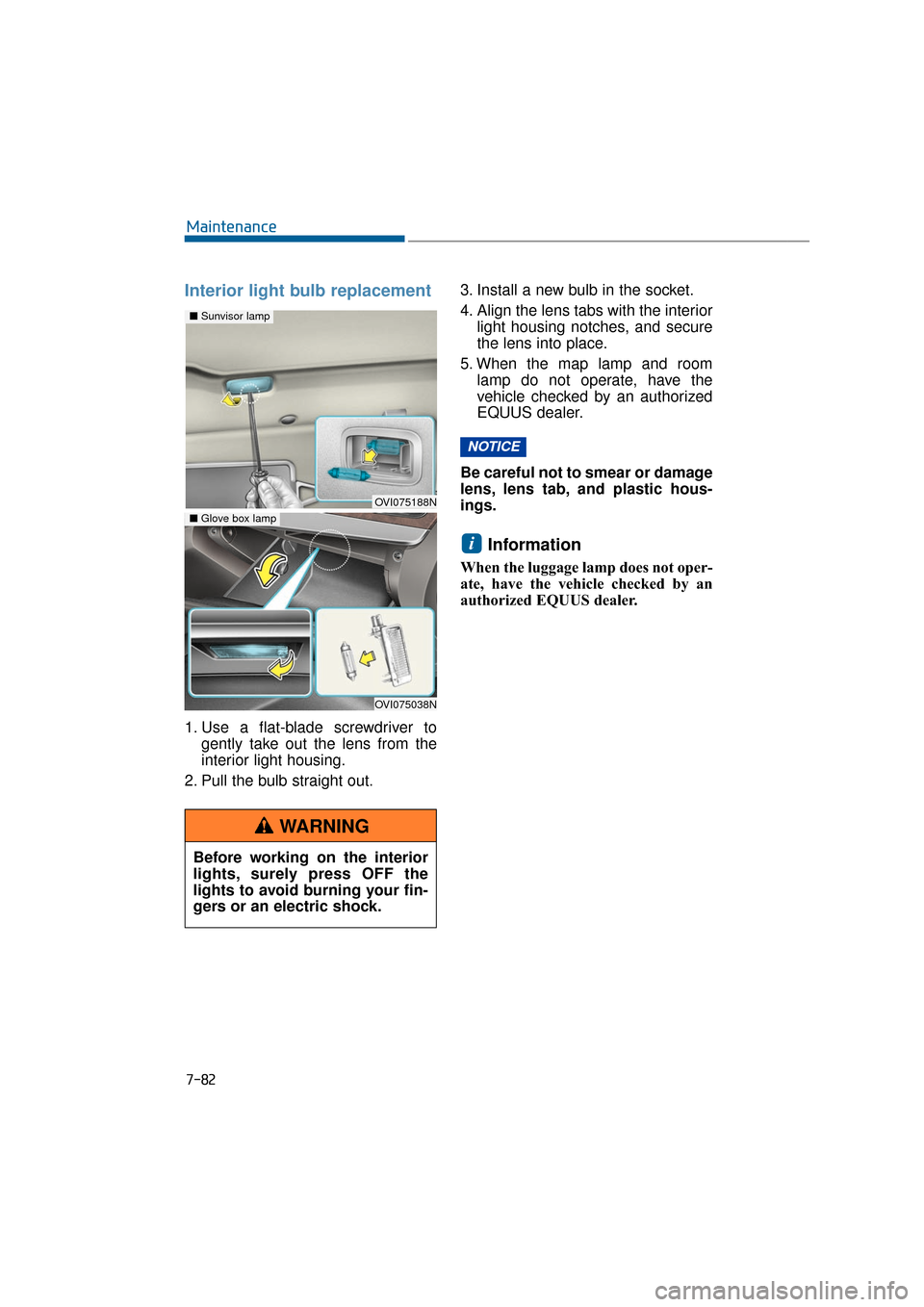
Interior light bulb replacement
1. Use a flat-blade screwdriver togently take out the lens from the
interior light housing.
2. Pull the bulb straight out. 3. Install a new bulb in the socket.
4. Align the lens tabs with the interior
light housing notches, and secure
the lens into place.
5. When the map lamp and room lamp do not operate, have the
vehicle checked by an authorized
EQUUS dealer.
Be careful not to smear or damage
lens, lens tab, and plastic hous-
ings.
Information
When the luggage lamp does not oper-
ate, have the vehicle checked by an
authorized EQUUS dealer.
i
NOTICE
OVI075188N
■ Sunvisor lamp
OVI075038N
■Glove box lamp
Before working on the interior
lights, surely press OFF the
lights to avoid burning your fin-
gers or an electric shock.
WARNING
Page 440 of 477
7-83
Maintenance07
A
AP
PP
PE
EA
A R
RA
A N
N C
CE
E
C
C A
A R
RE
E
Exterior care
Exterior general caution
It is very important to follow the label
directions when using any chemical
cleaner or polish. Read all the warn-
ings and cautions on the label.
High-pressure washing
• When using high-pressure wash-
ers, make sure to maintain suffi-
cient distance from the vehicle.
Insufficient clearance or excessive
pressure can lead to component
damage or water penetration.
Do not spray the camera, sensors or its surrounding area directly with
a high pressure washer. Shock
applied from high pressure water
may cause the device to not oper-
ate normally.
Do not bring the nozzle tip close to boots (rubber or plastic covers) or
connectors as they may be dam-
aged if they come into contact with
high pressure water.
Finish maintenance
Washing
To protect your vehicle’s paint from
rust and deterioration, thoroughly
wash the vehicle at least once a
month with lukewarm or cold water.
After each off-road driving, you
should wash the vehicle. Pay special
attention to removing any salty and
muddy substances. Make sure the
drain holes on the lower door edges
and on the rocker panels are kept
clear and clean. Insects, tar, tree sap, bird droppings,
industrial pollutants and similar
deposits damage your vehicle’s fin-
ish, if not immediately removed.
Even prompt washing with plain
water may not completely remove all
these deposits. A mild soap, which is
safe for a painted surface, may be
used.
After soaping, thoroughly rinse the
vehicle body with lukewarm or cold
water. Do not allow soap to dry on
the finish.
• Do not use strong soap, chemical detergents or hot
water. Do not wash the vehicle
when it is under direct sun-
light, or when its body is
warm.
Be careful when washing the side windows of your vehicle.
Especially, with high-pressure
water, water may penetrate
into the windows and wet the
interior.
To prevent damage to plastic parts and lamps, do not wash
the vehicle with chemical sol-
vents or strong detergents.
CAUTION
- Wet brakes
After washing the vehicle, test
the brake operations to check
whether it is affected by water.
When the braking performance
is deteriorated, dry the brakes
by lightly applying them and
driving forward at a slow speed.
WARNING
Page 441 of 477
7-84
Maintenance
Waxing
A good coat of wax bars contamina-
tion from the vehicle paint. Maintain a
good coat of wax on your vehicle to
protect it.
Wax the vehicle when the wax polish
vanishes.
Always wash and dry the vehicle
before waxing. Use a good quality
liquid or paste wax, and follow the
manufacturer’s instructions. Wax all
metal trim to protect it and to main-
tain its luster.A spot remover, which removes oil,
tar, and other similar materials, peels
off the wax coating from the finish.
Make sure to re-wax these areas,
even when the rest of the vehicle
does not need be waxed.
Finish damage repair
Deep scratches or stone chips on the
paint must be repaired in a prompt
manner. Any exposed metal area
quickly gets rusty, and repairing it
may cost a lot.
Information
When your vehicle requires any metal
repair or replacement after damage,
make sure the body shop applies anti-
corrosion materials to the parts to be
repaired or to be replaced.
i
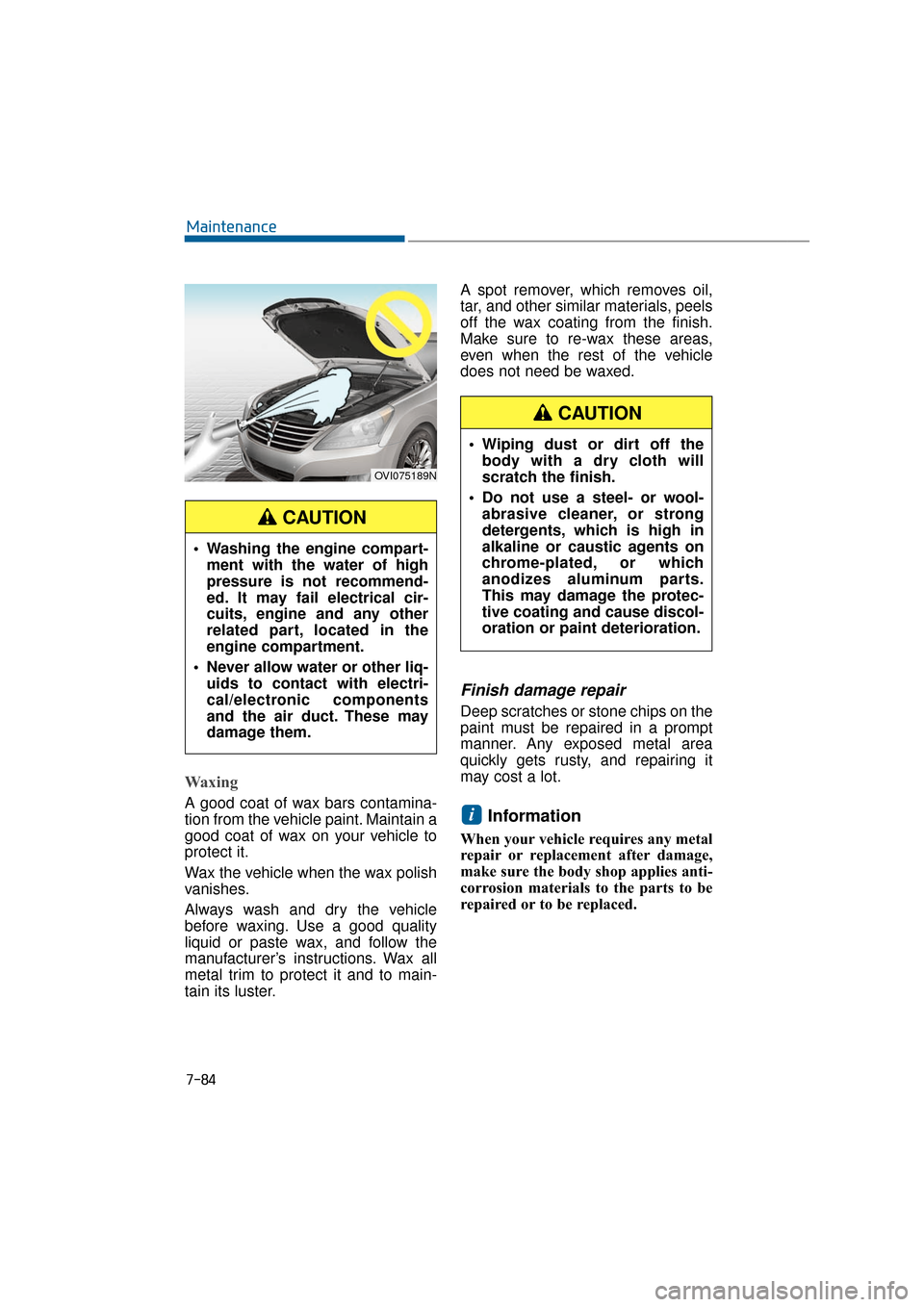
Washing the engine compart-
ment with the water of high
pressure is not recommend-
ed. It may fail electrical cir-
cuits, engine and any other
related part, located in the
engine compartment.
Never allow water or other liq- uids to contact with electri-
cal/electronic components
and the air duct. These may
damage them.
CAUTION
Wiping dust or dirt off thebody with a dry cloth will
scratch the finish.
Do not use a steel- or wool- abrasive cleaner, or strong
detergents, which is high in
alkaline or caustic agents on
chrome-plated, or which
anodizes aluminum parts.
This may damage the protec-
tive coating and cause discol-
oration or paint deterioration.
CAUTION
OVI075189N
Page 442 of 477
7-85
Maintenance07
Bright-metal maintenance
Use a tar remover to remove roadtar and insects, not scraping or
using a sharp object.
To protect a bright metal surface from corrosion, apply a coat of wax
or chrome preservative, or polish
the surface.
In winter or in coastal areas, apply a bright metal part with a heavy
coat of wax or preservative. If nec-
essary, coat the part with non-cor-
rosive petroleum jelly or other pro-
tective compound.
Underbody maintenance
Corrosive materials, which are used
to remove ice, snow or dusts, may
accumulate across the vehicle
underbody. When these materials
are not promptly removed, rusting
process may accelerate across the
underbody, such as the fuel lines,
frame, floor pan and exhaust system,
regardless of the rust-protection
treatment.
Thoroughly wash the vehicle under-
body and wheel openings with luke-
warm or cold water once a month,
after driving off a road, or after the
winter season. Pay special attention
to the underbody areas to find any
mud or dirt. Remaining road dirt or
grime across the vehicle underbody
does more harm than good. The
lower edges of doors, rocker panels,
and frame members have drain
holes, which should not be clogged
with dirt; clogging in these areas may
cause rusting.
Aluminum wheel maintenance
The aluminum wheels are coated
with a clear protective finish.
Do not use any abrasive cleaner,polishing compound, solvent, or
wire brushes on aluminum wheels.
They may scratch or damage the
finish.
Clean the wheel, while it is cool.
Use only a mild soap or neutral detergent, and thoroughly rinse
with water. Also, always clean the
wheels after driving on a salted
road. This prevents corrosion.
Avoid washing the wheels with an automatic high-speed washing
brush.
Do not use any alkaline or acid detergent. It may damage and cor-
rode the aluminum wheels coated
with a clear protective finish.
After washing the vehicle, test
the brakes by slowly applying
them to check whether they are
affected by water. When braking
performance is impaired, dry
the brakes by lightly applying
them while driving forward at a
slow speed.
WARNING
Page 443 of 477
7-86
Maintenance
Corrosion protection
Protecting your vehicle from corro-
sion
HYUNDAI produces a vehicle of the
highest quality by using the most
advanced design and construction
practices to combat corrosion.
However, this is only one part of anti-
corrosion resistance practices. To
achieve a long-term corrosion resist-
ance of your vehicle, your coopera-
tion and assistance are required.
Common causes of corrosion
The followings are the most common
causes of corrosion:
accumulate across the vehicle
underbody.
to corrosion due to the removal of
paint or protective coat, possibly by
a stone, gravel, abrasion, minor
scrape, or dent.
High-corrosion areas
In an area, where your vehicle is reg-
ularly exposed to corrosive materi-
als, an anti-corrosion measure is
particularly important. Some of the
common causes of instant vehicle
corrosion are road salts, dust, chem-
icals, salty air and industrial pollu-
tants.
Moisture breeds corrosion
Moisture creates a condition in which
corrosion is most likely to occur. For
example, a corrosion process is
accelerated by high humidity, partic-
ularly when a temperature is just
above the freezing point. In such
condition, the vehicle surface is kept
in contact with moisture that is slow
to evaporate.
Mud is particularly corrosive
because it is slow to dry and holds
moisture in contact with the vehicle.
Although the mud appears to be dry,
it may still retain some moisture
inside and promote corrosion.
A high temperature also accelerates
a corrosion process, when the air is
unventilated, and when the moisture
pervades. For all these reasons, it is
particularly important to keep your
vehicle clean, and remove mud or
any other accumulated substances.
This applies not only to the visible
surfaces but particularly to the vehi-
cle underbody.
To help prevent corrosion
You can prevent corrosion from the
start by following the below precau-
tions.
Page 444 of 477
7-87
Maintenance07
Keep your car clean
The best way to prevent corrosion is
to keep your vehicle clean and free
of corrosive materials. Constant
attention to the underbody is particu-
larly important.
In an area, which is high in corro-sive materials, such as salts on a
road, salty air, industrial pollutants,
acid rain, you should take extra
care to prevent corrosion. In winter,
wash off the underbody at least
once a month and make sure to
clean the underbody when the win-
ter is over.
When cleaning the vehicle under- body, give particular attention to
the components, such as fenders,
which are hidden underneath.
Thoroughly wash the vehicle.
When you just damp the under-
body, across which mud is accu-
mulated, without washing off the
mud, accelerates corrosion, rather
than preventing it. High-pressure
water and steam are particularly
effective in removing accumulated
mud and corrosive materials.
When cleaning lower door panels, rocker panels and frame members,
make sure that drain holes are kept
clean. Thus moisture can evapo-
rate, without being trapped inside
to accelerate corrosion. Keep your garage dry
Do not park your vehicle in a damp or
unventilated garage. This creates the
environment, which is favorable to
corrosion. This is particularly true,
when you wash your vehicle in a
garage, when the garage is still wet,
or when the garage is covered with
snow, ice, or mud. Even, a high tem-
perature of a garage may accelerate
corrosion, until it is properly ventilat-
ed, and moisture evaporates.
Keep paint and trim in good condi-
tion
Scratches or chips over the finish
should be immediately covered with
a "touch-up" paint to prevent corro-
sion. When the bare metal is
exposed, it is recommended to visit a
qualified body or paint shop.
Bird droppings : Bird droppings are
highly corrosive and may damage
painted surfaces in just a few hours.
Always remove bird droppings as
soon as possible.
Don't neglect the interior
Moisture may be dense over the floor
mats and carpeting, causing corro-
sion. Check the floor mats at a regu-
lar basis to make sure that it is dry.
Pay particular attention, when carry-
ing fertilizers, cleaning materials or
chemicals inside the vehicle.
These should be carried only in
proper containers. Any spills or leak-
ages should be cleaned up, flushed
with clean water and thoroughly
dried.
Page 445 of 477
7-88
Maintenance
Interior care
Interior general precautions
Do not use chemicals, such as per-
fume, cosmetic oil, sun cream, hand
cleaner, and air freshener, inside the
vehicle, because they may damage
or discolor the interior. When one of
the above materials contacts the
interior part, immediately wipe them
off. Refer to the vinyl-cleaning
instructions for the proper cleaning
procedure.
Cleaning the upholstery andinterior trim
Vinyl
Dust the vinyl off with a whisk broom
or vacuum cleaner. Clean a vinyl sur-
face with a vinyl cleaner.
Fabric
Dust the fabric off with a whisk
broom or vacuum cleaner. Clean it
with a mild soap, recommended for
upholstery or carpets. Immediately
remove a stain with a fabric spot
cleaner. When a stain is not immedi-
ately removed, the stain may perma-
nently remain, and its color is
changed. Also, its fire-resistance
capacity is reduced, when the mate-
rial is not properly maintained.
Unauthorized cleaner or incorrect
cleaning procedures may impair
the fabric surface and the fire-
resistant capacity.
Cleaning the lap/shoulder beltwebbing
Clean the belt webbing with a mild
soap, recommended for cleaning
upholstery or carpet. Follow any
instructions of the soap. Do not
bleach or re-dye the webbing, as the
webbing surface may deteriorate.
Cleaning the interior windowglass
When the inner window surface
becomes fogged (possibly covered
with oily, greasy or waxy film), they
should be cleaned with a glass
cleaner. Follow any directions of the
glass cleaner.
Do not scrape or scratch the inner
surfaces of the rear windows. This
may damage the defroster grid of
the rear windows.
NOTICE
NOTICE
Never allow water or other liq-
uids to come in contact with
electrical/electronic compo-
nents inside the vehicle as
this may damage them.
When cleaning leather prod- ucts (i.e. steering wheel and
seats), use a neutral detergent
or a low-alcohol solution.
When using a solution, which
is rich in alcohol, acid or alka-
line, the leather color may
fade or the surface may get
stripped off.
CAUTION
Page 446 of 477
7-89
Maintenance07
The emission control system of your
vehicle is covered by a written limited
warranty. Please refer to the Owner’s
Handbook & Warranty Information
booklet for more warranty information.
Your vehicle is equipped with an
emission control system to meet all
applicable emission regulations.
Below are the three emission control
systems.
(1) Crankcase emission control sys-tem
(2) Evaporative emission control sys- tem
(3) Exhaust emission control system
In order to assure the proper opera-
tion of the emission control systems,
it is recommended that you have
your car inspected and maintained
by an authorized EQUUS dealer in
accordance with the maintenance
schedule in this manual.
Caution for the Inspection and
Maintenance Test (With Electronic
Stability Control (ESC) system)
To prevent a misfiring during a dynamometer test, press the
Electronic Stability Control (ESC)
system OFF.
After a dynamometer test, turn ON the ESC system back.1. Crankcase emission control system
The positive crankcase ventilation
system is to prevent the gas emis-
sion from the crankcase and to
reduce the air pollution. This system
supplies filtered-out, fresh air to the
crankcase through the air intake
hose. Inside the crankcase, the fil-
tered-out air mixes with gases, which
then pass through the PCV valve into
the induction system.
2. Evaporative emission control(including ORVR: Onboard
Refueling Vapor Recovery)
system
The Evaporative Emission Control
System is designed to prevent fuel
vapor emission into the atmosphere.
(The ORVR system is designed to
keep the fuel vapors in a canister
while being refueled at the gas sta-
tion, preventing the fuel vapor emis-
sion into the atmosphere.)
Canister
Fuel vapors generated inside the fuel
tank are absorbed and stored in the
onboard canister. When the engine is
running, the fuel vapors are
absorbed in the canister, and are
drawn into the engine intake mani-
fold through the purge control sole-
noid valve.
E EM
M I
IS
S S
SI
IO
O N
N
C
C O
O N
NT
TR
R O
O L
L
S
S Y
Y S
ST
T E
EM
M
Page 447 of 477
7-90
Maintenance
Purge Control Solenoid Valve(PCSV)
The purge control solenoid valve is
controlled by the Engine Control
Module (ECM). When the engine
coolant temperature is low during
idling, the PCSV closes to prevent
the evaporated fuel from getting into
the engine. After warming up the
engine in a normal driving condition,
the PCSV opens to introduce evapo-
rated fuel to the engine.
3. Exhaust emission control system
The Exhaust Emission Control
System is highly effective in control-
ling exhaust emissions, while main-
taining good vehicle performance.
Vehicle modifications
This vehicle should not be modi-
fied. Modification of your vehicle
may affect its driving performance,
safety or durability. This even may
violate safety and emissions regu-
lations of the government.
In addition, damage or perform-
ance problems, which is resulted in
due to any modification, may not
be covered by a warranty.
Use of unauthorized electric devices may cause abnormal vehi-
cle operation, wire damage, bat-
tery discharge and a fire.
Be careful not to damage your
vehicle by using an unauthorized
electric device.
Engine exhaust gas precautions (carbon monoxide)
Carbon monoxide is present in
exhaust fumes. Therefore, when
you smell exhaust fumes of any
kinds, inside your vehicle, immedi-
ately have it inspected and
repaired. When you suspect
exhaust fume emission into your
vehicle, drive the vehicle only when
all windows are fully opened.
Immediately have your vehicle
checked and repaired immediately.
- Exhaust
Engine exhaust gases contain
carbon monoxide (CO). Though
colorless and odorless, it is
dangerous and is lethal, if
inhaled. Follow the instructions
on this page to avoid CO poi-
soning.
WARNING
Engine exhaust and a wide vari-
ety of automobile components
and parts, including compo-
nents found in the interior fur-
nishings in a vehicle, contain or
emit chemicals known to the
State of California to cause can-
cer and birth defects and repro-
ductive harm. In addition, cer-
tain fluids contained in vehicles
and certain products of compo-
nent wear contain or emit chem-
icals known to the State of
California to cause cancer and
birth defects or other reproduc-
tive harm.
CALIFORNIA PROPOSI- TION 65 WARNING