fuel cap Hyundai Equus 2016 User Guide
[x] Cancel search | Manufacturer: HYUNDAI, Model Year: 2016, Model line: Equus, Model: Hyundai Equus 2016Pages: 477, PDF Size: 16.25 MB
Page 333 of 477
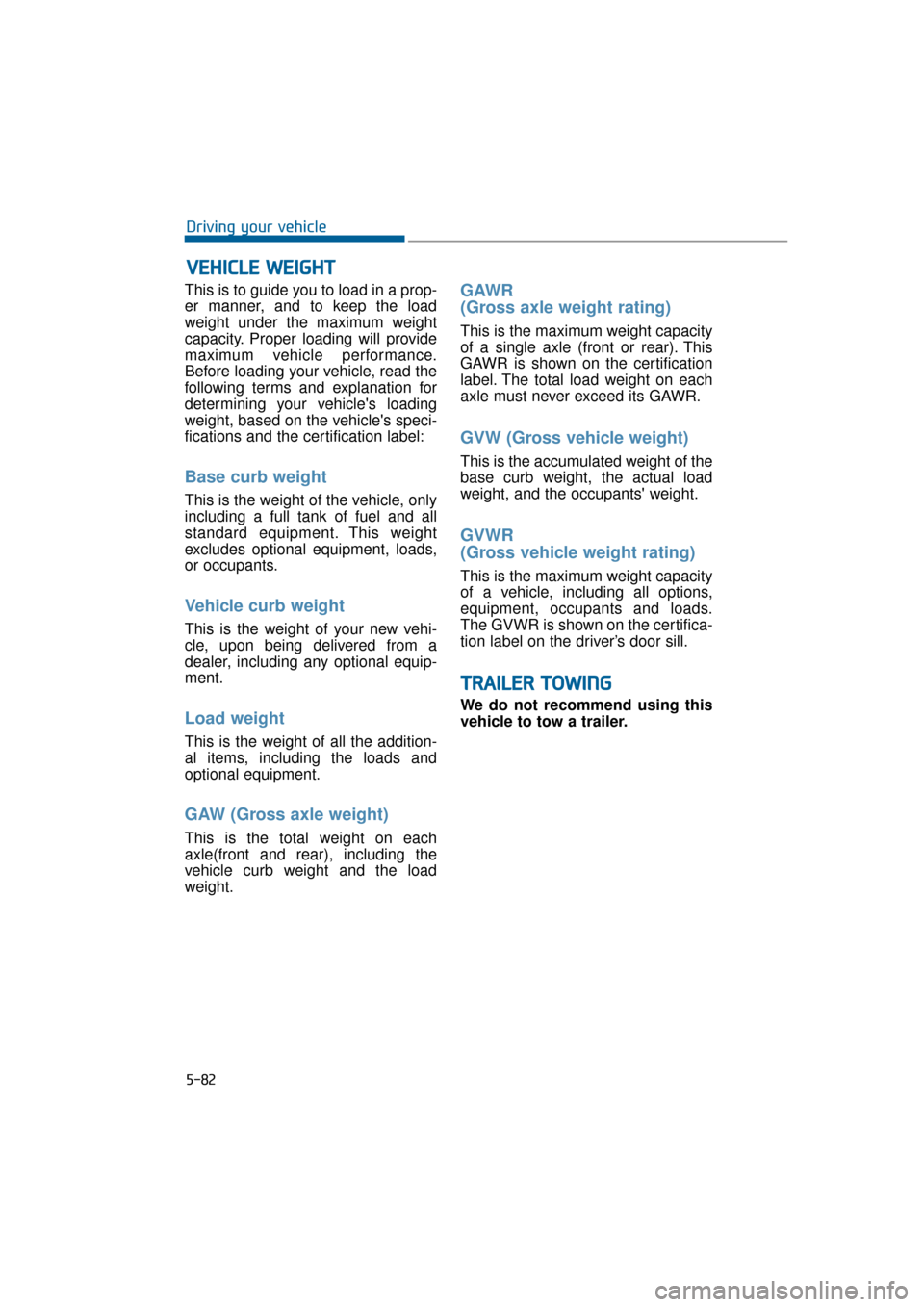
This is to guide you to load in a prop-
er manner, and to keep the load
weight under the maximum weight
capacity. Proper loading will provide
maximum vehicle performance.
Before loading your vehicle, read the
following terms and explanation for
determining your vehicle's loading
weight, based on the vehicle's speci-
fications and the certification label:
Base curb weight
This is the weight of the vehicle, only
including a full tank of fuel and all
standard equipment. This weight
excludes optional equipment, loads,
or occupants.
Vehicle curb weight
This is the weight of your new vehi-
cle, upon being delivered from a
dealer, including any optional equip-
ment.
Load weight
This is the weight of all the addition-
al items, including the loads and
optional equipment.
GAW (Gross axle weight)
This is the total weight on each
axle(front and rear), including the
vehicle curb weight and the load
weight.
GAWR
(Gross axle weight rating)
This is the maximum weight capacity
of a single axle (front or rear). This
GAWR is shown on the certification
label. The total load weight on each
axle must never exceed its GAWR.
GVW (Gross vehicle weight)
This is the accumulated weight of the
base curb weight, the actual load
weight, and the occupants' weight.
GVWR
(Gross vehicle weight rating)
This is the maximum weight capacity
of a vehicle, including all options,
equipment, occupants and loads.
The GVWR is shown on the certifica-
tion label on the driver’s door sill.
T TR
R A
A I
IL
L E
E R
R
T
T O
O W
W I
IN
N G
G
We do not recommend using this
vehicle to tow a trailer.
V VE
EH
H I
IC
C L
LE
E
W
W E
EI
IG
G H
H T
T
Driving your vehicle
5-82
Page 367 of 477
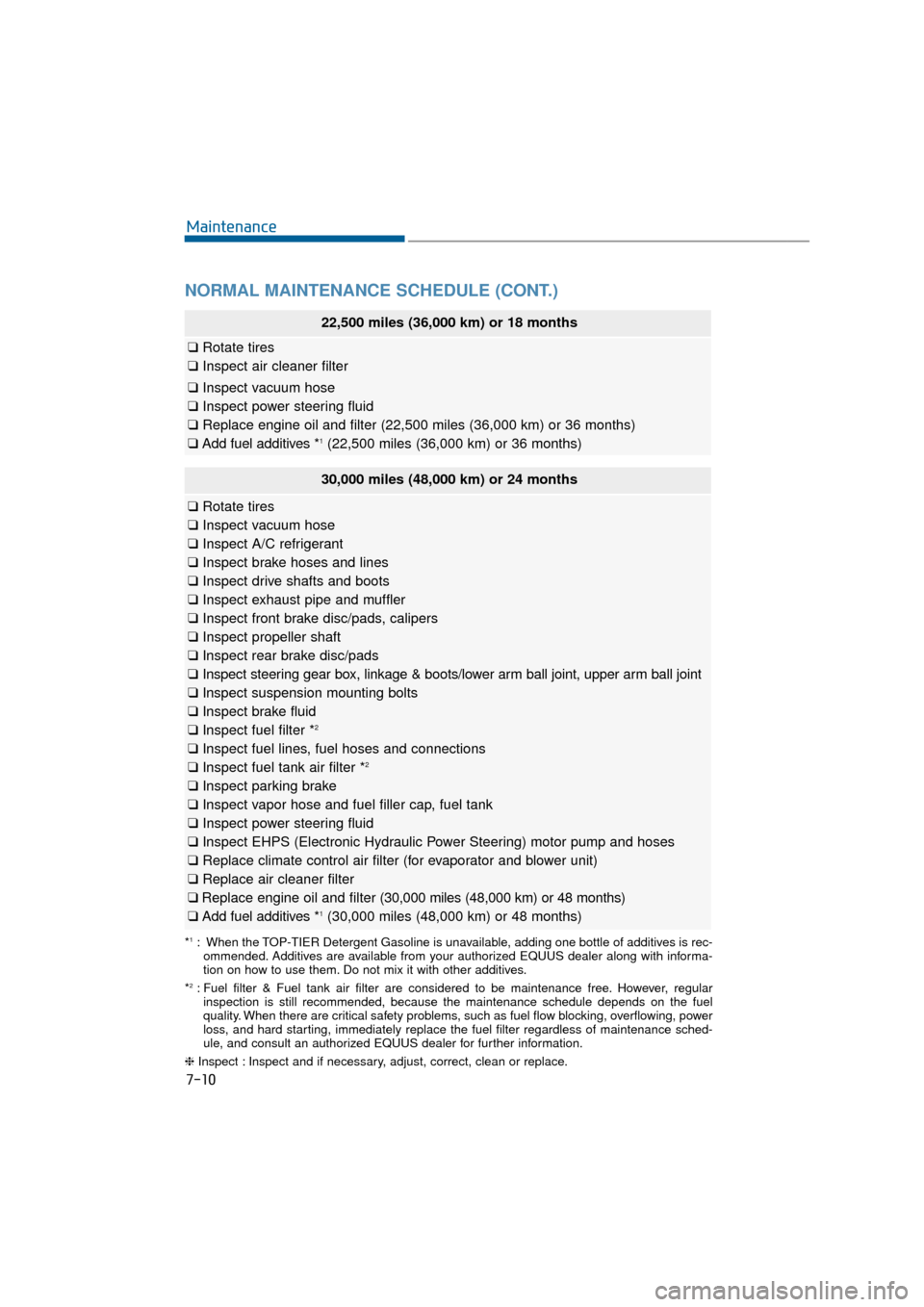
NORMAL MAINTENANCE SCHEDULE (CONT.)
7-10
Maintenance
22,500 miles (36,000 km) or 18 months
❑Rotate tires
❑ Inspect air cleaner filter
❑ Inspect vacuum hose
❑ Inspect power steering fluid
❑ Replace engine oil and filter (22,500 miles (36,000 km) or 36 months)\
❑ Add fuel additives *
1(22,500 miles (36,000 km) or 36 months)
*1: When the TOP-TIER Detergent Gasoline is unavailable, adding one bottle of additives is rec-
ommended. Additives are available from your authorized EQUUS dealer along with informa-
tion on how to use them. Do not mix it with other additives.
*
2: Fuel filter & Fuel tank air filter are considered to be maintenance free\
. However, regular inspection is still recommended, because the maintenance schedule depend\
s on the fuel
quality. When there are critical safety problems, such as fuel flow blocking, overflowing, power
loss, and hard starting, immediately replace the fuel filter regardless of maintenance sche\
d-
ule, and consult an authorized EQUUS dealer for further information.
❈ Inspect : Inspect and if necessary, adjust, correct, clean or replace.
30,000 miles (48,000 km) or 24 months
❑Rotate tires
❑ Inspect vacuum hose
❑ Inspect A/C refrigerant
❑ Inspect brake hoses and lines
❑ Inspect drive shafts and boots
❑ Inspect exhaust pipe and muffler
❑ Inspect front brake disc/pads, calipers
❑ Inspect propeller shaft
❑ Inspect rear brake disc/pads
❑ Inspect steering gear box, linkage & boots/lower arm ball joint, upper arm ball joint
❑ Inspect suspension mounting bolts
❑ Inspect brake fluid
❑ Inspect fuel filter *
2
❑Inspect fuel lines, fuel hoses and connections
❑ Inspect fuel tank air filter *2
❑Inspect parking brake
❑ Inspect vapor hose and fuel filler cap, fuel tank
❑ Inspect power steering fluid
❑ Inspect EHPS (Electronic Hydraulic Power Steering) motor pump and hoses
❑ Replace climate control air filter (for evaporator and blower unit)
❑ Replace air cleaner filter
❑ Replace engine oil and filter (30,000 miles (48,000 km) or 48 months)
❑ Add fuel additives *
1(30,000 miles (48,000 km) or 48 months)
Page 369 of 477
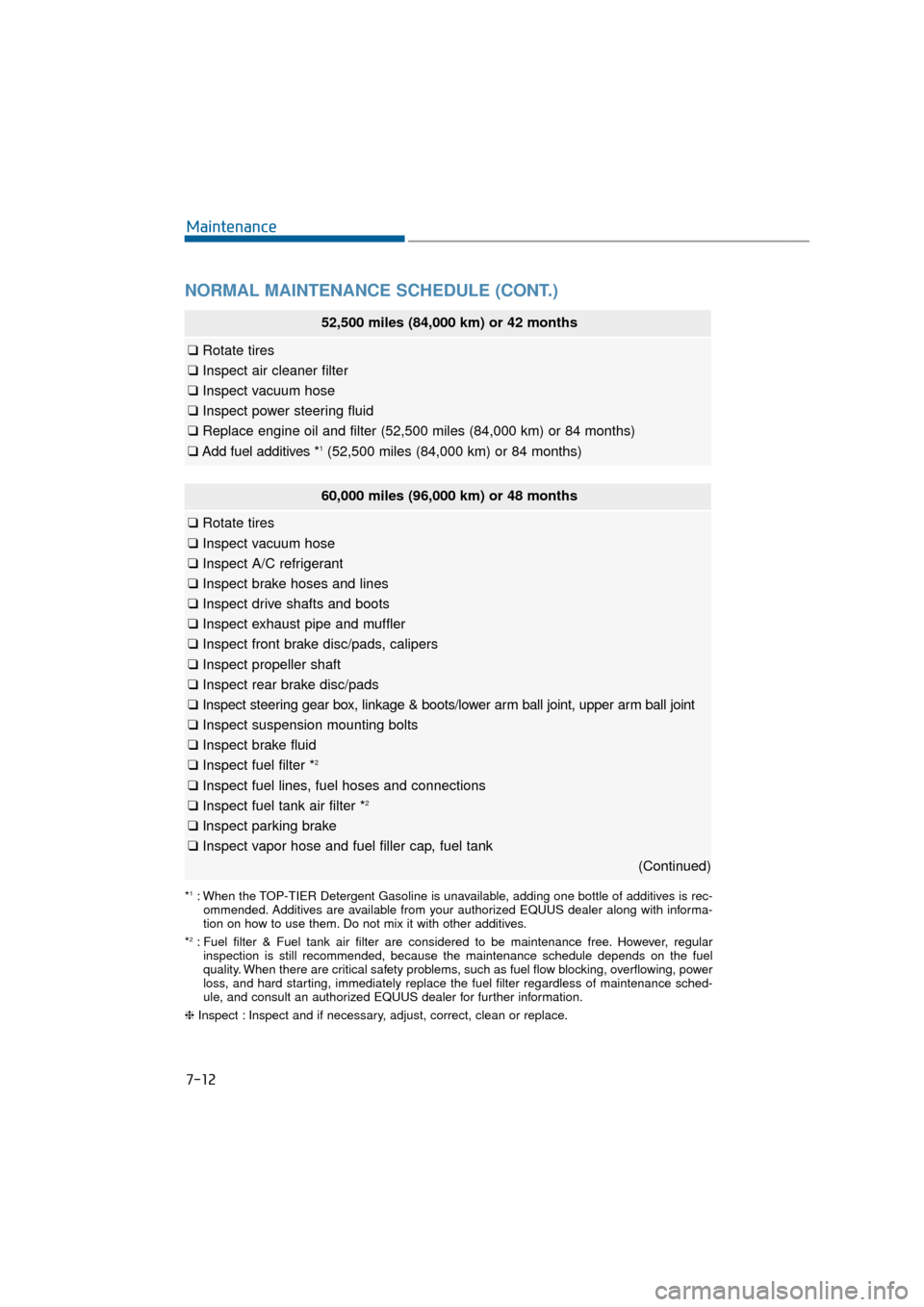
NORMAL MAINTENANCE SCHEDULE (CONT.)
7-12
Maintenance
52,500 miles (84,000 km) or 42 months
❑Rotate tires
❑ Inspect air cleaner filter
❑ Inspect vacuum hose
❑ Inspect power steering fluid
❑ Replace engine oil and filter (52,500 miles (84,000 km) or 84 months)\
❑ Add fuel additives *
1(52,500 miles (84,000 km) or 84 months)
60,000 miles (96,000 km) or 48 months
❑ Rotate tires
❑ Inspect vacuum hose
❑ Inspect A/C refrigerant
❑ Inspect brake hoses and lines
❑ Inspect drive shafts and boots
❑ Inspect exhaust pipe and muffler
❑ Inspect front brake disc/pads, calipers
❑ Inspect propeller shaft
❑ Inspect rear brake disc/pads
❑ Inspect steering gear box, linkage & boots/lower arm ball joint, upper arm ball joint
❑ Inspect suspension mounting bolts
❑ Inspect brake fluid
❑ Inspect fuel filter *
2
❑Inspect fuel lines, fuel hoses and connections
❑ Inspect fuel tank air filter *2
❑Inspect parking brake
❑ Inspect vapor hose and fuel filler cap, fuel tank
(Continued)
*1: When the TOP-TIER Detergent Gasoline is unavailable, adding one bottle of additives is rec-ommended. Additives are available from your authorized EQUUS dealer along with informa-
tion on how to use them. Do not mix it with other additives.
*
2: Fuel filter & Fuel tank air filter are considered to be maintenance free\
. However, regular inspection is still recommended, because the maintenance schedule depend\
s on the fuel
quality. When there are critical safety problems, such as fuel flow blocking, overflowing, power
loss, and hard starting, immediately replace the fuel filter regardless of maintenance sche\
d-
ule, and consult an authorized EQUUS dealer for further information.
❈ Inspect : Inspect and if necessary, adjust, correct, clean or replace.
Page 372 of 477
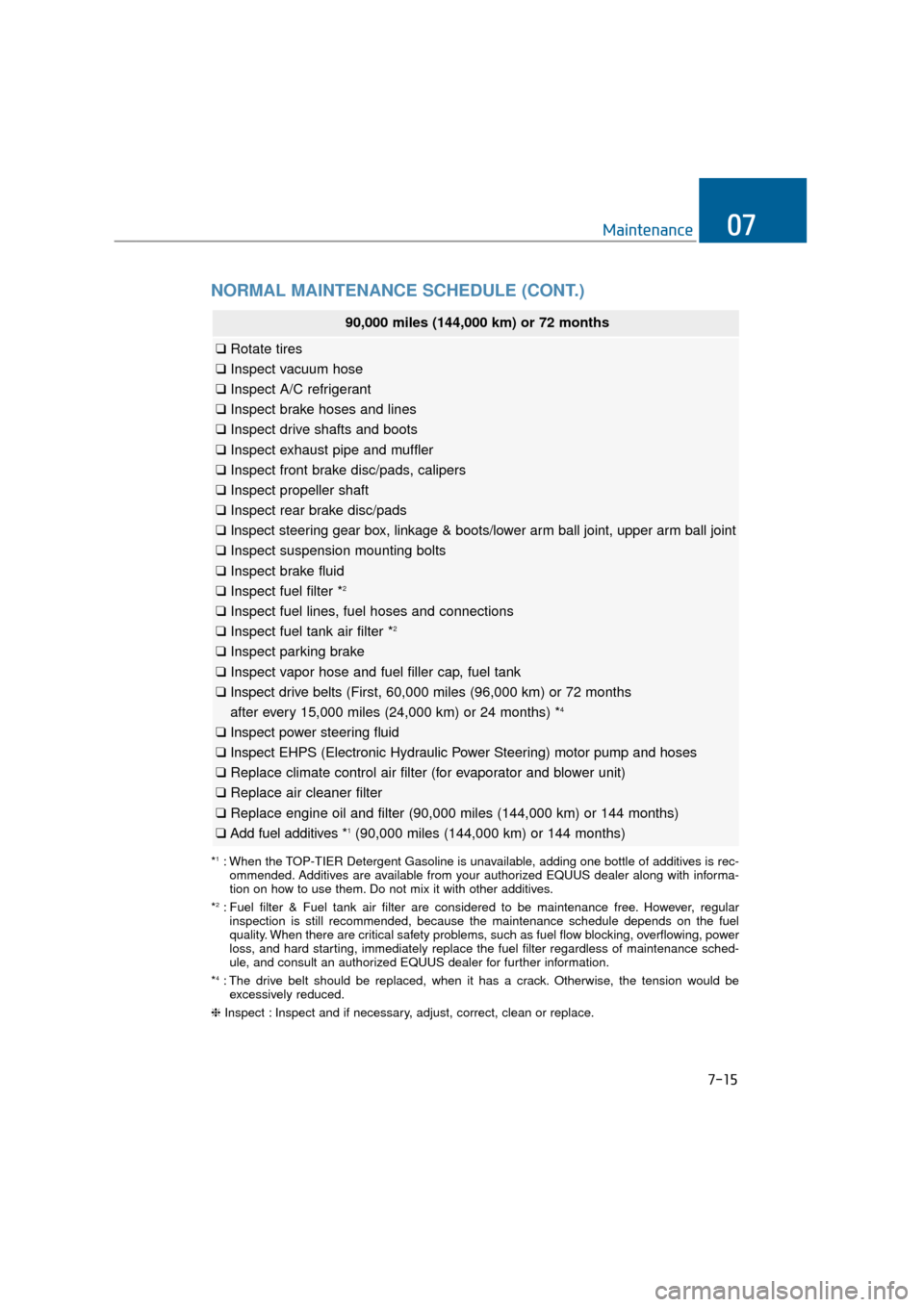
NORMAL MAINTENANCE SCHEDULE (CONT.)
7-15
Maintenance07
90,000 miles (144,000 km) or 72 months
❑Rotate tires
❑ Inspect vacuum hose
❑ Inspect A/C refrigerant
❑ Inspect brake hoses and lines
❑ Inspect drive shafts and boots
❑ Inspect exhaust pipe and muffler
❑ Inspect front brake disc/pads, calipers
❑ Inspect propeller shaft
❑ Inspect rear brake disc/pads
❑ Inspect steering gear box, linkage & boots/lower arm ball joint, upper arm ball joint
❑ Inspect suspension mounting bolts
❑ Inspect brake fluid
❑ Inspect fuel filter *
2
❑Inspect fuel lines, fuel hoses and connections
❑ Inspect fuel tank air filter *2
❑Inspect parking brake
❑ Inspect vapor hose and fuel filler cap, fuel tank
❑ Inspect drive belts (First, 60,000 miles (96,000 km) or 72 months
after every 15,000 miles (24,000 km) or 24 months) *
4
❑ Inspect power steering fluid
❑ Inspect EHPS (Electronic Hydraulic Power Steering) motor pump and hoses
❑ Replace climate control air filter (for evaporator and blower unit)
❑ Replace air cleaner filter
❑ Replace engine oil and filter (90,000 miles (144,000 km) or 144 month\
s)
❑ Add fuel additives *
1(90,000 miles (144,000 km) or 144 months)
*1: When the TOP-TIER Detergent Gasoline is unavailable, adding one bottle of additives is rec-
ommended. Additives are available from your authorized EQUUS dealer along with informa-
tion on how to use them. Do not mix it with other additives.
*
2: Fuel filter & Fuel tank air filter are considered to be maintenance free\
. However, regular inspection is still recommended, because the maintenance schedule depend\
s on the fuel
quality. When there are critical safety problems, such as fuel flow blocking, overflowing, power
loss, and hard starting, immediately replace the fuel filter regardless of maintenance sche\
d-
ule, and consult an authorized EQUUS dealer for further information.
*
4: The drive belt should be replaced, when it has a crack. Otherwise, the tension would be excessively reduced.
❈ Inspect : Inspect and if necessary, adjust, correct, clean or replace.
Page 374 of 477
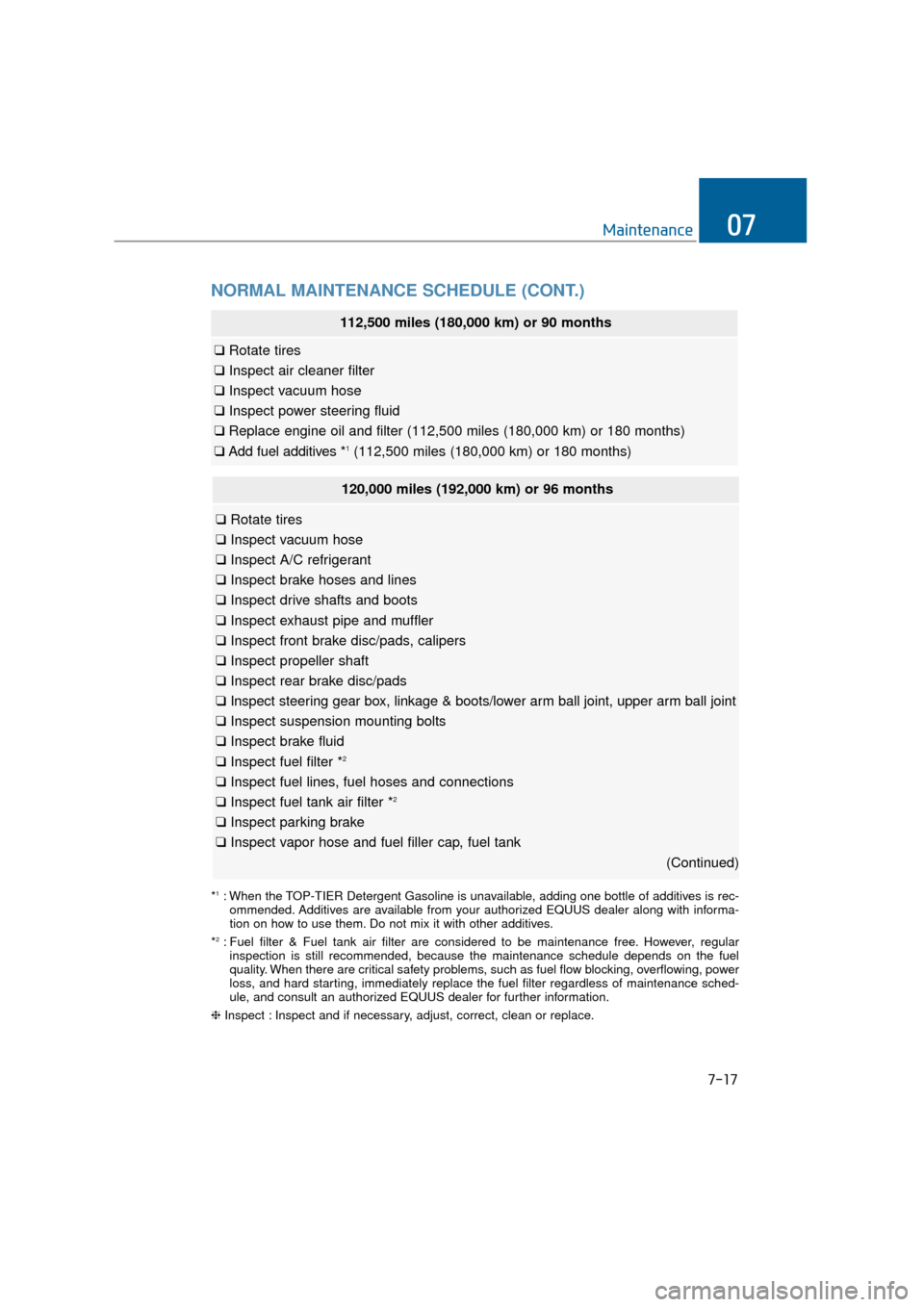
NORMAL MAINTENANCE SCHEDULE (CONT.)
7-17
Maintenance07
112,500 miles (180,000 km) or 90 months
❑Rotate tires
❑ Inspect air cleaner filter
❑ Inspect vacuum hose
❑ Inspect power steering fluid
❑ Replace engine oil and filter (112,500 miles (180,000 km) or 180 mont\
hs)
❑ Add fuel additives *
1(112,500 miles (180,000 km) or 180 months)
120,000 miles (192,000 km) or 96 months
❑ Rotate tires
❑ Inspect vacuum hose
❑ Inspect A/C refrigerant
❑ Inspect brake hoses and lines
❑ Inspect drive shafts and boots
❑ Inspect exhaust pipe and muffler
❑ Inspect front brake disc/pads, calipers
❑ Inspect propeller shaft
❑ Inspect rear brake disc/pads
❑ Inspect steering gear box, linkage & boots/lower arm ball joint, upper arm ball joint
❑ Inspect suspension mounting bolts
❑ Inspect brake fluid
❑ Inspect fuel filter *
2
❑Inspect fuel lines, fuel hoses and connections
❑ Inspect fuel tank air filter *2
❑Inspect parking brake
❑ Inspect vapor hose and fuel filler cap, fuel tank
(Continued)
*1: When the TOP-TIER Detergent Gasoline is unavailable, adding one bottle of additives is rec-ommended. Additives are available from your authorized EQUUS dealer along with informa-
tion on how to use them. Do not mix it with other additives.
*
2: Fuel filter & Fuel tank air filter are considered to be maintenance free\
. However, regular inspection is still recommended, because the maintenance schedule depend\
s on the fuel
quality. When there are critical safety problems, such as fuel flow blocking, overflowing, power
loss, and hard starting, immediately replace the fuel filter regardless of maintenance sche\
d-
ule, and consult an authorized EQUUS dealer for further information.
❈ Inspect : Inspect and if necessary, adjust, correct, clean or replace.
Page 377 of 477
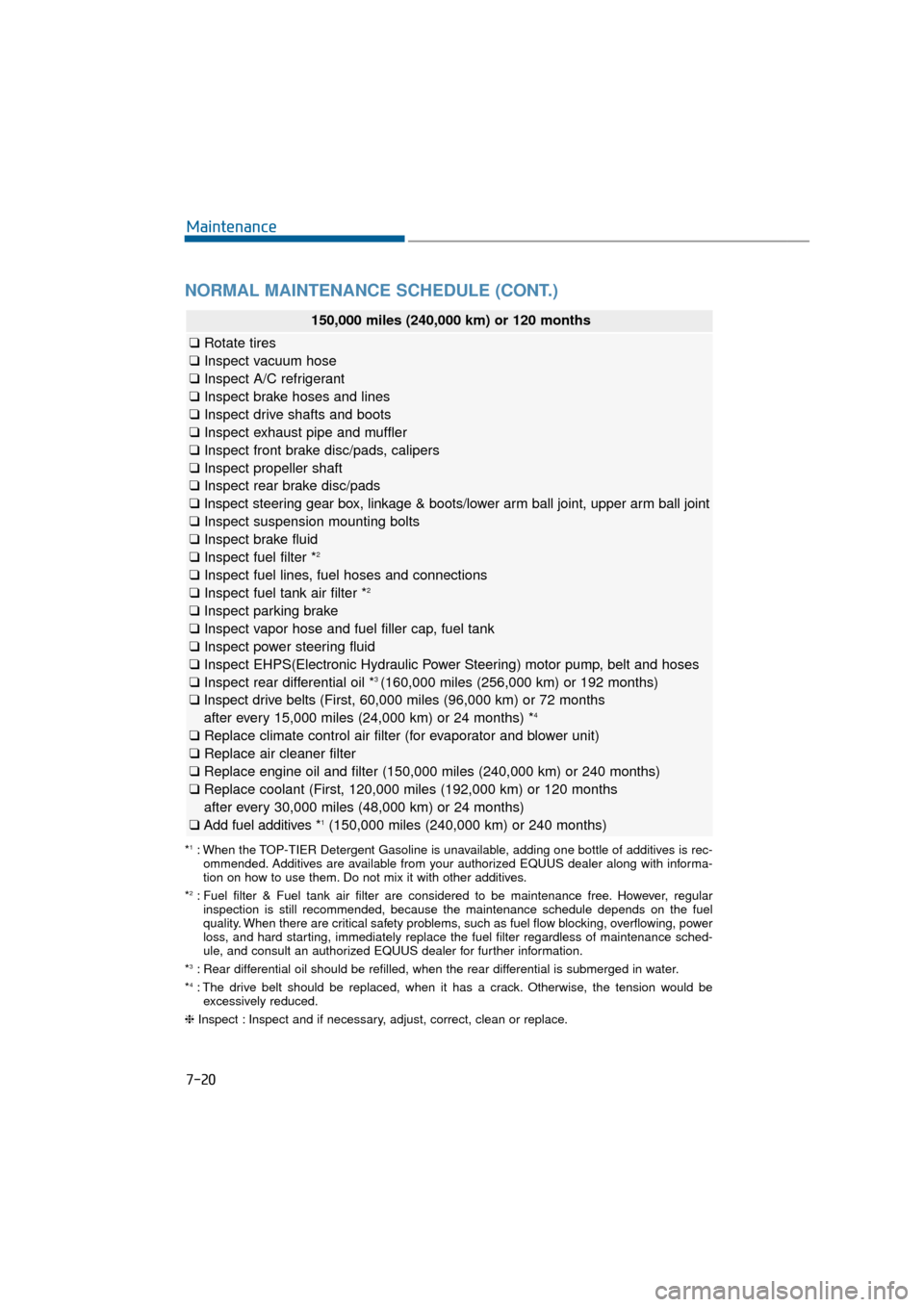
NORMAL MAINTENANCE SCHEDULE (CONT.)
7-20
Maintenance
150,000 miles (240,000 km) or 120 months
❑Rotate tires
❑ Inspect vacuum hose
❑ Inspect A/C refrigerant
❑ Inspect brake hoses and lines
❑ Inspect drive shafts and boots
❑ Inspect exhaust pipe and muffler
❑ Inspect front brake disc/pads, calipers
❑ Inspect propeller shaft
❑ Inspect rear brake disc/pads
❑ Inspect steering gear box, linkage & boots/lower arm ball joint, upper arm ball joint
❑ Inspect suspension mounting bolts
❑ Inspect brake fluid
❑ Inspect fuel filter *
2
❑Inspect fuel lines, fuel hoses and connections
❑ Inspect fuel tank air filter *2
❑Inspect parking brake
❑ Inspect vapor hose and fuel filler cap, fuel tank
❑ Inspect power steering fluid
❑ Inspect EHPS(Electronic Hydraulic Power Steer ing) motor pump, belt and hoses
❑ Inspect rear differential oil *
3 (160,000 miles (256,000 km) or 192 months)
❑ Inspect drive belts (First, 60,000 miles (96,000 km) or 72 months
after every 15,000 miles (24,000 km) or 24 months) *
4
❑ Replace climate control air filter (for evaporator and blower unit)
❑ Replace air cleaner filter
❑ Replace engine oil and filter (150,000 miles (240,000 km) or 240 mont\
hs)
❑ Replace coolant (First, 120,000 miles (192,000 km) or 120 months
after every 30,000 miles (48,000 km) or 24 months)
❑ Add fuel additives *
1(150,000 miles (240,000 km) or 240 months)
*1: When the TOP-TIER Detergent Gasoline is unavailable, adding one bottle of additives is rec-
ommended. Additives are available from your authorized EQUUS dealer along with informa-
tion on how to use them. Do not mix it with other additives.
*
2: Fuel filter & Fuel tank air filter are considered to be maintenance free\
. However, regular inspection is still recommended, because the maintenance schedule depend\
s on the fuel
quality. When there are critical safety problems, such as fuel flow blocking, overflowing, power
loss, and hard starting, immediately replace the fuel filter regardless of maintenance sche\
d-
ule, and consult an authorized EQUUS dealer for further information.
*
3: Rear differential oil should be refilled, when the rear differential is submerged in water.
*4: The drive belt should be replaced, when it has a crack. Otherwise, the tension would be excessively reduced.
❈ Inspect : Inspect and if necessary, adjust, correct, clean or replace.
Page 380 of 477
7-23
Maintenance07
E
EX
X P
PL
LA
A N
N A
AT
TI
IO
O N
N
O
O F
F
S
S C
C H
H E
ED
D U
U L
LE
E D
D
M
M A
AI
IN
N T
TE
EN
N A
AN
N C
CE
E
I
IT
T E
EM
M S
S
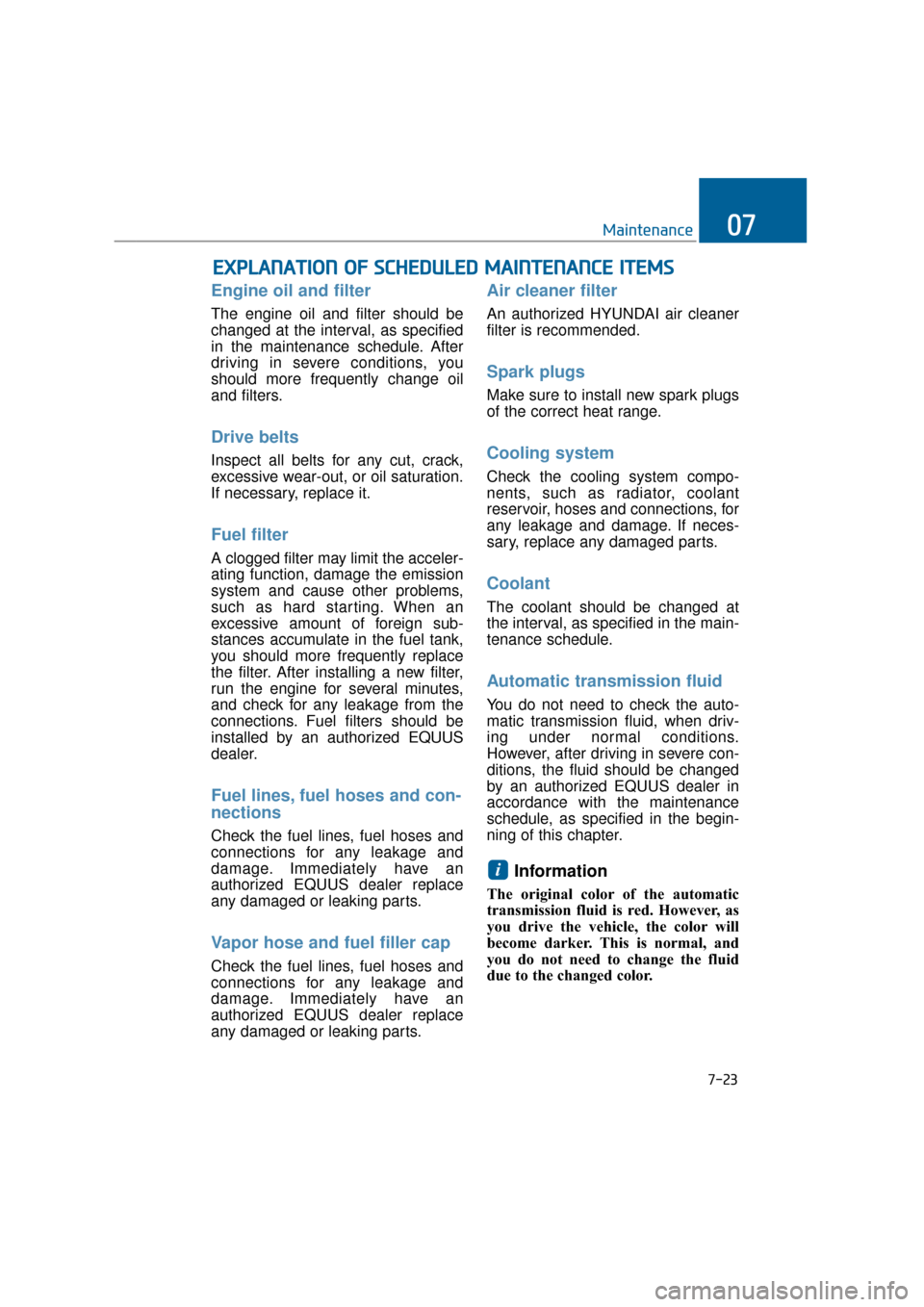
Engine oil and filter
The engine oil and filter should be
changed at the interval, as specified
in the maintenance schedule. After
driving in severe conditions, you
should more frequently change oil
and filters.
Drive belts
Inspect all belts for any cut, crack,
excessive wear-out, or oil saturation.
If necessary, replace it.
Fuel filter
A clogged filter may limit the acceler-
ating function, damage the emission
system and cause other problems,
such as hard starting. When an
excessive amount of foreign sub-
stances accumulate in the fuel tank,
you should more frequently replace
the filter. After installing a new filter,
run the engine for several minutes,
and check for any leakage from the
connections. Fuel filters should be
installed by an authorized EQUUS
dealer.
Fuel lines, fuel hoses and con-
nections
Check the fuel lines, fuel hoses and
connections for any leakage and
damage. Immediately have an
authorized EQUUS dealer replace
any damaged or leaking parts.
Vapor hose and fuel filler cap
Check the fuel lines, fuel hoses and
connections for any leakage and
damage. Immediately have an
authorized EQUUS dealer replace
any damaged or leaking parts.
Air cleaner filter
An authorized HYUNDAI air cleaner
filter is recommended.
Spark plugs
Make sure to install new spark plugs
of the correct heat range.
Cooling system
Check the cooling system compo-
nents, such as radiator, coolant
reservoir, hoses and connections, for
any leakage and damage. If neces-
sary, replace any damaged parts.
Coolant
The coolant should be changed at
the interval, as specified in the main-
tenance schedule.
Automatic transmission fluid
You do not need to check the auto-
matic transmission fluid, when driv-
ing under normal conditions.
However, after driving in severe con-
ditions, the fluid should be changed
by an authorized EQUUS dealer in
accordance with the maintenance
schedule, as specified in the begin-
ning of this chapter.
Information
The original color of the automatic
transmission fluid is red. However, as
you drive the vehicle, the color will
become darker. This is normal, and
you do not need to change the fluid
due to the changed color.
i
Page 400 of 477
7-43
Maintenance07
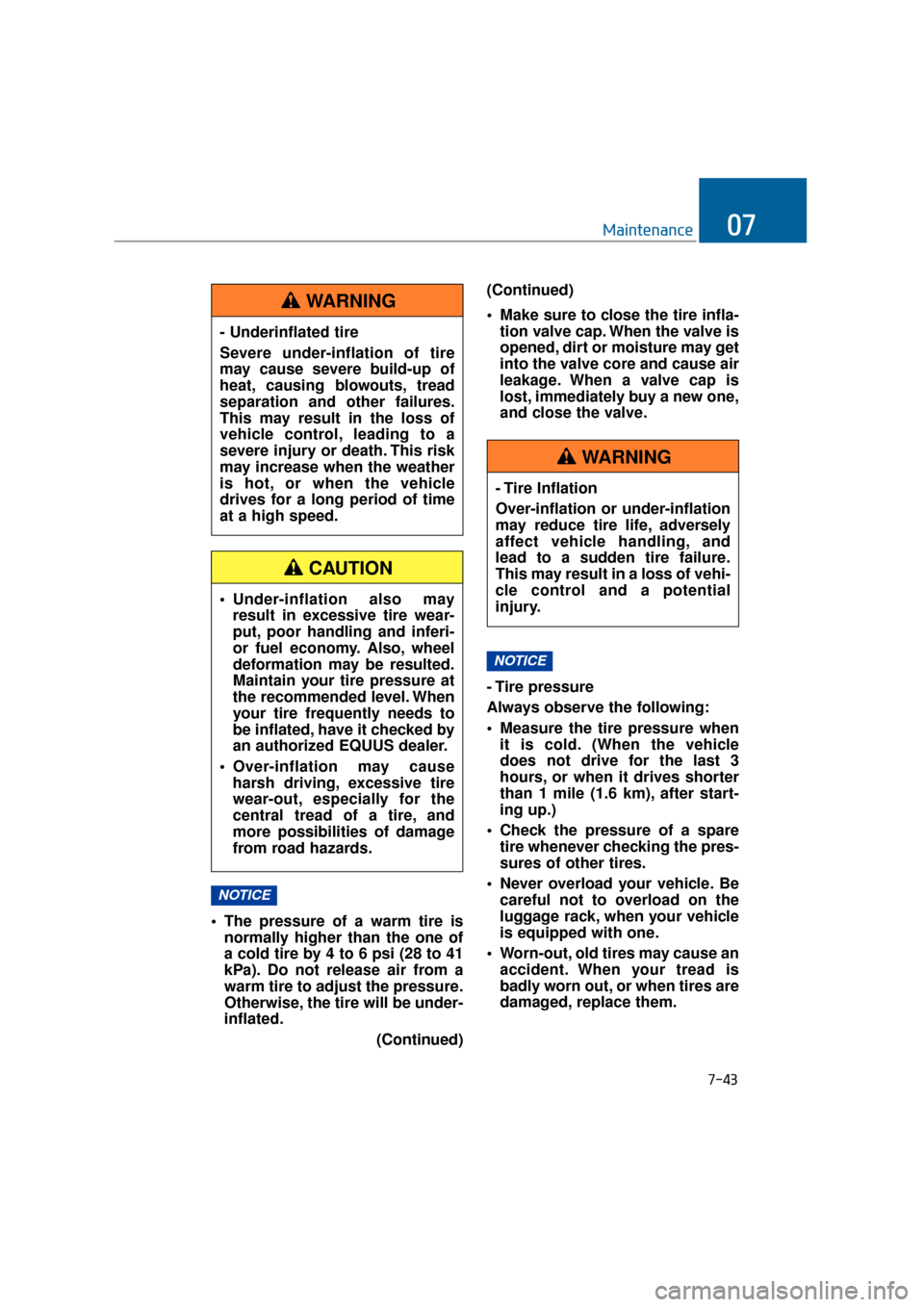
The pressure of a warm tire isnormally higher than the one of
a cold tire by 4 to 6 psi (28 to 41
kPa). Do not release air from a
warm tire to adjust the pressure.
Otherwise, the tire will be under-
inflated.
(Continued)(Continued)
Make sure to close the tire infla-
tion valve cap. When the valve is
opened, dirt or moisture may get
into the valve core and cause air
leakage. When a valve cap is
lost, immediately buy a new one,
and close the valve.
- Tire pressure
Always observe the following:
Measure the tire pressure when it is cold. (When the vehicle
does not drive for the last 3
hours, or when it drives shorter
than 1 mile (1.6 km), after start-
ing up.)
Check the pressure of a spare tire whenever checking the pres-
sures of other tires.
Never overload your vehicle. Be careful not to overload on the
luggage rack, when your vehicle
is equipped with one.
Worn-out, old tires may cause an accident. When your tread is
badly worn out, or when tires are
damaged, replace them.
NOTICE
NOTICE
- Underinflated tire
Severe under-inflation of tire
may cause severe build-up of
heat, causing blowouts, tread
separation and other failures.
This may result in the loss of
vehicle control, leading to a
severe injury or death. This risk
may increase when the weather
is hot, or when the vehicle
drives for a long period of time
at a high speed.
WARNING
- Tire Inflation
Over-inflation or under-inflation
may reduce tire life, adversely
affect vehicle handling, and
lead to a sudden tire failure.
This may result in a loss of vehi-
cle control and a potential
injury.
WARNING
Under-inflation also mayresult in excessive tire wear-
put, poor handling and inferi-
or fuel economy. Also, wheel
deformation may be resulted.
Maintain your tire pressure at
the recommended level. When
your tire frequently needs to
be inflated, have it checked by
an authorized EQUUS dealer.
Over-inflation may cause harsh driving, excessive tire
wear-out, especially for the
central tread of a tire, and
more possibilities of damage
from road hazards.
CAUTION