inflation pressure Hyundai Equus 2016 User Guide
[x] Cancel search | Manufacturer: HYUNDAI, Model Year: 2016, Model line: Equus, Model: Hyundai Equus 2016Pages: 477, PDF Size: 16.25 MB
Page 400 of 477
7-43
Maintenance07
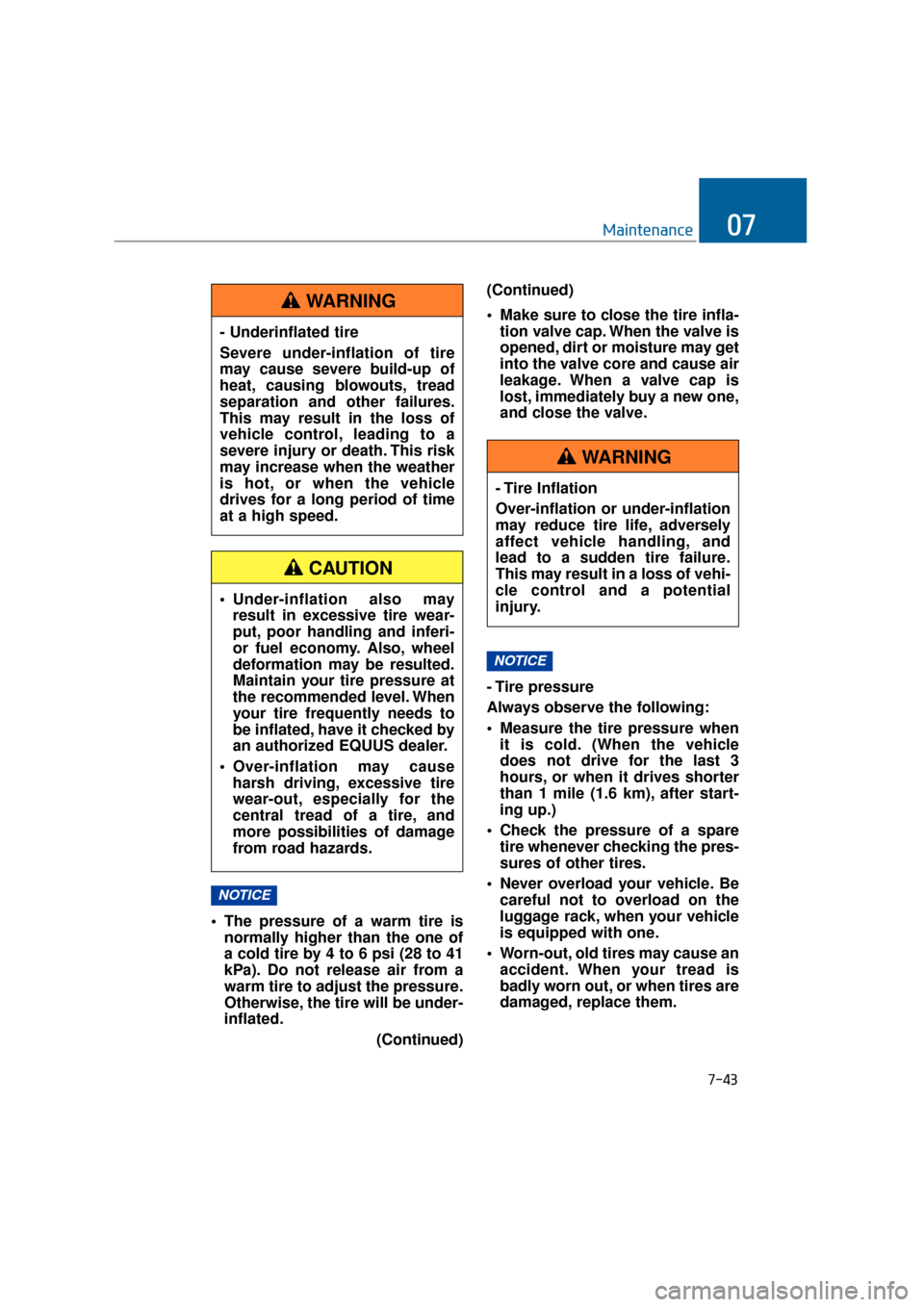
The pressure of a warm tire isnormally higher than the one of
a cold tire by 4 to 6 psi (28 to 41
kPa). Do not release air from a
warm tire to adjust the pressure.
Otherwise, the tire will be under-
inflated.
(Continued)(Continued)
Make sure to close the tire infla-
tion valve cap. When the valve is
opened, dirt or moisture may get
into the valve core and cause air
leakage. When a valve cap is
lost, immediately buy a new one,
and close the valve.
- Tire pressure
Always observe the following:
Measure the tire pressure when it is cold. (When the vehicle
does not drive for the last 3
hours, or when it drives shorter
than 1 mile (1.6 km), after start-
ing up.)
Check the pressure of a spare tire whenever checking the pres-
sures of other tires.
Never overload your vehicle. Be careful not to overload on the
luggage rack, when your vehicle
is equipped with one.
Worn-out, old tires may cause an accident. When your tread is
badly worn out, or when tires are
damaged, replace them.
NOTICE
NOTICE
- Underinflated tire
Severe under-inflation of tire
may cause severe build-up of
heat, causing blowouts, tread
separation and other failures.
This may result in the loss of
vehicle control, leading to a
severe injury or death. This risk
may increase when the weather
is hot, or when the vehicle
drives for a long period of time
at a high speed.
WARNING
- Tire Inflation
Over-inflation or under-inflation
may reduce tire life, adversely
affect vehicle handling, and
lead to a sudden tire failure.
This may result in a loss of vehi-
cle control and a potential
injury.
WARNING
Under-inflation also mayresult in excessive tire wear-
put, poor handling and inferi-
or fuel economy. Also, wheel
deformation may be resulted.
Maintain your tire pressure at
the recommended level. When
your tire frequently needs to
be inflated, have it checked by
an authorized EQUUS dealer.
Over-inflation may cause harsh driving, excessive tire
wear-out, especially for the
central tread of a tire, and
more possibilities of damage
from road hazards.
CAUTION
Page 401 of 477
7-44
Maintenance
Checking tire inflation pres-
sure
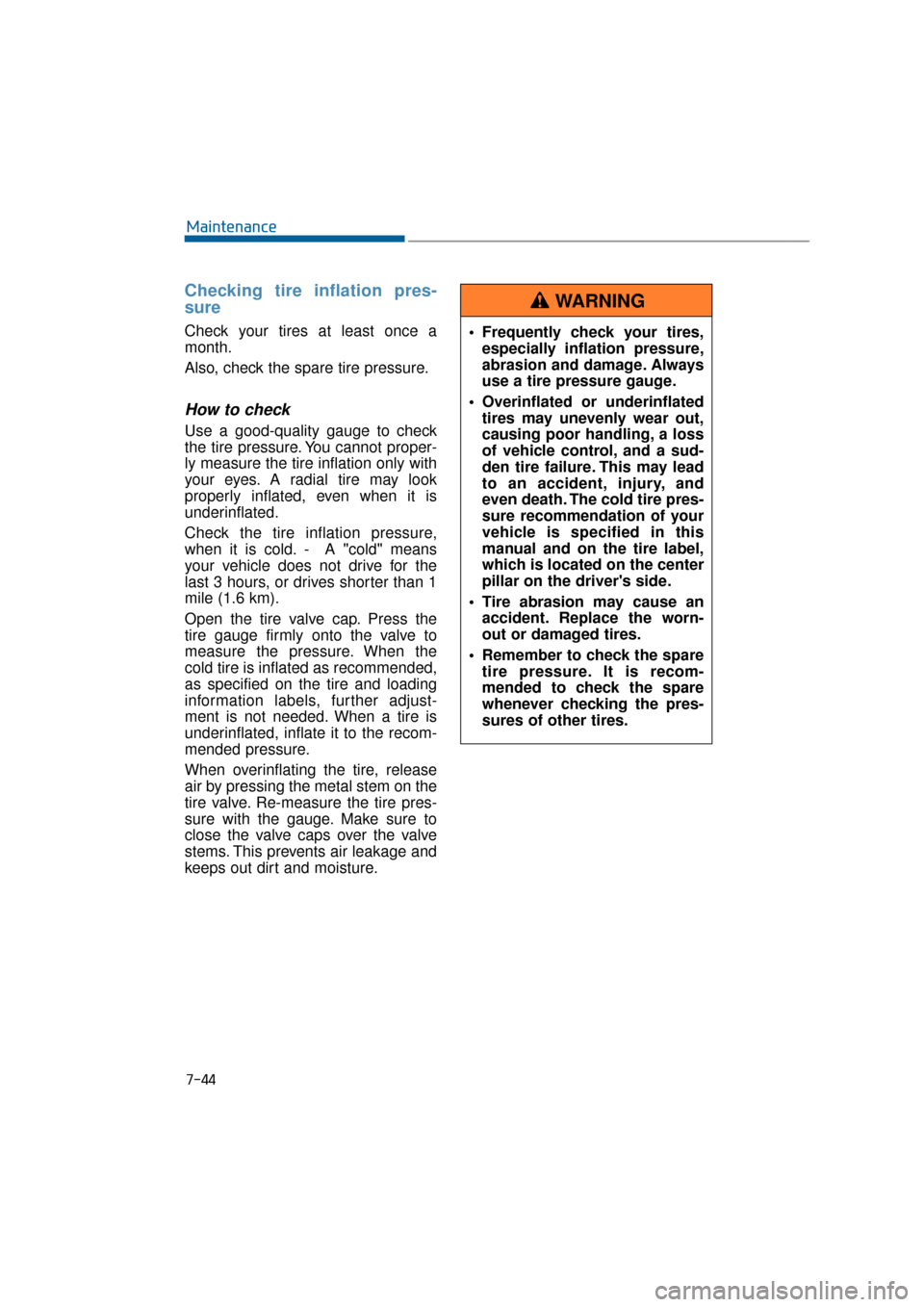
Check your tires at least once a
month.
Also, check the spare tire pressure.
How to check
Use a good-quality gauge to check
the tire pressure. You cannot proper-
ly measure the tire inflation only with
your eyes. A radial tire may look
properly inflated, even when it is
underinflated.
Check the tire inflation pressure,
when it is cold. - A "cold" means
your vehicle does not drive for the
last 3 hours, or drives shorter than 1
mile (1.6 km).
Open the tire valve cap. Press the
tire gauge firmly onto the valve to
measure the pressure. When the
cold tire is inflated as recommended,
as specified on the tire and loading
information labels, further adjust-
ment is not needed. When a tire is
underinflated, inflate it to the recom-
mended pressure.
When overinflating the tire, release
air by pressing the metal stem on the
tire valve. Re-measure the tire pres-
sure with the gauge. Make sure to
close the valve caps over the valve
stems. This prevents air leakage and
keeps out dirt and moisture. Frequently check your tires,
especially inflation pressure,
abrasion and damage. Always
use a tire pressure gauge.
Overinflated or underinflated tires may unevenly wear out,
causing poor handling, a loss
of vehicle control, and a sud-
den tire failure. This may lead
to an accident, injury, and
even death. The cold tire pres-
sure recommendation of your
vehicle is specified in this
manual and on the tire label,
which is located on the center
pillar on the driver's side.
Tire abrasion may cause an accident. Replace the worn-
out or damaged tires.
Remember to check the spare tire pressure. It is recom-
mended to check the spare
whenever checking the pres-
sures of other tires.
WARNING
Page 405 of 477
7-48
Maintenance
Tire maintenance
In addition to the proper inflation
pressure, correct wheel alignment
prevents tire abrasion. When you find
uneven tire abrasion, have the wheel
alignment checked by your EQUUS
dealer.
When replacing your tires, make
sure they are well balanced. This
increases your driving comfort and
tire life. Additionally, a tire should be
rebalanced after being removed from
a wheel.
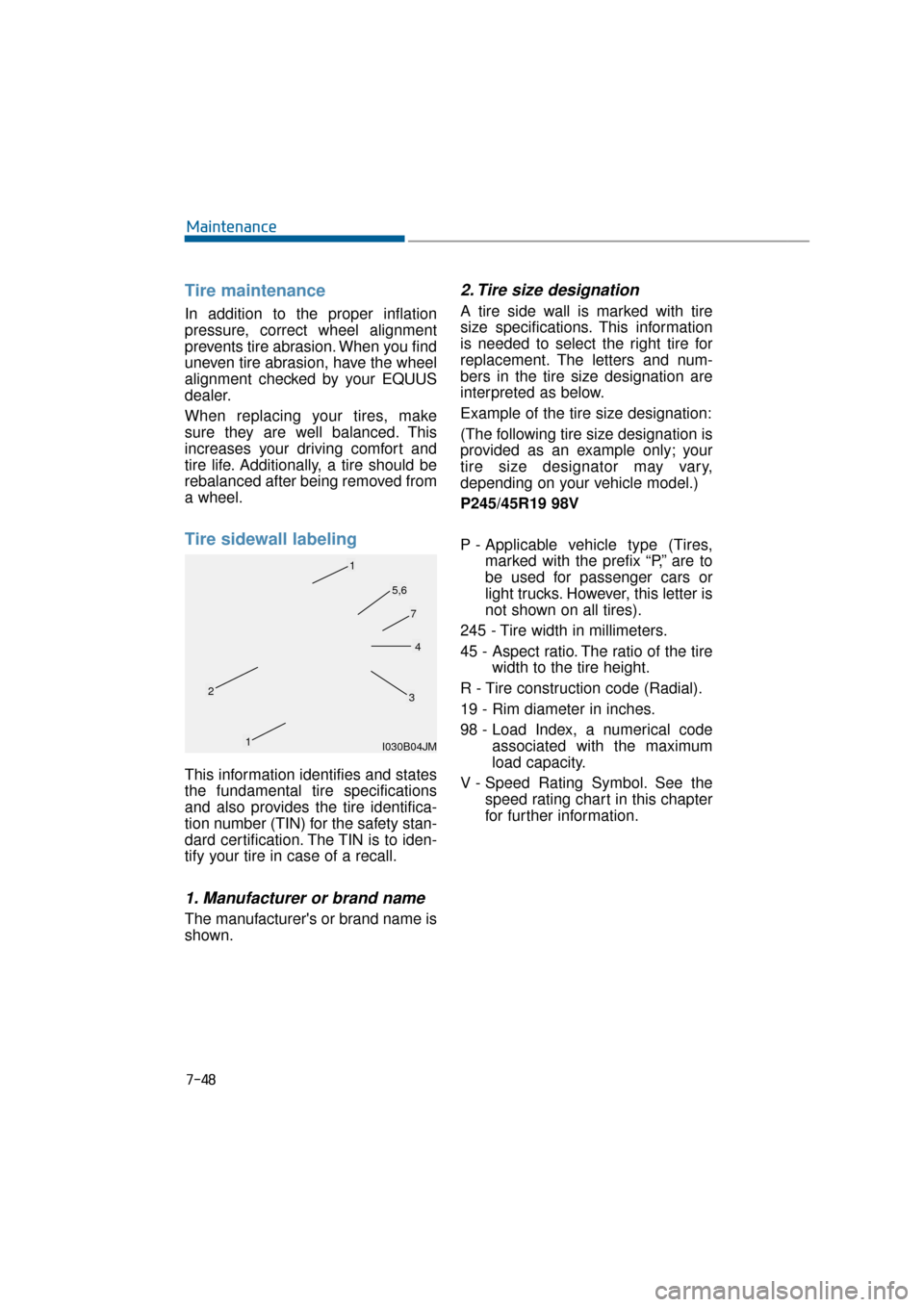
Tire sidewall labeling
This information identifies and states
the fundamental tire specifications
and also provides the tire identifica-
tion number (TIN) for the safety stan-
dard certification. The TIN is to iden-
tify your tire in case of a recall.
1. Manufacturer or brand name
The manufacturer's or brand name is
shown.
2. Tire size designation
A tire side wall is marked with tire
size specifications. This information
is needed to select the right tire for
replacement. The letters and num-
bers in the tire size designation are
interpreted as below.
Example of the tire size designation:
(The following tire size designation is
provided as an example only; your
tire size designator may vary,
depending on your vehicle model.)
P245/45R19 98V
P - Applicable vehicle type (Tires,marked with the prefix “P,’’ are to
be used for passenger cars or
light trucks. However, this letter is
not shown on all tires).
245 - Tire width in millimeters.
45 - Aspect ratio. The ratio of the tire width to the tire height.
R - Tire construction code (Radial).
19 - Rim diameter in inches.
98 - Load Index, a numerical code associated with the maximum
load capacity.
V - Speed Rating Symbol. See the speed rating chart in this chapter
for further information.
I030B04JM
1
1
23
4
5,6
7
Page 407 of 477
7-50
Maintenance
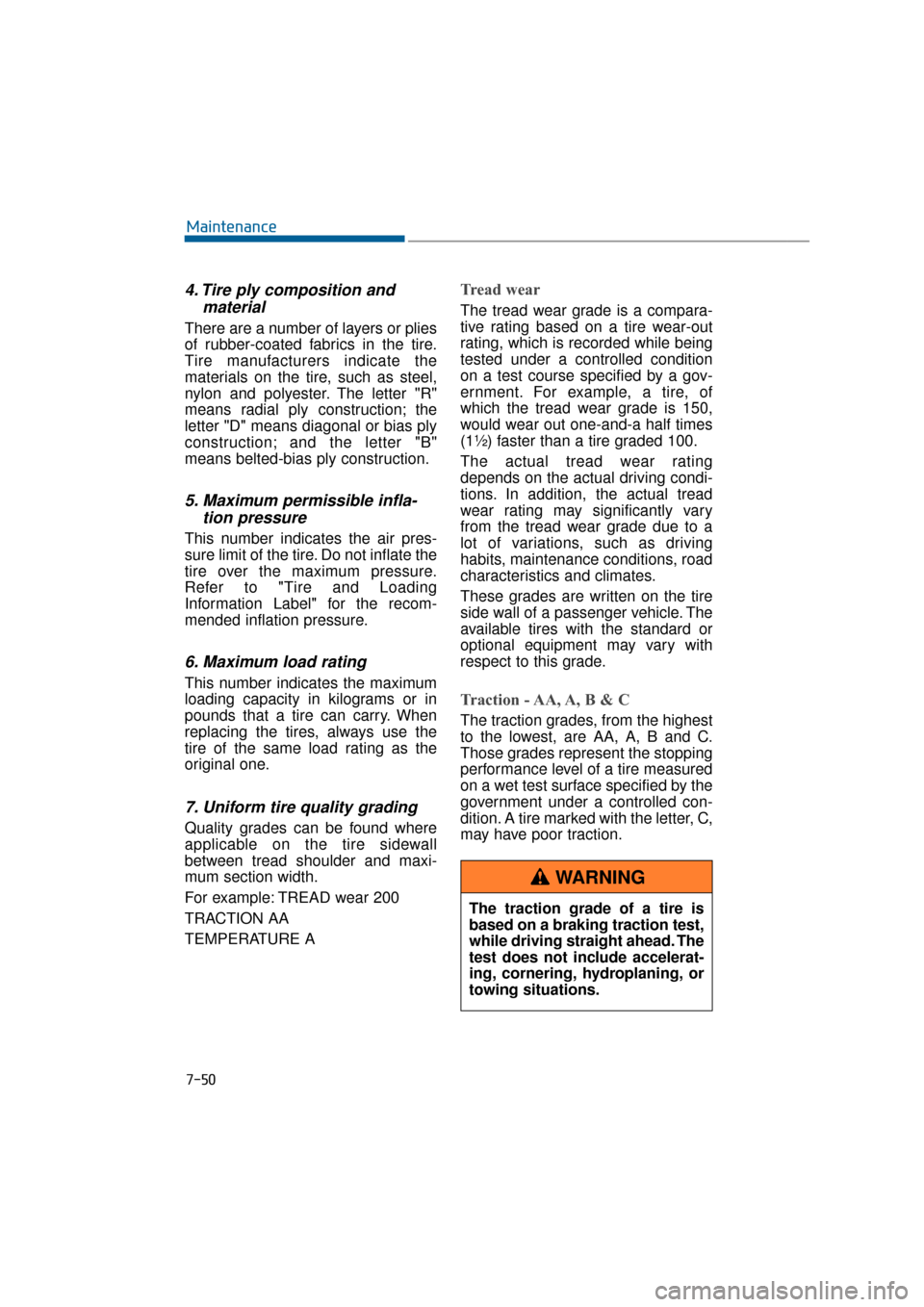
4. Tire ply composition andmaterial
There are a number of layers or plies
of rubber-coated fabrics in the tire.
Tire manufacturers indicate the
materials on the tire, such as steel,
nylon and polyester. The letter "R"
means radial ply construction; the
letter "D" means diagonal or bias ply
construction; and the letter "B"
means belted-bias ply construction.
5. Maximum permissible infla-tion pressure
This number indicates the air pres-
sure limit of the tire. Do not inflate the
tire over the maximum pressure.
Refer to "Tire and Loading
Information Label" for the recom-
mended inflation pressure.
6. Maximum load rating
This number indicates the maximum
loading capacity in kilograms or in
pounds that a tire can carry. When
replacing the tires, always use the
tire of the same load rating as the
original one.
7. Uniform tire quality grading
Quality grades can be found where
applicable on the tire sidewall
between tread shoulder and maxi-
mum section width.
For example: TREAD wear 200
TRACTION AA
TEMPERATURE A
Tread wear
The tread wear grade is a compara-
tive rating based on a tire wear-out
rating, which is recorded while being
tested under a controlled condition
on a test course specified by a gov-
ernment. For example, a tire, of
which the tread wear grade is 150,
would wear out one-and-a half times
(1½) faster than a tire graded 100.
The actual tread wear rating
depends on the actual driving condi-
tions. In addition, the actual tread
wear rating may significantly vary
from the tread wear grade due to a
lot of variations, such as driving
habits, maintenance conditions, road
characteristics and climates.
These grades are written on the tire
side wall of a passenger vehicle. The
available tires with the standard or
optional equipment may vary with
respect to this grade.
Traction - AA, A, B & C
The traction grades, from the highest
to the lowest, are AA, A, B and C.
Those grades represent the stopping
performance level of a tire measured
on a wet test surface specified by the
government under a controlled con-
dition. A tire marked with the letter, C,
may have poor traction.
The traction grade of a tire is
based on a braking traction test,
while driving straight ahead. The
test does not include accelerat-
ing, cornering, hydroplaning, or
towing situations.
WARNING
Page 408 of 477
7-51
Maintenance07
Temperature -A, B & C
The temperature grades of a tire are
A, B and C, from the highest to the
lowest, representing the heat-resist-
ing and the heat-dissipating capabili-
ty. A tire is tested under a controlled
condition on a specified indoor labo-
ratory test wheel.
Continuous driving at a high temper-
ature may degenerate the tire mate-
rials and reduce the tire life. Also, a
quick temperature increase may
cause a sudden tire failure. A tire
with the grade C just meets the per-
formance level required by the
Federal Vehicle Safety Standard No.
109, which all tires for a passenger
vehicle must meet. Grades A and B
represent a higher performance level
of a tire on the indoor laboratory test
wheel, above the minimum law
requirement.
Low aspect ratio tire
(if equipped)
A low aspect ratio tire, of which the
aspect ratio is lower than 50, is
designed for a sporty-look vehicle.
The low aspect ratio is to optimize
handling and braking. Thus, it may
be uncomfortable to ride and it may
generate noises, in comparison with
a normal tire.
- Tire temperature
The temperature grade for this
tire is established for a tire that
is properly inflated and not
overloaded. Excessive speed,
underinflation, or excessive
loading, either separately or in
combination, can cause heat
build-up and possible sudden
tire failure. This can cause loss
of vehicle control and serious
injury or death.
WARNING
The side wall of a low aspect
ratio tire is shorter than the nor-
mal one. Thus, the low-aspect
wheel and tire are easily dam-
aged. Follow the below instruc-
tions.
When driving on a rough road or driving off a road, be care-
ful not to damage the tires
and wheels. After driving,
inspect the tires and wheels.
When passing over a pothole, speed bump, manhole, or
curb stone, slowly drive the
vehicle not to damage the
tires and wheels.
When there is an impact on a tire, inspect the tire condition.
Or, contact an authorized
EQUUS dealer.
Inspect the tire condition and pressure every 1,800 miles
(3,000 km) to prevent a tire
damage.
CAUTION
Page 409 of 477
7-52
Maintenance
Tire terminology and defini-
tions
Air Pressure:The amount of air
inside a tire, pressing the inside the
tire outwards. Air pressure is meas-
ured in pounds per square inch (psi)
or kilopascal (kPa).
Accessory Weight: This is the com-
bined weights of optional acces-
sories. Some examples of optional
accessories are the automatic trans-
mission, power seats, and air condi-
tioning.
Aspect Ratio: The ratio of a tire
width to a height.
Belt: A rubber coated layer of cords
that is located between the plies and
the tread. Cords may be made from
steel or other reinforcing materials.
Bead: The tire bead contains the
steel wires wrapped with steel cords.
This holds a tire onto a rim. Bias Ply Tire:
This is a pneumatic
tire, in which plies are laid at alter-
nate angles less than 90 degrees on
the tread centerline.
Cold Tire Pressure: This is the
amount of air pressure inside a tire,
measured in pounds per square inch
(psi) or kilopascals (kPa), before the
heat build-up due to driving.
Curb Weight: This is the vehicle
weight with standard and optional
equipment including the full fuel tank,
oil tanks and coolant tanks. However,
this excludes the weight of passen-
gers and loads.
DOT Markings: This code is marked
on a tire side wall, as an indication of
the its compliance with the U.S.
Department of Transportation motor
vehicle safety standards. The DOT
code includes the Tire Identification
Number (TIN), alphanumeric desig-
nator for the manufacturer identifica-
tion, manufacturing plant, brand and
manufacturing date.
GVWR: Gross Vehicle Weight Rating
GAWR FRT: Gross Axle Weight
Rating for the Front Axle.
GAWR RR: Gross Axle Weight
Rating for the Rear axle.
Intended Outboard Sidewall: This
asymmetrical tire side must face out-
wards, while being installed on a
vehicle.
Kilopascal (kPa): The metric unit for
air pressure.
Light Truck (LT) Tire: A tire desig-
nated by its manufacturer as primari-
ly intended for use on lightweight
trucks or multipurpose passenger
vehicles.
Load Ratings: The maximum load
that a tire is rated to carry for a given
inflation pressure.
• It is difficult to recognize a tire
damage only with your eyes.
When there is a slight hint of a
tire damage, check and
replace the tire to prevent the
damage caused by air leak-
age.
When a tire is damaged while driving on a rough road, off a
road, or over obstacles, such
as a pothole, manhole, or curb
stone, your warranty does not
cover the damage.
The tire information is speci- fied on the tire side wall.
CAUTION
Page 410 of 477
7-53
Maintenance07
Load Index:The numerical index,
on a scale of 1 to 279, to indicate a
tire loading capacity.
Maximum Inflation Pressure: The
maximum air pressure to which a
cold tire may be inflated. The maxi-
mum air pressure information is
specified on a tire side wall.
Maximum Load Rating: The load-
ing capacity for a tire, which is inflat-
ed to the maximum.
Maximum Loaded Vehicle Weight:
The sum of curb weight; accessory
weight; vehicle capacity weight; and
production options weight.
Normal Occupant Weight: The mul-
tiplication of the designated occu-
pant seat number by 150 pounds (68
kg).
Occupant Distribution: Designated
seating positions.
Outward Facing Sidewall: The side
of a asymmetrical tire that has a par-
ticular side that faces outward when
mounted on a vehicle. The outward
facing sidewall bears white lettering
or bears manufacturer, brand, and/or
model name molding that is higher or
deeper than the same moldings on
the inner facing sidewall.
Passenger (P-Metric) Tire: This tire
is for a passenger vehicle, a light
truck or a multipurpose vehicle.
Ply: A layer of rubber-coated parallel
cords
Pneumatic Tire: A mechanical
device made of rubber, chemicals,
fabric and steel or other materials,
that, when mounted on an automo-
tive wheel, provides the traction and
contains the gas or fluid that sustains
the load. Production Options Weight:
The
combined weight of installed regular
production options weighing over 5
lb.(2.3 kg) in excess of the standard
items which they replace, not previ-
ously considered in curb weight or
accessory weight, including heavy
duty brakes, ride levelers, roof rack,
heavy duty battery, and special trim.
Recommended Inflation Pressure:
Vehicle manufacturer's recommend-
ed pressure to inflate a tire. This is
specified on a tire placard.
Radial Ply Tire: A pneumatic tire in
which the ply cords that extend to the
beads are laid at 90 degrees to the
centerline of the tread.
Rim: A metal support for a tire and
upon which the tire beads are seat-
ed.
Sidewall: The portion of a tire
between the tread and the bead.
Speed Rating: An alphanumeric
code to indicate the maximum speed
to which a tire can operate.
Traction: The friction between a tire
and a road surface. The amount of
grip provided.
Tread: The contacting portion of a
tire with the road.
Treadwear Indicators: This is a nar-
row band, sometimes called "wear
bars." This appears across the tread,
when only 2/32 inch of tread
remains.
UTQGS: The Uniform Tire Quality
Grading Standards is the information
of traction, temperature and tread
abrasion. A rating is measured by a
tire manufacturer in accordance with
the government-specified testing
procedure. The rating information is
specified on the tire side wall.
Page 411 of 477
7-54
Maintenance
Vehicle Capacity Weight: The mul-
tiplication of the designated occu-
pant seat number by 150 pounds (68
kg) plus the loading weight.
Vehicle Maximum Load on the
Tire: Loading capacity for an individ-
ual tire. The curb and accessory
weights plus the maximum occupant
and loading weights.
Vehicle Normal Load on the Tire:
Loading capacity for an individual
axle. The sum of the curb, accessory,
and normal occupant weights is
divided by 2.
Vehicle Placard: A label, perma-
nently attached to a vehicle, to indi-
cate the original equipment tire size
and the recommended inflation pres-
sure.
All season tires
HYUNDAI designated some models
of all-season tires to provide good
performance for use all year round,
including snowy and icy road condi-
tions. All-season tires are identified
by ALL SEASON and/or M+S (Mud
and Snow) on the tire side wall.
Snow tires have better snow traction
than all season tires and may be
more appropriate in some areas.
Summer tires
HYUNDAI designated some models
of summer tires to provide superior
performance on dry roads. Summer
tire performance is substantially
reduced in snow and ice. Summer
tires do not have a tire traction rating
mark, M+S (Mud and Snow), on the
tire side wall. Before driving in snowy
or icy conditions, it is recommended
to install snow tires or all-season
tires on all four wheels.
Snow tires
When equipping your vehicle with
snow tires, the tires should be in the
same size and have the same load
capacity as the original ones. Snow
tires should be installed on all four
wheels. Otherwise, it may cause
poor handling. Snow tires should be
more inflated by 4 psi (28 kPa) than
the lesser of the two recommended
pressures - one specified on the tire
label attached to the central pillar on
the driver's side, and the other spec-
ified on the tire side wall.
Do not drive faster than 75 mph (120
km/h) when your car is equipped with
snow tires.
- Snow or ice
When driving on a snowy or icy road, drive slower than 20
mph (30 km/h).
Use the SAE “S” class or wire chains.
When you hear chain-rattling noise, retighten the chain to
avoid its contact with the
vehicle body.
To prevent damage to the vehicle body, retighten the
chains after driving 0.3~0.6
miles (0.5~1.0 km).
Do not use tire chains on a vehicle equipped with alu-
minum wheels. In unavoidable
circumstance, use the wire-
type chains.
Use the wire chains, of which the diameter is less than 0.47
inches (12 mm), to prevent
damage to the chain connect-
ing parts.
WARNING
Page 412 of 477
7-55
Maintenance07
Tire chains
Tire chains, if necessary, should be
installed on the drive wheels (rear
wheels).
Make sure that the chains are
installed in accordance with the man-
ufacturer's instructions.
To minimize the abrasion of tires and
chains, do not use the chains, when
unnecessary.
Radial-ply tires
Radial-ply tires provide longer tread
life, better road hazard resistance
and smoother riding at a high speed.
The radial-ply tires used on this vehi-
cle are of belted construction, and
are to improve your driving and han-
dling. Radial-ply tires have the same
loading capacity as the bias-ply or
bias-belted tires of the same size.
Inflate the radial-ply tires to the same
recommended inflation pressure. It is
not recommended to attempt a
cross-combination of radial-ply tires
and bias-ply(or bias-belted) tires on
the same vehicle. Any cross-combi-
nation of radial-ply and bias-ply(or
bias-belted) tires on one vehicle will
seriously deteriorate vehicle han-
dling. The best rule to follow is:
Identical radial-ply tires should
always be used for a set of four tires.
A tire, which is driven for a long peri-
od of time, is more susceptible to
irregular tread abrasion. It is very
important to rotate tires, at the inter-
val instructed in this chapter, to use it
up to its potential tread life. Any cut
and puncture on a radial-ply tire is
repairable, only when it is on the
tread, because of the side wall flex-
ing. Consult your tire dealer for a
radial-ply tire repair.
Page 452 of 477
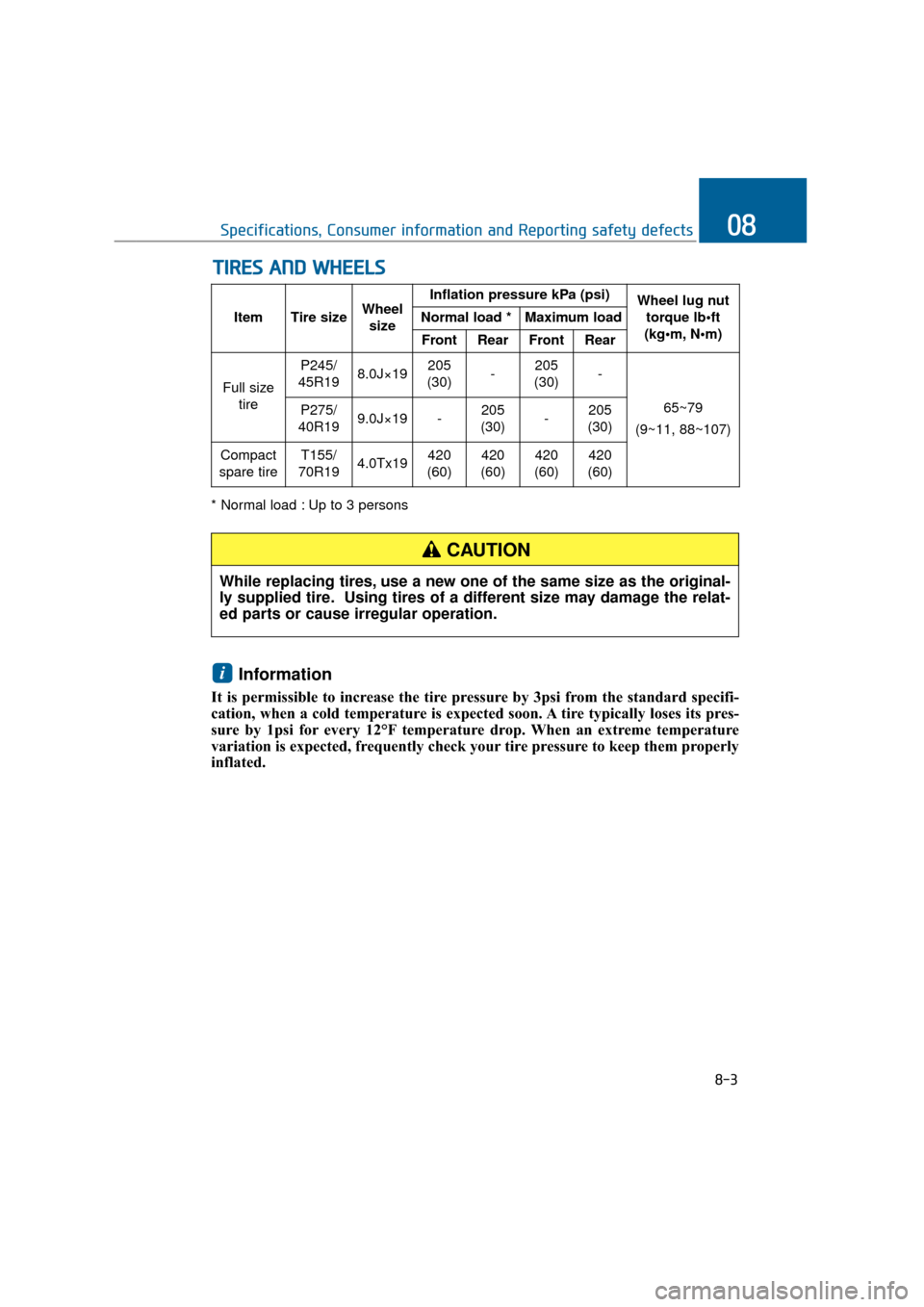
* Normal load : Up to 3 persons
Information
It is permissible to increase the tire pressure by 3psi from the standard specifi-
cation, when a cold temperature is expected soon. A tire typically loses its pres-
sure by 1psi for every 12°F temperature drop. When an extreme temperature
variation is expected, frequently check your tire pressure to keep them properly
inflated.
i
T TI
IR
R E
ES
S
A
A N
N D
D
W
W H
HE
EE
EL
LS
S
8-3
Specifications, Consumer information and Reporting safety defects08
Item Tire size Wheel
size Inflation pressure kPa (psi)
Wheel lug nut
torque lb•ft
(kg N
Normal load * Maximum load
Front Rear Front Rear
Full size tire P245/
45R19 8.0J×19 205
(30) -205
(30) -
65~79
(9~11, 88~107)
P275/
40R19 9.0J×19 - 205
(30) -205
(30)
Compact
spare tireT155/
70R194.0Tx19420
(60)420
(60)420
(60)420
(60)
While replacing tires, use a new one of the same size as the original-
ly supplied tire. Using tires of a different size may damage the relat-
ed parts or cause irregular operation.
CAUTION