load capacity Hyundai Equus 2016 User Guide
[x] Cancel search | Manufacturer: HYUNDAI, Model Year: 2016, Model line: Equus, Model: Hyundai Equus 2016Pages: 477, PDF Size: 16.25 MB
Page 407 of 477
7-50
Maintenance
4. Tire ply composition andmaterial
There are a number of layers or plies
of rubber-coated fabrics in the tire.
Tire manufacturers indicate the
materials on the tire, such as steel,
nylon and polyester. The letter "R"
means radial ply construction; the
letter "D" means diagonal or bias ply
construction; and the letter "B"
means belted-bias ply construction.
5. Maximum permissible infla-tion pressure
This number indicates the air pres-
sure limit of the tire. Do not inflate the
tire over the maximum pressure.
Refer to "Tire and Loading
Information Label" for the recom-
mended inflation pressure.
6. Maximum load rating
This number indicates the maximum
loading capacity in kilograms or in
pounds that a tire can carry. When
replacing the tires, always use the
tire of the same load rating as the
original one.
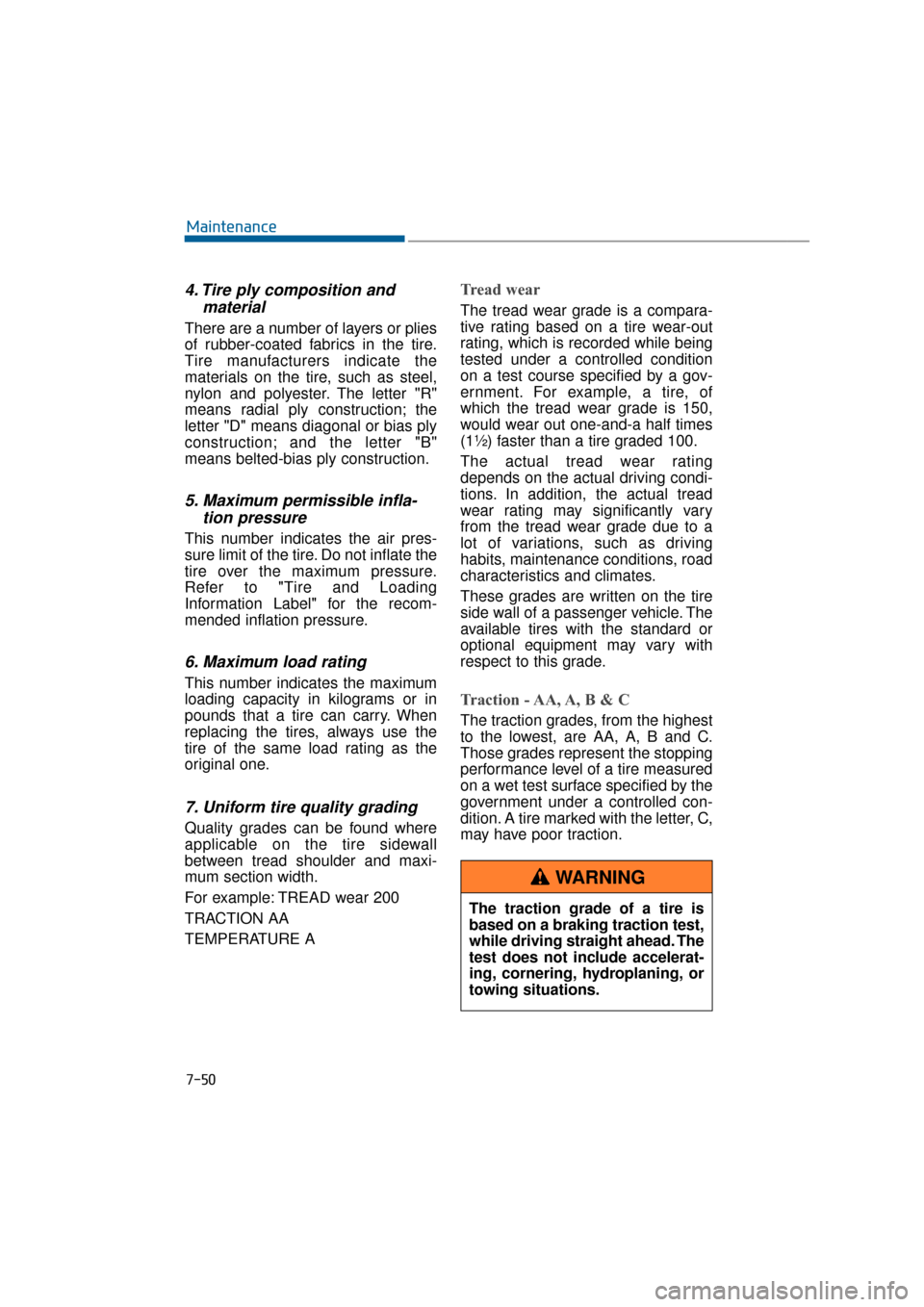
7. Uniform tire quality grading
Quality grades can be found where
applicable on the tire sidewall
between tread shoulder and maxi-
mum section width.
For example: TREAD wear 200
TRACTION AA
TEMPERATURE A
Tread wear
The tread wear grade is a compara-
tive rating based on a tire wear-out
rating, which is recorded while being
tested under a controlled condition
on a test course specified by a gov-
ernment. For example, a tire, of
which the tread wear grade is 150,
would wear out one-and-a half times
(1½) faster than a tire graded 100.
The actual tread wear rating
depends on the actual driving condi-
tions. In addition, the actual tread
wear rating may significantly vary
from the tread wear grade due to a
lot of variations, such as driving
habits, maintenance conditions, road
characteristics and climates.
These grades are written on the tire
side wall of a passenger vehicle. The
available tires with the standard or
optional equipment may vary with
respect to this grade.
Traction - AA, A, B & C
The traction grades, from the highest
to the lowest, are AA, A, B and C.
Those grades represent the stopping
performance level of a tire measured
on a wet test surface specified by the
government under a controlled con-
dition. A tire marked with the letter, C,
may have poor traction.
The traction grade of a tire is
based on a braking traction test,
while driving straight ahead. The
test does not include accelerat-
ing, cornering, hydroplaning, or
towing situations.
WARNING
Page 410 of 477
7-53
Maintenance07
Load Index:The numerical index,
on a scale of 1 to 279, to indicate a
tire loading capacity.
Maximum Inflation Pressure: The
maximum air pressure to which a
cold tire may be inflated. The maxi-
mum air pressure information is
specified on a tire side wall.
Maximum Load Rating: The load-
ing capacity for a tire, which is inflat-
ed to the maximum.
Maximum Loaded Vehicle Weight:
The sum of curb weight; accessory
weight; vehicle capacity weight; and
production options weight.
Normal Occupant Weight: The mul-
tiplication of the designated occu-
pant seat number by 150 pounds (68
kg).
Occupant Distribution: Designated
seating positions.
Outward Facing Sidewall: The side
of a asymmetrical tire that has a par-
ticular side that faces outward when
mounted on a vehicle. The outward
facing sidewall bears white lettering
or bears manufacturer, brand, and/or
model name molding that is higher or
deeper than the same moldings on
the inner facing sidewall.
Passenger (P-Metric) Tire: This tire
is for a passenger vehicle, a light
truck or a multipurpose vehicle.
Ply: A layer of rubber-coated parallel
cords
Pneumatic Tire: A mechanical
device made of rubber, chemicals,
fabric and steel or other materials,
that, when mounted on an automo-
tive wheel, provides the traction and
contains the gas or fluid that sustains
the load. Production Options Weight:
The
combined weight of installed regular
production options weighing over 5
lb.(2.3 kg) in excess of the standard
items which they replace, not previ-
ously considered in curb weight or
accessory weight, including heavy
duty brakes, ride levelers, roof rack,
heavy duty battery, and special trim.
Recommended Inflation Pressure:
Vehicle manufacturer's recommend-
ed pressure to inflate a tire. This is
specified on a tire placard.
Radial Ply Tire: A pneumatic tire in
which the ply cords that extend to the
beads are laid at 90 degrees to the
centerline of the tread.
Rim: A metal support for a tire and
upon which the tire beads are seat-
ed.
Sidewall: The portion of a tire
between the tread and the bead.
Speed Rating: An alphanumeric
code to indicate the maximum speed
to which a tire can operate.
Traction: The friction between a tire
and a road surface. The amount of
grip provided.
Tread: The contacting portion of a
tire with the road.
Treadwear Indicators: This is a nar-
row band, sometimes called "wear
bars." This appears across the tread,
when only 2/32 inch of tread
remains.
UTQGS: The Uniform Tire Quality
Grading Standards is the information
of traction, temperature and tread
abrasion. A rating is measured by a
tire manufacturer in accordance with
the government-specified testing
procedure. The rating information is
specified on the tire side wall.
Page 411 of 477
7-54
Maintenance
Vehicle Capacity Weight: The mul-
tiplication of the designated occu-
pant seat number by 150 pounds (68
kg) plus the loading weight.
Vehicle Maximum Load on the
Tire: Loading capacity for an individ-
ual tire. The curb and accessory
weights plus the maximum occupant
and loading weights.
Vehicle Normal Load on the Tire:
Loading capacity for an individual
axle. The sum of the curb, accessory,
and normal occupant weights is
divided by 2.
Vehicle Placard: A label, perma-
nently attached to a vehicle, to indi-
cate the original equipment tire size
and the recommended inflation pres-
sure.
All season tires
HYUNDAI designated some models
of all-season tires to provide good
performance for use all year round,
including snowy and icy road condi-
tions. All-season tires are identified
by ALL SEASON and/or M+S (Mud
and Snow) on the tire side wall.
Snow tires have better snow traction
than all season tires and may be
more appropriate in some areas.
Summer tires
HYUNDAI designated some models
of summer tires to provide superior
performance on dry roads. Summer
tire performance is substantially
reduced in snow and ice. Summer
tires do not have a tire traction rating
mark, M+S (Mud and Snow), on the
tire side wall. Before driving in snowy
or icy conditions, it is recommended
to install snow tires or all-season
tires on all four wheels.
Snow tires
When equipping your vehicle with
snow tires, the tires should be in the
same size and have the same load
capacity as the original ones. Snow
tires should be installed on all four
wheels. Otherwise, it may cause
poor handling. Snow tires should be
more inflated by 4 psi (28 kPa) than
the lesser of the two recommended
pressures - one specified on the tire
label attached to the central pillar on
the driver's side, and the other spec-
ified on the tire side wall.
Do not drive faster than 75 mph (120
km/h) when your car is equipped with
snow tires.
- Snow or ice
When driving on a snowy or icy road, drive slower than 20
mph (30 km/h).
Use the SAE “S” class or wire chains.
When you hear chain-rattling noise, retighten the chain to
avoid its contact with the
vehicle body.
To prevent damage to the vehicle body, retighten the
chains after driving 0.3~0.6
miles (0.5~1.0 km).
Do not use tire chains on a vehicle equipped with alu-
minum wheels. In unavoidable
circumstance, use the wire-
type chains.
Use the wire chains, of which the diameter is less than 0.47
inches (12 mm), to prevent
damage to the chain connect-
ing parts.
WARNING
Page 412 of 477
7-55
Maintenance07
Tire chains
Tire chains, if necessary, should be
installed on the drive wheels (rear
wheels).
Make sure that the chains are
installed in accordance with the man-
ufacturer's instructions.
To minimize the abrasion of tires and
chains, do not use the chains, when
unnecessary.
Radial-ply tires
Radial-ply tires provide longer tread
life, better road hazard resistance
and smoother riding at a high speed.
The radial-ply tires used on this vehi-
cle are of belted construction, and
are to improve your driving and han-
dling. Radial-ply tires have the same
loading capacity as the bias-ply or
bias-belted tires of the same size.
Inflate the radial-ply tires to the same
recommended inflation pressure. It is
not recommended to attempt a
cross-combination of radial-ply tires
and bias-ply(or bias-belted) tires on
the same vehicle. Any cross-combi-
nation of radial-ply and bias-ply(or
bias-belted) tires on one vehicle will
seriously deteriorate vehicle han-
dling. The best rule to follow is:
Identical radial-ply tires should
always be used for a set of four tires.
A tire, which is driven for a long peri-
od of time, is more susceptible to
irregular tread abrasion. It is very
important to rotate tires, at the inter-
val instructed in this chapter, to use it
up to its potential tread life. Any cut
and puncture on a radial-ply tire is
repairable, only when it is on the
tread, because of the side wall flex-
ing. Consult your tire dealer for a
radial-ply tire repair.
Page 413 of 477
7-56
Maintenance
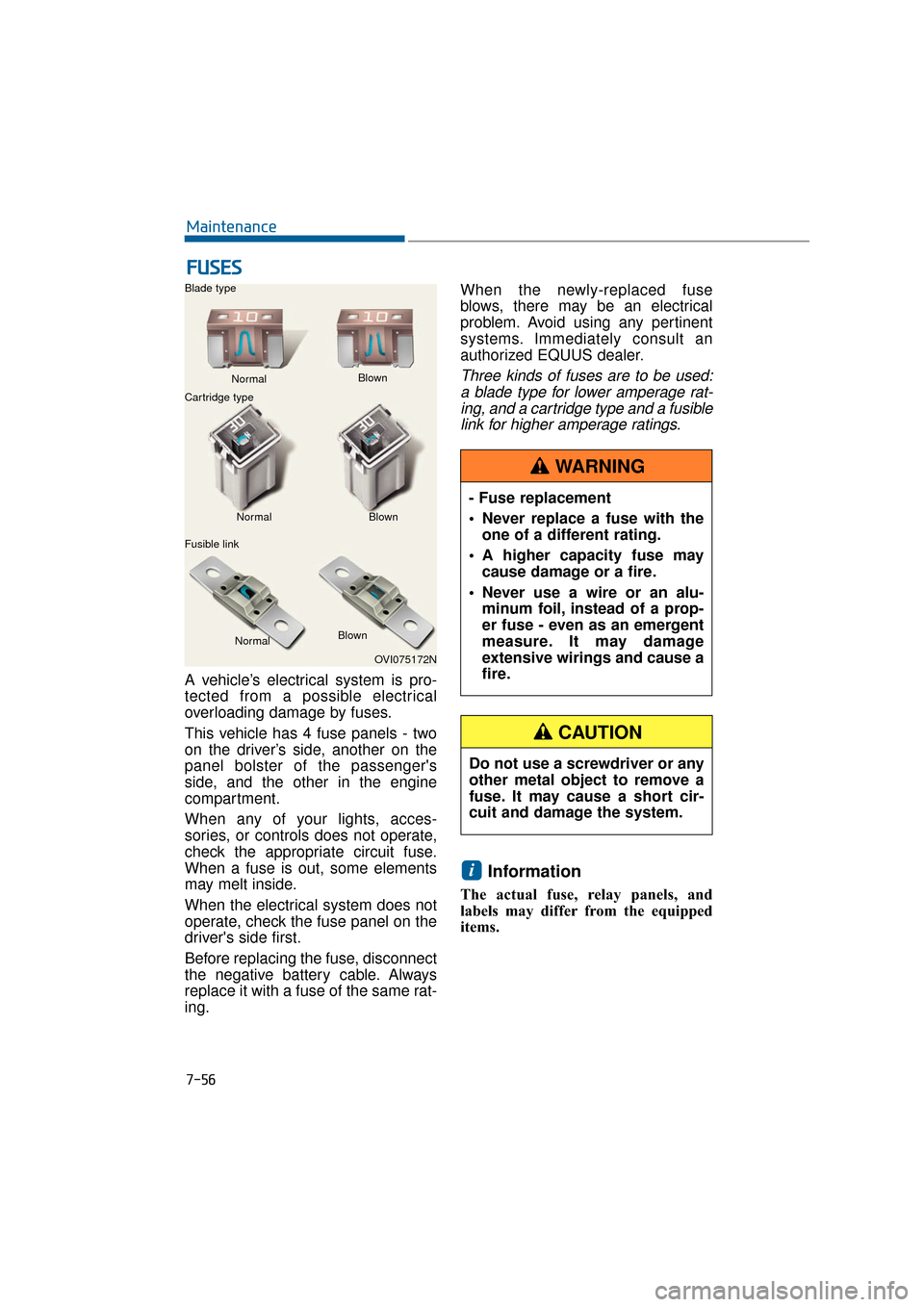
A vehicle’s electrical system is pro-
tected from a possible electrical
overloading damage by fuses.
This vehicle has 4 fuse panels - two
on the driver’s side, another on the
panel bolster of the passenger's
side, and the other in the engine
compartment.
When any of your lights, acces-
sories, or controls does not operate,
check the appropriate circuit fuse.
When a fuse is out, some elements
may melt inside.
When the electrical system does not
operate, check the fuse panel on the
driver's side first.
Before replacing the fuse, disconnect
the negative battery cable. Always
replace it with a fuse of the same rat-
ing. When the newly-replaced fuse
blows, there may be an electrical
problem. Avoid using any pertinent
systems. Immediately consult an
authorized EQUUS dealer.
Three kinds of fuses are to be used:
a blade type for lower amperage rat-ing, and a cartridge type and a fusiblelink for higher amperage ratings.
Information
The actual fuse, relay panels, and
labels may differ from the equipped
items.
i
F F U
U S
SE
E S
S
OVI075172N
Normal
Normal
Blade type
Cartridge type
Fusible link Blown
Blown
Normal Blown
- Fuse replacement
Never replace a fuse with the
one of a different rating.
A higher capacity fuse may cause damage or a fire.
Never use a wire or an alu- minum foil, instead of a prop-
er fuse - even as an emergent
measure. It may damage
extensive wirings and cause a
fire.
WARNING
Do not use a screwdriver or any
other metal object to remove a
fuse. It may cause a short cir-
cuit and damage the system.
CAUTION