seats Hyundai Equus 2016 User Guide
[x] Cancel search | Manufacturer: HYUNDAI, Model Year: 2016, Model line: Equus, Model: Hyundai Equus 2016Pages: 477, PDF Size: 16.25 MB
Page 42 of 477
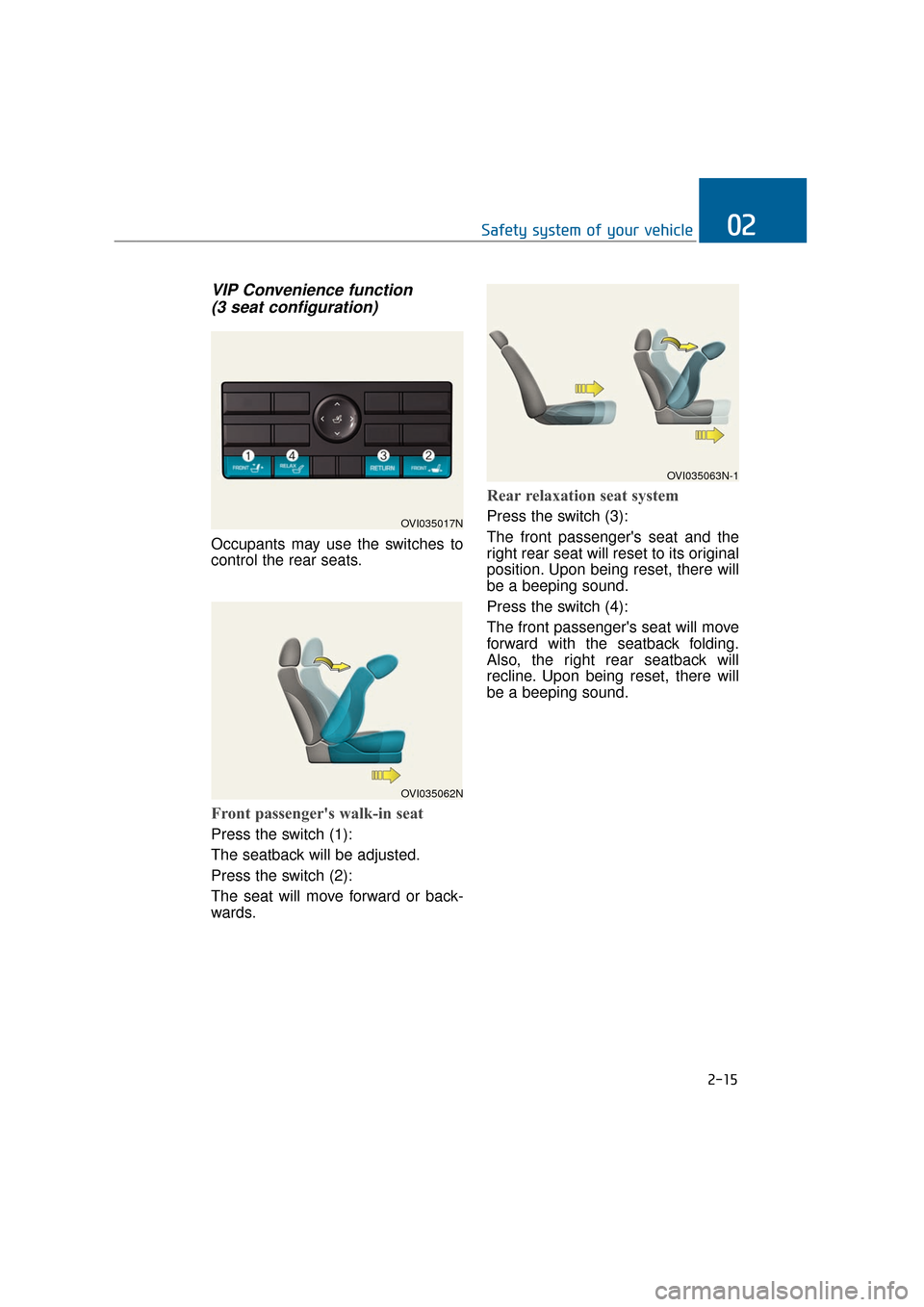
VIP Convenience function (3 seat configuration)
Occupants may use the switches to
control the rear seats.
Front passenger's walk-in seat
Press the switch (1):
The seatback will be adjusted.
Press the switch (2):
The seat will move forward or back-
wards.
Rear relaxation seat system
Press the switch (3):
The front passenger's seat and the
right rear seat will reset to its original
position. Upon being reset, there will
be a beeping sound.
Press the switch (4):
The front passenger's seat will move
forward with the seatback folding.
Also, the right rear seatback will
recline. Upon being reset, there will
be a beeping sound.
2-15
Safety system of your vehicle02
OVI035062N
OVI035063N-1
OVI035017N
Page 43 of 477
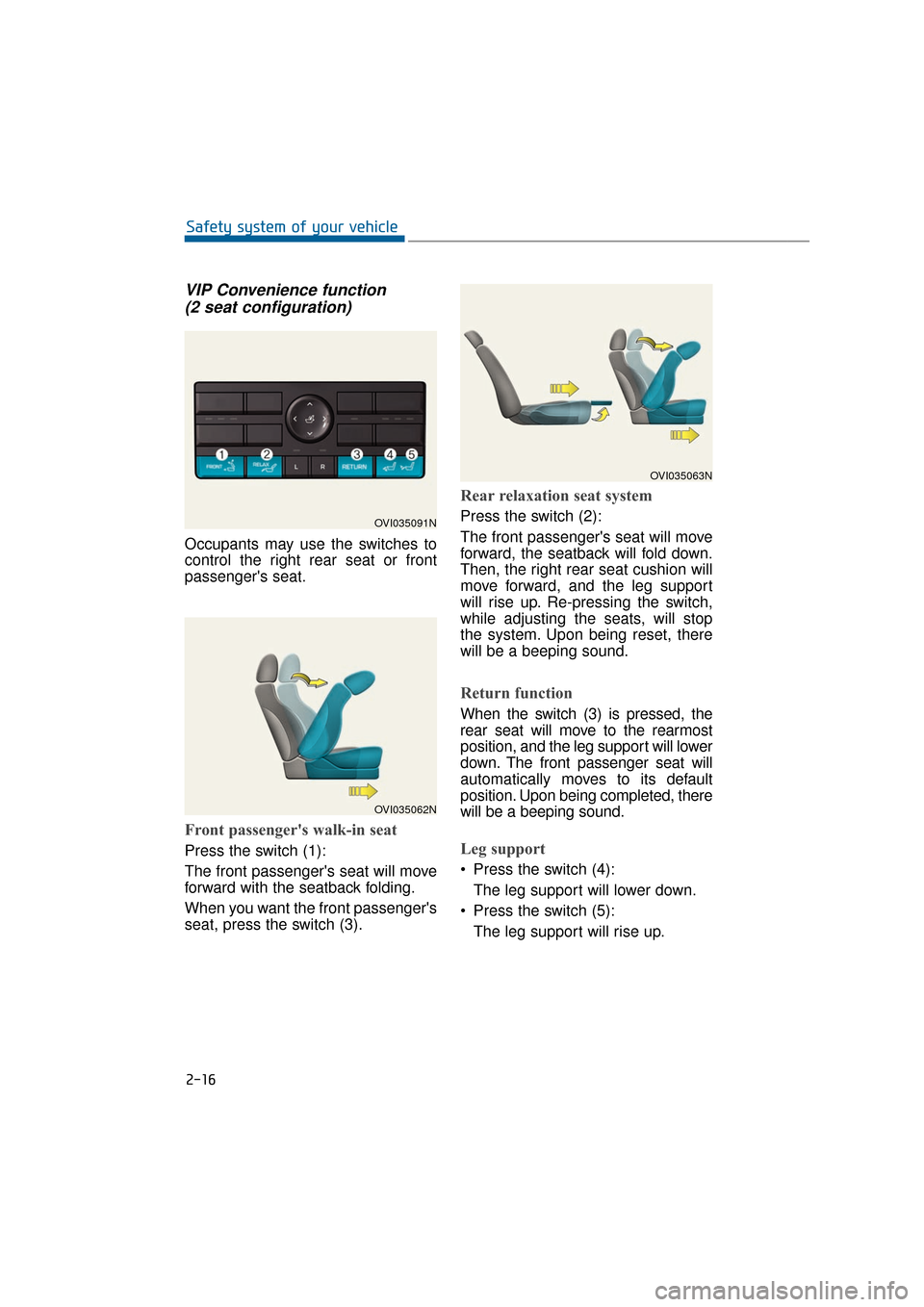
VIP Convenience function (2 seat configuration)
Occupants may use the switches to
control the right rear seat or front
passenger's seat.
Front passenger's walk-in seat
Press the switch (1):
The front passenger's seat will move
forward with the seatback folding.
When you want the front passenger's
seat, press the switch (3).
Rear relaxation seat system
Press the switch (2):
The front passenger's seat will move
forward, the seatback will fold down.
Then, the right rear seat cushion will
move forward, and the leg support
will rise up. Re-pressing the switch,
while adjusting the seats, will stop
the system. Upon being reset, there
will be a beeping sound.
Return function
When the switch (3) is pressed, the
rear seat will move to the rearmost
position, and the leg support will lower
down. The front passenger seat will
automatically moves to its default
position. Upon being completed, there
will be a beeping sound.
Leg support
Press the switch (4):
The leg support will lower down.
Press the switch (5): The leg support will rise up.
2-16
Safety system of your vehicle
OVI035063N
OVI035091N
OVI035062N
Page 45 of 477
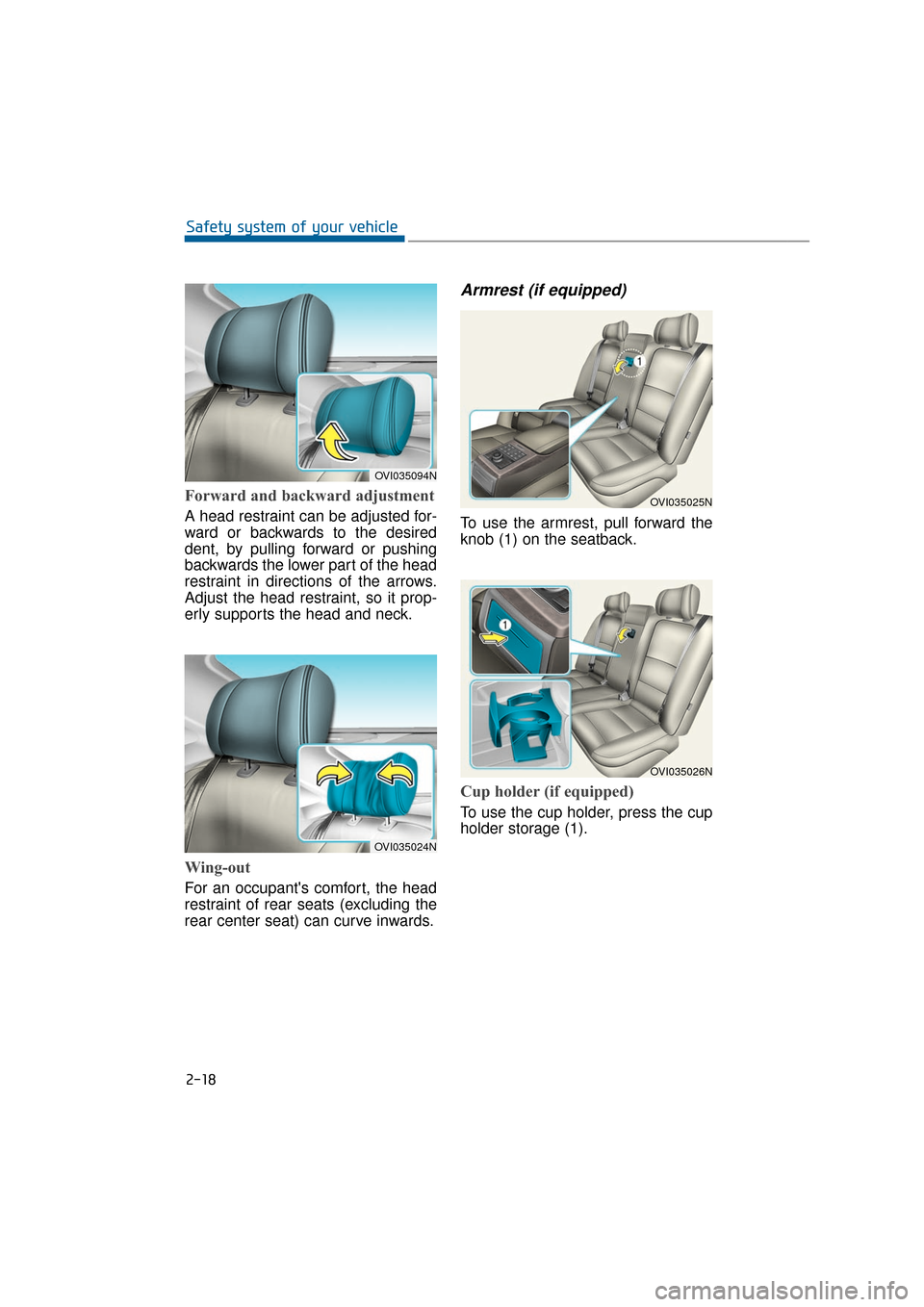
Forward and backward adjustment
A head restraint can be adjusted for-
ward or backwards to the desired
dent, by pulling forward or pushing
backwards the lower part of the head
restraint in directions of the arrows.
Adjust the head restraint, so it prop-
erly supports the head and neck.
Wing-out
For an occupant's comfort, the head
restraint of rear seats (excluding the
rear center seat) can curve inwards.
Armrest (if equipped)
To use the armrest, pull forward the
knob (1) on the seatback.
Cup holder (if equipped)
To use the cup holder, press the cup
holder storage (1).
2-18
Safety system of your vehicle
OVI035025N
OVI035026N
OVI035094N
OVI035024N
Page 46 of 477
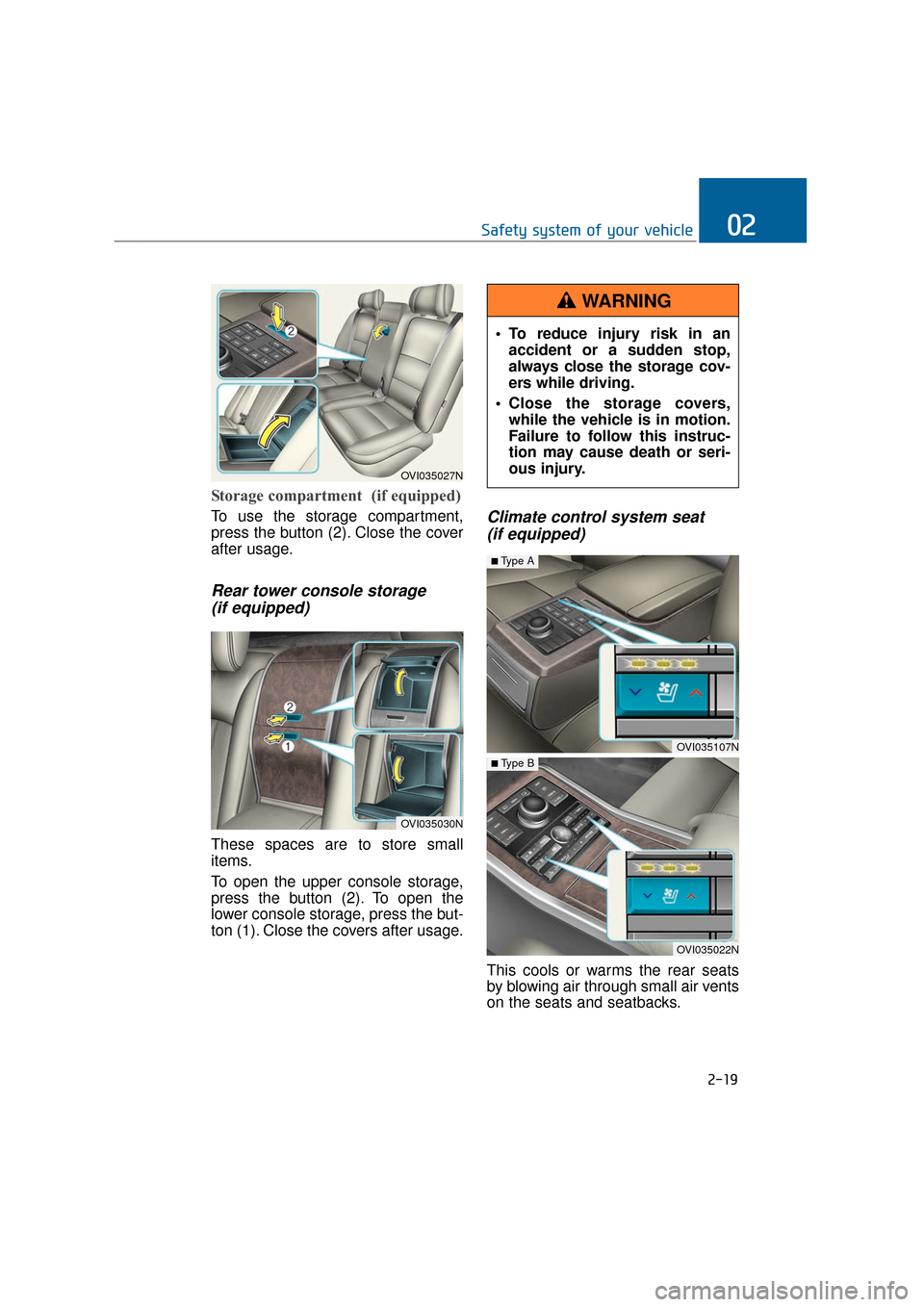
Storage compartment (if equipped)
To use the storage compartment,
press the button (2). Close the cover
after usage.
Rear tower console storage (if equipped)
These spaces are to store small
items.
To open the upper console storage,
press the button (2). To open the
lower console storage, press the but-
ton (1). Close the covers after usage.
Climate control system seat(if equipped)
This cools or warms the rear seats
by blowing air through small air vents
on the seats and seatbacks.
2-19
Safety system of your vehicle02
OVI035030N
OVI035027N
To reduce injury risk in an
accident or a sudden stop,
always close the storage cov-
ers while driving.
Close the storage covers, while the vehicle is in motion.
Failure to follow this instruc-
tion may cause death or seri-
ous injury.
WARNING
OVI035107N
■Type A
OVI035022N
■ Type B
Page 47 of 477
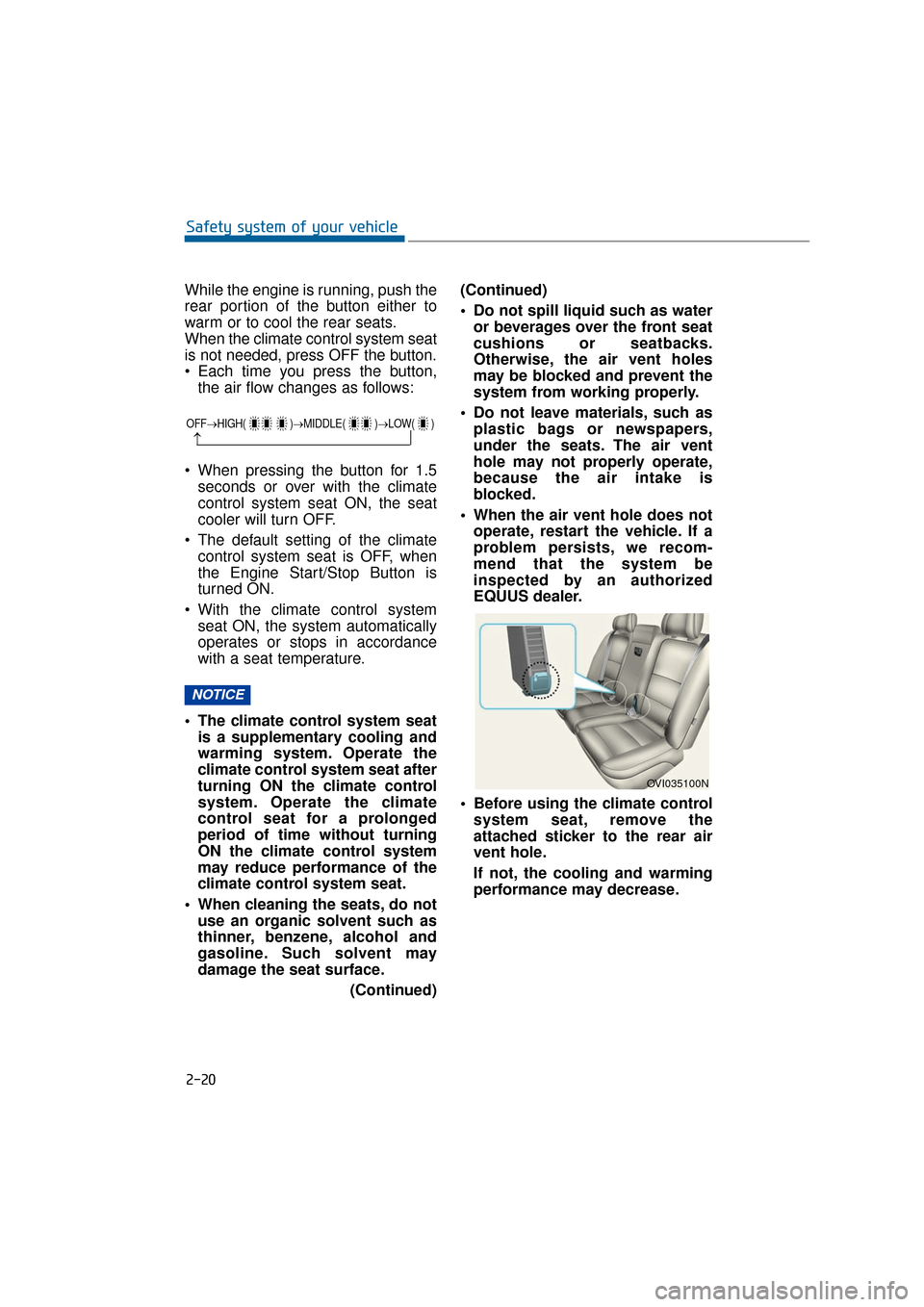
While the engine is running, push the
rear portion of the button either to
warm or to cool the rear seats.
When the climate control system seat
is not needed, press OFF the button.
Each time you press the button,the air flow changes as follows:
When pressing the button for 1.5 seconds or over with the climate
control system seat ON, the seat
cooler will turn OFF.
The default setting of the climate control system seat is OFF, when
the Engine Start/Stop Button is
turned ON.
With the climate control system seat ON, the system automatically
operates or stops in accordance
with a seat temperature.
The climate control system seat is a supplementary cooling and
warming system. Operate the
climate control system seat after
turning ON the climate control
system. Operate the climate
control seat for a prolonged
period of time without turning
ON the climate control system
may reduce performance of the
climate control system seat.
When cleaning the seats, do not use an organic solvent such as
thinner, benzene, alcohol and
gasoline. Such solvent may
damage the seat surface.
(Continued)(Continued)
Do not spill liquid such as water
or beverages over the front seat
cushions or seatbacks.
Otherwise, the air vent holes
may be blocked and prevent the
system from working properly.
Do not leave materials, such as plastic bags or newspapers,
under the seats. The air vent
hole may not properly operate,
because the air intake is
blocked.
When the air vent hole does not operate, restart the vehicle. If a
problem persists, we recom-
mend that the system be
inspected by an authorized
EQUUS dealer.
Before using the climate control system seat, remove the
attached sticker to the rear air
vent hole.
If not, the cooling and warming
performance may decrease.
OVI035100N
NOTICE
2-20
Safety system of your vehicle
OFF→ HIGH( )→ MIDDLE( )→LOW( )
→
Page 49 of 477
Seat belt warning (for driver’s seat)
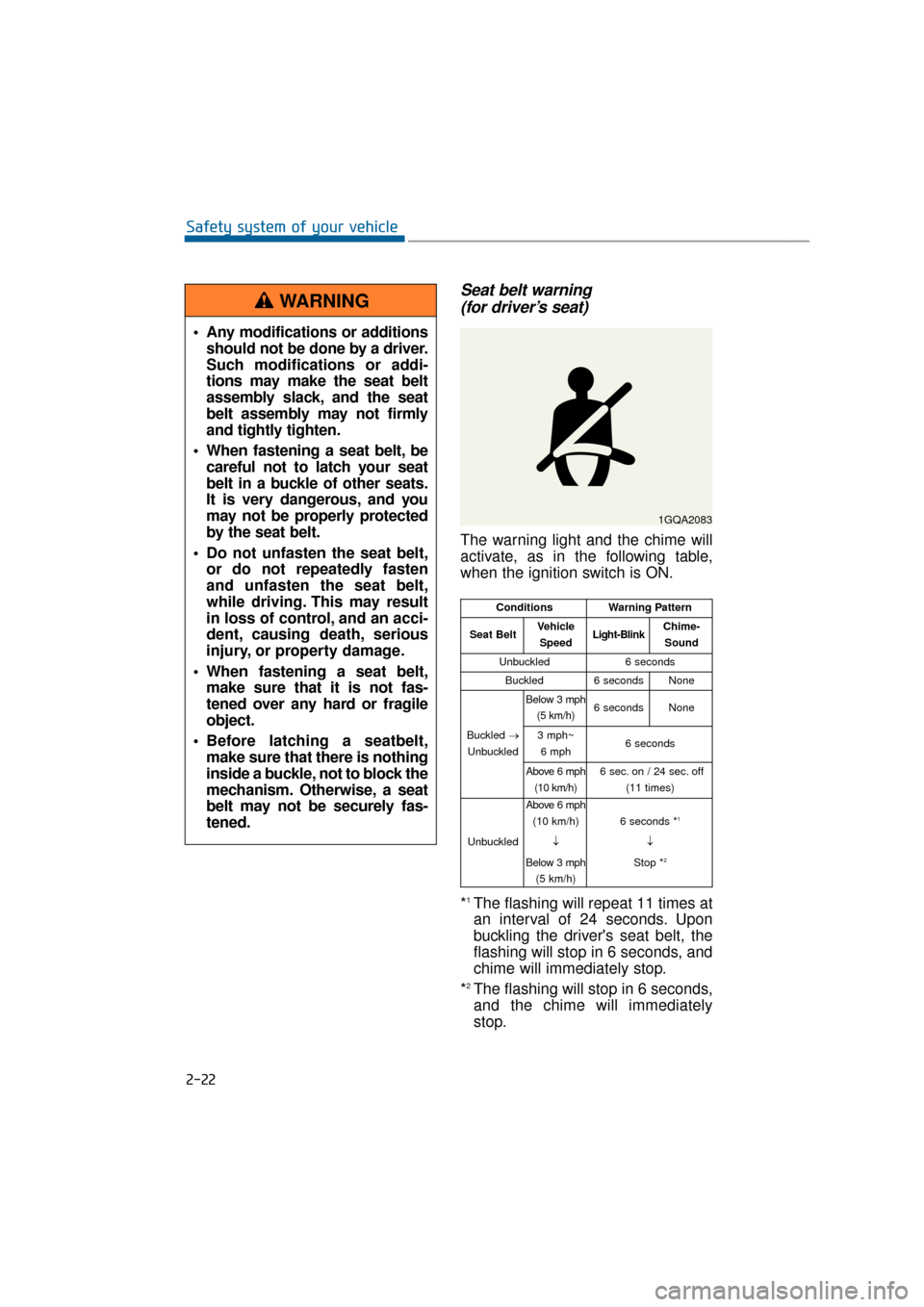
The warning light and the chime will
activate, as in the following table,
when the ignition switch is ON.
*
1The flashing will repeat 11 times at
an interval of 24 seconds. Upon
buckling the driver's seat belt, the
flashing will stop in 6 seconds, and
chime will immediately stop.
*
2The flashing will stop in 6 seconds,
and the chime will immediately
stop.
2-22
Safety system of your vehicle
Any modifications or additions should not be done by a driver.
Such modifications or addi-
tions may make the seat belt
assembly slack, and the seat
belt assembly may not firmly
and tightly tighten.
When fastening a seat belt, be careful not to latch your seat
belt in a buckle of other seats.
It is very dangerous, and you
may not be properly protected
by the seat belt.
Do not unfasten the seat belt, or do not repeatedly fasten
and unfasten the seat belt,
while driving. This may result
in loss of control, and an acci-
dent, causing death, serious
injury, or property damage.
When fastening a seat belt, make sure that it is not fas-
tened over any hard or fragile
object.
Before latching a seatbelt, make sure that there is nothing
inside a buckle, not to block the
mechanism. Otherwise, a seat
belt may not be securely fas-
tened.
WARNING
1GQA2083
ConditionsWarning Pattern
Seat BeltVehicle
SpeedLight-BlinkChime-Sound
Unbuckled6 seconds
Buckled6 secondsNone
Buckled →
Unbuckled
Below 3 mph (5 km/h)6 secondsNone
3 mph~6 mph6 seconds
Above 6 mph (10 km/h)6 sec. on / 24 sec. off (11 times)
Unbuckled
Above 6 mph(10 km/h)
↓
Below 3 mph (5 km/h)
6 seconds *1
↓
Stop *
2
Page 56 of 477

2-29
Safety system of your vehicle02
Automatic Seat Belt Retracting
In order to prevent a seat belt from
being slack due to weak fabric dura-
bility, your seat belt assembly is
equipped with the automatic retract-
ing function. A motor automatically
retracts the seat belt after approxi-
mately 3 seconds. However, this
does not operate, when the seat belt
is unfastened with little slack.
Seat belt precautions
Infant or small child
All 50 states have child restraint laws
which require children to travel in
approved child restraint devices,
including booster seats. The ages, at
which seat belts may be used
instead of child restraints, differ
among states, so you should check
the specific requirements in your
state before driving. Infant and child
restraints must be properly placed
and installed in a rear seat.
For further information, refer to the
Child Restraint Systems chapter.
All occupants of the vehicle
must and always fasten their
seat belts. Seat belts and child
restraints reduce the risk of
serious or fatal injury in the
event of a collision or a sudden
stop. Without fastening a seat
belt, occupants may fall too
close to a deploying air bag,
strike the interior structure or
be thrown out of the vehicle.
Proper fastening greatly
reduces these hazards.
Even with advanced air bag
technologies, unbelted occu-
pants may be severely injured
due to air bag inflation. Always
follow the precautions about
seat belts, air bags and occu-
pant safety contained in this
manual.
WARNING
Every person in your vehicle
needs to be properly and
always restrained, including
infants and children. Never hold
a child in your arms or on your
laps when riding in a vehicle.
The violent impact in a crash
may force you miss the child
from your arms and the child
may strike against the vehicle
interior.
Always use a child restraint
appropriate for your child's
height and weight.
WARNING
Page 59 of 477

Do not lie down
To reduce the chance of injury in the
event of an accident and to achieve
maximum effects of the restraint sys-
tem, all passengers should seat in an
upright position in front and rear
seats when the vehicle is in motion.
Proper protection cannot be provid-
ed, when an occupant lies on rear
seats, or when a seat is reclined.
Care of seat belts
Seat belt systems should never be
disassembled or modified. In addi-
tion, care should be taken not to
damage seat belts or belt assem-
blies by seat hinges, doors or other
abuse.
Periodic inspection
All seat belts should be checked on a
regular basis for any wear-out or
damage. Any damaged parts should
be replaced as soon as possible.
Keep belts clean and dry
Seat belts should be kept clean and
dry. When belts become dirty, clean
them with mild soap and warm water.
Bleach, dye, strong detergents or
abrasives should not be used,
because they may damage and
weaken the fabric.
When to replace seat belts
An entire seat belt assembly should
be replaced after an accident. This
should be done, even when no dam-
age is visible. Consult an authorized
EQUUS dealer for additional ques-
tions about the seat belt operation.
2-32
Safety system of your vehicleRiding with a reclined seatback
increases your chance of seri-
ous or fatal injuries in the event
of a collision or sudden stop.
The protection of your restraint
system (seat belts and air bags)
increasingly reduces, when
your seat is reclined. A seat belt
must be snug against your hips
and chest to properly operate.
The more a seatback is
reclined, the greater the chance
that an occupant's hips will
slide under the lap portion of a
seat belt, causing serious inter-
nal injury or hard pressure on
the occupant's neck from the
shoulder portion of a seat belt.
Drivers and passengers should
always sit well back in their
seats, be properly belted, and
put their seatbacks upright.
DANGER
Page 60 of 477
Children under age 13 must always
ride in rear seats and be properly
restrained to minimize the risk of
injury in an accident, a sudden stop
or a sudden maneuver. According to
the accident statistics, children are
safer when being properly restrained
in rear seats than in the front pas-
senger's seat. Even with advanced
air bag systems, children may be
seriously injured or killed. A child,
who is too big for a child restraint,
must fasten a seat belt provided.
All 50 states have child restraint
laws, which require children to travel
in approved child restraint devices.
The laws to govern and restrict chil-
dren's age, height, and weight, at
which a seat belt is allowed to use
instead of a child restraint, differ
among states. So, you should check
any specific requirements in your
state, before travelling. A child
restraint must be properly placed
and installed in a rear seat. You must
use a commercially available child
restraint, which meets the require-
ments of the Federal Motor Vehicle
Safety Standards (FMVSS).
A child restraint is generally
designed to be secured in a seat by
a lap belt, lap/shoulder belts, or a
LATCH system.
A child may be injured or killed in a
crash, when a child restraint is not
properly secured.
C CH
H I
IL
L D
D
R
R E
ES
ST
T R
R A
A I
IN
N T
T
S
S Y
Y S
ST
T E
EM
M
2-33
Safety system of your vehicle02
A child restraint must be
placed in a rear seat. Never
install a child or infant seat in
the front passenger's seat.
When an accident occurs and
the passenger-side air bag
inflates, it may severely injure
or kill an infant or a child.
Thus, always install a child
restraint in a rear seat.
When a child restraint is not in use, fasten it with a seat
belt or store it in the trunk, so
it does not fall forward in a
sudden stop or an accident.
Children may be seriously injured or killed by an inflating
air bag. All children, even who
are too big for child restraints,
must ride in a rear seat.
WARNING
A seat belt or a child restraint
easily gets hot, when it is
exposed to the sunlight in a
closed vehicle even in the mild
weather. Check the temperature
of a seat cover and buckles
before seating a child.
CAUTION
Page 62 of 477
2-35
Safety system of your vehicle02
Rear-Facing child restraint
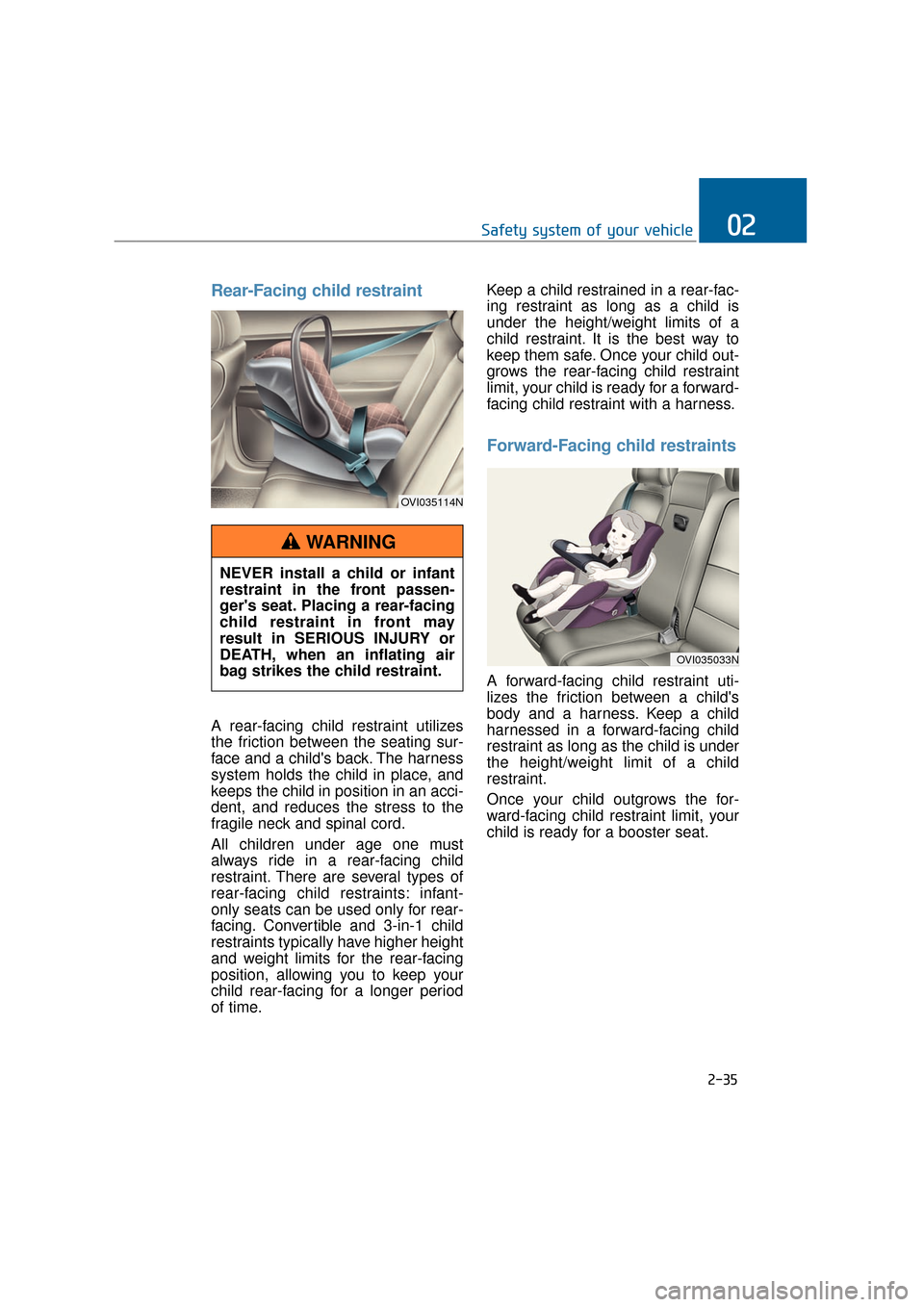
A rear-facing child restraint utilizes
the friction between the seating sur-
face and a child's back. The harness
system holds the child in place, and
keeps the child in position in an acci-
dent, and reduces the stress to the
fragile neck and spinal cord.
All children under age one must
always ride in a rear-facing child
restraint. There are several types of
rear-facing child restraints: infant-
only seats can be used only for rear-
facing. Convertible and 3-in-1 child
restraints typically have higher height
and weight limits for the rear-facing
position, allowing you to keep your
child rear-facing for a longer period
of time.Keep a child restrained in a rear-fac-
ing restraint as long as a child is
under the height/weight limits of a
child restraint. It is the best way to
keep them safe. Once your child out-
grows the rear-facing child restraint
limit, your child is ready for a forward-
facing child restraint with a harness.
Forward-Facing child restraints
A forward-facing child restraint uti-
lizes the friction between a child's
body and a harness. Keep a child
harnessed in a forward-facing child
restraint as long as the child is under
the height/weight limit of a child
restraint.
Once your child outgrows the for-
ward-facing child restraint limit, your
child is ready for a booster seat.
OVI035114N
NEVER install a child or infant
restraint in the front passen-
ger's seat. Placing a rear-facing
child restraint in front may
result in SERIOUS INJURY or
DEATH, when an inflating air
bag strikes the child restraint.
WARNING
OVI035033N