seats Hyundai Equus 2016 Owner's Guide
[x] Cancel search | Manufacturer: HYUNDAI, Model Year: 2016, Model line: Equus, Model: Hyundai Equus 2016Pages: 477, PDF Size: 16.25 MB
Page 93 of 477
Additional safety precautions
All occupants should sit in anupright position, fully back in their
seats with their seat belts fastened
and their feet rested on the floor.
Occupants should not take an
inappropriate seating position,
while the vehicle is moving. An
unfastened occupant may strike
against the vehicle interior, against
other occupants, or out of the vehi-
cle, in a crash or emergency stop.
Each seat belt is designed to
restrain only one occupant.
When more than one person fas-
ten the same seat belt, they may
be seriously injured or killed in a
collision.
Do not put any accessories on
seat belts. Devices, which claims
to improve occupants' comfort,
may reduce the protection of a seat
belt and increase the chance of
serious injury in a crash.
Occupants should not place
hard or sharp objects between
themselves and the air bags.
Carrying hard or sharp objects on
your laps or in your mouth may
result in injuries, when an air bag
inflates.
Keep occupants away from the
air bags. All occupants should sit
upright, fully back in their seats
with their seat belts fastened and
their feet rested on the floor. When
the occupants are too close to the
air bag covers, they could be
injured if the air bags inflate.
Do not attach or place objects
on or near the air bag covers.
Any object attached to or placed
on the front or side impact air bag
covers could interfere with the
proper operation of the air bags.
2-66
Safety system of your vehicle
(Continued)
No objects should be placed over or near the air bag mod-
ules on the steering wheel,
instrument panel, and the
front panel above the glove
box, because such an object
may cause harm in a crash,
which is severe enough to
inflate the air bags.
After the air bags inflate, those must be replaced by an
authorized EQUUS dealer.
Do not modify or disconnect SRS wiring and other compo-
nents. Doing so may result in
injury, due to inadvertent air
bag inflation or the deactivat-
ed air bag system.
When components of the air bag system are to be discard-
ed, or when the vehicle must
be scrapped, certain safety
precautions must be
observed. An authorized
EQUUS dealer knows these
precautions and can give you
the necessary information.
Failure to follow these precau-
tions and procedures may
increase the risk of personal
injury.
When your vehicle is flooded and the floor mats are soaked,
you should not attempt to
start the engine. Have the
vehicle towed to an author-
ized EQUUS dealer.
Page 94 of 477
Do not modify the front seats.
Modification of the front seats
could interfere with the operation of
the SRS sensing components or
side impact air bags.
Do not place items under the
front seats. Items under the front
seats could interfere with the oper-
ation of the SRS sensing compo-
nents or wiring harnesses.
Never hold an infant or child on
your laps. The infant or child may
be seriously injured or killed in the
event of a crash. All infants and
children should be properly
restrained in an appropriate child
restraint or in a rear seat with a
seat belt.Adding equipment to or modify- ing your air bag-equipped vehi-cle
When you modify your vehicle frame,
bumper system, front-end or side-
sheet metal or ride height, this may
adversely affect the operation of your
vehicle's air bag system.
2-67
Safety system of your vehicle02
Sitting improperly or out of
position may cause occu-
pants to slant too close
towards a deploying air bag,
strike the interior structure or
be thrown from the vehicle,
resulting in serious injury or
death.
Always put a seatback upright, and seat on the cen-
ter of the seat cushion with
your seat belt fastened, legs
comfortably extended and
your feet rested on the floor.
Be careful not to impact doors, when the Engine
Start/Stop Button is ON. The
impact may cause the air bags
to inflate.
WARNING
Page 112 of 477
Auto Door Lock/Unlock Features
You can adjust the auto door lock/
unlock modes in the User Setting.
Refer to the User Setting Mode in the
chapter 3.
Child-Protector Rear Door
Locks
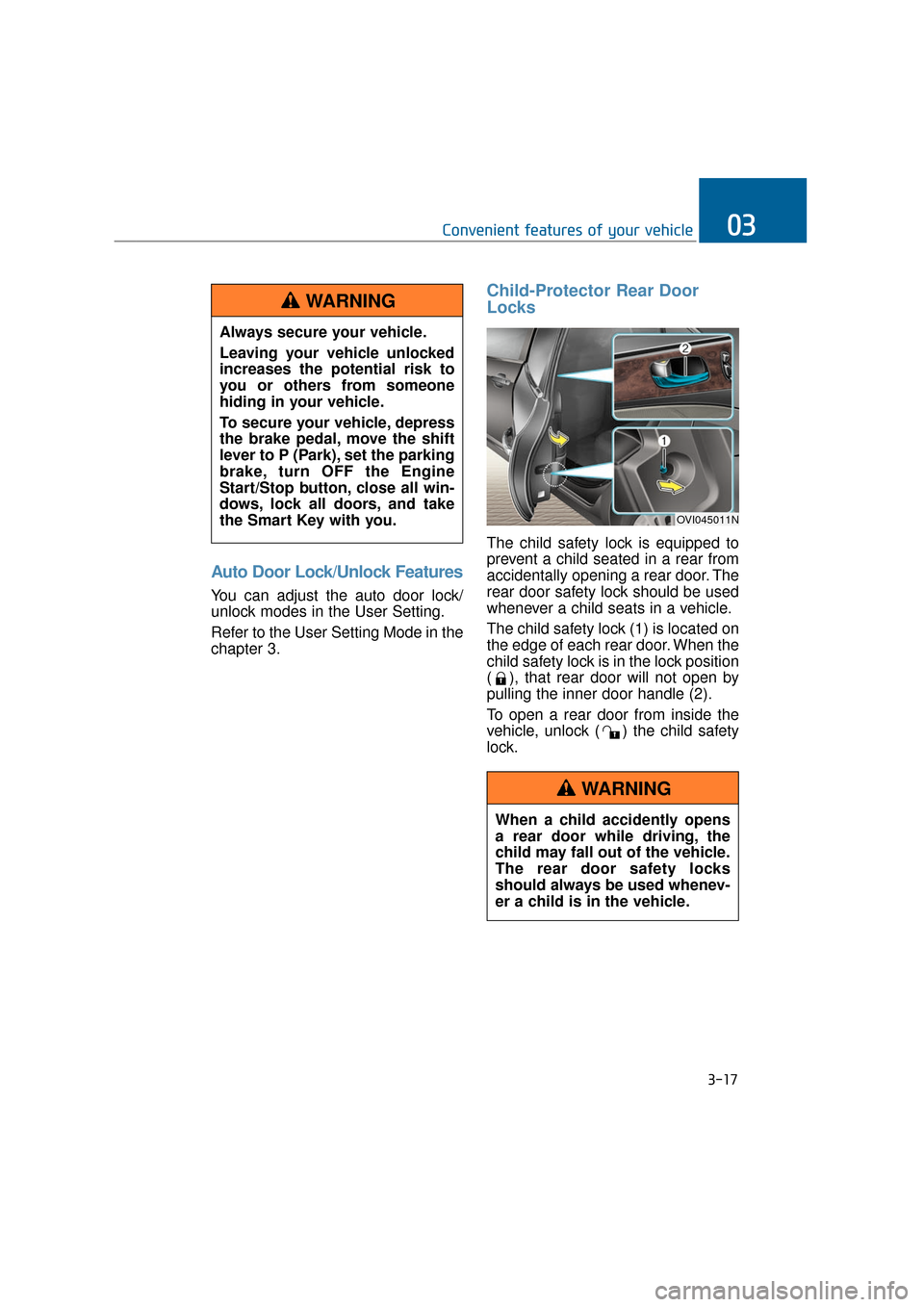
The child safety lock is equipped to
prevent a child seated in a rear from
accidentally opening a rear door. The
rear door safety lock should be used
whenever a child seats in a vehicle.
The child safety lock (1) is located on
the edge of each rear door. When the
child safety lock is in the lock position
( ), that rear door will not open by
pulling the inner door handle (2).
To open a rear door from inside the
vehicle, unlock ( ) the child safety
lock.
3-17
Convenient features of your vehicle03
When a child accidently opens
a rear door while driving, the
child may fall out of the vehicle.
The rear door safety locks
should always be used whenev-
er a child is in the vehicle.
WARNING
Always secure your vehicle.
Leaving your vehicle unlocked
increases the potential risk to
you or others from someone
hiding in your vehicle.
To secure your vehicle, depress
the brake pedal, move the shift
lever to P (Park), set the parking
brake, turn OFF the Engine
Start/Stop button, close all win-
dows, lock all doors, and take
the Smart Key with you.
WARNING
OVI045011N
Page 219 of 477
3-124
Convenient features of your vehicle
Automatic heating and air con-
ditioning
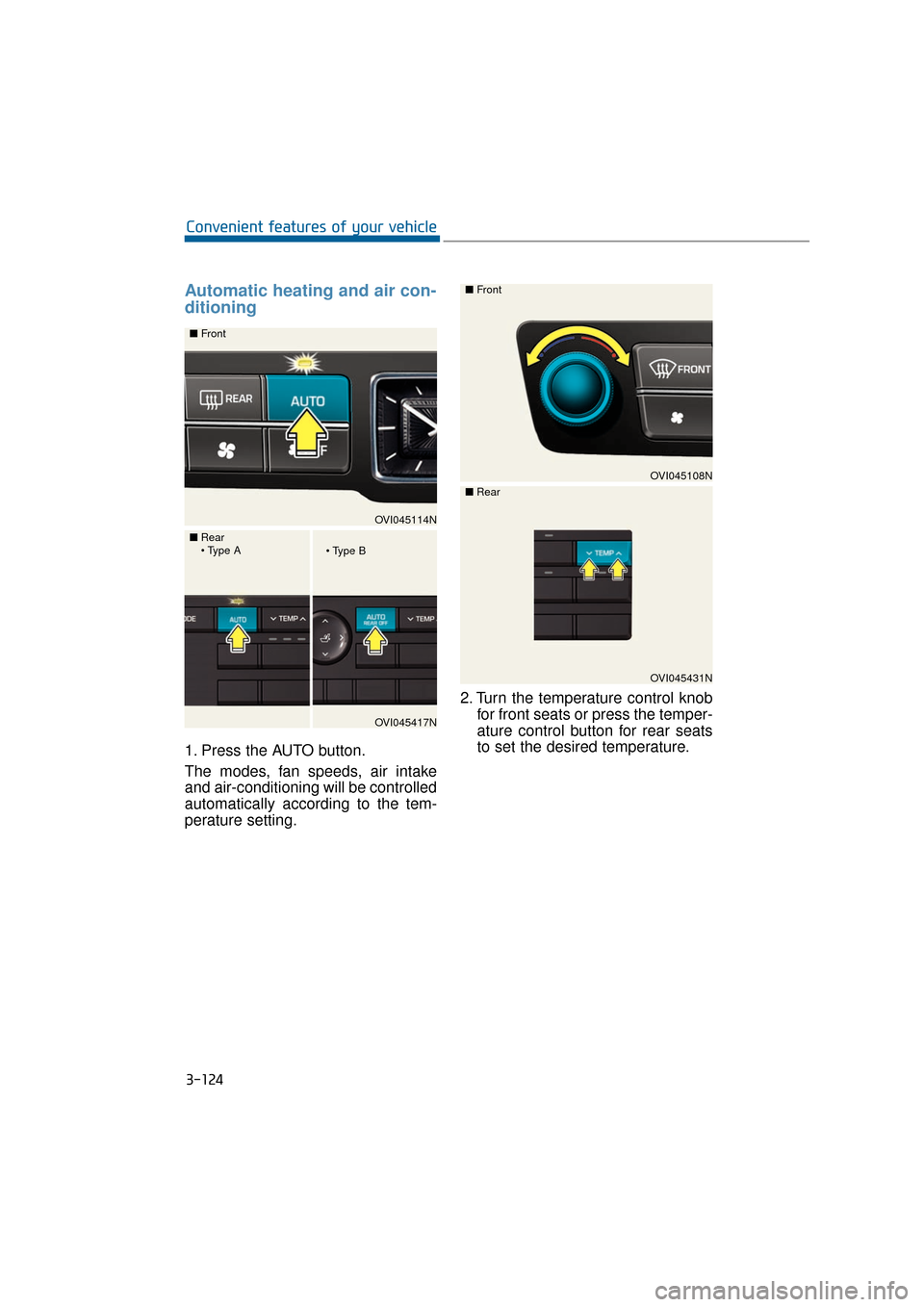
1. Press the AUTO button.
The modes, fan speeds, air intake
and air-conditioning will be controlled
automatically according to the tem-
perature setting.2. Turn the temperature control knob
for front seats or press the temper-
ature control button for rear seats
to set the desired temperature.
OVI045114N
■
Front
OVI045417N
■
Rear
OVI045108N
■
Front
OVI045431N
■
Rear
Page 225 of 477
3-130
Convenient features of your vehicle
Temperature control
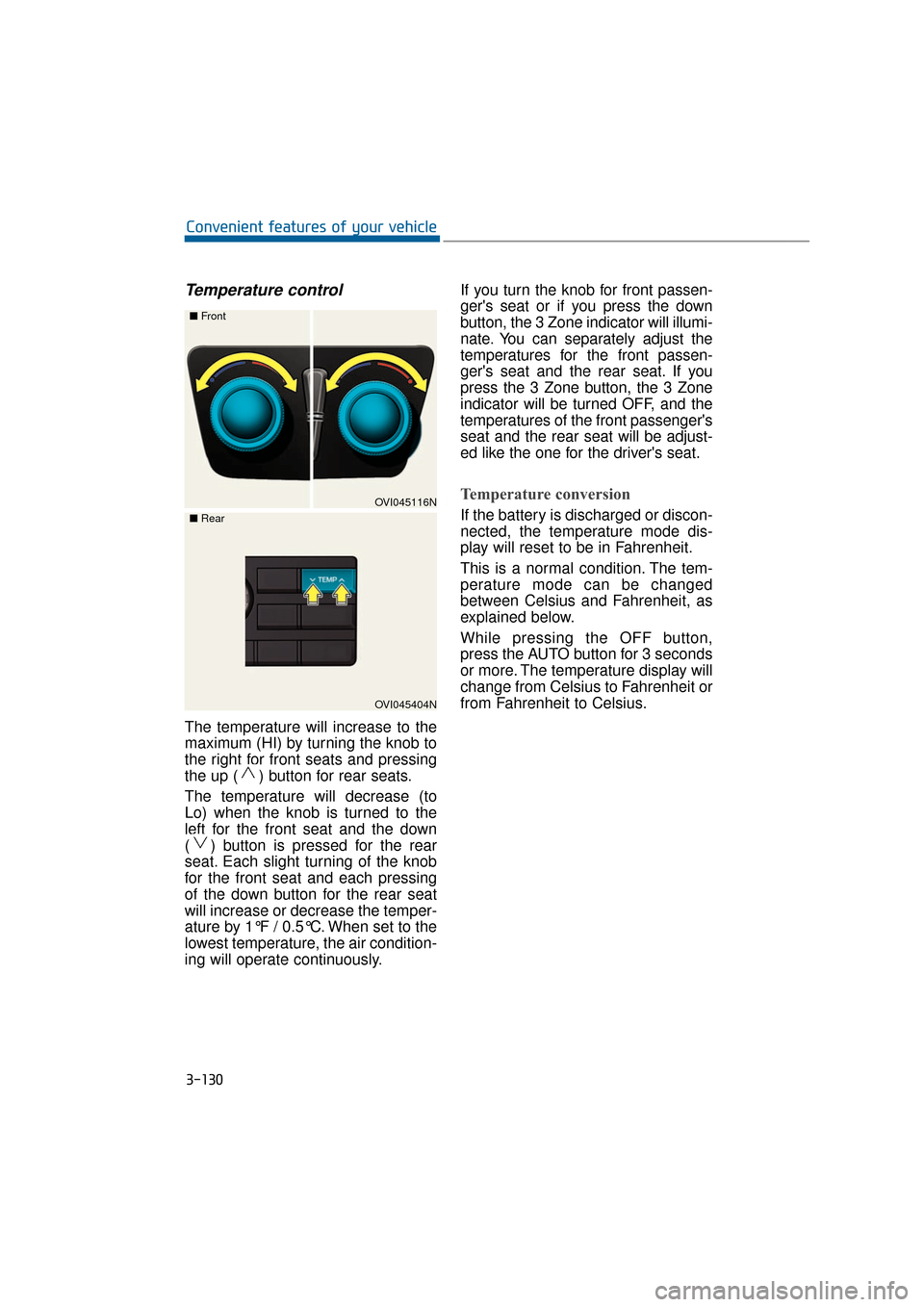
The temperature will increase to the
maximum (HI) by turning the knob to
the right for front seats and pressing
the up ( ) button for rear seats.
The temperature will decrease (to
Lo) when the knob is turned to the
left for the front seat and the down
( ) button is pressed for the rear
seat. Each slight turning of the knob
for the front seat and each pressing
of the down button for the rear seat
will increase or decrease the temper-
ature by 1°F / 0.5°C. When set to the
lowest temperature, the air condition-
ing will operate continuously.If you turn the knob for front passen-
ger's seat or if you press the down
button, the 3 Zone indicator will illumi-
nate. You can separately adjust the
temperatures for the front passen-
ger's seat and the rear seat. If you
press the 3 Zone button, the 3 Zone
indicator will be turned OFF, and the
temperatures of the front passenger's
seat and the rear seat will be adjust-
ed like the one for the driver's seat.
Temperature conversion
If the battery is discharged or discon-
nected, the temperature mode dis-
play will reset to be in Fahrenheit.
This is a normal condition. The tem-
perature mode can be changed
between Celsius and Fahrenheit, as
explained below.
While pressing the OFF button,
press the AUTO button for 3 seconds
or more. The temperature display will
change from Celsius to Fahrenheit or
from Fahrenheit to Celsius.OVI045116N
■
Front
OVI045404N
■
Rear
Page 409 of 477
7-52
Maintenance
Tire terminology and defini-
tions
Air Pressure:The amount of air
inside a tire, pressing the inside the
tire outwards. Air pressure is meas-
ured in pounds per square inch (psi)
or kilopascal (kPa).
Accessory Weight: This is the com-
bined weights of optional acces-
sories. Some examples of optional
accessories are the automatic trans-
mission, power seats, and air condi-
tioning.
Aspect Ratio: The ratio of a tire
width to a height.
Belt: A rubber coated layer of cords
that is located between the plies and
the tread. Cords may be made from
steel or other reinforcing materials.
Bead: The tire bead contains the
steel wires wrapped with steel cords.
This holds a tire onto a rim. Bias Ply Tire:
This is a pneumatic
tire, in which plies are laid at alter-
nate angles less than 90 degrees on
the tread centerline.
Cold Tire Pressure: This is the
amount of air pressure inside a tire,
measured in pounds per square inch
(psi) or kilopascals (kPa), before the
heat build-up due to driving.
Curb Weight: This is the vehicle
weight with standard and optional
equipment including the full fuel tank,
oil tanks and coolant tanks. However,
this excludes the weight of passen-
gers and loads.
DOT Markings: This code is marked
on a tire side wall, as an indication of
the its compliance with the U.S.
Department of Transportation motor
vehicle safety standards. The DOT
code includes the Tire Identification
Number (TIN), alphanumeric desig-
nator for the manufacturer identifica-
tion, manufacturing plant, brand and
manufacturing date.
GVWR: Gross Vehicle Weight Rating
GAWR FRT: Gross Axle Weight
Rating for the Front Axle.
GAWR RR: Gross Axle Weight
Rating for the Rear axle.
Intended Outboard Sidewall: This
asymmetrical tire side must face out-
wards, while being installed on a
vehicle.
Kilopascal (kPa): The metric unit for
air pressure.
Light Truck (LT) Tire: A tire desig-
nated by its manufacturer as primari-
ly intended for use on lightweight
trucks or multipurpose passenger
vehicles.
Load Ratings: The maximum load
that a tire is rated to carry for a given
inflation pressure.
• It is difficult to recognize a tire
damage only with your eyes.
When there is a slight hint of a
tire damage, check and
replace the tire to prevent the
damage caused by air leak-
age.
When a tire is damaged while driving on a rough road, off a
road, or over obstacles, such
as a pothole, manhole, or curb
stone, your warranty does not
cover the damage.
The tire information is speci- fied on the tire side wall.
CAUTION
Page 445 of 477
7-88
Maintenance
Interior care
Interior general precautions
Do not use chemicals, such as per-
fume, cosmetic oil, sun cream, hand
cleaner, and air freshener, inside the
vehicle, because they may damage
or discolor the interior. When one of
the above materials contacts the
interior part, immediately wipe them
off. Refer to the vinyl-cleaning
instructions for the proper cleaning
procedure.
Cleaning the upholstery andinterior trim
Vinyl
Dust the vinyl off with a whisk broom
or vacuum cleaner. Clean a vinyl sur-
face with a vinyl cleaner.
Fabric
Dust the fabric off with a whisk
broom or vacuum cleaner. Clean it
with a mild soap, recommended for
upholstery or carpets. Immediately
remove a stain with a fabric spot
cleaner. When a stain is not immedi-
ately removed, the stain may perma-
nently remain, and its color is
changed. Also, its fire-resistance
capacity is reduced, when the mate-
rial is not properly maintained.
Unauthorized cleaner or incorrect
cleaning procedures may impair
the fabric surface and the fire-
resistant capacity.
Cleaning the lap/shoulder beltwebbing
Clean the belt webbing with a mild
soap, recommended for cleaning
upholstery or carpet. Follow any
instructions of the soap. Do not
bleach or re-dye the webbing, as the
webbing surface may deteriorate.
Cleaning the interior windowglass
When the inner window surface
becomes fogged (possibly covered
with oily, greasy or waxy film), they
should be cleaned with a glass
cleaner. Follow any directions of the
glass cleaner.
Do not scrape or scratch the inner
surfaces of the rear windows. This
may damage the defroster grid of
the rear windows.
NOTICE
NOTICE
Never allow water or other liq-
uids to come in contact with
electrical/electronic compo-
nents inside the vehicle as
this may damage them.
When cleaning leather prod- ucts (i.e. steering wheel and
seats), use a neutral detergent
or a low-alcohol solution.
When using a solution, which
is rich in alcohol, acid or alka-
line, the leather color may
fade or the surface may get
stripped off.
CAUTION
Page 470 of 477
................................................................")
Rocking the vehicle........................................................................\
.....................5-68
Room lamp (front)........................................................................\
.....................3-118
Room lamp (rear) ........................................................................\
......................3-119
Rotation (Tire) ........................................................................\
.............................7-45
Safety messages ........................................................................\
............................F-6
Scheduled maintenance service ........................................................................\
....7-8
Seat belt warning........................................................................\
.........................2-22
Seat belts ........................................................................\
.....................................2-213-point system with emergency locking retractor ........................................2-23
Height adjustment ........................................................................\
................2-24
Pre-safe seat belt (PSB)........................................................................\
........2-28
Pre-tensioner seat belt ........................................................................\
..........2-25
Seat belt warning ........................................................................\
..................2-22
Seat cooler (front seat) ........................................................................\
..................2-9
Seat cooler (rear seat)........................................................................\
..................2-19
Seat warmer (front seat) ........................................................................\
................2-9
Seat warmer (rear seat) ........................................................................\
...............2-19
Seatback pocket........................................................................\
...........................2-10
Seats ........................................................................\
..............................................2-2 Armrest (rear seat)........................................................................\
................2-18
Front seat adjustment ........................................................................\
............2-4
Head restraint (front seat)........................................................................\
.......2-6
Head restraint (rear seat) ........................................................................\
......2-17
Rear seat adjustment ........................................................................\
............2-11
Seat cooler (front seat) ........................................................................\
...........2-9
Seat cooler (rear seat) ........................................................................\
...........2-19
Seat warmer (front seat) ........................................................................\
.........2-9
Seat warmer (rear seat)........................................................................\
.........2-19
Seatback pocket ........................................................................\
....................2-10
Shift lock system ........................................................................\
.........................5-14
Side air bag........................................................................\
..................................2-58
Smart key ........................................................................\
......................................3-6
Smart trunk ........................................................................\
..................................3-24
Smooth cornering ........................................................................\
........................5-69
Snow tires ........................................................................\
....................................5-72
I-12
Index
S