tires Hyundai Equus 2016 User Guide
[x] Cancel search | Manufacturer: HYUNDAI, Model Year: 2016, Model line: Equus, Model: Hyundai Equus 2016Pages: 477, PDF Size: 16.25 MB
Page 321 of 477
5-70
Driving your vehicle
Driving in the rain
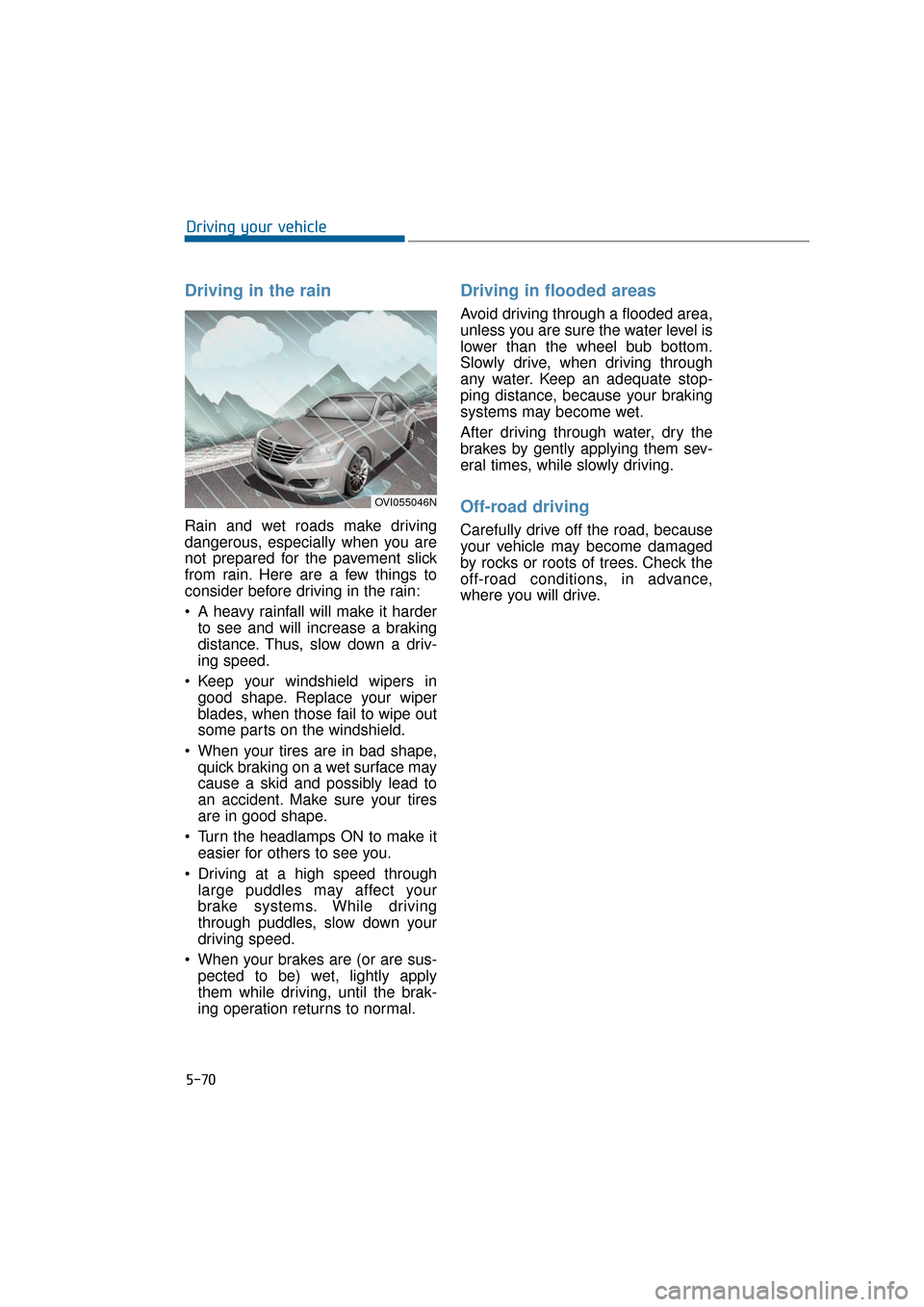
Rain and wet roads make driving
dangerous, especially when you are
not prepared for the pavement slick
from rain. Here are a few things to
consider before driving in the rain:
A heavy rainfall will make it harderto see and will increase a braking
distance. Thus, slow down a driv-
ing speed.
Keep your windshield wipers in good shape. Replace your wiper
blades, when those fail to wipe out
some parts on the windshield.
When your tires are in bad shape, quick braking on a wet surface may
cause a skid and possibly lead to
an accident. Make sure your tires
are in good shape.
Turn the headlamps ON to make it easier for others to see you.
Driving at a high speed through large puddles may affect your
brake systems. While driving
through puddles, slow down your
driving speed.
When your brakes are (or are sus- pected to be) wet, lightly apply
them while driving, until the brak-
ing operation returns to normal.
Driving in flooded areas
Avoid driving through a flooded area,
unless you are sure the water level is
lower than the wheel bub bottom.
Slowly drive, when driving through
any water. Keep an adequate stop-
ping distance, because your braking
systems may become wet.
After driving through water, dry the
brakes by gently applying them sev-
eral times, while slowly driving.
Off-road driving
Carefully drive off the road, because
your vehicle may become damaged
by rocks or roots of trees. Check the
off-road conditions, in advance,
where you will drive.
OVI055046N
Page 322 of 477
5-71
Driving your vehicle05
Highway driving
Tires
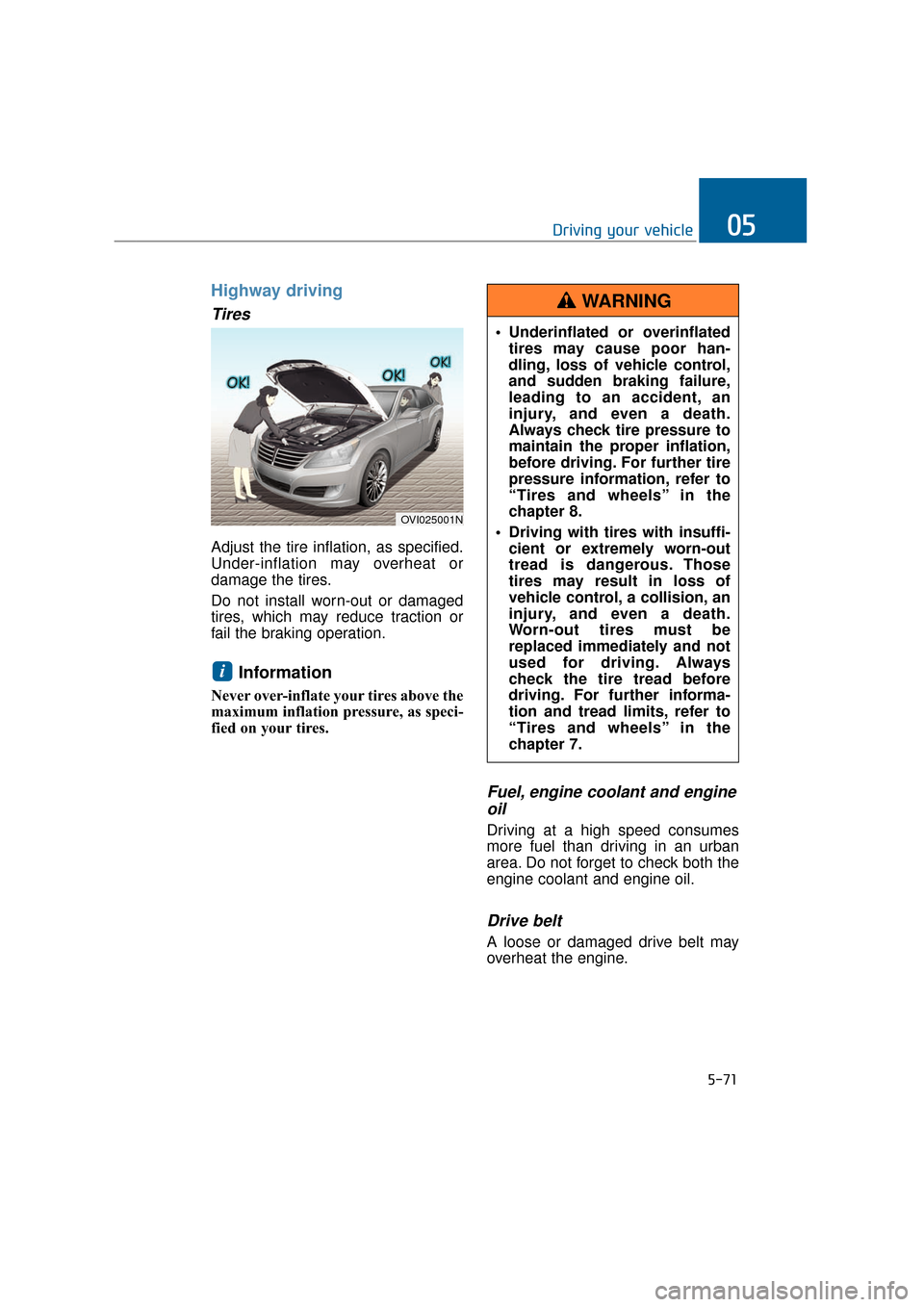
Adjust the tire inflation, as specified.
Under-inflation may overheat or
damage the tires.
Do not install worn-out or damaged
tires, which may reduce traction or
fail the braking operation.
Information
Never over-inflate your tires above the
maximum inflation pressure, as speci-
fied on your tires.
Fuel, engine coolant and engineoil
Driving at a high speed consumes
more fuel than driving in an urban
area. Do not forget to check both the
engine coolant and engine oil.
Drive belt
A loose or damaged drive belt may
overheat the engine.
i
OVI025001N
Underinflated or overinflated
tires may cause poor han-
dling, loss of vehicle control,
and sudden braking failure,
leading to an accident, an
injury, and even a death.
Always check tire pressure to
maintain the proper inflation,
before driving. For further tire
pressure information, refer to
“Tires and wheels” in the
chapter 8.
Driving with tires with insuffi- cient or extremely worn-out
tread is dangerous. Those
tires may result in loss of
vehicle control, a collision, an
injury, and even a death.
Worn-out tires must be
replaced immediately and not
used for driving. Always
check the tire tread before
driving. For further informa-
tion and tread limits, refer to
“Tires and wheels” in the
chapter 7.
WARNING
Page 323 of 477
5-72
Driving your vehicle
The severe weather conditions of
winter quickly wear out tires and
cause other problems. To minimize
winter driving problems, you should
take the following suggestions:
Snowy or icy conditions
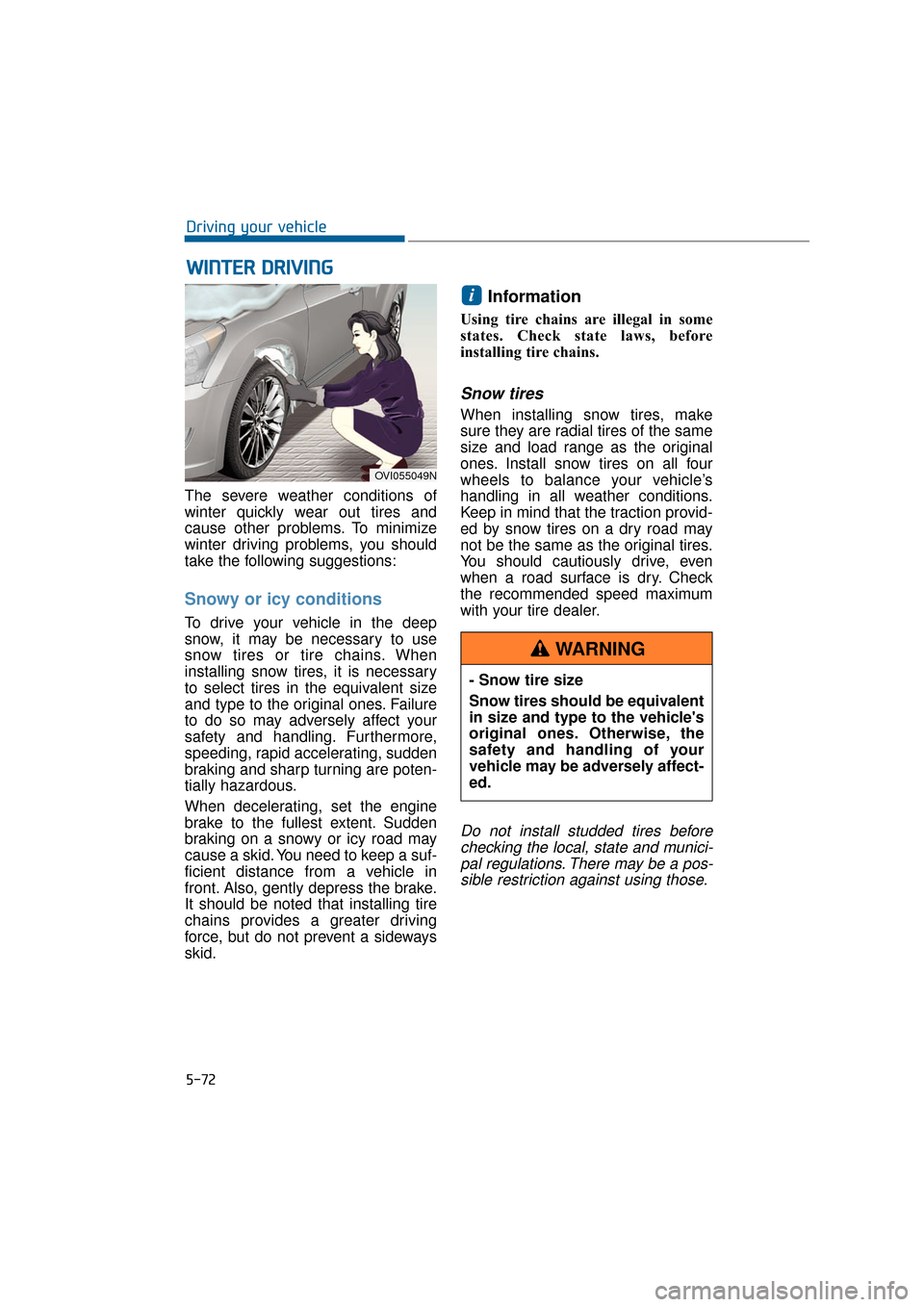
To drive your vehicle in the deep
snow, it may be necessary to use
snow tires or tire chains. When
installing snow tires, it is necessary
to select tires in the equivalent size
and type to the original ones. Failure
to do so may adversely affect your
safety and handling. Furthermore,
speeding, rapid accelerating, sudden
braking and sharp turning are poten-
tially hazardous.
When decelerating, set the engine
brake to the fullest extent. Sudden
braking on a snowy or icy road may
cause a skid. You need to keep a suf-
ficient distance from a vehicle in
front. Also, gently depress the brake.
It should be noted that installing tire
chains provides a greater driving
force, but do not prevent a sideways
skid.
Information
Using tire chains are illegal in some
states. Check state laws, before
installing tire chains.
Snow tires
When installing snow tires, make
sure they are radial tires of the same
size and load range as the original
ones. Install snow tires on all four
wheels to balance your vehicle’s
handling in all weather conditions.
Keep in mind that the traction provid-
ed by snow tires on a dry road may
not be the same as the original tires.
You should cautiously drive, even
when a road surface is dry. Check
the recommended speed maximum
with your tire dealer.
Do not install studded tires before checking the local, state and munici-pal regulations. There may be a pos-sible restriction against using those.
i
W W I
IN
N T
TE
ER
R
D
D R
RI
IV
V I
IN
N G
G
OVI055049N
- Snow tire size
Snow tires should be equivalent
in size and type to the vehicle's
original ones. Otherwise, the
safety and handling of your
vehicle may be adversely affect-
ed.
WARNING
Page 324 of 477
5-73
Driving your vehicle05
Tire chains
Since the sides of radial tires are thin-
ner, they may be damaged by
installing some types of snow chains.
Therefore, snow tires are more rec-
ommended than snow chains. Do not
install tire chains on tires over the alu-
minum wheels. Snow chains may
cause damage to those wheels.
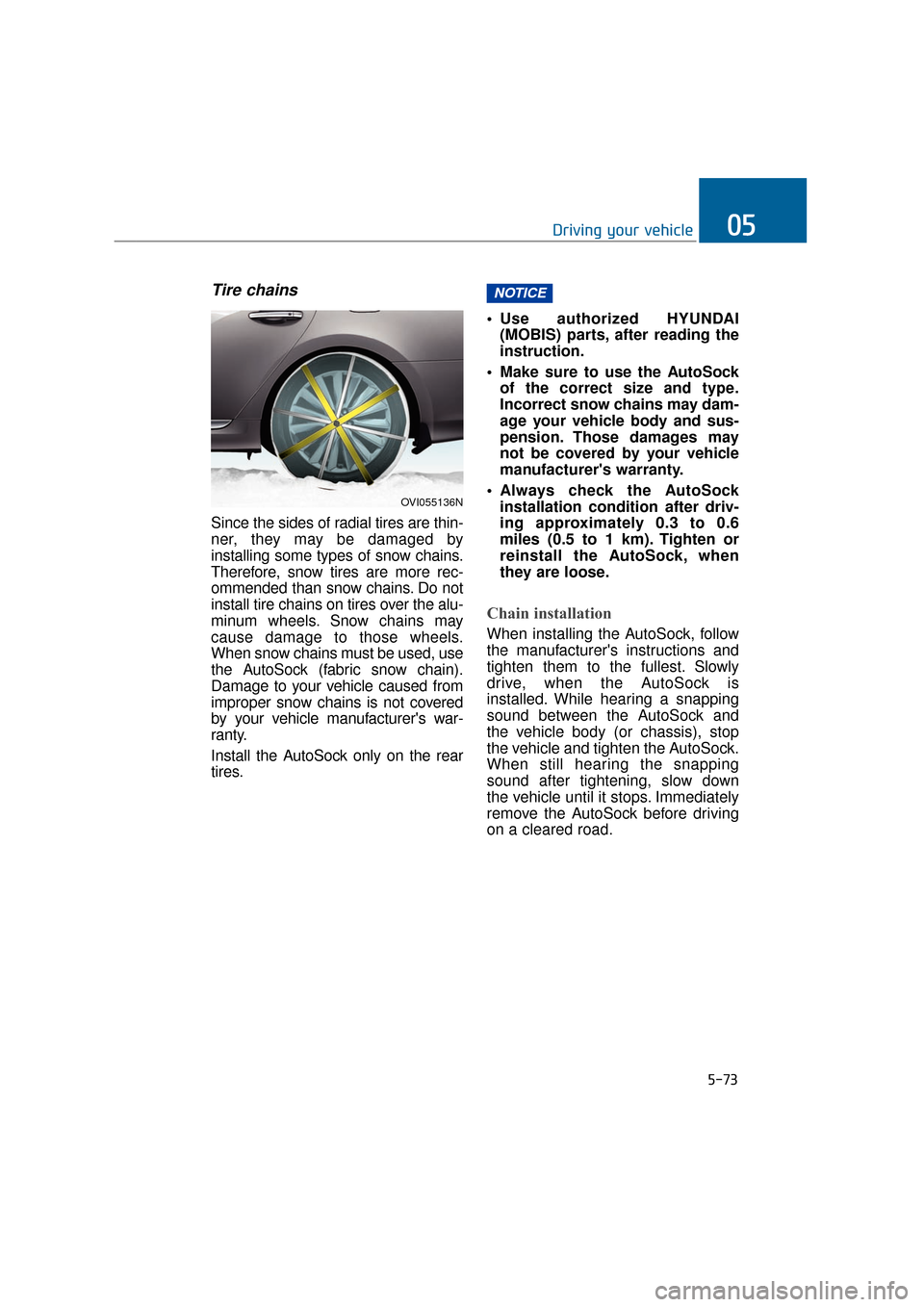
When snow chains must be used, use
the AutoSock (fabric snow chain).
Damage to your vehicle caused from
improper snow chains is not covered
by your vehicle manufacturer's war-
ranty.
Install the AutoSock only on the rear
tires. Use authorized HYUNDAI
(MOBIS) parts, after reading the
instruction.
Make sure to use the AutoSock of the correct size and type.
Incorrect snow chains may dam-
age your vehicle body and sus-
pension. Those damages may
not be covered by your vehicle
manufacturer's warranty.
Always check the AutoSock installation condition after driv-
ing approximately 0.3 to 0.6
miles (0.5 to 1 km). Tighten or
reinstall the AutoSock, when
they are loose.
Chain installation
When installing the AutoSock, follow
the manufacturer's instructions and
tighten them to the fullest. Slowly
drive, when the AutoSock is
installed. While hearing a snapping
sound between the AutoSock and
the vehicle body (or chassis), stop
the vehicle and tighten the AutoSock.
When still hearing the snapping
sound after tightening, slow down
the vehicle until it stops. Immediately
remove the AutoSock before driving
on a cleared road.
NOTICE
OVI055136N
Page 331 of 477
5-80
Driving your vehicle
Certification label
The certification label is located on
right side of the driver's door sill.
This label shows the maximum
weight capacity, or called GVWR
(Gross Vehicle Weight Rating). The
GVWR includes the weight of the
vehicle, all occupants, fuel, and load.
This label also tells you the maxi-
mum weight that can be supported
by the front and rear axles, called
Gross Axle Weight Rating (GAWR).
To find out the actual load weight of
the front and rear axles, you need to
weigh your vehicle. Your dealer can
help you with this. Equally and even-
ly spread out the loads across the
centerline.The label will help you decide how
much loads and installed equipment
your vehicle can carry.
When your vehicle carries items
inside, such as suitcases, tools and
packages, those loads move as fast
as your vehicle. When stopping or
sharply turning, or if there is a crash,
those loads may throw forwards
under the influence of inertia, and
cause an injury by hitting with the
driver or an occupant.
OBH059070
- Over loading
Never exceed the GVWR or
the GAWR of your vehicle.
Overloading above those lim-
its may cause an accident or a
vehicle damage. You can cal-
culate the load weight capaci-
ty by weighing the items (or
people), before putting them
in the vehicle. Be careful not
to overload your vehicle.
Do not overload your vehicle above the GVWR, the
front/rear GAWRs or the vehi-
cle weight capacity. When
overloading, including tires,
parts may break. Even, it may
adversely affects the vehicle
handling and braking per-
formance. You may lose con-
trol and crash. Also, overload-
ing may shorten the life span
of your vehicle.
WARNING
Page 332 of 477
5-81
Driving your vehicle05
Overloading may damage yourvehicle. Repairs are not covered
by your warranty. Do not over-
load your vehicle.
Heavier suspension compo- nents for higher durability may
not change the weight capacity.
Ask your dealer to help you load
your vehicle the right way.
NOTICE
Overloading your vehicle mayoverheat the tires and cause
tire failure, possibly leading to
a crash.
Overloading your vehicle may increase a stopping distance,
possibly leading to a crash.
A crash, which is resulted from poor handling, vehicle
damage, tire failure, or a
longer stopping distance, may
result in a serious injury or
death.
WARNING
- Unsecured loads
Items you carry inside your
vehicle may hit and injure an
occupant in a sudden stop or
turn, or in a crash.
Put items in the trunk. Try toevenly spread the weight.
Never stack up items, like suitcases, inside the vehicle,
especially above the seat-
backs.
Do not leave an unsecured child restraint in your vehicle.
When you carry something inside the vehicle, secure it.
WARNING
Page 334 of 477
What to do in an emergency
Road warning..........................................................6-2
Hazard warning flasher ...................................................6-2
In case of an emergency while driving ..............6-2
If the engine stalls at a crossroad or a railroad
crossing........................................................................\
........6-2
If you have a flat tire while driving..............................6-2
If engine stalls while driving...........................................6-3
If the engine will not start ...................................6-3
When the engine does not revolve, or slowly
revolves........................................................................\
........6-3
When the engine normally revolves, but does not
start.....................................................................\
..................6-3
Emergency starting ...............................................6-4
Jump starting ......................................................................6-\
4
Push-starting .....................................................................6-5\
If the engine overheats ........................................6-6
Tire pressure monitoring system (TPMS) ..........6-7
Low tire pressure telltale ................................................6-8
Low tire pressure position telltale ................................6-8
TPMS (Tire Pressure Monitoring System)
malfunction indicator .......................................................6-9
Changing a tire with TPMS...........................................6-10
If you have a flat tire..........................................6-12
Jack and tools ..................................................................6-12
Removing and storing the spare tire .........................6-13
Changing tires .................................................................6-13
Jack label ........................................................................\
...6-19
Towing ...................................................................6-20
Towing service .................................................................6-20
Removable towing hook ................................................6-22
Emergency towing ..........................................................6-22
Page 340 of 477
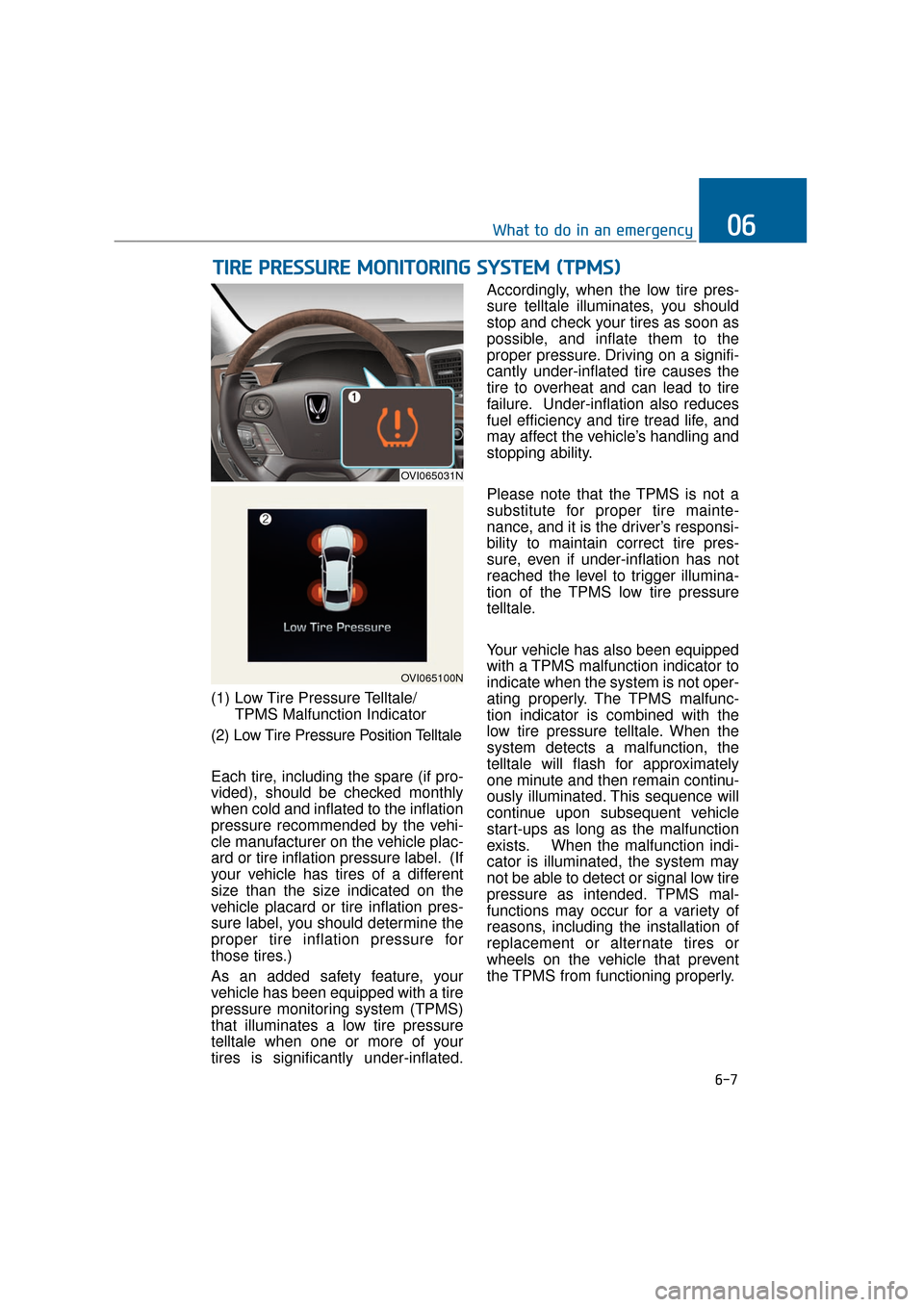
(1) Low Tire Pressure Telltale/TPMS Malfunction Indicator
(2) Low Tire Pressure Position Telltale
Each tire, including the spare (if pro-
vided), should be checked monthly
when cold and inflated to the inflation
pressure recommended by the vehi-
cle manufacturer on the vehicle plac-
ard or tire inflation pressure label. (If
your vehicle has tires of a different
size than the size indicated on the
vehicle placard or tire inflation pres-
sure label, you should determine the
proper tire inflation pressure for
those tires.)
As an added safety feature, your
vehicle has been equipped with a tire
pressure monitoring system (TPMS)
that illuminates a low tire pressure
telltale when one or more of your
tires is significantly under-inflated. Accordingly, when the low tire pres-
sure telltale illuminates, you should
stop and check your tires as soon as
possible, and inflate them to the
proper pressure. Driving on a signifi-
cantly under-inflated tire causes the
tire to overheat and can lead to tire
failure. Under-inflation also reduces
fuel efficiency and tire tread life, and
may affect the vehicle’s handling and
stopping ability.
Please note that the TPMS is not a
substitute for proper tire mainte-
nance, and it is the driver’s responsi-
bility to maintain correct tire pres-
sure, even if under-inflation has not
reached the level to trigger illumina-
tion of the TPMS low tire pressure
telltale.
Your vehicle has also been equipped
with a TPMS malfunction indicator to
indicate when the system is not oper-
ating properly. The TPMS malfunc-
tion indicator is combined with the
low tire pressure telltale. When the
system detects a malfunction, the
telltale will flash for approximately
one minute and then remain continu-
ously illuminated. This sequence will
continue upon subsequent vehicle
start-ups as long as the malfunction
exists. When the malfunction indi-
cator is illuminated, the system may
not be able to detect or signal low tire
pressure as intended. TPMS mal-
functions may occur for a variety of
reasons, including the installation of
replacement or alternate tires or
wheels on the vehicle that prevent
the TPMS from functioning properly.
T T
I
IR
R E
E
P
P R
R E
ES
SS
SU
U R
RE
E
M
M O
ON
NI
IT
T O
O R
RI
IN
N G
G
S
S Y
Y S
ST
T E
EM
M
(
( T
T P
P M
M S
S)
)
6-7
What to do in an emergency06
OVI065031N
OVI065100N
Page 341 of 477
Always check the TPMS malfunction
telltale after replacing one or more
tires or wheels on your vehicle to
ensure that the replacement or alter-
nate tires and wheels allow the TPMS
to continue to function properly.
Information
If any of the followings happens, we
recommend that the system be
checked by an authorized EQUUS
dealer.
1. The low tire pressure telltale/TPMSmalfunction indicator does not illu-
minate for 3 seconds when the igni-
tion switch is turned ON or engine is
running.
2. The TPMS malfunction indicator remains ON after flashing for
approximately 1 minute.
3. The Low tire pressure position tell- tale remains ON.
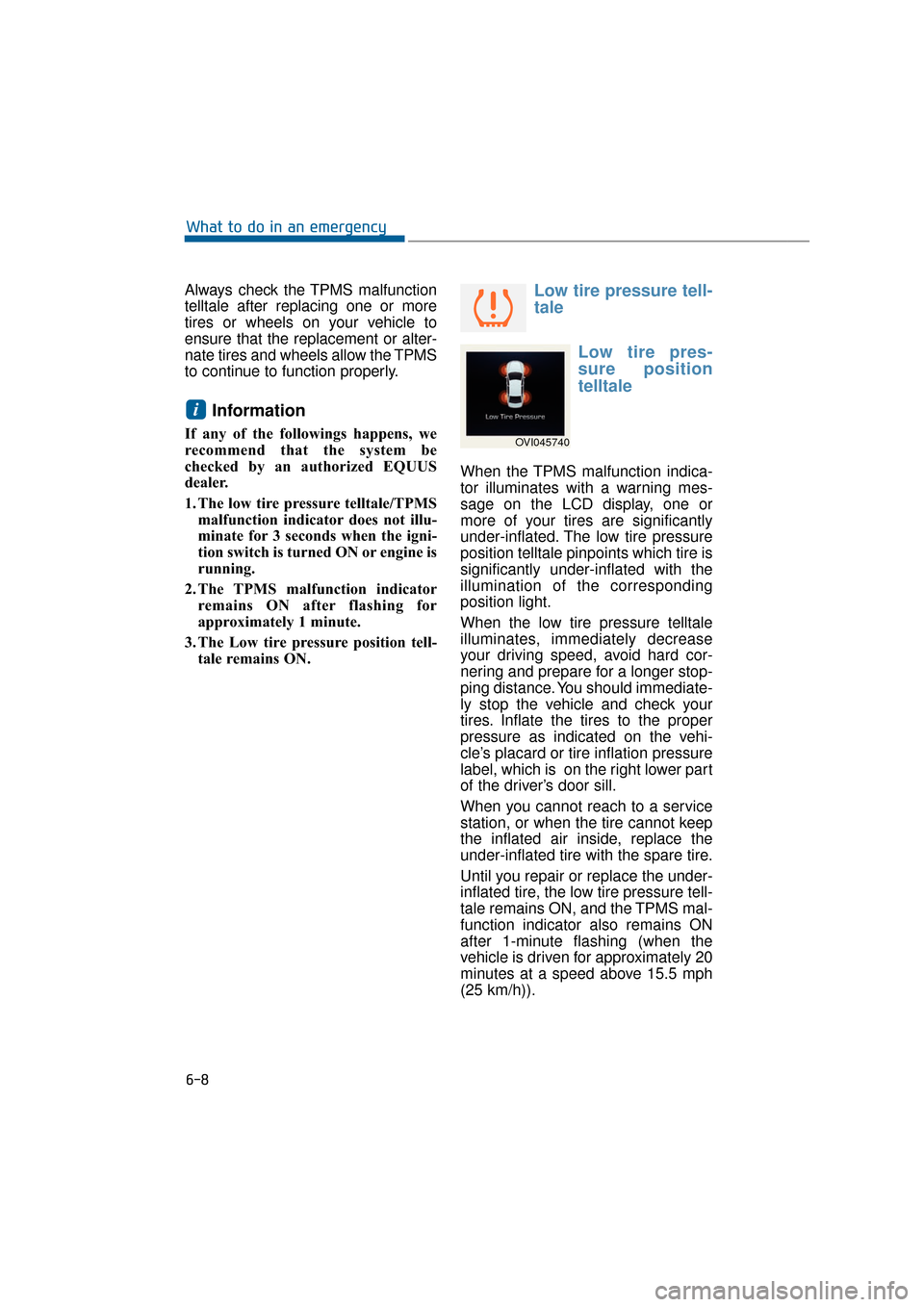
Low tire pressure tell-
tale
Low tire pres-
sure position
telltale
When the TPMS malfunction indica-
tor illuminates with a warning mes-
sage on the LCD display, one or
more of your tires are significantly
under-inflated. The low tire pressure
position telltale pinpoints which tire is
significantly under-inflated with the
illumination of the corresponding
position light.
When the low tire pressure telltale
illuminates, immediately decrease
your driving speed, avoid hard cor-
nering and prepare for a longer stop-
ping distance. You should immediate-
ly stop the vehicle and check your
tires. Inflate the tires to the proper
pressure as indicated on the vehi-
cle’s placard or tire inflation pressure
label, which is on the right lower part
of the driver’s door sill.
When you cannot reach to a service
station, or when the tire cannot keep
the inflated air inside, replace the
under-inflated tire with the spare tire.
Until you repair or replace the under-
inflated tire, the low tire pressure tell-
tale remains ON, and the TPMS mal-
function indicator also remains ON
after 1-minute flashing (when the
vehicle is driven for approximately 20
minutes at a speed above 15.5 mph
(25 km/h)).
i
6-8
What to do in an emergency
OVI045740
Page 342 of 477
Information
A tire pressure sensor is not equipped
with the spare tire.
TPMS (Tire Pressure
Monitoring System)
malfunction indicator
The TPMS malfunction indicator illu-
minates after approximately 1-
minute flashing, when the TPMS
detects the malfunction.
Immediately have the system
checked by an authorized EQUUS
dealer to find the cause of the mal-
function.
Information
If there is the TPMS malfunction, the
low tire pressure position telltale will
not illuminate even with an under-
inflated tire.
The TPMS malfunction indicatormay remain ON after approxi-
mately 1-minute flashing, when
the vehicle drives near electric
power supply cables or a radio
transmitter, such as a police sta-
tion, government/public office,
broadcasting station, military
installation, airport, or transmit-
ting tower. Those may interfere
the normal TPMS operation.
The TPMS malfunction indicator may remain ON after approxi-
mately 1-minute flashing, when
the snow chains or some of your
personal electronic devices, such
as a laptop computer, mobile
charger, remote starting device or
navigation, are used inside the
vehicle. Those may interrupt the
normal TPMS operation.
NOTICE
i
i
6-9
What to do in an emergency06
The low tire pressure telltale
may illuminate in cold weather,
when the tire pressure was
adjusted in warm weather. It
does not indicate the TPMS mal-
function, because the lower
temperature proportionally low-
ers the tire pressure.
When your vehicle drive
through the severe temperature
difference, from warm to cold
and vice versa, or the outside
temperature is greatly higher or
lower, you should check and
readjust the tire pressure to the
recommended level.
CAUTION
- Low pressure damage
Significantly under-inflated
tires makes your driving unsta-
ble, possibly increasing a brak-
ing distance and causing a loss
of vehicle control.
Long-time driving on under-
inflated tires may overheat or
fail the tires.
WARNING