tires Hyundai Equus 2016 Owner's Guide
[x] Cancel search | Manufacturer: HYUNDAI, Model Year: 2016, Model line: Equus, Model: Hyundai Equus 2016Pages: 477, PDF Size: 16.25 MB
Page 343 of 477
Changing a tire with TPMS
When you have a flat tire, both of the
low tire pressure telltale and the low
tire position telltale will illuminate.
Immediately have the flat tire
repaired or replaced by an author-
ized EQUUS dealer.
The spare tire is not equipped with a
tire pressure monitoring sensor.
Thus, when replacing with the spare
tire, the low tire pressure telltale will
remain ON.
Also, the TPMS Malfunction Indicator
will illuminate after 1-minute flashing,
when the vehicle drives at a speed
above 15.5 mph (25 km/h) for
approximately 20 minutes.
When the tire equipped with a tire
pressure monitoring sensor is re-
inflated to the recommended level,
the low tire pressure telltale and
TPMS malfunction indicator will go
OFF for a few minutes.
When the indicator illumination does
not go OFF after a few minutes,
please visit an authorized EQUUS
dealer.Each wheel is equipped with a tire
pressure sensor, inside the tire and
behind the valve stem (except for the
spare tire). You must use the TPMS-
specific wheels. It is recommended
that you always have your tires serv-
iced by an authorized EQUUS deal-
er.
You cannot diagnose under-inflation
of a tire only with eyes. Always use a
tire pressure gauge of good quality to
measure the pressure level. Please
note that a heated tire (from being
driven) has higher pressure meas-
urement criteria than a cold tire.
A cold tire means the vehicle was
driven for less than 1 mile (1.6 km),
or was mostly idle for the last 3
hours.
Cool down the tire before measuring
the inflation pressure. Always make
sure that the tire is cold before inflat-
ing the tire to the recommended
pressure level.
6-10
What to do in an emergency
Never use an unauthorized
puncture-repairing agent to
repair and/or inflate an under-
inflated tire. Unauthorized tire
sealant may damage the tire
pressure sensor.
CAUTION
- TPMS
The TPMS cannot alert the driver to a sudden but severe
tire damage caused by exter-
nal factors, such as nails or
road debris.
When you sense any driving instability, immediately take
your foot off the accelerator,
lightly apply the brakes, and
slowly drive to a safe place off
the road.
WARNING
Page 345 of 477
Jack and tools
The jack, jack handle, and wheel lug
nut wrench are stored in the luggage
compartment. Pull up the luggage
box cover to find those equipment.
(1) Jack handle
(2) Jack
(3) Wheel lug nut wrench
Jacking instructions
The jack is provided for emergent tire
changing only.
To prevent the jack from “rattling”
inside while driving, store it properly.
Follow jacking instructions to prevent
a possible personal injury.
I IF
F
Y
Y O
O U
U
H
H A
AV
VE
E
A
A
F
F L
LA
A T
T
T
T I
IR
R E
E
6-12
What to do in an emergency
OVI065004N
- Changing tires
Never attempt to change tires
in the traffic lanes of a road or
highway.
Always drive the vehicle com- pletely off the road or onto the
shoulder before changing a
tire. The jack should be used
on a level and firm ground.
When you cannot find this
level and firm place off the
road, call a towing service
company for assistance.
Always check the jack direc- tion - in the correct front and
rear positions. Never use the
bumper or any other parts of
the vehicle for additional jack-
ing-up support.
The vehicle may roll off the jack, causing a serious injury
or death. Never place any part
of a person's body under-
neath a vehicle, while jacking
up the vehicle; use vehicle
support stands.
Do not start or run the engine, while jacking up the vehicle.
Do not allow anyone to remain inside, while jacking up the
vehicle.
Keep all children in a safe place away from the road and
from the vehicle to be jacked
up.
WARNING
Page 346 of 477
Removing and storing the
spare tire
Unscrew the hold-down wing bolt in
a counterclockwise direction to
remove the tire.
Screw it in the clockwise direction to
store the spare tire.
To prevent the spare tire and tools
from “rattling” inside while driving,
properly store them.
When it is too tight to loosen the
hold-down wing bolt by hand, you
can easily loosen it, using the Jack
handle.
1.Put the Jack handle (1) in the hold-down wing bolt.
2.Unscrew the hold-down wing bolt in a counterclockwise direction
with the Jack handle, utilizing the
principles of the lever and fulcrum. When you remove or store the
spare tire, do not touch or hit the
battery with the spare tire.
Touching or hitting of the battery
may cause failure of electrical cir-
cuits.
Changing tires
1.Park the vehicle on a level surface,
and firmly set the parking brake.
2.Set the shift lever in P(Park).
3.Press ON the hazard warning flasher.
4.Take out the wheel lug nut wrench, jack, jack handle, and spare tire
from the vehicle.
NOTICE
6-13
What to do in an emergency06
OVI065005N
OVI065033N
OVI065001N
OVI065007N
Page 350 of 477
To prevent the jack, jack handle,
wheel lug nut wrench and spare tire
from rattling inside a vehicle while
driving, store them in a proper place.
Important - use of compactspare tire
Your vehicle is equipped with a com-
pact spare tire. This compact spare
tire takes up less space than an orig-
inal one. This tire is smaller than an
original one, and is designed for tem-
porary use only.
You should carefully drive when
a compact spare tire is in use.
The compact spare tire should
immediately be replaced with a
proper regular tire.
Driving on more than one com- pact spare tire is not recom-
mended. A compact spare tire should be inflat-
ed to 60 psi (420 kPa).Information
Check the inflation pressure after
installing a spare tire. Adjust its pres-
sure to the recommended level, if nec-
essary.
When using a compact spare tire,
take the following precautions:
Under no circumstances should a
driving speed exceed 50 mph (80
km/h). A higher speed may dam-
age the tire.
You should drive slowly enough to avoid all hazards in accordance of
road conditions. Any road hazard,
such as a pothole or debris, may
seriously damage a compact
spare.
Any continuous driving on a spare tire may result in tire failure, loss of
vehicle control, and a possible per-
sonal injury.
Do not exceed the vehicle’s maxi- mum weight capacity or the load
capacity, which is detailed on a
side of a compact spare tire.
i
NOTICE
6-17
What to do in an emergency06
- Inadequate spare tire pressure
Immediately check the inflation
pressures of a spare tire after
installment. If necessary, adjust
it to the recommended pres-
sure. Refer to “Tires and
wheels” in the chapter 8.
WARNING
A compact spare tire is for
emergency use only. Do not
drive your vehicle on this com-
pact spare at a speed over 50
mph (80 km/h). Replacement
with a proper regular tire should
immediately be done to avoid
failure of the spare tire, possibly
leading to a personal injury or
death.
WARNING
Page 351 of 477
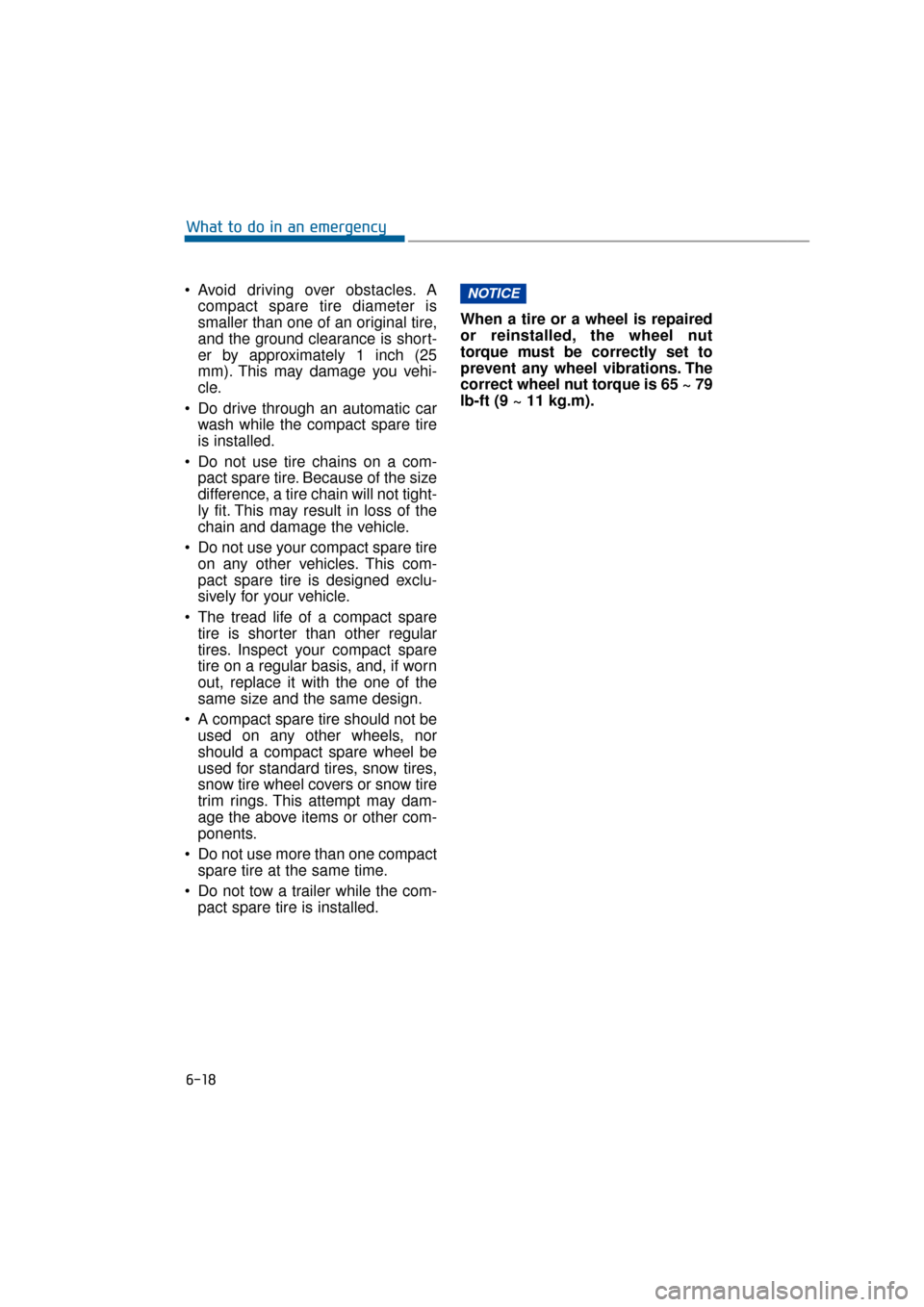
Avoid driving over obstacles. Acompact spare tire diameter is
smaller than one of an original tire,
and the ground clearance is short-
er by approximately 1 inch (25
mm). This may damage you vehi-
cle.
Do drive through an automatic car wash while the compact spare tire
is installed.
Do not use tire chains on a com- pact spare tire. Because of the size
difference, a tire chain will not tight-
ly fit. This may result in loss of the
chain and damage the vehicle.
Do not use your compact spare tire on any other vehicles. This com-
pact spare tire is designed exclu-
sively for your vehicle.
The tread life of a compact spare tire is shorter than other regular
tires. Inspect your compact spare
tire on a regular basis, and, if worn
out, replace it with the one of the
same size and the same design.
A compact spare tire should not be used on any other wheels, nor
should a compact spare wheel be
used for standard tires, snow tires,
snow tire wheel covers or snow tire
trim rings. This attempt may dam-
age the above items or other com-
ponents.
Do not use more than one compact spare tire at the same time.
Do not tow a trailer while the com- pact spare tire is installed. When a tire or a wheel is repaired
or reinstalled, the wheel nut
torque must be correctly set to
prevent any wheel vibrations. The
correct wheel nut torque is 65 ~ 79
lb-ft (9 ~ 11 kg.m).NOTICE
6-18
What to do in an emergency
Page 359 of 477
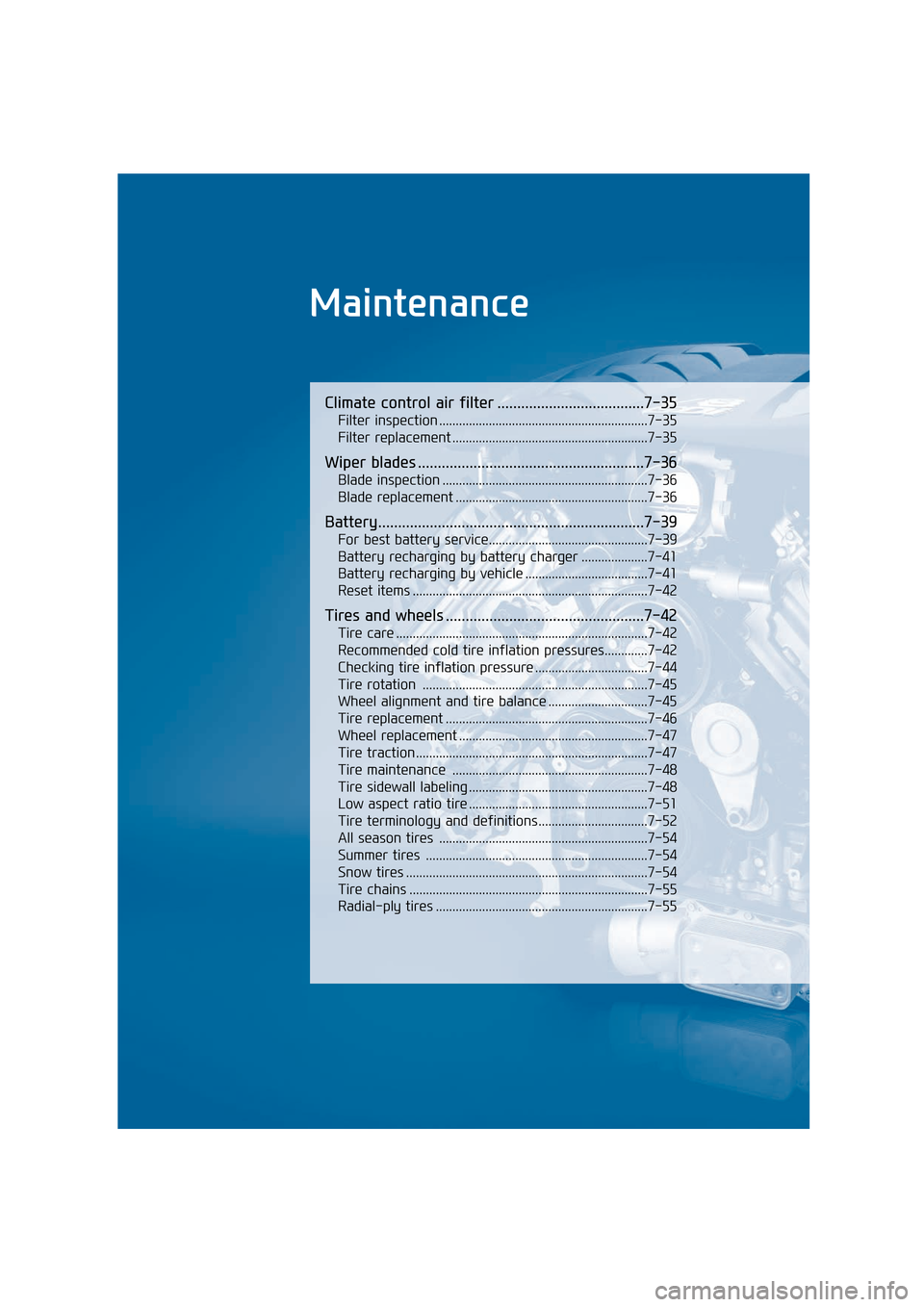
Maintenance
Climate control air filter .....................................7-35
Filter inspection ...............................................................7-35
Filter replacement ...........................................................7-35
Wiper blades .........................................................7-36
Blade inspection ..............................................................7-36
Blade replacement ..........................................................7-36
Battery...................................................................7-39
For best battery service................................................7-39
Battery recharging by battery charger ....................7-41
Battery recharging by vehicle .....................................7-41
Reset items .......................................................................7\
-42
Tires and wheels ..................................................7-42
Tire care ........................................................................\
....7-42
Recommended cold tire inflation pressures.............7-42
Checking tire inflation pressure ..................................7-44
Tire rotation ....................................................................7-45\
Wheel alignment and tire balance ..............................7-45
Tire replacement .............................................................7-46
Wheel replacement .........................................................7-47
Tire traction ......................................................................7-\
47
Tire maintenance ...........................................................7-48
Tire sidewall labeling ......................................................7-48
Low aspect ratio tire ......................................................7-51
Tire terminology and definitions.................................7-52
All season tires ...............................................................7-54
Summer tires ...................................................................7-54
Snow tires ........................................................................\
.7-54
Tire chains ........................................................................\
7-55
Radial-ply tires ................................................................7-55
Page 364 of 477
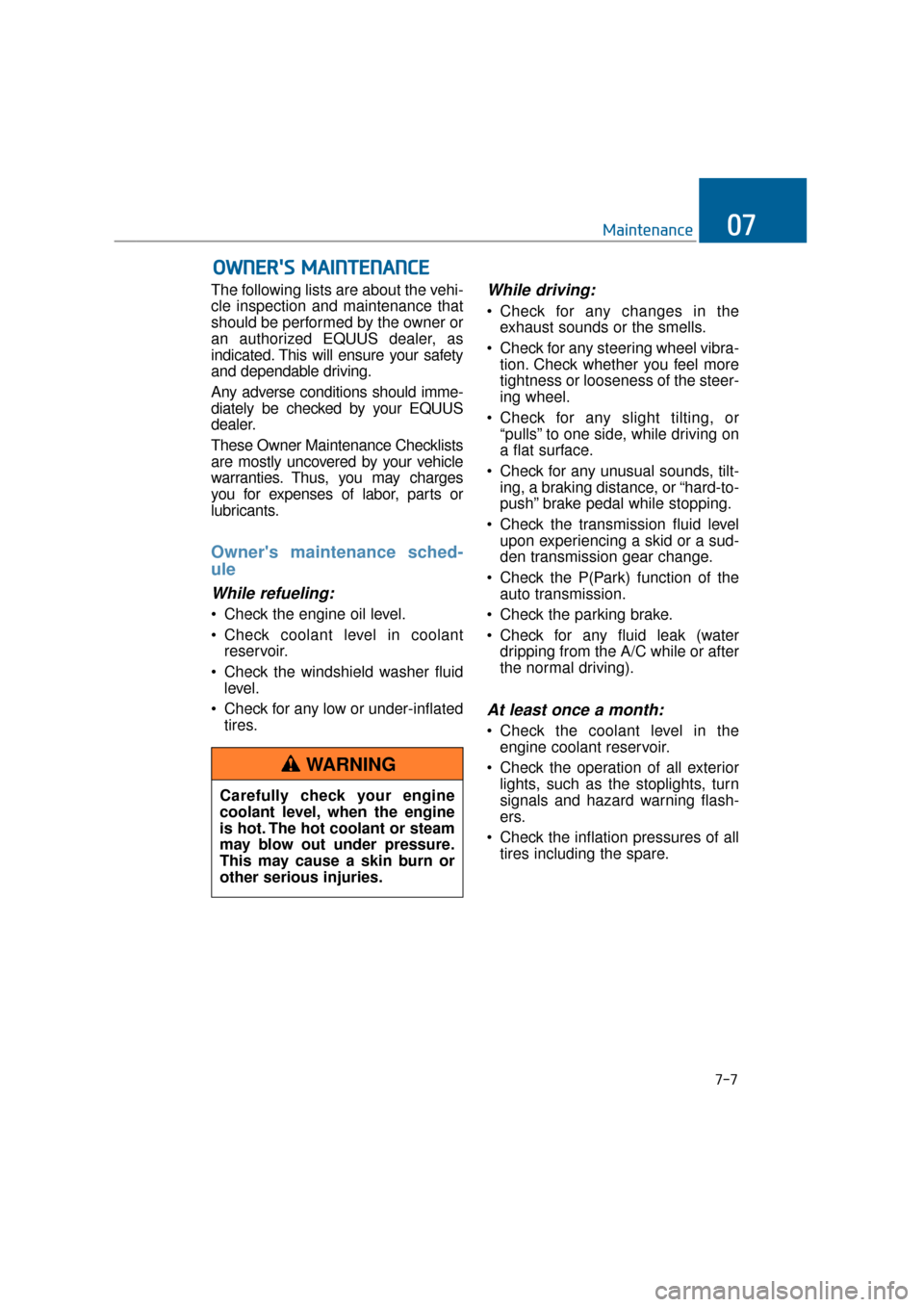
The following lists are about the vehi-
cle inspection and maintenance that
should be performed by the owner or
an authorized EQUUS dealer, as
indicated. This will ensure your safety
and dependable driving.
Any adverse conditions should imme-
diately be checked by your EQUUS
dealer.
These Owner Maintenance Checklists
are mostly uncovered by your vehicle
warranties. Thus, you may charges
you for expenses of labor, parts or
lubricants.
Owner's maintenance sched-
ule
While refueling:
Check the engine oil level.
Check coolant level in coolantreservoir.
Check the windshield washer fluid level.
Check for any low or under-inflated tires.
While driving:
Check for any changes in theexhaust sounds or the smells.
Check for any steering wheel vibra- tion. Check whether you feel more
tightness or looseness of the steer-
ing wheel.
Check for any slight tilting, or “pulls” to one side, while driving on
a flat surface.
Check for any unusual sounds, tilt- ing, a braking distance, or “hard-to-
push” brake pedal while stopping.
Check the transmission fluid level upon experiencing a skid or a sud-
den transmission gear change.
Check the P(Park) function of the auto transmission.
Check the parking brake.
Check for any fluid leak (water dripping from the A/C while or after
the normal driving).
At least once a month:
Check the coolant level in theengine coolant reservoir.
Check the operation of all exterior lights, such as the stoplights, turn
signals and hazard warning flash-
ers.
Check the inflation pressures of all tires including the spare.
O OW
W N
NE
ER
R '
'S
S
M
M A
AI
IN
N T
TE
EN
N A
AN
N C
CE
E
7-7
Maintenance07
Carefully check your engine
coolant level, when the engine
is hot. The hot coolant or steam
may blow out under pressure.
This may cause a skin burn or
other serious injuries.
WARNING
Page 366 of 477
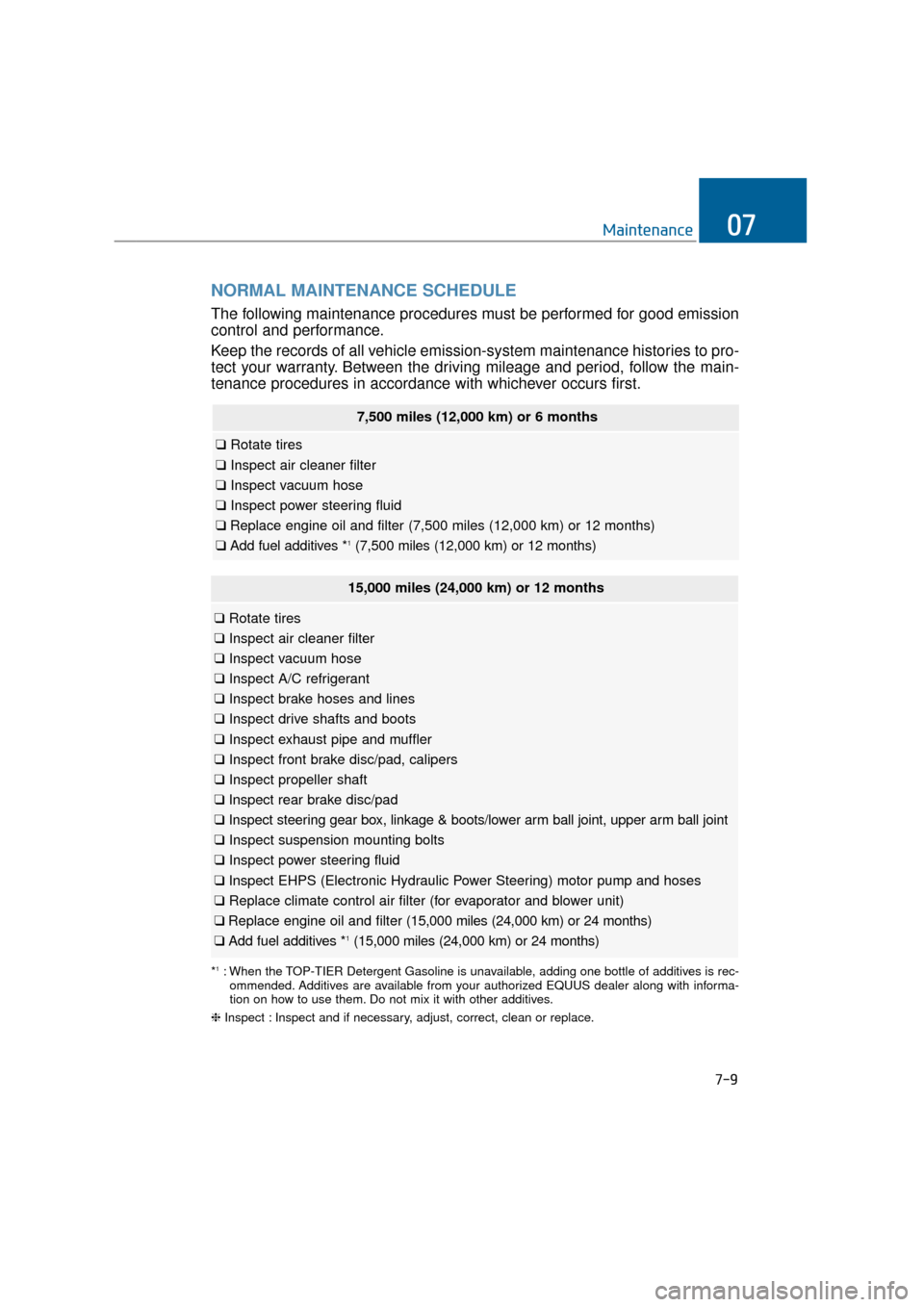
NORMAL MAINTENANCE SCHEDULE
The following maintenance procedures must be performed for good emission
control and performance.
Keep the records of all vehicle emission-system maintenance histories to pro-
tect your warranty. Between the driving mileage and period, follow the main-
tenance procedures in accordance with whichever occurs first.
7-9
Maintenance07
7,500 miles (12,000 km) or 6 months
❑Rotate tires
❑ Inspect air cleaner filter
❑ Inspect vacuum hose
❑ Inspect power steering fluid
❑ Replace engine oil and filter (7,500 miles (12,000 km) or 12 months)\
❑ Add fuel additives *
1(7,500 miles (12,000 km) or 12 months)
15,000 miles (24,000 km) or 12 months
❑ Rotate tires
❑ Inspect air cleaner filter
❑ Inspect vacuum hose
❑ Inspect A/C refrigerant
❑ Inspect brake hoses and lines
❑ Inspect drive shafts and boots
❑ Inspect exhaust pipe and muffler
❑ Inspect front brake disc/pad, calipers
❑ Inspect propeller shaft
❑ Inspect rear brake disc/pad
❑ Inspect steering gear box, linkage & boots/lower arm ball joint, upper arm ball joint
❑ Inspect suspension mounting bolts
❑ Inspect power steering fluid
❑ Inspect EHPS (Electronic Hydraulic Power Steering) motor pump and hoses
❑ Replace climate control air filter (for evaporator and blower unit)
❑ Replace engine oil and filter (15,000 miles (24,000 km) or 24 months)
❑ Add fuel additives *
1(15,000 miles (24,000 km) or 24 months)
*1: When the TOP-TIER Detergent Gasoline is unavailable, adding one bottle of additives is rec-
ommended. Additives are available from your authorized EQUUS dealer along with informa-
tion on how to use them. Do not mix it with other additives.
❈ Inspect : Inspect and if necessary, adjust, correct, clean or replace.
Page 367 of 477
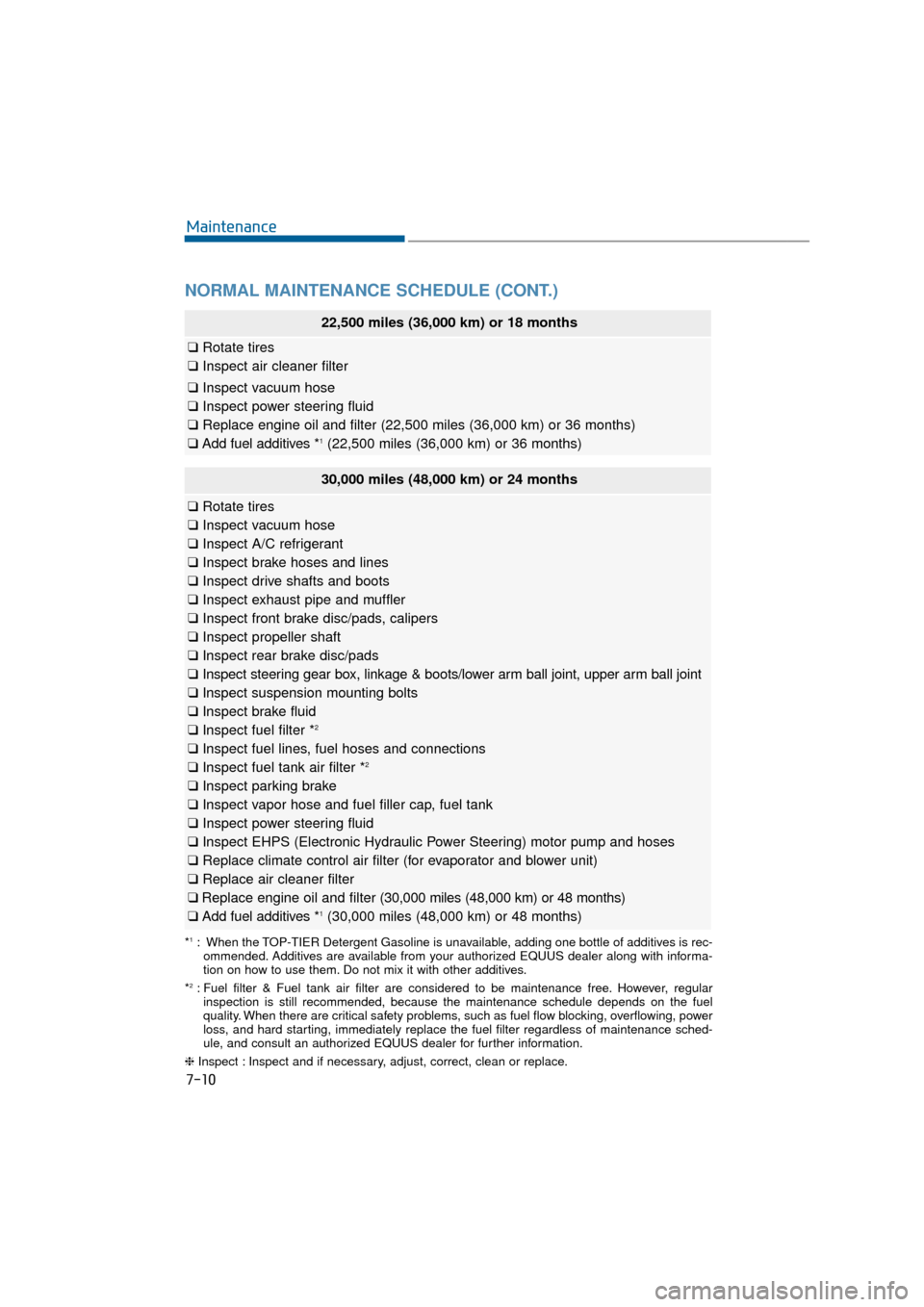
NORMAL MAINTENANCE SCHEDULE (CONT.)
7-10
Maintenance
22,500 miles (36,000 km) or 18 months
❑Rotate tires
❑ Inspect air cleaner filter
❑ Inspect vacuum hose
❑ Inspect power steering fluid
❑ Replace engine oil and filter (22,500 miles (36,000 km) or 36 months)\
❑ Add fuel additives *
1(22,500 miles (36,000 km) or 36 months)
*1: When the TOP-TIER Detergent Gasoline is unavailable, adding one bottle of additives is rec-
ommended. Additives are available from your authorized EQUUS dealer along with informa-
tion on how to use them. Do not mix it with other additives.
*
2: Fuel filter & Fuel tank air filter are considered to be maintenance free\
. However, regular inspection is still recommended, because the maintenance schedule depend\
s on the fuel
quality. When there are critical safety problems, such as fuel flow blocking, overflowing, power
loss, and hard starting, immediately replace the fuel filter regardless of maintenance sche\
d-
ule, and consult an authorized EQUUS dealer for further information.
❈ Inspect : Inspect and if necessary, adjust, correct, clean or replace.
30,000 miles (48,000 km) or 24 months
❑Rotate tires
❑ Inspect vacuum hose
❑ Inspect A/C refrigerant
❑ Inspect brake hoses and lines
❑ Inspect drive shafts and boots
❑ Inspect exhaust pipe and muffler
❑ Inspect front brake disc/pads, calipers
❑ Inspect propeller shaft
❑ Inspect rear brake disc/pads
❑ Inspect steering gear box, linkage & boots/lower arm ball joint, upper arm ball joint
❑ Inspect suspension mounting bolts
❑ Inspect brake fluid
❑ Inspect fuel filter *
2
❑Inspect fuel lines, fuel hoses and connections
❑ Inspect fuel tank air filter *2
❑Inspect parking brake
❑ Inspect vapor hose and fuel filler cap, fuel tank
❑ Inspect power steering fluid
❑ Inspect EHPS (Electronic Hydraulic Power Steering) motor pump and hoses
❑ Replace climate control air filter (for evaporator and blower unit)
❑ Replace air cleaner filter
❑ Replace engine oil and filter (30,000 miles (48,000 km) or 48 months)
❑ Add fuel additives *
1(30,000 miles (48,000 km) or 48 months)
Page 368 of 477
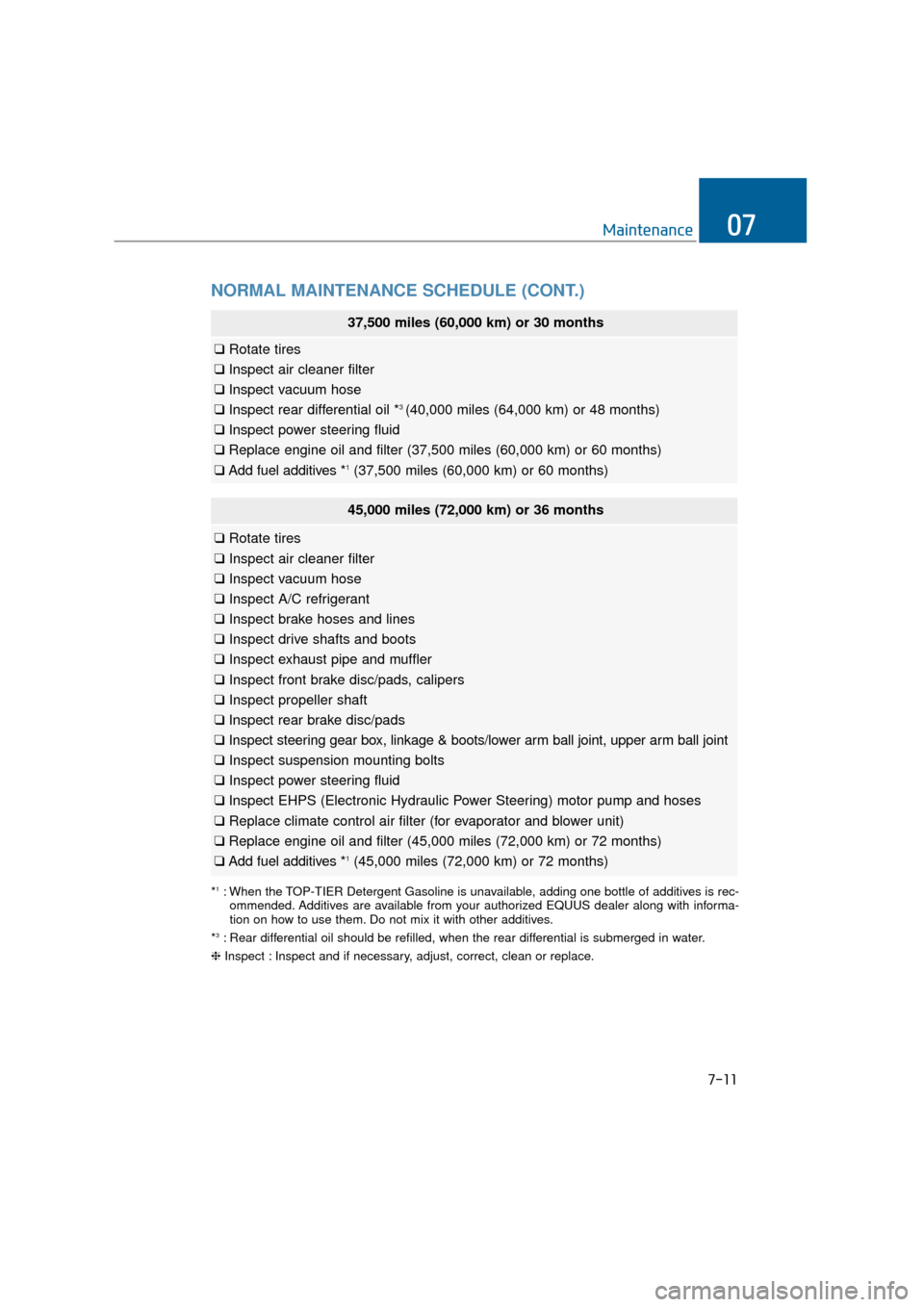
NORMAL MAINTENANCE SCHEDULE (CONT.)
7-11
Maintenance07
37,500 miles (60,000 km) or 30 months
❑Rotate tires
❑ Inspect air cleaner filter
❑ Inspect vacuum hose
❑ Inspect rear differential oil *
3 (40,000 miles (64,000 km) or 48 months)
❑ Inspect power steering fluid
❑ Replace engine oil and filter (37,500 miles (60,000 km) or 60 months)\
❑ Add fuel additives *
1(37,500 miles (60,000 km) or 60 months)
45,000 miles (72,000 km) or 36 months
❑ Rotate tires
❑ Inspect air cleaner filter
❑ Inspect vacuum hose
❑ Inspect A/C refrigerant
❑ Inspect brake hoses and lines
❑ Inspect drive shafts and boots
❑ Inspect exhaust pipe and muffler
❑ Inspect front brake disc/pads, calipers
❑ Inspect propeller shaft
❑ Inspect rear brake disc/pads
❑ Inspect steering gear box, linkage & boots/lower arm ball joint, upper arm ball joint
❑ Inspect suspension mounting bolts
❑ Inspect power steering fluid
❑ Inspect EHPS (Electronic Hydraulic Power Steering) motor pump and hoses
❑ Replace climate control air filter (for evaporator and blower unit)
❑ Replace engine oil and filter (45,000 miles (72,000 km) or 72 months)\
❑ Add fuel additives *
1(45,000 miles (72,000 km) or 72 months)
*1: When the TOP-TIER Detergent Gasoline is unavailable, adding one bottle of additives is rec-
ommended. Additives are available from your authorized EQUUS dealer along with informa-
tion on how to use them. Do not mix it with other additives.
*
3: Rear differential oil should be refilled, when the rear differential is submerged in water.
❈ Inspect : Inspect and if necessary, adjust, correct, clean or replace.