towing Hyundai Equus 2016 User Guide
[x] Cancel search | Manufacturer: HYUNDAI, Model Year: 2016, Model line: Equus, Model: Hyundai Equus 2016Pages: 477, PDF Size: 16.25 MB
Page 334 of 477
What to do in an emergency
Road warning..........................................................6-2
Hazard warning flasher ...................................................6-2
In case of an emergency while driving ..............6-2
If the engine stalls at a crossroad or a railroad
crossing........................................................................\
........6-2
If you have a flat tire while driving..............................6-2
If engine stalls while driving...........................................6-3
If the engine will not start ...................................6-3
When the engine does not revolve, or slowly
revolves........................................................................\
........6-3
When the engine normally revolves, but does not
start.....................................................................\
..................6-3
Emergency starting ...............................................6-4
Jump starting ......................................................................6-\
4
Push-starting .....................................................................6-5\
If the engine overheats ........................................6-6
Tire pressure monitoring system (TPMS) ..........6-7
Low tire pressure telltale ................................................6-8
Low tire pressure position telltale ................................6-8
TPMS (Tire Pressure Monitoring System)
malfunction indicator .......................................................6-9
Changing a tire with TPMS...........................................6-10
If you have a flat tire..........................................6-12
Jack and tools ..................................................................6-12
Removing and storing the spare tire .........................6-13
Changing tires .................................................................6-13
Jack label ........................................................................\
...6-19
Towing ...................................................................6-20
Towing service .................................................................6-20
Removable towing hook ................................................6-22
Emergency towing ..........................................................6-22
Page 345 of 477
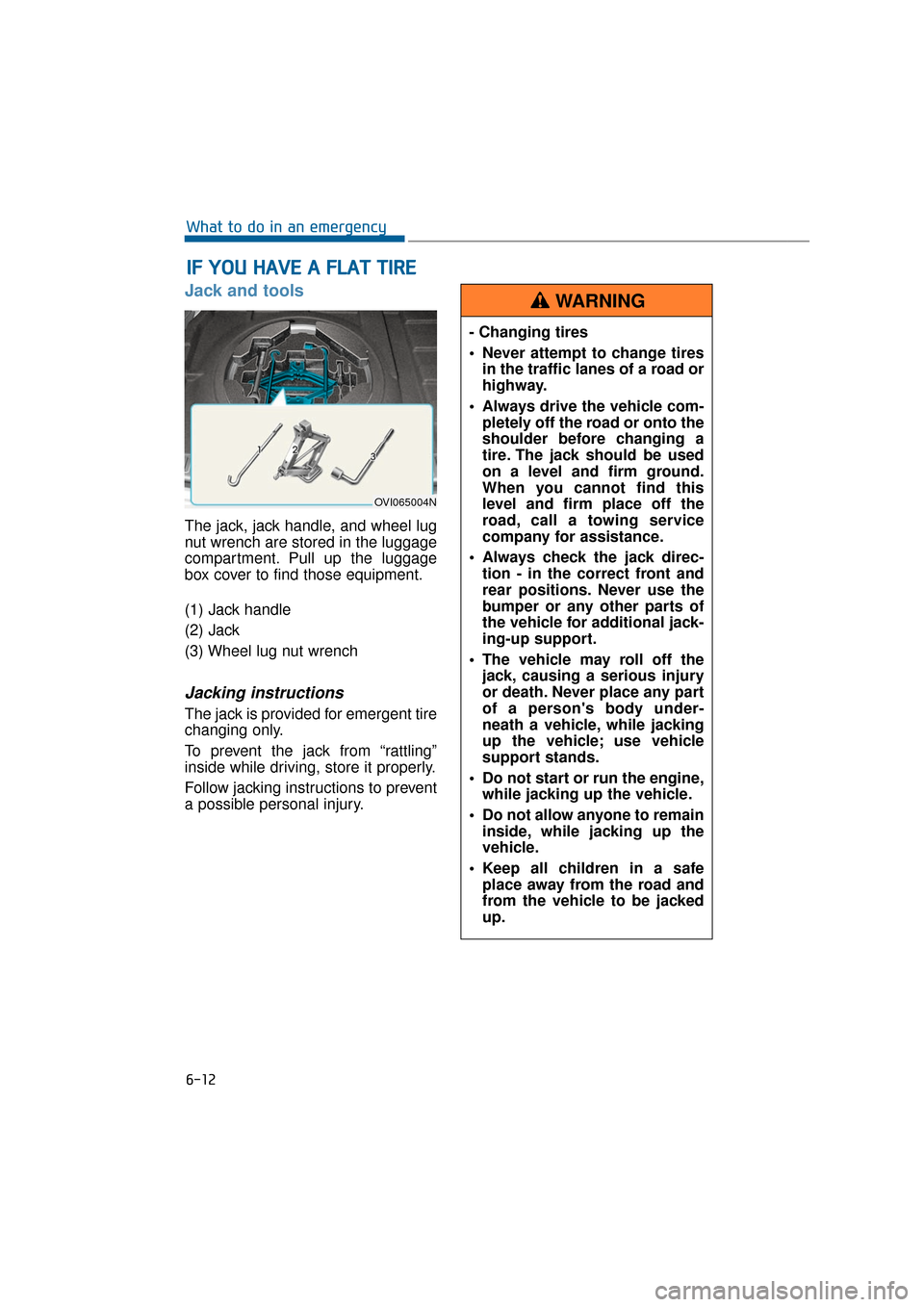
Jack and tools
The jack, jack handle, and wheel lug
nut wrench are stored in the luggage
compartment. Pull up the luggage
box cover to find those equipment.
(1) Jack handle
(2) Jack
(3) Wheel lug nut wrench
Jacking instructions
The jack is provided for emergent tire
changing only.
To prevent the jack from “rattling”
inside while driving, store it properly.
Follow jacking instructions to prevent
a possible personal injury.
I IF
F
Y
Y O
O U
U
H
H A
AV
VE
E
A
A
F
F L
LA
A T
T
T
T I
IR
R E
E
6-12
What to do in an emergency
OVI065004N
- Changing tires
Never attempt to change tires
in the traffic lanes of a road or
highway.
Always drive the vehicle com- pletely off the road or onto the
shoulder before changing a
tire. The jack should be used
on a level and firm ground.
When you cannot find this
level and firm place off the
road, call a towing service
company for assistance.
Always check the jack direc- tion - in the correct front and
rear positions. Never use the
bumper or any other parts of
the vehicle for additional jack-
ing-up support.
The vehicle may roll off the jack, causing a serious injury
or death. Never place any part
of a person's body under-
neath a vehicle, while jacking
up the vehicle; use vehicle
support stands.
Do not start or run the engine, while jacking up the vehicle.
Do not allow anyone to remain inside, while jacking up the
vehicle.
Keep all children in a safe place away from the road and
from the vehicle to be jacked
up.
WARNING
Page 353 of 477
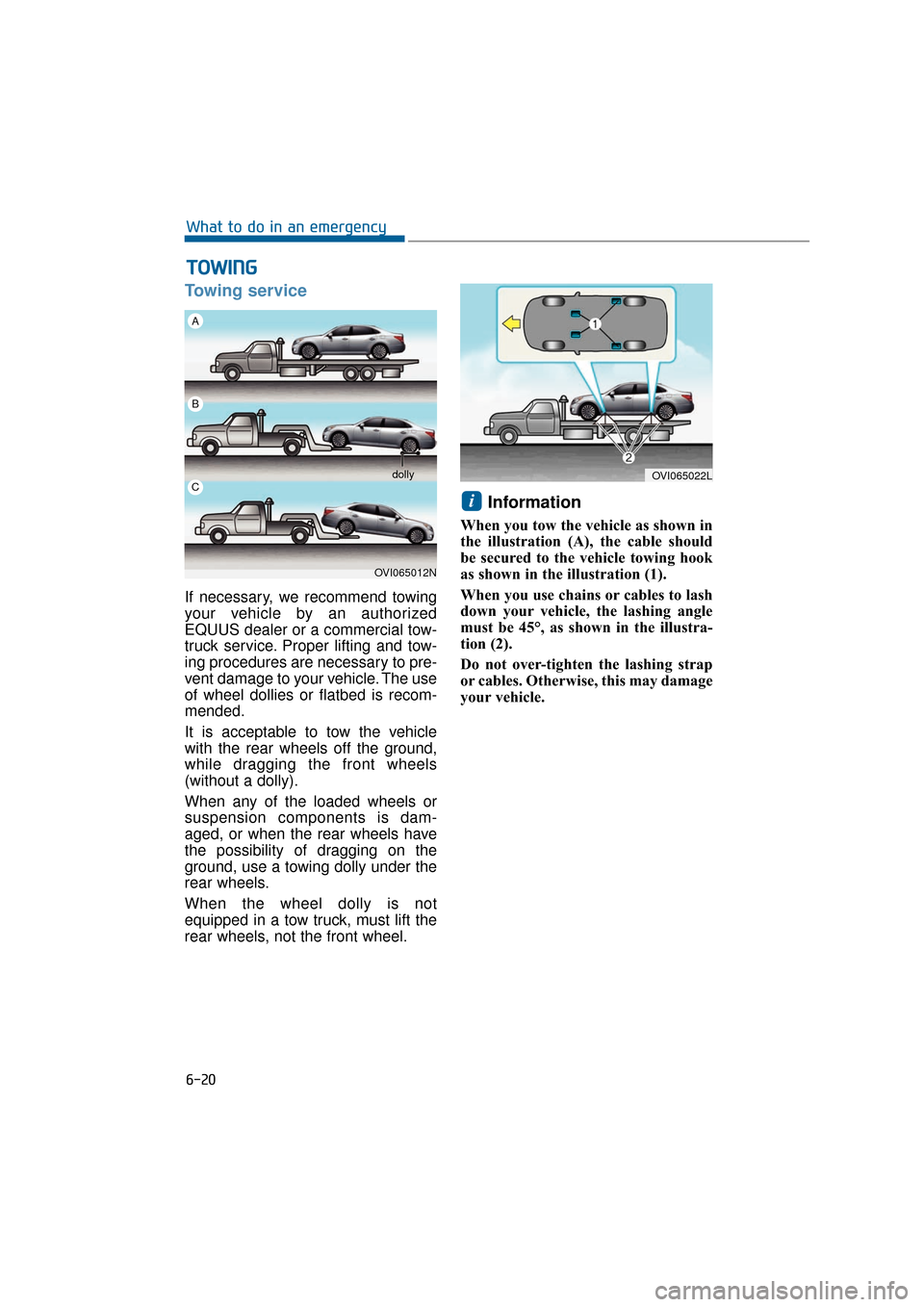
Towing service
If necessary, we recommend towing
your vehicle by an authorized
EQUUS dealer or a commercial tow-
truck service. Proper lifting and tow-
ing procedures are necessary to pre-
vent damage to your vehicle. The use
of wheel dollies or flatbed is recom-
mended.
It is acceptable to tow the vehicle
with the rear wheels off the ground,
while dragging the front wheels
(without a dolly).
When any of the loaded wheels or
suspension components is dam-
aged, or when the rear wheels have
the possibility of dragging on the
ground, use a towing dolly under the
rear wheels.
When the wheel dolly is not
equipped in a tow truck, must lift the
rear wheels, not the front wheel.
Information
When you tow the vehicle as shown in
the illustration (A), the cable should
be secured to the vehicle towing hook
as shown in the illustration (1).
When you use chains or cables to lash
down your vehicle, the lashing angle
must be 45°, as shown in the illustra-
tion (2).
Do not over-tighten the lashing strap
or cables. Otherwise, this may damage
your vehicle.
i
6-20
What to do in an emergency
T TO
O W
W I
IN
N G
G
OVI065012N
A
B
C dollyOVI065022L
Page 354 of 477
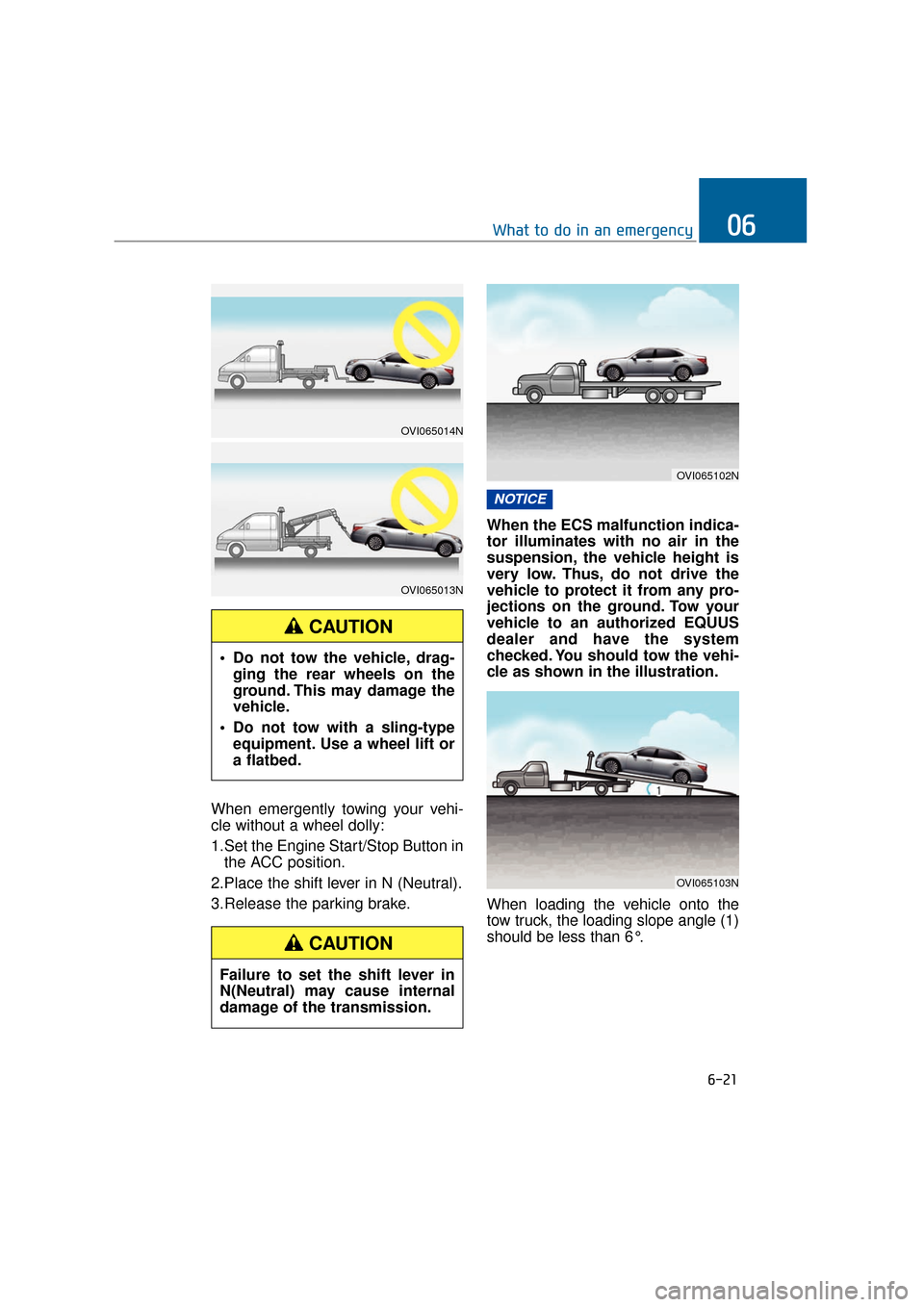
When emergently towing your vehi-
cle without a wheel dolly:
1.Set the Engine Start/Stop Button inthe ACC position.
2.Place the shift lever in N (Neutral).
3.Release the parking brake. When the ECS malfunction indica-
tor illuminates with no air in the
suspension, the vehicle height is
very low. Thus, do not drive the
vehicle to protect it from any pro-
jections on the ground. Tow your
vehicle to an authorized EQUUS
dealer and have the system
checked. You should tow the vehi-
cle as shown in the illustration.
When loading the vehicle onto the
tow truck, the loading slope angle (1)
should be less than 6°.
NOTICE
6-21
What to do in an emergency06
Do not tow the vehicle, drag-
ging the rear wheels on the
ground. This may damage the
vehicle.
Do not tow with a sling-type equipment. Use a wheel lift or
a flatbed.
CAUTION
Failure to set the shift lever in
N(Neutral) may cause internal
damage of the transmission.
CAUTION
OVI065102N
OVI065103N
OVI065014N
OVI065013N
Page 355 of 477
6-22
What to do in an emergency
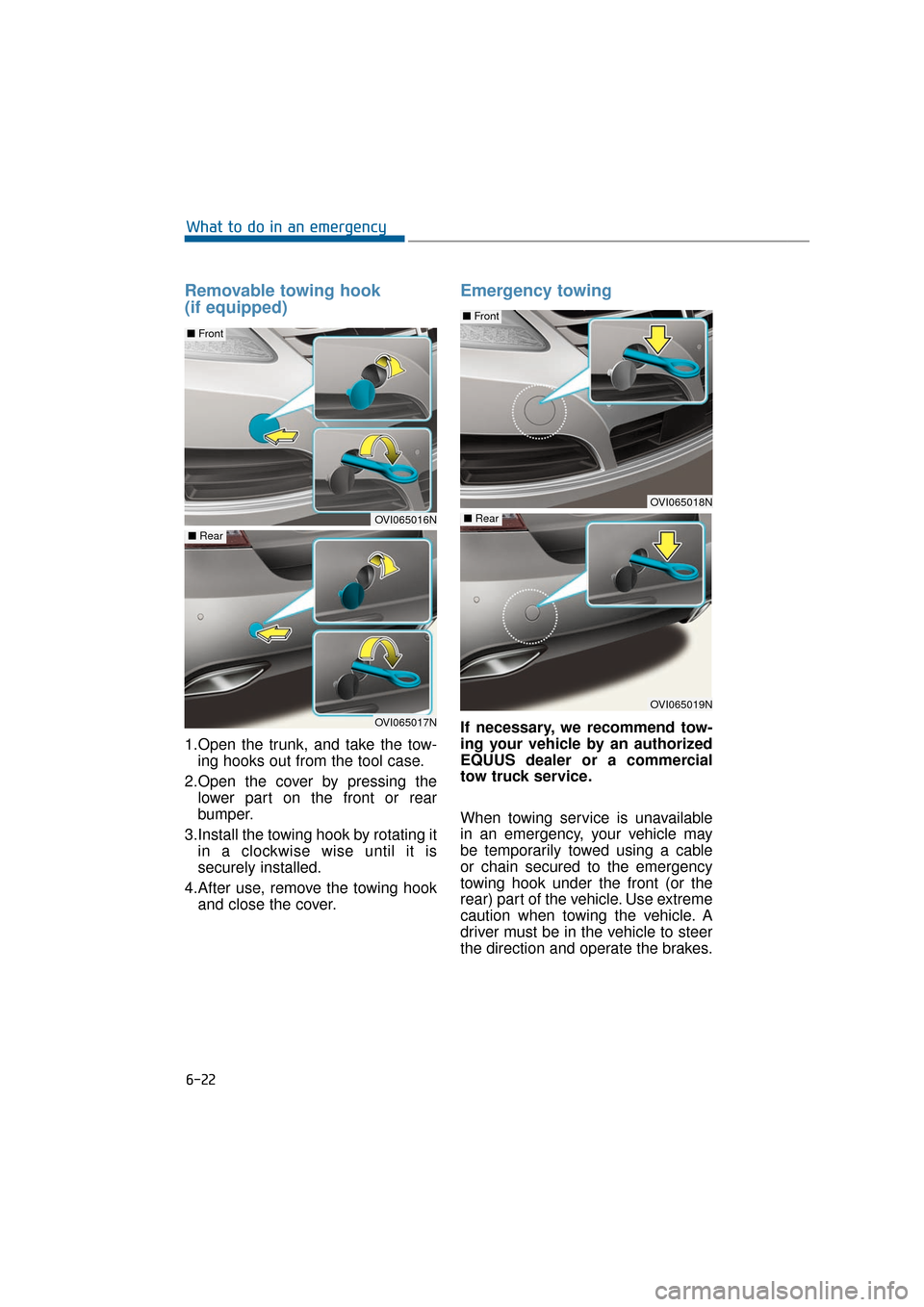
Removable towing hook
(if equipped)
1.Open the trunk, and take the tow-ing hooks out from the tool case.
2.Open the cover by pressing the lower part on the front or rear
bumper.
3.Install the towing hook by rotating it in a clockwise wise until it is
securely installed.
4.After use, remove the towing hook and close the cover.
Emergency towing
If necessary, we recommend tow-
ing your vehicle by an authorized
EQUUS dealer or a commercial
tow truck service.
When towing service is unavailable
in an emergency, your vehicle may
be temporarily towed using a cable
or chain secured to the emergency
towing hook under the front (or the
rear) part of the vehicle. Use extreme
caution when towing the vehicle. A
driver must be in the vehicle to steer
the direction and operate the brakes.
OVI065018N
■ Front
OVI065019N
■ RearOVI065016N
■ Front
OVI065017N
■ Rear
Page 356 of 477
6-23
What to do in an emergency06
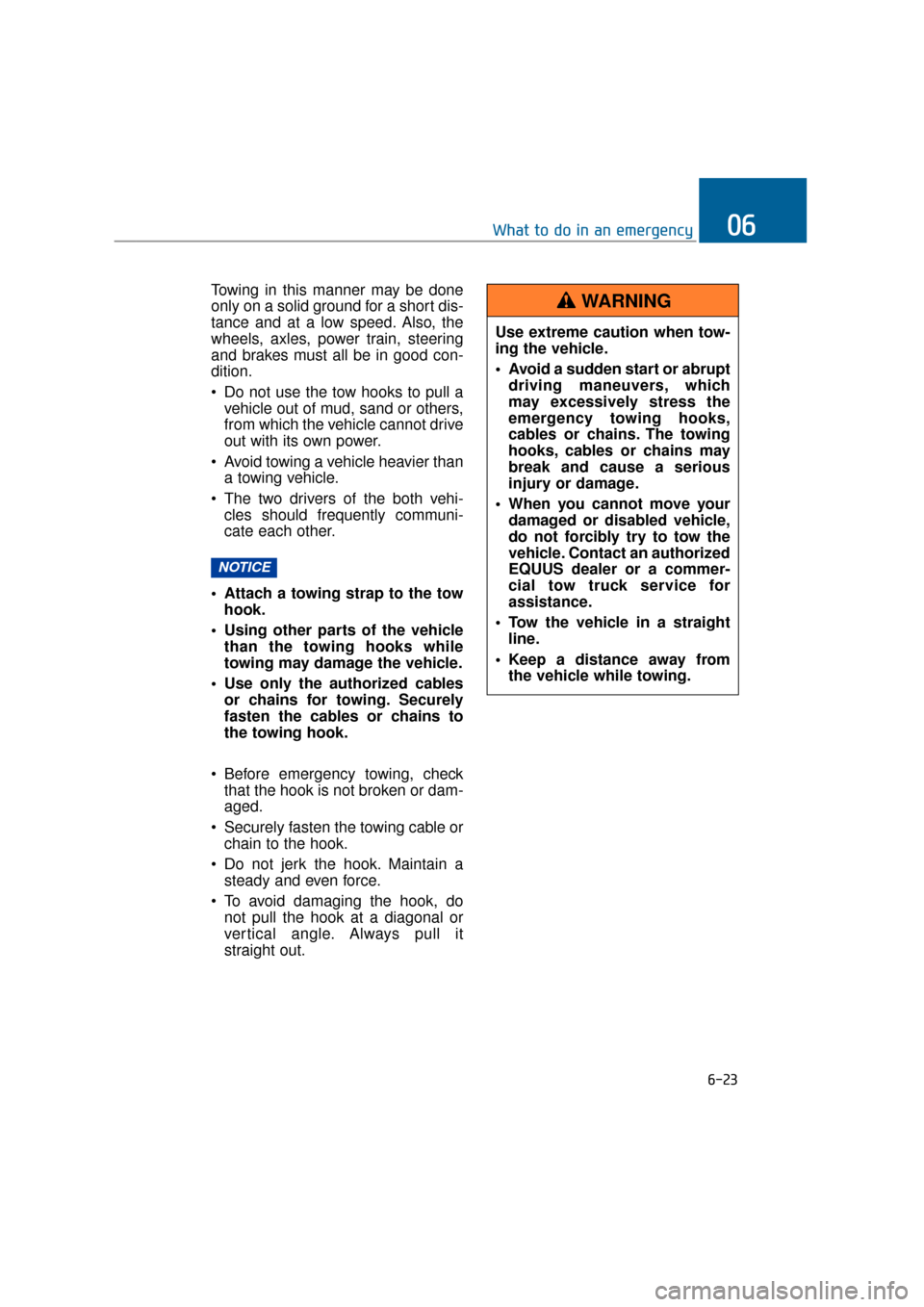
Towing in this manner may be done
only on a solid ground for a short dis-
tance and at a low speed. Also, the
wheels, axles, power train, steering
and brakes must all be in good con-
dition.
Do not use the tow hooks to pull avehicle out of mud, sand or others,
from which the vehicle cannot drive
out with its own power.
Avoid towing a vehicle heavier than a towing vehicle.
The two drivers of the both vehi- cles should frequently communi-
cate each other.
Attach a towing strap to the tow hook.
Using other parts of the vehicle than the towing hooks while
towing may damage the vehicle.
Use only the authorized cables or chains for towing. Securely
fasten the cables or chains to
the towing hook.
Before emergency towing, check that the hook is not broken or dam-
aged.
Securely fasten the towing cable or chain to the hook.
Do not jerk the hook. Maintain a steady and even force.
To avoid damaging the hook, do not pull the hook at a diagonal or
vertical angle. Always pull it
straight out.
NOTICE
Use extreme caution when tow-
ing the vehicle.
Avoid a sudden start or abruptdriving maneuvers, which
may excessively stress the
emergency towing hooks,
cables or chains. The towing
hooks, cables or chains may
break and cause a serious
injury or damage.
When you cannot move your damaged or disabled vehicle,
do not forcibly try to tow the
vehicle. Contact an authorized
EQUUS dealer or a commer-
cial tow truck service for
assistance.
Tow the vehicle in a straight line.
Keep a distance away from the vehicle while towing.
WARNING
Page 357 of 477
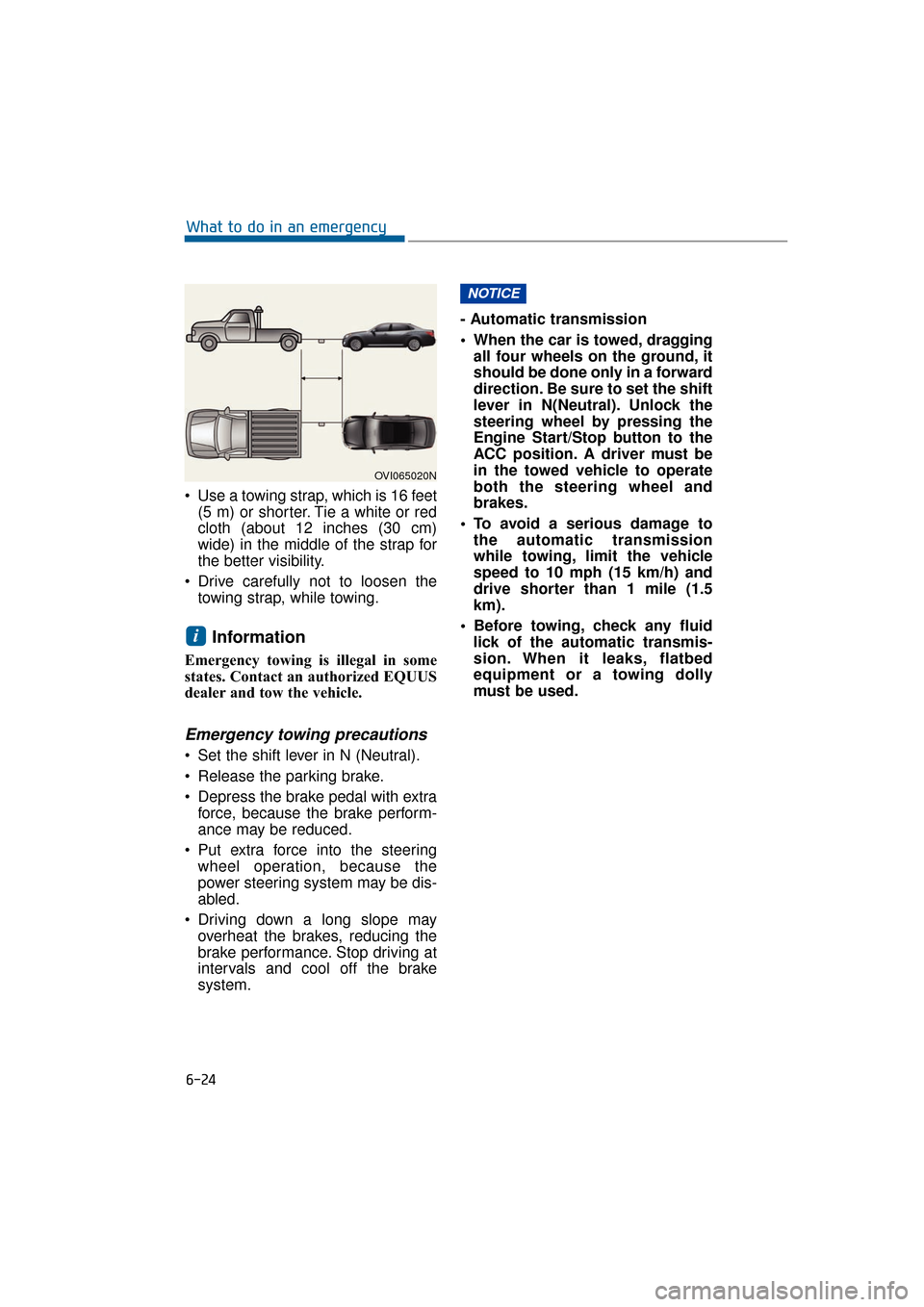
Use a towing strap, which is 16 feet(5 m) or shorter. Tie a white or red
cloth (about 12 inches (30 cm)
wide) in the middle of the strap for
the better visibility.
Drive carefully not to loosen the towing strap, while towing.
Information
Emergency towing is illegal in some
states. Contact an authorized EQUUS
dealer and tow the vehicle.
Emergency towing precautions
Set the shift lever in N (Neutral).
Release the parking brake.
Depress the brake pedal with extraforce, because the brake perform-
ance may be reduced.
Put extra force into the steering wheel operation, because the
power steering system may be dis-
abled.
Driving down a long slope may overheat the brakes, reducing the
brake performance. Stop driving at
intervals and cool off the brake
system. - Automatic transmission
When the car is towed, dragging
all four wheels on the ground, it
should be done only in a forward
direction. Be sure to set the shift
lever in N(Neutral). Unlock the
steering wheel by pressing the
Engine Start/Stop button to the
ACC position. A driver must be
in the towed vehicle to operate
both the steering wheel and
brakes.
To avoid a serious damage to the automatic transmission
while towing, limit the vehicle
speed to 10 mph (15 km/h) and
drive shorter than 1 mile (1.5
km).
Before towing, check any fluid lick of the automatic transmis-
sion. When it leaks, flatbed
equipment or a towing dolly
must be used.
NOTICE
i
6-24
What to do in an emergency
OVI065020N
Page 379 of 477
7-22
Maintenance
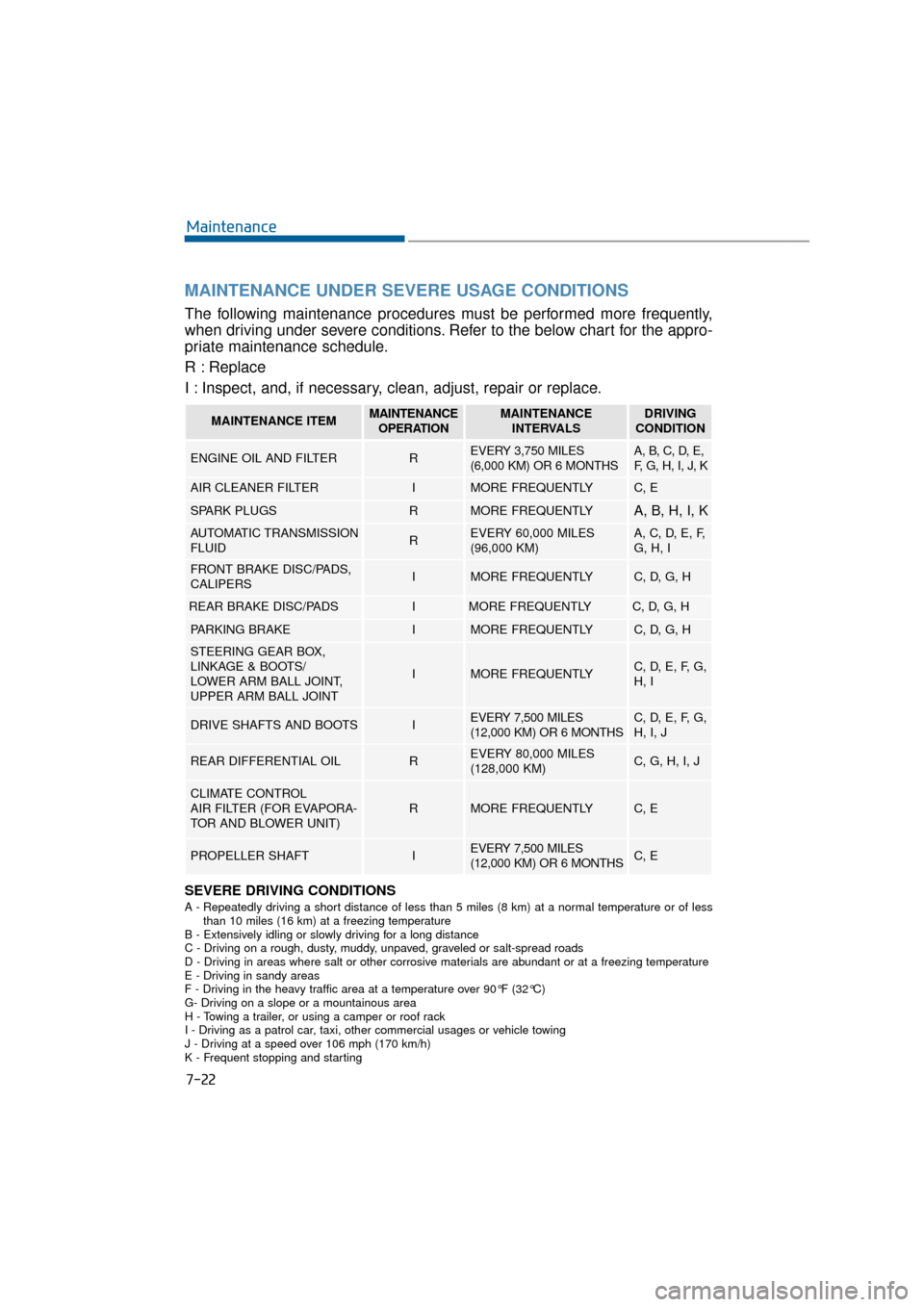
MAINTENANCE UNDER SEVERE USAGE CONDITIONS
The following maintenance procedures must be performed more frequently,
when driving under severe conditions. Refer to the below chart for the appro-
priate maintenance schedule.
R : Replace
I : Inspect, and, if necessary, clean, adjust, repair or replace.
SEVERE DRIVING CONDITIONS
A - Repeatedly driving a short distance of less than 5 miles (8 km) at a normal temperature or of lessthan 10 miles (16 km) at a freezing temperature
B - Extensively idling or slowly driving for a long distance
C - Driving on a rough, dusty, muddy, unpaved, graveled or salt-spread roads
D - Driving in areas where salt or other corrosive materials are abundant or at a freezing temperature
E - Driving in sandy areas
F - Driving in the heavy traffic area at a temperature over 90°F (32°C)
G- Driving on a slope or a mountainous area
H - Towing a trailer, or using a camper or roof rack
I - Driving as a patrol car, taxi, other commercial usages or vehicle towing
J - Driving at a speed over 106 mph (170 km/h)
K - Frequent stopping and starting
MAINTENANCE ITEMMAINTENANCE
OPERATIONMAINTENANCE INTERVALSDRIVING
CONDITION
ENGINE OIL AND FILTERREVERY 3,750 MILES
(6,000 KM) OR 6 MONTHSA, B, C, D, E,
F, G, H, I, J, K
AIR CLEANER FILTERIMORE FREQUENTLYC, E
SPARK PLUGSRMORE FREQUENTLYA, B, H, I, K
AUTOMATIC TRANSMISSION
FLUIDREVERY 60,000 MILES
(96,000 KM) A, C, D, E, F,
G, H, I
FRONT BRAKE DISC/PADS,
CALIPERSIMORE FREQUENTLYC, D, G, H
REAR BRAKE DISC/PADSIMORE FREQUENTLYC, D, G, H
PARKING BRAKEIMORE FREQUENTLYC, D, G, H
STEERING GEAR BOX,
LINKAGE & BOOTS/
LOWER ARM BALL JOINT,
UPPER ARM BALL JOINT
IMORE FREQUENTLYC, D, E, F, G,
H, I
DRIVE SHAFTS AND BOOTSIEVERY 7,500 MILES
(12,000 KM) OR 6 MONTHSC, D, E, F, G,
H, I, J
REAR DIFFERENTIAL OILREVERY 80,000 MILES
(128,000 KM)C, G, H, I, J
CLIMATE CONTROL
AIR FILTER (FOR EVAPORA-
TOR AND BLOWER UNIT)RMORE FREQUENTLYC, E
PROPELLER SHAFTIEVERY 7,500 MILES
(12,000 KM) OR 6 MONTHSC, E
Page 407 of 477
7-50
Maintenance
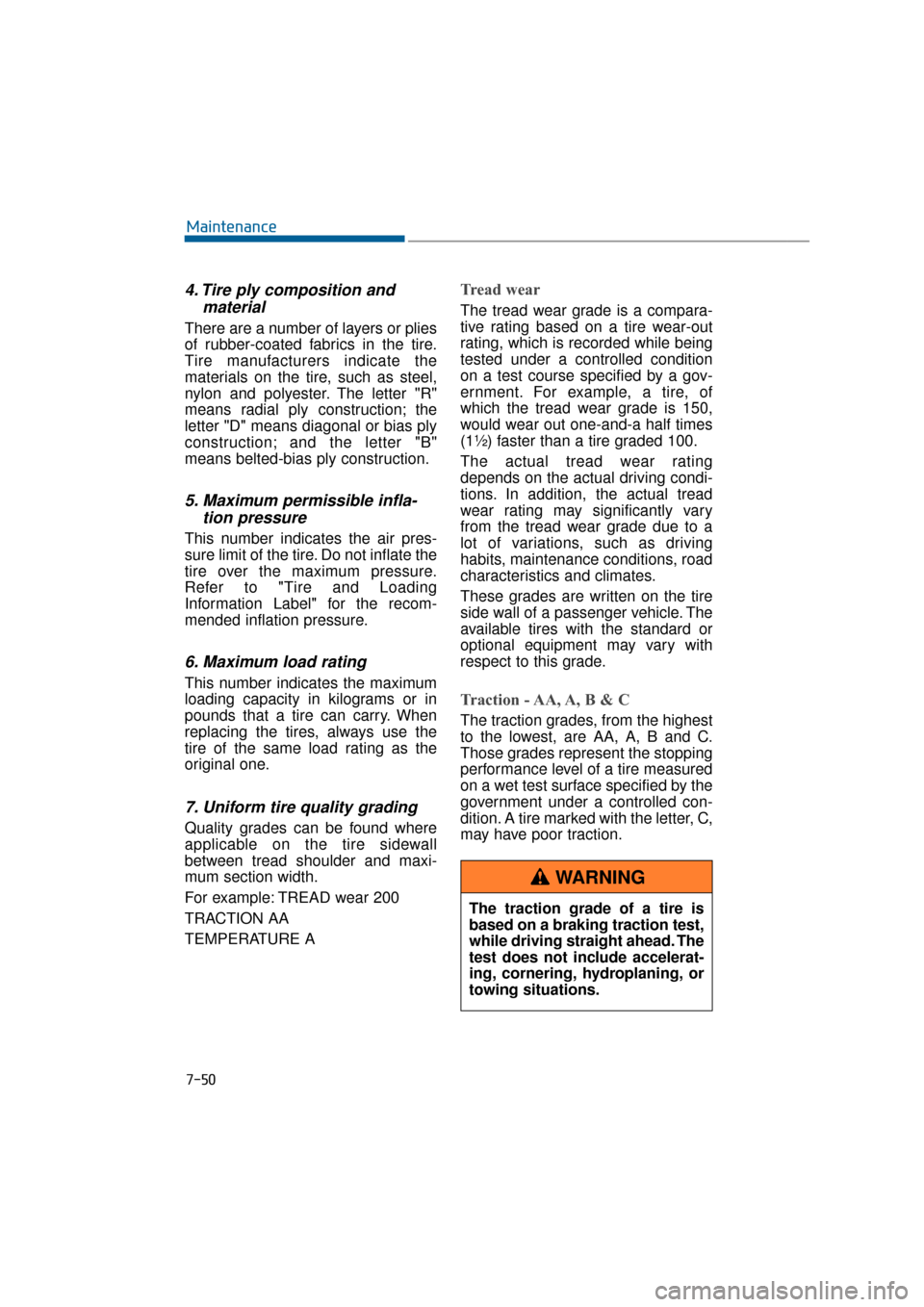
4. Tire ply composition andmaterial
There are a number of layers or plies
of rubber-coated fabrics in the tire.
Tire manufacturers indicate the
materials on the tire, such as steel,
nylon and polyester. The letter "R"
means radial ply construction; the
letter "D" means diagonal or bias ply
construction; and the letter "B"
means belted-bias ply construction.
5. Maximum permissible infla-tion pressure
This number indicates the air pres-
sure limit of the tire. Do not inflate the
tire over the maximum pressure.
Refer to "Tire and Loading
Information Label" for the recom-
mended inflation pressure.
6. Maximum load rating
This number indicates the maximum
loading capacity in kilograms or in
pounds that a tire can carry. When
replacing the tires, always use the
tire of the same load rating as the
original one.
7. Uniform tire quality grading
Quality grades can be found where
applicable on the tire sidewall
between tread shoulder and maxi-
mum section width.
For example: TREAD wear 200
TRACTION AA
TEMPERATURE A
Tread wear
The tread wear grade is a compara-
tive rating based on a tire wear-out
rating, which is recorded while being
tested under a controlled condition
on a test course specified by a gov-
ernment. For example, a tire, of
which the tread wear grade is 150,
would wear out one-and-a half times
(1½) faster than a tire graded 100.
The actual tread wear rating
depends on the actual driving condi-
tions. In addition, the actual tread
wear rating may significantly vary
from the tread wear grade due to a
lot of variations, such as driving
habits, maintenance conditions, road
characteristics and climates.
These grades are written on the tire
side wall of a passenger vehicle. The
available tires with the standard or
optional equipment may vary with
respect to this grade.
Traction - AA, A, B & C
The traction grades, from the highest
to the lowest, are AA, A, B and C.
Those grades represent the stopping
performance level of a tire measured
on a wet test surface specified by the
government under a controlled con-
dition. A tire marked with the letter, C,
may have poor traction.
The traction grade of a tire is
based on a braking traction test,
while driving straight ahead. The
test does not include accelerat-
ing, cornering, hydroplaning, or
towing situations.
WARNING
Page 463 of 477
Dashboard illumination, see instrument panel illumination ...............................3-64
Dashboard, see instrument cluster ......................................................................3-\
62
Daytime running light ........................................................................\
...............3-113
Defogging (Windshield)........................................................................\
............3-138
Defroster (Rear window) ........................................................................\
..........3-122
Defrosting (Windshield)........................................................................\
............3-138
Dimensions ........................................................................\
....................................8-2
Display illumination, see instrument panel illumination ....................................3-64
Displays, see instrument cluster........................................................................\
..3-62
Door courtesy lamp ........................................................................\
...................3-119
Door locks ........................................................................\
...................................3-14Central door lock switch ........................................................................\
......3-16
Child-protector rear door lock......................................................................3-\
17
Drinks holders, see cup holders ........................................................................\
3-146
Drive mode integrated control system ECO mode ........................................................................\
............................5-34
SNOW mode ........................................................................\
........................5-35
SPORT mode ........................................................................\
........................5-35
Driver position memory system ........................................................................\
..3-40
Driver’s air bag ........................................................................\
...........................2-54
Driving at night ........................................................................\
...........................5-69
Driving in flooded areas........................................................................\
..............5-70
Driving in the rain ........................................................................\
.......................5-70
Economical operation........................................................................\
..................5-65
Electric chromic mirror (ECM) with HomeLink
®system and compass ..3-44, 3-51
Electric parking brake (EPB) ........................................................................\
......5-19
Electronic controlled suspension (ECS) .............................................................5-36
Electronic hydraulic power steering (EHPS) ......................................................3-42
Electronic stability control (ESC) .......................................................................5\
-28
Emergency starting........................................................................\
........................6-4 Jump starting ........................................................................\
..........................6-4
Emergency towing ........................................................................\
......................6-22
Emergency while driving ........................................................................\
..............6-2
I-5
IndexI
D
E