wheel size Hyundai Equus 2016 User Guide
[x] Cancel search | Manufacturer: HYUNDAI, Model Year: 2016, Model line: Equus, Model: Hyundai Equus 2016Pages: 477, PDF Size: 16.25 MB
Page 405 of 477
7-48
Maintenance
Tire maintenance
In addition to the proper inflation
pressure, correct wheel alignment
prevents tire abrasion. When you find
uneven tire abrasion, have the wheel
alignment checked by your EQUUS
dealer.
When replacing your tires, make
sure they are well balanced. This
increases your driving comfort and
tire life. Additionally, a tire should be
rebalanced after being removed from
a wheel.
Tire sidewall labeling
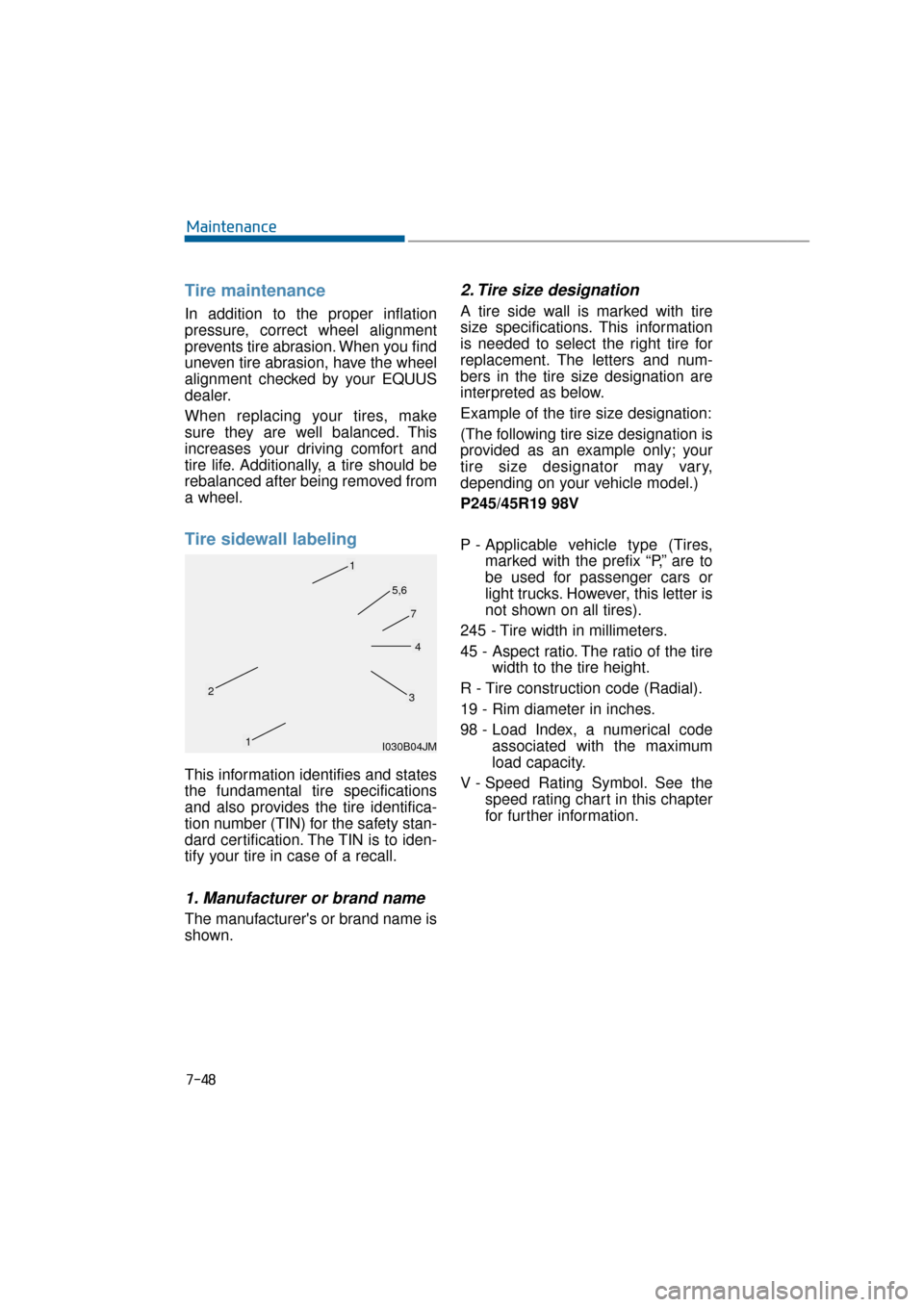
This information identifies and states
the fundamental tire specifications
and also provides the tire identifica-
tion number (TIN) for the safety stan-
dard certification. The TIN is to iden-
tify your tire in case of a recall.
1. Manufacturer or brand name
The manufacturer's or brand name is
shown.
2. Tire size designation
A tire side wall is marked with tire
size specifications. This information
is needed to select the right tire for
replacement. The letters and num-
bers in the tire size designation are
interpreted as below.
Example of the tire size designation:
(The following tire size designation is
provided as an example only; your
tire size designator may vary,
depending on your vehicle model.)
P245/45R19 98V
P - Applicable vehicle type (Tires,marked with the prefix “P,’’ are to
be used for passenger cars or
light trucks. However, this letter is
not shown on all tires).
245 - Tire width in millimeters.
45 - Aspect ratio. The ratio of the tire width to the tire height.
R - Tire construction code (Radial).
19 - Rim diameter in inches.
98 - Load Index, a numerical code associated with the maximum
load capacity.
V - Speed Rating Symbol. See the speed rating chart in this chapter
for further information.
I030B04JM
1
1
23
4
5,6
7
Page 406 of 477
7-49
Maintenance07
Wheel size designation
Wheels are also marked with impor-
tant specifications. The following
example of the wheel size designa-
tion explains how the letters and
numbers are interpreted.
Example wheel size designation:
8.0JX19
8.0 - Rim width in inches.
J - Rim contour designation.
19 - Rim diameter in inches.
Tire speed ratings
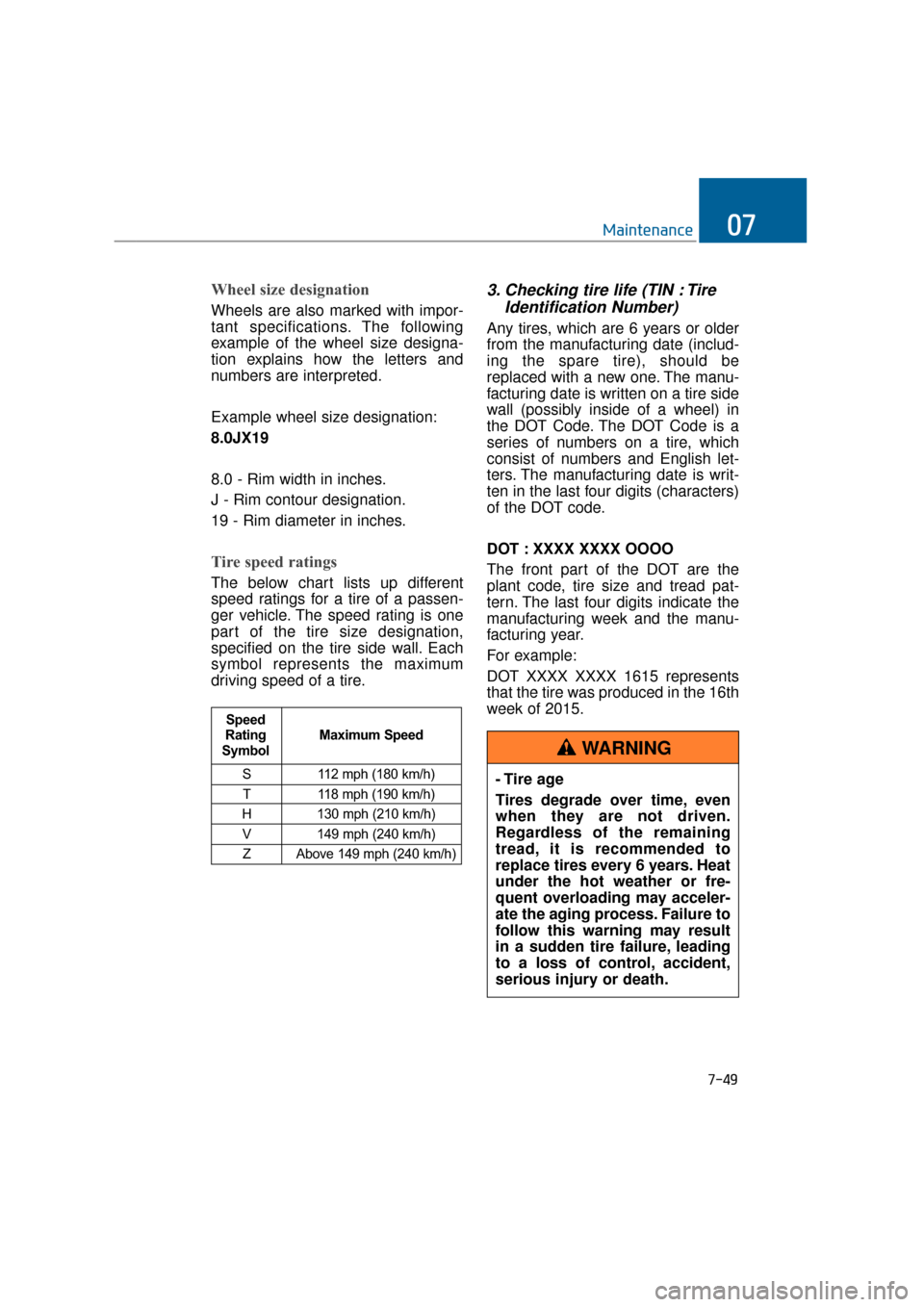
The below chart lists up different
speed ratings for a tire of a passen-
ger vehicle. The speed rating is one
part of the tire size designation,
specified on the tire side wall. Each
symbol represents the maximum
driving speed of a tire.
3. Checking tire life (TIN : TireIdentification Number)
Any tires, which are 6 years or older
from the manufacturing date (includ-
ing the spare tire), should be
replaced with a new one. The manu-
facturing date is written on a tire side
wall (possibly inside of a wheel) in
the DOT Code. The DOT Code is a
series of numbers on a tire, which
consist of numbers and English let-
ters. The manufacturing date is writ-
ten in the last four digits (characters)
of the DOT code.
DOT : XXXX XXXX OOOO
The front part of the DOT are the
plant code, tire size and tread pat-
tern. The last four digits indicate the
manufacturing week and the manu-
facturing year.
For example:
DOT XXXX XXXX 1615 represents
that the tire was produced in the 16th
week of 2015.
S 112 mph (180 km/h)
T 118 mph (190 km/h)
H 130 mph (210 km/h) V 149 mph (240 km/h)Z Above 149 mph (240 km/h)
Maximum Speed
Speed
Rating
Symbol
- Tire age
Tires degrade over time, even
when they are not driven.
Regardless of the remaining
tread, it is recommended to
replace tires every 6 years. Heat
under the hot weather or fre-
quent overloading may acceler-
ate the aging process. Failure to
follow this warning may result
in a sudden tire failure, leading
to a loss of control, accident,
serious injury or death.
WARNING
Page 411 of 477
7-54
Maintenance
Vehicle Capacity Weight: The mul-
tiplication of the designated occu-
pant seat number by 150 pounds (68
kg) plus the loading weight.
Vehicle Maximum Load on the
Tire: Loading capacity for an individ-
ual tire. The curb and accessory
weights plus the maximum occupant
and loading weights.
Vehicle Normal Load on the Tire:
Loading capacity for an individual
axle. The sum of the curb, accessory,
and normal occupant weights is
divided by 2.
Vehicle Placard: A label, perma-
nently attached to a vehicle, to indi-
cate the original equipment tire size
and the recommended inflation pres-
sure.
All season tires
HYUNDAI designated some models
of all-season tires to provide good
performance for use all year round,
including snowy and icy road condi-
tions. All-season tires are identified
by ALL SEASON and/or M+S (Mud
and Snow) on the tire side wall.
Snow tires have better snow traction
than all season tires and may be
more appropriate in some areas.
Summer tires
HYUNDAI designated some models
of summer tires to provide superior
performance on dry roads. Summer
tire performance is substantially
reduced in snow and ice. Summer
tires do not have a tire traction rating
mark, M+S (Mud and Snow), on the
tire side wall. Before driving in snowy
or icy conditions, it is recommended
to install snow tires or all-season
tires on all four wheels.
Snow tires
When equipping your vehicle with
snow tires, the tires should be in the
same size and have the same load
capacity as the original ones. Snow
tires should be installed on all four
wheels. Otherwise, it may cause
poor handling. Snow tires should be
more inflated by 4 psi (28 kPa) than
the lesser of the two recommended
pressures - one specified on the tire
label attached to the central pillar on
the driver's side, and the other spec-
ified on the tire side wall.
Do not drive faster than 75 mph (120
km/h) when your car is equipped with
snow tires.
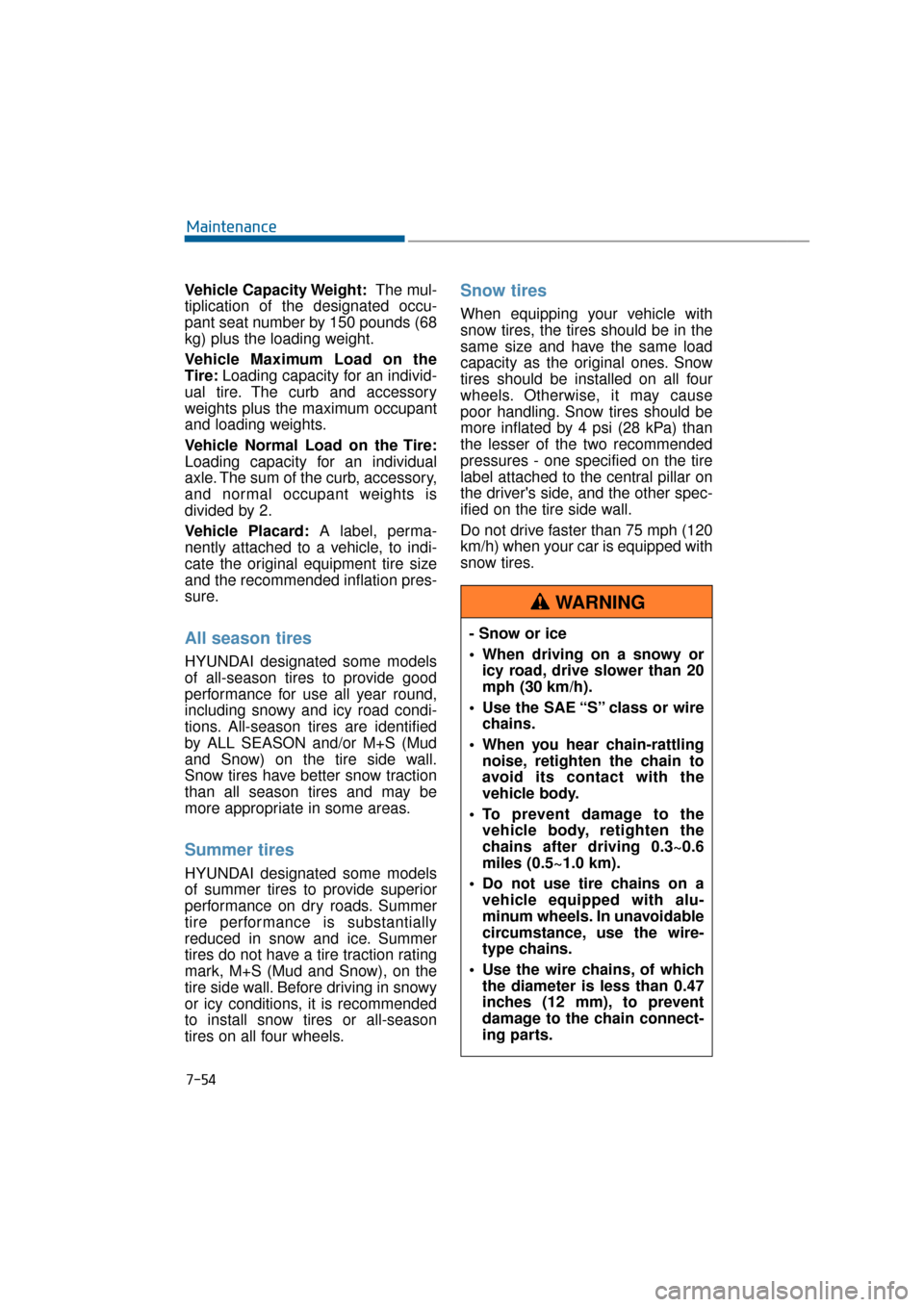
- Snow or ice
When driving on a snowy or icy road, drive slower than 20
mph (30 km/h).
Use the SAE “S” class or wire chains.
When you hear chain-rattling noise, retighten the chain to
avoid its contact with the
vehicle body.
To prevent damage to the vehicle body, retighten the
chains after driving 0.3~0.6
miles (0.5~1.0 km).
Do not use tire chains on a vehicle equipped with alu-
minum wheels. In unavoidable
circumstance, use the wire-
type chains.
Use the wire chains, of which the diameter is less than 0.47
inches (12 mm), to prevent
damage to the chain connect-
ing parts.
WARNING
Page 412 of 477
7-55
Maintenance07
Tire chains
Tire chains, if necessary, should be
installed on the drive wheels (rear
wheels).
Make sure that the chains are
installed in accordance with the man-
ufacturer's instructions.
To minimize the abrasion of tires and
chains, do not use the chains, when
unnecessary.
Radial-ply tires
Radial-ply tires provide longer tread
life, better road hazard resistance
and smoother riding at a high speed.
The radial-ply tires used on this vehi-
cle are of belted construction, and
are to improve your driving and han-
dling. Radial-ply tires have the same
loading capacity as the bias-ply or
bias-belted tires of the same size.
Inflate the radial-ply tires to the same
recommended inflation pressure. It is
not recommended to attempt a
cross-combination of radial-ply tires
and bias-ply(or bias-belted) tires on
the same vehicle. Any cross-combi-
nation of radial-ply and bias-ply(or
bias-belted) tires on one vehicle will
seriously deteriorate vehicle han-
dling. The best rule to follow is:
Identical radial-ply tires should
always be used for a set of four tires.
A tire, which is driven for a long peri-
od of time, is more susceptible to
irregular tread abrasion. It is very
important to rotate tires, at the inter-
val instructed in this chapter, to use it
up to its potential tread life. Any cut
and puncture on a radial-ply tire is
repairable, only when it is on the
tread, because of the side wall flex-
ing. Consult your tire dealer for a
radial-ply tire repair.
Page 452 of 477
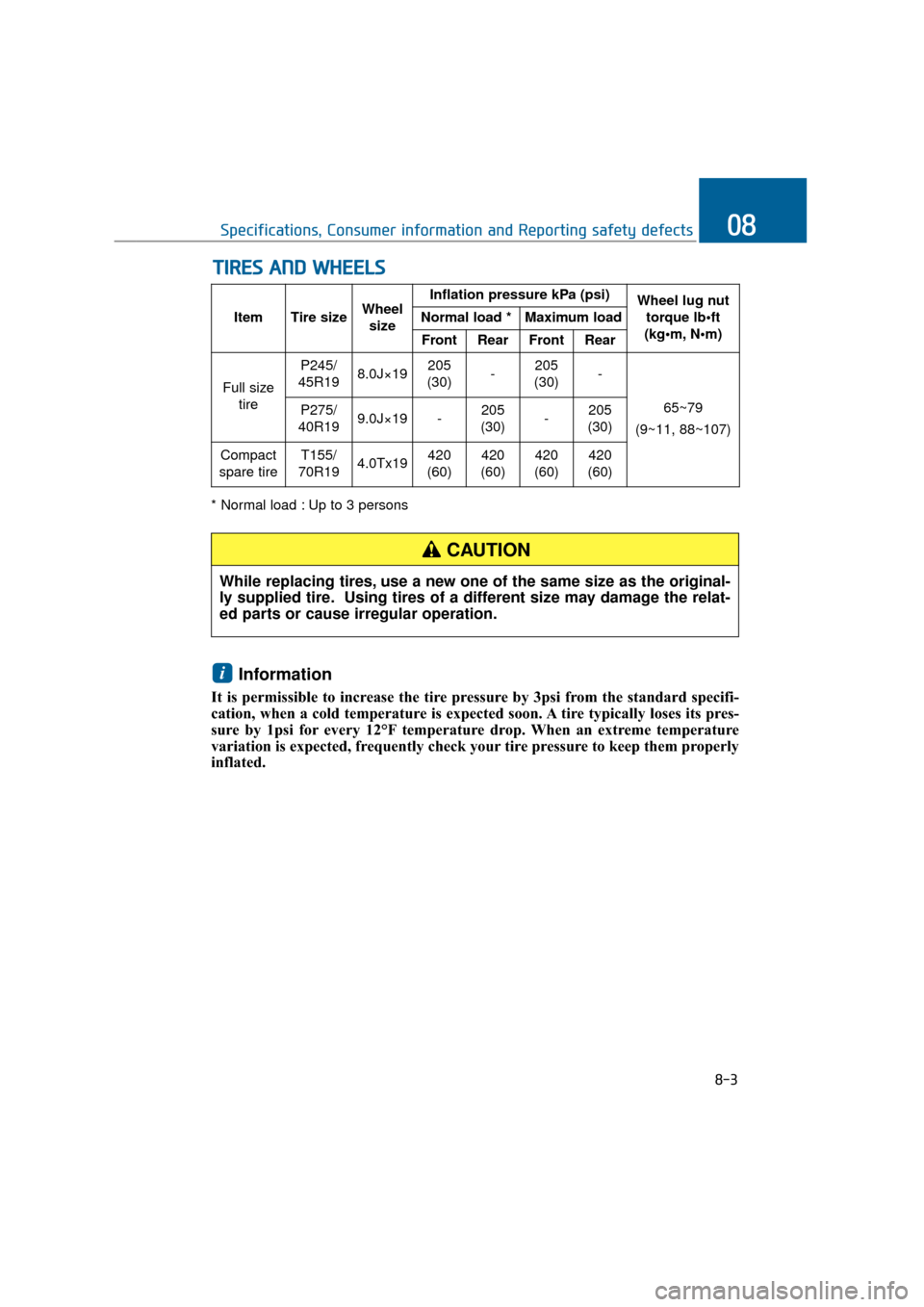
* Normal load : Up to 3 persons
Information
It is permissible to increase the tire pressure by 3psi from the standard specifi-
cation, when a cold temperature is expected soon. A tire typically loses its pres-
sure by 1psi for every 12°F temperature drop. When an extreme temperature
variation is expected, frequently check your tire pressure to keep them properly
inflated.
i
T TI
IR
R E
ES
S
A
A N
N D
D
W
W H
HE
EE
EL
LS
S
8-3
Specifications, Consumer information and Reporting safety defects08
Item Tire size Wheel
size Inflation pressure kPa (psi)
Wheel lug nut
torque lb•ft
(kg N
Normal load * Maximum load
Front Rear Front Rear
Full size tire P245/
45R19 8.0J×19 205
(30) -205
(30) -
65~79
(9~11, 88~107)
P275/
40R19 9.0J×19 - 205
(30) -205
(30)
Compact
spare tireT155/
70R194.0Tx19420
(60)420
(60)420
(60)420
(60)
While replacing tires, use a new one of the same size as the original-
ly supplied tire. Using tires of a different size may damage the relat-
ed parts or cause irregular operation.
CAUTION