belt Hyundai Equus 2016 Owner's Guide
[x] Cancel search | Manufacturer: HYUNDAI, Model Year: 2016, Model line: Equus, Model: Hyundai Equus 2016Pages: 477, PDF Size: 16.25 MB
Page 63 of 477
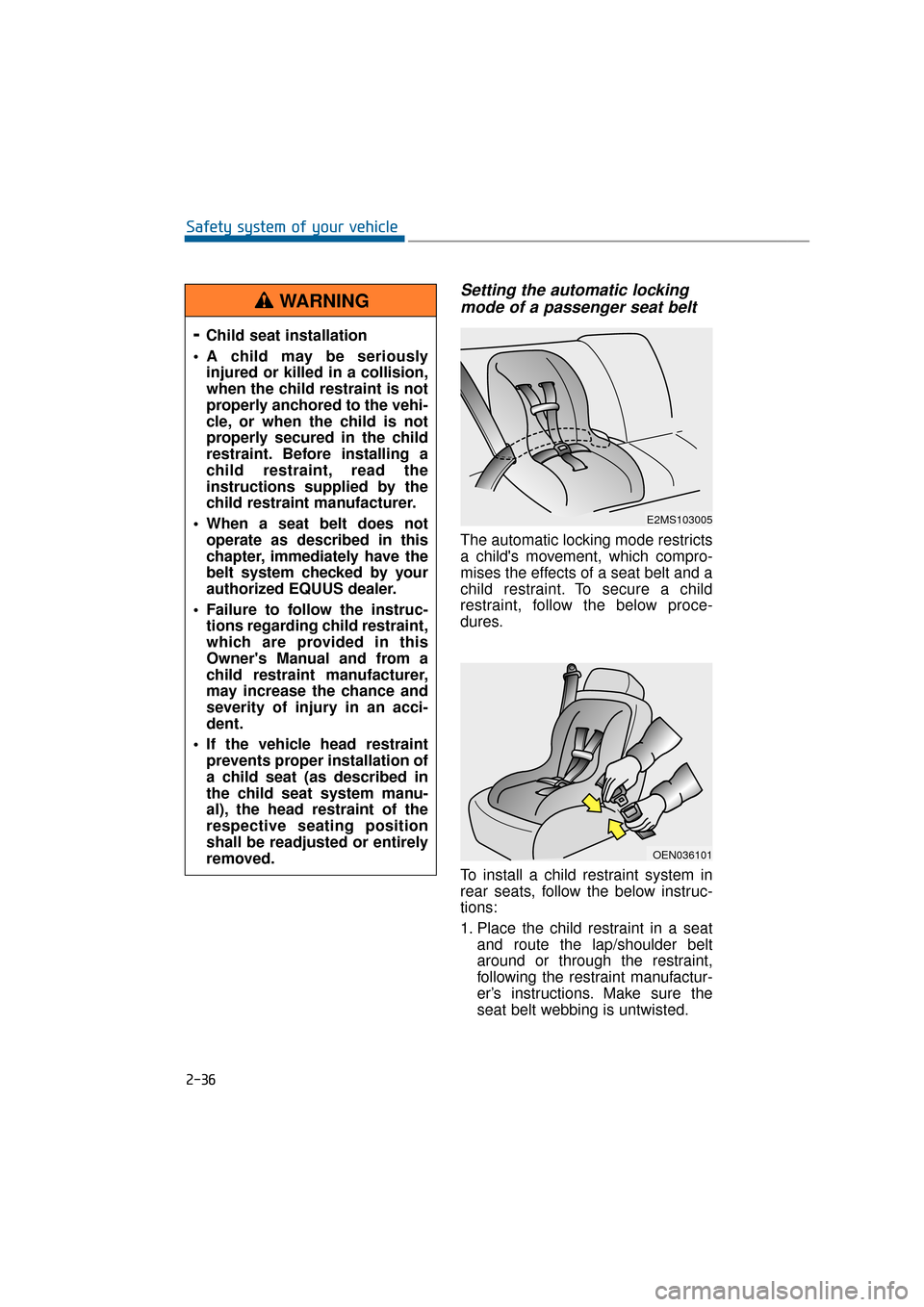
Setting the automatic lockingmode of a passenger seat belt
The automatic locking mode restricts
a child's movement, which compro-
mises the effects of a seat belt and a
child restraint. To secure a child
restraint, follow the below proce-
dures.
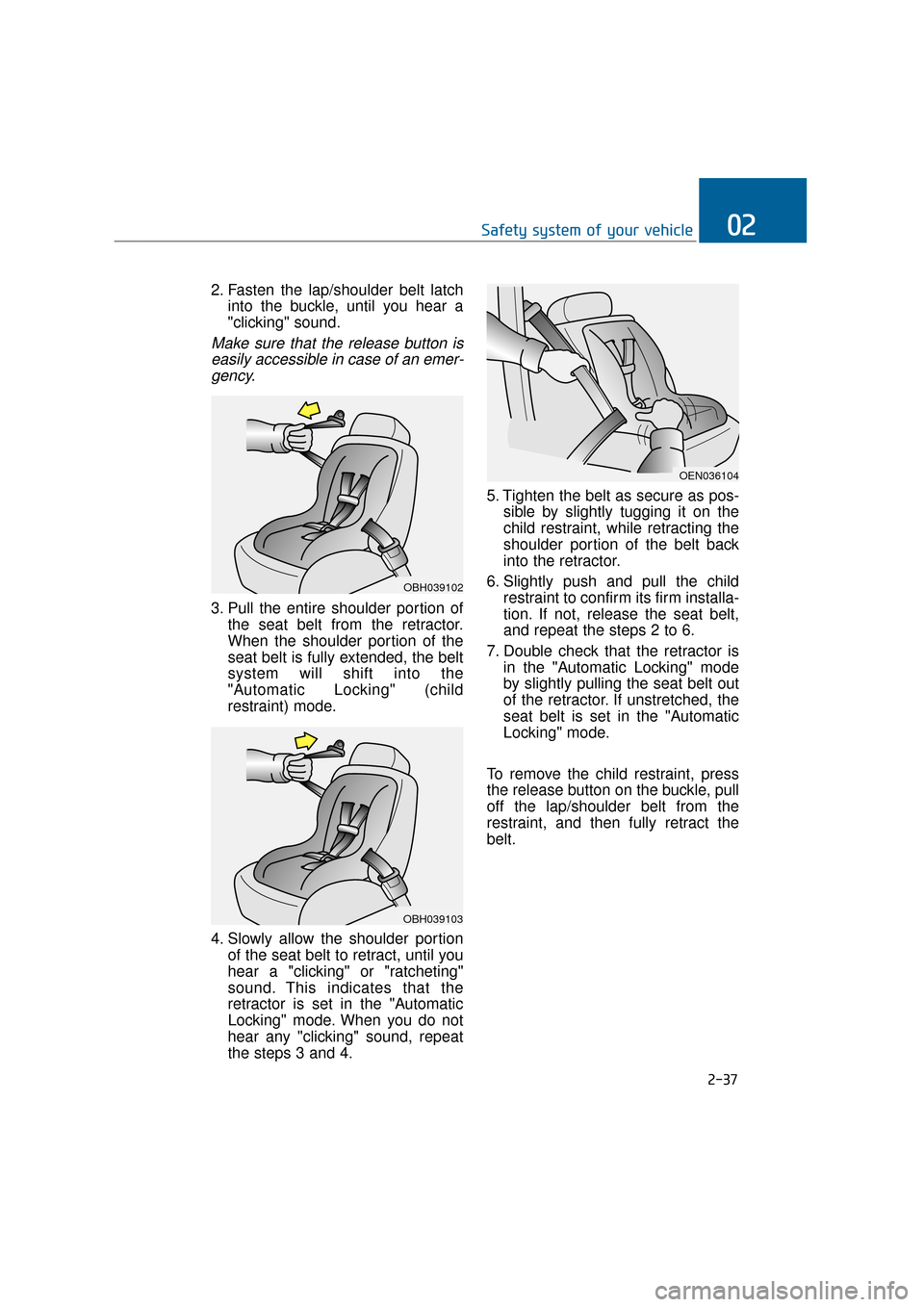
To install a child restraint system in
rear seats, follow the below instruc-
tions:
1. Place the child restraint in a seat
and route the lap/shoulder belt
around or through the restraint,
following the restraint manufactur-
er’s instructions. Make sure the
seat belt webbing is untwisted.
2-36
Safety system of your vehicle
- Child seat installation
A child may be seriously injured or killed in a collision,
when the child restraint is not
properly anchored to the vehi-
cle, or when the child is not
properly secured in the child
restraint. Before installing a
child restraint, read the
instructions supplied by the
child restraint manufacturer.
When a seat belt does not operate as described in this
chapter, immediately have the
belt system checked by your
authorized EQUUS dealer.
Failure to follow the instruc- tions regarding child restraint,
which are provided in this
Owner's Manual and from a
child restraint manufacturer,
may increase the chance and
severity of injury in an acci-
dent.
If the vehicle head restraint prevents proper installation of
a child seat (as described in
the child seat system manu-
al), the head restraint of the
respective seating position
shall be readjusted or entirely
removed.
WARNING
E2MS103005
OEN036101
Page 64 of 477
2. Fasten the lap/shoulder belt latchinto the buckle, until you hear a
"clicking" sound.
Make sure that the release button iseasily accessible in case of an emer-gency.
3. Pull the entire shoulder portion of the seat belt from the retractor.
When the shoulder portion of the
seat belt is fully extended, the belt
system will shift into the
"Automatic Locking" (child
restraint) mode.
4. Slowly allow the shoulder portion of the seat belt to retract, until you
hear a "clicking" or "ratcheting"
sound. This indicates that the
retractor is set in the "Automatic
Locking" mode. When you do not
hear any "clicking" sound, repeat
the steps 3 and 4. 5. Tighten the belt as secure as pos-
sible by slightly tugging it on the
child restraint, while retracting the
shoulder portion of the belt back
into the retractor.
6. Slightly push and pull the child restraint to confirm its firm installa-
tion. If not, release the seat belt,
and repeat the steps 2 to 6.
7. Double check that the retractor is in the "Automatic Locking" mode
by slightly pulling the seat belt out
of the retractor. If unstretched, the
seat belt is set in the "Automatic
Locking" mode.
To remove the child restraint, press
the release button on the buckle, pull
off the lap/shoulder belt from the
restraint, and then fully retract the
belt.
2-37
Safety system of your vehicle02
OBH039102
OBH039103
OEN036104
Page 65 of 477
Once the seat belt is released after
being fully retracted, the retractor
will automatically switch from the
"Automatic Locking" mode to the
"Emergency Locking" mode for
normal usage.
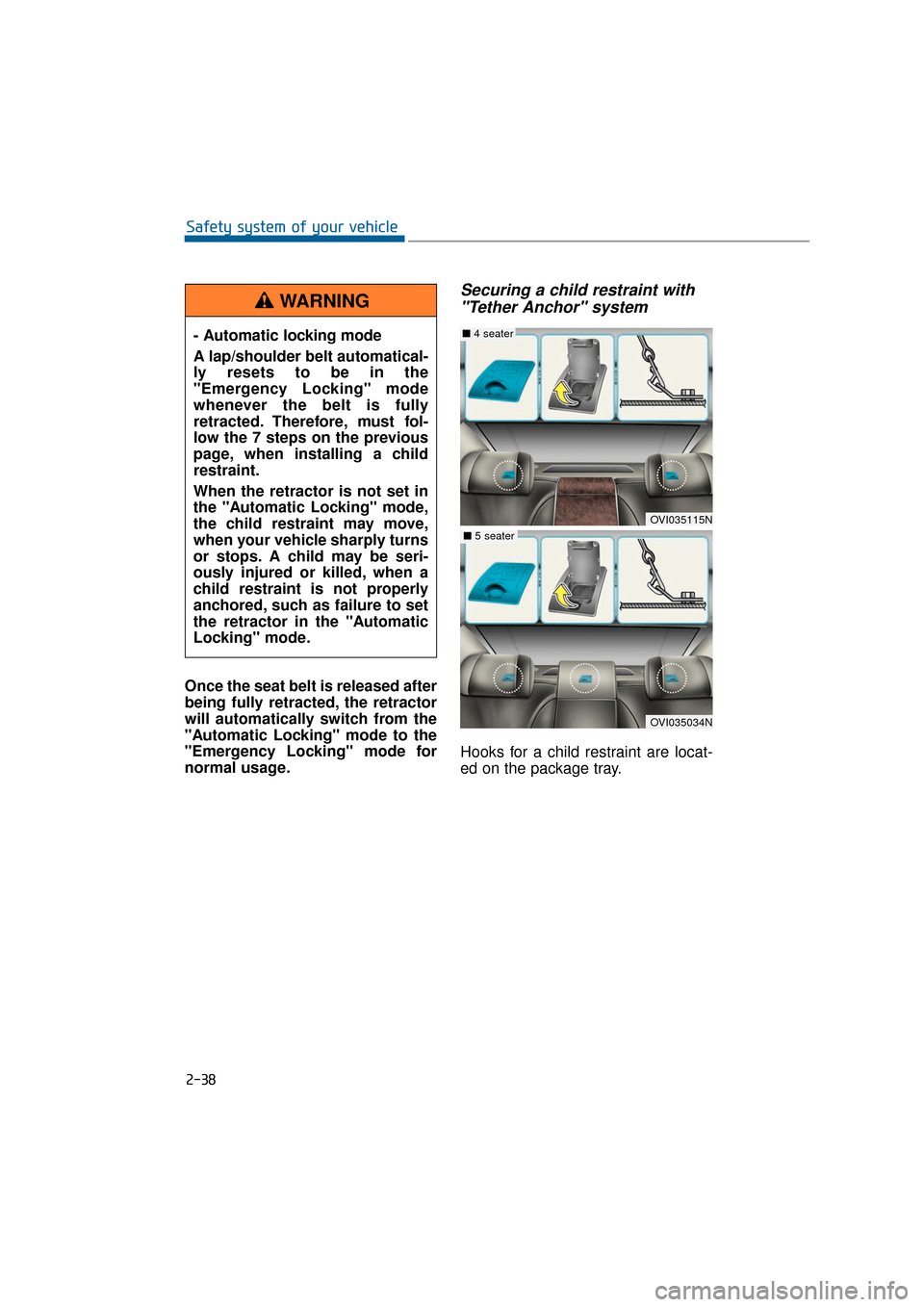
Securing a child restraint with"Tether Anchor" system
Hooks for a child restraint are locat-
ed on the package tray.
2-38
Safety system of your vehicle
OVI035115N
■ 4 seater
OVI035034N
■ 5 seater
- Automatic loc king mode
A lap/shoulder belt automatical-
ly resets to be in the
"Emergency Locking" mode
whenever the belt is fully
retracted. Therefore, must fol-
low the 7 steps on the previous
page, when installing a child
restraint.
When the retractor is not set in
the "Automatic Locking" mode,
the child restraint may move,
when your vehicle sharply turns
or stops. A child may be seri-
ously injured or killed, when a
child restraint is not properly
anchored, such as failure to set
the retractor in the "Automatic
Locking" mode.
WARNING
Page 66 of 477
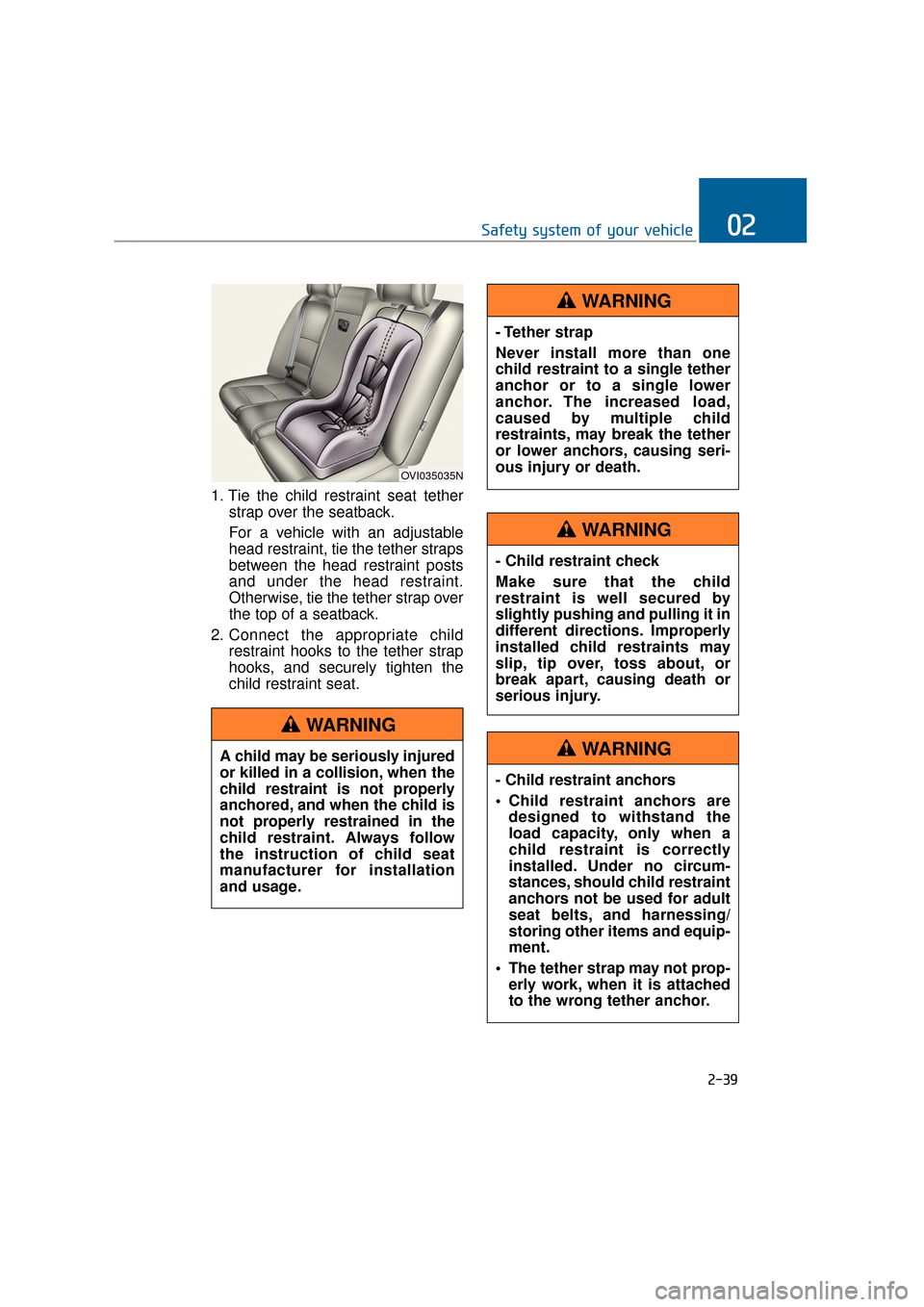
1. Tie the child restraint seat tetherstrap over the seatback.
For a vehicle with an adjustable
head restraint, tie the tether straps
between the head restraint posts
and under the head restraint.
Otherwise, tie the tether strap over
the top of a seatback.
2. Connect the appropriate child restraint hooks to the tether strap
hooks, and securely tighten the
child restraint seat.
2-39
Safety system of your vehicle02
OVI035035N
A child may be seriously injured
or killed in a collision, when the
child restraint is not properly
anchored, and when the child is
not properly restrained in the
child restraint. Always follow
the instruction of child seat
manufacturer for installation
and usage.
WARNING
- Tether strap
Never install more than one
child restraint to a single tether
anchor or to a single lower
anchor. The increased load,
caused by multiple child
restraints, may break the tether
or lower anchors, causing seri-
ous injury or death.
WARNING
- Child restraint check
Make sure that the child
restraint is well secured by
slightly pushing and pulling it in
different directions. Improperly
installed child restraints may
slip, tip over, toss about, or
break apart, causing death or
serious injury.
WARNING
- Child restraint anchors
Child restraint anchors aredesigned to withstand the
load capacity, only when a
child restraint is correctly
installed. Under no circum-
stances, should child restraint
anchors not be used for adult
seat belts, and harnessing/
storing other items and equip-
ment.
The tether strap may not prop- erly work, when it is attached
to the wrong tether anchor.
WARNING
Page 67 of 477
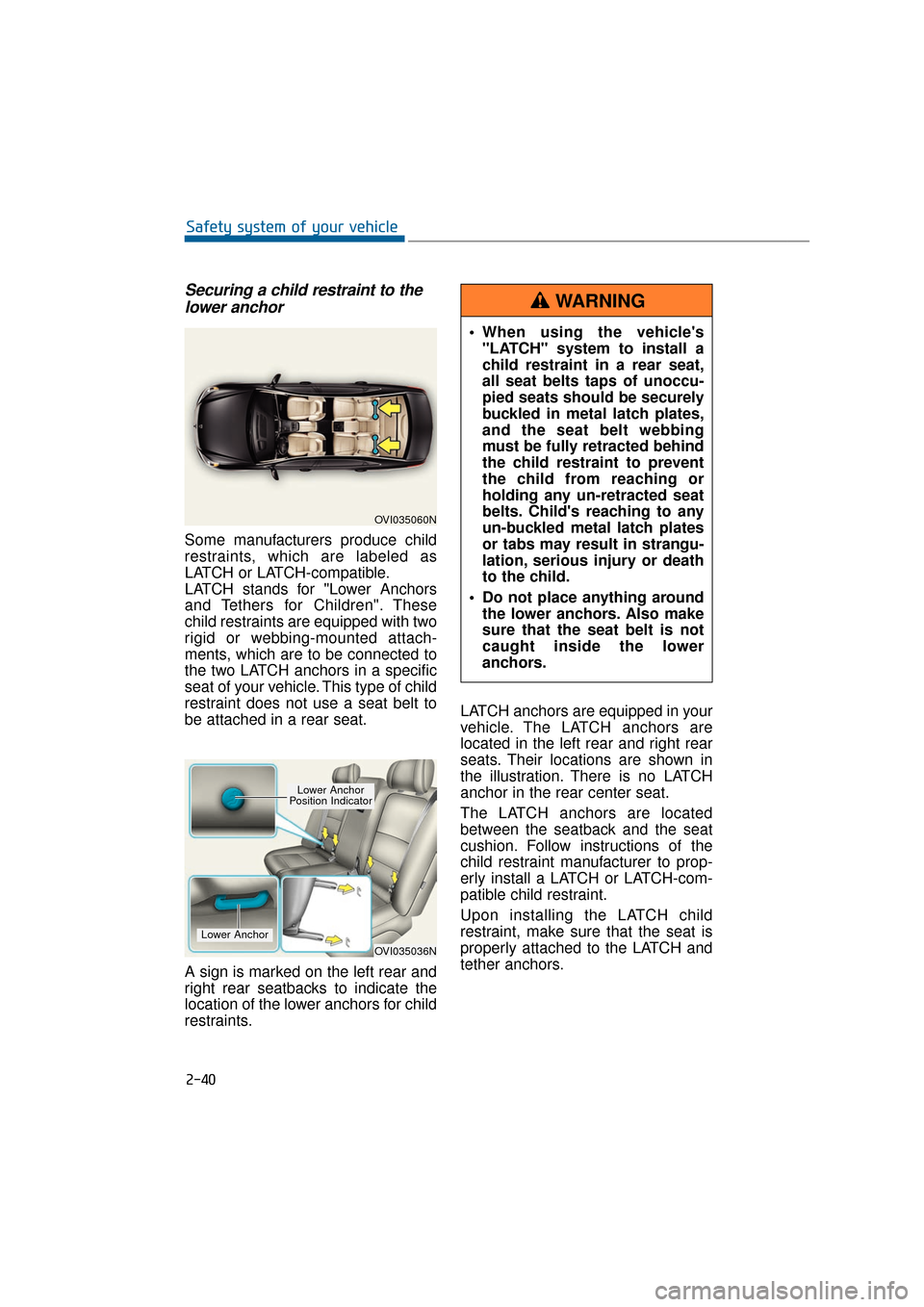
Securing a child restraint to thelower anchor
Some manufacturers produce child
restraints, which are labeled as
LATCH or LATCH-compatible.
LATCH stands for "Lower Anchors
and Tethers for Children". These
child restraints are equipped with two
rigid or webbing-mounted attach-
ments, which are to be connected to
the two LATCH anchors in a specific
seat of your vehicle. This type of child
restraint does not use a seat belt to
be attached in a rear seat.
A sign is marked on the left rear and
right rear seatbacks to indicate the
location of the lower anchors for child
restraints. LATCH anchors are equipped in your
vehicle. The LATCH anchors are
located in the left rear and right rear
seats. Their locations are shown in
the illustration. There is no LATCH
anchor in the rear center seat.
The LATCH anchors are located
between the seatback and the seat
cushion. Follow instructions of the
child restraint manufacturer to prop-
erly install a LATCH or LATCH-com-
patible child restraint.
Upon installing the LATCH child
restraint, make sure that the seat is
properly attached to the LATCH and
tether anchors.
2-40
Safety system of your vehicle
OVI035060N
OVI035036N
Lower Anchor
Lower Anchor
Position Indicator
When using the vehicle's
"LATCH" system to install a
child restraint in a rear seat,
all seat belts taps of unoccu-
pied seats should be securely
buckled in metal latch plates,
and the seat belt webbing
must be fully retracted behind
the child restraint to prevent
the child from reaching or
holding any un-retracted seat
belts. Child's reaching to any
un-buckled metal latch plates
or tabs may result in strangu-
lation, serious injury or death
to the child.
Do not place anything around the lower anchors. Also make
sure that the seat belt is not
caught inside the lower
anchors.
WARNING
Page 68 of 477
Also, test the child restraint before
seating your child. Slightly shake the
restraint from side to side. Also try to
tug the restraint forward. Check
whether the anchors securely hold
the restraint in place.
Do not scratch or pinch a rear seat
belt webbing with a child restraint
latch or a LATCH anchor during
the installation.The recommended weight for the
LATCH system is under 65 lbs (30
kg).
How to calculate the child
restraint weight :
Child restraint weight =
65 lbs (30 kg) - Child weightNOTICE
NOTICE
2-41
Safety system of your vehicle02
- LATCH lower anchors
LATCH lower anchors are to be
used only in the left rear and
right rear seats. Never attempt
to install a child restraint in the
rear center seat. You may dam-
age the anchors, or the anchors
may fail and break apart in a
collision.
WARNING
When the child restraint is not
properly anchored, the risk of a
child's serious injury or death in
a collision greatly increases.
DANGER
Page 69 of 477
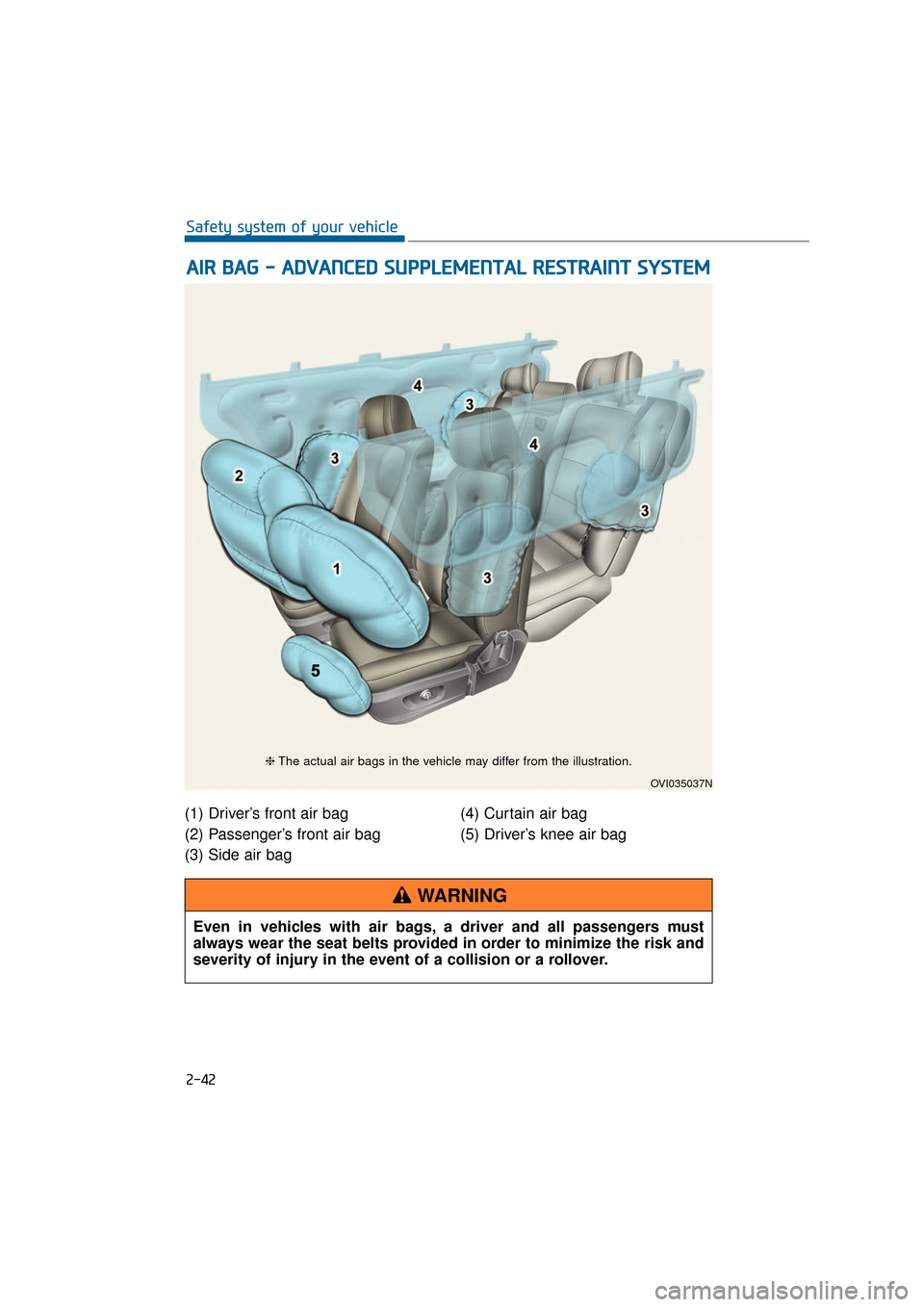
(1) Driver’s front air bag
(2) Passenger’s front air bag
(3) Side air bag(4) Curtain air bag
(5) Driver’s knee air bag
A A
I
IR
R
B
B A
A G
G
-
-
A
A D
DV
VA
A N
N C
CE
E D
D
S
S U
U P
PP
PL
LE
E M
M E
EN
N T
TA
A L
L
R
R E
ES
ST
T R
R A
A I
IN
N T
T
S
S Y
Y S
ST
T E
EM
M
2-42
Safety system of your vehicle
❈ The actual air bags in the vehicle may differ from the illustration.
OVI035037N
Even in vehicles with air bags, a driver and all passengers must
always wear the seat belts provided in order to minimize the risk and
severity of injury in the event of a collision or a rollover.
WARNING
Page 71 of 477
Noise and smoke
When the air bags inflate, they pro-
duce not only a loud noise, but also
smoke and powder inside the vehi-
cle. This is normal and is a result of
the ignition of the air bag inflator.
After the air bag inflates, you may
feel substantial discomfort, while
breathing due to the contact of your
chest with both the seat belt and the
air bag, as well as from inhaled
smoke and powder.Open your
doors and windows as soon as
possible after air bag deployment
in order to reduce your discomfort
and prevent prolonged exposure
to the smoke and powder.
Though the smoke and powder are
non-toxic, they may cause skin irrita-
tion (i.e. eyes, nose and throat). In
this case, immediately wash your
skin with cold water and consult a
doctor if the symptom persists.
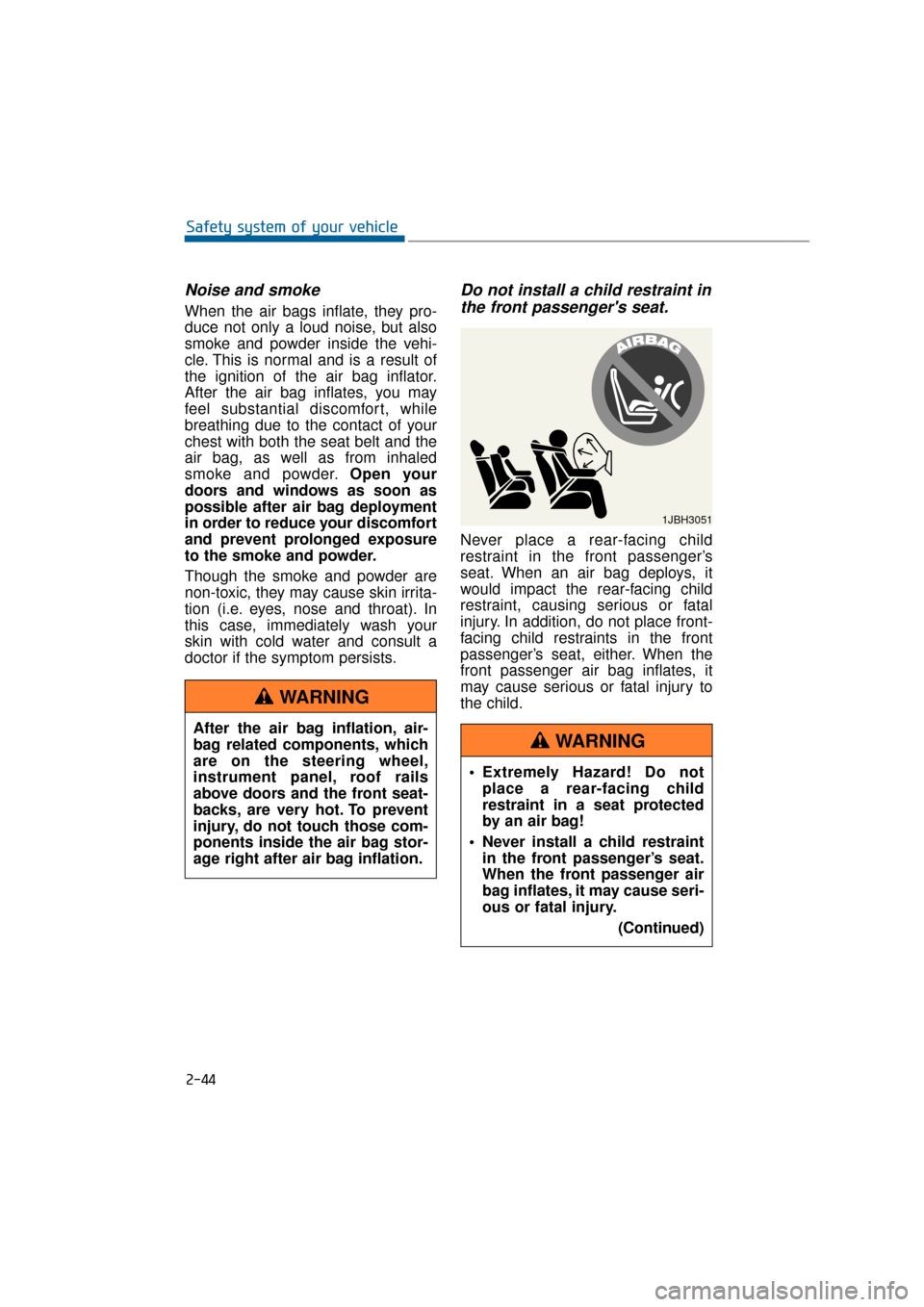
Do not install a child restraint in the front passenger's seat.
Never place a rear-facing child
restraint in the front passenger’s
seat. When an air bag deploys, it
would impact the rear-facing child
restraint, causing serious or fatal
injury. In addition, do not place front-
facing child restraints in the front
passenger’s seat, either. When the
front passenger air bag inflates, it
may cause serious or fatal injury to
the child.
2-44
Safety system of your vehicle
After the air bag inflation, air-
bag related components, which
are on the steering wheel,
instrument panel, roof rails
above doors and the front seat-
backs, are very hot. To prevent
injury, do not touch those com-
ponents inside the air bag stor-
age right after air bag inflation.
WARNING
1JBH3051
Extremely Hazard! Do not place a rear-facing child
restraint in a seat protected
by an air bag!
Never install a child restraint in the front passenger’s seat.
When the front passenger air
bag inflates, it may cause seri-
ous or fatal injury.
(Continued)
WARNING
Page 72 of 477
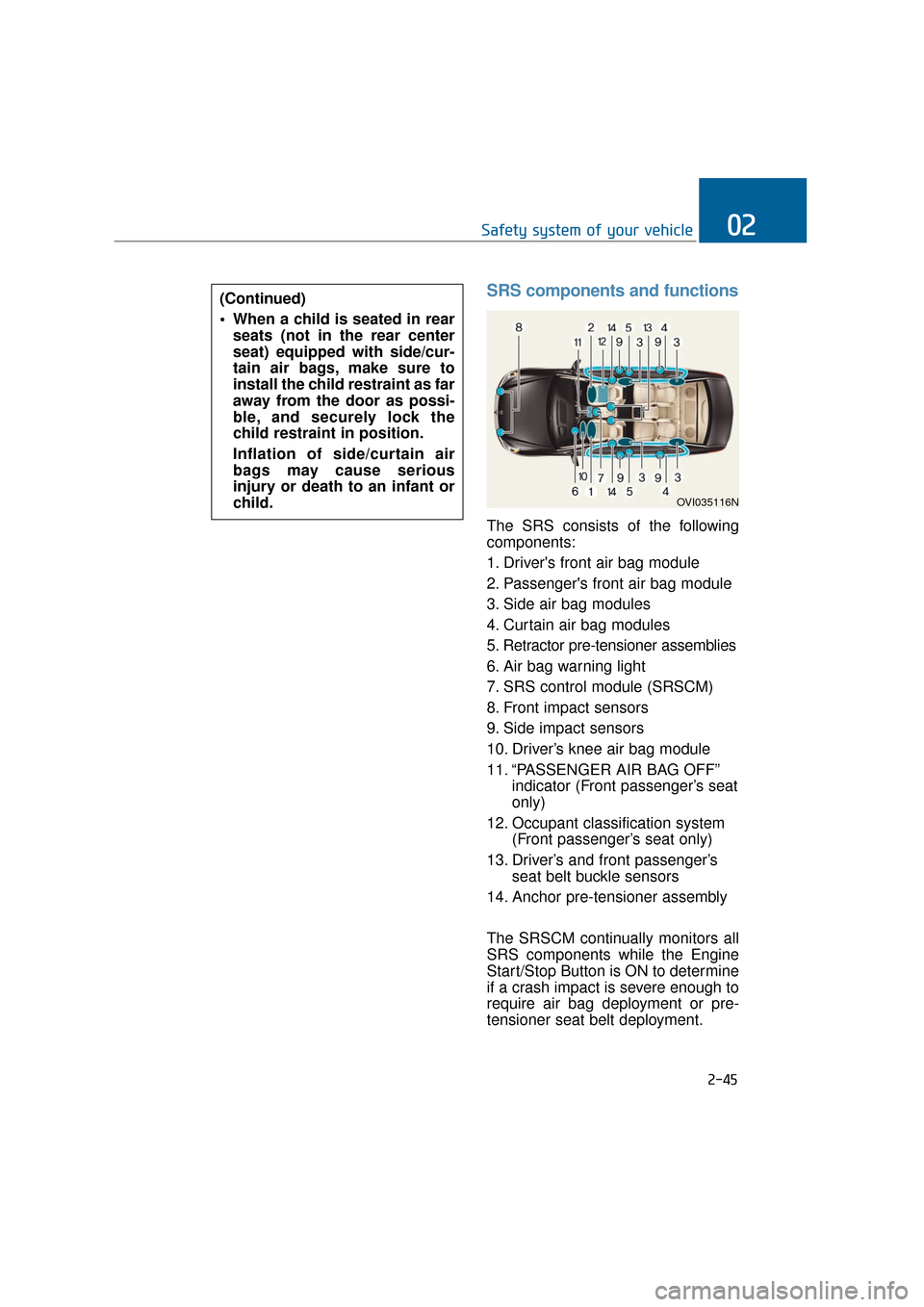
SRS components and functions
The SRS consists of the following
components:
1. Driver's front air bag module
2. Passenger's front air bag module
3. Side air bag modules
4. Curtain air bag modules
5. Retractor pre-tensioner assemblies
6. Air bag warning light
7. SRS control module (SRSCM)
8. Front impact sensors
9. Side impact sensors
10. Driver’s knee air bag module
11. “PASSENGER AIR BAG OFF”indicator (Front passenger’s seat
only)
12. Occupant classification system (Front passenger’s seat only)
13. Driver’s and front passenger’s seat belt buckle sensors
14. Anchor pre-tensioner assembly
The SRSCM continually monitors all
SRS components while the Engine
Start/Stop Button is ON to determine
if a crash impact is severe enough to
require air bag deployment or pre-
tensioner seat belt deployment.
2-45
Safety system of your vehicle02
(Continued)
When a child is seated in rear seats (not in the rear center
seat) equipped with side/cur-
tain air bags, make sure to
install the child restraint as far
away from the door as possi-
ble, and securely lock the
child restraint in position.
Inflation of side/curtain air
bags may cause serious
injury or death to an infant or
child.
OVI035116N
Page 74 of 477
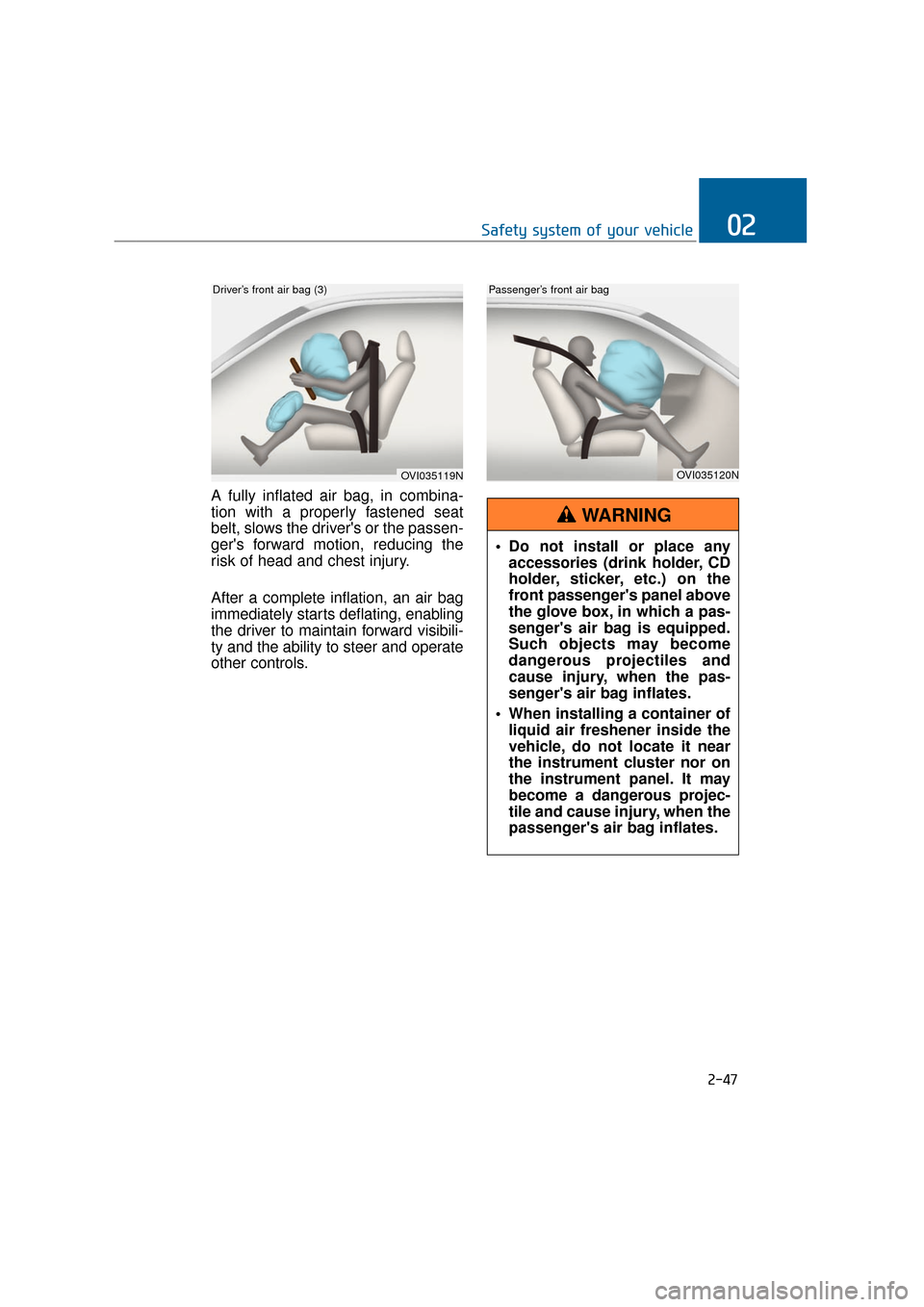
A fully inflated air bag, in combina-
tion with a properly fastened seat
belt, slows the driver's or the passen-
ger's forward motion, reducing the
risk of head and chest injury.
After a complete inflation, an air bag
immediately starts deflating, enabling
the driver to maintain forward visibili-
ty and the ability to steer and operate
other controls.
2-47
Safety system of your vehicle02
OVI035119N
Driver’s front air bag (3)
OVI035120N
Passenger’s front air bag
Do not install or place anyaccessories (drink holder, CD
holder, sticker, etc.) on the
front passenger's panel above
the glove box, in which a pas-
senger's air bag is equipped.
Such objects may become
dangerous projectiles and
cause injury, when the pas-
senger's air bag inflates.
When installing a container of liquid air freshener inside the
vehicle, do not locate it near
the instrument cluster nor on
the instrument panel. It may
become a dangerous projec-
tile and cause injury, when the
passenger's air bag inflates.
WARNING