change time Hyundai Equus 2016 Owner's Guide
[x] Cancel search | Manufacturer: HYUNDAI, Model Year: 2016, Model line: Equus, Model: Hyundai Equus 2016Pages: 477, PDF Size: 16.25 MB
Page 294 of 477
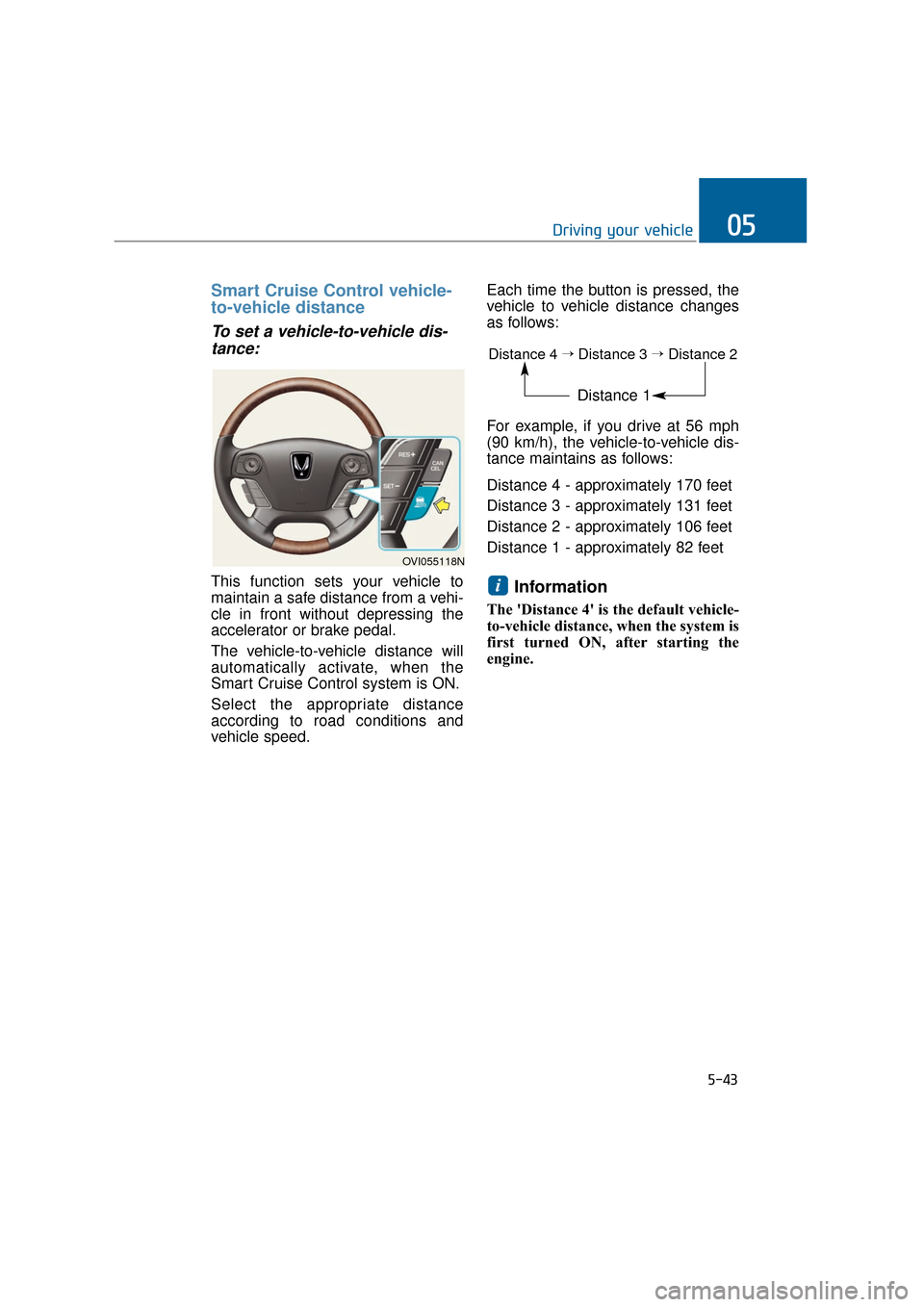
Smart Cruise Control vehicle-
to-vehicle distance
To set a vehicle-to-vehicle dis-tance:
This function sets your vehicle to
maintain a safe distance from a vehi-
cle in front without depressing the
accelerator or brake pedal.
The vehicle-to-vehicle distance will
automatically activate, when the
Smart Cruise Control system is ON.
Select the appropriate distance
according to road conditions and
vehicle speed. Each time the button is pressed, the
vehicle to vehicle distance changes
as follows:
For example, if you drive at 56 mph
(90 km/h), the vehicle-to-vehicle dis-
tance maintains as follows:
Distance 4 - approximately 170 feet
Distance 3 - approximately 131 feet
Distance 2 - approximately 106 feet
Distance 1 - approximately 82 feetInformation
The 'Distance 4' is the default vehicle-
to-vehicle distance, when the system is
first turned ON, after starting the
engine.
i
5-43
Driving your vehicle05
OVI055118N
Distance 4→Distance 3→Distance 2
Distance 1
Page 301 of 477
The Smart Cruise Control system
may be temporarily inoperable
due to any strong electromagnetic
waves.
NOTICE
5-50
Driving your vehicle The vehicle cannot be stopped by using the Smart Cruise
Control system.
If necessary, you must
depress the brake.
Maintain a safe distance from a vehicle in front depending
on the road conditions and the
vehicle speed. When the vehi-
cle-to-vehicle distance is too
close while driving at a high
speed, it may cause a serious
collision.
The Smart Cruise Control sys- tem cannot recognize stopped
vehicles, pedestrians or
oncoming vehicles.
Always cautiously look
around the front to prevent
unexpected and sudden situa-
tions from occurring.
When a vehicle in front fre- quently change lanes, it may
delay the system reaction
time or may react to recognize
a vehicle in the next lane.
Always cautiously look
around the front to prevent
unexpected and sudden situa-
tions from occurring.
The Smart Cruise Control sys- tem is not a substitute for
your safe driving practices
but only a system for your
convenience. It is the driver's
responsibility to always check
the speed and the vehicle-to-
vehicle distance.
Always be aware of the set speed and vehicle-to-vehicle
distance.
(Continued)
(Continued)
Always maintain a sufficientbraking distance. If neces-
sary, decelerate your vehicle
by depressing the brake.
Always pay close attention to the driving conditions and the
vehicle speed, since the
Smart Cruise Control system
may not recognize complex
driving situations.
For your safe operation, care- fully read the manual in
advance and follow the
instructions.WARNING
Page 305 of 477
DRIVER'S ATTENTION
The driver must be cautious in the
below situations, because the sys-
tem may not assist the driver nor
work properly.
The lane is not visible due tosnow, rain, stain, puddles or oth-
ers.
The exterior brightness sudden- ly changes, such as driving
through a tunnel.
The headlamp is turned OFF or weak in the night time or in a
tunnel.
It is difficult to distinguish the lane mark colors from the road.
The vehicle drives on a steep slope or a curve.
Lights, such as sunlight, street- light or lights from other vehi-
cles, reflect from the water on
the road.
The lens or windshield is stained with foreign substances.
The sensor cannot detect the lane lines because of fog, heavy
rain or heavy snow.
The surrounding temperature of the inside rear view mirror is
extremely high due to direct
sunlight.
The lane is very wide or narrow.
The lane mark is damaged or indistinct.
The shadow of median strips cast on the lane marks.
There are similar marks to lane marks.
There is a boundary structure.
The distance from a vehicle in front is very short. So, its driving
hides the lane marks in front.
(Continued)(Continued)
The vehicle is violently shaken.
The number of lane marks
increases or decreases, or the
lane marks cross each other in a
complicated manner.
Something is placed on the dashboard.
The vehicle drives against sun- light.
The vehicle drives in a construc- tion area.
There are more than two lane marks.
The lane marks are hard to be distinguished due to dust or
grease in a tunnel.
The lane marks are hard to be distinguished after raining at
night.
The lane marks are hard to be distinguished due to dust.
5-54
Driving your vehicle
Page 316 of 477
5-65
Driving your vehicle05
Your vehicle's fuel economy depends
mainly on your driving style such as
where you drive and when you drive.
Each of these factors affects your
fuel economy (how many miles/kilo-
meters you can drive with a
gallon/liter of fuel). To drive your vehi-
cle as economically as possible, fol-
low the below driving suggestions.
These will help you save in both the
fuel and repair expenses:
Drive smoothly. Accelerate at amoderate rate. Do not make
"jackrabbit" starts or full-throttle
shifts. Maintain a steady cruising
speed. Do not race between stop-
lights. Try to adjust your speed in
accordance with other traffic to
avoid unnecessary speed
changes. Avoid heavy traffic when-
ever possible. Always maintain a
safe distance from a vehicle in
front to avoid unnecessary braking.
This also reduces brake wear-out.
Drive at a moderate speed. The faster you drive, the more fuel your
vehicle uses. Driving at a moderate
speed, in the highest gear appro-
priate for the driving conditions
especially on the highway, is one of
the most effective ways to reduce
fuel consumption.
Do not "ride" the brake pedal. This can increase fuel consumption and
also wear out the brake compo-
nents. In addition, resting your foot
on the brake pedal, while driving,
may overheat the brake, reducing
breaking effects and possibly lead-
ing a serious consequence.
Check your tire conditions. Keep them inflated to the recommended
pressure level. Under or over infla-
tion will unnecessarily tire wear-
out. Check the tire pressures at
least once a month. Make sure that the wheels are cor-
rectly aligned. Hitting a curb or
driving too fast on uneven surfaces
may distort the wheel alignment.
Poor alignment causes faster tire
wear-out and may also result in
other problems as well as greater
fuel consumption.
Keep your vehicle in good condi- tion. For the better fuel economy
and the cheaper maintenance
expenses, maintain your vehicle in
accordance with the maintenance
schedule in the chapter 7. When
you drive your vehicle in harsh con-
ditions, more frequent mainte-
nance is required (refer to the
chapter 7 for further information).
Keep your vehicle clean. Your vehi- cle should be kept clean and away
from any corrosive substances. It is
especially important that mud, dirt,
ice and others are not daubed
under the vehicle. This extra weight
may increase the fuel consumption
and also cause corrosion.
Avoid a heavy loading. Do not carry unnecessary weight in your
vehicle. It will improve your fuel
economy.
Do not let the engine idle longer than necessary. When you wait
(not in traffic), turn OFF the engine.
Then restart the engine, when you
are ready to go.
Remember that your vehicle does not require the engine warm-up for
a long time. After turning On the
engine, run the engine for 10 to 20
seconds, before shifting the gear.
In cold weather, however, your
engine needs a slightly longer
warm-up period.
E EC
CO
O N
NO
O M
M I
IC
C A
A L
L
O
O P
PE
ER
R A
A T
TI
IO
O N
N
Page 383 of 477
7-26
Maintenance
Changing the engine oil and
filter
Have engine oil and filter changed by
an authorized EQUUS dealer in
accordance with the Maintenance
Schedule, as specified in the begin-
ning of this chapter.
Engine oil contains chemicals
known to the State of California
to cause cancer, birth defects
and reproductive harm. Used
engine oil may cause irritation
or cancer of the skin if left in
contact with the skin for pro-
longed periods of time. Always
protect your skin by washing
your hands thoroughly with
soap and warm water as soon
as possible after handling used
oil.
CALIFORNIA PROPOSI-TION 65 WARNING
OVI075161N
Page 468 of 477
 .....................................")
Lighting ........................................................................\
.....................................3-109AFLS (Adaptive Front Lighting System) ..................................................3-114
Auto light/AFLS position ........................................................................\
...3-110
Battery saver function ........................................................................\
........3-109
Daytime running light ........................................................................\
........3-113
Front fog light........................................................................\
.....................3-113
Headlamp position ........................................................................\
..............3-111
Headlight (Headlamp) escort function .......................................................3-109
Headlight leveling device ........................................................................\
...3-113
High beam operation ........................................................................\
..........3-111
Parking light position ........................................................................\
.........3-111
Turn signals and lane change signals .........................................................3-112
Lower anchor system ........................................................................\
..................2-40
Lubricants and capacities ........................................................................\
..............8-4
Luggage net (holder) ........................................................................\
.................3-151
Maintenance Explanation of scheduled maintenance items ..............................................7-23
Maintenance services ........................................................................\
.............7-5
Owner's maintenance........................................................................\
..............7-7
Scheduled maintenance service......................................................................7-\
8
Tire maintenance ........................................................................\
..................7-48
Maintenance services ........................................................................\
....................7-5
Map lamp (front) ........................................................................\
.......................3-118
Map lamp (rear)........................................................................\
.........................3-119
Mirrors........................................................................\
.........................................3-44 Electric chromic mirror (ECM) with HomeLink
®system and
compass........................................................................\
....................3-44, 3-51
Interior rearview mirror........................................................................\
........3-44
Outside rearview mirror ........................................................................\
.......3-58
Reverse parking aid function ......................................................................3-\
61
Moonroof, see sunroof ........................................................................\
................3-37
Multimedia system ........................................................................\
........................4-2 Antenna ........................................................................\
..................................4-2
Multi-view camera system ........................................................................\
........3-108
I-10
Index
M