ignition Hyundai Equus 2016 Owner's Guide
[x] Cancel search | Manufacturer: HYUNDAI, Model Year: 2016, Model line: Equus, Model: Hyundai Equus 2016Pages: 477, PDF Size: 16.25 MB
Page 254 of 477
Winter driving .......................................................5-72
Snowy or icy conditions ................................................5-72
Use high quality ethylene glycol coolant .................5-74
Check battery and cables .............................................5-74
Change to "winter weight" oil if necessary .............5-74
Check spark plugs and ignition system .....................5-74
To prevent the locks from frozen ..............................5-75
Use authorized window washer anti-freezer
solution in system ...........................................................5-75
Do not let your parking brake freeze .......................5-75
Do not let ice and snow accumulate underneath...5-75
Carry emergency equipment ........................................5-75
Do not place objects or materials in the engine
compartment ....................................................................5-75\
Vehicle load limit ..................................................5-76
Tire and loading information label .............................5-76
Certification label ............................................................5-80
Vehicle weight ......................................................5-82
Base curb weight ...........................................................5-82
Vehicle curb weight ........................................................5-82
Load weight ......................................................................5-\
82
GAW (Gross axle weight) ..............................................5-82
GAWR (Gross axle weight rating) ...............................5-82
GVW (Gross vehicle weight) .........................................5-82
GVWR (Gross vehicle weight rating) ..........................5-82
Trailer towing .......................................................5-82
Page 278 of 477
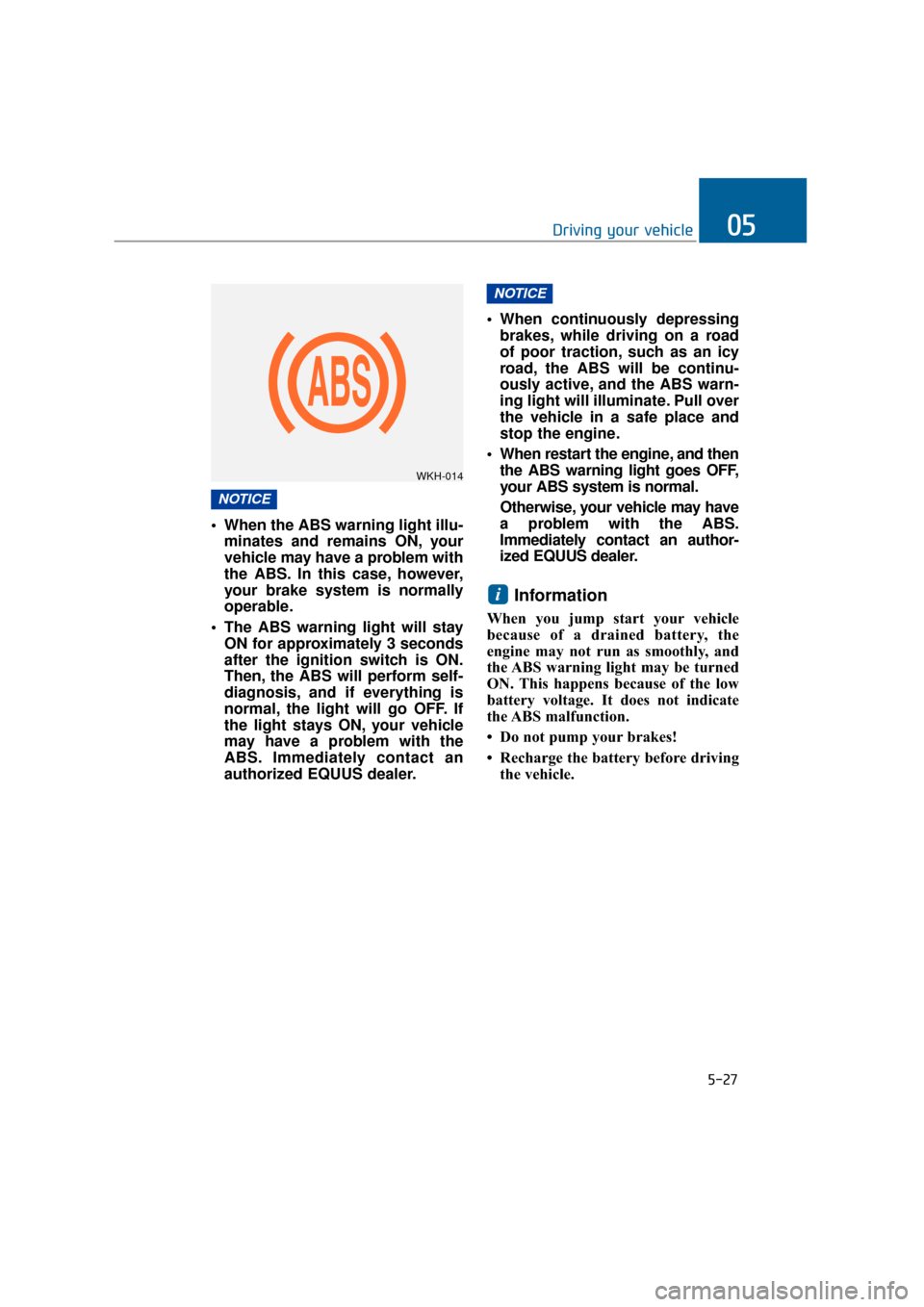
When the ABS warning light illu-minates and remains ON, your
vehicle may have a problem with
the ABS. In this case, however,
your brake system is normally
operable.
The ABS warning light will stay ON for approximately 3 seconds
after the ignition switch is ON.
Then, the ABS will perform self-
diagnosis, and if everything is
normal, the light will go OFF. If
the light stays ON, your vehicle
may have a problem with the
ABS. Immediately contact an
authorized EQUUS dealer. When continuously depressing
brakes, while driving on a road
of poor traction, such as an icy
road, the ABS will be continu-
ously active, and the ABS warn-
ing light will illuminate. Pull over
the vehicle in a safe place and
stop the engine.
When restart the engine, and then the ABS warning light goes OFF,
your ABS system is normal.
Otherwise, your vehicle may have
a problem with the ABS.
Immediately contact an author-
ized EQUUS dealer.
Information
When you jump start your vehicle
because of a drained battery, the
engine may not run as smoothly, and
the ABS warning light may be turned
ON. This happens because of the low
battery voltage. It does not indicate
the ABS malfunction.
• Do not pump your brakes!
• Recharge the battery before drivingthe vehicle.
i
NOTICE
NOTICE
5-27
Driving your vehicle05
WKH-014
Page 279 of 477
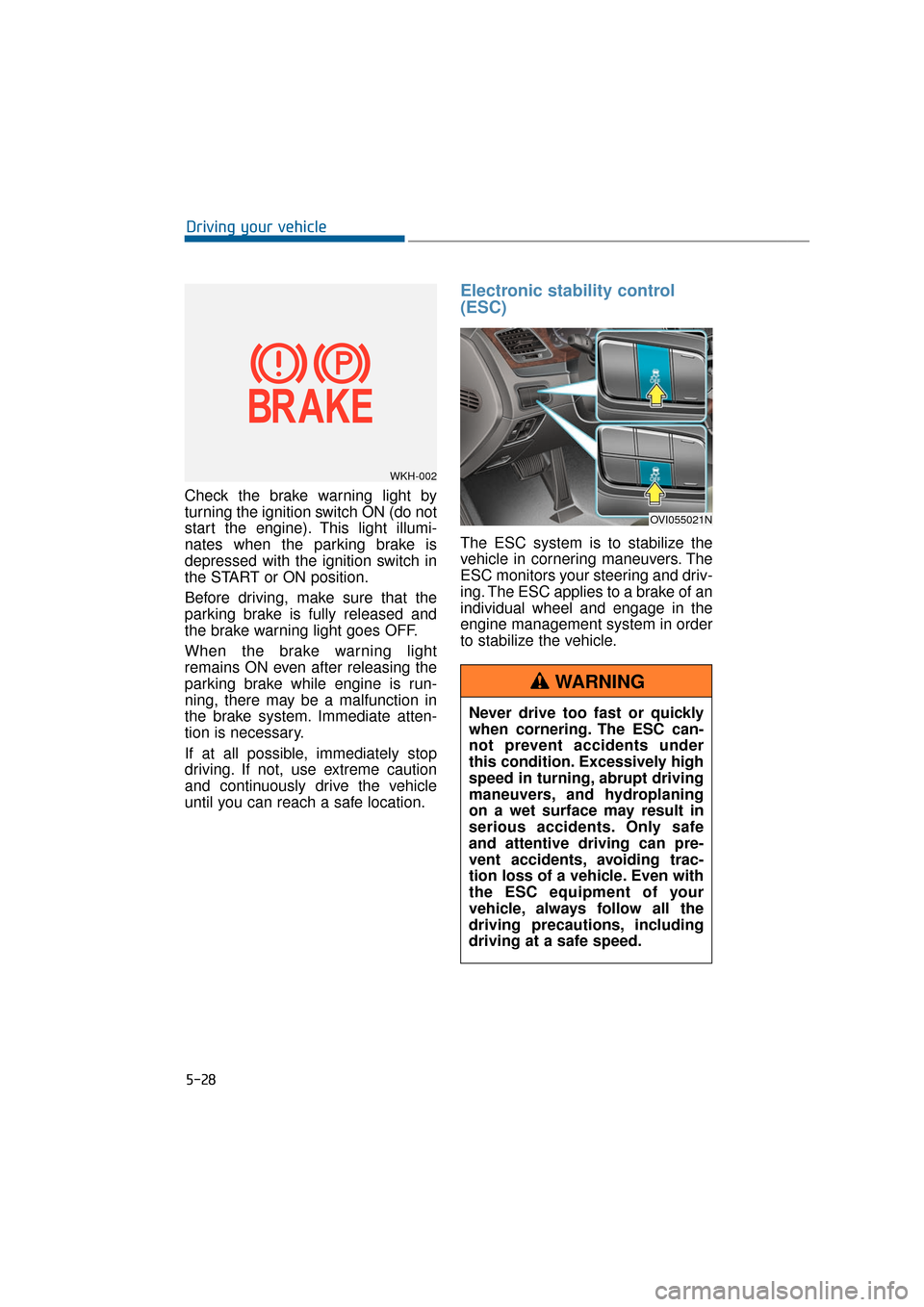
Check the brake warning light by
turning the ignition switch ON (do not
start the engine). This light illumi-
nates when the parking brake is
depressed with the ignition switch in
the START or ON position.
Before driving, make sure that the
parking brake is fully released and
the brake warning light goes OFF.
When the brake warning light
remains ON even after releasing the
parking brake while engine is run-
ning, there may be a malfunction in
the brake system. Immediate atten-
tion is necessary.
If at all possible, immediately stop
driving. If not, use extreme caution
and continuously drive the vehicle
until you can reach a safe location.
Electronic stability control
(ESC)
The ESC system is to stabilize the
vehicle in cornering maneuvers. The
ESC monitors your steering and driv-
ing. The ESC applies to a brake of an
individual wheel and engage in the
engine management system in order
to stabilize the vehicle.
5-28
Driving your vehicle
OVI055021N
Never drive too fast or quickly
when cornering. The ESC can-
not prevent accidents under
this condition. Excessively high
speed in turning, abrupt driving
maneuvers, and hydroplaning
on a wet surface may result in
serious accidents. Only safe
and attentive driving can pre-
vent accidents, avoiding trac-
tion loss of a vehicle. Even with
the ESC equipment of your
vehicle, always follow all the
driving precautions, including
driving at a safe speed.
WARNING
WKH-002
Page 310 of 477
Operating conditions
The BSD indicator will illuminate
when the BSD system switch is
pressed ON after turning the Engine
Start/Stop button ON.
When the vehicle speed exceeds 9.3
mph (15 km/h), the system will acti-
vate.
When you press the BSD switch
again, the indicator and the BSD sys-
tem will be turned OFF.
When the ignition switch is pressed
ON after engine turn-OFF, the BSD
system returns to the previous state.
When the BSD system is not used,
turn the BSD system OFF by press-
ing the switch.
When the BSD system is turned ON,
the warning light will illuminate for 3
seconds on the outside rearview mir-
ror.
Warning types
The system will activate as below.
1.The system is ON.
2.The vehicle speed is above 9.3mph (15 km/h).
3.Other vehicles are detected behind your vehicle.
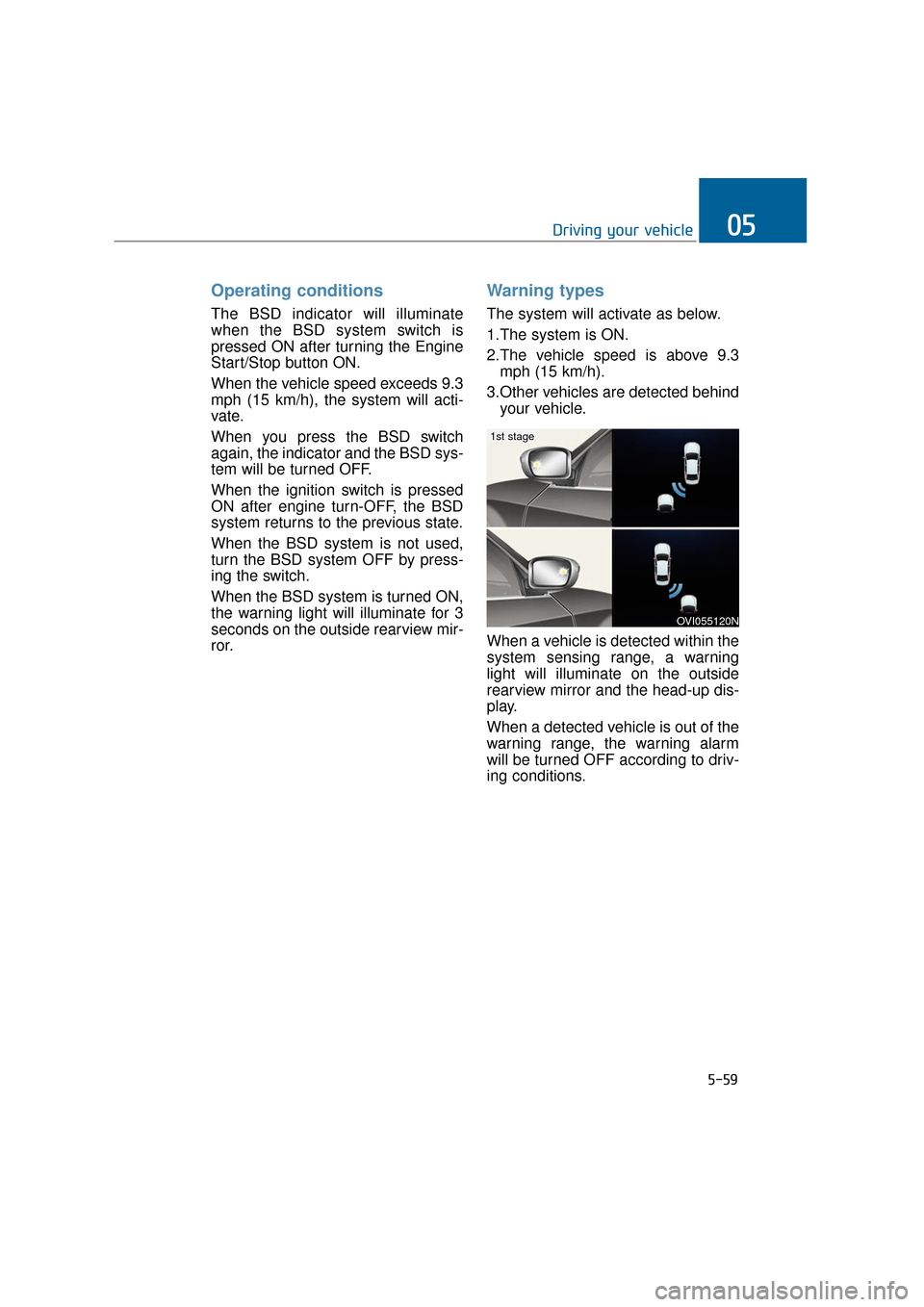
When a vehicle is detected within the
system sensing range, a warning
light will illuminate on the outside
rearview mirror and the head-up dis-
play.
When a detected vehicle is out of the
warning range, the warning alarm
will be turned OFF according to driv-
ing conditions.
5-59
Driving your vehicle05
OVI055120N
1st stage
Page 313 of 477
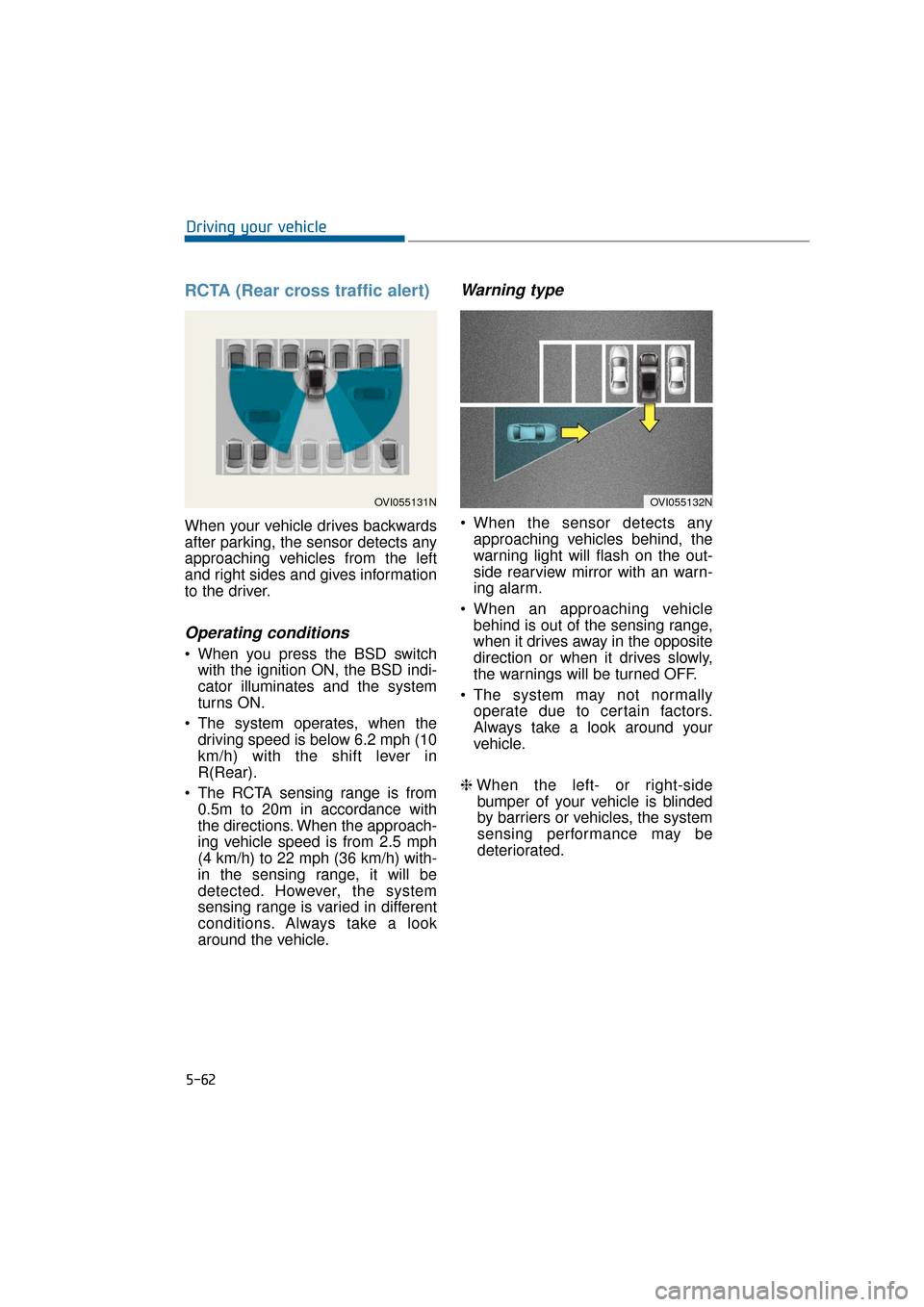
RCTA (Rear cross traffic alert)
When your vehicle drives backwards
after parking, the sensor detects any
approaching vehicles from the left
and right sides and gives information
to the driver.
Operating conditions
When you press the BSD switchwith the ignition ON, the BSD indi-
cator illuminates and the system
turns ON.
The system operates, when the driving speed is below 6.2 mph (10
km/h) with the shift lever in
R(Rear).
The RCTA sensing range is from 0.5m to 20m in accordance with
the directions. When the approach-
ing vehicle speed is from 2.5 mph
(4 km/h) to 22 mph (36 km/h) with-
in the sensing range, it will be
detected. However, the system
sensing range is varied in different
conditions. Always take a look
around the vehicle.
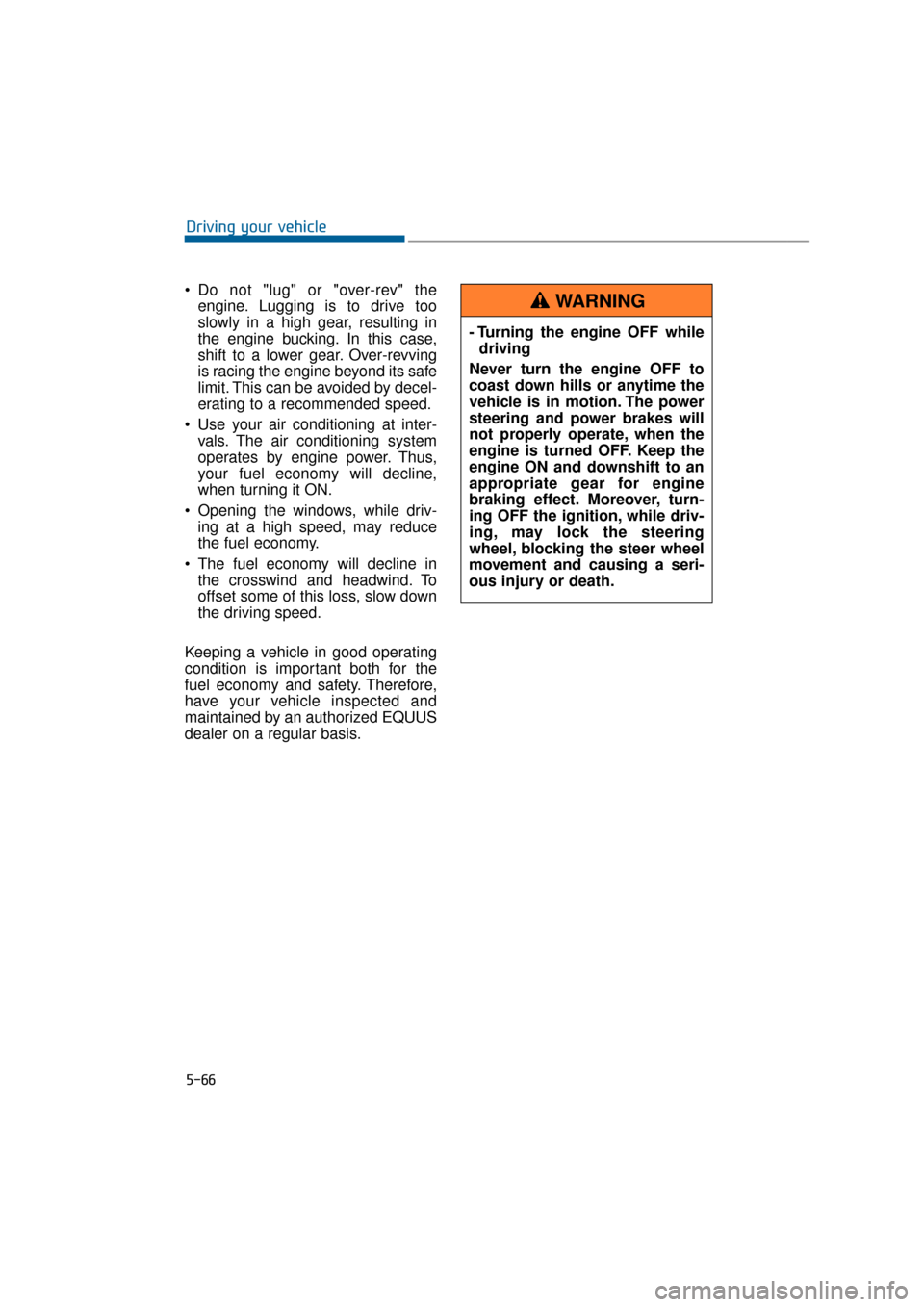
Warning type
When the sensor detects anyapproaching vehicles behind, the
warning light will flash on the out-
side rearview mirror with an warn-
ing alarm.
When an approaching vehicle behind is out of the sensing range,
when it drives away in the opposite
direction or when it drives slowly,
the warnings will be turned OFF.
The system may not normally operate due to certain factors.
Always take a look around your
vehicle.
❈ When the left- or right-side
bumper of your vehicle is blinded
by barriers or vehicles, the system
sensing performance may be
deteriorated.
5-62
Driving your vehicle
OVI055132NOVI055131N
Page 317 of 477
5-66
Driving your vehicle
Do not "lug" or "over-rev" the engine. Lugging is to drive too
slowly in a high gear, resulting in
the engine bucking. In this case,
shift to a lower gear. Over-revving
is racing the engine beyond its safe
limit. This can be avoided by decel-
erating to a recommended speed.
Use your air conditioning at inter- vals. The air conditioning system
operates by engine power. Thus,
your fuel economy will decline,
when turning it ON.
Opening the windows, while driv- ing at a high speed, may reduce
the fuel economy.
The fuel economy will decline in the crosswind and headwind. To
offset some of this loss, slow down
the driving speed.
Keeping a vehicle in good operating
condition is important both for the
fuel economy and safety. Therefore,
have your vehicle inspected and
maintained by an authorized EQUUS
dealer on a regular basis. - Turning the engine OFF while
driving
Never turn the engine OFF to
coast down hills or anytime the
vehicle is in motion. The power
steering and power brakes will
not properly operate, when the
engine is turned OFF. Keep the
engine ON and downshift to an
appropriate gear for engine
braking effect. Moreover, turn-
ing OFF the ignition, while driv-
ing, may lock the steering
wheel, blocking the steer wheel
movement and causing a seri-
ous injury or death.
WARNING
Page 325 of 477
5-74
Driving your vehicle
An AutoSock, which is in the wrong size or is improperly
installed, may damage brake
lines, suspension, body and
wheels of your vehicle.
Stop driving and retighten the AutoSock, whenever there are
snapping sounds between the
vehicle and the AutoSock.
Use high quality ethylene gly-
col coolant
The cooling system of your vehicle is
filled with the high-quality ethylene
glycol coolant when being delivered.
It is the only type of coolant that your
vehicle is filled with, because it pre-
vents corrosion of the cooling sys-
tem, lubricates the water pump and
prevents freezing. Refill the cooling
system in accordance with your
maintenance schedule in the chapter
7. Before winter, check your coolant
to assure that the freezing point is
sufficiently lower than the expected
winter temperature.
Check battery and cables
The winter temperature increases
the battery consumption. Inspect the
battery and cables, as described in
the chapter 7. The battery charging
level can be checked by an author-
ized EQUUS dealer or in a service
station.
Change to "winter weight" oil,
if necessary
In some regions during the cold win-
ter, it is recommended to use the
"winter weight" oil with lower viscosi-
ty. For further information about this,
refer to the chapter 8. When you can-
not be sure about a type of winter
weight oil, consult an authorized
EQUUS dealer.
Check spark plugs and ignition
system
Inspect your spark plugs and, if nec-
essary, replace them. Also check all
ignition wirings and components for
any cracks, wear-out, and damage.
NOTICE
- Chain installation
When installing the AutoSock,
park the vehicle on level ground
away from other vehicles. Press
ON the Hazard Warning flasher
and place a warning triangle
behind your vehicle, if available.
Place the shift lever in P(Park),
set the parking brake and turn
OFF the engine, before
installing the AutoSock.
WARNING
- Tire chains
The use of the AutoSock may
adversely affect vehicle han-
dling.
Do not drive faster than the lower of the two - 20 mph (30
km/h) and the AutoSock manu-
facturer’s recommended
speed limit.
Drive carefully and avoid bumps, holes, sharp turns, and
other road hazards, which may
bounce the vehicle.
Avoid turning sharply or lock- ing the wheel brake.
WARNING
Page 335 of 477
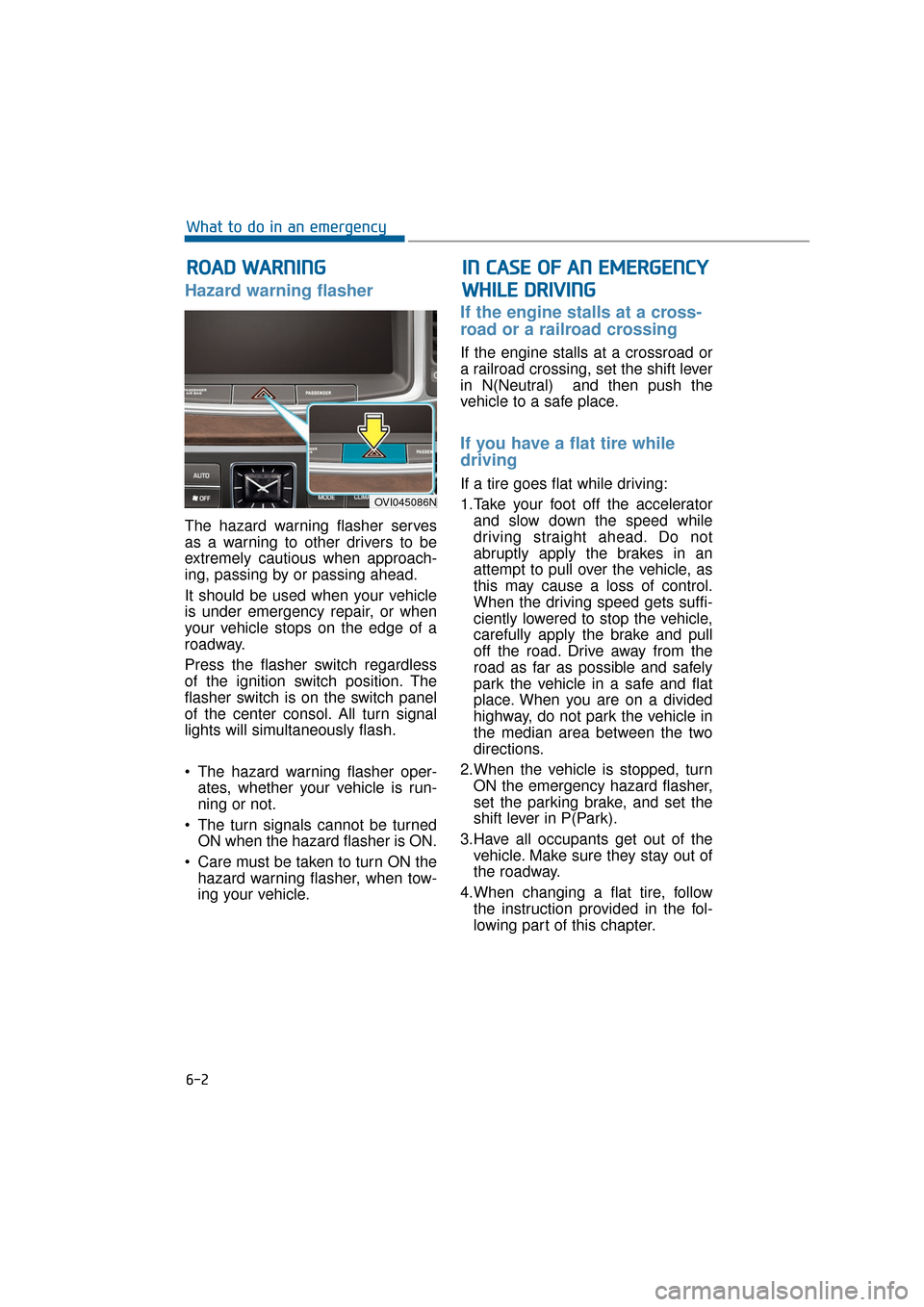
Hazard warning flasher
The hazard warning flasher serves
as a warning to other drivers to be
extremely cautious when approach-
ing, passing by or passing ahead.
It should be used when your vehicle
is under emergency repair, or when
your vehicle stops on the edge of a
roadway.
Press the flasher switch regardless
of the ignition switch position. The
flasher switch is on the switch panel
of the center consol. All turn signal
lights will simultaneously flash.
• The hazard warning flasher oper-ates, whether your vehicle is run-
ning or not.
The turn signals cannot be turned ON when the hazard flasher is ON.
Care must be taken to turn ON the hazard warning flasher, when tow-
ing your vehicle.
If the engine stalls at a cross-
road or a railroad crossing
If the engine stalls at a crossroad or
a railroad crossing, set the shift lever
in N(Neutral) and then push the
vehicle to a safe place.
If you have a flat tire while
driving
If a tire goes flat while driving:
1.Take your foot off the acceleratorand slow down the speed while
driving straight ahead. Do not
abruptly apply the brakes in an
attempt to pull over the vehicle, as
this may cause a loss of control.
When the driving speed gets suffi-
ciently lowered to stop the vehicle,
carefully apply the brake and pull
off the road. Drive away from the
road as far as possible and safely
park the vehicle in a safe and flat
place. When you are on a divided
highway, do not park the vehicle in
the median area between the two
directions.
2.When the vehicle is stopped, turn ON the emergency hazard flasher,
set the parking brake, and set the
shift lever in P(Park).
3.Have all occupants get out of the vehicle. Make sure they stay out of
the roadway.
4.When changing a flat tire, follow the instruction provided in the fol-
lowing part of this chapter.
R RO
O A
AD
D
W
W A
AR
RN
N I
IN
N G
G
6-2
What to do in an emergency
OVI045086N
I
IN
N
C
C A
A S
SE
E
O
O F
F
A
A N
N
E
E M
M E
ER
R G
G E
EN
N C
CY
Y
W
W H
HI
IL
L E
E
D
D R
RI
IV
V I
IN
N G
G
Page 336 of 477
If engine stalls while driving
1.Gradually reduce your drivingspeed while driving straight ahead.
Cautiously drive off the road to a
safe place.
2.Press the emergency hazard flash- er.
3.Try to re-start the engine again. When your vehicle does not re-
start, contact an authorized
EQUUS dealer for the qualified
assistance.When the engine does not
revolve, or slowly revolves
1.Make sure that the shift lever is inN(Neutral) or P (Park), and the
emergency brake is set.
2.Check that the battery connections are clean and tight.
3.Turn ON the interior light. When the light dims or goes out upon operat-
ing the starter, the battery is dis-
charged.
4.Check that the starter connections are securely tightened.
5.Do not push or pull the vehicle to start it. Follow instructions provided
in "Jump starting".
When the engine normally
revolves, but does not start
1.Check the fuel level.
2.With the Engine Start/Stop Buttonin the OFF position, check all con-
nectors of the ignition coils and the
spark plugs. Reconnect any dis-
connected or loose parts.
3.If the engine still does not start, contact an authorized EQUUS
dealer for the qualified assistance
6-3
What to do in an emergency06
I IF
F
T
T H
H E
E
E
E N
N G
GI
IN
N E
E
W
W I
IL
L L
L
N
N O
O T
T
S
S T
T A
A R
RT
T
When the engine does not start,
do not push or pull the car to
start it. This may result in a col-
lision or cause other damage.
CAUTION
Page 337 of 477
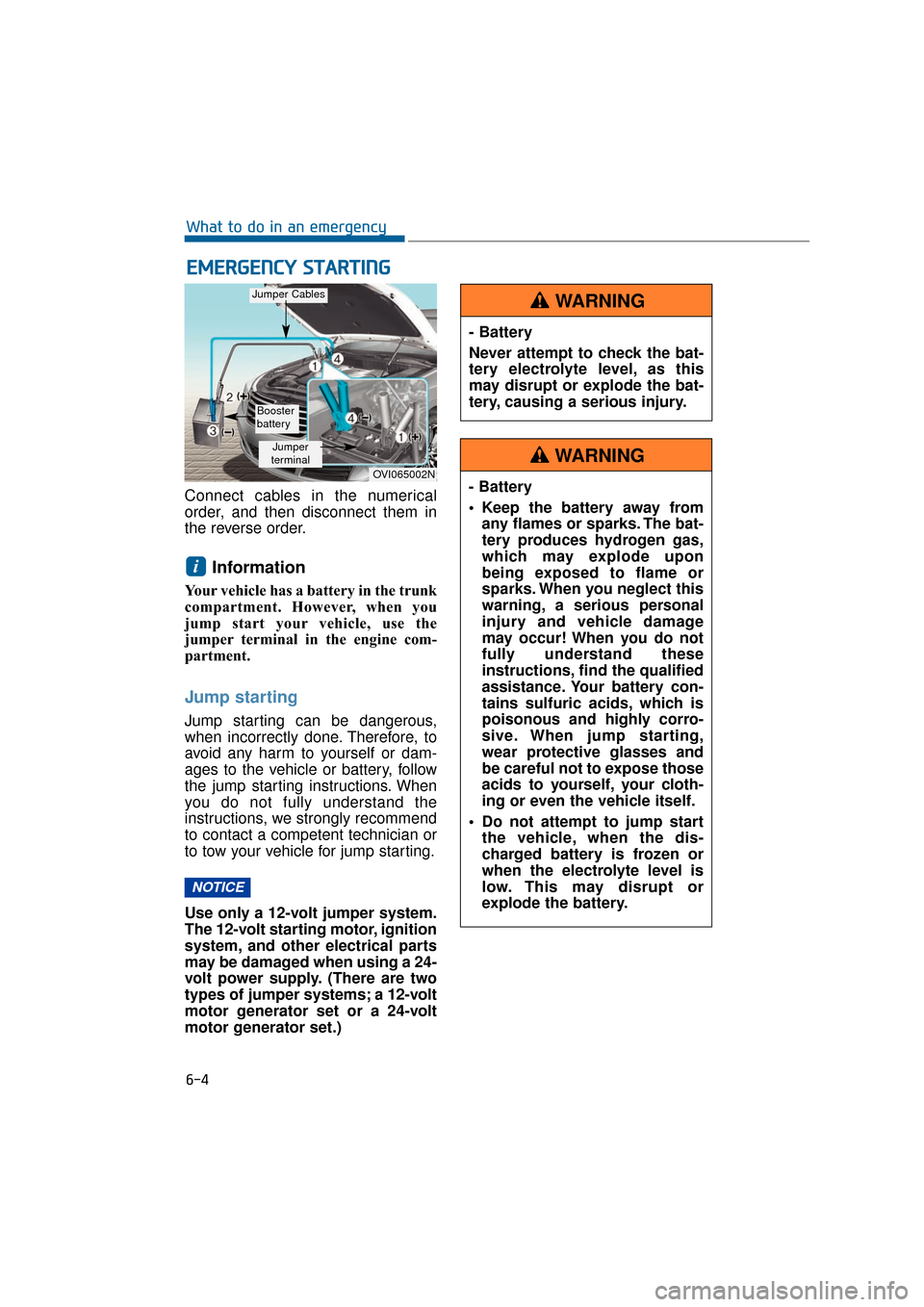
Connect cables in the numerical
order, and then disconnect them in
the reverse order.
Information
Your vehicle has a battery in the trunk
compartment. However, when you
jump start your vehicle, use the
jumper terminal in the engine com-
partment.
Jump starting
Jump starting can be dangerous,
when incorrectly done. Therefore, to
avoid any harm to yourself or dam-
ages to the vehicle or battery, follow
the jump starting instructions. When
you do not fully understand the
instructions, we strongly recommend
to contact a competent technician or
to tow your vehicle for jump starting.
Use only a 12-volt jumper system.
The 12-volt starting motor, ignition
system, and other electrical parts
may be damaged when using a 24-
volt power supply. (There are two
types of jumper systems; a 12-volt
motor generator set or a 24-volt
motor generator set.)
NOTICE
i
E EM
M E
ER
R G
G E
EN
N C
CY
Y
S
S T
T A
A R
RT
TI
IN
N G
G
6-4
What to do in an emergency
OVI065002N
Jumper
terminal
Jumper Cables
Booster
battery
- Battery
Never attempt to check the bat-
tery electrolyte level, as this
may disrupt or explode the bat-
tery, causing a serious injury.
WARNING
- Battery
• Keep the battery away from any flames or sparks. The bat-
tery produces hydrogen gas,
which may explode upon
being exposed to flame or
sparks. When you neglect this
warning, a serious personal
injury and vehicle damage
may occur! When you do not
fully understand these
instructions, find the qualified
assistance. Your battery con-
tains sulfuric acids, which is
poisonous and highly corro-
sive. When jump starting,
wear protective glasses and
be careful not to expose those
acids to yourself, your cloth-
ing or even the vehicle itself.
Do not attempt to jump start the vehicle, when the dis-
charged battery is frozen or
when the electrolyte level is
low. This may disrupt or
explode the battery.
WARNING