oil Hyundai Equus 2016 Service Manual
[x] Cancel search | Manufacturer: HYUNDAI, Model Year: 2016, Model line: Equus, Model: Hyundai Equus 2016Pages: 477, PDF Size: 16.25 MB
Page 413 of 477
7-56
Maintenance
A vehicle’s electrical system is pro-
tected from a possible electrical
overloading damage by fuses.
This vehicle has 4 fuse panels - two
on the driver’s side, another on the
panel bolster of the passenger's
side, and the other in the engine
compartment.
When any of your lights, acces-
sories, or controls does not operate,
check the appropriate circuit fuse.
When a fuse is out, some elements
may melt inside.
When the electrical system does not
operate, check the fuse panel on the
driver's side first.
Before replacing the fuse, disconnect
the negative battery cable. Always
replace it with a fuse of the same rat-
ing. When the newly-replaced fuse
blows, there may be an electrical
problem. Avoid using any pertinent
systems. Immediately consult an
authorized EQUUS dealer.
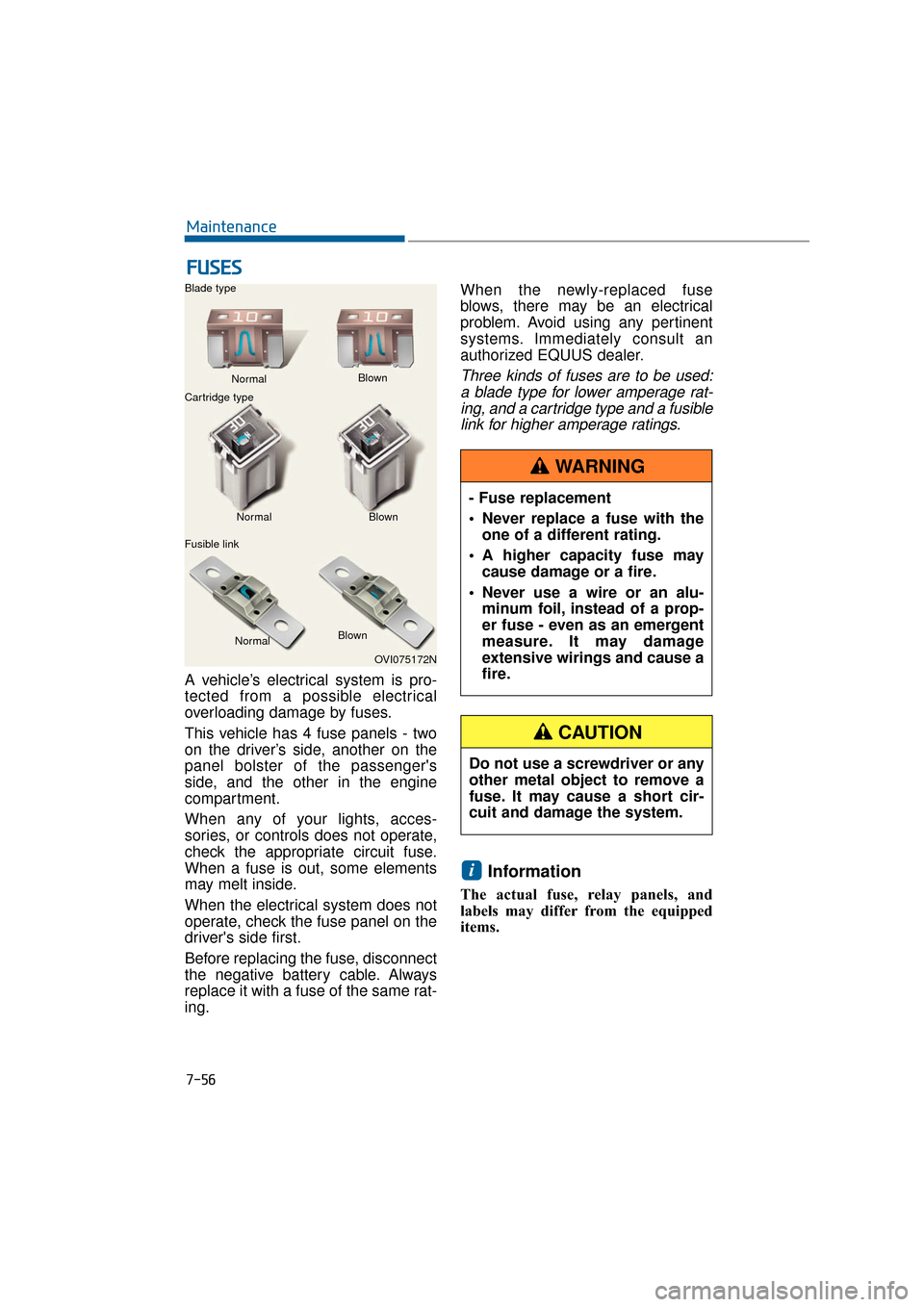
Three kinds of fuses are to be used:
a blade type for lower amperage rat-ing, and a cartridge type and a fusiblelink for higher amperage ratings.
Information
The actual fuse, relay panels, and
labels may differ from the equipped
items.
i
F F U
U S
SE
E S
S
OVI075172N
Normal
Normal
Blade type
Cartridge type
Fusible link Blown
Blown
Normal Blown
- Fuse replacement
Never replace a fuse with the
one of a different rating.
A higher capacity fuse may cause damage or a fire.
Never use a wire or an alu- minum foil, instead of a prop-
er fuse - even as an emergent
measure. It may damage
extensive wirings and cause a
fire.
WARNING
Do not use a screwdriver or any
other metal object to remove a
fuse. It may cause a short cir-
cuit and damage the system.
CAUTION
Page 424 of 477
7-67
Maintenance07
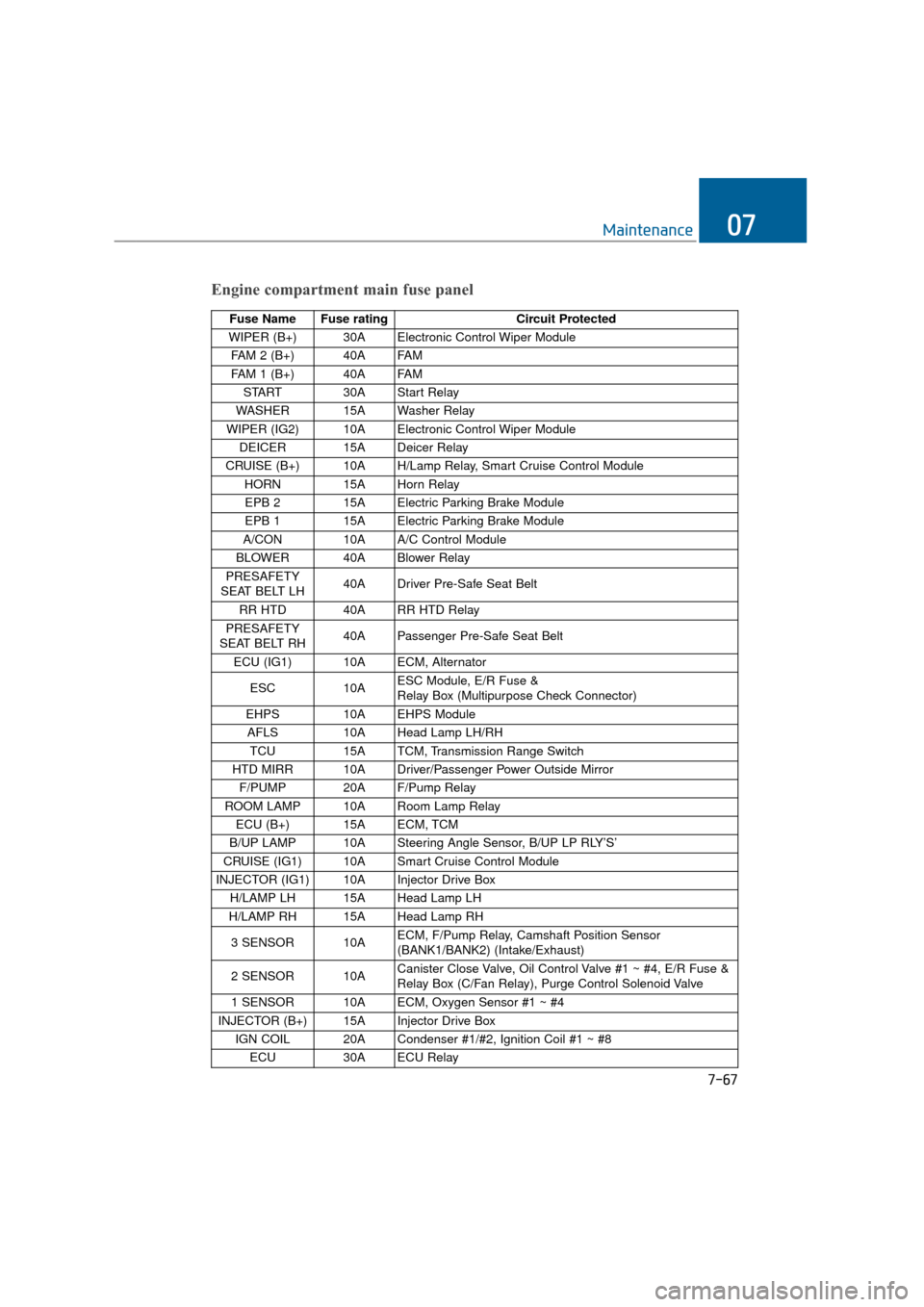
Engine compartment main fuse panel
Fuse Name Fuse ratingCircuit Protected
WIPER (B+) 30A Electronic Control Wiper Module FAM 2 (B+) 40A FAM
FAM 1 (B+) 40A FAM START 30A Start Relay
WASHER 15A Washer Relay
WIPER (IG2) 10A Electronic Control Wiper Module DEICER 15A Deicer Relay
CRUISE (B+) 10A H/Lamp Relay, Smart Cruise Control Module HORN 15A Horn Relay
EPB 2 15A Electric Parking Brake Module
EPB 1 15A Electric Parking Brake Module
A/CON 10A A/C Control Module
BLOWER 40A Blower Relay
PRESAFETY
SEAT BELT LH 40A Driver Pre-Safe Seat Belt
RR HTD 40A RR HTD Relay
PRESAFETY
SEAT BELT RH 40A Passenger Pre-Safe Seat Belt
ECU (IG1) 10A ECM, Alternator ESC 10AESC Module, E/R Fuse &
Relay Box (Multipurpose Check Connector)
EHPS 10A EHPS Module
AFLS 10A Head Lamp LH/RH
TCU 15A TCM, Transmission Range Switch
HTD MIRR 10A Driver/Passenger Power Outside Mirror F/PUMP 20A F/Pump Relay
ROOM LAMP 10A Room Lamp Relay ECU (B+) 15A ECM, TCM
B/UP LAMP 10A Steering Angle Sensor, B/UP LP RLY’S’
CRUISE (IG1) 10A Smart Cruise Control Module
INJECTOR (IG1) 10A Injector Drive Box H/LAMP LH 15A Head Lamp LH
H/LAMP RH 15A Head Lamp RH
3 SENSOR 10A ECM, F/Pump Relay, Camshaft Position Sensor
(BANK1/BANK2) (Intake/Exhaust)
2 SENSOR 10A Canister Close Valve, Oil Control Valve #1 ~ #4, E/R Fuse &
Relay Box (C/Fan Relay), Purge Control Solenoid Valve
1 SENSOR 10A ECM, Oxygen Sensor #1 ~ #4
INJECTOR (B+) 15A Injector Drive Box IGN COIL 20A Condenser #1/#2, Ignition Coil #1 ~ #8ECU 30A ECU Relay
Page 430 of 477
7-73
Maintenance07
Information
HID lamps have superior perform-
ance in comparison to halogen bulbs.
HID lamps are estimated to last twice
as long as halogen bulbs, or longer, by
the manufacturer, depending on the
usage hours. HID lamps needs to be
replaced at some point within the
vehicle life. Frequent turning the
headlamps ON and OFF shortens the
HID lamps life. HID lamps do not
blow out in the same manner as halo-
gen incandescent lamps. When a
headlamp blows out after a period of
operation, the lamp light gradually
fades away after being turned ON.
Even when the lamp is turned ON by
turning ON the switch, it needs to be
replaced. The HID lamp components
are more complex than the ones of
conventional halogen bulbs. Thus, the
repairing costs are more expensive.
Headlight (bulb type), front turnsignal, position, side markerand fog light bulbs
When a bulb is out, have the vehicle
checked by an authorized EQUUS
dealer.
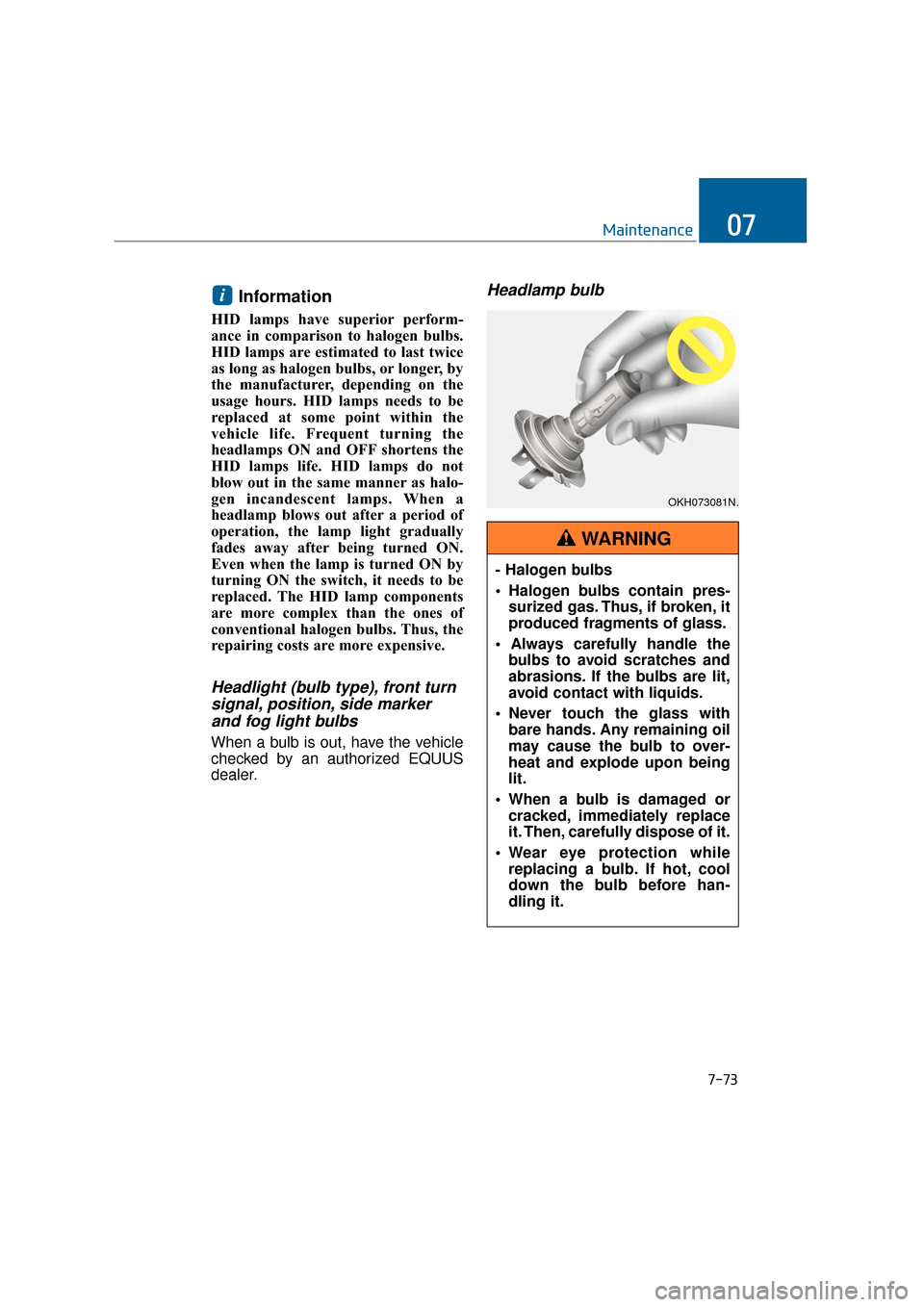
Headlamp bulb i
OKH073081N.
- Halogen bulbs
Halogen bulbs contain pres-
surized gas. Thus, if broken, it
produced fragments of glass.
bulbs to avoid scratches and
abrasions. If the bulbs are lit,
avoid contact with liquids.
Never touch the glass with bare hands. Any remaining oil
may cause the bulb to over-
heat and explode upon being
lit.
When a bulb is damaged or cracked, immediately replace
it. Then, carefully dispose of it.
Wear eye protection while replacing a bulb. If hot, cool
down the bulb before han-
dling it.
WARNING
Page 441 of 477
7-84
Maintenance
Waxing
A good coat of wax bars contamina-
tion from the vehicle paint. Maintain a
good coat of wax on your vehicle to
protect it.
Wax the vehicle when the wax polish
vanishes.
Always wash and dry the vehicle
before waxing. Use a good quality
liquid or paste wax, and follow the
manufacturer’s instructions. Wax all
metal trim to protect it and to main-
tain its luster.A spot remover, which removes oil,
tar, and other similar materials, peels
off the wax coating from the finish.
Make sure to re-wax these areas,
even when the rest of the vehicle
does not need be waxed.
Finish damage repair
Deep scratches or stone chips on the
paint must be repaired in a prompt
manner. Any exposed metal area
quickly gets rusty, and repairing it
may cost a lot.
Information
When your vehicle requires any metal
repair or replacement after damage,
make sure the body shop applies anti-
corrosion materials to the parts to be
repaired or to be replaced.
i
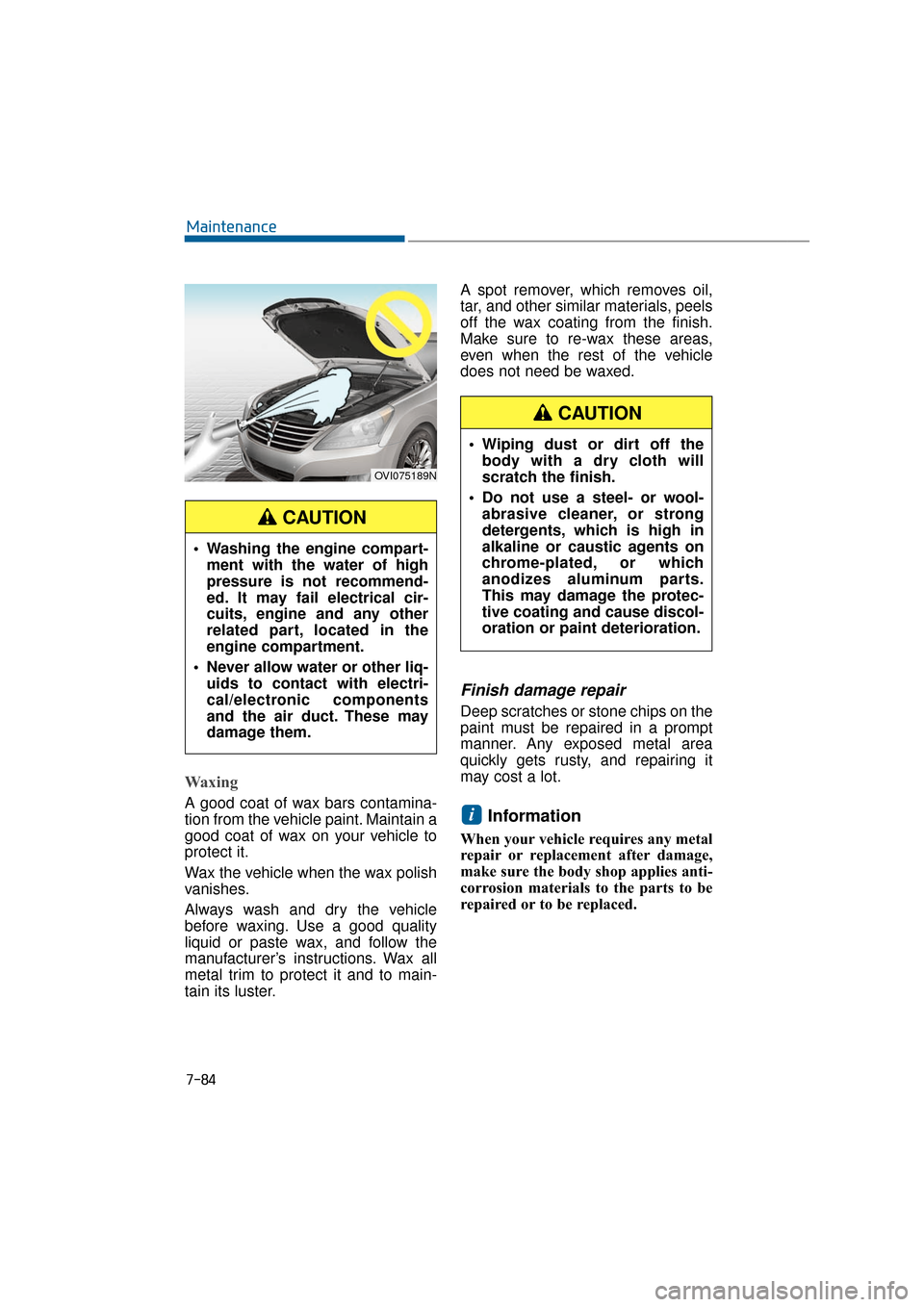
Washing the engine compart-
ment with the water of high
pressure is not recommend-
ed. It may fail electrical cir-
cuits, engine and any other
related part, located in the
engine compartment.
Never allow water or other liq- uids to contact with electri-
cal/electronic components
and the air duct. These may
damage them.
CAUTION
Wiping dust or dirt off thebody with a dry cloth will
scratch the finish.
Do not use a steel- or wool- abrasive cleaner, or strong
detergents, which is high in
alkaline or caustic agents on
chrome-plated, or which
anodizes aluminum parts.
This may damage the protec-
tive coating and cause discol-
oration or paint deterioration.
CAUTION
OVI075189N
Page 445 of 477
7-88
Maintenance
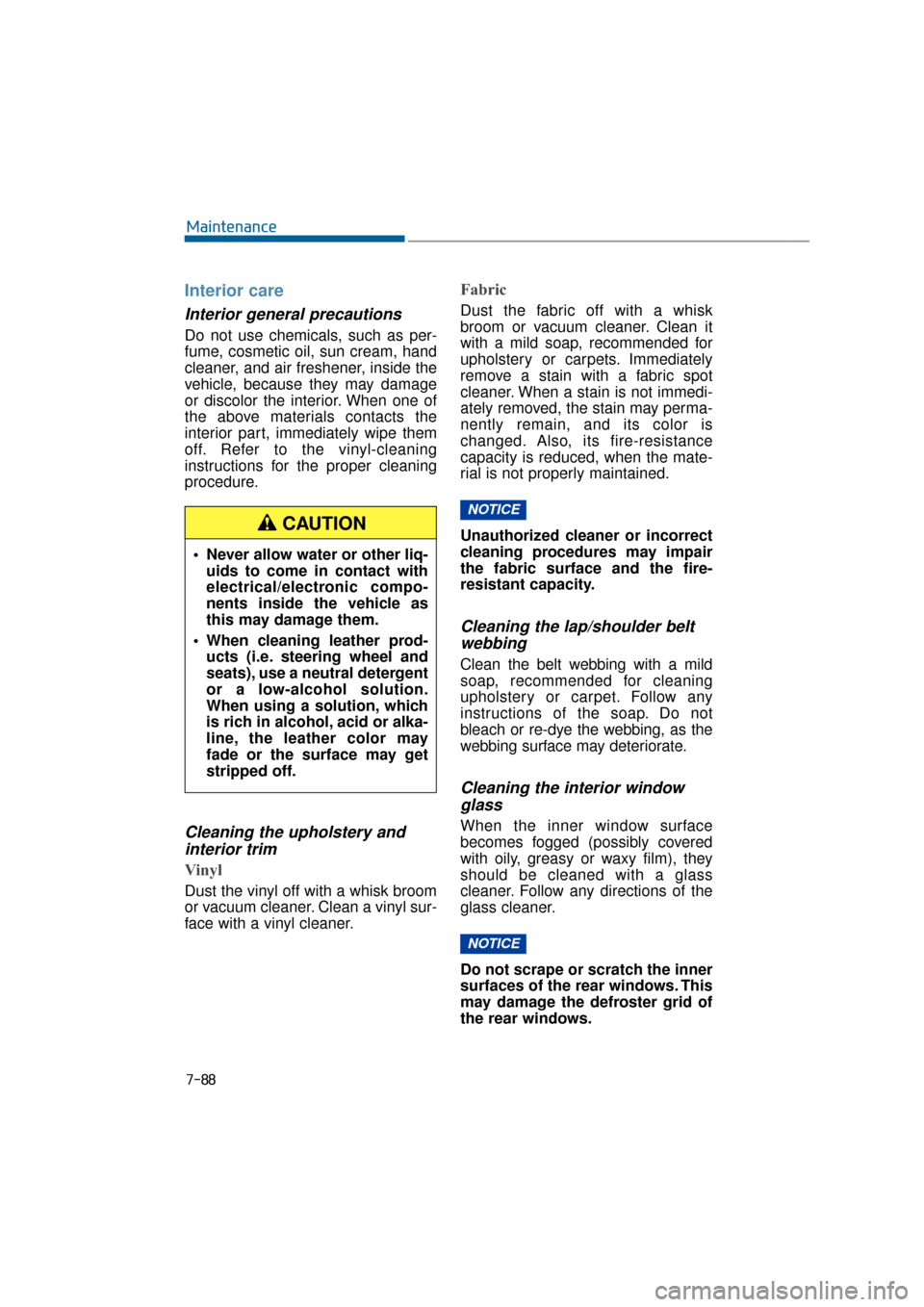
Interior care
Interior general precautions
Do not use chemicals, such as per-
fume, cosmetic oil, sun cream, hand
cleaner, and air freshener, inside the
vehicle, because they may damage
or discolor the interior. When one of
the above materials contacts the
interior part, immediately wipe them
off. Refer to the vinyl-cleaning
instructions for the proper cleaning
procedure.
Cleaning the upholstery andinterior trim
Vinyl
Dust the vinyl off with a whisk broom
or vacuum cleaner. Clean a vinyl sur-
face with a vinyl cleaner.
Fabric
Dust the fabric off with a whisk
broom or vacuum cleaner. Clean it
with a mild soap, recommended for
upholstery or carpets. Immediately
remove a stain with a fabric spot
cleaner. When a stain is not immedi-
ately removed, the stain may perma-
nently remain, and its color is
changed. Also, its fire-resistance
capacity is reduced, when the mate-
rial is not properly maintained.
Unauthorized cleaner or incorrect
cleaning procedures may impair
the fabric surface and the fire-
resistant capacity.
Cleaning the lap/shoulder beltwebbing
Clean the belt webbing with a mild
soap, recommended for cleaning
upholstery or carpet. Follow any
instructions of the soap. Do not
bleach or re-dye the webbing, as the
webbing surface may deteriorate.
Cleaning the interior windowglass
When the inner window surface
becomes fogged (possibly covered
with oily, greasy or waxy film), they
should be cleaned with a glass
cleaner. Follow any directions of the
glass cleaner.
Do not scrape or scratch the inner
surfaces of the rear windows. This
may damage the defroster grid of
the rear windows.
NOTICE
NOTICE
Never allow water or other liq-
uids to come in contact with
electrical/electronic compo-
nents inside the vehicle as
this may damage them.
When cleaning leather prod- ucts (i.e. steering wheel and
seats), use a neutral detergent
or a low-alcohol solution.
When using a solution, which
is rich in alcohol, acid or alka-
line, the leather color may
fade or the surface may get
stripped off.
CAUTION
Page 453 of 477
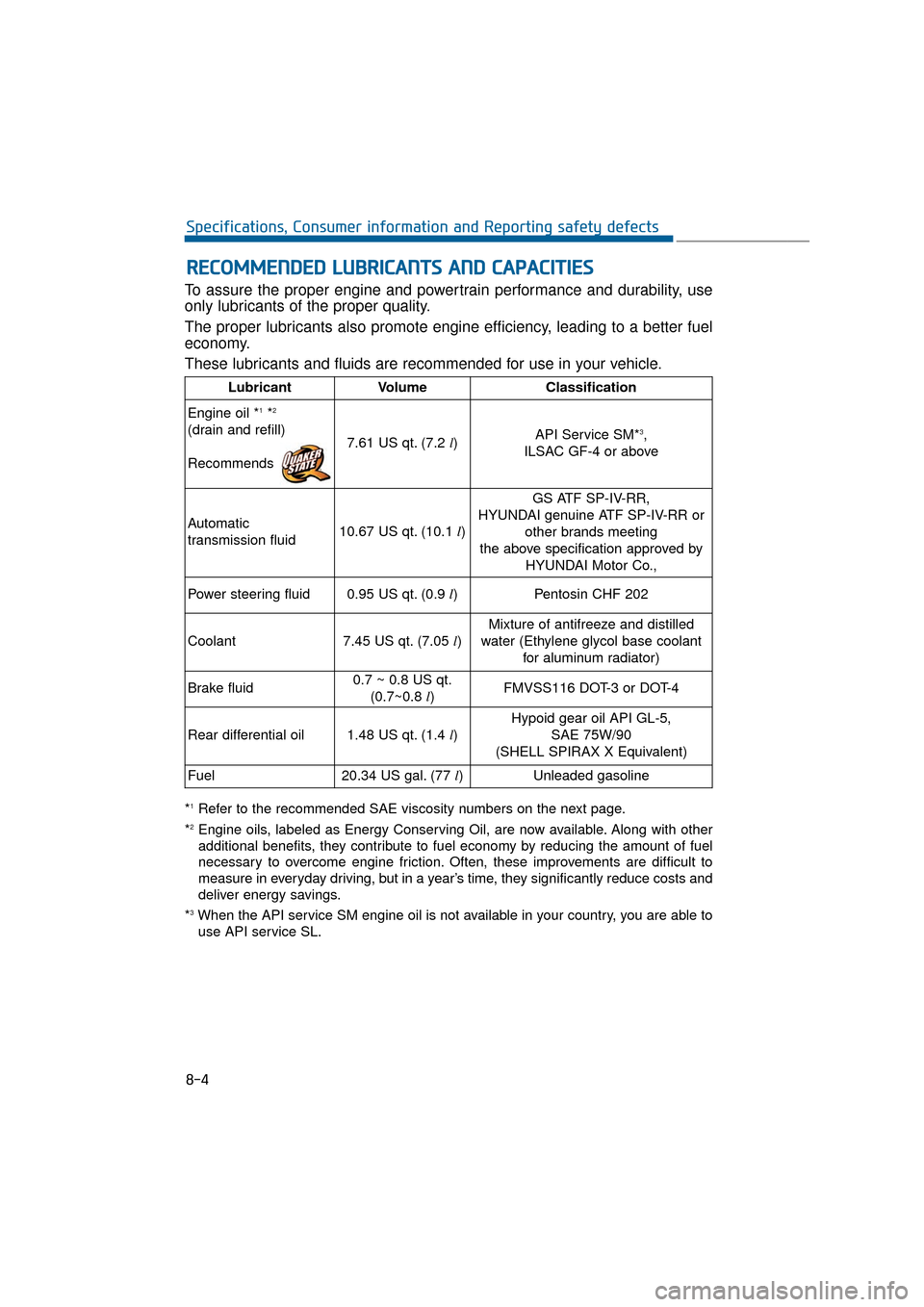
To assure the proper engine and powertrain performance and durability, use
only lubricants of the proper quality.
The proper lubricants also promote engine efficiency, leading to a better fuel
economy.
These lubricants and fluids are recommended for use in your vehicle.
*1Refer to the recommended SAE viscosity numbers on the next page.
*
2Engine oils, labeled as Energy Conserving Oil, are now available. Along with other
additional benefits, they contribute to fuel economy by reducing the amount of fuel
necessary to overcome engine friction. Often, these improvements are difficult to
measure in everyday driving, but in a year’s time, they significantly reduce costs and
deliver energy savings.
*
3When the API service SM engine oil is not available in your country, you are able to use API service SL.
R R E
EC
CO
O M
M M
ME
EN
N D
DE
ED
D
L
L U
U B
BR
RI
IC
C A
A N
N T
TS
S
A
A N
N D
D
C
C A
A P
PA
A C
CI
IT
T I
IE
E S
S
8-4
Specifications, Consumer information and Reporting safety defects
Lubricant Volume Classification
Engine oil *
1*2
(drain and refill)
Recommends 7.61 US qt. (7.2
l)API Service SM*3,
ILSAC GF-4 or above
Automatic
transmission fluid 10.67 US qt. (10.1
l)GS ATF SP-IV-RR,
HYUNDAI genuine ATF SP-IV-RR or other brands meeting
the above specification approved by HYUNDAI Motor Co.,
Power steering fluid 0.95 US qt. (0.9
l)
Pentosin CHF 202
Coolant 7.45 US qt. (7.05
l)Mixture of antifreeze and distilled
water (Ethylene glycol base coolant for aluminum radiator)
Brake fluid 0.7 ~ 0.8 US qt.
(0.7~0.8 l) FMVSS116 DOT-3 or DOT-4
Rear differential oil 1.48 US qt. (1.4 l) Hypoid gear oil API GL-5,
SAE 75W/90
(SHELL SPIRAX X Equivalent)
Fuel 20.34 US gal. (77 l)
Unleaded gasoline
Page 454 of 477
Recommended SAE viscosity number
Always be sure to clean the filler-plug area, drain plug, or dipstick before
checking or draining any lubricant. This is especially important in dusty
or sandy areas or after driving on an unpaved road. The practice to
maintain the plug and dipstick areas clean prevents dirt and grit from
entering the engine or the other mechanisms, which may be damaged.
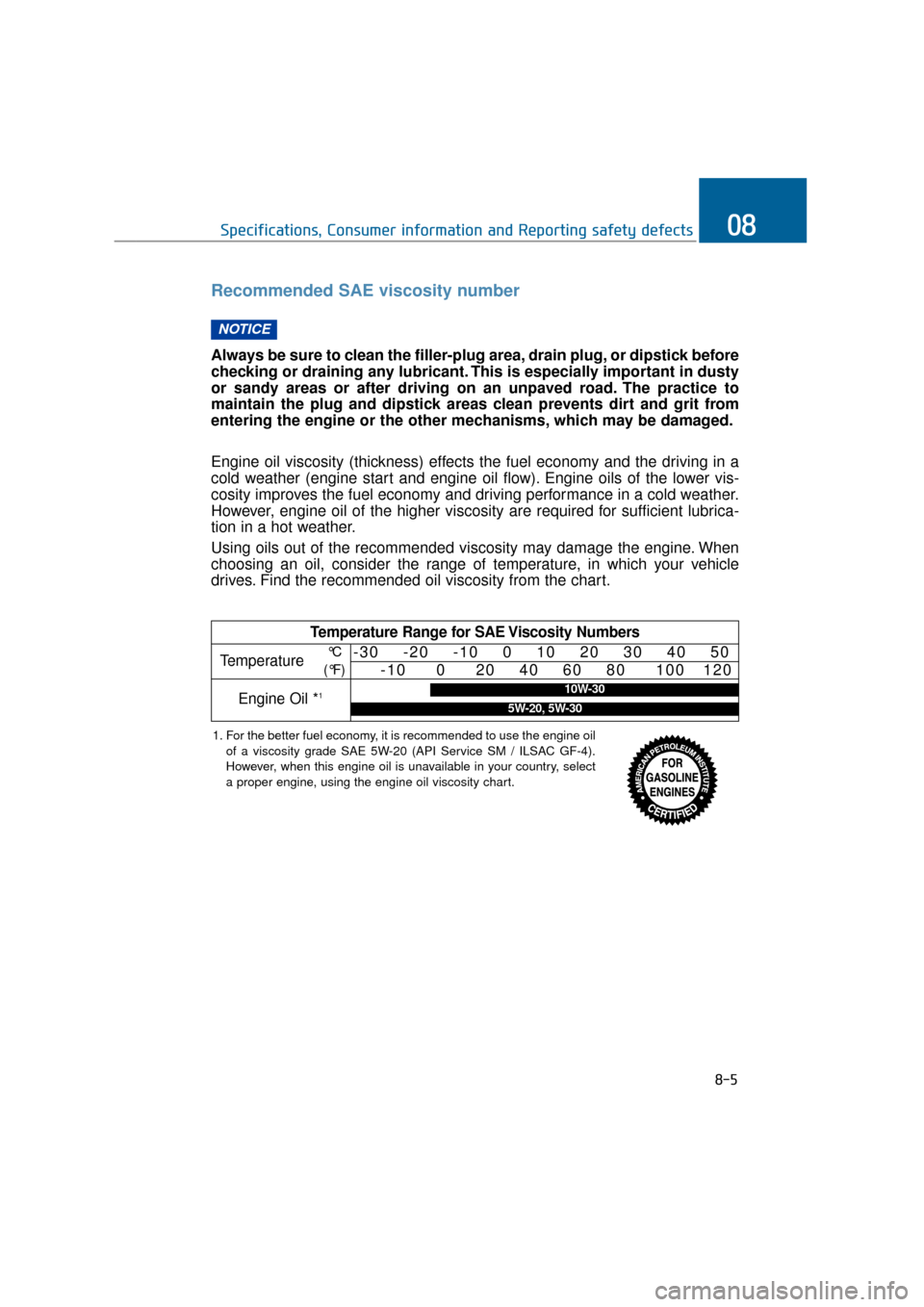
Engine oil viscosity (thickness) effects the fuel economy and the driving in a
cold weather (engine start and engine oil flow). Engine oils of the lower vis-
cosity improves the fuel economy and driving performance in a cold weather.
However, engine oil of the higher viscosity are required for sufficient lubrica-
tion in a hot weather.
Using oils out of the recommended viscosity may damage the engine. When
choosing an oil, consider the range of temperature, in which your vehicle
drives. Find the recommended oil viscosity from the chart.
NOTICE
8-5
Specifications, Consumer information and Reporting safety defects08
Temperature Range for SAE Viscosity Numbers
TemperatureEngine Oil *
1
°C
(°F)-30 -20 -10 0 10 20 30 40 50 -10 0 20 40 60 80 100 120
1. For the better fuel economy, it is recommended to use the engine oil
of a viscosity grade SAE 5W-20 (API Service SM / ILSAC GF-4).
However, when this engine oil is unavailable in your country, select
a proper engine, using the engine oil viscosity chart.
10W-30
5W-20, 5W-30
Page 464 of 477

Emission control system ........................................................................\
.............7-89Crankcase emission control system .............................................................7-89
Evaporative emission control system ...........................................................7-89
Exhaust emission control system .................................................................7-90
Engine compartment ........................................................................\
.....................1-6
Engine compartment fuse........................................................................\
............7-59
Engine coolant........................................................................\
.............................7-27
Engine coolant temperature gauge ......................................................................3-\
66
Engine number ........................................................................\
..............................8-7
Engine oil ........................................................................\
....................................7-25
Engine overheating......................................................\
..........................................6-6
Engine start/stop button ........................................................................\
................5-7
Evaporative emission control system..................................................................7-89
Exhaust emission control system ........................................................................\
7-90
Explanation of scheduled maintenance items .....................................................7-23
Exterior care ........................................................................\
................................7-83
Exterior overview (Front) ........................................................................\
.............1-2
Exterior overview (Rear) ........................................................................\
..............1-3
Flat tire ........................................................................\
.......................................6-12 Changing tires ........................................................................\
......................6-13
Compact spare tire........................................................................\
................6-17
Jack and tools ........................................................................\
.......................6-12
Removing and storing the spare tire ............................................................6-13
Floor mat anchor(s) ........................................................................\
...................3-150
Fluid Brake fluid ........................................................................\
............................7-30
Power steering fluid ........................................................................\
.............7-31
Washer fluid ........................................................................\
.........................7-32
Fog light ........................................................................\
...................................3-113
Front seat adjustment ........................................................................\
....................2-4
Fuel Economy ........................................................................\
.............................3-87
Fuel filler lid........................................................................\
................................3-34
Fuel gauge ........................................................................\
...................................3-67
Fuel requirements.......................................................\
...........................................F-8
Fuse switch ........................................................................\
..................................7-58
I-6
Index
F
Page 469 of 477

Occupant classification system ........................................................................\
...2-48
Odometer ........................................................................\
.....................................3-68
Oil (Engine)........................................................................\
.................................7-25
Outside rearview mirror ........................................................................\
..............3-58
Outside temperature gauge........................................................................\
..........3-68
Overheating ........................................................................\
...................................6-6
Owner's maintenance ........................................................................\
....................7-7
Parking assist system ........................................................................\
................3-102
Parking light position ........................................................................\
................3-111
Passenger’s air bag ........................................................................\
......................2-54
Power brakes ........................................................................\
...............................5-17
Power outlet ........................................................................\
..............................3-148
Power steering fluid ........................................................................\
....................7-31
Power trunk ........................................................................\
.................................3-19
Power window lock button ........................................................................\
.........3-32
Pre-safe seat belt (PSB) ........................................................................\
..............2-28
Pre-tensioner seat belt ........................................................................\
.................2-25
Puddle lamp welcome ........................................................................\
...............3-121
Rear console storage ........................................................................\
.................3-142
Rear curtain ........................................................................\
...............................3-152
Rear door window curtains ........................................................................\
.........3-31
Rear seat adjustment ........................................................................\
..................2-11
Rear vanity mirror ........................................................................\
.....................3-147
Rear view camera ........................................................................\
......................3-107
Recommended cold tire inflation pressures ........................................................7-42
Recommended lubricants and capacities ..............................................................8-4Recommended SAE viscosity number ...........................................................8-5
Refrigerant label ........................................................................\
............................8-7
Replacement light bulb ........................................................................\
...............7-69
Reporting safety defects ........................................................................\
................8-9
Reverse parking aid function ........................................................................\
.....3-61
Road warning Hazard warning flasher ........................................................................\
..........6-2
I-11
IndexI
O
P
R