transmission oil Hyundai Equus 2016 Owner's Manual
[x] Cancel search | Manufacturer: HYUNDAI, Model Year: 2016, Model line: Equus, Model: Hyundai Equus 2016Pages: 477, PDF Size: 16.25 MB
Page 364 of 477
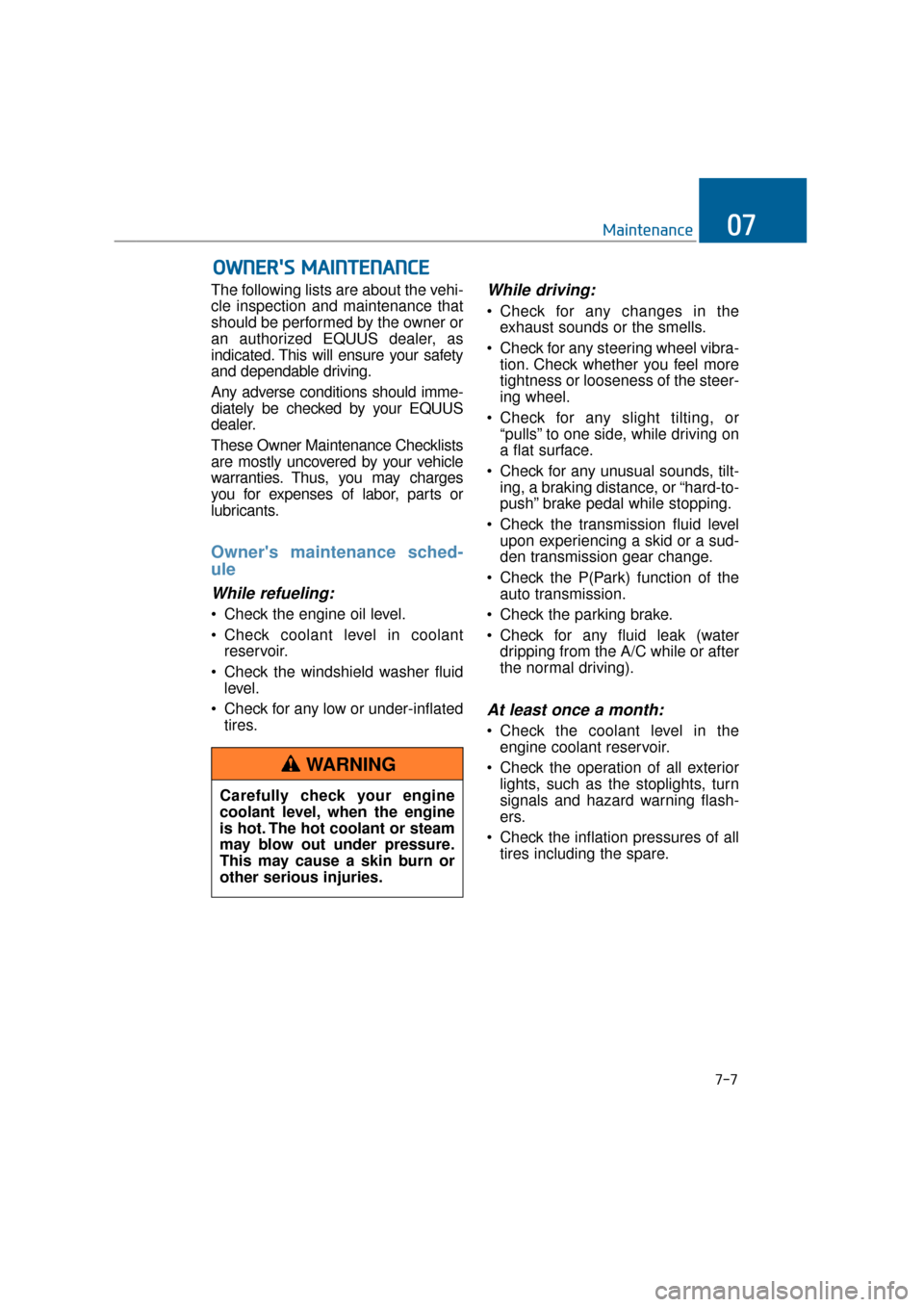
The following lists are about the vehi-
cle inspection and maintenance that
should be performed by the owner or
an authorized EQUUS dealer, as
indicated. This will ensure your safety
and dependable driving.
Any adverse conditions should imme-
diately be checked by your EQUUS
dealer.
These Owner Maintenance Checklists
are mostly uncovered by your vehicle
warranties. Thus, you may charges
you for expenses of labor, parts or
lubricants.
Owner's maintenance sched-
ule
While refueling:
Check the engine oil level.
Check coolant level in coolantreservoir.
Check the windshield washer fluid level.
Check for any low or under-inflated tires.
While driving:
Check for any changes in theexhaust sounds or the smells.
Check for any steering wheel vibra- tion. Check whether you feel more
tightness or looseness of the steer-
ing wheel.
Check for any slight tilting, or “pulls” to one side, while driving on
a flat surface.
Check for any unusual sounds, tilt- ing, a braking distance, or “hard-to-
push” brake pedal while stopping.
Check the transmission fluid level upon experiencing a skid or a sud-
den transmission gear change.
Check the P(Park) function of the auto transmission.
Check the parking brake.
Check for any fluid leak (water dripping from the A/C while or after
the normal driving).
At least once a month:
Check the coolant level in theengine coolant reservoir.
Check the operation of all exterior lights, such as the stoplights, turn
signals and hazard warning flash-
ers.
Check the inflation pressures of all tires including the spare.
O OW
W N
NE
ER
R '
'S
S
M
M A
AI
IN
N T
TE
EN
N A
AN
N C
CE
E
7-7
Maintenance07
Carefully check your engine
coolant level, when the engine
is hot. The hot coolant or steam
may blow out under pressure.
This may cause a skin burn or
other serious injuries.
WARNING
Page 379 of 477
7-22
Maintenance
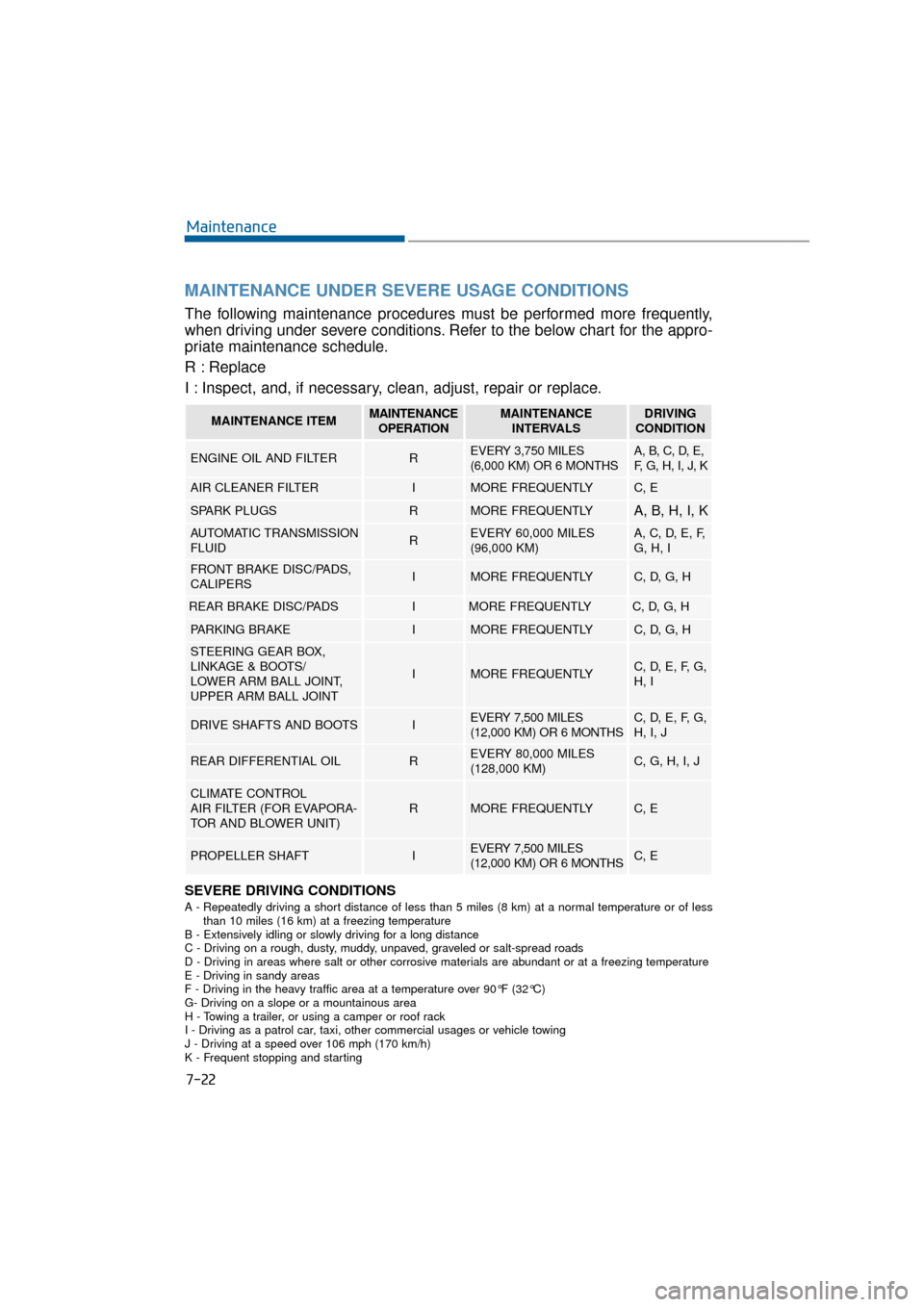
MAINTENANCE UNDER SEVERE USAGE CONDITIONS
The following maintenance procedures must be performed more frequently,
when driving under severe conditions. Refer to the below chart for the appro-
priate maintenance schedule.
R : Replace
I : Inspect, and, if necessary, clean, adjust, repair or replace.
SEVERE DRIVING CONDITIONS
A - Repeatedly driving a short distance of less than 5 miles (8 km) at a normal temperature or of lessthan 10 miles (16 km) at a freezing temperature
B - Extensively idling or slowly driving for a long distance
C - Driving on a rough, dusty, muddy, unpaved, graveled or salt-spread roads
D - Driving in areas where salt or other corrosive materials are abundant or at a freezing temperature
E - Driving in sandy areas
F - Driving in the heavy traffic area at a temperature over 90°F (32°C)
G- Driving on a slope or a mountainous area
H - Towing a trailer, or using a camper or roof rack
I - Driving as a patrol car, taxi, other commercial usages or vehicle towing
J - Driving at a speed over 106 mph (170 km/h)
K - Frequent stopping and starting
MAINTENANCE ITEMMAINTENANCE
OPERATIONMAINTENANCE INTERVALSDRIVING
CONDITION
ENGINE OIL AND FILTERREVERY 3,750 MILES
(6,000 KM) OR 6 MONTHSA, B, C, D, E,
F, G, H, I, J, K
AIR CLEANER FILTERIMORE FREQUENTLYC, E
SPARK PLUGSRMORE FREQUENTLYA, B, H, I, K
AUTOMATIC TRANSMISSION
FLUIDREVERY 60,000 MILES
(96,000 KM) A, C, D, E, F,
G, H, I
FRONT BRAKE DISC/PADS,
CALIPERSIMORE FREQUENTLYC, D, G, H
REAR BRAKE DISC/PADSIMORE FREQUENTLYC, D, G, H
PARKING BRAKEIMORE FREQUENTLYC, D, G, H
STEERING GEAR BOX,
LINKAGE & BOOTS/
LOWER ARM BALL JOINT,
UPPER ARM BALL JOINT
IMORE FREQUENTLYC, D, E, F, G,
H, I
DRIVE SHAFTS AND BOOTSIEVERY 7,500 MILES
(12,000 KM) OR 6 MONTHSC, D, E, F, G,
H, I, J
REAR DIFFERENTIAL OILREVERY 80,000 MILES
(128,000 KM)C, G, H, I, J
CLIMATE CONTROL
AIR FILTER (FOR EVAPORA-
TOR AND BLOWER UNIT)RMORE FREQUENTLYC, E
PROPELLER SHAFTIEVERY 7,500 MILES
(12,000 KM) OR 6 MONTHSC, E
Page 380 of 477
7-23
Maintenance07
E
EX
X P
PL
LA
A N
N A
AT
TI
IO
O N
N
O
O F
F
S
S C
C H
H E
ED
D U
U L
LE
E D
D
M
M A
AI
IN
N T
TE
EN
N A
AN
N C
CE
E
I
IT
T E
EM
M S
S
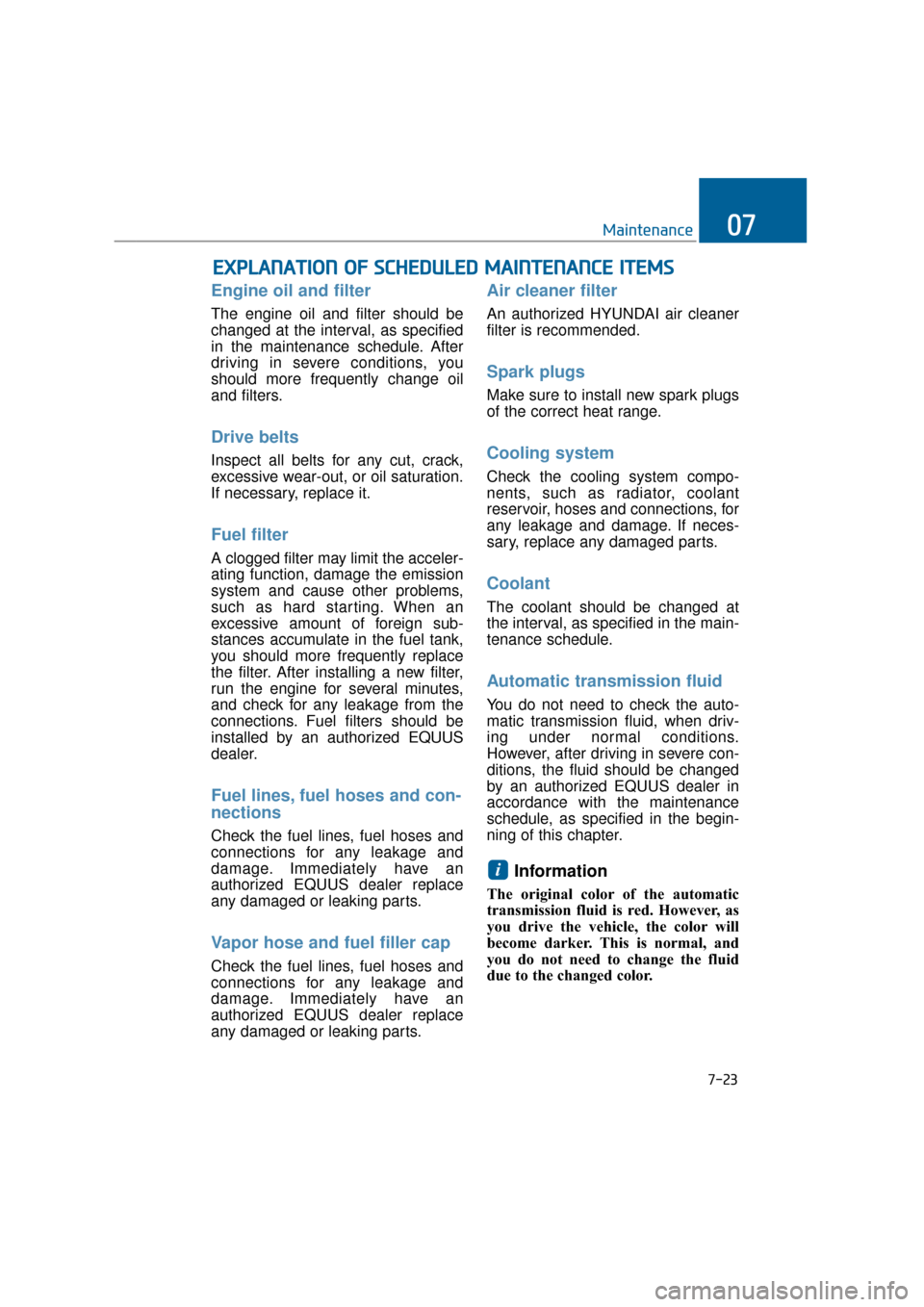
Engine oil and filter
The engine oil and filter should be
changed at the interval, as specified
in the maintenance schedule. After
driving in severe conditions, you
should more frequently change oil
and filters.
Drive belts
Inspect all belts for any cut, crack,
excessive wear-out, or oil saturation.
If necessary, replace it.
Fuel filter
A clogged filter may limit the acceler-
ating function, damage the emission
system and cause other problems,
such as hard starting. When an
excessive amount of foreign sub-
stances accumulate in the fuel tank,
you should more frequently replace
the filter. After installing a new filter,
run the engine for several minutes,
and check for any leakage from the
connections. Fuel filters should be
installed by an authorized EQUUS
dealer.
Fuel lines, fuel hoses and con-
nections
Check the fuel lines, fuel hoses and
connections for any leakage and
damage. Immediately have an
authorized EQUUS dealer replace
any damaged or leaking parts.
Vapor hose and fuel filler cap
Check the fuel lines, fuel hoses and
connections for any leakage and
damage. Immediately have an
authorized EQUUS dealer replace
any damaged or leaking parts.
Air cleaner filter
An authorized HYUNDAI air cleaner
filter is recommended.
Spark plugs
Make sure to install new spark plugs
of the correct heat range.
Cooling system
Check the cooling system compo-
nents, such as radiator, coolant
reservoir, hoses and connections, for
any leakage and damage. If neces-
sary, replace any damaged parts.
Coolant
The coolant should be changed at
the interval, as specified in the main-
tenance schedule.
Automatic transmission fluid
You do not need to check the auto-
matic transmission fluid, when driv-
ing under normal conditions.
However, after driving in severe con-
ditions, the fluid should be changed
by an authorized EQUUS dealer in
accordance with the maintenance
schedule, as specified in the begin-
ning of this chapter.
Information
The original color of the automatic
transmission fluid is red. However, as
you drive the vehicle, the color will
become darker. This is normal, and
you do not need to change the fluid
due to the changed color.
i
Page 381 of 477
7-24
Maintenance
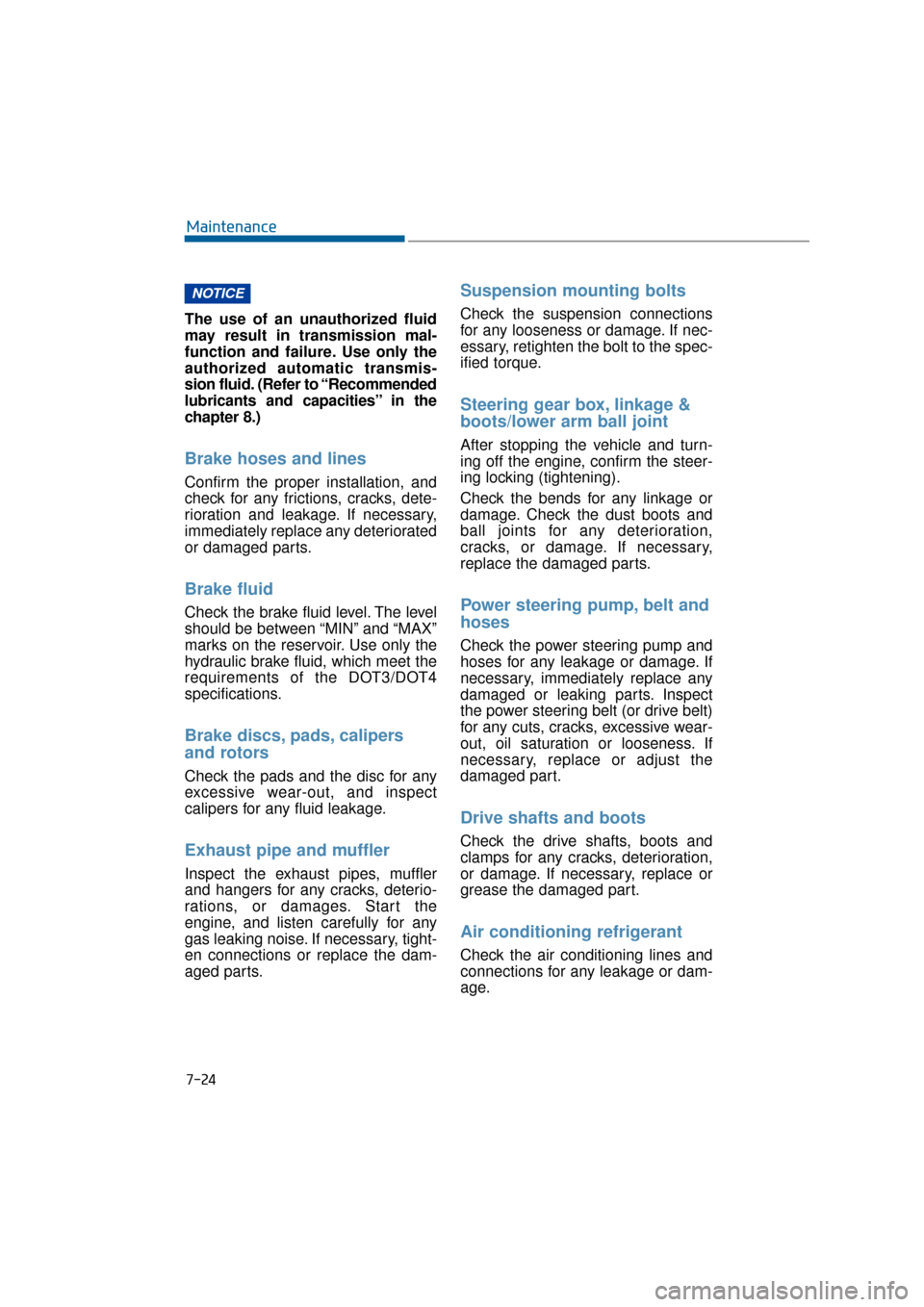
The use of an unauthorized fluid
may result in transmission mal-
function and failure. Use only the
authorized automatic transmis-
sion fluid. (Refer to “Recommended
lubricants and capacities” in the
chapter 8.)
Brake hoses and lines
Confirm the proper installation, and
check for any frictions, cracks, dete-
rioration and leakage. If necessary,
immediately replace any deteriorated
or damaged parts.
Brake fluid
Check the brake fluid level. The level
should be between “MIN” and “MAX”
marks on the reservoir. Use only the
hydraulic brake fluid, which meet the
requirements of the DOT3/DOT4
specifications.
Brake discs, pads, calipers
and rotors
Check the pads and the disc for any
excessive wear-out, and inspect
calipers for any fluid leakage.
Exhaust pipe and muffler
Inspect the exhaust pipes, muffler
and hangers for any cracks, deterio-
rations, or damages. Start the
engine, and listen carefully for any
gas leaking noise. If necessary, tight-
en connections or replace the dam-
aged parts.
Suspension mounting bolts
Check the suspension connections
for any looseness or damage. If nec-
essary, retighten the bolt to the spec-
ified torque.
Steering gear box, linkage &
boots/lower arm ball joint
After stopping the vehicle and turn-
ing off the engine, confirm the steer-
ing locking (tightening).
Check the bends for any linkage or
damage. Check the dust boots and
ball joints for any deterioration,
cracks, or damage. If necessary,
replace the damaged parts.
Power steering pump, belt and
hoses
Check the power steering pump and
hoses for any leakage or damage. If
necessary, immediately replace any
damaged or leaking parts. Inspect
the power steering belt (or drive belt)
for any cuts, cracks, excessive wear-
out, oil saturation or looseness. If
necessary, replace or adjust the
damaged part.
Drive shafts and boots
Check the drive shafts, boots and
clamps for any cracks, deterioration,
or damage. If necessary, replace or
grease the damaged part.
Air conditioning refrigerant
Check the air conditioning lines and
connections for any leakage or dam-
age.
NOTICE
Page 424 of 477
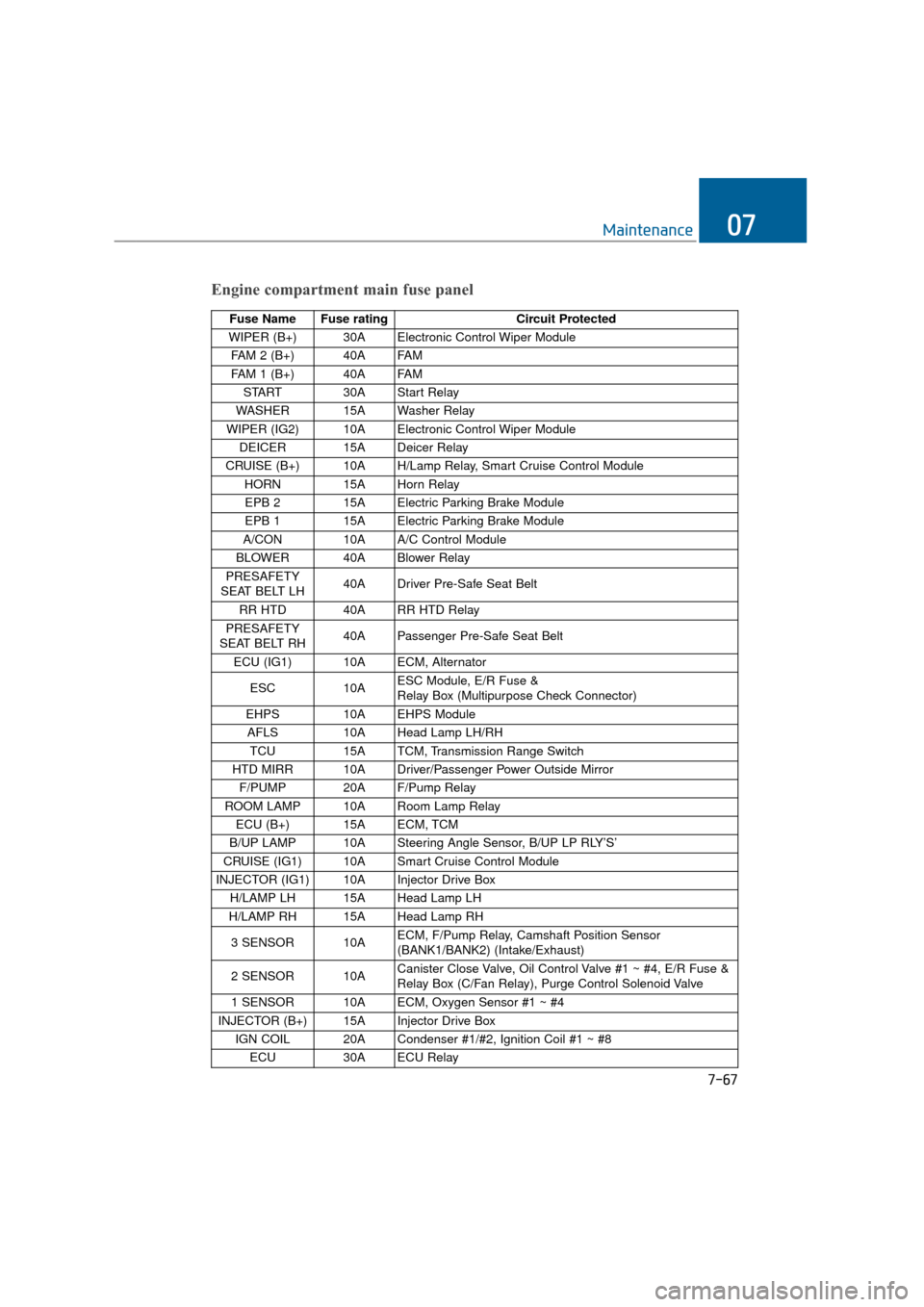
7-67
Maintenance07
Engine compartment main fuse panel
Fuse Name Fuse ratingCircuit Protected
WIPER (B+) 30A Electronic Control Wiper Module FAM 2 (B+) 40A FAM
FAM 1 (B+) 40A FAM START 30A Start Relay
WASHER 15A Washer Relay
WIPER (IG2) 10A Electronic Control Wiper Module DEICER 15A Deicer Relay
CRUISE (B+) 10A H/Lamp Relay, Smart Cruise Control Module HORN 15A Horn Relay
EPB 2 15A Electric Parking Brake Module
EPB 1 15A Electric Parking Brake Module
A/CON 10A A/C Control Module
BLOWER 40A Blower Relay
PRESAFETY
SEAT BELT LH 40A Driver Pre-Safe Seat Belt
RR HTD 40A RR HTD Relay
PRESAFETY
SEAT BELT RH 40A Passenger Pre-Safe Seat Belt
ECU (IG1) 10A ECM, Alternator ESC 10AESC Module, E/R Fuse &
Relay Box (Multipurpose Check Connector)
EHPS 10A EHPS Module
AFLS 10A Head Lamp LH/RH
TCU 15A TCM, Transmission Range Switch
HTD MIRR 10A Driver/Passenger Power Outside Mirror F/PUMP 20A F/Pump Relay
ROOM LAMP 10A Room Lamp Relay ECU (B+) 15A ECM, TCM
B/UP LAMP 10A Steering Angle Sensor, B/UP LP RLY’S’
CRUISE (IG1) 10A Smart Cruise Control Module
INJECTOR (IG1) 10A Injector Drive Box H/LAMP LH 15A Head Lamp LH
H/LAMP RH 15A Head Lamp RH
3 SENSOR 10A ECM, F/Pump Relay, Camshaft Position Sensor
(BANK1/BANK2) (Intake/Exhaust)
2 SENSOR 10A Canister Close Valve, Oil Control Valve #1 ~ #4, E/R Fuse &
Relay Box (C/Fan Relay), Purge Control Solenoid Valve
1 SENSOR 10A ECM, Oxygen Sensor #1 ~ #4
INJECTOR (B+) 15A Injector Drive Box IGN COIL 20A Condenser #1/#2, Ignition Coil #1 ~ #8ECU 30A ECU Relay
Page 453 of 477
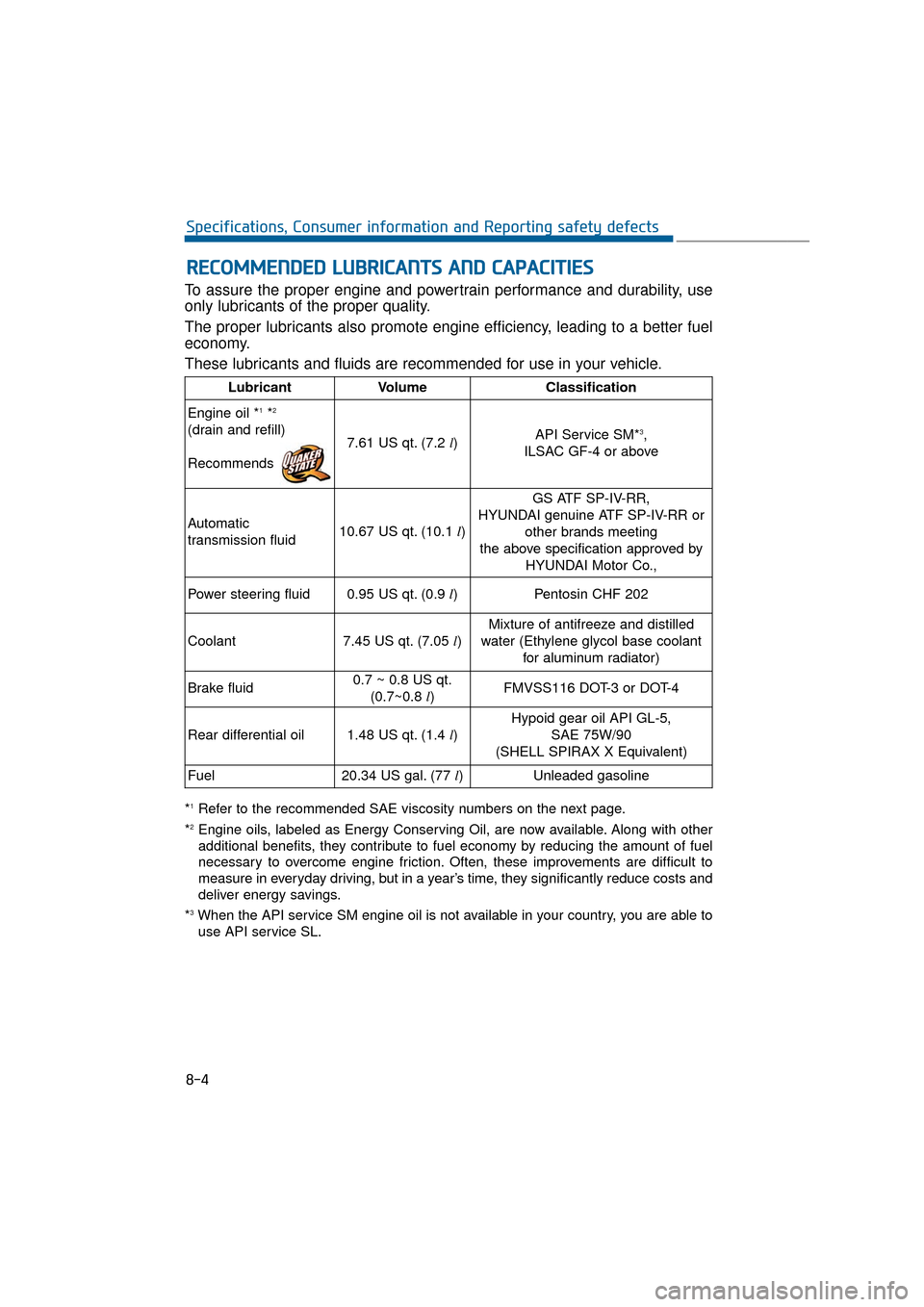
To assure the proper engine and powertrain performance and durability, use
only lubricants of the proper quality.
The proper lubricants also promote engine efficiency, leading to a better fuel
economy.
These lubricants and fluids are recommended for use in your vehicle.
*1Refer to the recommended SAE viscosity numbers on the next page.
*
2Engine oils, labeled as Energy Conserving Oil, are now available. Along with other
additional benefits, they contribute to fuel economy by reducing the amount of fuel
necessary to overcome engine friction. Often, these improvements are difficult to
measure in everyday driving, but in a year’s time, they significantly reduce costs and
deliver energy savings.
*
3When the API service SM engine oil is not available in your country, you are able to use API service SL.
R R E
EC
CO
O M
M M
ME
EN
N D
DE
ED
D
L
L U
U B
BR
RI
IC
C A
A N
N T
TS
S
A
A N
N D
D
C
C A
A P
PA
A C
CI
IT
T I
IE
E S
S
8-4
Specifications, Consumer information and Reporting safety defects
Lubricant Volume Classification
Engine oil *
1*2
(drain and refill)
Recommends 7.61 US qt. (7.2
l)API Service SM*3,
ILSAC GF-4 or above
Automatic
transmission fluid 10.67 US qt. (10.1
l)GS ATF SP-IV-RR,
HYUNDAI genuine ATF SP-IV-RR or other brands meeting
the above specification approved by HYUNDAI Motor Co.,
Power steering fluid 0.95 US qt. (0.9
l)
Pentosin CHF 202
Coolant 7.45 US qt. (7.05
l)Mixture of antifreeze and distilled
water (Ethylene glycol base coolant for aluminum radiator)
Brake fluid 0.7 ~ 0.8 US qt.
(0.7~0.8 l) FMVSS116 DOT-3 or DOT-4
Rear differential oil 1.48 US qt. (1.4 l) Hypoid gear oil API GL-5,
SAE 75W/90
(SHELL SPIRAX X Equivalent)
Fuel 20.34 US gal. (77 l)
Unleaded gasoline