engine light Hyundai Equus 2016 Workshop Manual
[x] Cancel search | Manufacturer: HYUNDAI, Model Year: 2016, Model line: Equus, Model: Hyundai Equus 2016Pages: 477, PDF Size: 16.25 MB
Page 273 of 477
The EPB warning light may illu-minate, when the EPB switch is
abnormally operated. Turn the
engine OFF and, after a few min-
utes, turn it ON again. The EPB
warning light will go OFF and
the EPB switch will be normally
operable. However, when the
EPB warning light still remains
ON, have the system be checked
by an authorized EQUUS dealer.
The EPB is not set ON, when the parking brake warning light
does not illuminate or flash,
even though the EPB switch was
pulled up.
When the parking brake warning light flashes with the EPB warn-
ing light ON, press the EPB
switch, and then pull it up.
Repeat this one more time.
When the EPB warning does not
go OFF, have the system
checked by an authorized
EQUUS dealer.
Emergency braking
When there is a problem with the
brake while driving, emergency brak-
ing is possible by pulling and holding
the EPB switch.
However, braking distance will be
longer than it is in normal driving.
Information
In emergency braking with the EPB
switch, the parking brake warning
light will illuminate to indicate the
system operation.
If there is noise or burning smell
after emergency braking, immedi-
ately have your vehicle checked
by an authorized EQUUS dealer.
When the EPB (electric parkingbrake) is not released
When the EPB is normally released,
we recommend that you contact an
authorized EQUUS dealer, tow your
vehicle, and have the system
checked.
If you continuously notice a noise
or burning smell after using the
EPB for emergency braking, we
recommend that you have the sys-
tem checked by an authorized
EQUUS dealer.
NOTICE
NOTICE
i
NOTICE
5-22
Driving your vehicle
Do not operate the parking
brake while the vehicle is mov-
ing except in an emergency situ-
ation. It may damage the brake
system and lead to an accident.
WARNING
Page 275 of 477
Information
• The Auto Hold does not operate,when:
- The driver's seat belt is unfastenedand driver's door is opened
- The engine hood is opened
- The trunk is opened
- The shift lever is in P (Park)
- The EPB is set
• For your safety, the Auto Hold auto- matically switches to EPB, when:
- The driver's seat belt is unfastenedand driver's door is opened
- The engine hood is opened with the shift lever in D (Drive)
- The trunk is opened with the shift lever in R (Reverse)
- The vehicle stops for more than 10 minutes
- The vehicle stands on a steep slope
- The vehicle moves several times
In these cases, the brake warning
light illuminates, the AUTO HOLD
indicator color changes from green
to white, and a message will be dis-
played with warming sound to
inform you that EPB is automatical-
ly set. (Continued)(Continued)
Before driving off again, depress
brake pedal, take a look around
your vehicle, and manually release
the parking brake and the EPB
switch.
• When the AUTO HOLD indicator illuminates in yellow, the Auto Hold
does not properly work. Take your
vehicle to an authorized EQUUS
dealer and have the system checked.
When there is a malfunction with
the driver’s door, hood or trunk
open detection system, the AUTO
HOLD may not properly operate.
Take your vehicle to an authorized
EQUUS dealer and have the sys-
tem checked.
NOTICE
i
5-24
Driving your vehicle
Depress the accelerator slow-ly when you start the vehicle.
For your safety, cancel the AUTO HOLD operation, when:
- Drive a downhill
- Slowly drive, park or drivebackwards
- Wash the vehicle in an auto- matic car wash
WARNING
Page 278 of 477
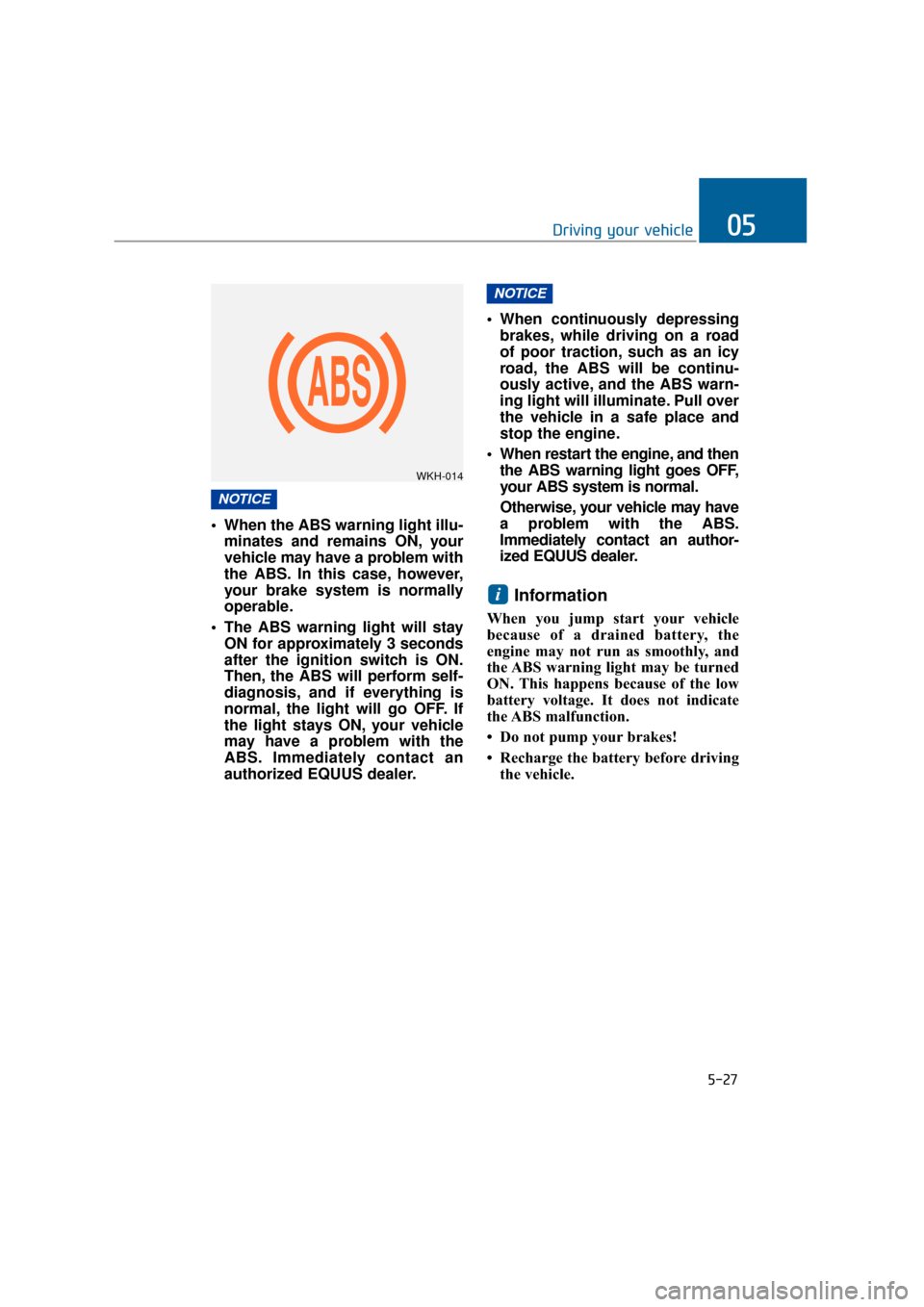
When the ABS warning light illu-minates and remains ON, your
vehicle may have a problem with
the ABS. In this case, however,
your brake system is normally
operable.
The ABS warning light will stay ON for approximately 3 seconds
after the ignition switch is ON.
Then, the ABS will perform self-
diagnosis, and if everything is
normal, the light will go OFF. If
the light stays ON, your vehicle
may have a problem with the
ABS. Immediately contact an
authorized EQUUS dealer. When continuously depressing
brakes, while driving on a road
of poor traction, such as an icy
road, the ABS will be continu-
ously active, and the ABS warn-
ing light will illuminate. Pull over
the vehicle in a safe place and
stop the engine.
When restart the engine, and then the ABS warning light goes OFF,
your ABS system is normal.
Otherwise, your vehicle may have
a problem with the ABS.
Immediately contact an author-
ized EQUUS dealer.
Information
When you jump start your vehicle
because of a drained battery, the
engine may not run as smoothly, and
the ABS warning light may be turned
ON. This happens because of the low
battery voltage. It does not indicate
the ABS malfunction.
• Do not pump your brakes!
• Recharge the battery before drivingthe vehicle.
i
NOTICE
NOTICE
5-27
Driving your vehicle05
WKH-014
Page 279 of 477
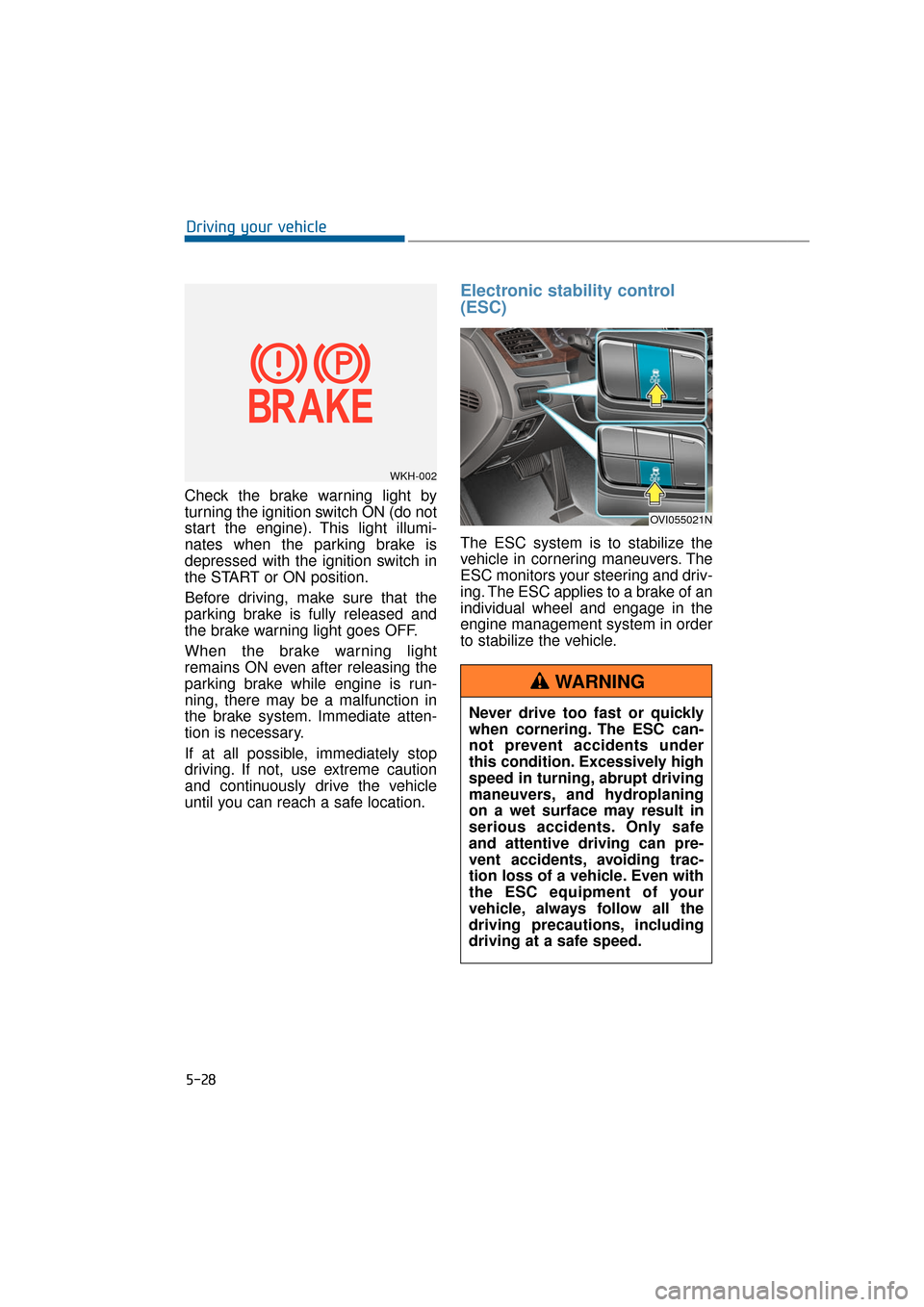
Check the brake warning light by
turning the ignition switch ON (do not
start the engine). This light illumi-
nates when the parking brake is
depressed with the ignition switch in
the START or ON position.
Before driving, make sure that the
parking brake is fully released and
the brake warning light goes OFF.
When the brake warning light
remains ON even after releasing the
parking brake while engine is run-
ning, there may be a malfunction in
the brake system. Immediate atten-
tion is necessary.
If at all possible, immediately stop
driving. If not, use extreme caution
and continuously drive the vehicle
until you can reach a safe location.
Electronic stability control
(ESC)
The ESC system is to stabilize the
vehicle in cornering maneuvers. The
ESC monitors your steering and driv-
ing. The ESC applies to a brake of an
individual wheel and engage in the
engine management system in order
to stabilize the vehicle.
5-28
Driving your vehicle
OVI055021N
Never drive too fast or quickly
when cornering. The ESC can-
not prevent accidents under
this condition. Excessively high
speed in turning, abrupt driving
maneuvers, and hydroplaning
on a wet surface may result in
serious accidents. Only safe
and attentive driving can pre-
vent accidents, avoiding trac-
tion loss of a vehicle. Even with
the ESC equipment of your
vehicle, always follow all the
driving precautions, including
driving at a safe speed.
WARNING
WKH-002
Page 280 of 477
The ESC system is an electronic
system to help the driver maintain
vehicle control in adverse conditions.
It is not a substitute for safe driving
practices. Various factors, including
speed, road conditions and driver's
steering maneuver, affect the ESC
performance in preventing a loss of
control. It is still driver's responsibility
to drive and corner at a proper speed
and to keep a safe distance. When
depressing the brake under condi-
tions, which may lock the wheels,
you may hear a snapping sound and
feel like that from the brake pedal.
This is normal and indicates your
ESC actively operates.
Information
A clicking sound may be heard from
the engine compartment, when the
engine is started and the vehicle
begins to move. This is normal, indi-
cating that the ESC actively operates.
ESC operation
ESC ON condition
When the Engine Start/Stop button
is turned ON, the ESC and the ESC
OFF indicator lights illuminate for
approximately 3 seconds and goes
off, then the ESC is turned on.
When operating
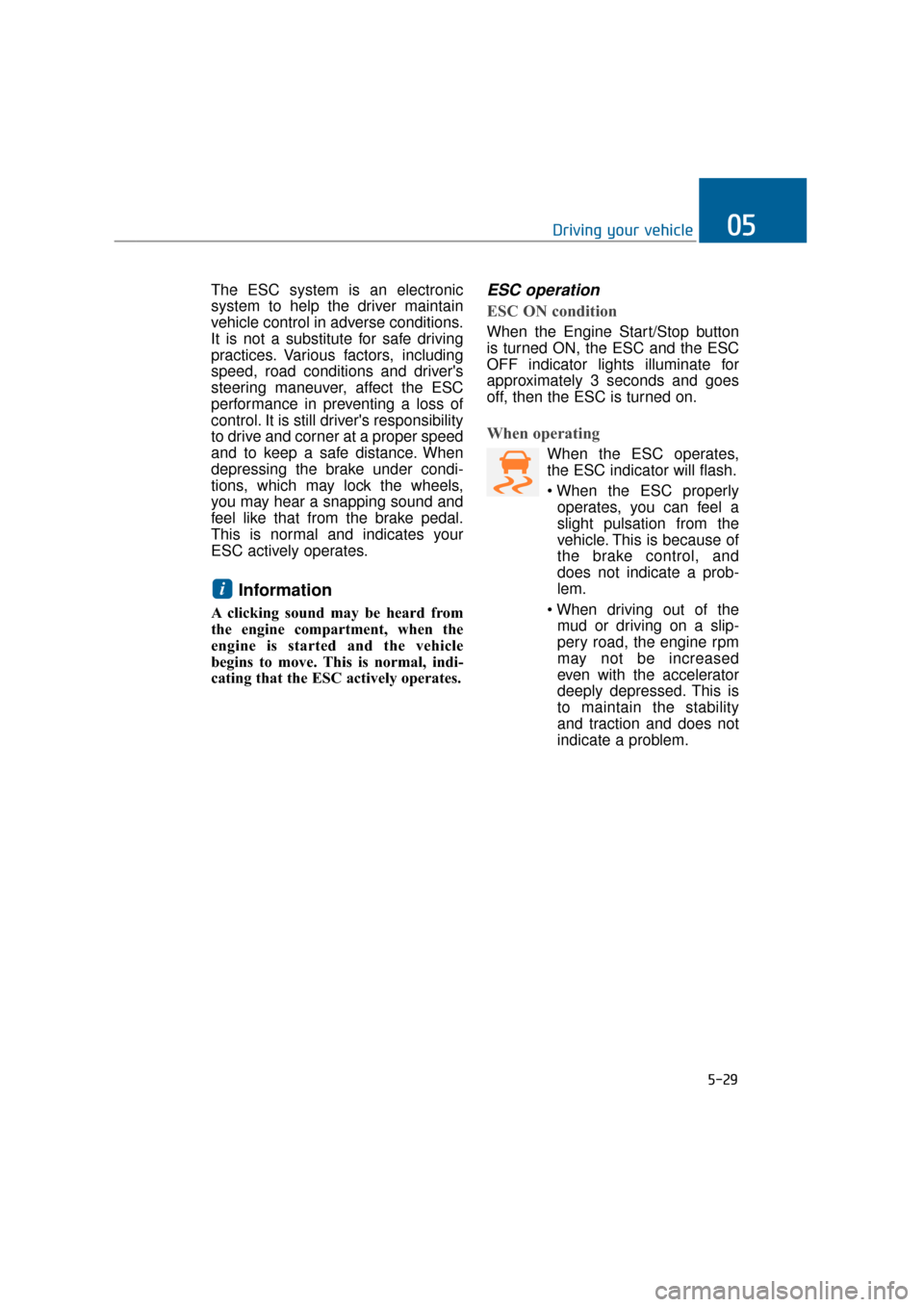
When the ESC operates,
the ESC indicator will flash.
operates, you can feel a
slight pulsation from the
vehicle. This is because of
the brake control, and
does not indicate a prob-
lem.
mud or driving on a slip-
pery road, the engine rpm
may not be increased
even with the accelerator
deeply depressed. This is
to maintain the stability
and traction and does not
indicate a problem.
i
5-29
Driving your vehicle05
Page 281 of 477
ESC operation OFF
ESC OFF status
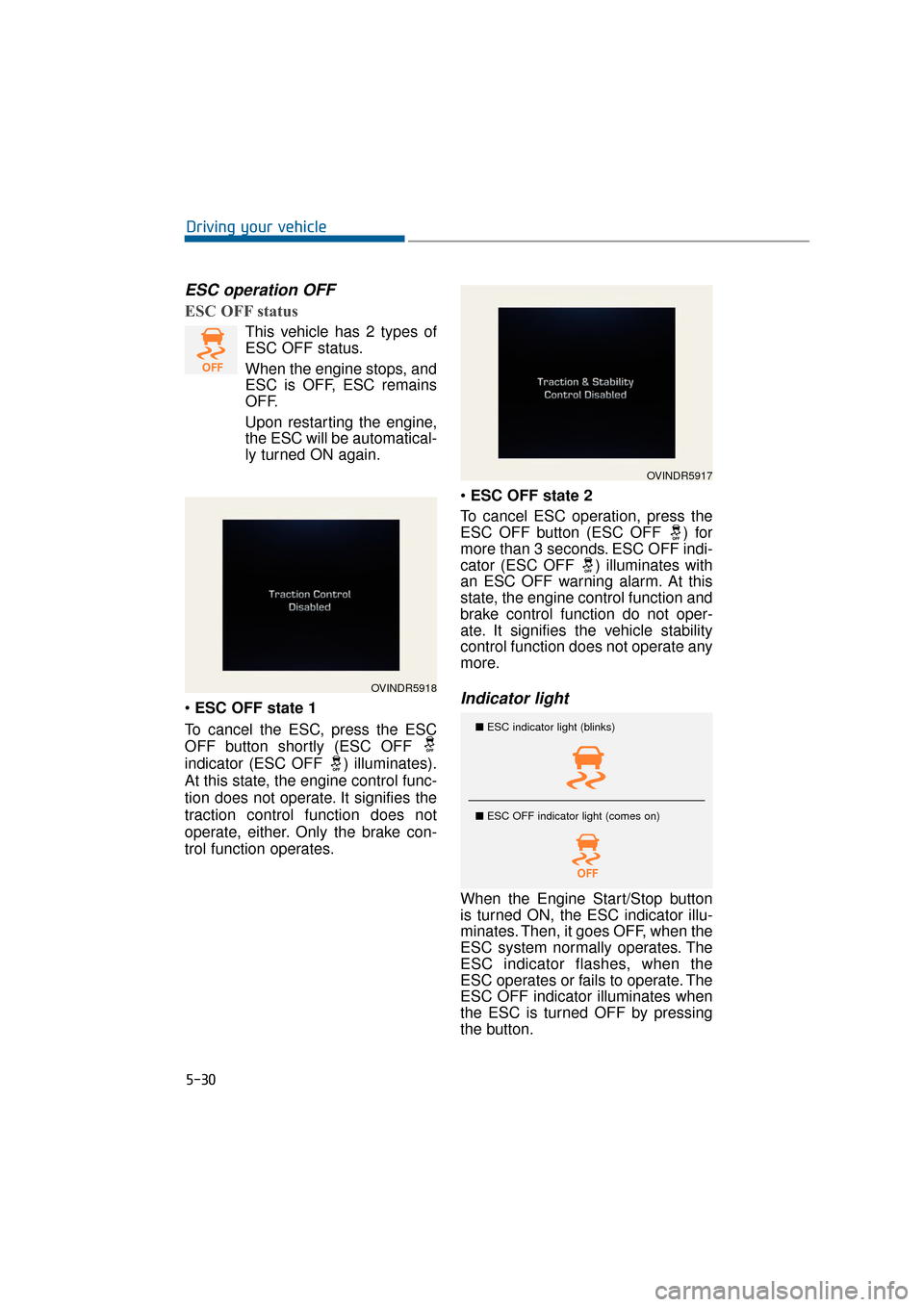
This vehicle has 2 types of
ESC OFF status.
When the engine stops, and
ESC is OFF, ESC remains
OFF.
Upon restarting the engine,
the ESC will be automatical-
ly turned ON again.
ESC OFF state 1
To cancel the ESC, press the ESC
OFF button shortly (ESC OFF
indicator (ESC OFF ) illuminates).
At this state, the engine control func-
tion does not operate. It signifies the
traction control function does not
operate, either. Only the brake con-
trol function operates.
ESC OFF state 2
To cancel ESC operation, press the
ESC OFF button (ESC OFF ) for
more than 3 seconds. ESC OFF indi-
cator (ESC OFF ) illuminates with
an ESC OFF warning alarm. At this
state, the engine control function and
brake control function do not oper-
ate. It signifies the vehicle stability
control function does not operate any
more.
Indicator light
When the Engine Start/Stop button
is turned ON, the ESC indicator illu-
minates. Then, it goes OFF, when the
ESC system normally operates. The
ESC indicator flashes, when the
ESC operates or fails to operate. The
ESC OFF indicator illuminates when
the ESC is turned OFF by pressing
the button.
5-30
Driving your vehicle
OVINDR5917
OVINDR5918
■ ESC indicator light (blinks)
■ ESC OFF indicator light (comes on)
Page 310 of 477
Operating conditions
The BSD indicator will illuminate
when the BSD system switch is
pressed ON after turning the Engine
Start/Stop button ON.
When the vehicle speed exceeds 9.3
mph (15 km/h), the system will acti-
vate.
When you press the BSD switch
again, the indicator and the BSD sys-
tem will be turned OFF.
When the ignition switch is pressed
ON after engine turn-OFF, the BSD
system returns to the previous state.
When the BSD system is not used,
turn the BSD system OFF by press-
ing the switch.
When the BSD system is turned ON,
the warning light will illuminate for 3
seconds on the outside rearview mir-
ror.
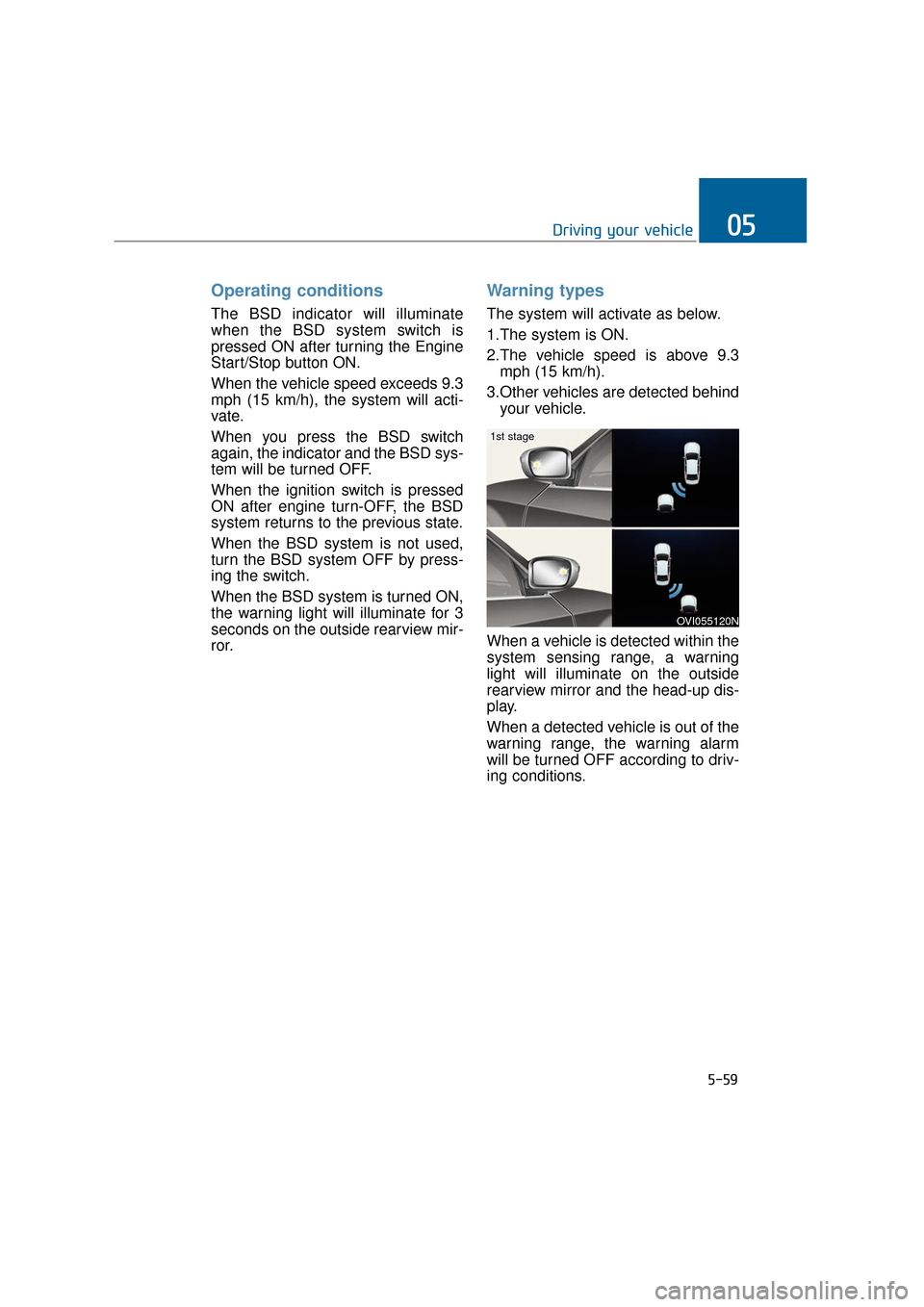
Warning types
The system will activate as below.
1.The system is ON.
2.The vehicle speed is above 9.3mph (15 km/h).
3.Other vehicles are detected behind your vehicle.
When a vehicle is detected within the
system sensing range, a warning
light will illuminate on the outside
rearview mirror and the head-up dis-
play.
When a detected vehicle is out of the
warning range, the warning alarm
will be turned OFF according to driv-
ing conditions.
5-59
Driving your vehicle05
OVI055120N
1st stage
Page 316 of 477
5-65
Driving your vehicle05
Your vehicle's fuel economy depends
mainly on your driving style such as
where you drive and when you drive.
Each of these factors affects your
fuel economy (how many miles/kilo-
meters you can drive with a
gallon/liter of fuel). To drive your vehi-
cle as economically as possible, fol-
low the below driving suggestions.
These will help you save in both the
fuel and repair expenses:
Drive smoothly. Accelerate at amoderate rate. Do not make
"jackrabbit" starts or full-throttle
shifts. Maintain a steady cruising
speed. Do not race between stop-
lights. Try to adjust your speed in
accordance with other traffic to
avoid unnecessary speed
changes. Avoid heavy traffic when-
ever possible. Always maintain a
safe distance from a vehicle in
front to avoid unnecessary braking.
This also reduces brake wear-out.
Drive at a moderate speed. The faster you drive, the more fuel your
vehicle uses. Driving at a moderate
speed, in the highest gear appro-
priate for the driving conditions
especially on the highway, is one of
the most effective ways to reduce
fuel consumption.
Do not "ride" the brake pedal. This can increase fuel consumption and
also wear out the brake compo-
nents. In addition, resting your foot
on the brake pedal, while driving,
may overheat the brake, reducing
breaking effects and possibly lead-
ing a serious consequence.
Check your tire conditions. Keep them inflated to the recommended
pressure level. Under or over infla-
tion will unnecessarily tire wear-
out. Check the tire pressures at
least once a month. Make sure that the wheels are cor-
rectly aligned. Hitting a curb or
driving too fast on uneven surfaces
may distort the wheel alignment.
Poor alignment causes faster tire
wear-out and may also result in
other problems as well as greater
fuel consumption.
Keep your vehicle in good condi- tion. For the better fuel economy
and the cheaper maintenance
expenses, maintain your vehicle in
accordance with the maintenance
schedule in the chapter 7. When
you drive your vehicle in harsh con-
ditions, more frequent mainte-
nance is required (refer to the
chapter 7 for further information).
Keep your vehicle clean. Your vehi- cle should be kept clean and away
from any corrosive substances. It is
especially important that mud, dirt,
ice and others are not daubed
under the vehicle. This extra weight
may increase the fuel consumption
and also cause corrosion.
Avoid a heavy loading. Do not carry unnecessary weight in your
vehicle. It will improve your fuel
economy.
Do not let the engine idle longer than necessary. When you wait
(not in traffic), turn OFF the engine.
Then restart the engine, when you
are ready to go.
Remember that your vehicle does not require the engine warm-up for
a long time. After turning On the
engine, run the engine for 10 to 20
seconds, before shifting the gear.
In cold weather, however, your
engine needs a slightly longer
warm-up period.
E EC
CO
O N
NO
O M
M I
IC
C A
A L
L
O
O P
PE
ER
R A
A T
TI
IO
O N
N
Page 326 of 477
5-75
Driving your vehicle05
To prevent the locks from
frozen
To prevent the locks from being
frozen, spray authorized de-icing
fluid or glycerin into key openings.
When a lock opening is already cov-
ered with ice, spray authorized de-
icing fluid on the ice to remove it.
When an internal part of a lock
freezes, try to thaw it with a heated
key. Carefully use the heated key to
avoid an injury.
Use authorized window-wash-
er anti-freezer solution in sys-
tem
To prevent the window washer from
being frozen, add authorized win-
dow-washer anti-freeze solution, as
instructed on the window-washer
container. Window-washer anti-
freeze solution is available from an
authorized EQUUS dealer, and so
are the most auto parts outlets. Do
not use engine coolant or other types
of anti-freezer solution, because
these may damage the vehicle paint.
Do not let your parking brake
freeze
Under some conditions, your parking
brake may freeze in the engaged
position. This is most likely to hap-
pen, when there is an accumulation
of snow or ice around/near the rear
brakes, or when the brakes are wet.
When there is the risk that your park-
ing brake may freeze, temporarily
apply it after locating the shift lever in
P(Park). Also, block the rear wheels
in advance, so the vehicle may not
roll. Then, release the parking brake.
Do not let ice and snow accu-
mulate underneath
Under some conditions, snow and
ice may build up under the fenders
and interfere with the steering. When
driving in such conditions during the
severe winter, you should check
underneath the vehicle on a regular
basis to assure that moving the front
wheels and the steering components
is unobstructed.
Carry emergency equipment
In accordance with weather condi-
tions, you should carry appropriate
emergency equipment, while driving.
Some of the items you may want to
carry include tire chains, tow straps,
chains, flashlight, emergency flares,
sand, a shovel, jumper cables, a win-
dow scraper, gloves, ground cloth,
coveralls and a blanket.
Do not place objects or materi-
als in the engine compartment
Putting objects or materials in the
engine compartment may cause an
engine failure or combustion,
because those may block the engine
cooling. The manufacturer is not
responsible for the damage caused
by such placement.
Page 335 of 477
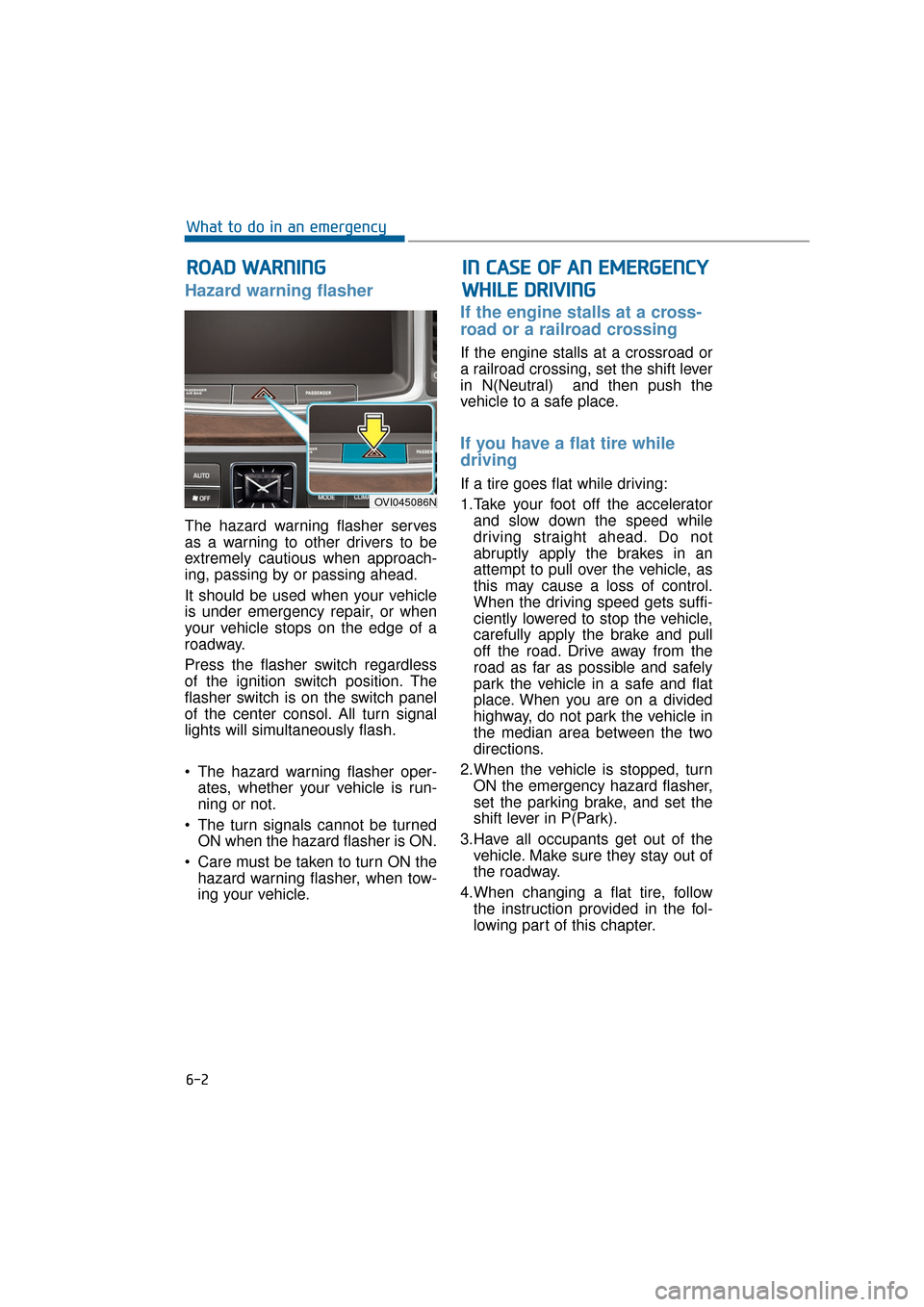
Hazard warning flasher
The hazard warning flasher serves
as a warning to other drivers to be
extremely cautious when approach-
ing, passing by or passing ahead.
It should be used when your vehicle
is under emergency repair, or when
your vehicle stops on the edge of a
roadway.
Press the flasher switch regardless
of the ignition switch position. The
flasher switch is on the switch panel
of the center consol. All turn signal
lights will simultaneously flash.
• The hazard warning flasher oper-ates, whether your vehicle is run-
ning or not.
The turn signals cannot be turned ON when the hazard flasher is ON.
Care must be taken to turn ON the hazard warning flasher, when tow-
ing your vehicle.
If the engine stalls at a cross-
road or a railroad crossing
If the engine stalls at a crossroad or
a railroad crossing, set the shift lever
in N(Neutral) and then push the
vehicle to a safe place.
If you have a flat tire while
driving
If a tire goes flat while driving:
1.Take your foot off the acceleratorand slow down the speed while
driving straight ahead. Do not
abruptly apply the brakes in an
attempt to pull over the vehicle, as
this may cause a loss of control.
When the driving speed gets suffi-
ciently lowered to stop the vehicle,
carefully apply the brake and pull
off the road. Drive away from the
road as far as possible and safely
park the vehicle in a safe and flat
place. When you are on a divided
highway, do not park the vehicle in
the median area between the two
directions.
2.When the vehicle is stopped, turn ON the emergency hazard flasher,
set the parking brake, and set the
shift lever in P(Park).
3.Have all occupants get out of the vehicle. Make sure they stay out of
the roadway.
4.When changing a flat tire, follow the instruction provided in the fol-
lowing part of this chapter.
R RO
O A
AD
D
W
W A
AR
RN
N I
IN
N G
G
6-2
What to do in an emergency
OVI045086N
I
IN
N
C
C A
A S
SE
E
O
O F
F
A
A N
N
E
E M
M E
ER
R G
G E
EN
N C
CY
Y
W
W H
HI
IL
L E
E
D
D R
RI
IV
V I
IN
N G
G