brake Hyundai Equus 2016 Repair Manual
[x] Cancel search | Manufacturer: HYUNDAI, Model Year: 2016, Model line: Equus, Model: Hyundai Equus 2016Pages: 477, PDF Size: 16.25 MB
Page 301 of 477
The Smart Cruise Control system
may be temporarily inoperable
due to any strong electromagnetic
waves.
NOTICE
5-50
Driving your vehicle The vehicle cannot be stopped by using the Smart Cruise
Control system.
If necessary, you must
depress the brake.
Maintain a safe distance from a vehicle in front depending
on the road conditions and the
vehicle speed. When the vehi-
cle-to-vehicle distance is too
close while driving at a high
speed, it may cause a serious
collision.
The Smart Cruise Control sys- tem cannot recognize stopped
vehicles, pedestrians or
oncoming vehicles.
Always cautiously look
around the front to prevent
unexpected and sudden situa-
tions from occurring.
When a vehicle in front fre- quently change lanes, it may
delay the system reaction
time or may react to recognize
a vehicle in the next lane.
Always cautiously look
around the front to prevent
unexpected and sudden situa-
tions from occurring.
The Smart Cruise Control sys- tem is not a substitute for
your safe driving practices
but only a system for your
convenience. It is the driver's
responsibility to always check
the speed and the vehicle-to-
vehicle distance.
Always be aware of the set speed and vehicle-to-vehicle
distance.
(Continued)
(Continued)
Always maintain a sufficientbraking distance. If neces-
sary, decelerate your vehicle
by depressing the brake.
Always pay close attention to the driving conditions and the
vehicle speed, since the
Smart Cruise Control system
may not recognize complex
driving situations.
For your safe operation, care- fully read the manual in
advance and follow the
instructions.WARNING
Page 306 of 477
5-55
Driving your vehicle05
The AVSM measures a distance
from a vehicle in front with the sen-
sor, warns you of a possible collision
with a vehicle in front, and protects
you in certain hazardous situations
by giving a warning message, a
warning alarm and seatbelt vibration
(if equipped).
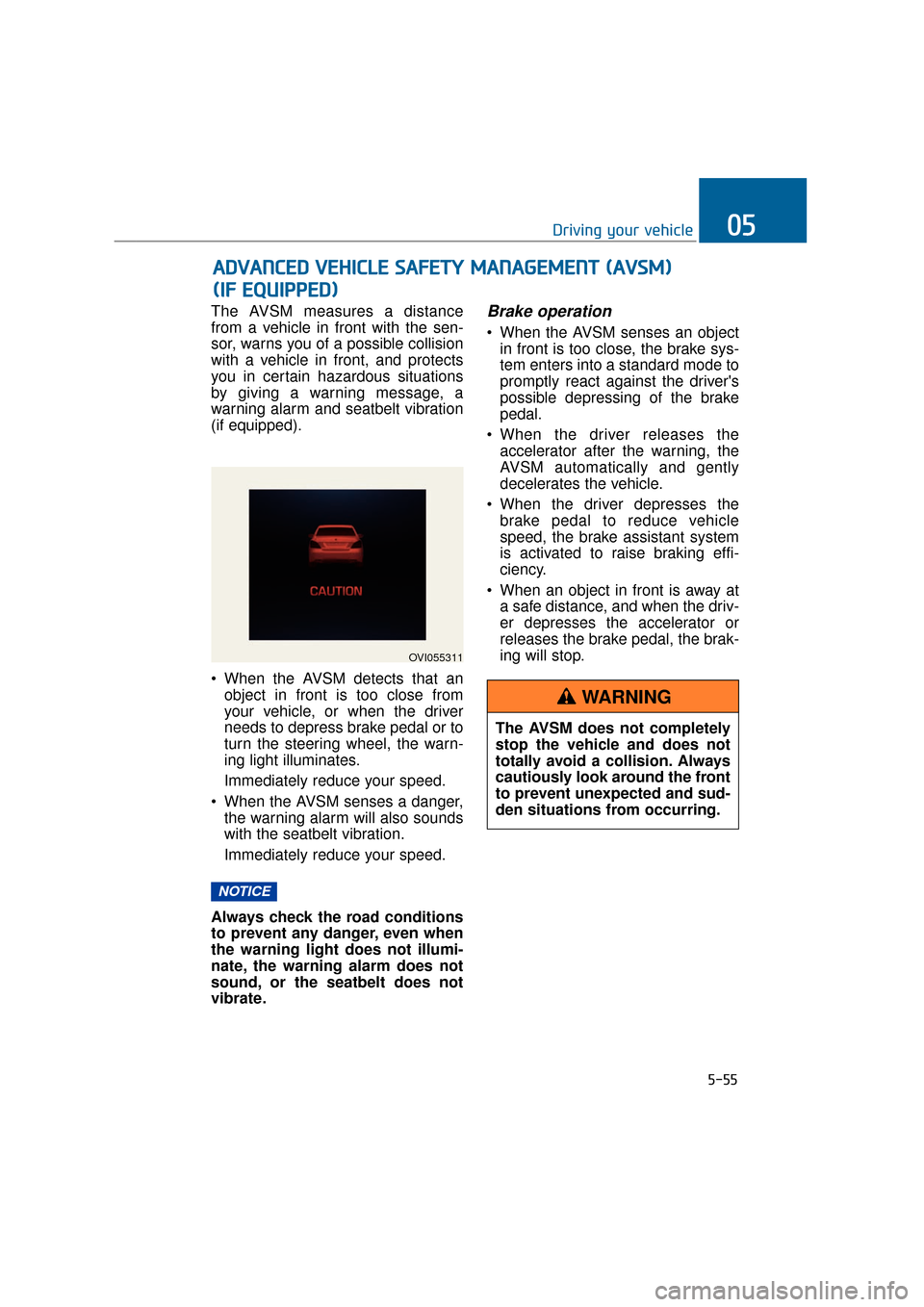
When the AVSM detects that anobject in front is too close from
your vehicle, or when the driver
needs to depress brake pedal or to
turn the steering wheel, the warn-
ing light illuminates.
Immediately reduce your speed.
When the AVSM senses a danger, the warning alarm will also sounds
with the seatbelt vibration.
Immediately reduce your speed.
Always check the road conditions
to prevent any danger, even when
the warning light does not illumi-
nate, the warning alarm does not
sound, or the seatbelt does not
vibrate.Brake operation
When the AVSM senses an object in front is too close, the brake sys-
tem enters into a standard mode to
promptly react against the driver's
possible depressing of the brake
pedal.
When the driver releases the accelerator after the warning, the
AVSM automatically and gently
decelerates the vehicle.
When the driver depresses the brake pedal to reduce vehicle
speed, the brake assistant system
is activated to raise braking effi-
ciency.
When an object in front is away at a safe distance, and when the driv-
er depresses the accelerator or
releases the brake pedal, the brak-
ing will stop.
NOTICE
A AD
DV
VA
A N
N C
CE
E D
D
V
V E
EH
H I
IC
C L
LE
E
S
S A
A F
FE
E T
T Y
Y
M
M A
AN
N A
AG
G E
EM
M E
EN
N T
T
(
( A
A V
VS
SM
M )
)
(
( I
IF
F
E
E Q
Q U
UI
IP
P P
PE
ED
D )
)
OVI055311
The AVSM does not completely
stop the vehicle and does not
totally avoid a collision. Always
cautiously look around the front
to prevent unexpected and sud-
den situations from occurring.
WARNING
Page 307 of 477
Seat belt operating
The seat belt tightens when the vehi-
cle senses a collision.
When the AVSM is activated ordeactivated, make sure that the
vehicle is stopped.
When the engine runs, the AVSM is automatically turned ON. If
unnecessary, select the AVSM
OFF in the User Settings mode.
Even when the AVSM ON is selected in the User Settings
mode, but when the ESC is
turned OFF by pressing the ESC
OFF button, the AVSM is auto-
matically deactivated. Then, it is
impossible to manually control
the AVSM.
Malfunction indicator
The AVSM OFF indicator illumi-nates, when the Engine Start/Stop
button is pressed ON. However, it
goes OFF in approximately 3 sec-
onds. When the indicator does not
illuminate, or continuously remains
ON even after 3 seconds, with the
Engine Start/Stop button ON, or
when the indicator remains ON
while driving, the AVSM does not
properly operate. Take your vehicle
to an authorized EQUUS dealer
and have the system checked.
The AVSM OFF indicator may illu- minate, when the ESC indicator or
SCC indicator illuminates. It does
not indicate a malfunction of the
AVSM.
NOTICE
5-56
Driving your vehicle
The AVSM is not a substitute for
your safe driving practices, but
only a supplementary system. It
is the driver's responsibility to
always check the speed and the
vehicle-to-vehicle distance.
WARNING
The AVSM is activated depend-
ing on the vehicle-to-vehicle
distance, relative velocity and
driver's brake pedal/accelerator
operation. Do not recklessly
drive on purpose to activate the
AVSM.
WARNING
Page 308 of 477
5-57
Driving your vehicle05
Even if there is a malfunctionin AVSM braking, the brake is
normally operable by
depressing the brake pedal.
The AVSM braking does not
operate in certain hazardous
situations.
The AVSM is designed to be active, while driving above
approximately 9.3 mph (15
km/h) and below approximate-
ly 111.8 mph (180 km/h).
The AVSM does not react to: - A person or animal
- An oncoming vehicle inlanes of the opposite direc-
tion or a vehicle in an inter-
section
- A stopped object
The AVSM cannot detect an object in below conditions:
- The sensors are stained orcovered with dirt.
- There is heavy rain or heavy snow.
- There is interference from electromagnetic waves.
- There are strong radar reflections.
- The vehicle drives in a curve.
- The vehicle drives uphill or downhill.
- The vehicle drives in a con- struction area.
- An object in front is very nar- row, such as a motorcycle or
bicycle.
- A vehicle suddenly cuts in front.
(Continued)
(Continued)
The AVSM braking operationin inoperable, when the driver
does not release the accelera-
tor nor depress the brake
pedal.WARNING
Page 316 of 477
5-65
Driving your vehicle05
Your vehicle's fuel economy depends
mainly on your driving style such as
where you drive and when you drive.
Each of these factors affects your
fuel economy (how many miles/kilo-
meters you can drive with a
gallon/liter of fuel). To drive your vehi-
cle as economically as possible, fol-
low the below driving suggestions.
These will help you save in both the
fuel and repair expenses:
Drive smoothly. Accelerate at amoderate rate. Do not make
"jackrabbit" starts or full-throttle
shifts. Maintain a steady cruising
speed. Do not race between stop-
lights. Try to adjust your speed in
accordance with other traffic to
avoid unnecessary speed
changes. Avoid heavy traffic when-
ever possible. Always maintain a
safe distance from a vehicle in
front to avoid unnecessary braking.
This also reduces brake wear-out.
Drive at a moderate speed. The faster you drive, the more fuel your
vehicle uses. Driving at a moderate
speed, in the highest gear appro-
priate for the driving conditions
especially on the highway, is one of
the most effective ways to reduce
fuel consumption.
Do not "ride" the brake pedal. This can increase fuel consumption and
also wear out the brake compo-
nents. In addition, resting your foot
on the brake pedal, while driving,
may overheat the brake, reducing
breaking effects and possibly lead-
ing a serious consequence.
Check your tire conditions. Keep them inflated to the recommended
pressure level. Under or over infla-
tion will unnecessarily tire wear-
out. Check the tire pressures at
least once a month. Make sure that the wheels are cor-
rectly aligned. Hitting a curb or
driving too fast on uneven surfaces
may distort the wheel alignment.
Poor alignment causes faster tire
wear-out and may also result in
other problems as well as greater
fuel consumption.
Keep your vehicle in good condi- tion. For the better fuel economy
and the cheaper maintenance
expenses, maintain your vehicle in
accordance with the maintenance
schedule in the chapter 7. When
you drive your vehicle in harsh con-
ditions, more frequent mainte-
nance is required (refer to the
chapter 7 for further information).
Keep your vehicle clean. Your vehi- cle should be kept clean and away
from any corrosive substances. It is
especially important that mud, dirt,
ice and others are not daubed
under the vehicle. This extra weight
may increase the fuel consumption
and also cause corrosion.
Avoid a heavy loading. Do not carry unnecessary weight in your
vehicle. It will improve your fuel
economy.
Do not let the engine idle longer than necessary. When you wait
(not in traffic), turn OFF the engine.
Then restart the engine, when you
are ready to go.
Remember that your vehicle does not require the engine warm-up for
a long time. After turning On the
engine, run the engine for 10 to 20
seconds, before shifting the gear.
In cold weather, however, your
engine needs a slightly longer
warm-up period.
E EC
CO
O N
NO
O M
M I
IC
C A
A L
L
O
O P
PE
ER
R A
A T
TI
IO
O N
N
Page 317 of 477
5-66
Driving your vehicle
Do not "lug" or "over-rev" the engine. Lugging is to drive too
slowly in a high gear, resulting in
the engine bucking. In this case,
shift to a lower gear. Over-revving
is racing the engine beyond its safe
limit. This can be avoided by decel-
erating to a recommended speed.
Use your air conditioning at inter- vals. The air conditioning system
operates by engine power. Thus,
your fuel economy will decline,
when turning it ON.
Opening the windows, while driv- ing at a high speed, may reduce
the fuel economy.
The fuel economy will decline in the crosswind and headwind. To
offset some of this loss, slow down
the driving speed.
Keeping a vehicle in good operating
condition is important both for the
fuel economy and safety. Therefore,
have your vehicle inspected and
maintained by an authorized EQUUS
dealer on a regular basis. - Turning the engine OFF while
driving
Never turn the engine OFF to
coast down hills or anytime the
vehicle is in motion. The power
steering and power brakes will
not properly operate, when the
engine is turned OFF. Keep the
engine ON and downshift to an
appropriate gear for engine
braking effect. Moreover, turn-
ing OFF the ignition, while driv-
ing, may lock the steering
wheel, blocking the steer wheel
movement and causing a seri-
ous injury or death.
WARNING
Page 318 of 477
5-67
Driving your vehicle05
Hazardous driving conditions
When hazardous driving elements
are encountered such as water,
snow, ice, mud and sand, take these
suggestions:
Drive cautiously and keep a longerbraking distance.
Avoid abrupt braking or steering. When your vehicle is stuck in snow,
mud, or sand, use the second
gear. Accelerate slowly to avoid
unnecessary spinning of the drive
wheels.
Put sand, rock salt, tire chains or other non-slip materials under the
drive wheels to provide additional
traction when being stuck in ice,
snow, or mud.
S SP
P E
EC
CI
IA
A L
L
D
D R
RI
IV
V I
IN
N G
G
C
C O
O N
ND
DI
IT
T I
IO
O N
NS
S
OVI055043N
- ABS
Do not pump the brake pedal,
when your vehicle is equipped
with the ABS.
WARNING
- Downshifting
Downshifting with an automatic
transmission, while driving on
slippery surfaces, may cause an
accident. A sudden speed
change in driving may cause
the tires to skid. Be careful
when downshifting on a slip-
pery surface.
WARNING
Page 321 of 477
5-70
Driving your vehicle
Driving in the rain
Rain and wet roads make driving
dangerous, especially when you are
not prepared for the pavement slick
from rain. Here are a few things to
consider before driving in the rain:
A heavy rainfall will make it harderto see and will increase a braking
distance. Thus, slow down a driv-
ing speed.
Keep your windshield wipers in good shape. Replace your wiper
blades, when those fail to wipe out
some parts on the windshield.
When your tires are in bad shape, quick braking on a wet surface may
cause a skid and possibly lead to
an accident. Make sure your tires
are in good shape.
Turn the headlamps ON to make it easier for others to see you.
Driving at a high speed through large puddles may affect your
brake systems. While driving
through puddles, slow down your
driving speed.
When your brakes are (or are sus- pected to be) wet, lightly apply
them while driving, until the brak-
ing operation returns to normal.
Driving in flooded areas
Avoid driving through a flooded area,
unless you are sure the water level is
lower than the wheel bub bottom.
Slowly drive, when driving through
any water. Keep an adequate stop-
ping distance, because your braking
systems may become wet.
After driving through water, dry the
brakes by gently applying them sev-
eral times, while slowly driving.
Off-road driving
Carefully drive off the road, because
your vehicle may become damaged
by rocks or roots of trees. Check the
off-road conditions, in advance,
where you will drive.
OVI055046N
Page 323 of 477
5-72
Driving your vehicle
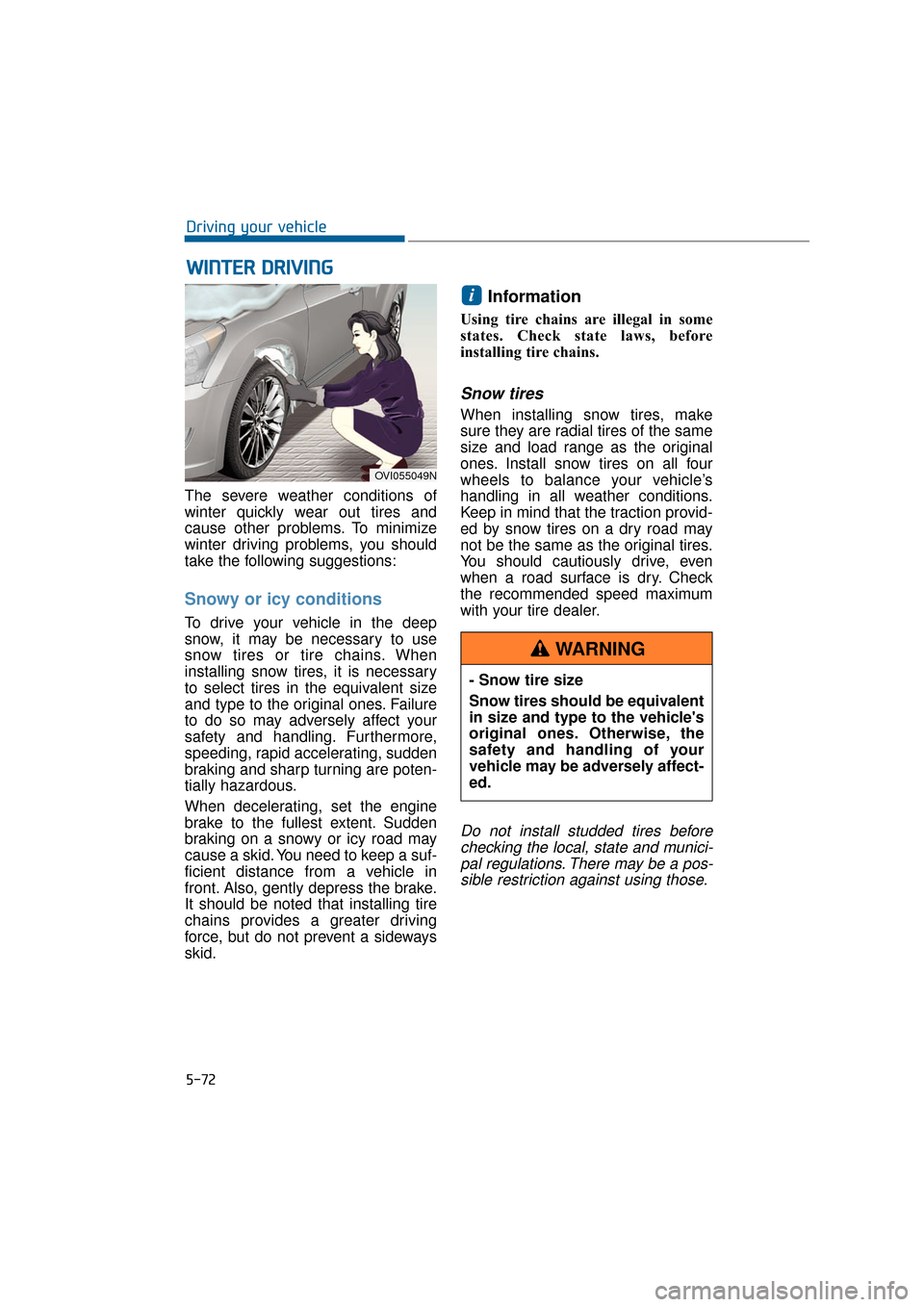
The severe weather conditions of
winter quickly wear out tires and
cause other problems. To minimize
winter driving problems, you should
take the following suggestions:
Snowy or icy conditions
To drive your vehicle in the deep
snow, it may be necessary to use
snow tires or tire chains. When
installing snow tires, it is necessary
to select tires in the equivalent size
and type to the original ones. Failure
to do so may adversely affect your
safety and handling. Furthermore,
speeding, rapid accelerating, sudden
braking and sharp turning are poten-
tially hazardous.
When decelerating, set the engine
brake to the fullest extent. Sudden
braking on a snowy or icy road may
cause a skid. You need to keep a suf-
ficient distance from a vehicle in
front. Also, gently depress the brake.
It should be noted that installing tire
chains provides a greater driving
force, but do not prevent a sideways
skid.
Information
Using tire chains are illegal in some
states. Check state laws, before
installing tire chains.
Snow tires
When installing snow tires, make
sure they are radial tires of the same
size and load range as the original
ones. Install snow tires on all four
wheels to balance your vehicle’s
handling in all weather conditions.
Keep in mind that the traction provid-
ed by snow tires on a dry road may
not be the same as the original tires.
You should cautiously drive, even
when a road surface is dry. Check
the recommended speed maximum
with your tire dealer.
Do not install studded tires before checking the local, state and munici-pal regulations. There may be a pos-sible restriction against using those.
i
W W I
IN
N T
TE
ER
R
D
D R
RI
IV
V I
IN
N G
G
OVI055049N
- Snow tire size
Snow tires should be equivalent
in size and type to the vehicle's
original ones. Otherwise, the
safety and handling of your
vehicle may be adversely affect-
ed.
WARNING
Page 325 of 477
5-74
Driving your vehicle
An AutoSock, which is in the wrong size or is improperly
installed, may damage brake
lines, suspension, body and
wheels of your vehicle.
Stop driving and retighten the AutoSock, whenever there are
snapping sounds between the
vehicle and the AutoSock.
Use high quality ethylene gly-
col coolant
The cooling system of your vehicle is
filled with the high-quality ethylene
glycol coolant when being delivered.
It is the only type of coolant that your
vehicle is filled with, because it pre-
vents corrosion of the cooling sys-
tem, lubricates the water pump and
prevents freezing. Refill the cooling
system in accordance with your
maintenance schedule in the chapter
7. Before winter, check your coolant
to assure that the freezing point is
sufficiently lower than the expected
winter temperature.
Check battery and cables
The winter temperature increases
the battery consumption. Inspect the
battery and cables, as described in
the chapter 7. The battery charging
level can be checked by an author-
ized EQUUS dealer or in a service
station.
Change to "winter weight" oil,
if necessary
In some regions during the cold win-
ter, it is recommended to use the
"winter weight" oil with lower viscosi-
ty. For further information about this,
refer to the chapter 8. When you can-
not be sure about a type of winter
weight oil, consult an authorized
EQUUS dealer.
Check spark plugs and ignition
system
Inspect your spark plugs and, if nec-
essary, replace them. Also check all
ignition wirings and components for
any cracks, wear-out, and damage.
NOTICE
- Chain installation
When installing the AutoSock,
park the vehicle on level ground
away from other vehicles. Press
ON the Hazard Warning flasher
and place a warning triangle
behind your vehicle, if available.
Place the shift lever in P(Park),
set the parking brake and turn
OFF the engine, before
installing the AutoSock.
WARNING
- Tire chains
The use of the AutoSock may
adversely affect vehicle han-
dling.
Do not drive faster than the lower of the two - 20 mph (30
km/h) and the AutoSock manu-
facturer’s recommended
speed limit.
Drive carefully and avoid bumps, holes, sharp turns, and
other road hazards, which may
bounce the vehicle.
Avoid turning sharply or lock- ing the wheel brake.
WARNING