height Hyundai Equus 2016 Owner's Manual
[x] Cancel search | Manufacturer: HYUNDAI, Model Year: 2016, Model line: Equus, Model: Hyundai Equus 2016Pages: 477, PDF Size: 16.25 MB
Page 17 of 477
Interior features...............3-145
Ashtray ...................................3-145
Cup holder..............................3-146
Sunvisor ..................................3-147
Rear vanity mirror ...............3-147
Power outlet ..........................3-148
Clock ........................................3-149
Clothes hanger......................3-150
Bag hanger ............................3-150
Floor mat anchor(s).............3-150
Luggage net (holder) ..........3-151
Rear curtain...........................3-152
AUX, USB and iPod
®port ..3-153
Multimedia system ...............4-2
Antenna.......................................4-2
Steering wheel audio
control .........................................4-3
Before driving ......................5-5
Before entering vehicle ..........5-5
Necessary inspections ............5-5
Before starting ........................5-5
Engine start/stop button ....5-7
Illuminated Engine Start/Stop
Button..........................................5-7
Engine Start/Stop Button
position........................................5-7
Starting the engine..............5-9
Automatic transmission.....5-11
Automatic transmission
operation ..................................5-12
Good driving practices ..........5-15
Brake system ......................5-17
Power brakes ..........................5-17
Electric parking brake
(EPB)..........................................5-19
Emergency braking ................5-22
AUTO HOLD .............................5-23
Anti-lock brake system
(ABS)..........................................5-26
Electronic stability control
(ESC) ..........................................5-28
Hill-start assist control
(HAC) .........................................5-32
Good braking practices.........5-32
Drive mode integrated
control system....................5-34
DRIVE mode / SNOW mode ..5-34
Electronic controlled
suspension (ECS) ...............5-36
To control the vehicle
height ........................................5-36
ECS (Electronic Controlled
Suspension) malfunction
warning message....................5-37
F17
4Multimedia system
5Driving your vehicle
Page 22 of 477
Your vehicle at a glance
Exterior overview (front) .....................................1-2
: Towing hook, Hood, Front windshield wiper blades, Sunroof, Outside rearview mirror, Door locks,
Tires and wheels, Headlamps, Front fog light
Exterior overview (rear) .......................................1-3
: Glass antenna and Defroster, High mounted stop light, Trunk, Rear combination light, Rearview camera,
Parking assist system, Towing hook, Fuel filler lid,
Door locks, Window
Interior overview ....................................................1-4
: Inside door handle, Driver's seat control, Driver position memory system button, Power window switch,
Outside rearview mirror control, Fuel-filler lid opener,
Trunk lid release switch or power trunk main control
switch, Seats, Steering wheel, etc...
Instrument panel overview ...................................1-5
: Instrument cluster, Lighting control lever, Wiper and washer control lever, Engine Start/Stop Button,
Climate control system, Vehicle height control but-
ton, etc...
Engine compartment .............................................1-6
: Engine coolant reservoir, Air cleaner, Engine oil fillercap, Windshield washer fluid reservoir, Fuse box,
Jump start connector, etc...
Page 26 of 477
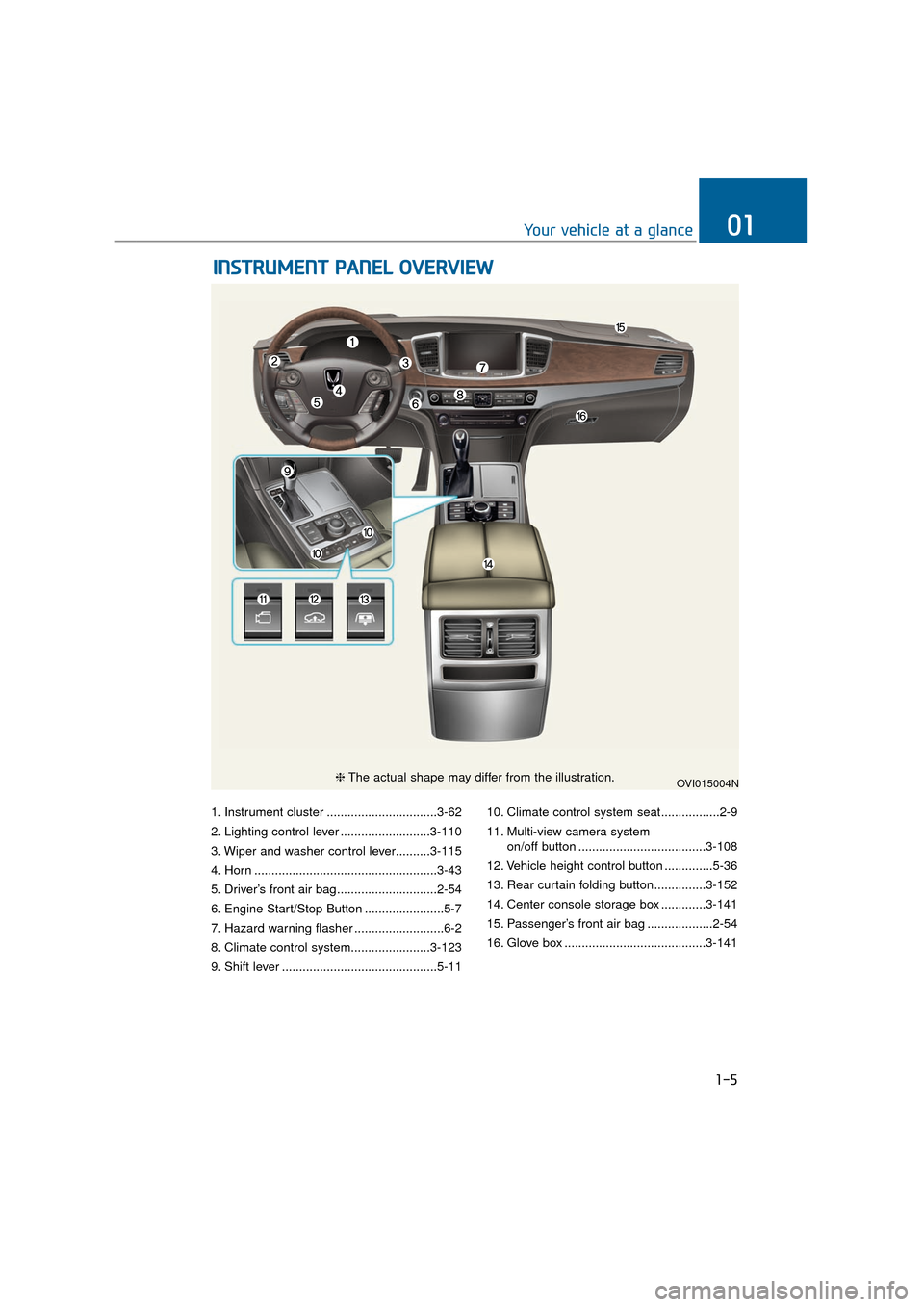
1. Instrument cluster ................................3-62
2. Lighting control lever ..........................3-110
3. Wiper and washer control lever..........3-115
4. Horn .....................................................3-43
5. Driver’s front air bag.............................2-54
6. Engine Start/Stop Button .......................5-7
7. Hazard warning flasher ..........................6-2
8. Climate control system.......................3-123
9. Shift lever .............................................5-1110. Climate control system seat.................2-9
11. Multi-view camera system
on/off button .....................................3-108
12. Vehicle height control button ..............5-36
13. Rear curtain folding button...............3-152
14. Center console storage box .............3-141
15. Passenger’s front air bag ...................2-54
16. Glove box .........................................3-141
I I N
N S
ST
T R
R U
U M
M E
EN
N T
T
P
P A
A N
N E
EL
L
O
O V
VE
ER
R V
V I
IE
E W
W
1-5
Your vehicle at a glance01
OVI015004N❈ The actual shape may differ from the illustration.
Page 29 of 477
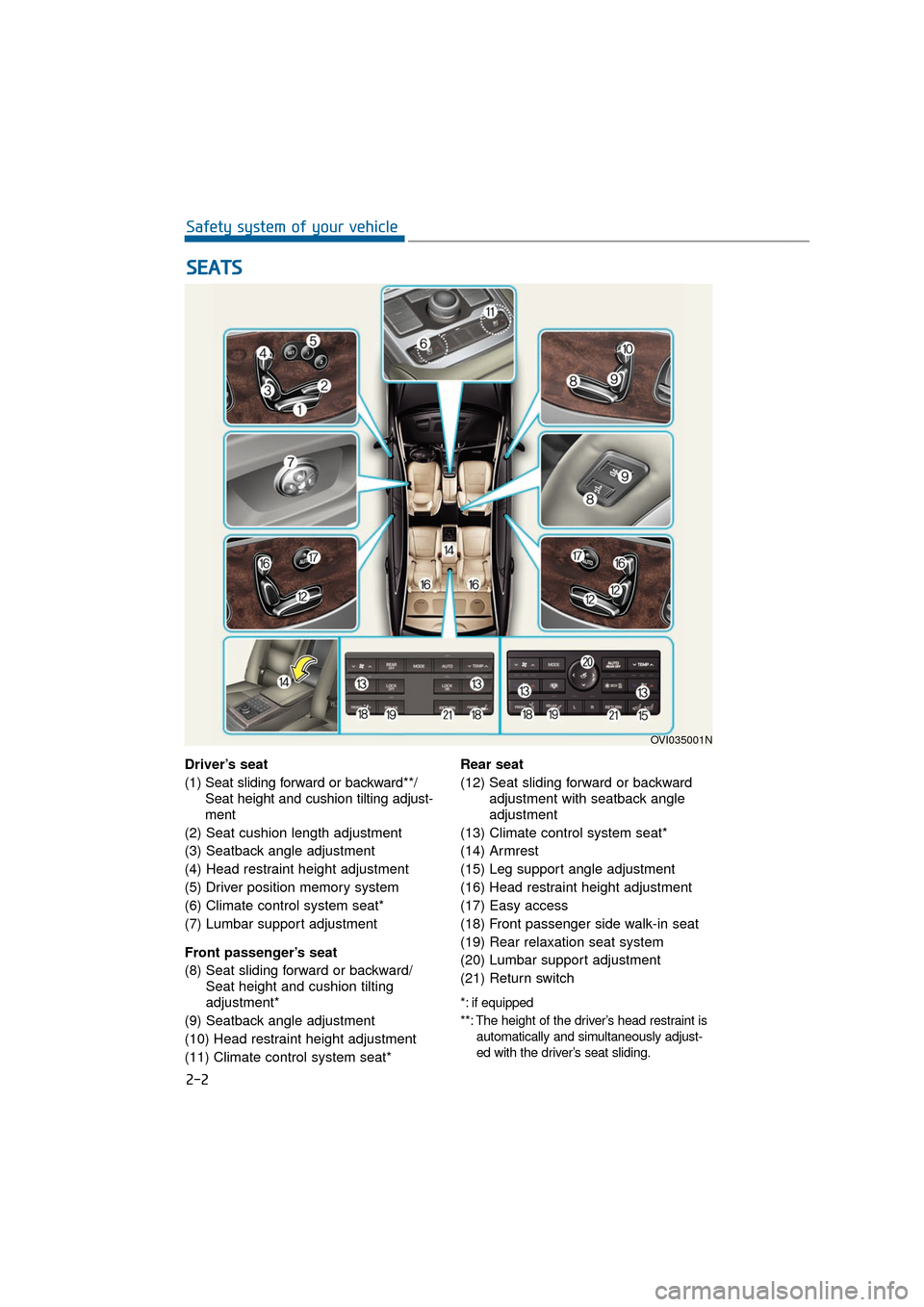
Driver’s seat
(1) Seat sliding forward or backward**/Seat height and cushion tilting adjust-
ment
(2) Seat cushion length adjustment
(3) Seatback angle adjustment
(4) Head restraint height adjustment
(5) Driver position memory system
(6) Climate control system seat*
(7) Lumbar support adjustment
Front passenger’s seat
(8) Seat sliding forward or backward/ Seat height and cushion tilting
adjustment*
(9) Seatback angle adjustment
(10) Head restraint height adjustment
(11) Climate control system seat* Rear seat
(12) Seat sliding forward or backward
adjustment with seatback angle
adjustment
(13) Climate control system seat*
(14) Armrest
(15) Leg support angle adjustment
(16) Head restraint height adjustment
(17) Easy access
(18) Front passenger side walk-in seat
(19) Rear relaxation seat system
(20) Lumbar support adjustment
(21) Return switch
*: if equipped
**: The height of the driver’s head restraint is automatically and simultaneously adjust-
ed with the driver’s seat sliding.
S SE
E A
A T
TS
S
2-2
Safety system of your vehicle
OVI035001N
Page 32 of 477
2-5
Safety system of your vehicle02
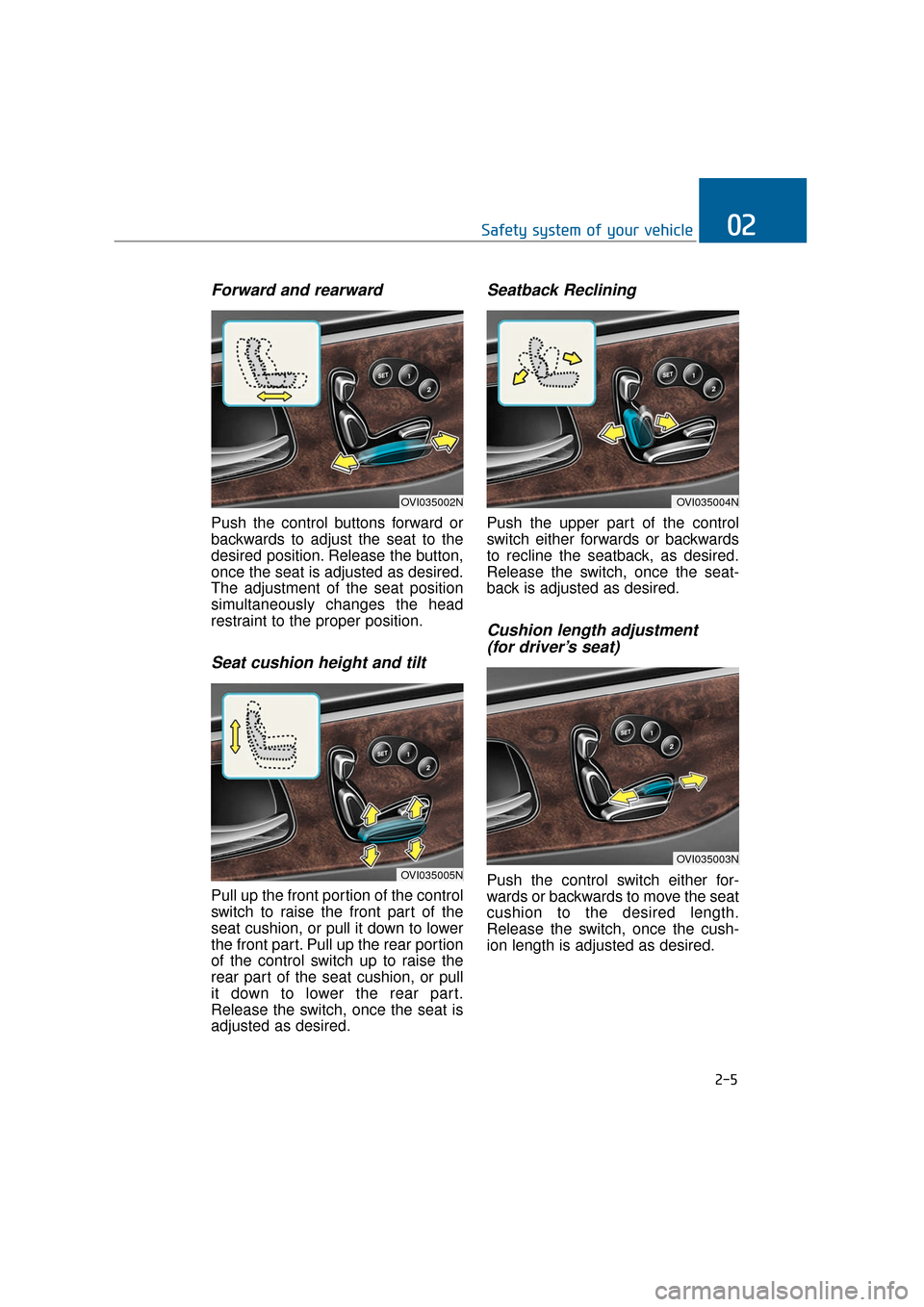
Forward and rearward
Push the control buttons forward or
backwards to adjust the seat to the
desired position. Release the button,
once the seat is adjusted as desired.
The adjustment of the seat position
simultaneously changes the head
restraint to the proper position.
Seat cushion height and tilt
Pull up the front portion of the control
switch to raise the front part of the
seat cushion, or pull it down to lower
the front part. Pull up the rear portion
of the control switch up to raise the
rear part of the seat cushion, or pull
it down to lower the rear part.
Release the switch, once the seat is
adjusted as desired.
Seatback Reclining
Push the upper part of the control
switch either forwards or backwards
to recline the seatback, as desired.
Release the switch, once the seat-
back is adjusted as desired.
Cushion length adjustment (for driver’s seat)
Push the control switch either for-
wards or backwards to move the seat
cushion to the desired length.
Release the switch, once the cush-
ion length is adjusted as desired.
OVI035002N
OVI035005N
OVI035004N
OVI035003N
Page 33 of 477
Lumbar support (for driver’s seat)
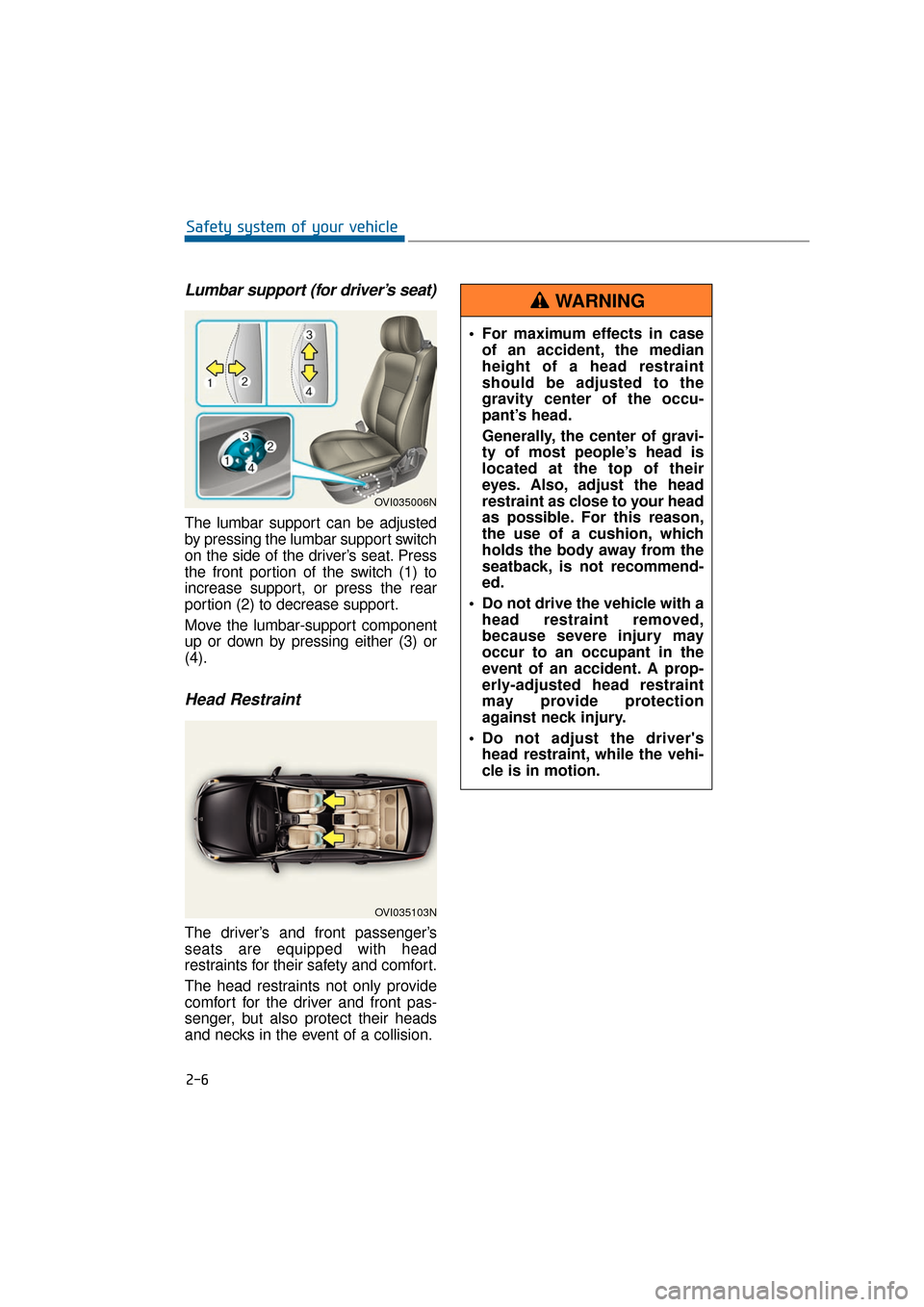
The lumbar support can be adjusted
by pressing the lumbar support switch
on the side of the driver’s seat. Press
the front portion of the switch (1) to
increase support, or press the rear
portion (2) to decrease support.
Move the lumbar-support component
up or down by pressing either (3) or
(4).
Head Restraint
The driver’s and front passenger’s
seats are equipped with head
restraints for their safety and comfort.
The head restraints not only provide
comfort for the driver and front pas-
senger, but also protect their heads
and necks in the event of a collision.
2-6
Safety system of your vehicle
OVI035006N
OVI035103N
For maximum effects in caseof an accident, the median
height of a head restraint
should be adjusted to the
gravity center of the occu-
pant’s head.
Generally, the center of gravi-
ty of most people’s head is
located at the top of their
eyes. Also, adjust the head
restraint as close to your head
as possible. For this reason,
the use of a cushion, which
holds the body away from the
seatback, is not recommend-
ed.
Do not drive the vehicle with a head restraint removed,
because severe injury may
occur to an occupant in the
event of an accident. A prop-
erly-adjusted head restraint
may provide protection
against neck injury.
Do not adjust the driver's head restraint, while the vehi-
cle is in motion.
WARNING
Page 35 of 477
Reinstall
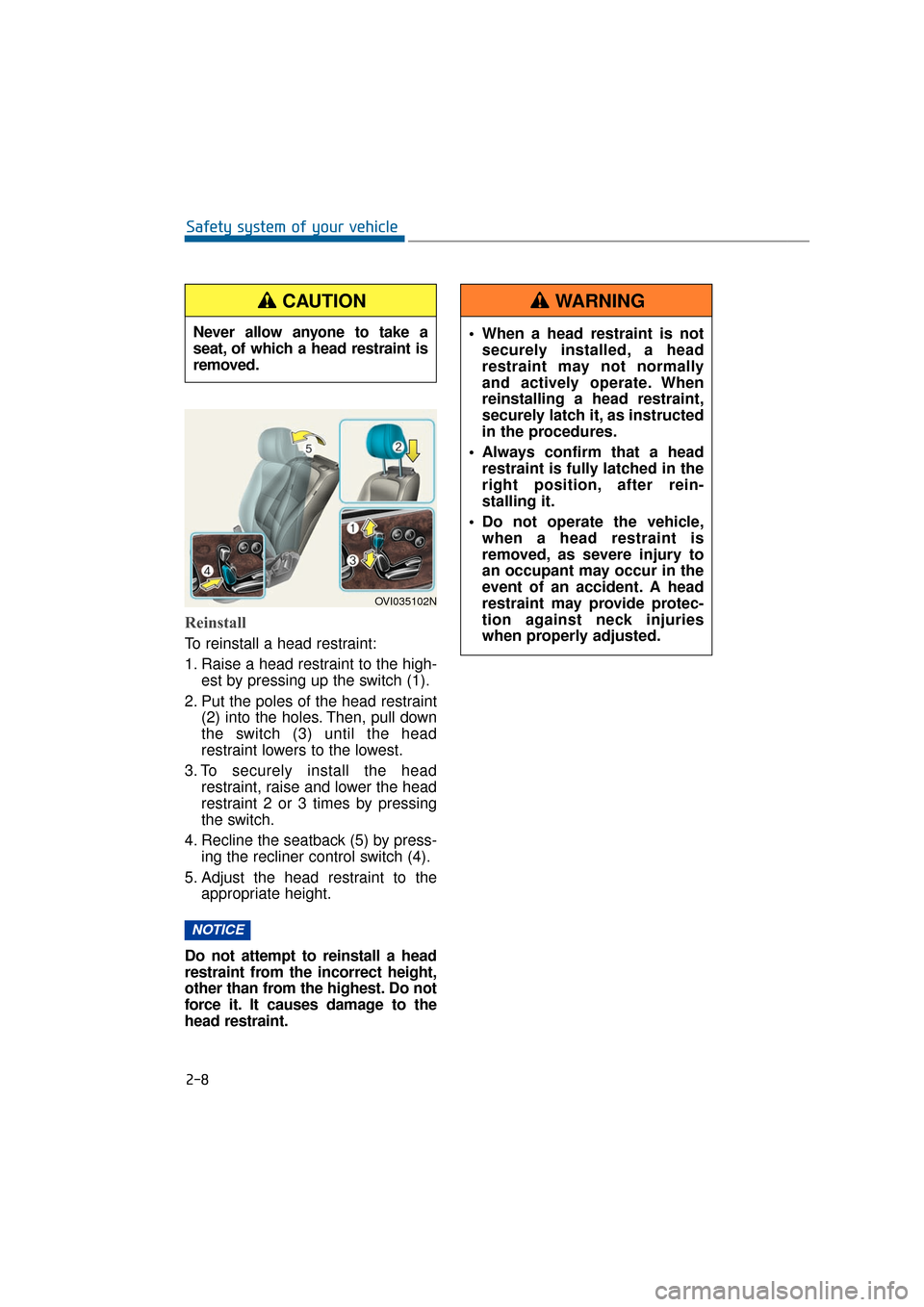
To reinstall a head restraint:
1. Raise a head restraint to the high-est by pressing up the switch (1).
2. Put the poles of the head restraint (2) into the holes. Then, pull down
the switch (3) until the head
restraint lowers to the lowest.
3. To securely install the head restraint, raise and lower the head
restraint 2 or 3 times by pressing
the switch.
4. Recline the seatback (5) by press- ing the recliner control switch (4).
5. Adjust the head restraint to the appropriate height.
Do not attempt to reinstall a head
restraint from the incorrect height,
other than from the highest. Do not
force it. It causes damage to the
head restraint.
NOTICE
2-8
Safety system of your vehicle
OVI035102N
When a head restraint is not securely installed, a head
restraint may not normally
and actively operate. When
reinstalling a head restraint,
securely latch it, as instructed
in the procedures.
Always confirm that a head restraint is fully latched in the
right position, after rein-
stalling it.
Do not operate the vehicle, when a head restraint is
removed, as severe injury to
an occupant may occur in the
event of an accident. A head
restraint may provide protec-
tion against neck injuries
when properly adjusted.
WARNING
Never allow anyone to take a
seat, of which a head restraint is
removed.
CAUTION
Page 44 of 477
Head restraint
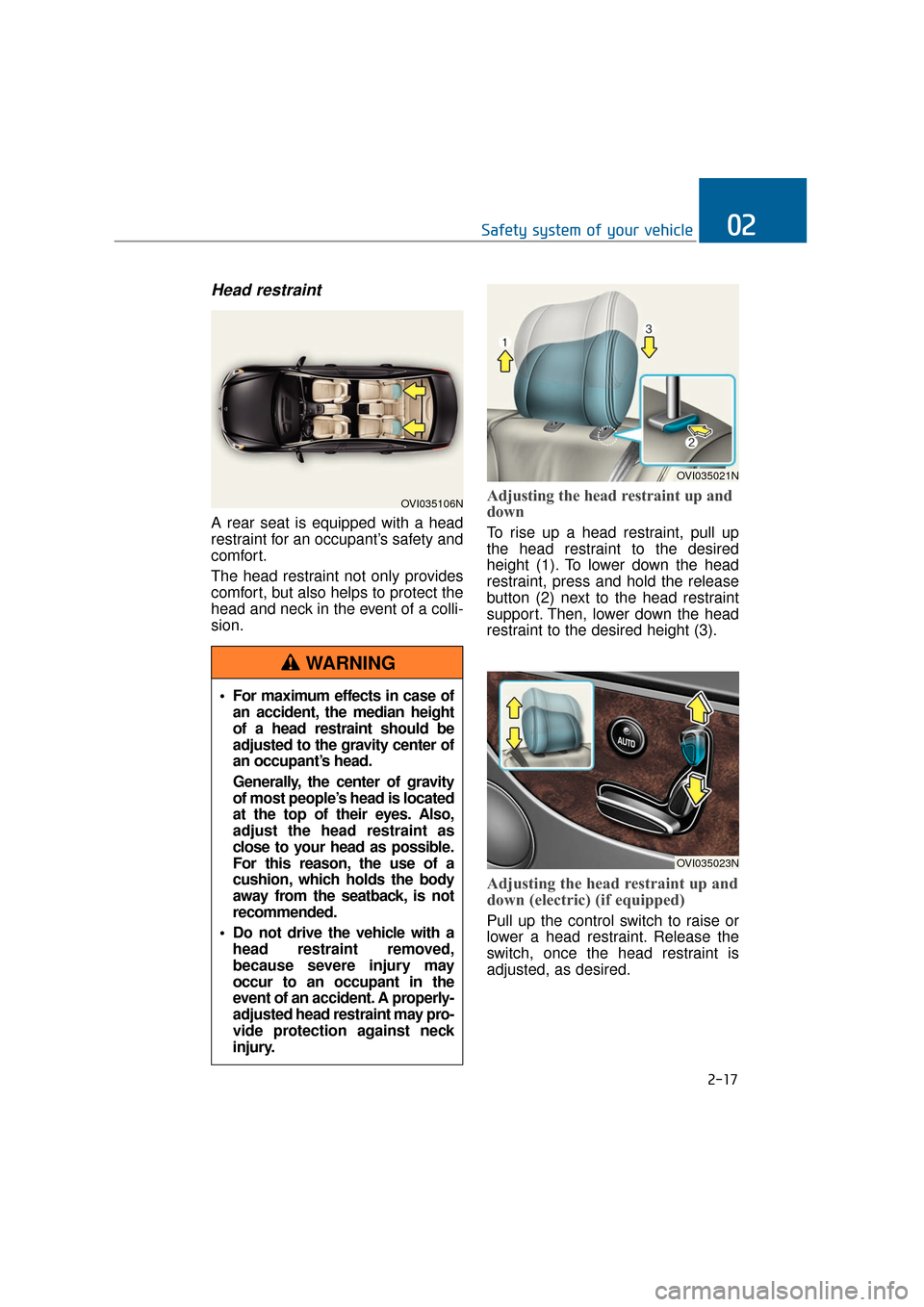
A rear seat is equipped with a head
restraint for an occupant’s safety and
comfort.
The head restraint not only provides
comfort, but also helps to protect the
head and neck in the event of a colli-
sion.
Adjusting the head restraint up and
down
To rise up a head restraint, pull up
the head restraint to the desired
height (1). To lower down the head
restraint, press and hold the release
button (2) next to the head restraint
support. Then, lower down the head
restraint to the desired height (3).
Adjusting the head restraint up and
down (electric) (if equipped)
Pull up the control switch to raise or
lower a head restraint. Release the
switch, once the head restraint is
adjusted, as desired.
2-17
Safety system of your vehicle02
OVI035021N
OVI035023N
For maximum effects in case ofan accident, the median height
of a head restraint should be
adjusted to the gravity center of
an occupant’s head.
Generally, the center of gravity
of most people’s head is located
at the top of their eyes. Also,
adjust the head restraint as
close to your head as possible.
For this reason, the use of a
cushion, which holds the body
away from the seatback, is not
recommended.
Do not drive the vehicle with a head restraint removed,
because severe injury may
occur to an occupant in the
event of an accident. A properly-
adjusted head restraint may pro-
vide protection against neck
injury.
WARNING
OVI035106N
Page 51 of 477

Height adjustment
The anchor height for the shoulder
portion of the belt can be adjusted to
one of the 4 positions for your greatest
comfort and safety.
The anchor height should be adjusted,
so the shoulder portion is fastened
over your chest and midway over the
shoulder nearest the door, not over
your neck.
To adjust the anchor height, rise up or
lower down the adjuster.
To rise up the adjuster, pull it up (1). To
lower it down, push it down (3) while
pressing the height adjuster button (2).
Release the button to lock the anchor
height. Attempt to slide up or down the
adjuster to confirm its locking.
2-24
Safety system of your vehicle
OVI035109N
Front seat
Make sure that the shoulderbelt anchor is securely locked
at an appropriate height.
Never fasten the shoulder
portion of the belt over your
neck or face. Improper fasten-
ing may cause serious injury
in an accident.
(Continued)
WARNING
(Continued)
Failure to replace a seat beltassembly after an accident
may put you in danger,
because the damaged seat
belt will not provide protec-
tion in the event of another
collision, leading to personal
injury or death. Immediately
replace your seat belts after
an accident.
The lap portion of a seat belt
should be fastened as low as
possible and snugly across your
hips, not on your waist. When
the lap belt is fastened too high
on your waist, it may increase
injury risk in the event of a colli-
sion. Both arms should not be
under or over the belt. Rather,
one should be over and the
other under, as shown in the
illustration.
The seat belt should not be fas-
tened under the driver's left arm,
or the front passenger's right
arm.
WARNING
OVI035110N
Page 56 of 477

2-29
Safety system of your vehicle02
Automatic Seat Belt Retracting
In order to prevent a seat belt from
being slack due to weak fabric dura-
bility, your seat belt assembly is
equipped with the automatic retract-
ing function. A motor automatically
retracts the seat belt after approxi-
mately 3 seconds. However, this
does not operate, when the seat belt
is unfastened with little slack.
Seat belt precautions
Infant or small child
All 50 states have child restraint laws
which require children to travel in
approved child restraint devices,
including booster seats. The ages, at
which seat belts may be used
instead of child restraints, differ
among states, so you should check
the specific requirements in your
state before driving. Infant and child
restraints must be properly placed
and installed in a rear seat.
For further information, refer to the
Child Restraint Systems chapter.
All occupants of the vehicle
must and always fasten their
seat belts. Seat belts and child
restraints reduce the risk of
serious or fatal injury in the
event of a collision or a sudden
stop. Without fastening a seat
belt, occupants may fall too
close to a deploying air bag,
strike the interior structure or
be thrown out of the vehicle.
Proper fastening greatly
reduces these hazards.
Even with advanced air bag
technologies, unbelted occu-
pants may be severely injured
due to air bag inflation. Always
follow the precautions about
seat belts, air bags and occu-
pant safety contained in this
manual.
WARNING
Every person in your vehicle
needs to be properly and
always restrained, including
infants and children. Never hold
a child in your arms or on your
laps when riding in a vehicle.
The violent impact in a crash
may force you miss the child
from your arms and the child
may strike against the vehicle
interior.
Always use a child restraint
appropriate for your child's
height and weight.
WARNING