engine oil Hyundai Genesis 2010 Owner's Guide
[x] Cancel search | Manufacturer: HYUNDAI, Model Year: 2010, Model line: Genesis, Model: Hyundai Genesis 2010Pages: 399, PDF Size: 10 MB
Page 344 of 399
729
Maintenance
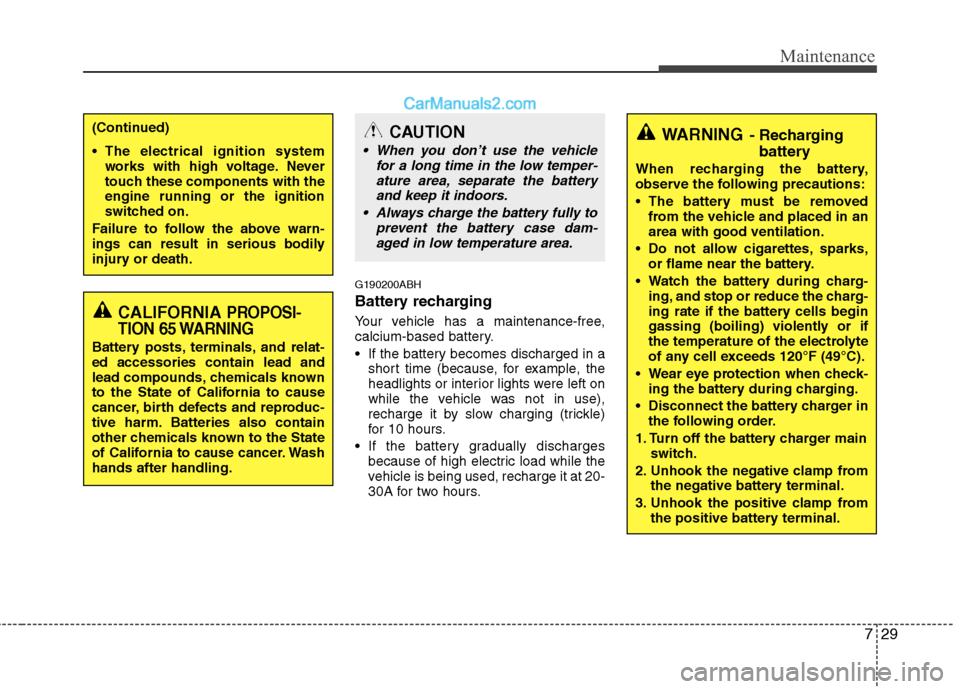
G190200ABH
Battery recharging
Your vehicle has a maintenance-free,
calcium-based battery.
If the battery becomes discharged in a
short time (because, for example, the
headlights or interior lights were left on
while the vehicle was not in use),
recharge it by slow charging (trickle)
for 10 hours.
If the battery gradually discharges
because of high electric load while the
vehicle is being used, recharge it at 20-
30A for two hours.
WARNING- Recharging
battery
When recharging the battery,
observe the following precautions:
The battery must be removed
from the vehicle and placed in an
area with good ventilation.
Do not allow cigarettes, sparks,
or flame near the battery.
Watch the battery during charg-
ing, and stop or reduce the charg-
ing rate if the battery cells begin
gassing (boiling) violently or if
the temperature of the electrolyte
of any cell exceeds 120°F (49°C).
Wear eye protection when check-
ing the battery during charging.
Disconnect the battery charger in
the following order.
1. Turn off the battery charger main
switch.
2. Unhook the negative clamp from
the negative battery terminal.
3. Unhook the positive clamp from
the positive battery terminal.
CALIFORNIA PROPOSI-
TION 65 WARNING
Battery posts, terminals, and relat-
ed accessories contain lead and
lead compounds, chemicals known
to the State of California to cause
cancer, birth defects and reproduc-
tive harm. Batteries also contain
other chemicals known to the State
of California to cause cancer. Wash
hands after handling.
CAUTION
When you don’t use the vehicle
for a long time in the low temper-
ature area, separate the battery
and keep it indoors.
Always charge the battery fully to
prevent the battery case dam-
aged in low temperature area.
(Continued)
The electrical ignition system
works with high voltage. Never
touch these components with the
engine running or the ignition
switched on.
Failure to follow the above warn-
ings can result in serious bodily
injury or death.
Page 366 of 399
751
Maintenance
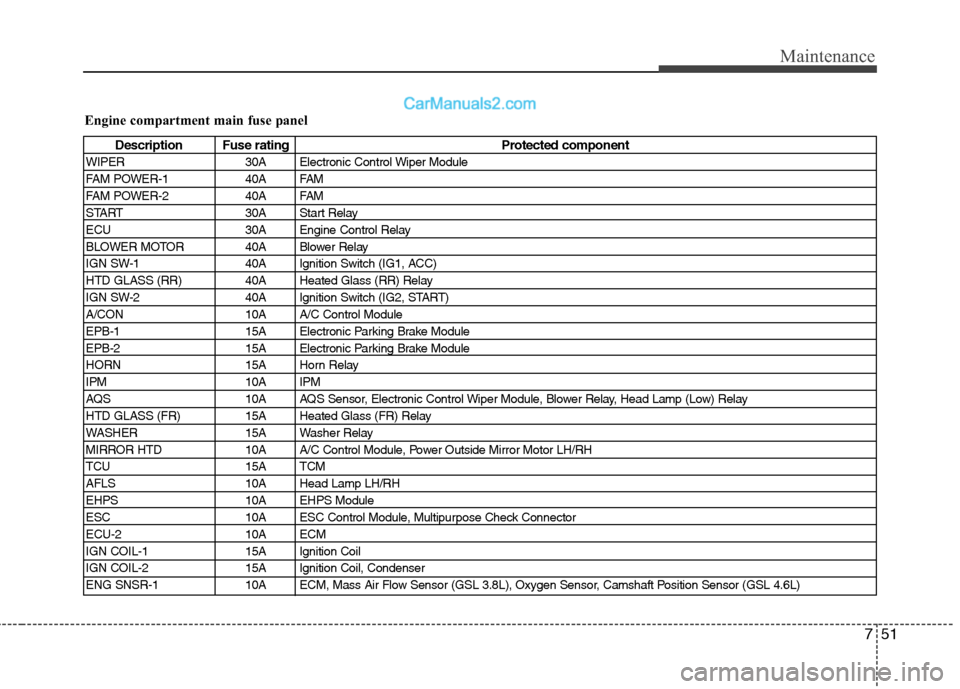
Engine compartment main fuse panel
Description Fuse rating Protected component
WIPER 30A Electronic Control Wiper Module
FAM POWER-1 40A FAM
FAM POWER-2 40A FAM
START 30A Start Relay
ECU 30A Engine Control Relay
BLOWER MOTOR 40A Blower Relay
IGN SW-1 40A Ignition Switch (IG1, ACC)
HTD GLASS (RR) 40A Heated Glass (RR) Relay
IGN SW-2 40A Ignition Switch (IG2, START)
A/CON 10A A/C Control Module
EPB-1 15A Electronic Parking Brake Module
EPB-2 15A Electronic Parking Brake Module
HORN 15A Horn Relay
IPM 10A IPM
AQS 10A AQS Sensor, Electronic Control Wiper Module, Blower Relay, Head Lamp (Low) Relay
HTD GLASS (FR) 15A Heated Glass (FR) Relay
WASHER 15A Washer Relay
MIRROR HTD 10A A/C Control Module, Power Outside Mirror Motor LH/RH
TCU 15A TCM
AFLS 10A Head Lamp LH/RH
EHPS 10A EHPS Module
ESC 10A ESC Control Module, Multipurpose Check Connector
ECU-2 10A ECM
IGN COIL-1 15A Ignition Coil
IGN COIL-2 15A Ignition Coil, Condenser
ENG SNSR-1 10A ECM, Mass Air Flow Sensor (GSL 3.8L), Oxygen Sensor, Camshaft Position Sensor (GSL 4.6L)
Page 387 of 399
Specifications, Consumer information, Reporting safety defeccts
4 8
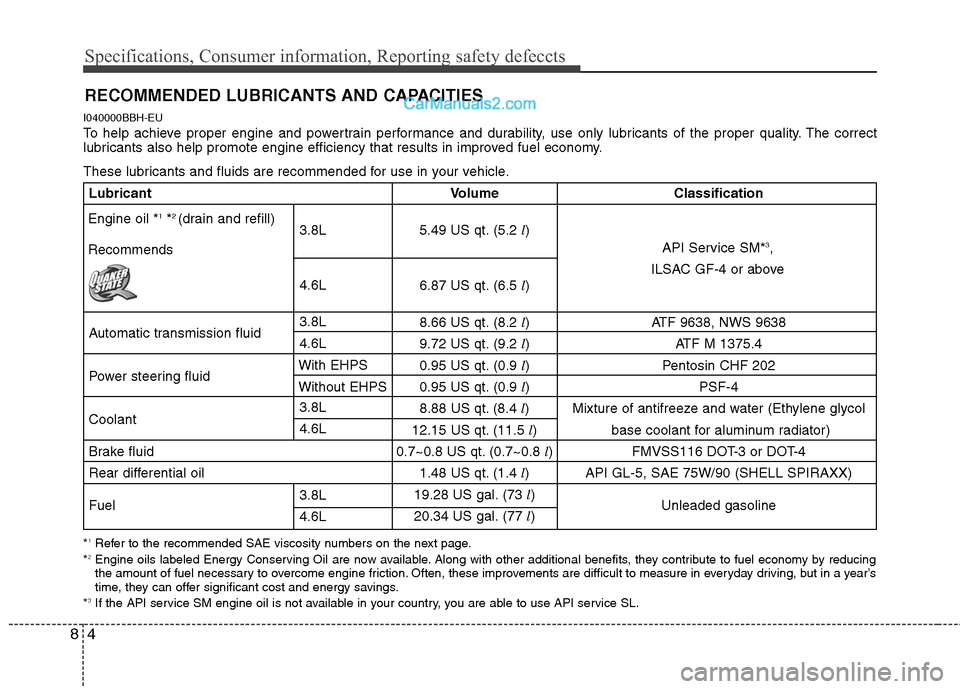
RECOMMENDED LUBRICANTS AND CAPACITIES
I040000BBH-EU
To help achieve proper engine and powertrain performance and durability, use only lubricants of the proper quality. The correct
lubricants also help promote engine efficiency that results in improved fuel economy.
These lubricants and fluids are recommended for use in your vehicle.
*1Refer to the recommended SAE viscosity numbers on the next page.
*2Engine oils labeled Energy Conserving Oil are now available. Along with other additional benefits, they contribute to fuel economy by reducing
the amount of fuel necessary to overcome engine friction. Often, these improvements are difficult to measure in everyday driving, but in a year’s
time, they can offer significant cost and energy savings.
*
3If the API service SM engine oil is not available in your country, you are able to use API service SL.
Lubricant Volume Classification
5.49 US qt. (5.2 l)
6.87 US qt. (6.5 l)
Automatic transmission fluid 8.66 US qt. (8.2 l) ATF 9638, NWS 9638
9.72 US qt. (9.2 l) ATF M 1375.4
Power steering fluid0.95 US qt. (0.9 l) Pentosin CHF 202
0.95 US qt. (0.9 l) PSF-4
8.88 US qt. (8.4 l) Mixture of antifreeze and water (Ethylene glycol
Coolant
12.15 US qt. (11.5 l) base coolant for aluminum radiator)
Brake fluid 0.7~0.8 US qt. (0.7~0.8 l) FMVSS116 DOT-3 or DOT-4
Rear differential oil 1.48 US qt. (1.4 l) API GL-5, SAE 75W/90 (SHELL SPIRAXX)
Fuel19.28 US gal. (73 l)
Unleaded gasoline
20.34 US gal. (77 l)
Engine oil *1*2 (drain and refill)
Recommends3.8L
4.6L
3.8L
4.6L
With EHPS
Without EHPS
3.8L
4.6LAPI Service SM*
3,
ILSAC GF-4 or above
3.8L
4.6L
Page 388 of 399
85
Specifications, Consumer information, Reporting safety defeccts
I040100ABH-EU
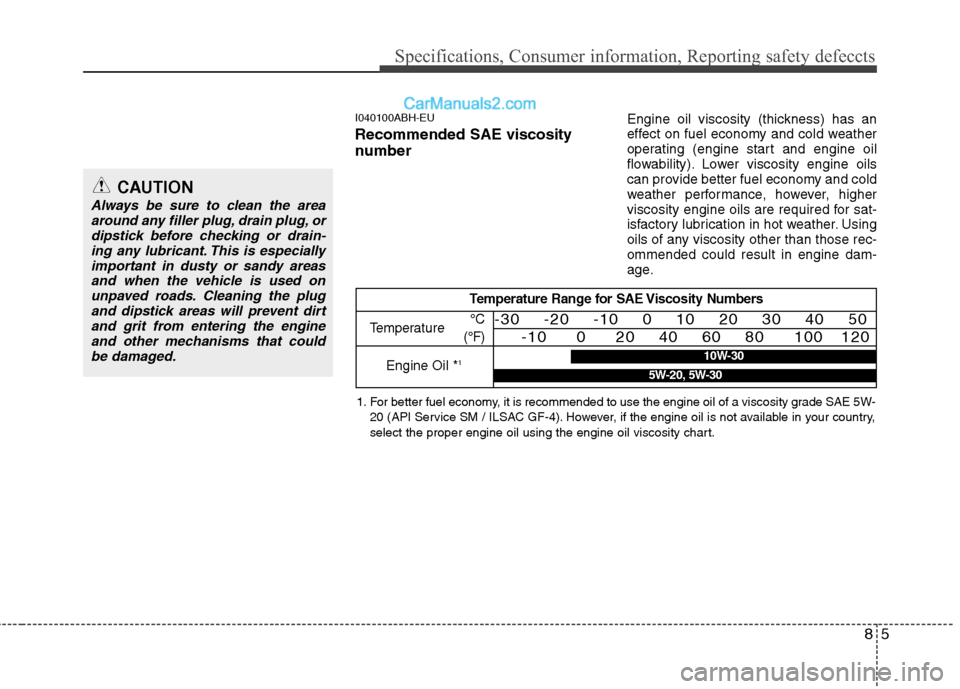
Recommended SAE viscosity
number
Engine oil viscosity (thickness) has an
effect on fuel economy and cold weather
operating (engine start and engine oil
flowability). Lower viscosity engine oils
can provide better fuel economy and cold
weather performance, however, higher
viscosity engine oils are required for sat-
isfactory lubrication in hot weather. Using
oils of any viscosity other than those rec-
ommended could result in engine dam-
age.
CAUTION
Always be sure to clean the area
around any filler plug, drain plug, or
dipstick before checking or drain-
ing any lubricant. This is especially
important in dusty or sandy areas
and when the vehicle is used on
unpaved roads. Cleaning the plug
and dipstick areas will prevent dirt
and grit from entering the engine
and other mechanisms that could
be damaged.
Temperature Range for SAE Viscosity Numbers
Temperature
Engine Oil *
1
°C
(°F)-30 -20 -10 0 10 20 30 40 50
-10 0 20 40 60 80 100 120
1. For better fuel economy, it is recommended to use the engine oil of a viscosity grade SAE 5W-
20 (API Service SM / ILSAC GF-4). However, if the engine oil is not available in your country,
select the proper engine oil using the engine oil viscosity chart.
10W-30
5W-20, 5W-30
Page 395 of 399

I3
Index
Defroster ······································································ 4-84
Dimensions ···································································· 8-2
Door locks ··································································· 4-16
Central door lock switch ··········································· 4-17
Child-protector rear door lock ··································· 4-19
Driver position memory system ·································· 4-34
Economical operation ·················································· 5-48
Emergency starting ························································ 6-4
Jump starting ······························································· 6-4
Push starting ································································ 6-5
Emission control system ·············································· 7-65
Crankcase emission control system ·························· 7-65
Evaporative emission control (including ORVR:
Onboard Refueling Vapor Recovery) System ········· 7-65
Exhaust emission control system ······························ 7-66
Engine compartment ·············································· 2-4, 7-2
Engine coolant ····························································· 7-16
Engine number ······························································· 8-7
Engine oil ····································································· 7-15
Engine start/stop button ················································· 5-7
Engine start/stop button position ································· 5-7
Starting the engine ······················································· 5-9
Explanation of scheduled maintenance items ············· 7-12Foot parking brake ·························································7-22
Fuel filler lid ································································ 4-28
Emergency fuel filer lid release ································ 4-30
Fuel requirements ·························································· 1-3
Fuses ············································································ 7-44
Fuse/relay panel description ······································ 7-48
Main fuse ··································································· 7-47
Memory fuse ····························································· 7-46
Hazard warning flasher ················································ 4-72
Hood ············································································ 4-27
How to use this manual ················································· 1-2
If the engine overheats ·················································· 6-6
If the engine will not start ············································· 6-3
If you have a flat tire ··················································· 6-12
Changing tires ··························································· 6-13
Compact spare tire ····················································· 6-18
Jack and tools ···························································· 6-12
Removing and storing the spare tire ························· 6-13
In case of an emergency while driving ·························· 6-2
Indicator symbols on the instrument cluster ················· 1-7
D
E
F
H
I