belt Hyundai Genesis 2011 Owner's Guide
[x] Cancel search | Manufacturer: HYUNDAI, Model Year: 2011, Model line: Genesis, Model: Hyundai Genesis 2011Pages: 409, PDF Size: 38.54 MB
Page 49 of 409
Safety features of your vehicle
30 3
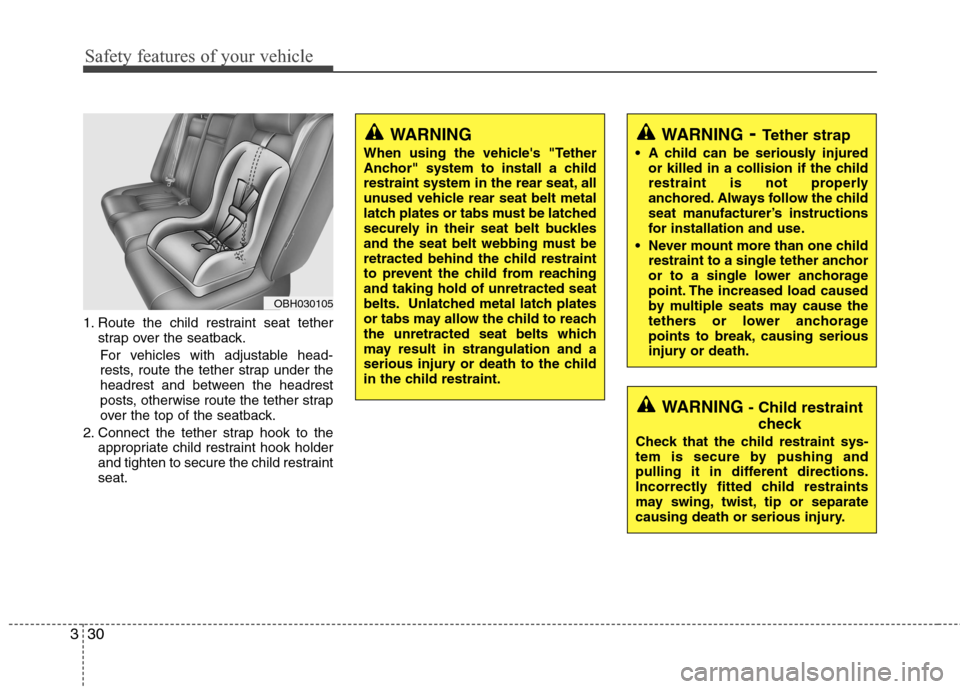
1. Route the child restraint seat tether
strap over the seatback.
For vehicles with adjustable head-
rests, route the tether strap under the
headrest and between the headrest
posts, otherwise route the tether strap
over the top of the seatback.
2. Connect the tether strap hook to the
appropriate child restraint hook holder
and tighten to secure the child restraint
seat.
OBH030105
WARNING
When using the vehicle's "Tether
Anchor" system to install a child
restraint system in the rear seat, all
unused vehicle rear seat belt metal
latch plates or tabs must be latched
securely in their seat belt buckles
and the seat belt webbing must be
retracted behind the child restraint
to prevent the child from reaching
and taking hold of unretracted seat
belts. Unlatched metal latch plates
or tabs may allow the child to reach
the unretracted seat belts which
may result in strangulation and a
serious injury or death to the child
in the child restraint.
WARNING - Child restraint
check
Check that the child restraint sys-
tem is secure by pushing and
pulling it in different directions.
Incorrectly fitted child restraints
may swing, twist, tip or separate
causing death or serious injury.
WARNING- Tether strap
A child can be seriously injured
or killed in a collision if the child
restraint is not properly
anchored. Always follow the child
seat manufacturer’s instructions
for installation and use.
Never mount more than one child
restraint to a single tether anchor
or to a single lower anchorage
point. The increased load caused
by multiple seats may cause the
tethers or lower anchorage
points to break, causing serious
injury or death.
Page 50 of 409
331
Safety features of your vehicle
C030104AEN-EU
Securing a child restraint seat with
child seat lower anchor system
Some child seat manufacturers make
child restraint seats that are labeled as
LATCH or LATCH-compatible child
restraint seats. LATCH stands for "Lower
Anchors and Tethers for Children". These
seats include two rigid or webbing
mounted attachments that connect to
two LATCH anchors at specific seating
positions in your vehicle. This type of
child restraint seat eliminates the need to
use seat belts to attach the child seat in
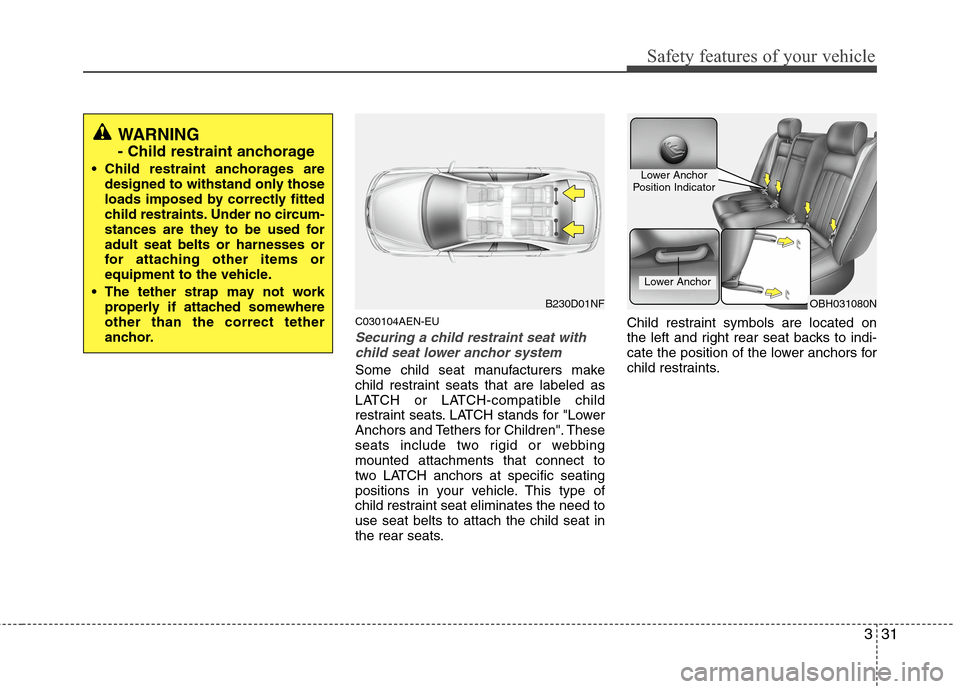
the rear seats.Child restraint symbols are located on
the left and right rear seat backs to indi-
cate the position of the lower anchors for
child restraints.
B230D01NFOBH031080N
WARNING
- Child restraint anchorage
Child restraint anchorages are
designed to withstand only those
loads imposed by correctly fitted
child restraints. Under no circum-
stances are they to be used for
adult seat belts or harnesses or
for attaching other items or
equipment to the vehicle.
The tether strap may not work
properly if attached somewhere
other than the correct tether
anchor.Lower Anchor
Position Indicator
Lower Anchor
Page 51 of 409
Safety features of your vehicle
32 3
LATCH anchors have been provided in
your vehicle. The LATCH anchors are
located in the left and right outboard rear
seating positions. Their locations are
shown in the illustration. There is no
LATCH anchor provided for the center
rear seating position.
The LATCH anchors are located between
the seatback and the seat cushion of the
rear seat left and right outboard seating
positions.
Follow the child seat manufacturer’s
instructions to properly install child
restraint seats with LATCH or LATCH-
compatible attachments.
Once you have installed the LATCH child
restraint, assure that the seat is properly
attached to the LATCH and tether
anchors.
Also, test the child restraint seat before
you place the child in it. Tilt the seat from
side to side. Also try to tug the seat for-
ward. Check to see if the anchors hold
the seat in place.
WARNING
If the child restraint is not anchored
properly, the risk of a child being
seriously injured or killed in a colli-
sion greatly increases.
WARNING - LATCH lower
anchors
LATCH lower anchors are only to
be used with the left and right rear
outboard seating positions. Never
attempt to attach a LATCH
equipped seat in the center seating
position. You may damage the
anchors or the anchors may fail
and break in a collision.
WARNING
When using the vehicle's "LATCH"
system to install a child restraint
system in the rear seat, all unused
vehicle rear seat belt metal latch
plates or tabs must be latched
securely in their seat belt buckles
and the seat belt webbing must be
retracted behind the child restraint
to prevent the child from reaching
and taking hold of unretracted seat
belts. Unlatched metal latch plates
or tabs may allow the child to reach
the unretracted seat belts which
may result in strangulation and a
serious injury or death to the child
in the child restraint.
CAUTION
Do not allow the rear seat belt web-
bing to get scratched or pinched by
the child-seat latch and LATCH
anchor during the installation.
Page 52 of 409
333
Safety features of your vehicle
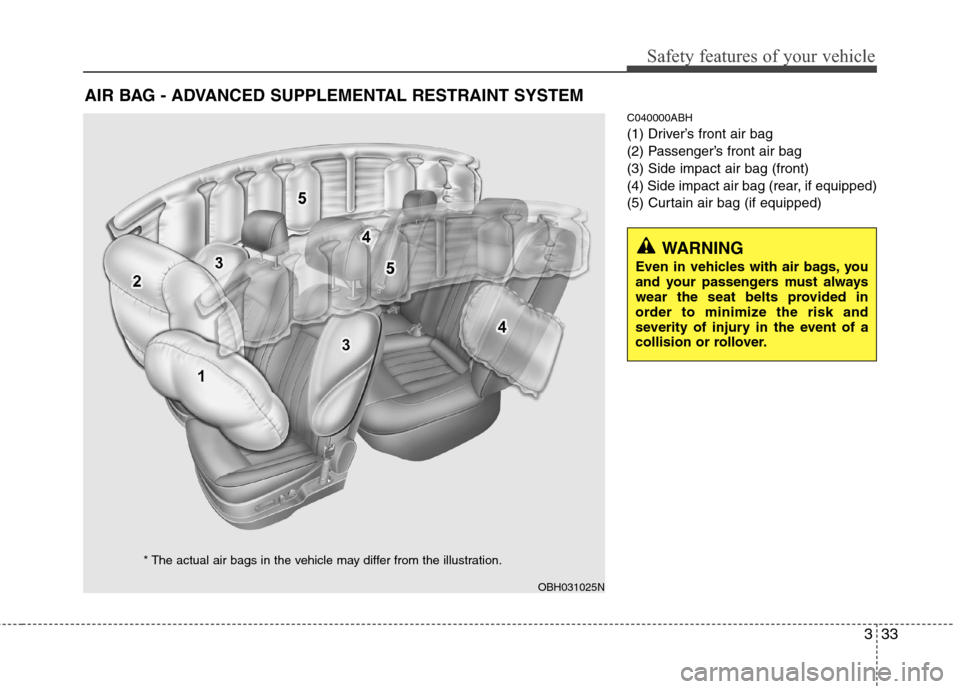
C040000ABH
(1) Driver’s front air bag
(2) Passenger’s front air bag
(3) Side impact air bag (front)
(4) Side impact air bag (rear, if equipped)
(5) Curtain air bag (if equipped)
AIR BAG - ADVANCED SUPPLEMENTAL RESTRAINT SYSTEM
OBH031025N
* The actual air bags in the vehicle may differ from the illustration.
WARNING
Even in vehicles with air bags, you
and your passengers must always
wear the seat belts provided in
order to minimize the risk and
severity of injury in the event of a
collision or rollover.
Page 54 of 409
335
Safety features of your vehicle
C040902AEN
Noise and smoke
When the air bags inflate, they make a loud
noise and they leave smoke and powder in
the air inside of the vehicle. This is normal
and is a result of the ignition of the air bag
inflator. After the air bag inflates, you may
feel substantial discomfort in breathing due
to the contact of your chest with both the
seat belt and the air bag, as well as from
breathing the smoke and powder.Open
your doors and/or windows as soon as
possible after impact in order to reduce
discomfort and prevent prolonged
exposure to the smoke and powder.
Though the smoke and powder are non-
toxic, they may cause irritation to the skin
(eyes, nose and throat, etc). If this is the
case, wash and rinse with cold water
immediately and consult a doctor if the
symptom persists.
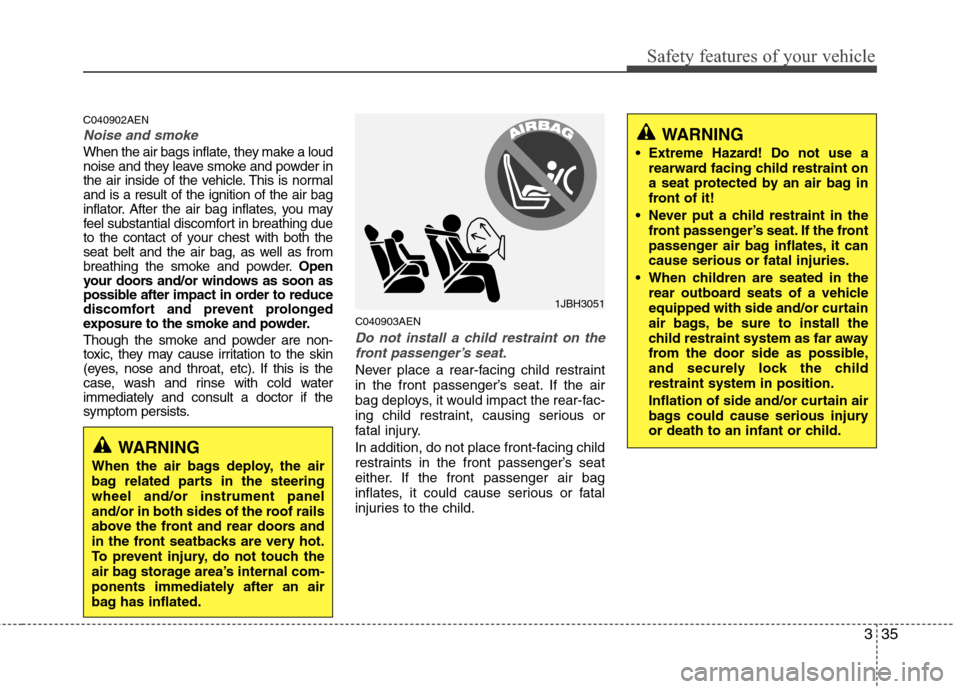
C040903AEN
Do not install a child restraint on the
front passenger’s seat.
Never place a rear-facing child restraint
in the front passenger’s seat. If the air
bag deploys, it would impact the rear-fac-
ing child restraint, causing serious or
fatal injury.
In addition, do not place front-facing child
restraints in the front passenger’s seat
either. If the front passenger air bag
inflates, it could cause serious or fatal
injuries to the child.
1JBH3051
WARNING
When the air bags deploy, the air
bag related parts in the steering
wheel and/or instrument panel
and/or in both sides of the roof rails
above the front and rear doors and
in the front seatbacks are very hot.
To prevent injury, do not touch the
air bag storage area’s internal com-
ponents immediately after an air
bag has inflated.
WARNING
Extreme Hazard! Do not use a
rearward facing child restraint on
a seat protected by an air bag in
front of it!
Never put a child restraint in the
front passenger’s seat. If the front
passenger air bag inflates, it can
cause serious or fatal injuries.
When children are seated in the
rear outboard seats of a vehicle
equipped with side and/or curtain
air bags, be sure to install the
child restraint system as far away
from the door side as possible,
and securely lock the child
restraint system in position.
Inflation of side and/or curtain air
bags could cause serious injury
or death to an infant or child.
Page 55 of 409
Safety features of your vehicle
36 3
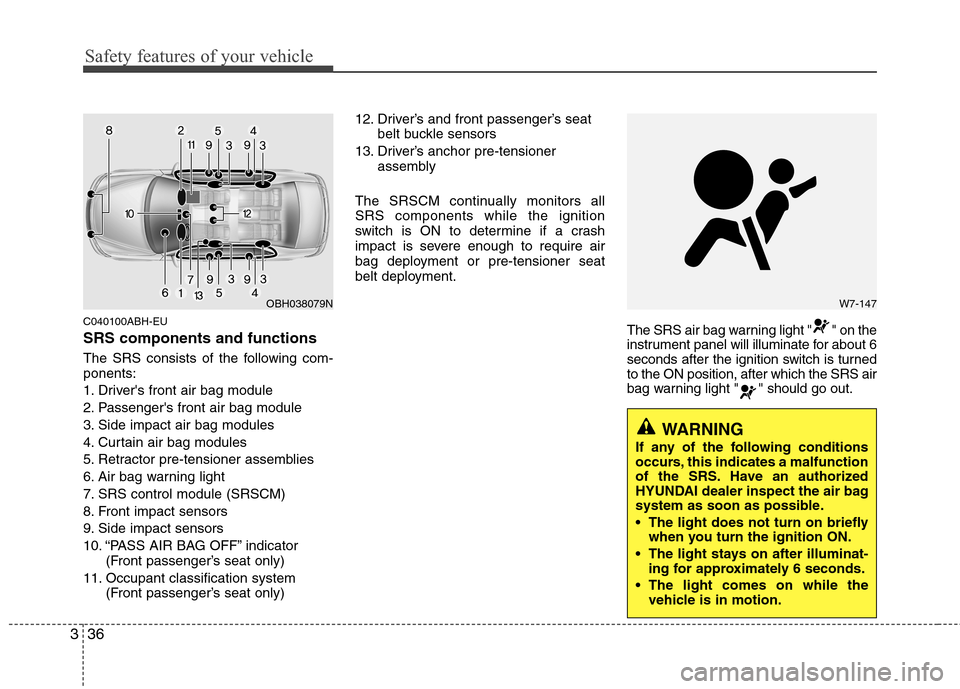
C040100ABH-EU
SRS components and functions
The SRS consists of the following com-
ponents:
1. Driver's front air bag module
2. Passenger's front air bag module
3. Side impact air bag modules
4. Curtain air bag modules
5. Retractor pre-tensioner assemblies
6. Air bag warning light
7. SRS control module (SRSCM)
8. Front impact sensors
9. Side impact sensors
10. “PASS AIR BAG OFF” indicator
(Front passenger’s seat only)
11. Occupant classification system
(Front passenger’s seat only)12. Driver’s and front passenger’s seat
belt buckle sensors
13. Driver’s anchor pre-tensioner
assembly
The SRSCM continually monitors all
SRS components while the ignition
switch is ON to determine if a crash
impact is severe enough to require air
bag deployment or pre-tensioner seat
belt deployment.
The SRS air bag warning light " " on the
instrument panel will illuminate for about 6
seconds after the ignition switch is turned
to the ON position, after which the SRS air
bag warning light " " should go out.
W7-147OBH038079N
WARNING
If any of the following conditions
occurs, this indicates a malfunction
of the SRS. Have an authorized
HYUNDAI dealer inspect the air bag
system as soon as possible.
The light does not turn on briefly
when you turn the ignition ON.
The light stays on after illuminat-
ing for approximately 6 seconds.
The light comes on while the
vehicle is in motion.
Page 56 of 409
337
Safety features of your vehicle
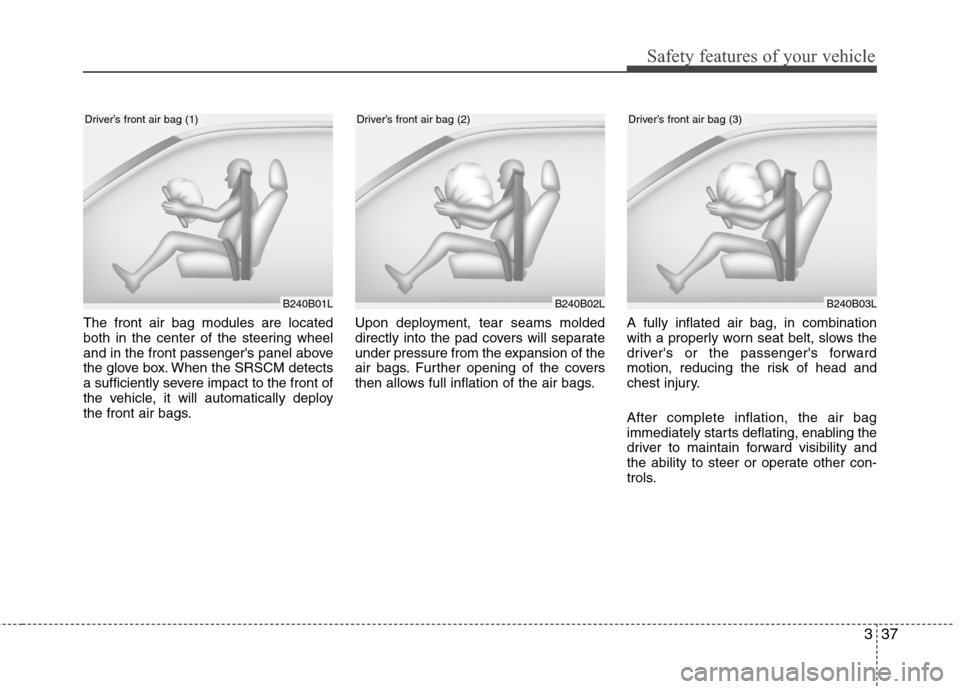
The front air bag modules are located
both in the center of the steering wheel
and in the front passenger's panel above
the glove box. When the SRSCM detects
a sufficiently severe impact to the front of
the vehicle, it will automatically deploy
the front air bags.Upon deployment, tear seams molded
directly into the pad covers will separate
under pressure from the expansion of the
air bags. Further opening of the covers
then allows full inflation of the air bags.A fully inflated air bag, in combination
with a properly worn seat belt, slows the
driver's or the passenger's forward
motion, reducing the risk of head and
chest injury.
After complete inflation, the air bag
immediately starts deflating, enabling the
driver to maintain forward visibility and
the ability to steer or operate other con-
trols.
B240B01L
Driver’s front air bag (1)
B240B02LB240B03L
Driver’s front air bag (2)Driver’s front air bag (3)
Page 58 of 409
339
Safety features of your vehicle
C040300ABH
Occupant classification system
Your vehicle is equipped with an occu-
pant classification system in the front
passenger's seat.
The occupant classification system is
designed to detect the presence of a
properly-seated front passenger and
determine if the passenger's front air bag
should be enabled (may inflate) or not.
The driver's front air bag is not affected
or controlled by the occupant classifica-
tion system.
Main components of occupant
classification system
A detection device located under the
front passenger seat cushion.
Electronic system to determine
whether the passenger air bag sys-
tems (both front and side) should be
activated or deactivated.
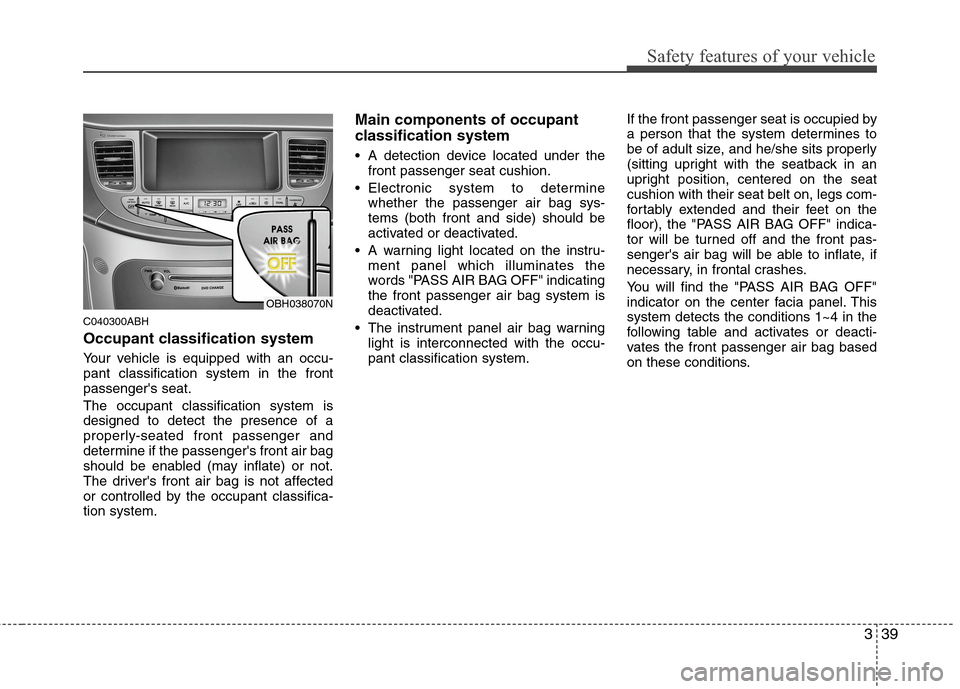
A warning light located on the instru-
ment panel which illuminates the
words "PASS AIR BAG OFF" indicating
the front passenger air bag system is
deactivated.
The instrument panel air bag warning
light is interconnected with the occu-
pant classification system.If the front passenger seat is occupied by
a person that the system determines to
be of adult size, and he/she sits properly
(sitting upright with the seatback in an
upright position, centered on the seat
cushion with their seat belt on, legs com-
fortably extended and their feet on the
floor), the "PASS AIR BAG OFF" indica-
tor will be turned off and the front pas-
senger's air bag will be able to inflate, if
necessary, in frontal crashes.
You will find the "PASS AIR BAG OFF"
indicator on the center facia panel. This
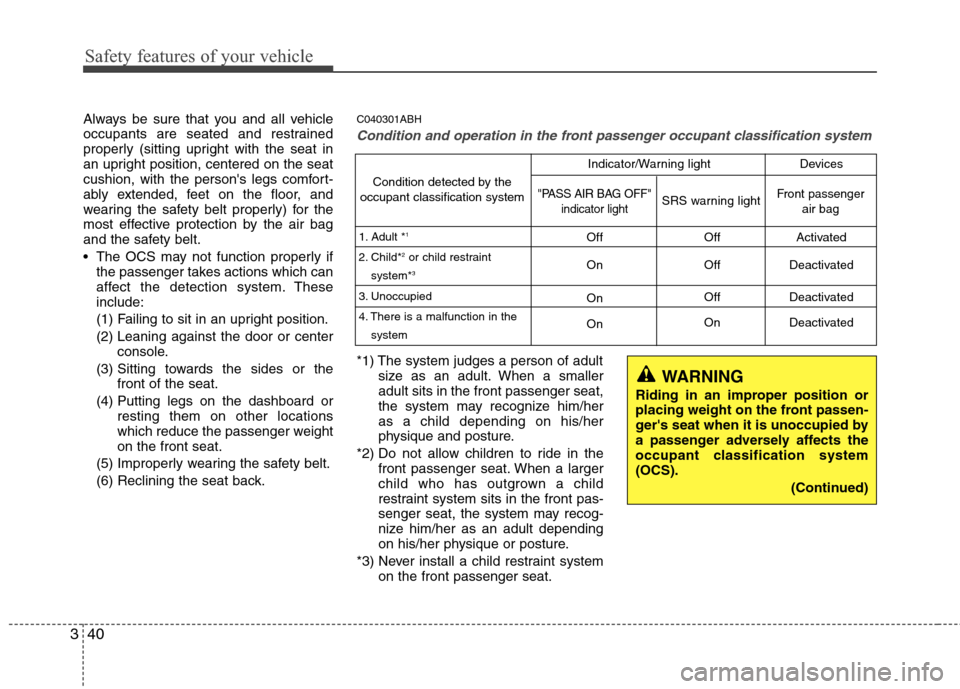
system detects the conditions 1~4 in the
following table and activates or deacti-
vates the front passenger air bag based
on these conditions.
OBH038070N
Page 59 of 409
Safety features of your vehicle
40 3
Always be sure that you and all vehicle
occupants are seated and restrained
properly (sitting upright with the seat in
an upright position, centered on the seat
cushion, with the person's legs comfort-
ably extended, feet on the floor, and
wearing the safety belt properly) for the
most effective protection by the air bag
and the safety belt.
The OCS may not function properly if
the passenger takes actions which can
affect the detection system. These
include:
(1) Failing to sit in an upright position.
(2) Leaning against the door or center
console.
(3) Sitting towards the sides or the
front of the seat.
(4) Putting legs on the dashboard or
resting them on other locations
which reduce the passenger weight
on the front seat.
(5) Improperly wearing the safety belt.
(6) Reclining the seat back.C040301ABH
Condition and operation in the front passenger occupant classification system
*1) The system judges a person of adult
size as an adult. When a smaller
adult sits in the front passenger seat,
the system may recognize him/her
as a child depending on his/her
physique and posture.
*2) Do not allow children to ride in the
front passenger seat. When a larger
child who has outgrown a child
restraint system sits in the front pas-
senger seat, the system may recog-
nize him/her as an adult depending
on his/her physique or posture.
*3) Never install a child restraint system
on the front passenger seat.
WARNING
Riding in an improper position or
placing weight on the front passen-
ger's seat when it is unoccupied by
a passenger adversely affects the
occupant classification system
(OCS).
(Continued)
Condition detected by the
occupant classification system
1. Adult *1
2. Child*2or child restraint
system*3
3. Unoccupied
4. There is a malfunction in the
system
Off
On
On
OnOff
Off
Off
OnActivated
Deactivated
Deactivated
Deactivated
"PASS AIR BAG OFF"
indicator lightSRS warning lightFront passenger
air bag
Indicator/Warning light Devices
Page 61 of 409
Safety features of your vehicle
42 3
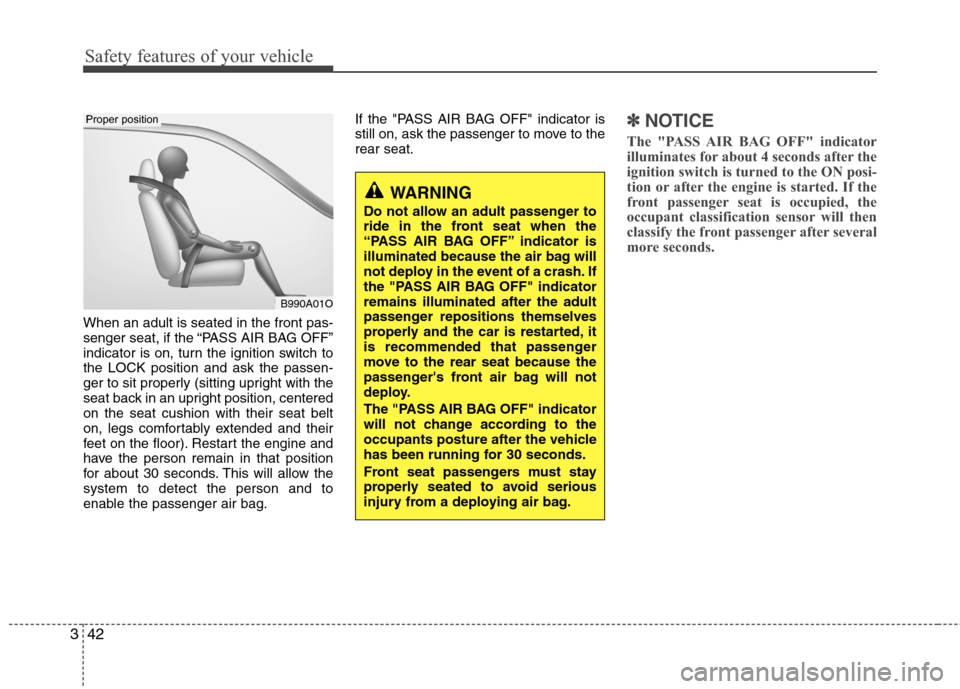
When an adult is seated in the front pas-
senger seat, if the “PASS AIR BAG OFF”
indicator is on, turn the ignition switch to
the LOCK position and ask the passen-
ger to sit properly (sitting upright with the
seat back in an upright position, centered
on the seat cushion with their seat belt
on, legs comfortably extended and their
feet on the floor). Restart the engine and
have the person remain in that position
for about 30 seconds. This will allow the
system to detect the person and to
enable the passenger air bag.If the "PASS AIR BAG OFF" indicator is
still on, ask the passenger to move to the
rear seat.
✽ ✽
NOTICE
The "PASS AIR BAG OFF" indicator
illuminates for about 4 seconds after the
ignition switch is turned to the ON posi-
tion or after the engine is started. If the
front passenger seat is occupied, the
occupant classification sensor will then
classify the front passenger after several
more seconds.
B990A01O
WARNING
Do not allow an adult passenger to
ride in the front seat when the
“PASS AIR BAG OFF” indicator is
illuminated because the air bag will
not deploy in the event of a crash. If
the "PASS AIR BAG OFF" indicator
remains illuminated after the adult
passenger repositions themselves
properly and the car is restarted, it
is recommended that passenger
move to the rear seat because the
passenger's front air bag will not
deploy.
The "PASS AIR BAG OFF" indicator
will not change according to the
occupants posture after the vehicle
has been running for 30 seconds.
Front seat passengers must stay
properly seated to avoid serious
injury from a deploying air bag.
Proper position