back seat Hyundai Genesis 2014 User Guide
[x] Cancel search | Manufacturer: HYUNDAI, Model Year: 2014, Model line: Genesis, Model: Hyundai Genesis 2014Pages: 546, PDF Size: 13.59 MB
Page 41 of 546
2-23
Safety system of your vehicle
2
(Continued)
•Do not place materials such as
plastic bags or newspapers
under the seats. They may
block the air intake causing
the air vents to not work prop-
erly.
•Do not change the seat cov-
ers. It may damage the seat
warmer or cooler.
•If the air vents do not operate,
restart the vehicle. If there is
no change, we recommend
that you have your vehicle
inspected by an authorized
HYUNDAI dealer.
To prevent damage to the seat
warmer, seat cooler and seats:
•Use the seat warmer and cool-
er ONLY when the climate
control system is on. Using
the seat warmer and cooler
for prolonged periods of time
with the climate control sys-
tem off could cause the seat
warmer and cooler to mal-
function.
•Never use a solvent such as
paint thinner, benzene, alco-
hol or gasoline to clean the
seats.
•Avoid spilling liquids on the
surface of the seats and seat-
backs; this may cause the air
vent holes to become blocked
and not work properly.
(Continued)
CAUTION
Page 42 of 546
2-24
Safety system of your vehicle
This section describes how to use the
seat belts properly. It also describes
some of the things not to do when
using seat belts.
Seat belt safety precautions
Always fasten your seat belt and
make sure all passengers have fas-
tened their seat belts before starting
any trip. Air bags (if equipped) are
designed to supplement the seat belt
as an additional safety device, but
they are not a substitute. Most coun-
tries require all occupants of a vehicle
to wear seat belts.
SEAT BELTS
Seat belts must be used by ALL
passengers whenever the vehi-
cle is moving. Take the following
precautions when adjusting and
wearing seat belts:
•ALWAYS properly restrain
children under age 13 in the
rear seats.
•NEVER allow children to ride
in the front passenger seat. If
a child age 13 or older must be
seated in the front seat, move
the seat as far back as possi-
ble and properly restrain them
in the seat.
•NEVER allow an infant or child
to be carried on an occupant’s
lap.
•NEVER ride with the seatback
reclined when the vehicle is
moving.
•Do not allow children to share
a seat or seat belt.
(Continued)
WARNING (Continued)
•Do not wear the shoulder belt
under your arm or behind your
back.
•Never wear a seat belt over
fragile objects. If there is a
sudden stop or impact, the
seat belt can damage it.
•Do not use the seat belt if it is
twisted. A twisted seat belt
will not protect you properly
in an accident.
•Do not use a seat belt if the
webbing or hardware is dam-
aged.
•Do not latch the seat belt into
the buckles of other seats.
•NEVER unfasten the seat belt
while driving. This may cause
loss of vehicle control result-
ing in an accident.
•Make sure there is nothing in
the buckle interfering with the
seat belt latch mechanism.
This may prevent the seat belt
from fastening securely.
(Continued)
Page 47 of 546
2-29
Safety system of your vehicle
2
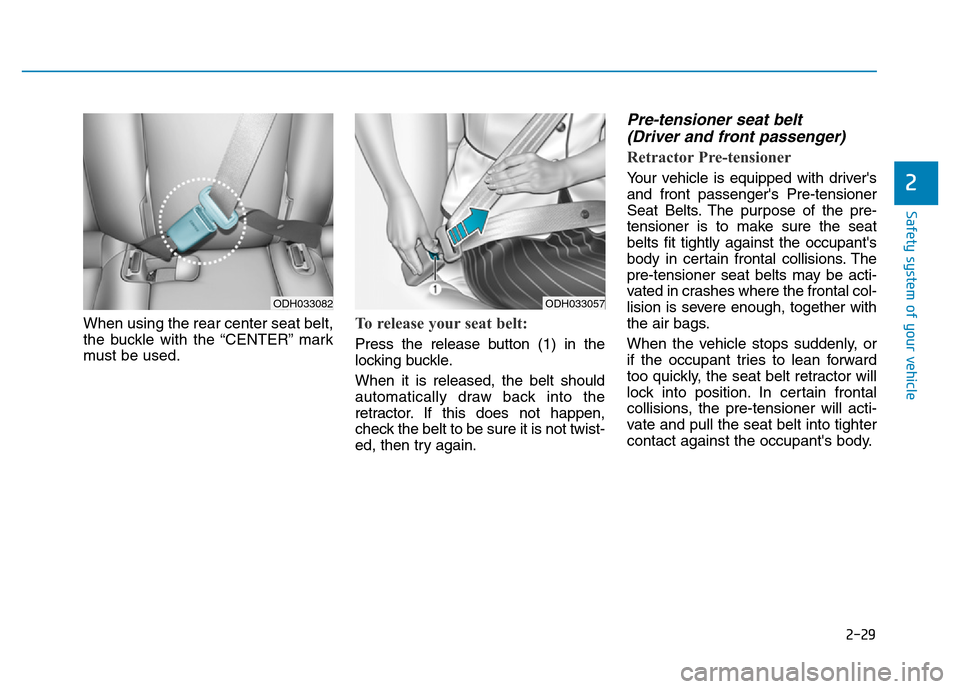
When using the rear center seat belt,
the buckle with the “CENTER” mark
must be used.To release your seat belt:
Press the release button (1) in the
locking buckle.
When it is released, the belt should
automatically draw back into the
retractor. If this does not happen,
check the belt to be sure it is not twist-
ed, then try again.
Pre-tensioner seat belt
(Driver and front passenger)
Retractor Pre-tensioner
Your vehicle is equipped with driver's
and front passenger's Pre-tensioner
Seat Belts. The purpose of the pre-
tensioner is to make sure the seat
belts fit tightly against the occupant's
body in certain frontal collisions. The
pre-tensioner seat belts may be acti-
vated in crashes where the frontal col-
lision is severe enough, together with
the air bags.
When the vehicle stops suddenly, or
if the occupant tries to lean forward
too quickly, the seat belt retractor will
lock into position. In certain frontal
collisions, the pre-tensioner will acti-
vate and pull the seat belt into tighter
contact against the occupant's body.
ODH033057ODH033082
Page 53 of 546
2-35
Safety system of your vehicle
2
Seat belt use and injured people
A seat belt should be used when an
injured person is being transported.
Consult a physician for specific rec-
ommendations.
One person per belt
Two people (including children) should
never attempt to use a single seat belt.
This could increase the severity of
injuries in case of an accident.
Do not lie down
Sitting in a reclined position when
the vehicle is in motion can be dan-
gerous. Even when buckled up, the
protections of your restraint system
(seat belts and/or air bags) is greatly
reduced by reclining your seatback.
Seat belts must be snug against your
hips and chest to work properly.
During an accident, you could be
thrown into the seat belt, causing
neck or other injuries.
The more the seatback is reclined,
the greater chance the passenger’s
hips will slide under the lap belt or
the passenger’s neck will strike the
shoulder belt.
•NEVER ride with a reclined
seatback when the vehicle is
moving.
•Riding with a reclined seatback
increases your chance of seri-
ous or fatal injuries in the event
of a collision or sudden stop.
•Driver and passengers should
always sit well back in their
seats, properly belted, and with
the seatbacks upright.
WARNING
Page 56 of 546
2-38
Safety system of your vehicle
Selecting a Child Restraint
System (CRS)
When selecting a CRS for your child,
always:
• Make sure the CRS has a label
certifying that it meets applicable
Safety Standards of your country.
• Select a child restraint based on
your child’s height and weight. The
required label or the instructions
for use typically provide this infor-
mation.
• Select a child restraint that fits the
vehicle seating position where it
will be used.
• Read and comply with the warn-
ings and instructions for installation
and use provided with the child
restraint system.
Child restraint system types
There are three main types of child
restraint systems: rear-facing seats,
forward-facing seats, and booster
seats. They are classified according
to the child’s age, height and weight.
Rear-facing child restraints
(Continued)
•Always follow the child
restraint system manufactur-
er’s instructions for installa-
tion and use.
•Always properly restrain your
child in the child restraint.
•Do not use an infant carrier or
a child safety seat that
“hooks” over a seatback, it
may not provide adequate
protection in an accident.
•After an accident, we recom-
mend a HYUNDAI dealer
check the child restraint sys-
tem, seat belts, ISOFIX lower
anchorages and top-tether
anchorages.
NEVER install a child or infant
restraint in the front passen-
ger’s seat.
Placing a rear-facing child
restraint in the front seat can
result in SERIOUS INJURY or
DEATH if the child restraint is
struck by an inflating air bag.
WARNING
Page 57 of 546
2-39
Safety system of your vehicle
2
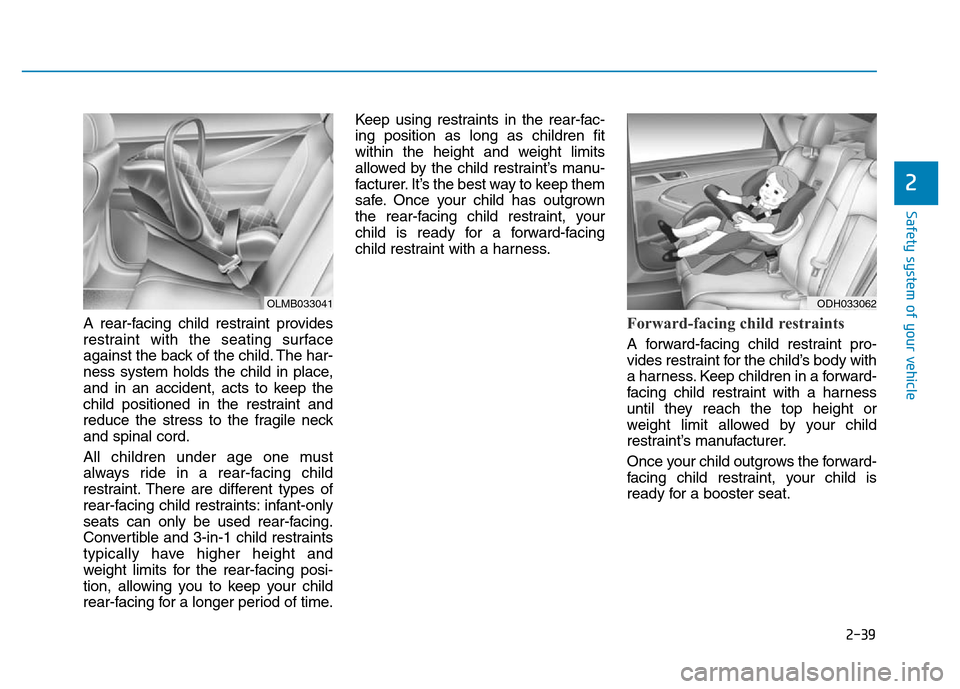
A rear-facing child restraint provides
restraint with the seating surface
against the back of the child. The har-
ness system holds the child in place,
and in an accident, acts to keep the
child positioned in the restraint and
reduce the stress to the fragile neck
and spinal cord.
All children under age one must
always ride in a rear-facing child
restraint. There are different types of
rear-facing child restraints: infant-only
seats can only be used rear-facing.
Convertible and 3-in-1 child restraints
typically have higher height and
weight limits for the rear-facing posi-
tion, allowing you to keep your child
rear-facing for a longer period of time.Keep using restraints in the rear-fac-
ing position as long as children fit
within the height and weight limits
allowed by the child restraint’s manu-
facturer. It’s the best way to keep them
safe. Once your child has outgrown
the rear-facing child restraint, your
child is ready for a forward-facing
child restraint with a harness.Forward-facing child restraints
A forward-facing child restraint pro-
vides restraint for the child’s body with
a harness. Keep children in a forward-
facing child restraint with a harness
until they reach the top height or
weight limit allowed by your child
restraint’s manufacturer.
Once your child outgrows the forward-
facing child restraint, your child is
ready for a booster seat.
OLMB033041ODH033062
Page 60 of 546
2-42
Safety system of your vehicle
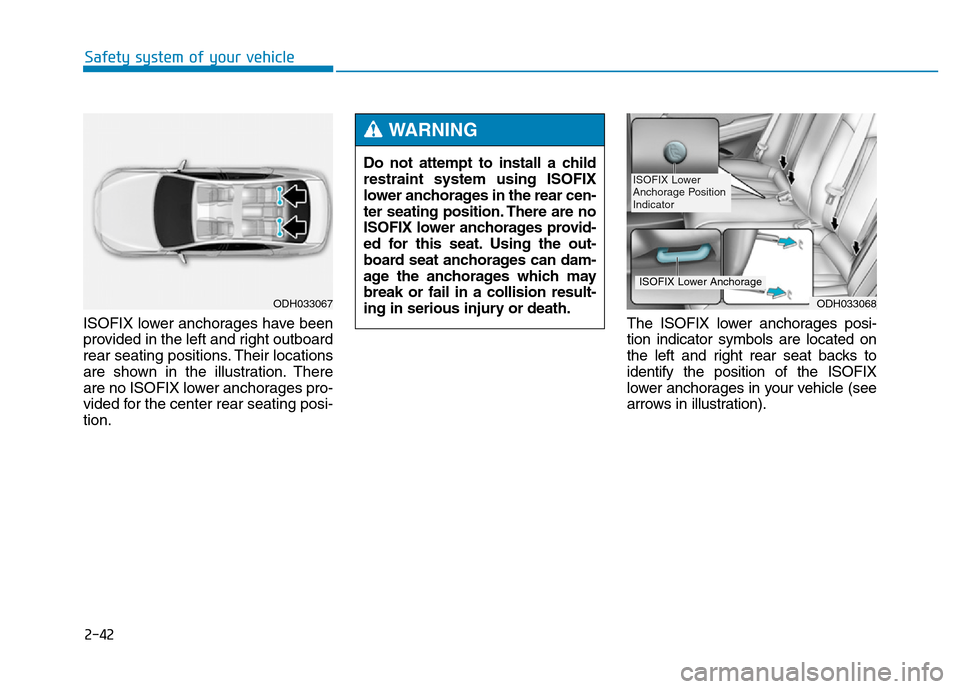
ISOFIX lower anchorages have been
provided in the left and right outboard
rear seating positions. Their locations
are shown in the illustration. There
are no ISOFIX lower anchorages pro-
vided for the center rear seating posi-
tion.The ISOFIX lower anchorages posi-
tion indicator symbols are located on
the left and right rear seat backs to
identify the position of the ISOFIX
lower anchorages in your vehicle (see
arrows in illustration).
ODH033067
Do not attempt to install a child
restraint system using ISOFIX
lower anchorages in the rear cen-
ter seating position. There are no
ISOFIX lower anchorages provid-
ed for this seat. Using the out-
board seat anchorages can dam-
age the anchorages which may
break or fail in a collision result-
ing in serious injury or death.
WARNING
ODH033068
ISOFIX Lower
Anchorage Position
Indicator
ISOFIX Lower Anchorage
Page 61 of 546
2-43
Safety system of your vehicle
2
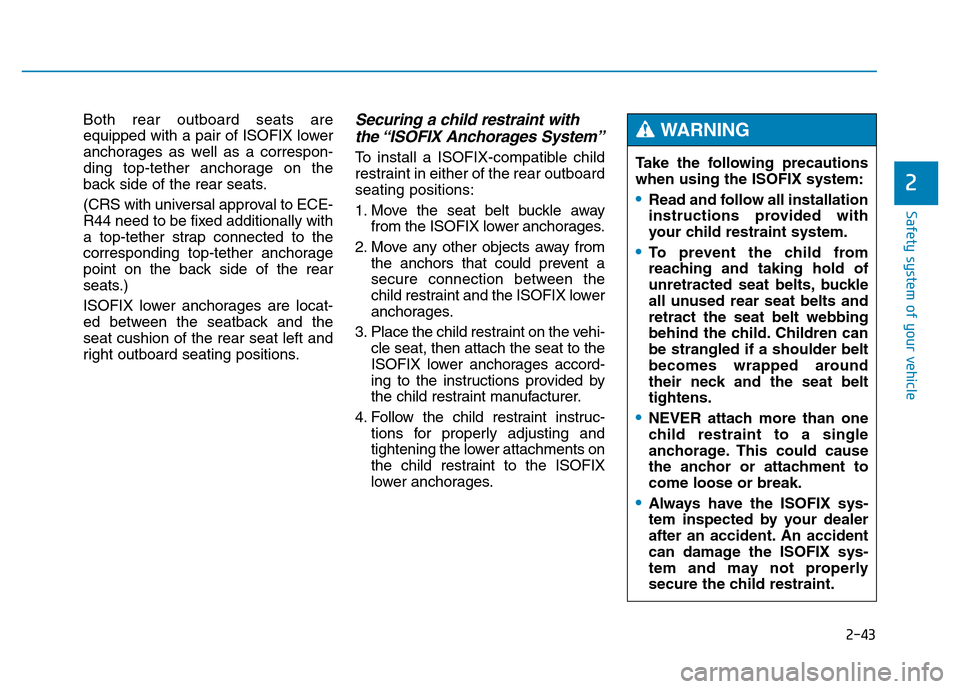
Both rear outboard seats are
equipped with a pair of ISOFIX lower
anchorages as well as a correspon-
ding top-tether anchorage on the
back side of the rear seats.
(CRS with universal approval to ECE-
R44 need to be fixed additionally with
a top-tether strap connected to the
corresponding top-tether anchorage
point on the back side of the rear
seats.)
ISOFIX lower anchorages are locat-
ed between the seatback and the
seat cushion of the rear seat left and
right outboard seating positions.Securing a child restraint with
the “ISOFIX Anchorages System”
To install a ISOFIX-compatible child
restraint in either of the rear outboard
seating positions:
1. Move the seat belt buckle away
from the ISOFIX lower anchorages.
2. Move any other objects away from
the anchors that could prevent a
secure connection between the
child restraint and the ISOFIX lower
anchorages.
3. Place the child restraint on the vehi-
cle seat, then attach the seat to the
ISOFIX lower anchorages accord-
ing to the instructions provided by
the child restraint manufacturer.
4. Follow the child restraint instruc-
tions for properly adjusting and
tightening the lower attachments on
the child restraint to the ISOFIX
lower anchorages.Take the following precautions
when using the ISOFIX system:
•Read and follow all installation
instructions provided with
your child restraint system.
•To prevent the child from
reaching and taking hold of
unretracted seat belts, buckle
all unused rear seat belts and
retract the seat belt webbing
behind the child. Children can
be strangled if a shoulder belt
becomes wrapped around
their neck and the seat belt
tightens.
•NEVER attach more than one
child restraint to a single
anchorage. This could cause
the anchor or attachment to
come loose or break.
•Always have the ISOFIX sys-
tem inspected by your dealer
after an accident. An accident
can damage the ISOFIX sys-
tem and may not properly
secure the child restraint.
WARNING
Page 62 of 546
2-44
Safety system of your vehicle
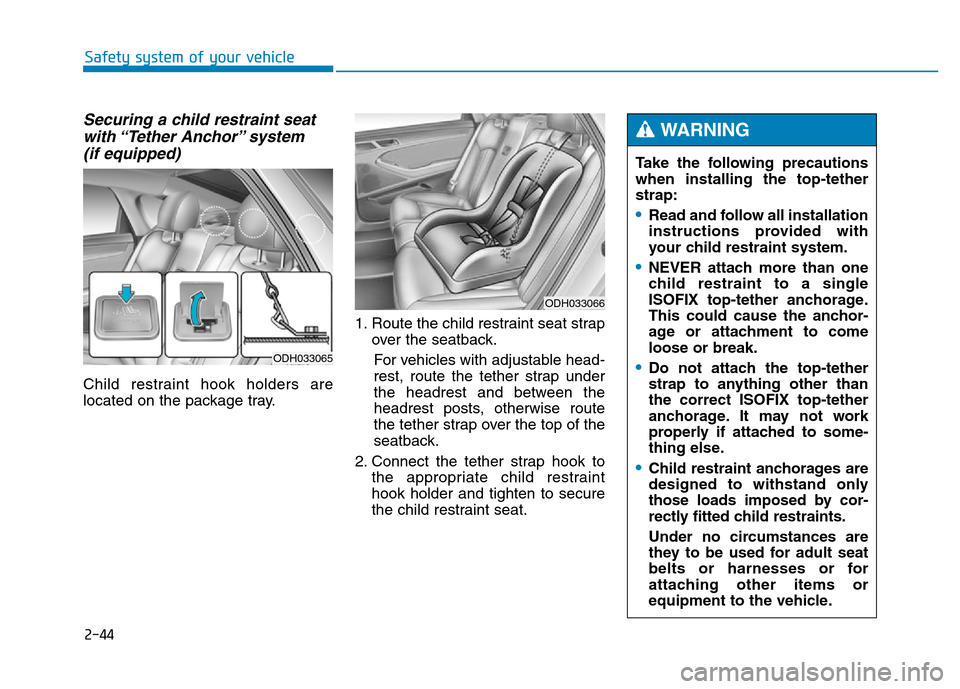
Securing a child restraint seat
with “Tether Anchor” system
(if equipped)
Child restraint hook holders are
located on the package tray.1. Route the child restraint seat strap
over the seatback.
For vehicles with adjustable head-
rest, route the tether strap under
the headrest and between the
headrest posts, otherwise route
the tether strap over the top of the
seatback.
2. Connect the tether strap hook to
the appropriate child restraint
hook holder and tighten to secure
the child restraint seat.
ODH033065
ODH033066
Take the following precautions
when installing the top-tether
strap:
•Read and follow all installation
instructions provided with
your child restraint system.
•NEVER attach more than one
child restraint to a single
ISOFIX top-tether anchorage.
This could cause the anchor-
age or attachment to come
loose or break.
•Do not attach the top-tether
strap to anything other than
the correct ISOFIX top-tether
anchorage. It may not work
properly if attached to some-
thing else.
•Child restraint anchorages are
designed to withstand only
those loads imposed by cor-
rectly fitted child restraints.
Under no circumstances are
they to be used for adult seat
belts or harnesses or for
attaching other items or
equipment to the vehicle.
WARNING
Page 63 of 546
2-45
Safety system of your vehicle
2
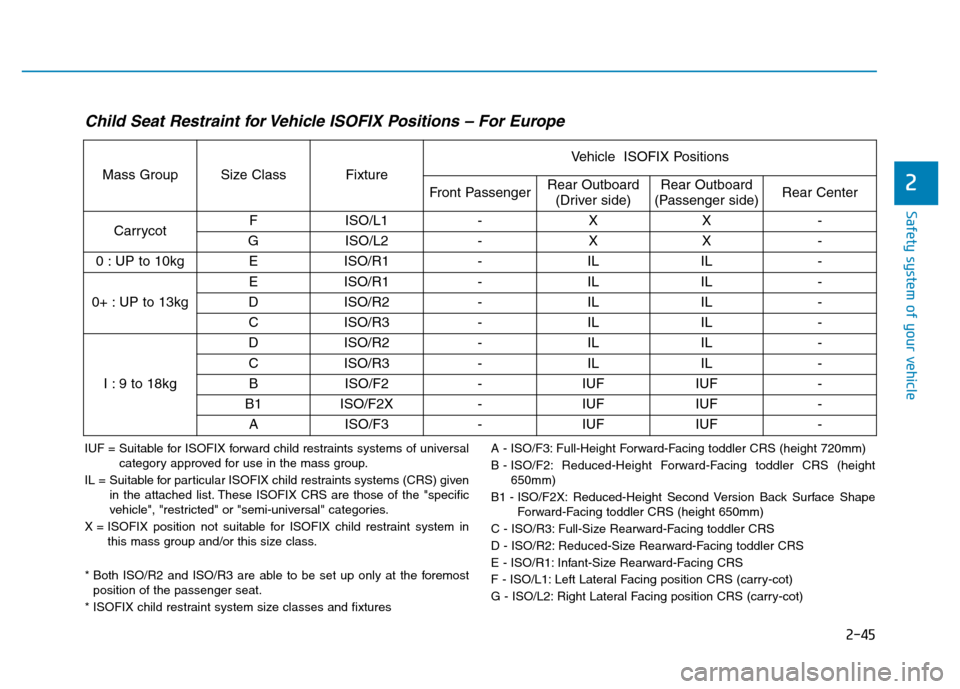
Child Seat Restraint for Vehicle ISOFIX Positions – For Europe
IUF = Suitable for ISOFIX forward child restraints systems of universal
category approved for use in the mass group.
IL = Suitable for particular ISOFIX child restraints systems (CRS) given
in the attached list. These ISOFIX CRS are those of the "specific
vehicle", "restricted" or "semi-universal" categories.
X = ISOFIX position not suitable for ISOFIX child restraint system in
this mass group and/or this size class.
* Both ISO/R2 and ISO/R3 are able to be set up only at the foremost
position of the passenger seat.
* ISOFIX child restraint system size classes and fixturesA - ISO/F3: Full-Height Forward-Facing toddler CRS (height 720mm)
B - ISO/F2: Reduced-Height Forward-Facing toddler CRS (height
650mm)
B1 - ISO/F2X: Reduced-Height Second Version Back Surface Shape
Forward-Facing toddler CRS (height 650mm)
C - ISO/R3: Full-Size Rearward-Facing toddler CRS
D - ISO/R2: Reduced-Size Rearward-Facing toddler CRS
E - ISO/R1: Infant-Size Rearward-Facing CRS
F - ISO/L1: Left Lateral Facing position CRS (carry-cot)
G - ISO/L2: Right Lateral Facing position CRS (carry-cot)
Mass Group Size Class FixtureVehicle ISOFIX Positions
Front PassengerRear Outboard
(Driver side)Rear Outboard
(Passenger side)Rear Center
CarrycotF ISO/L1 - X X -
G ISO/L2 - X X -
0 : UP to 10kg E ISO/R1 - IL IL -
0+ : UP to 13kgE ISO/R1 - IL IL -
D ISO/R2 - IL IL -
C ISO/R3 - IL IL -
I : 9 to 18kgD ISO/R2 - IL IL -
C ISO/R3 - IL IL -
B ISO/F2 - IUF IUF -
B1 ISO/F2X - IUF IUF -
A ISO/F3 - IUF IUF -