back seat Hyundai Genesis 2014 Owner's Guide
[x] Cancel search | Manufacturer: HYUNDAI, Model Year: 2014, Model line: Genesis, Model: Hyundai Genesis 2014Pages: 546, PDF Size: 13.59 MB
Page 65 of 546
2-47
Safety system of your vehicle
2
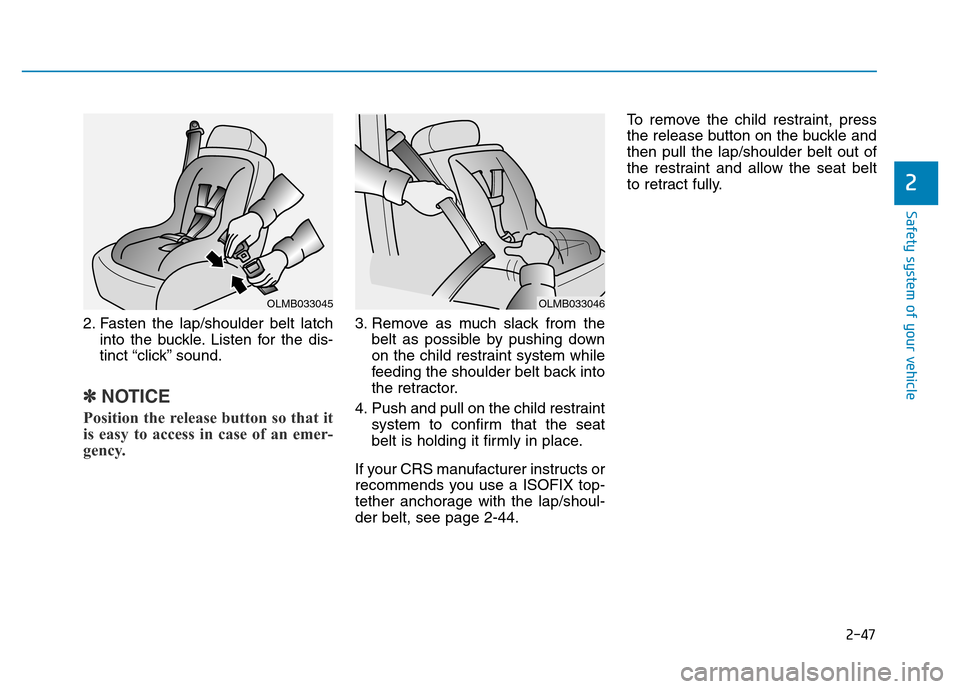
2. Fasten the lap/shoulder belt latch
into the buckle. Listen for the dis-
tinct “click” sound.
✽NOTICE
Position the release button so that it
is easy to access in case of an emer-
gency.
3. Remove as much slack from the
belt as possible by pushing down
on the child restraint system while
feeding the shoulder belt back into
the retractor.
4. Push and pull on the child restraint
system to confirm that the seat
belt is holding it firmly in place.
If your CRS manufacturer instructs or
recommends you use a ISOFIX top-
tether anchorage with the lap/shoul-
der belt, see page 2-44.To remove the child restraint, press
the release button on the buckle and
then pull the lap/shoulder belt out of
the restraint and allow the seat belt
to retract fully.
OLMB033045OLMB033046
Page 69 of 546
2-51
Safety system of your vehicle
2
Vehicles are equipped with a
Supplemental Air Bag System for the
driver’s seat, front passenger’s seats
and/or rear seats.
The front air bags are designed to
supplement the three-point seat
belts. For these air bags to provide
protection, the seat belts must be
worn at all times when driving.
You can be severely injured or killed
in an accident if you are not wearing
a seat belt. Air bags are designed to
supplement seat belts, but do not
replace them. Also, air bags are not
designed to deploy in every collision.
In some accidents, the seat belts are
the only restraint protecting you.AIR BAG SAFETY PRECAUTIONS
ALWAYS use seat belts and child restraints - every trip, every time,
everyone! Even with air bags, you can be seriously injured or killed in
a collision if you are improperly belted or not wearing your seat belt
when the air bag inflates.
NEVER place a child in any child restraint or booster seat in the front
passenger seat. An inflating air bag could forcefully strike the infant
or child causing serious or fatal injuries.
ABC - Always Buckle Children under age 13 in the back seat. It is the
safest place for children of any age to ride. If a child age 13 or older
must be seated in the front seat, he or she must be properly belted
and the seat should be moved as far back as possible.
All occupants should sit upright with the seatback in an upright posi-
tion, centered on the seat cushion with their seat belt on, legs com-
fortably extended and their feet on the floor until the vehicle is parked
and the engine is turned off. If an occupant is out of position during
an accident, the rapidly deploying air bag may forcefully contact the
occupant causing serious or fatal injuries.
You and your passengers should never sit or lean unnecessarily
close to the air bags or lean against the door or center console.
Move your seat as far back as possible from front air bags, while still
maintaining control of the vehicle. It is recommended that drivers
allow at least 25 cm (10 in) between the center of the steering wheel
and the chest.
WARNING (Continued)
•Keep the SRS parts and
wirings away from water or any
liquid. If the SRS components
are inoperative due to expo-
sure to water or liquids, it may
cause fire or severe injury.
Page 70 of 546
2-52
Safety system of your vehicle
Where are the air bags?
Driver’s and passenger’s front
air bags
Your vehicle is equipped with a
Supplemental Restraint System
(SRS) and lap/shoulder belts at both
the driver and passenger seating
positions.
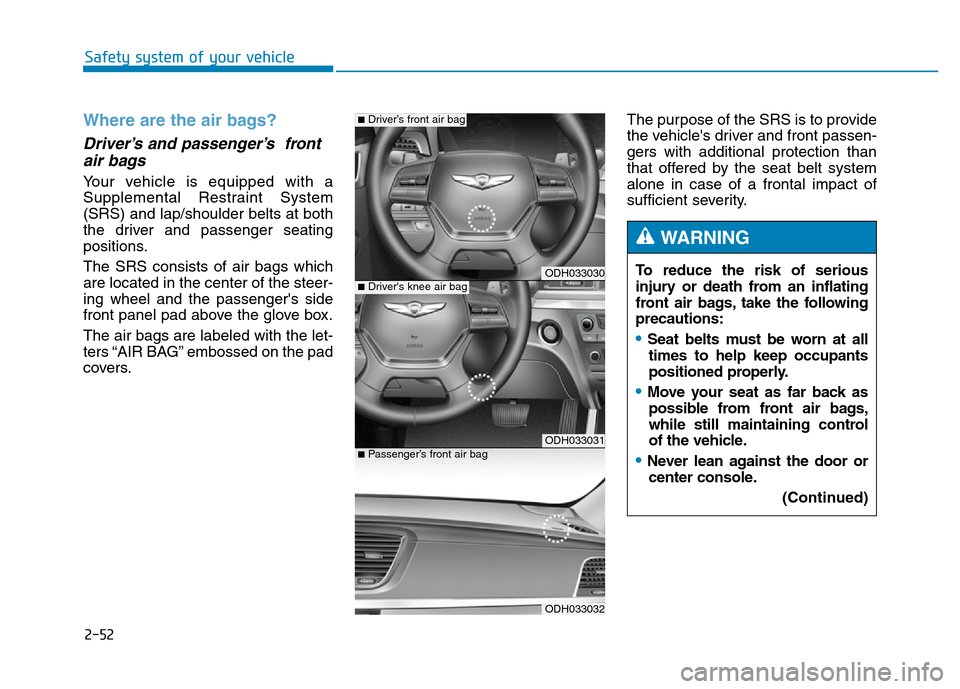
The SRS consists of air bags which
are located in the center of the steer-
ing wheel and the passenger's side
front panel pad above the glove box.
The air bags are labeled with the let-
ters “AIR BAG” embossed on the pad
covers.The purpose of the SRS is to provide
the vehicle's driver and front passen-
gers with additional protection than
that offered by the seat belt system
alone in case of a frontal impact of
sufficient severity.
To reduce the risk of serious
injury or death from an inflating
front air bags, take the following
precautions:
•Seat belts must be worn at all
times to help keep occupants
positioned properly.
•Move your seat as far back as
possible from front air bags,
while still maintaining control
of the vehicle.
•Never lean against the door or
center console.
(Continued)
WARNING
ODH033030
ODH033031
ODH033032
■Driver's knee air bag
■Driver’s front air bag
■Passenger’s front air bag
Page 84 of 546
2-66
Safety system of your vehicle
Air bag non-inflation conditions
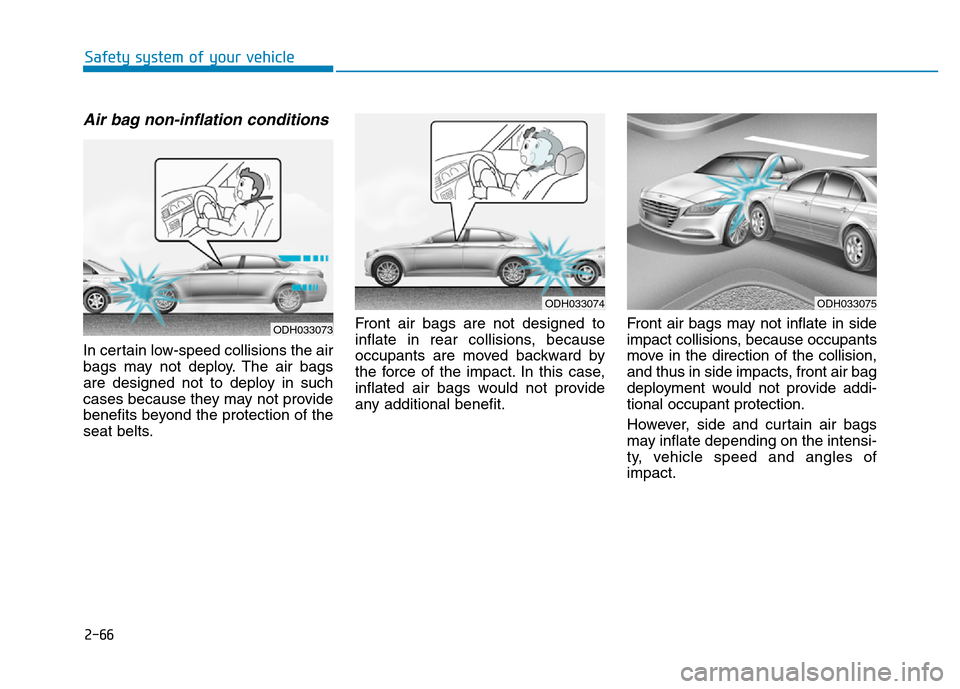
In certain low-speed collisions the air
bags may not deploy. The air bags
are designed not to deploy in such
cases because they may not provide
benefits beyond the protection of the
seat belts.Front air bags are not designed to
inflate in rear collisions, because
occupants are moved backward by
the force of the impact. In this case,
inflated air bags would not provide
any additional benefit.Front air bags may not inflate in side
impact collisions, because occupants
move in the direction of the collision,
and thus in side impacts, front air bag
deployment would not provide addi-
tional occupant protection.
However, side and curtain air bags
may inflate depending on the intensi-
ty, vehicle speed and angles of
impact.
ODH033075ODH033074
ODH033073
Page 262 of 546
3-171
Convenient features of your vehicle
3
Glove box
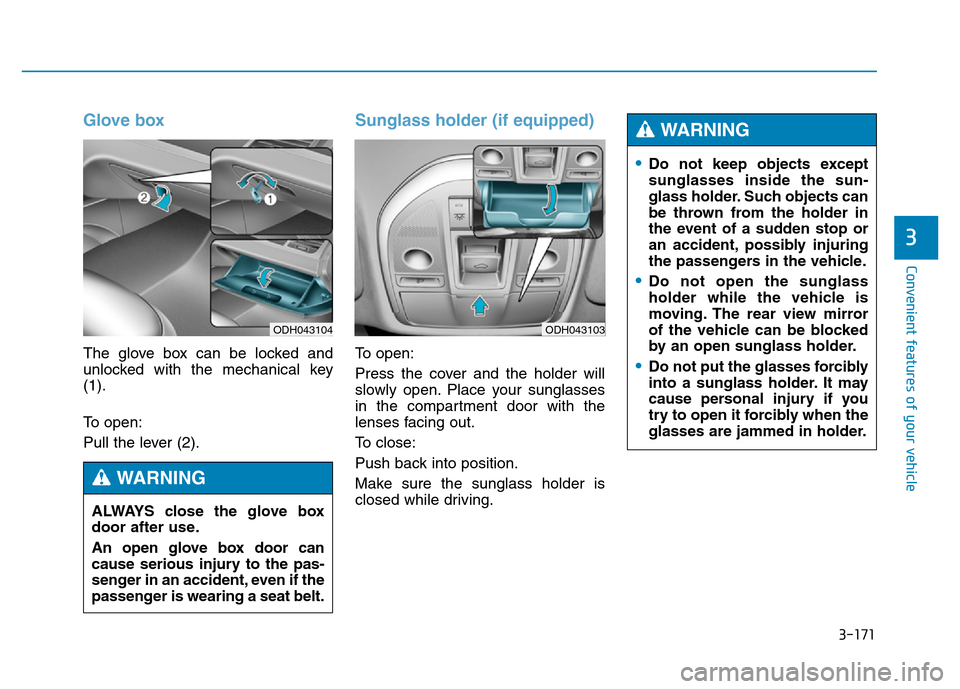
The glove box can be locked and
unlocked with the mechanical key
(1).
To open:
Pull the lever (2).
Sunglass holder (if equipped)
To open:
Press the cover and the holder will
slowly open. Place your sunglasses
in the compartment door with the
lenses facing out.
To close:
Push back into position.
Make sure the sunglass holder is
closed while driving.
ODH043104
ALWAYS close the glove box
door after use.
An open glove box door can
cause serious injury to the pas-
senger in an accident, even if the
passenger is wearing a seat belt.
WARNING
ODH043103
•Do not keep objects except
sunglasses inside the sun-
glass holder. Such objects can
be thrown from the holder in
the event of a sudden stop or
an accident, possibly injuring
the passengers in the vehicle.
•Do not open the sunglass
holder while the vehicle is
moving. The rear view mirror
of the vehicle can be blocked
by an open sunglass holder.
•Do not put the glasses forcibly
into a sunglass holder. It may
cause personal injury if you
try to open it forcibly when the
glasses are jammed in holder.
WARNING
Page 280 of 546
5-4
Driving your vehicle
Before entering the vehicle
• Be sure all windows, outside mir-
ror(s), and outside lights are clean
and unobstructed.
• Remove frost, snow, or ice.
• Visually check the tires for uneven
wear and damage.
• Check under the vehicle for any
sign of leaks.
• Be sure there are no obstacles
behind you if you intend to back up.
Before starting
• Make sure the hood, the trunk, and
the doors are securely closed and
locked.
• Adjust the position of the seat and
steering wheel.
• Adjust the inside and outside
rearview mirrors.
• Verify all the lights work.
• Fasten your seatbelt. Check that all
passengers have fastened their
seatbelts.
• Check the gauges and indicators in
the instrument panel and the mes-
sages on the instrument display
when the Engine Start/Stop button
is in the ON position.
• Check that any items you are car-
rying are stored properly or fas-
tened down securely.
BEFORE DRIVING
To reduce the risk of SERIOUS
INJURY or DEATH, take the fol-
lowing precautions:
•ALWAYS wear your seat belt.
All passengers must be prop-
erly belted whenever the vehi-
cle is moving. For more infor-
mation, refer to “Seat Belts” in
chapter 2.
•Always drive defensively.
Assume other drivers or
pedestrians may be careless
and make mistakes.
•Stay focused on the task of
driving. Driver distraction can
cause accidents.
•Leave plenty of space
between you and the vehicle
in front of you.
WARNING
Page 294 of 546
5-18
Driving your vehicle
To reduce the risk of SERIOUS
INJURY or DEATH:
•ALWAYS wear your seatbelt.
In a collision, an unbelted
occupant is significantly more
likely to be seriously injured
or killed than a properly belt-
ed occupant.
•Avoid high speeds when cor-
nering or turning.
•Do not make quick steering
wheel movements, such as
sharp lane changes or fast,
sharp turns.
•The risk of rollover is greatly
increased if you lose control
of your vehicle at highway
speeds.
•Loss of control often occurs if
two or more wheels drop off
the roadway and the driver
over steers to reenter the
roadway.
(Continued)
(Continued)
•In the event your vehicle
leaves the roadway, do not
steer sharply. Instead, slow
down before pulling back into
the travel lanes.
•HYUNDAI recommends you
follow all posted speed limits.
WARNING
Page 303 of 546
5-27
Driving your vehicle
5
To release EPB (Electric Parking
Brake) automatically:
• Shift lever in P (Park)
With the engine running depress
the brake pedal and shift out of P
(Park) to R (Rear) or D (Drive).
• Shift lever in N (Neutral)
With the engine running depress
the brake pedal and shift out of N
(Neutral) to R (Rear) or D (Drive).
• Satisfy the following conditions
1. Start the engine.
2. Fasten the driver's seat belt.
3. Close the driver's door, engine
hood and trunk.
4. Depress the accelerator pedal
while the shift lever is in D
(Drive) or Sports mode.
Make sure the brake warning light
goes off.
✽NOTICE
• For your safety, you can engage
the EPB even though the Engine
Stop/Start button is in the OFF
position, but you cannot release it.
• For your safety, depress the brake
pedal and release the parking
brake manually with the EPB
switch when you drive downhill or
when backing up the vehicle.EPB (Electric Parking Brake) may
be automatically applied when: • The EPB is overheated
• Requested by other systems
• The engine is turned off with the
EPB applied
✽NOTICE
If the driver turns the engine off
while Auto Hold is operating, EPB
will be automatically applied.
However, if you press the EPB
switch within one second after the
engine is turned off, the EPB will not
be applied.
•If the parking brake warning
light is still on even though
the EPB has been released,
we recommend that the sys-
tem be checked by an author-
ized HYUNDAI dealer.
•Do not drive your vehicle with
the EPB applied. It may cause
excessive brake pad and
brake rotor wear.
CAUTION
Page 309 of 546
5-33
Driving your vehicle
5
✽NOTICE
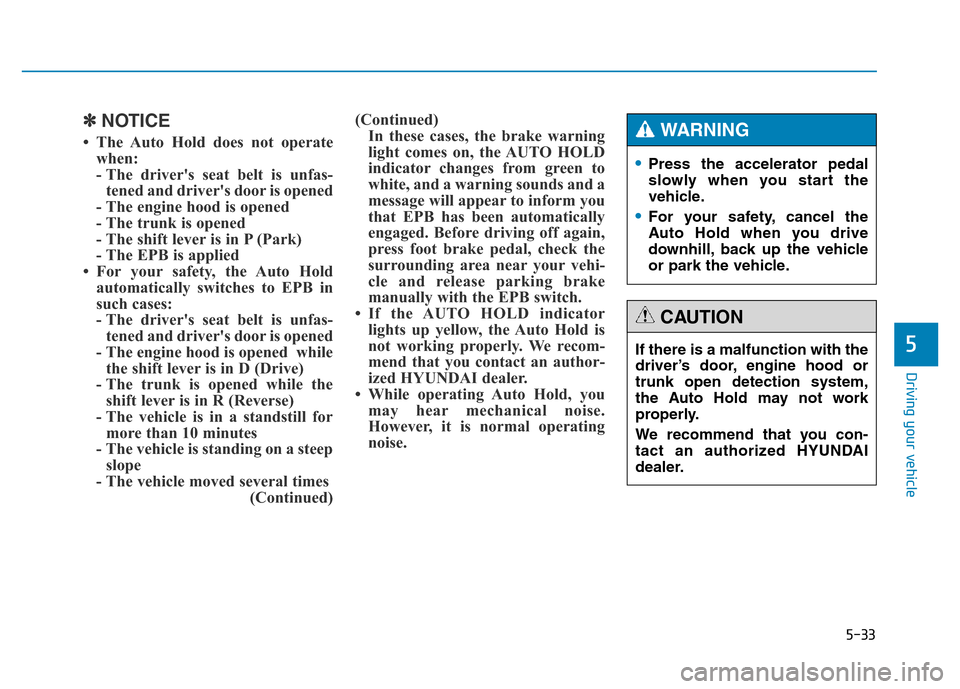
• The Auto Hold does not operate
when:
- The driver's seat belt is unfas-
tened and driver's door is opened
- The engine hood is opened
- The trunk is opened
- The shift lever is in P (Park)
- The EPB is applied
• For your safety, the Auto Hold
automatically switches to EPB in
such cases:
- The driver's seat belt is unfas-
tened and driver's door is opened
- The engine hood is opened while
the shift lever is in D (Drive)
- The trunk is opened while the
shift lever is in R (Reverse)
- The vehicle is in a standstill for
more than 10 minutes
- The vehicle is standing on a steep
slope
- The vehicle moved several times
(Continued)(Continued)
In these cases, the brake warning
light comes on, the AUTO HOLD
indicator changes from green to
white, and a warning sounds and a
message will appear to inform you
that EPB has been automatically
engaged. Before driving off again,
press foot brake pedal, check the
surrounding area near your vehi-
cle and release parking brake
manually with the EPB switch.
• If the AUTO HOLD indicator
lights up yellow, the Auto Hold is
not working properly. We recom-
mend that you contact an author-
ized HYUNDAI dealer.
• While operating Auto Hold, you
may hear mechanical noise.
However, it is normal operating
noise.
•Press the accelerator pedal
slowly when you start the
vehicle.
•For your safety, cancel the
Auto Hold when you drive
downhill, back up the vehicle
or park the vehicle.
WARNING
If there is a malfunction with the
driver’s door, engine hood or
trunk open detection system,
the Auto Hold may not work
properly.
We recommend that you con-
tact an authorized HYUNDAI
dealer.
CAUTION
Page 504 of 546
7-68
Maintenance
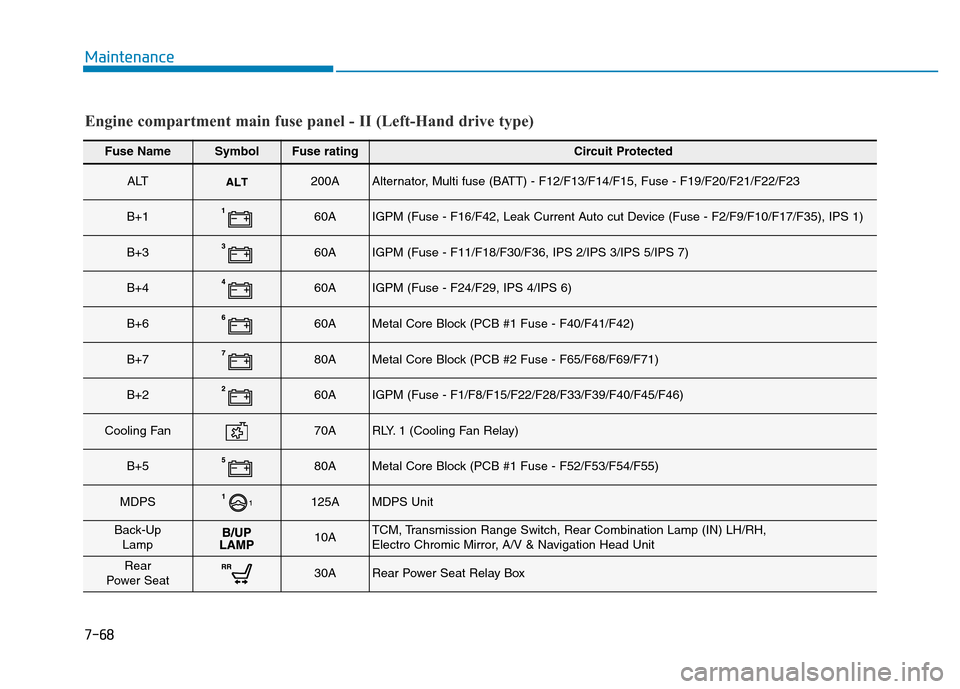
Fuse NameSymbolFuse ratingCircuit Protected
ALT200AAlternator, Multi fuse (BATT) - F12/F13/F14/F15, Fuse - F19/F20/F21/F22/F23
B+160AIGPM (Fuse - F16/F42, Leak Current Auto cut Device (Fuse - F2/F9/F10/F17/F35), IPS 1)
B+360AIGPM (Fuse - F11/F18/F30/F36, IPS 2/IPS 3/IPS 5/IPS 7)
B+460AIGPM (Fuse - F24/F29, IPS 4/IPS 6)
B+660AMetal Core Block (PCB #1 Fuse - F40/F41/F42)
B+780AMetal Core Block (PCB #2 Fuse - F65/F68/F69/F71)
B+260AIGPM (Fuse - F1/F8/F15/F22/F28/F33/F39/F40/F45/F46)
Cooling Fan70ARLY. 1 (Cooling Fan Relay)
B+580AMetal Core Block (PCB #1 Fuse - F52/F53/F54/F55)
MDPS125AMDPS Unit
Back-Up
Lamp10ATCM, Transmission Range Switch, Rear Combination Lamp (IN) LH/RH,
Electro Chromic Mirror, A/V & Navigation Head Unit
Rear
Power Seat30ARear Power Seat Relay Box
Engine compartment main fuse panel - II (Left-Hand drive type)