coolant Hyundai Genesis 2014 Owner's Guide
[x] Cancel search | Manufacturer: HYUNDAI, Model Year: 2014, Model line: Genesis, Model: Hyundai Genesis 2014Pages: 546, PDF Size: 13.59 MB
Page 469 of 546
7-33
7
Maintenance
WASHER FLUID
Checking the washer fluid
level
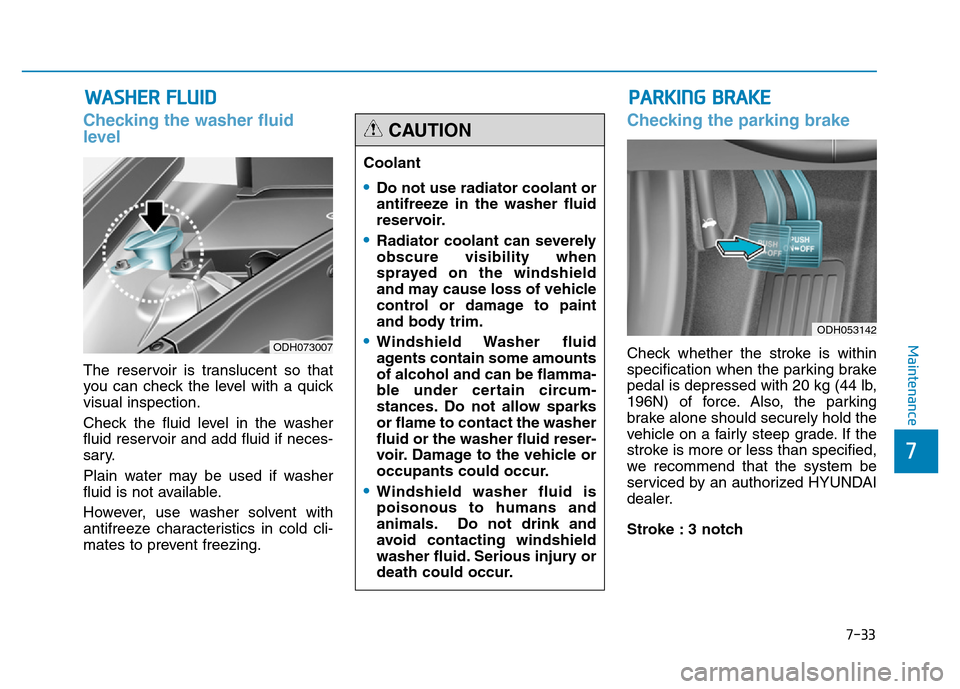
The reservoir is translucent so that
you can check the level with a quick
visual inspection.
Check the fluid level in the washer
fluid reservoir and add fluid if neces-
sary.
Plain water may be used if washer
fluid is not available.
However, use washer solvent with
antifreeze characteristics in cold cli-
mates to prevent freezing.
Checking the parking brake
Check whether the stroke is within
specification when the parking brake
pedal is depressed with 20 kg (44 lb,
196N) of force. Also, the parking
brake alone should securely hold the
vehicle on a fairly steep grade. If the
stroke is more or less than specified,
we recommend that the system be
serviced by an authorized HYUNDAI
dealer.
Stroke : 3 notchODH073007
Coolant
•Do not use radiator coolant or
antifreeze in the washer fluid
reservoir.
•Radiator coolant can severely
obscure visibility when
sprayed on the windshield
and may cause loss of vehicle
control or damage to paint
and body trim.
•Windshield Washer fluid
agents contain some amounts
of alcohol and can be flamma-
ble under certain circum-
stances. Do not allow sparks
or flame to contact the washer
fluid or the washer fluid reser-
voir. Damage to the vehicle or
occupants could occur.
•Windshield washer fluid is
poisonous to humans and
animals. Do not drink and
avoid contacting windshield
washer fluid. Serious injury or
death could occur.
CAUTION
ODH053142
PARKING BRAKE
Page 533 of 546
7-97
7
Maintenance
EMISSION CONTROL SYSTEM
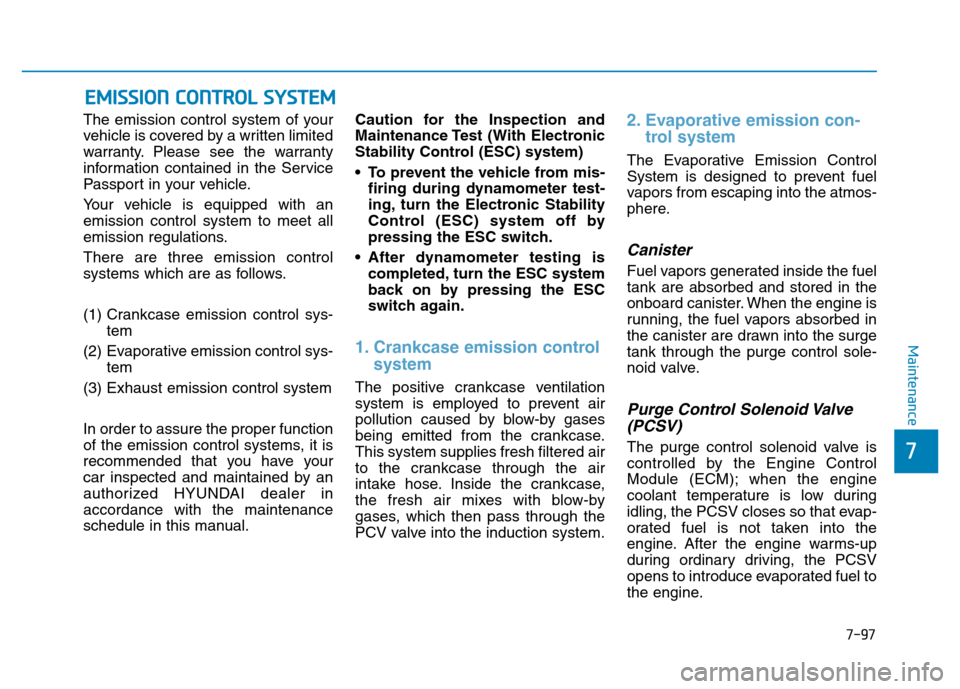
The emission control system of your
vehicle is covered by a written limited
warranty. Please see the warranty
information contained in the Service
Passport in your vehicle.
Your vehicle is equipped with an
emission control system to meet all
emission regulations.
There are three emission control
systems which are as follows.
(1) Crankcase emission control sys-
tem
(2) Evaporative emission control sys-
tem
(3) Exhaust emission control system
In order to assure the proper function
of the emission control systems, it is
recommended that you have your
car inspected and maintained by an
authorized HYUNDAI dealer in
accordance with the maintenance
schedule in this manual.Caution for the Inspection and
Maintenance Test (With Electronic
Stability Control (ESC) system)
• To prevent the vehicle from mis-
firing during dynamometer test-
ing, turn the Electronic Stability
Control (ESC) system off by
pressing the ESC switch.
• After dynamometer testing is
completed, turn the ESC system
back on by pressing the ESC
switch again.
1. Crankcase emission control
system
The positive crankcase ventilation
system is employed to prevent air
pollution caused by blow-by gases
being emitted from the crankcase.
This system supplies fresh filtered air
to the crankcase through the air
intake hose. Inside the crankcase,
the fresh air mixes with blow-by
gases, which then pass through the
PCV valve into the induction system.
2. Evaporative emission con-
trol system
The Evaporative Emission Control
System is designed to prevent fuel
vapors from escaping into the atmos-
phere.
Canister
Fuel vapors generated inside the fuel
tank are absorbed and stored in the
onboard canister. When the engine is
running, the fuel vapors absorbed in
the canister are drawn into the surge
tank through the purge control sole-
noid valve.
Purge Control Solenoid Valve
(PCSV)
The purge control solenoid valve is
controlled by the Engine Control
Module (ECM); when the engine
coolant temperature is low during
idling, the PCSV closes so that evap-
orated fuel is not taken into the
engine. After the engine warms-up
during ordinary driving, the PCSV
opens to introduce evaporated fuel to
the engine.
Page 541 of 546
8-6
Specifications & Consumer information
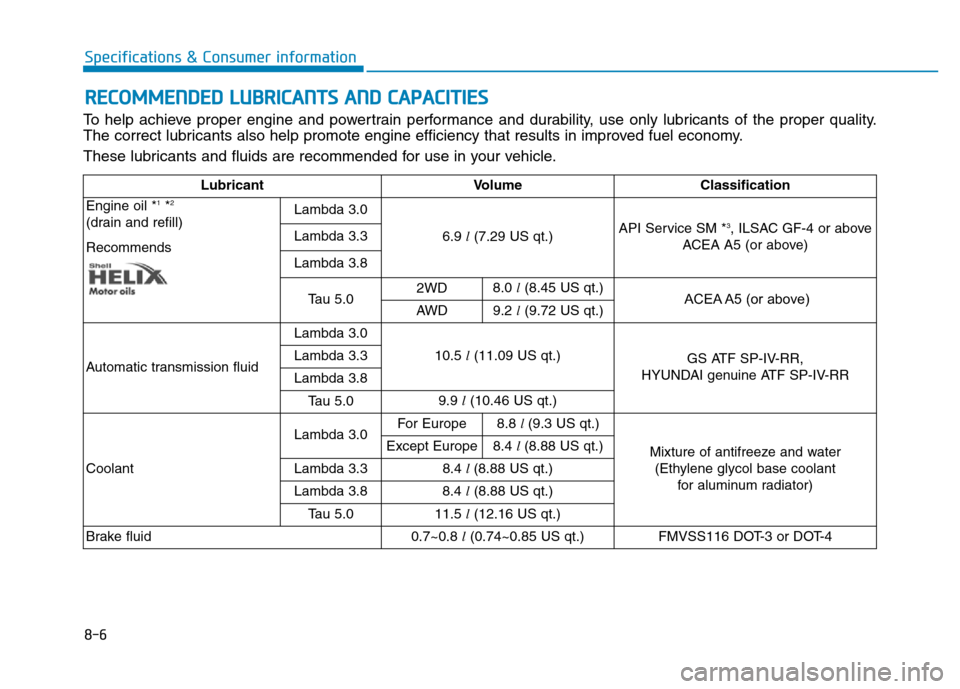
RECOMMENDED LUBRICANTS AND CAPACITIES
To help achieve proper engine and powertrain performance and durability, use only lubricants of the proper quality.
The correct lubricants also help promote engine efficiency that results in improved fuel economy.
These lubricants and fluids are recommended for use in your vehicle.
LubricantVolume Classification
Engine oil *
1*2
(drain and refill)
RecommendsLambda 3.06.9l(7.29 US qt.)API Service SM *3, ILSAC GF-4 or above
ACEA A5 (or above) Lambda 3.3
Lambda 3.8
Tau 5.02WD8.0l(8.45 US qt.)ACEA A5 (or above)AWD9.2l(9.72 US qt.)
Automatic transmission fluidLambda 3.0
10.5l(11.09 US qt.)
GS ATF SP-IV-RR,
HYUNDAI genuine ATF SP-IV-RR Lambda 3.3
Lambda 3.8
Tau 5.09.9l(10.46 US qt.)
Coolant
Lambda 3.0For Europe8.8l (9.3 US qt.)
Mixture of antifreeze and water
(Ethylene glycol base coolant
for aluminum radiator)Except Europe8.4l (8.88 US qt.)
Lambda 3.3
8.4l (8.88 US qt.)
Lambda 3.8
8.4l(8.88 US qt.)
Tau 5.0
11.5l(12.16 US qt.)
Brake fluid0.7~0.8 l(0.74~0.85 US qt.)FMVSS116 DOT-3 or DOT-4