air condition Hyundai Genesis 2014 Workshop Manual
[x] Cancel search | Manufacturer: HYUNDAI, Model Year: 2014, Model line: Genesis, Model: Hyundai Genesis 2014Pages: 546, PDF Size: 13.59 MB
Page 461 of 546
7-25
7
Maintenance
Brake pads, calipers and
rotors
Check the pads for excessive wear,
discs for run out and wear, and
calipers for fluid leakage.
For more information on checking
the pads or lining wear limit, refer to
the HYUNDAI web site.
(http://brakeman
ual.hmc.co.kr)
Suspension mounting bolts
Check the suspension connections
for looseness or damage. Retighten
to the specified torque.
Steering gear box, linkage &
boots/lower arm ball joint
With the vehicle stopped and engine
off, check for excessive free-play in
the steering wheel.
Check the linkage for bends or dam-
age. Check the dust boots and ball
joints for deterioration, cracks, or
damage. Replace any damaged
parts.
Drive shafts and boots
Check the drive shafts, boots and
clamps for cracks, deterioration, or
damage. Replace any damaged
parts and, if necessary, repack the
grease.
Air conditioning refrigerant/
compressor
Check the air conditioning lines and
connections for leakage and dam-
age.
Page 470 of 546
7-34
Maintenance
AIR CLEANER
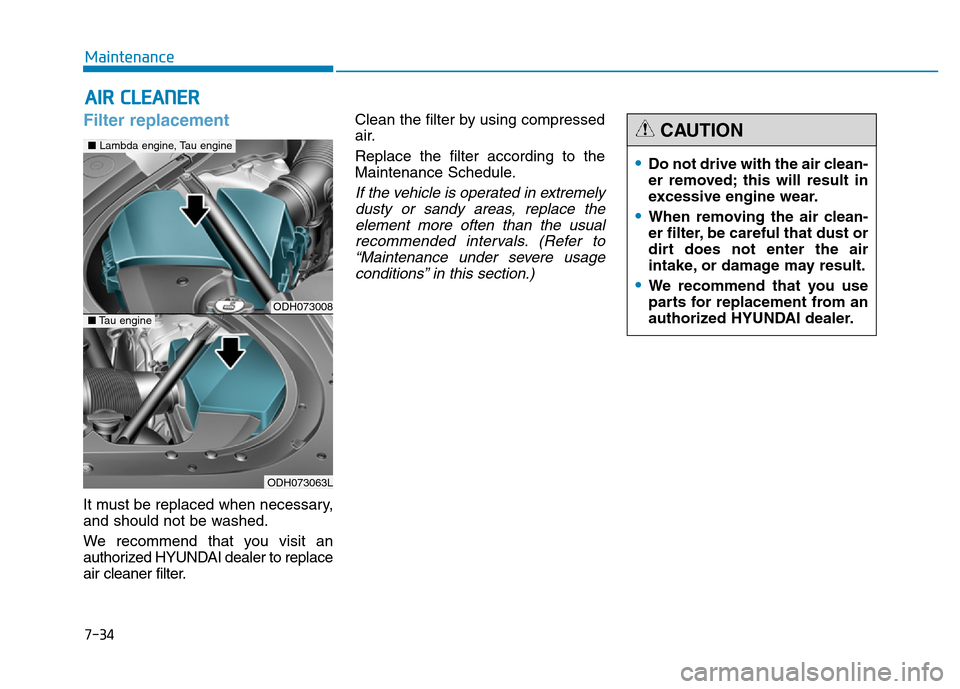
Filter replacement
It must be replaced when necessary,
and should not be washed.
We recommend that you visit an
authorized HYUNDAI dealer to replace
air cleaner filter.Clean the filter by using compressed
air.
Replace the filter according to the
Maintenance Schedule.
If the vehicle is operated in extremely
dusty or sandy areas, replace the
element more often than the usual
recommended intervals. (Refer to
“Maintenance under severe usage
conditions” in this section.)
•Do not drive with the air clean-
er removed; this will result in
excessive engine wear.
•When removing the air clean-
er filter, be careful that dust or
dirt does not enter the air
intake, or damage may result.
•We recommend that you use
parts for replacement from an
authorized HYUNDAI dealer.
CAUTION
ODH073008
ODH073063L
■Lambda engine, Tau engine
■Tau engine
Page 487 of 546
7-51
7
Maintenance
4. Tire ply composition and
material
The number of layers or plies of rub-
ber-coated fabric are in the tire. Tire
manufacturers also must indicate the
materials in the tire, which include
steel, nylon, polyester, and others.
The letter "R" means radial ply con-
struction; the letter "D" means diago-
nal or bias ply construction; and the
letter "B" means belted-bias ply con-
struction.
5. Maximum permissible infla-
tion pressure
This number is the greatest amount
of air pressure that should be put in
the tire. Do not exceed the maximum
permissible inflation pressure. Refer
to the Tire and Loading Information
label for recommended inflation
pressure.
6. Maximum load rating
This number indicates the maximum
load in kilograms and pounds that
can be carried by the tire. When
replacing the tires on the vehicle,
always use a tire that has the same
load rating as the factory installed
tire.
7. Uniform tire quality grading
Quality grades can be found where
applicable on the tire sidewall
between tread shoulder and maxi-
mum section width.
For example:
TREADWEAR 200
TRACTION AA
TEMPERATURE A
Tread wear
The tread wear grade is a compara-
tive rating based on the wear rate of
the tire when tested under controlled
conditions on a specified govern-
ment test course. For example, a tire
graded 150 would wear one-and-a-
half times (1½) as well on the gov-
ernment course as a tire graded 100.
The relative performance of tires
depends upon the actual conditions
of their use, however, and may
depart significantly from the norm
because of variations in driving
habits, service practices and differ-
ences in road characteristics and cli-
mate.
These grades are molded on the
side-walls of passenger vehicle tires.
The tires available as standard or
optional equipment on your vehicles
may vary with respect to grade.
Page 489 of 546
7-53
7
Maintenance
Low aspect ratio tire
(if equipped)
Low aspect ratio tires, whose aspect
ratio is lower than 50, are provided
for sporty looks.
Because the low aspect ratio tires
are optimized for handling and brak-
ing, it may be more uncomfortable to
ride in and there is more noise com-
pare with normal tires.Because the sidewall of the low
aspect ratio tire is shorter than
the normal, the wheel and tire of
the low aspect ratio tire is easi-
er to be damaged. So, follow the
instructions below.
- When driving on a rough road
or off road, drive cautiously
because tires and wheels may
be damaged. And after driving,
inspect tires and wheels.
- When passing over a pothole,
speed bump, manhole, or curb
stone, drive slowly so that the
tires and wheels are not dam-
aged.
- If the tire is impacted, we rec-
ommend that you inspect the
tire condition or contact an
authorized HYUNDAI dealer.
- To prevent damage to the tire,
inspect the tire condition and
pressure every 3,000km.
CAUTION
•It is not easy to recognize the
tire damage with your own
eyes. But if there is the slight-
est hint of tire damage, even
though you cannot see the
tire damage with your own
eyes, have the tire checked or
replaced because the tire
damage may cause air leak-
age from the tire.
•If the tire is damaged by driv-
ing on a rough road, off road,
pothole, manhole, or curb
stone, it will not be covered by
the warranty.
•You can find out the tire infor-
mation on the tire sidewall.
CAUTION
Page 529 of 546
7-93
7
Maintenance
High-corrosion areas
If you live in an area where your car
is regularly exposed to corrosive
materials, corrosion protection is
particularly important. Some of the
common causes of accelerated cor-
rosion are road salts, dust control
chemicals, ocean air and industrial
pollution.
Moisture breeds corrosion
Moisture creates the conditions in
which corrosion is most likely to
occur. For example, corrosion is
accelerated by high humidity, partic-
ularly when temperatures are just
above freezing. In such conditions,
the corrosive material is kept in con-
tact with the car surfaces by moisture
that is slow to evaporate.
Mud is particularly corrosive
because it is slow to dry and holds
moisture in contact with the vehicle.
Although the mud appears to be dry,
it can still retain the moisture and
promote corrosion.High temperatures can also acceler-
ate corrosion of parts that are not
properly ventilated so the moisture
can be dispersed. For all these rea-
sons, it is particularly important to
keep your car clean and free of mud
or accumulations of other materials.
This applies not only to the visible
surfaces but particularly to the
underside of the car.To help prevent corrosion
You can help prevent corrosion from
getting started by observing the fol-
lowing:Keep your car clean
The best way to prevent corrosion is
to keep your car clean and free of
corrosive materials. Attention to the
underside of the car is particularly
important.
• If you live in a high-corrosion area
— where road salts are used, near
the ocean, areas with industrial
pollution, acid rain, etc.—, you
should take extra care to prevent
corrosion. In winter, hose off the
underside of your car at least once
a month and be sure to clean the
underside thoroughly when winter
is over.
• When cleaning underneath the car,
give particular attention to the
components under the fenders and
other areas that are hidden from
view. Do a thorough job; just damp-
ening the accumulated mud rather
than washing it away will acceler-
ate corrosion rather than prevent
it. Water under high pressure and
steam are particularly effective in
removing accumulated mud and
corrosive materials.
Page 536 of 546
8
Specifications & Consumer information
8
Specifications & Consumer information
8
Dimensions ..............................................................8-2
Engine ......................................................................8-2
Luggage volume .....................................................8-2
Bulb wattage ...........................................................8-3
Air conditioning system ........................................8-3
Tires and wheels ....................................................8-4
Tire load and speed capacity ..............................8-5
Gross vehicle weight .............................................8-5
Recommended lubricants and capacities ...........8-6
Recommended SAE viscosity number ..........................8-8
Vehicle identification number (VIN) ....................8-9
Vehicle certification label .....................................8-9
TIRE specification and pressure label ..............8-10
Engine number .....................................................8-10
Air conditioner compressor label ......................8-10
Refrigerant label ..................................................8-11
Declaration of conformity ..................................8-11
Page 538 of 546
8-3
8
Specifications & Consumer information
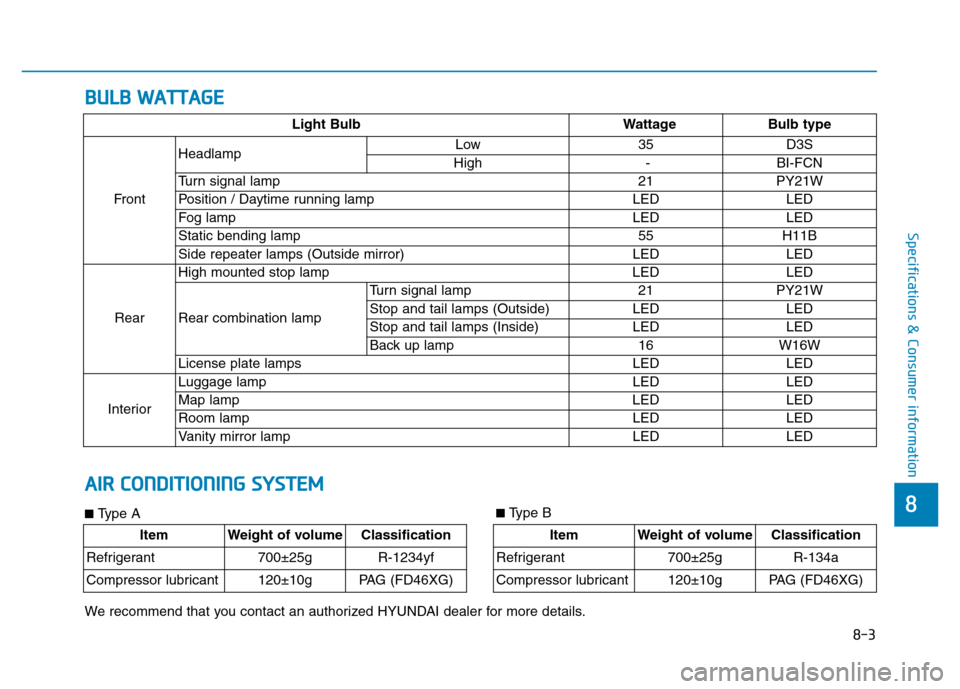
BULB WATTAGE
Light Bulb Wattage Bulb type
FrontHeadlamp
Low 35 D3S
High - BI-FCN
Turn signal lamp 21 PY21W
Position / Daytime running lamp LED LED
Fog lamp LED LED
Static bending lamp 55 H11B
Side repeater lamps (Outside mirror) LED LED
Rear
High mounted stop lampLEDLED
Rear combination lamp
Turn signal lamp 21 PY21W
Stop and tail lamps (Outside) LED LED
Stop and tail lamps (Inside) LED LED
Back up lamp 16 W16W
License plate lamps LED LED
InteriorLuggage lamp LED LED
Map lamp LED LED
Room lamp LED LED
Vanity mirror lamp LED LED
AIR CONDITIONING SYSTEM
ItemWeight of volume Classification
Refrigerant
700±25g R-1234yf
Compressor lubricant
120±10g PAG (FD46XG)
■Type A
Item
Weight of volume Classification
Refrigerant
700±25g R-134a
Compressor lubricant
120±10g PAG (FD46XG)
■Type B
We recommend that you contact an authorized HYUNDAI dealer for more details.
Page 545 of 546
8-10
Specifications & Consumer information
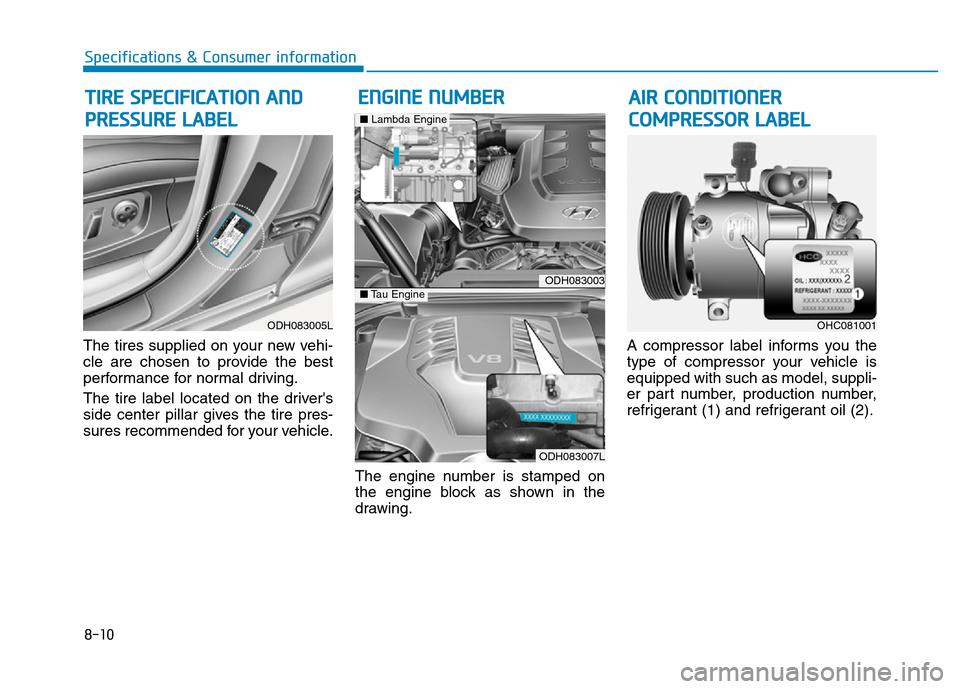
The tires supplied on your new vehi-
cle are chosen to provide the best
performance for normal driving.
The tire label located on the driver's
side center pillar gives the tire pres-
sures recommended for your vehicle.
The engine number is stamped on
the engine block as shown in the
drawing.A compressor label informs you the
type of compressor your vehicle is
equipped with such as model, suppli-
er part number, production number,
refrigerant (1) and refrigerant oil (2).
TIRE SPECIFICATION AND
PRESSURE LABELENGINE NUMBER
ODH083005L
ODH083003
ODH083007L
■Lambda Engine
■Tau Engine
OHC081001
AIR CONDITIONER
COMPRESSOR LABEL