Engine Oil Hyundai Genesis 2015 Owner's Guide
[x] Cancel search | Manufacturer: HYUNDAI, Model Year: 2015, Model line: Genesis, Model: Hyundai Genesis 2015Pages: 501, PDF Size: 38.76 MB
Page 425 of 501
7-43
7
Maintenance
By jump starting
After a jump start from a good bat-
tery, drive the vehicle for 20-30 min-
utes before it is shutoff. The vehicle
may not restart if you shut it off
before the battery had a chance to
adequately recharge. See “Jump
Starting” in chapter 6 for more infor-
mation on jump starting procedures.
✽ ✽
NOTICE
An inappropriately disposed
battery can be harmful to
the environment and human
health. Dispose the battery
according to your local
law(s) or regulation.
Always follow these instruc-
tions when recharging your
vehicle’s battery to avoid the
risk of SERIOUS INJURY or
DEATH from explosions or acid
burns:
Before performing mainte-
nance or recharging the bat-
tery, turn off all accessories
and press the Engine Start/
Stop button to the OFF posi-
tion.
Keep all flames, sparks, or
smoking materials away from
the battery.
Always work outdoors or in an
area with plenty of ventilation.
Wear eye protection when
checking the battery during
charging.
The battery must be removed
from the vehicle and placed in
a well ventilated area.
(Continued)
WARNING (Continued)
Watch the battery during
charging, and stop or reduce
the charging rate if the battery
cells begin boiling violently.
The negative battery cable
must be removed first and
installed last when the battery
is disconnected. Disconnect
the battery charger in the fol-
lowing order:
(1) Turn off the battery charg-
er main switch.
(2) Unhook the negative
clamp from the negative
battery terminal.
(3) Unhook the positive clamp
from the positive battery
terminal.
Always use a genuine
HYUNDAI approved battery
when you replace the battery.
Page 443 of 501
7-61
7
Maintenance
F FU
US
SE
ES
S
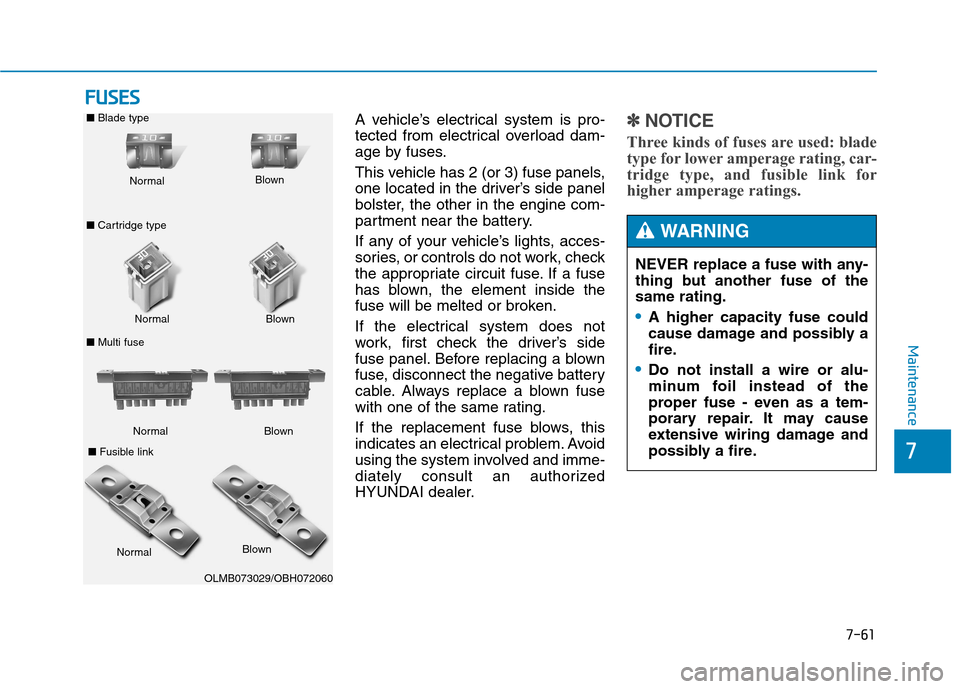
A vehicle’s electrical system is pro-
tected from electrical overload dam-
age by fuses.
This vehicle has 2 (or 3) fuse panels,
one located in the driver’s side panel
bolster, the other in the engine com-
partment near the battery.
If any of your vehicle’s lights, acces-
sories, or controls do not work, check
the appropriate circuit fuse. If a fuse
has blown, the element inside the
fuse will be melted or broken.
If the electrical system does not
work, first check the driver’s side
fuse panel. Before replacing a blown
fuse, disconnect the negative battery
cable. Always replace a blown fuse
with one of the same rating.
If the replacement fuse blows, this
indicates an electrical problem. Avoid
using the system involved and imme-
diately consult an authorized
HYUNDAI dealer.✽ ✽
NOTICE
Three kinds of fuses are used: blade
type for lower amperage rating, car-
tridge type, and fusible link for
higher amperage ratings.
NEVER replace a fuse with any-
thing but another fuse of the
same rating.
A higher capacity fuse could
cause damage and possibly a
fire.
Do not install a wire or alu-
minum foil instead of the
proper fuse - even as a tem-
porary repair. It may cause
extensive wiring damage and
possibly a fire.
WARNING
Normal Normal ■Blade type
■Cartridge type
■Multi fuseBlown
Blown
Normal Blown
■Fusible link
NormalBlown
OLMB073029/OBH072060
Page 455 of 501
7-73
7
Maintenance
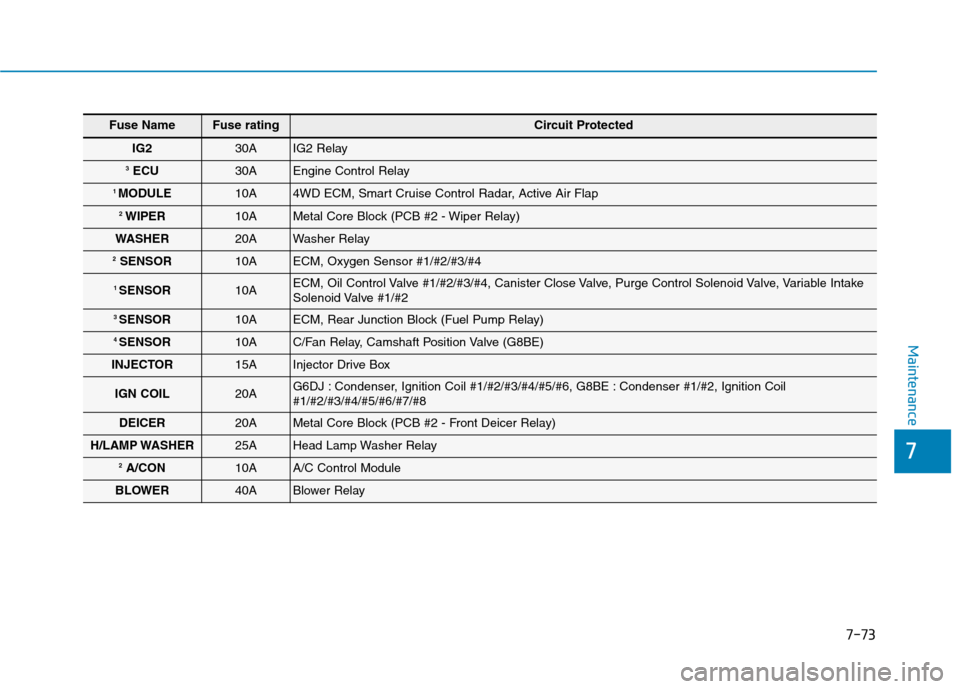
Fuse NameFuse ratingCircuit Protected
IG230A IG2 Relay
3ECU30A Engine Control Relay
1 MODULE 10A 4WD ECM, Smart Cruise Control Radar, Active Air Flap
2WIPER10A Metal Core Block (PCB #2 - Wiper Relay)
WASHER 20A Washer Relay
2SENSOR 10A ECM, Oxygen Sensor #1/#2/#3/#4
1 SENSOR10A ECM, Oil Control Valve #1/#2/#3/#4, Canister Close Valve, Purge Control Solenoid Valve, Variable Intake
Solenoid Valve #1/#2
3 SENSOR10A ECM, Rear Junction Block (Fuel Pump Relay)
4 SENSOR10A C/Fan Relay, Camshaft Position Valve (G8BE)
INJECTOR 15A Injector Drive Box
IGN COIL 20A G6DJ : Condenser, Ignition Coil #1/#2/#3/#4/#5/#6, G8BE : Condenser #1/#2, Ignition Coil
#1/#2/#3/#4/#5/#6/#7/#8
DEICER 20A Metal Core Block (PCB #2 - Front Deicer Relay)
H/LAMP WASHER 25A Head Lamp Washer Relay
2A/CON10A A/C Control Module
BLOWER 40A Blower Relay
Page 470 of 501
7-88
Maintenance
Waxing
A good coat of wax is a barrier
between your paint and contaminate.
Keeping a good coat of wax on your
vehicle will help protect it.
Wax the vehicle when water will no
longer bead on the paint.
Always wash and dry the vehicle
before waxing. Use a good quality
liquid or paste wax, and follow the
manufacturer’s instructions. Wax all
metal trim to protect it and to main-
tain its luster.
Removing oil, tar, and similar materi-
als with a spot remover will usually
strip the wax from the finish. Be sure
to re-wax these areas even if the rest
of the vehicle does not yet need wax-
ing.
OLMB073082
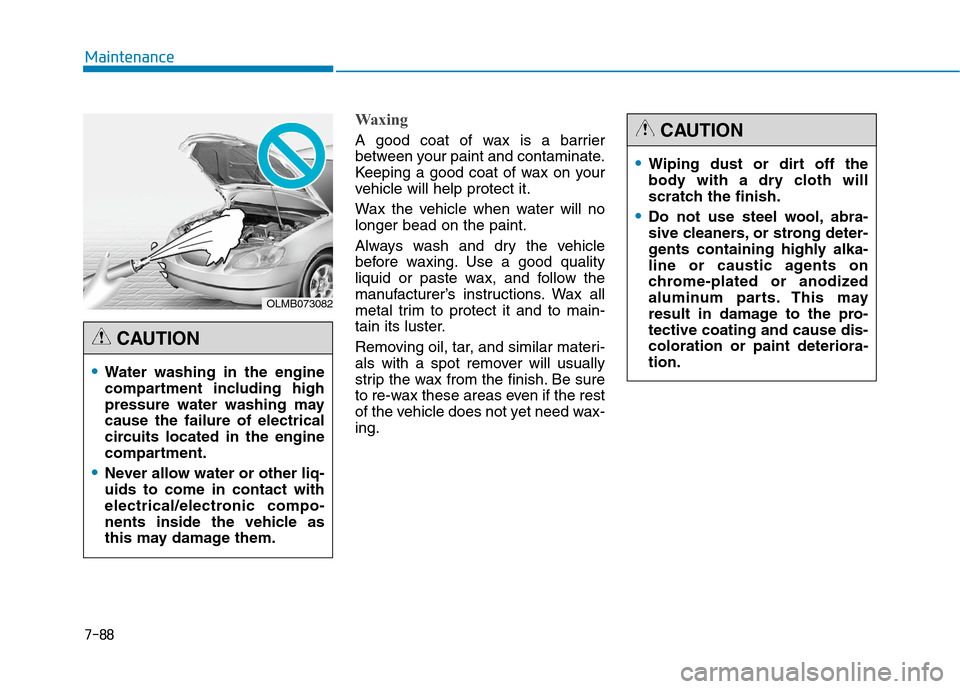
Water washing in the engine
compartment including high
pressure water washing may
cause the failure of electrical
circuits located in the engine
compartment.
Never allow water or other liq-
uids to come in contact with
electrical/electronic compo-
nents inside the vehicle as
this may damage them.
CAUTION
Wiping dust or dirt off the
body with a dry cloth will
scratch the finish.
Do not use steel wool, abra-
sive cleaners, or strong deter-
gents containing highly alka-
line or caustic agents on
chrome-plated or anodized
aluminum parts. This may
result in damage to the pro-
tective coating and cause dis-
coloration or paint deteriora-
tion.
CAUTION
Page 486 of 501
8-6
Specifications, Consumer information and Reporting safety defects
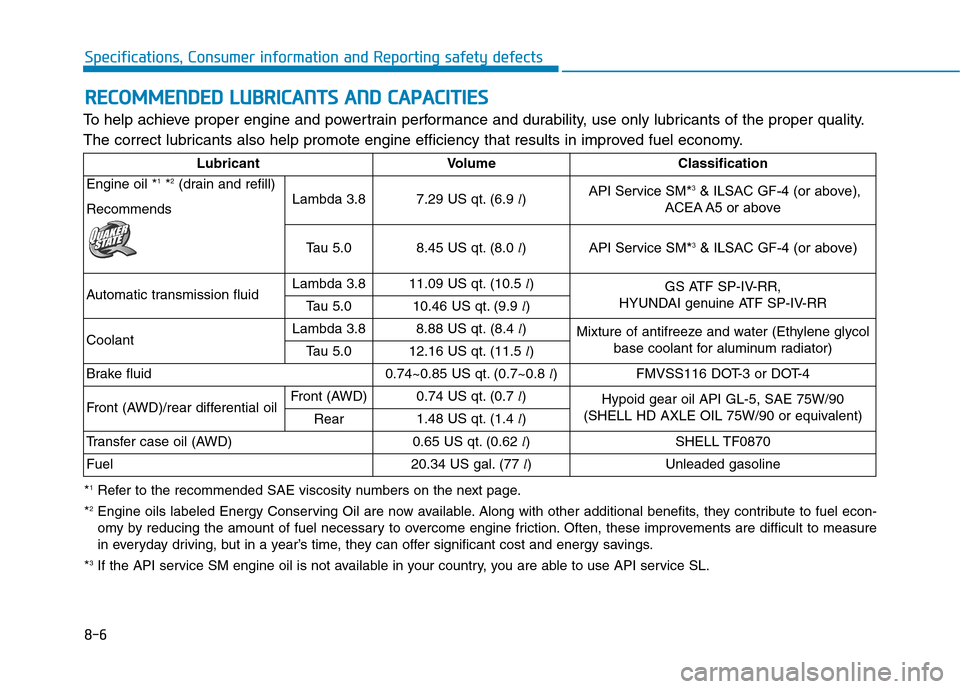
To help achieve proper engine and powertrain performance and durability, use only lubricants of the proper quality.
The correct lubricants also help promote engine efficiency that results in improved fuel economy.
R RE
EC
CO
OM
MM
ME
EN
ND
DE
ED
D
L
LU
UB
BR
RI
IC
CA
AN
NT
TS
S
A
AN
ND
D
C
CA
AP
PA
AC
CI
IT
TI
IE
ES
S
*1Refer to the recommended SAE viscosity numbers on the next page.
*
2Engine oils labeled Energy Conserving Oil are now available. Along with other additional benefits, they contribute to fuel econ-
omy by reducing the amount of fuel necessary to overcome engine friction. Often, these improvements are difficult to measure
in everyday driving, but in a year’s time, they can offer significant cost and energy savings.
*
3If the API service SM engine oil is not available in your country, you are able to use API service SL.Lubricant
Volume Classification
Engine oil *
1*2(drain and refill)
RecommendsLambda 3.87.29 US qt. (6.9l)API Service SM*3& ILSAC GF-4 (or above),
ACEA A5 or above
Tau 5.08.45 US qt. (8.0l)API Service SM*3& ILSAC GF-4 (or above)
Automatic transmission fluidLambda 3.8
11.09 US qt. (10.5l)
GS ATF SP-IV-RR,
HYUNDAI genuine ATF SP-IV-RR
Tau 5.010.46 US qt. (9.9l)
CoolantLambda 3.8
8.88 US qt. (8.4l)
Mixture of antifreeze and water (Ethylene glycol
base coolant for aluminum radiator)
Tau 5.0
12.16 US qt. (11.5l)
Brake fluid
0.74~0.85 US qt. (0.7~0.8 l)
FMVSS116 DOT-3 or DOT-4
Front (AWD)/rear differential oilFront (AWD)0.74 US qt. (0.7l)Hypoid gear oil API GL-5, SAE 75W/90
(SHELL HD AXLE OIL 75W/90 or equivalent)
Rear1.48 US qt. (1.4l)
Transfer case oil (AWD)0.65 US qt. (0.62l)SHELL TF0870
Fuel20.34 US gal. (77l)Unleaded gasoline
Page 487 of 501
8-7
88
Specifications, Consumer information and Reporting safety defects
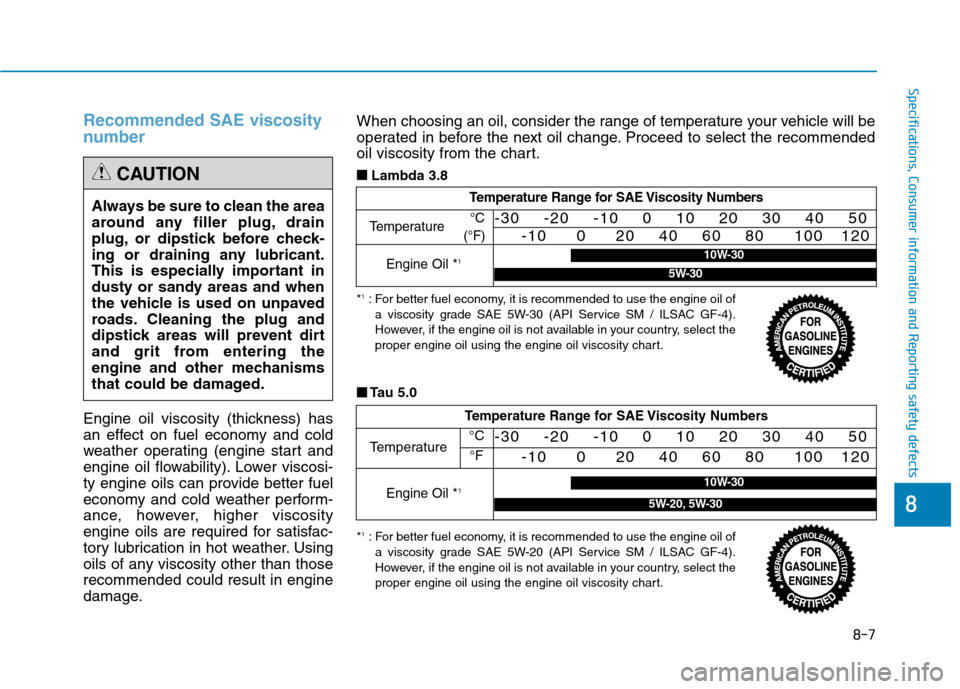
Recommended SAE viscosity
number
Engine oil viscosity (thickness) has
an effect on fuel economy and cold
weather operating (engine start and
engine oil flowability). Lower viscosi-
ty engine oils can provide better fuel
economy and cold weather perform-
ance, however, higher viscosity
engine oils are required for satisfac-
tory lubrication in hot weather. Using
oils of any viscosity other than those
recommended could result in engine
damage.Always be sure to clean the area
around any filler plug, drain
plug, or dipstick before check-
ing or draining any lubricant.
This is especially important in
dusty or sandy areas and when
the vehicle is used on unpaved
roads. Cleaning the plug and
dipstick areas will prevent dirt
and grit from entering the
engine and other mechanisms
that could be damaged.
CAUTION
Temperature Range for SAE Viscosity Numbers
Temperature
Engine Oil *1
°C
°F
-30 -20 -10 0 10 20 30 40 50
-10 0 20 40 60 80 100 120
10W-30
5W-20, 5W-30
*1: For better fuel economy, it is recommended to use the engine oil of
a viscosity grade SAE 5W-20 (API Service SM / ILSAC GF-4).
However, if the engine oil is not available in your country, select the
proper engine oil using the engine oil viscosity chart.
When choosing an oil, consider the range of temperature your vehicle will be
operated in before the next oil change. Proceed to select the recommended
oil viscosity from the chart.
Temperature Range for SAE Viscosity Numbers
Temperature
Engine Oil *
1
°C
(°F)-30 -20 -10 0 10 20 30 40 50
-10 0 20 40 60 80 100 120
*1: For better fuel economy, it is recommended to use the engine oil of
a viscosity grade SAE 5W-30 (API Service SM / ILSAC GF-4).
However, if the engine oil is not available in your country, select the
proper engine oil using the engine oil viscosity chart.
10W-30
5W-30
■ ■
Lambda 3.8
■ ■
Tau 5.0
Page 495 of 501
I-4
Drinks holders, see cup holders ....................................3-154
Drive mode integrated control system ............................5-42
Driver assist system ......................................................3-125
Rear view camera .....................................................3-125
Parking guide system ...............................................3-126
Parking assist system................................................3-127
Driver position memory system .....................................3-16
Driver’s air bag ...............................................................2-48
Driving at night ...............................................................5-87
Driving in flooded areas .................................................5-88
Driving in the rain...........................................................5-88
Electric chromic mirror...................................................3-21
Electric chromic mirror (ECM) with
HomeLink
®system......................................................3-21
Electric parking brake (EPB) ..........................................5-26
Electric power steering ...................................................3-18
Electronic control suspension (ECS) ..............................5-44
Electronic stability control (ESC)...................................5-38
Emergency starting
Jump starting ................................................................6-4
Push starting .................................................................6-6
Emergency towing ..........................................................6-24
Emergency while driving ..................................................6-2Emission control system .................................................7-94
Crankcase emission control system ...........................7-94
Evaporative emission control system .........................7-94
Exhaust emission control system ...............................7-95
Engine compartment..................................................1-7, 7-3
Engine coolant ................................................................7-29
Engine coolant temperature gauge .................................3-64
Engine number ..................................................................8-9
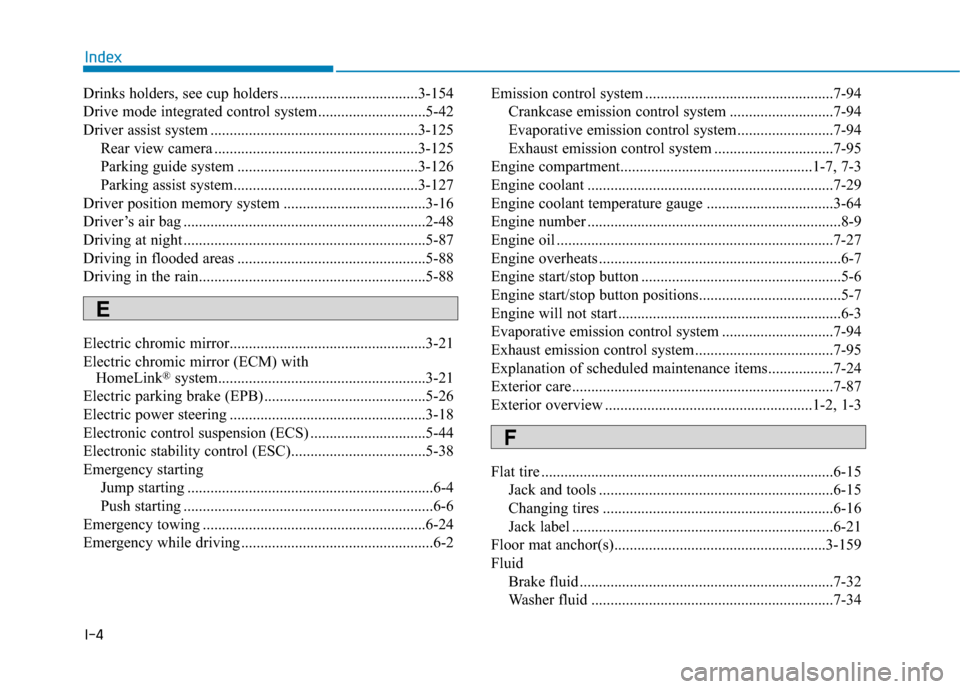
Engine oil ........................................................................7-27
Engine overheats ...............................................................6-7
Engine start/stop button ....................................................5-6
Engine start/stop button positions.....................................5-7
Engine will not start..........................................................6-3
Evaporative emission control system .............................7-94
Exhaust emission control system....................................7-95
Explanation of scheduled maintenance items.................7-24
Exterior care....................................................................7-87
Exterior overview ......................................................1-2, 1-3
Flat tire ............................................................................6-15
Jack and tools .............................................................6-15
Changing tires ............................................................6-16
Jack label ....................................................................6-21
Floor mat anchor(s).......................................................3-159
Fluid
Brake fluid ..................................................................7-32
Washer fluid ...............................................................7-34
Index
E
F
Page 498 of 501
I-7
Maintenance under severe usage conditions ..............7-22
Explanation of scheduled maintenance items ............7-24
Tire maintenance ........................................................7-51
Maintenance schedule
Normal maintenance schedule .....................................7-9
Maintenance under severe usage conditions ..............7-22
Maintenance services ........................................................7-5
Manual heating and air conditioning ............................3-135
Mirrors ............................................................................3-21
Inside rearview mirror ................................................3-21
Electric chromic mirror (ECM) with HomeLink
®
system......................................................................3-21
Outside rearview mirror .............................................3-35
Moonroof, see sunroof ....................................................3-43
Multi fuse ........................................................................7-65
Multimedia system............................................................4-2
AUX, USB and iPod
®port ..........................................4-2
Antenna ........................................................................4-3
Steering wheel audio control........................................4-4
Audio / Video / Navigation system (AVN) ..................4-5
Bluetooth
®Wireless Technology hands-free................4-5
Neck restraints, see headrest ...........................................2-14Odometer.........................................................................3-65
Oil (Engine) ....................................................................7-27
Outside rearview mirror..................................................3-35
Overheats ..........................................................................6-7
Owner maintenance ..........................................................7-6
Panorama sunroof ...........................................................3-43
Parking assist system ....................................................3-127
Parking brake.........................................................5-24, 5-26
Parking brake inspect......................................................7-34
Passenger's front air bag .................................................2-48
Power brakes ...................................................................5-23
Power outlet ..................................................................3-156
Power window lock button .............................................3-42
Push starting......................................................................6-6
Rear seat ..........................................................................2-11
Recommended cold tire inflation pressures ...................7-46
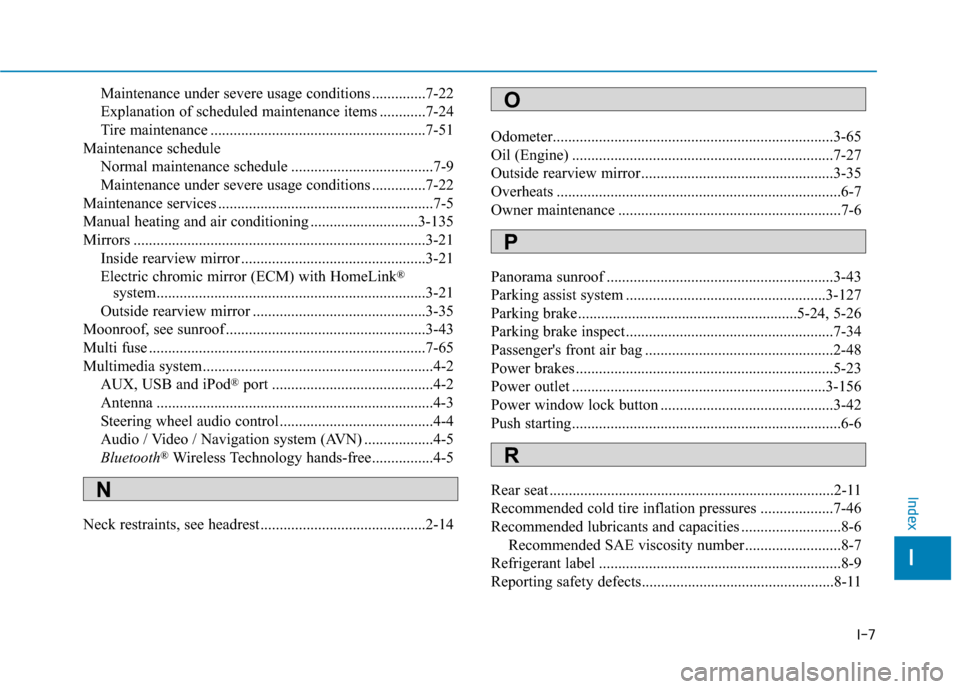
Recommended lubricants and capacities ..........................8-6
Recommended SAE viscosity number .........................8-7
Refrigerant label ...............................................................8-9
Reporting safety defects..................................................8-11
I
Index
O
P
R
N