window Hyundai Genesis 2016 - RHD (UK, Australia) Owner's Guide
[x] Cancel search | Manufacturer: HYUNDAI, Model Year: 2016, Model line: Genesis, Model: Hyundai Genesis 2016Pages: 502, PDF Size: 13.19 MB
Page 277 of 502
5-4
Driving your vehicle
Before entering the vehicle
• Be sure all windows, outside mir-
ror(s), and outside lights are clean
and unobstructed.
• Remove frost, snow, or ice.
• Visually check the tyres for uneven
wear and damage.
• Check under the vehicle for any
sign of leaks.
• Be sure there are no obstacles
behind you if you intend to back up.
Before starting
• Make sure the bonnet, the boot,
and the doors are securely closed
and locked.
• Adjust the position of the seat and
steering wheel.
• Adjust the inside and outside
rearview mirrors.
• Verify all the lights work.
• Fasten your seat belt. Check that
all passengers have fastened their
seat belts.
• Check the gauges and indicators in
the instrument panel and the mes-
sages on the instrument display
when the Engine Start/Stop button
is in the ON position.
• Check that any items you are car-
rying are stored properly or fas-
tened down securely.
BEFORE DRIVING
To reduce the risk of SERIOUS
INJURY or DEATH, take the fol-
lowing precautions:
•ALWAYS wear your seat belt.
All passengers must be prop-
erly belted whenever the vehi-
cle is moving. For more infor-
mation, refer to “Seat Belts” in
chapter 2.
•Always drive defensively.
Assume other drivers or
pedestrians may be careless
and make mistakes.
•Stay focused on the task of
driving. Driver distraction can
cause accidents.
•Leave plenty of space
between you and the vehicle
in front of you.
WARNING
Page 343 of 502
5-70
Driving your vehicle
This Lane Departure Warning
System detects the lane with the
sensor at the front windscreen and
warns you when your vehicle leaves
the lane.
LANE DEPARTURE WARNING SYSTEM (LDWS) (IF EQUIPPED)
ODH053029
ODH054030R
Take the following precautions
when using the Lane Departure
Warning System (LDWS):
•ALWAYS check the road con-
ditions. The LDWS does not
make the vehicle change
lanes.
•Do not turn the steering wheel
suddenly if the LDWS warns
that your vehicle is leaving the
lane.
•If the sensor cannot detect the
lane or if the vehicle speed
does not exceed 38 mph (60
km/h), the LDWS will not be
able to notify you if the vehi-
cle leaves the lane.
•If your vehicle has window tint
or other types of coating and
accessory on the front wind-
screen, the LDWS may not
work properly.
(Continued)
(Continued)
•Do not allow any water or liq-
uid to contact the LDWS sen-
sor or the sensor may be dam-
aged.
•Do not remove the LDWS
parts and do not damage the
sensor by a strong impact.
•Do not put objects that reflect
light on the dash board.
•The operation of the LDWS
can be affected by several fac-
tors (including environmental
conditions). It is the responsi-
bility of the driver to pay
attention to the roadway and
to maintain the vehicle in its
lane at all times.
WARNING
Page 362 of 502
5-89
Driving your vehicle
5
Non-operating condition
Outside rearview mirror may not
alert the driver when:
- The outside rearview mirror hous-
ing is damaged or covered with
debris.
- The window is covered with debris.
- The windows are severely tinted.
DRIVER'S ATTENTION
The driver must be cautious in the
below situations for the system may
not detect other vehicles or objects
in certain circumstances.
- Curved roads, tollgates, etc.
- The surrounding of the sensor is
polluted with rain, snow, mud, etc.
- The rear bumper near the sensor is
covered or hidden with a foreign
matter such as a sticker, bumper
guard, bicycle stand etc.
- The rear bumper is damaged or
the sensor is out of place.
- The height of the vehicle is altered
such as when the boot is loaded
with heavy objects, or there is low
tyre pressure etc.
- Bad weather such as heavy rain or
snow.
- A fixed object is near such as a
guardrail, tunnel, human and ani-
mal etc.
- Metal substances are near the vehi-
cles such as in a construction area.
- A big vehicle is near such as a bus
or truck.
(Continued)
•The system may not work
properly if the bumper has
been replaced or if repair work
has been done near the sensor.
•The detection area differs
according to the roads width. If
the road is narrow the system
may detect other vehicles in
the next lane. In addition, if the
road is very wide the system
may not detect other vehicles.
•The system may turn off due to
strong electromagnetic waves.
CAUTION
Page 367 of 502
5-94
Driving your vehicle
Snow or icy conditions
You need to keep sufficient distance
between your vehicle and the vehicle
in front of you.
Apply the brakes gently. Speeding,
rapid acceleration, sudden brake
applications, and sharp turns are
potentially very hazardous practices.
During deceleration, use engine
braking to the fullest extent. Sudden
brake applications on snowy or icy
roads may cause skids to occur.
To drive your vehicle in deep snow, it
may be necessary to use snow tyres
or to install tyre chains on your tyres.
Always carry emergency equipment.
Some of the items you may want to
carry include tyre chains, tow straps
or chains, a flashlight, emergency
flares, sand, a shovel, jumper cables,
a window scraper, gloves, ground
cloth, coveralls, a blanket, etc.
Snow tyres
WINTER DRIVING
Standard tyre Recommended snow tyre
Front Rear Front Rear
Tyre sizeWheel
sizeTyre sizeWheel
sizeTyre size
Wheel
sizeTyre sizeWheel
size
225/55R17 7.0Jx17 225/55R17 7.0Jx17 225/55R17
7.0Jx17 225/55R17 7.0Jx17
245/45R18
8.0Jx18 245/45R18 8.0Jx18
245/45R18 8.0Jx18 245/45R18 8.0Jx18 245/45R18
8.0Jx18 245/45R18 8.0Jx18
245/40R19
8.5Jx19245/40R19
or
275/35R198.5Jx19
or
9.0Jx19
245/40R19 8.5Jx19 275/35R19 9.0Jx19 245/40R19
8.5Jx19245/40R19
or
275/35R19 8.5Jx19
or
9.0Jx19
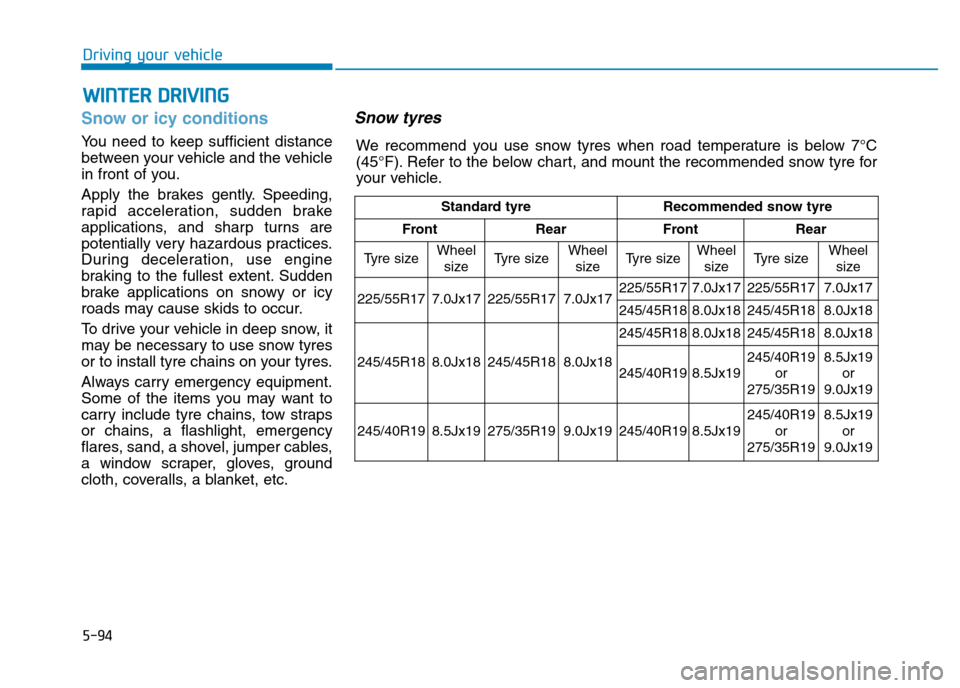
We recommend you use snow tyres when road temperature is below 7°C
(45°F). Refer to the below chart, and mount the recommended snow tyre for
your vehicle.
Page 370 of 502
5-97
Driving your vehicle
Winter precaution
Use high quality ethylene glycol
coolant
Your vehicle is delivered with high
quality ethylene glycol coolant in the
cooling system. It is the only type of
coolant that should be used because
it helps prevent corrosion in the cool-
ing system, lubricates the water
pump and prevents freezing. Be sure
to replace or replenish your coolant
in accordance with the maintenance
schedule in section 7. Before winter,
have your coolant tested to assure
that its freezing point is sufficient for
the temperatures anticipated during
the winter.
Check battery and cables
Winter puts additional burdens on
the battery system. Visually inspect
the battery and cables as described
in section 7. We recommend that the
level of charge in your battery be
checked by a HYUNDAI authorised
repairer.
Change to "winter weight" oil if
necessary
In some climates it is recommended
that a lower viscosity "winter weight"
oil be used during cold weather. See
section 8 for recommendations. If
you aren't sure what weight oil you
should use, we recommend that you
consult a HYUNDAI authorised
repairer.
Check spark plugs and ignition
system
Inspect your spark plugs as
described in section 7 and replace
them if necessary. Also check all
ignition wiring and components to be
sure they are not cracked, worn or
damaged in any way.
To keep locks from freezing
To keep the locks from freezing,
squirt an approved de-icer fluid or
glycerine into the key opening. If a
lock is covered with ice, squirt it with
an approved de-icing fluid to remove
the ice. If the lock is frozen internally,
you may be able to thaw it out by
using a heated key. Handle the heat-
ed key with care to avoid injury.
Use approved window washer
anti-freeze in system
To keep the water in the window
washer system from freezing, add an
approved window washer anti-freeze
solution in accordance with instruc-
tions on the container. Window wash-
er anti-freeze is available from a
HYUNDAI authorised repairer and
most auto parts outlets. Do not use
engine coolant or other types of anti-
freeze as these may damage the
paint finish.5
Page 371 of 502
5-98
Don't let your parking brake
freeze
Under some conditions your parking
brake can freeze in the engaged
position. This is most likely to hap-
pen when there is an accumulation
of snow or ice around or near the
rear brakes or if the brakes are wet.
If there is a risk the parking brake
may freeze, apply it only temporarily
whilst you put the shift lever in P and
block the rear wheels so the vehicle
cannot roll. Then release the parking
brake.
Don't let ice and snow accumu-
late underneath
Under some conditions, snow and
ice can build up under the fenders
and interfere with the steering. When
driving in severe winter conditions
where this may happen, you should
periodically check underneath the
vehicle to be sure the movement of
the front wheels and the steering
components is not obstructed.
Carry emergency equipment
Depending on the severity of the
weather, you should carry appropri-
ate emergency equipment. Some of
the items you may want to carry
include tyre chains, tow straps or
chains, flashlight, emergency flares,
sand, shovel, jumper cables, window
scraper, gloves, ground cloth, cover-
alls, blanket, etc.
Don't place foreign objects or
materials in the engine com-
partment
Placement of foreign objects or mate-
rials which prevent cooling of the
engine, in the engine compartment,
may cause a failure or combustion.
The manufacturer is not responsible
for the damage caused by such
placement.
Driving your vehicle
Page 435 of 502
7-29
7
Maintenance
Reset items
Items should be reset after the bat-
tery has been discharged or the bat-
tery has been disconnected.
• Auto up/down window
(See chapter 3)
• Sunroof (See chapter 3)
• Trip computer (See chapter 3)
• Climate control system
(See chapter 3) (Continued)•Disconnect the battery charg-
er in the following order.
1. Turn off the battery charger
main switch.
2. Unhook the negative clamp
from the negative battery
terminal.
3. Unhook the positive clamp
from the positive battery
terminal.
•Before performing mainte-
nance or recharging the bat-
tery, turn off all accessories
and stop the engine.
•The negative battery cable
must be removed first and
installed last when the battery
is disconnected.
Page 456 of 502
7-50
Maintenance
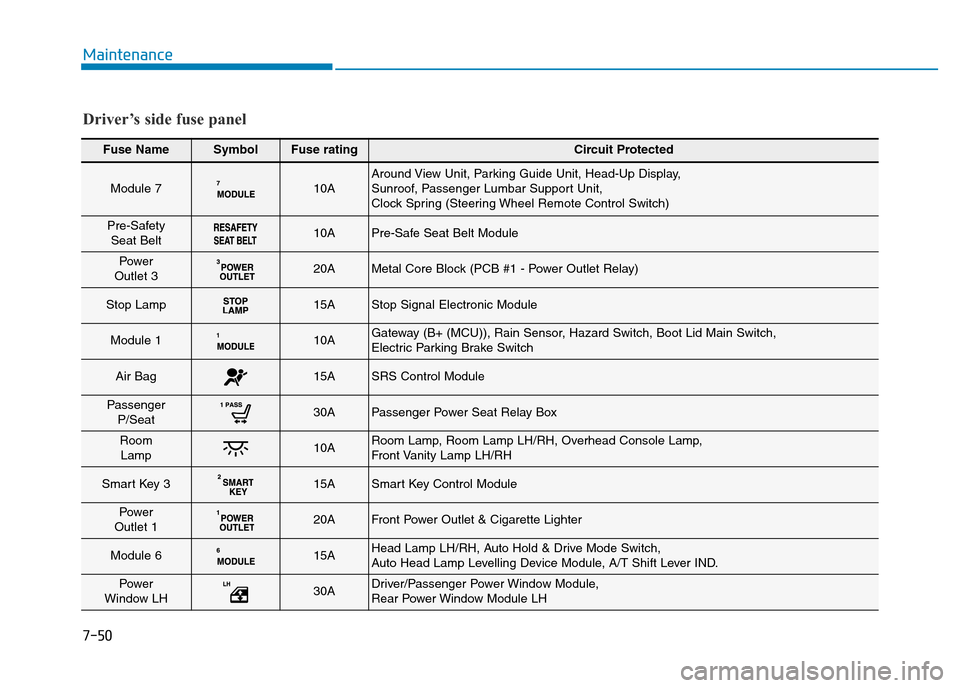
Fuse NameSymbolFuse ratingCircuit Protected
Module 710AAround View Unit, Parking Guide Unit, Head-Up Display,
Sunroof, Passenger Lumbar Support Unit,
Clock Spring (Steering Wheel Remote Control Switch)
Pre-Safety
Seat Belt10APre-Safe Seat Belt Module
Power
Outlet 320AMetal Core Block (PCB #1 - Power Outlet Relay)
Stop Lamp15AStop Signal Electronic Module
Module 110AGateway (B+ (MCU)), Rain Sensor, Hazard Switch, Boot Lid Main Switch,
Electric Parking Brake Switch
Air Bag15ASRS Control Module
Passenger
P/Seat30APassenger Power Seat Relay Box
Room
Lamp10ARoom Lamp, Room Lamp LH/RH, Overhead Console Lamp,
Front Vanity Lamp LH/RH
Smart Key 315ASmart Key Control Module
Power
Outlet 120AFront Power Outlet & Cigarette Lighter
Module 615AHead Lamp LH/RH, Auto Hold & Drive Mode Switch,
Auto Head Lamp Levelling Device Module, A/T Shift Lever IND.
Power
Window LH30ADriver/Passenger Power Window Module,
Rear Power Window Module LH
Driver’s side fuse panel
Page 467 of 502
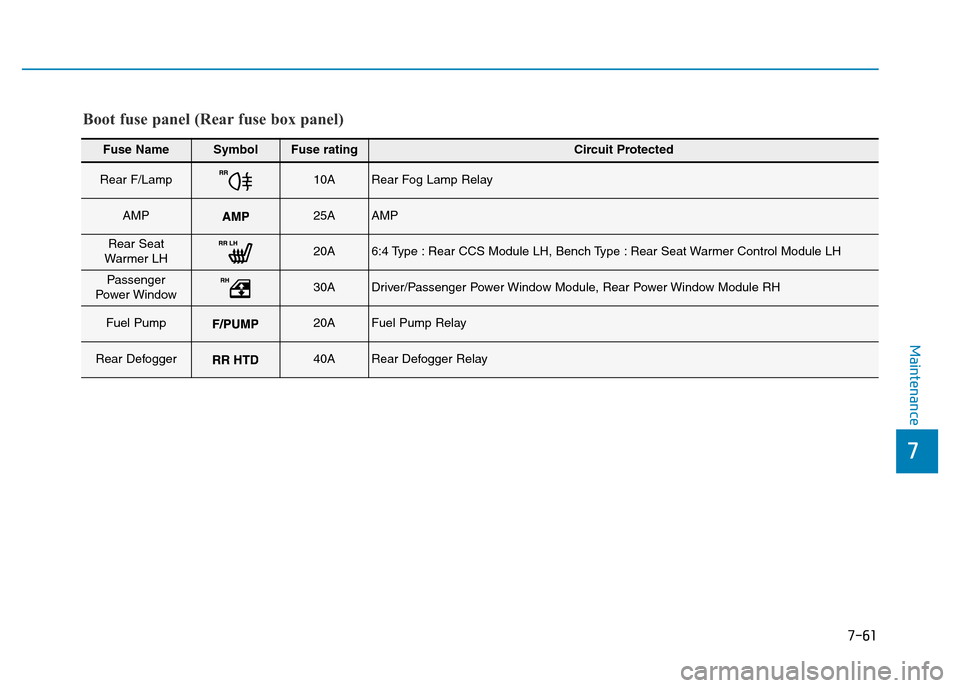
7-61
7
Maintenance
Fuse NameSymbolFuse ratingCircuit Protected
Rear F/Lamp10ARear Fog Lamp Relay
AMP25AAMP
Rear Seat
Warmer LH20A6:4 Type : Rear CCS Module LH, Bench Type : Rear Seat Warmer Control Module LH
Passenger
Power Window30ADriver/Passenger Power Window Module, Rear Power Window Module RH
Fuel Pump20AFuel Pump Relay
Rear Defogger40ARear Defogger Relay
Boot fuse panel (Rear fuse box panel)
Page 470 of 502
7-64
Maintenance
LIGHT BULBS
Use only the bulbs of the specified
wattage.
✽NOTICE
After heavy driving, rain or wash-
ing, headlamp and tail lamp lenses
could appear frosty. This condition
is caused by the temperature differ-
ence between the lamp inside and
outside. This is similar to the con-
densation on your windows inside
your vehicle during rain and doesn’t
indicate a problem with your vehi-
cle. If the water leaks into the lamp
bulb circuitry, we recommend that
the system be checked by a
HYUNDAI authorised repairer.
❈Traffic Change (For Europe)
The low beam light distribution is
asymmetric. If you go abroad to a
country with opposite traffic direc-
tion, this asymmetric part will dazzle
oncoming car driver. To prevent daz-
zle, ECE regulation demand several
technical solutions (ex. automatic
change system, adhesive sheet,
down aiming). These headlamps are
designed not to dazzle opposite driv-
ers. So, you need not change your
headlamps in a country with oppo-
site traffic direction. Be sure to replace the burned-
out bulb with one of the same
wattage rating. Otherwise, it
may cause damage to the fuse
or electric wiring system.
CAUTION
If you don’t have the necessary
tools, the correct bulbs and the
expertise, consult a HYUNDAI
authorised repairer. In many
cases, it is difficult to replace
vehicle light bulbs because
other parts of the vehicle must
be removed before you can get
to the bulb. This is especially
true if you have to remove the
headlamp assembly to get to
the bulb(s).
Removing/installing the head-
lamp assembly can result in
damage to the vehicle.
CAUTION
Working on the lights
Prior to working on the light, firm-
ly apply the parking brake,
ensure that the Engine Start/Stop
button is turned to the OFF posi-
tion and turn off the lights to
avoid sudden movement of the
vehicle and burning your fingers
or receiving an electric shock.
WARNING