air filter Hyundai Genesis 2016 Owner's Manual - RHD (UK, Australia)
[x] Cancel search | Manufacturer: HYUNDAI, Model Year: 2016, Model line: Genesis, Model: Hyundai Genesis 2016Pages: 502, PDF Size: 13.19 MB
Page 93 of 502
LCD display ...........................................................3-57
LCD Modes ........................................................................3-57
Trip Computer Mode.......................................................3-58
Turn By Turn (TBT) Mode ............................................3-59
ASCC/LDWS/LKAS Mode ..............................................3-59
A/V Mode..........................................................................3-59
Information Mode ...........................................................3-60
User Settings Mode ........................................................3-62
Warning Messages..........................................................3-69
Trip computer .......................................................3-80
Overview............................................................................3-80
Trip Modes ........................................................................3-80
Trip A/B .............................................................................3-80
Fuel Economy...................................................................3-81
Warning and indicator lights ..............................3-84
Warning lights ..................................................................3-84
Indicator Lights ................................................................3-93
Head Up Display (HUD) .......................................3-98
Description ........................................................................3-98
Head Up Display ON/OFF .............................................3-99
Head Up Display Information .......................................3-99
Head Up Display Setting .............................................3-100
Light .....................................................................3-101
Exterior lights ................................................................3-101
Smart High Beam ..........................................................3-103
Traffic change ...............................................................3-109
Welcome system ...........................................................3-109
Interior lights..................................................................3-111
Wipers and washers ..........................................3-116
Windscreen wipers ......................................................3-116
Windscreen washers ...................................................3-118
Driver assist system ..........................................3-119
Rearview camera...........................................................3-119
Parking assist system ..................................................3-120
Smart Parking Assist System (SPAS) .......................3-123
Parking guide system (For Europe) .........................3-142
Around View Monitoring (AVM) System .................3-143
Defroster .............................................................3-145
Rear window defroster ...............................................3-145
Automatic climate control system ...................3-147
Automatic heating and air conditioning ..................3-148
Manual heating and air conditioning .......................3-149
System operation ..........................................................3-157
Climate control air filter ............................................3-160
3
Page 251 of 502
3-160
Convenient features of your vehicle
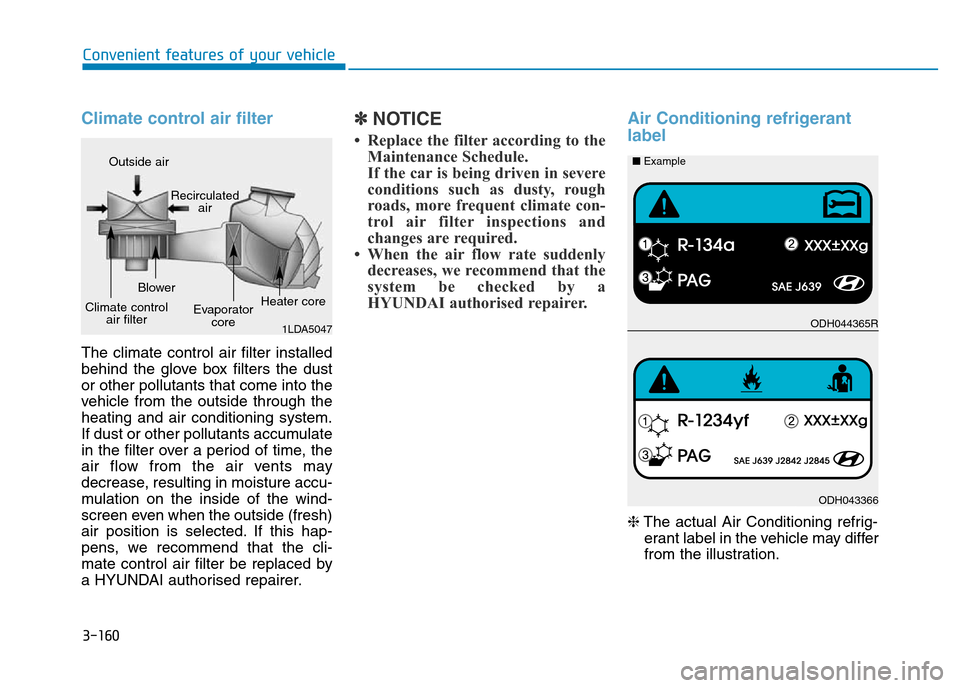
Climate control air filter
The climate control air filter installed
behind the glove box filters the dust
or other pollutants that come into the
vehicle from the outside through the
heating and air conditioning system.
If dust or other pollutants accumulate
in the filter over a period of time, the
air flow from the air vents may
decrease, resulting in moisture accu-
mulation on the inside of the wind-
screen even when the outside (fresh)
air position is selected. If this hap-
pens, we recommend that the cli-
mate control air filter be replaced by
a HYUNDAI authorised repairer.
✽NOTICE
• Replace the filter according to the
Maintenance Schedule.
If the car is being driven in severe
conditions such as dusty, rough
roads, more frequent climate con-
trol air filter inspections and
changes are required.
• When the air flow rate suddenly
decreases, we recommend that the
system be checked by a
HYUNDAI authorised repairer.
Air Conditioning refrigerant
label
❈The actual Air Conditioning refrig-
erant label in the vehicle may differ
from the illustration.
1LDA5047
Outside air
Recirculated
air
Climate control
air filterBlower
Evaporator
coreHeater core
ODH044365R
ODH043366 ■Example
Page 407 of 502
7
Maintenance
7
Maintenance
Engine compartment .............................................7-3
Maintenance services ...........................................7-5
Owner's responsibility ......................................................7-5
Owner maintenance precautions ..................................7-5
Owner maintenance ...............................................7-7
Owner maintenance schedule ........................................7-7
Scheduled maintenance service ..........................7-9
Explanation of scheduled maintenance items..7-10
Engine oil ..............................................................7-14
Checking the engine oil level .......................................7-14
Changing the engine oil and filter ..............................7-15
Engine coolant......................................................7-16
Checking the coolant level ...........................................7-16
Changing the coolant .....................................................7-18
Brake fluid ............................................................7-19
Checking the brake fluid level .....................................7-19
Washer fluid .........................................................7-21
Checking the washer fluid level ..................................7-21
Parking brake .......................................................7-21
Checking the parking brake .........................................7-21
Air cleaner ............................................................7-22
Filter replacement ...........................................................7-22
Climate control air filter .....................................7-23
Filter inspection ...............................................................7-23
Filter replacement ...........................................................7-23
Wiper blades .........................................................7-24
Blade inspection ..............................................................7-24
Blade replacement ..........................................................7-24
Battery...................................................................7-26
For best battery service................................................7-26
Battery capacity label ....................................................7-28
Battery recharging .........................................................7-28
Reset items .......................................................................7-29
Tyres and wheels .................................................7-30
Tyre care ...........................................................................7-30
Recommended cold tyre inflation pressures ...........7-30
Checking tyre inflation pressure.................................7-32
Tyre rotation ....................................................................7-33
Wheel alignment and tyre balance.............................7-34
Tyre replacement ............................................................7-34
Wheel replacement ........................................................7-36
Tyre traction ....................................................................7-36
Tyre maintenance ..........................................................7-36
Tyre sidewall labelling....................................................7-36
Low aspect ratio tyre.....................................................7-41
7
Page 416 of 502
7-10
Maintenance
EXPLANATION OF SCHEDULED MAINTENANCE ITEMS
Engine oil and filter
The engine oil and filter should be
changed at the intervals specified in
the maintenance schedule. If the car
is being driven in severe conditions,
more frequent oil and filter changes
are required.
Drive belts
Inspect all drive belts for evidence of
cuts, cracks, excessive wear or oil
saturation and replace if necessary.
Drive belts should be checked peri-
odically for proper tension and
adjusted as necessary.
Fuel filter (cartridge)
A clogged filter can limit the speed at
which the vehicle may be driven,
damage the emission system and
cause multiple issues such as hard
starting. If an excessive amount of
foreign matter accumulates in the
fuel tank, the filter may require
replacement more frequently.
After installing a new filter, run the
engine for several minutes, and
check for leaks at the connections.
We recommend that the fuel filter be
replaced by a HYUNDAI authorised
repairer.
Fuel lines, fuel hoses and con-
nections
Check the fuel lines, fuel hoses and
connections for leakage and dam-
age. We recommend that the fuel
lines, fuel hoses and connections be
replaced by a HYUNDAI authorised
repairer.
Vapour hose and fuel filler cap
The vapour hose and fuel filler cap
should be inspected at those inter-
vals specified in the maintenance
schedule. Make sure that a new
vapour hose or fuel filler cap is cor-
rectly replaced.
When you are inspecting the
belt, place the Engine Start/Stop
button in the OFF or ACC posi-
tion.
CAUTION
Page 417 of 502
7-11
7
Maintenance
Vacuum crankcase ventilation
hoses (if equipped)
Inspect the surface of hoses for evi-
dence of heat and/or mechanical
damage. Hard and brittle rubber,
cracking, tears, cuts, abrasions, and
excessive swelling indicate deterio-
ration. Particular attention should be
paid to examine those hose surfaces
nearest to high heat sources, such
as the exhaust manifold.
Inspect the hose routing to assure
that the hoses do not come in con-
tact with any heat source, sharp
edges or moving component which
might cause heat damage or
mechanical wear. Inspect all hose
connections, such as clamps and
couplings, to make sure they are
secure, and that no leaks are pres-
ent. Hoses should be replaced
immediately if there is any evidence
of deterioration or damage.
Air cleaner filter
We recommend that the air cleaner
filter be replaced by a HYUNDAI
authorised repairer.
Spark plugs
Make sure to install new spark plugs
of the correct heat range.
Valve clearance
(3.0L / 3.3L / 3.8L)
Inspect excessive valve noise and/or
engine vibration and adjust if neces-
sary. We recommend that the system
be serviced by a HYUNDAI autho-
rised repairer.
Cooling system
Check the cooling system parts,
such as radiator, coolant reservoir,
hoses and connections for leakage
and damage. Replace any damaged
parts.
Coolant
The coolant should be changed at
the intervals specified in the mainte-
nance schedule. Do not disconnect and inspect
spark plugs when the engine is
hot. You may burn yourself.
WARNING
Page 421 of 502
7-15
7
Maintenance
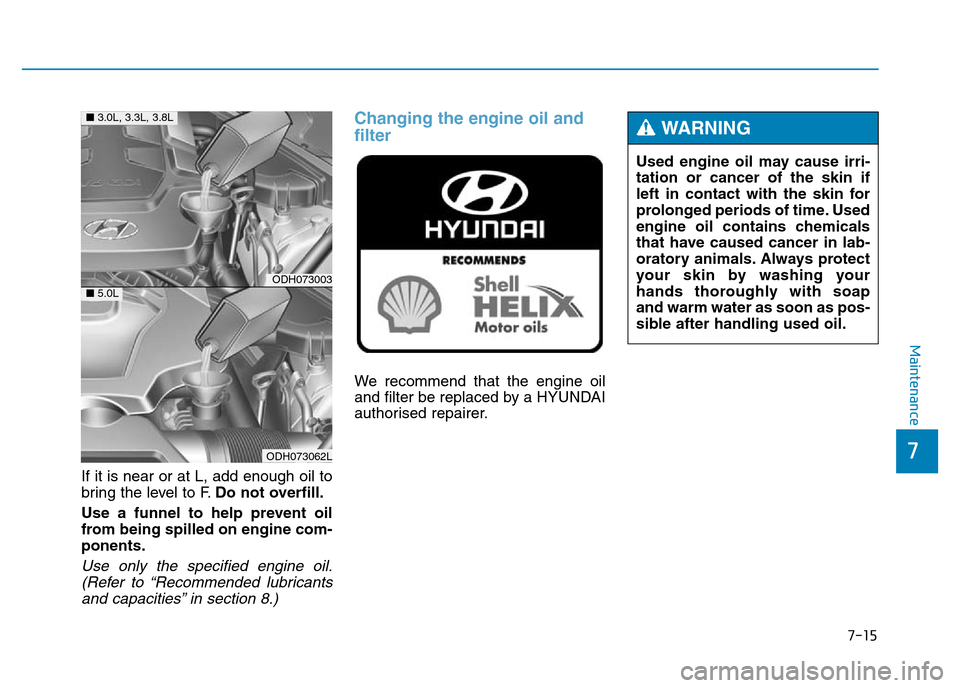
If it is near or at L, add enough oil to
bring the level to F.Do not overfill.
Use a funnel to help prevent oil
from being spilled on engine com-
ponents.
Use only the specified engine oil.
(Refer to “Recommended lubricants
and capacities” in section 8.)
Changing the engine oil and
filter
We recommend that the engine oil
and filter be replaced by a HYUNDAI
authorised repairer.
ODH073003
ODH073062L
■3.0L, 3.3L, 3.8L
■5.0L
Used engine oil may cause irri-
tation or cancer of the skin if
left in contact with the skin for
prolonged periods of time. Used
engine oil contains chemicals
that have caused cancer in lab-
oratory animals. Always protect
your skin by washing your
hands thoroughly with soap
and warm water as soon as pos-
sible after handling used oil.
WARNING
Page 428 of 502
7-22
Maintenance
AIR CLEANER
Filter replacement
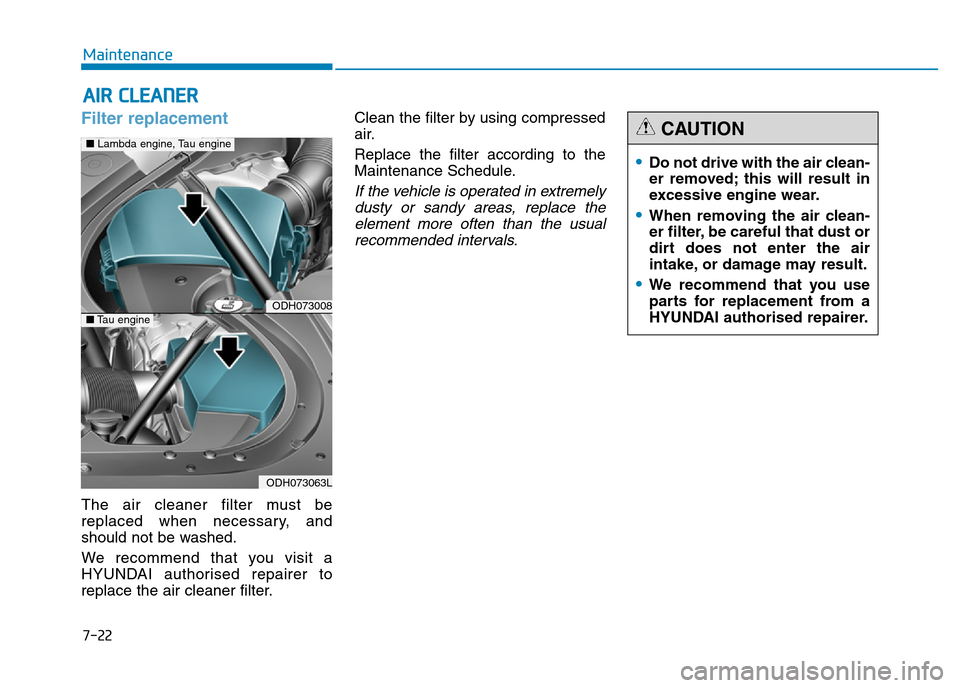
The air cleaner filter must be
replaced when necessary, and
should not be washed.
We recommend that you visit a
HYUNDAI authorised repairer to
replace the air cleaner filter.Clean the filter by using compressed
air.
Replace the filter according to the
Maintenance Schedule.
If the vehicle is operated in extremely
dusty or sandy areas, replace the
element more often than the usual
recommended intervals.
•Do not drive with the air clean-
er removed; this will result in
excessive engine wear.
•When removing the air clean-
er filter, be careful that dust or
dirt does not enter the air
intake, or damage may result.
•We recommend that you use
parts for replacement from a
HYUNDAI authorised repairer.
CAUTION
ODH073008
ODH073063L
■Lambda engine, Tau engine
■Tau engine
Page 429 of 502
7-23
7
Maintenance
CLIMATE CONTROL AIR FILTER
Filter inspection
If the vehicle is operated in severely
air-polluted cities or on dusty rough
roads for a long period, it should be
inspected more frequently and
replaced earlier. When you, the
owner, replace the climate control air
filter, replace it performing the follow-
ing procedure, and be careful to
avoid damaging other components.
Replace the filter according to the
Maintenance Schedule.
✽NOTICE
Install a new climate control air fil-
ter in the correct direction with the
arrow symbol (
↓) facing downwards.
Otherwise, the climate control effects
may decrease, possibly with a noise.
Filter replacement
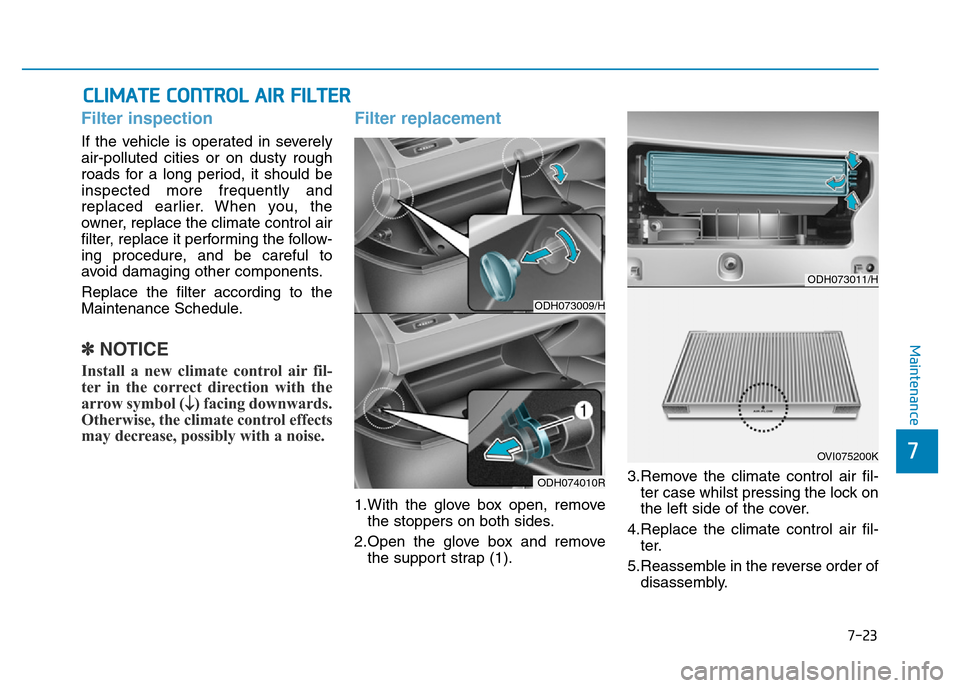
1.With the glove box open, remove
the stoppers on both sides.
2.Open the glove box and remove
the support strap (1).3.Remove the climate control air fil-
ter case whilst pressing the lock on
the left side of the cover.
4.Replace the climate control air fil-
ter.
5.Reassemble in the reverse order of
disassembly.
ODH073009/H
ODH074010R
ODH073011/H
OVI075200K
Page 489 of 502
7-83
7
Maintenance
EMISSION CONTROL SYSTEM
The emission control system of your
vehicle is covered by a written limited
warranty. Please see the warranty
information contained in the Warranty
Booklet in your vehicle.
Your vehicle is equipped with an
emission control system to meet all
emission regulations.
There are three emission control
systems which are as follows.
(1) Crankcase emission control sys-
tem
(2) Evaporative emission control sys-
tem
(3) Exhaust emission control system
In order to assure the proper function
of the emission control systems, it is
recommended that you have your
car inspected and maintained by a
HYUNDAI authorised repairer in
accordance with the maintenance
schedule in this manual.Caution for the Inspection and
Maintenance Test (With Electronic
Stability Control (ESC) system)
• To prevent the vehicle from mis-
firing during dynamometer test-
ing, turn the Electronic Stability
Control (ESC) system off by
pressing the ESC switch.
• After dynamometer testing is
completed, turn the ESC system
back on by pressing the ESC
switch again.
1. Crankcase emission control
system
The positive crankcase ventilation
system is employed to prevent air
pollution caused by blow-by gases
being emitted from the crankcase.
This system supplies fresh filtered air
to the crankcase through the air
intake hose. Inside the crankcase,
the fresh air mixes with blow-by
gases, which then pass through the
PCV valve into the induction system.
2. Evaporative emission con-
trol system
The Evaporative Emission Control
System is designed to prevent fuel
vapours from escaping into the
atmosphere.
Canister
Fuel vapours generated inside the
fuel tank are absorbed and stored in
the onboard canister. When the
engine is running, the fuel vapours
absorbed in the canister are drawn
into the surge tank through the purge
control solenoid valve.
Purge Control Solenoid Valve
(PCSV)
The purge control solenoid valve is
controlled by the Engine Control
Module (ECM); when the engine
coolant temperature is low during
idling, the PCSV closes so that evap-
orated fuel is not taken into the
engine. After the engine warms-up
during ordinary driving, the PCSV
opens to introduce evaporated fuel to
the engine.