four wheel drive Hyundai Genesis 2016 Owner's Manual - RHD (UK, Australia)
[x] Cancel search | Manufacturer: HYUNDAI, Model Year: 2016, Model line: Genesis, Model: Hyundai Genesis 2016Pages: 502, PDF Size: 13.19 MB
Page 292 of 502
5-19
Driving your vehicle
5
Using All Wheel Drive (AWD)
The All Wheel Drive (AWD) System
delivers engine power to front and
rear wheels for maximum traction.
AWD is useful when extra traction is
required, such as when driving slip-
pery, muddy, wet, or snow-covered
roads.
If the system determines there is a
need for four wheel drive, the
engine's driving power is distributed
to all four wheels automatically.
✽NOTICE
• Do not drive in water if the level is
higher than the bottom of the vehi-
cle.
• Check your brake condition once
you are out of mud or water.
Depress the brake pedal several
times as you move slowly until you
feel normal braking return.
• Shorten your scheduled mainte-
nance interval if you drive in off-
road conditions such as sand, mud
or water (see “Maintenance Under
Severe Usage Conditions” in chap-
ter 7).
• Make sure that AWD vehicle is
towed by a flatbed tow truck.
ALL WHEEL DRIVE (AWD) (IF EQUIPPED)
To reduce the risk of SERIOUS
INJURY or DEATH:
•Do not drive in conditions that
exceed the vehicles intended
design such as challenging
off-road conditions.
•Avoid high speeds when cor-
nering or turning.
•Do not make quick steering
wheel movements, such as
sharp lane changes or fast,
sharp turns.
•The risk of a rollover is great-
ly increased if you lose con-
trol of your vehicle at highway
speeds.
•Loss of control often occurs if
two or more wheels drop off
the roadway and the driver
over steers to reenter the
roadway.
•In the event your vehicle
leaves the roadway, do not
steer sharply. Instead, slow
down before pulling back into
the travel lanes.
WARNING
If the AWD warning light ( )
stays on the instrument cluster,
your vehicle may have a mal-
function with the AWD system.
When the AWD warning light
( ) illuminates we recom-
mend that the vehicle be
checked by a HYUNDAI autho-
rised repairer as soon as possi-
ble.
WARNING
Page 293 of 502
5-20
Driving your vehicle
For safe AWD operation
Before driving
• Make sure all passengers are
wearing seat belts.
• Sit upright and closer to the steer-
ing wheel than usual. Adjust the
steering wheel to a position com-
fortable for you to drive.
Driving on snow-covered or icy
roads
• Start off slowly by applying the
accelerator pedal gently.
• Use snow tyres or tyre chains.
• Keep sufficient distance between
your vehicle and the vehicle in front
of you.
• Use engine braking during deceler-
ation.
• Avoid speeding, rapid acceleration,
sudden brake applications, and
sharp turns to prevent skids.
Driving in sand or mud
• Maintain slow and constant speed.
• Use tyre chains driving in mud if
necessary.
• Keep sufficient distance between
your vehicle and the vehicle in front
of you.
• Reduce vehicle speed and always
check the road condition.
• Avoid speeding, rapid acceleration,
sudden brake applications, and
sharp turns to prevent getting
stuck.
✽NOTICE
• When using Snow Tyres, mount
them on all four wheels.
• When using Tyre Chains, install
them on all four tyres. However, if
you are in a situation to use only
two tyre chains, install them on
the rear tyres. In this case, drive a
short distance to prevent damage
to the AWD system.
• If tyre chains must be used, use
AutoSock (fabric snow chain) and
install the tyre chain after review-
ing the instructions provided with
the tyre chains.
For more information on Snow
Tyres and Tyre Chains, refer to
"Winter Driving" in this chapter.
When the vehicle is stuck in
snow, sand or mud, place a non-
slip material under the drive
wheels to provide traction OR
slowly spin the wheels in for-
ward and reverse directions
which causes a rocking motion
that may free the vehicle.
However, avoid running the
engine continuously at high
rpm, doing so may damage the
AWD system.
CAUTION
Page 294 of 502
5-21
Driving your vehicle
5
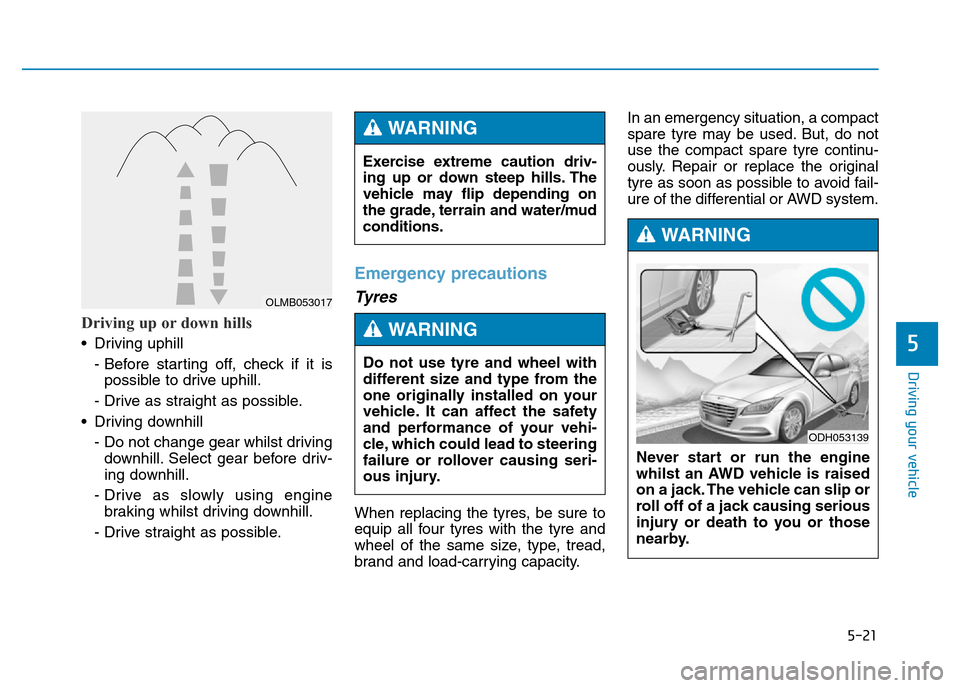
Driving up or down hills
• Driving uphill
- Before starting off, check if it is
possible to drive uphill.
- Drive as straight as possible.
• Driving downhill
- Do not change gear whilst driving
downhill. Select gear before driv-
ing downhill.
- Drive as slowly using engine
braking whilst driving downhill.
- Drive straight as possible.
Emergency precautions
Tyres
When replacing the tyres, be sure to
equip all four tyres with the tyre and
wheel of the same size, type, tread,
brand and load-carrying capacity.In an emergency situation, a compact
spare tyre may be used. But, do not
use the compact spare tyre continu-
ously. Repair or replace the original
tyre as soon as possible to avoid fail-
ure of the differential or AWD system. Exercise extreme caution driv-
ing up or down steep hills. The
vehicle may flip depending on
the grade, terrain and water/mud
conditions.
WARNING
OLMB053017
Never start or run the engine
whilst an AWD vehicle is raised
on a jack. The vehicle can slip or
roll off of a jack causing serious
injury or death to you or those
nearby.
WARNING
ODH053139
Do not use tyre and wheel with
different size and type from the
one originally installed on your
vehicle. It can affect the safety
and performance of your vehi-
cle, which could lead to steering
failure or rollover causing seri-
ous injury.
WARNING
Page 368 of 502
5-95
Driving your vehicle
5
If you mount snow tyres on your vehi-
cle, make sure to use the same infla-
tion pressure as the original tyres.
However, if you mount 245/40R19
size tyre on the rear, the tyre inflation
pressure should maintain 35psi.
Mount snow tyres on all four wheels
to balance your vehicle's handling in
all weather conditions. The traction
provided by snow tyres on dry road
may not be as high as your vehicle's
original equipment tyres. Check with
the tyre dealer for maximum speed
recommendations.
✽NOTICE
Do not install studded tyres without
first checking local and municipal
regulations for possible restrictions
against their use.
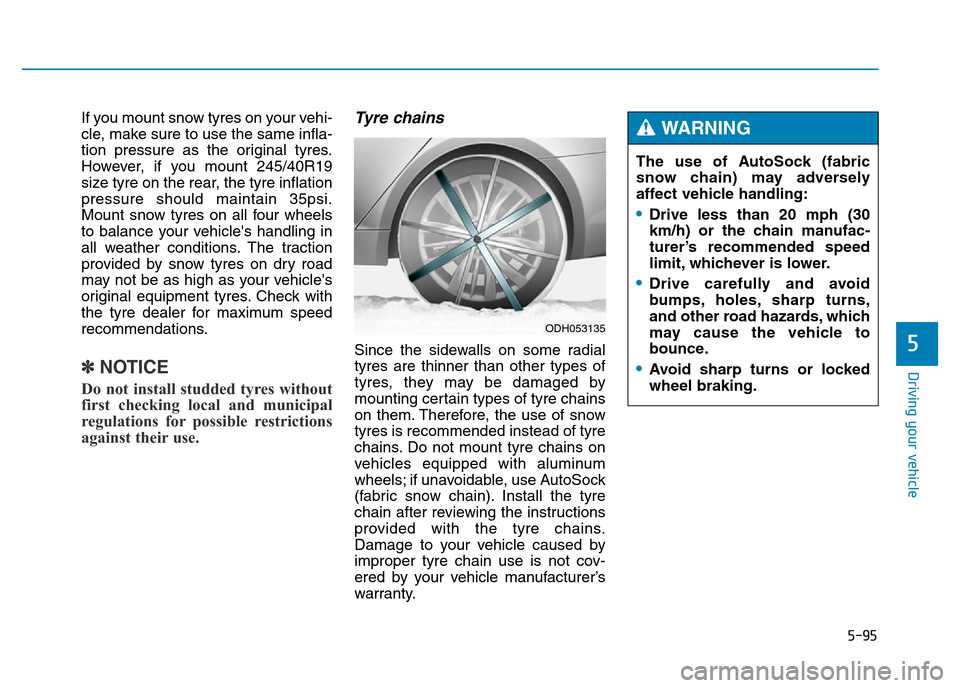
Tyre chains
Since the sidewalls on some radial
tyres are thinner than other types of
tyres, they may be damaged by
mounting certain types of tyre chains
on them. Therefore, the use of snow
tyres is recommended instead of tyre
chains. Do not mount tyre chains on
vehicles equipped with aluminum
wheels; if unavoidable, use AutoSock
(fabric snow chain). Install the tyre
chain after reviewing the instructions
provided with the tyre chains.
Damage to your vehicle caused by
improper tyre chain use is not cov-
ered by your vehicle manufacturer’s
warranty.The use of AutoSock (fabric
snow chain) may adversely
affect vehicle handling:
•Drive less than 20 mph (30
km/h) or the chain manufac-
turer’s recommended speed
limit, whichever is lower.
•Drive carefully and avoid
bumps, holes, sharp turns,
and other road hazards, which
may cause the vehicle to
bounce.
•Avoid sharp turns or locked
wheel braking.
WARNING
ODH053135
Page 369 of 502
5-96
Driving your vehicle
✽NOTICE
• Install AutoSock (fabric snow
chain) on the rear tyres for 2WD
vehicles or on all four tyres for
AWD vehicles. It should be noted
that installing AutoSock (fabric
snow chain) on the tyres will pro-
vide a greater driving force, but
will not prevent side skids.
• Do not install studded tyres with-
out first checking local and munic-
ipal regulations for possible
restrictions against their use.Chain InstallationWhen installing AutoSock (fabric
snow chain), follow the manufactur-
er's instructions and mount them as
tightly possible. Drive slowly (less
than 20 mph (30 km/h)) with chains
installed. If you hear the chains con-
tacting the body or chassis, stop and
tighten them. If they still make con-
tact, slow down until the noise stops.
Remove the AutoSock (fabric snow
chain) as soon as you begin driving
on cleared roads.
When mounting AutoSock (fabric
snow chain), park the vehicle on
level ground away from traffic. Turn
on the vehicle Hazard Warning
Flasher and place a triangular emer-
gency warning device behind the
vehicle (if available).
Always place the vehicle in P (Park),
apply the parking brake and turn off
the engine before installing tyre
chains.When using AutoSock (fabric
snow chain):
•Wrong size chains or improp-
erly installed chains can dam-
age your vehicle's brake lines,
suspension, body and wheels.
•If you hear noise caused by
chains contacting the body,
retighten the chain to prevent
contact with the vehicle body.
•To prevent body damage,
retighten the chains after driv-
ing 0.3~0.6 miles (0.5~1.0 km).
CAUTION