inflation pressure Hyundai Genesis 2016 Owner's Manual - RHD (UK, Australia)
[x] Cancel search | Manufacturer: HYUNDAI, Model Year: 2016, Model line: Genesis, Model: Hyundai Genesis 2016Pages: 502, PDF Size: 13.19 MB
Page 76 of 502
2-58
Safety system of your vehicle
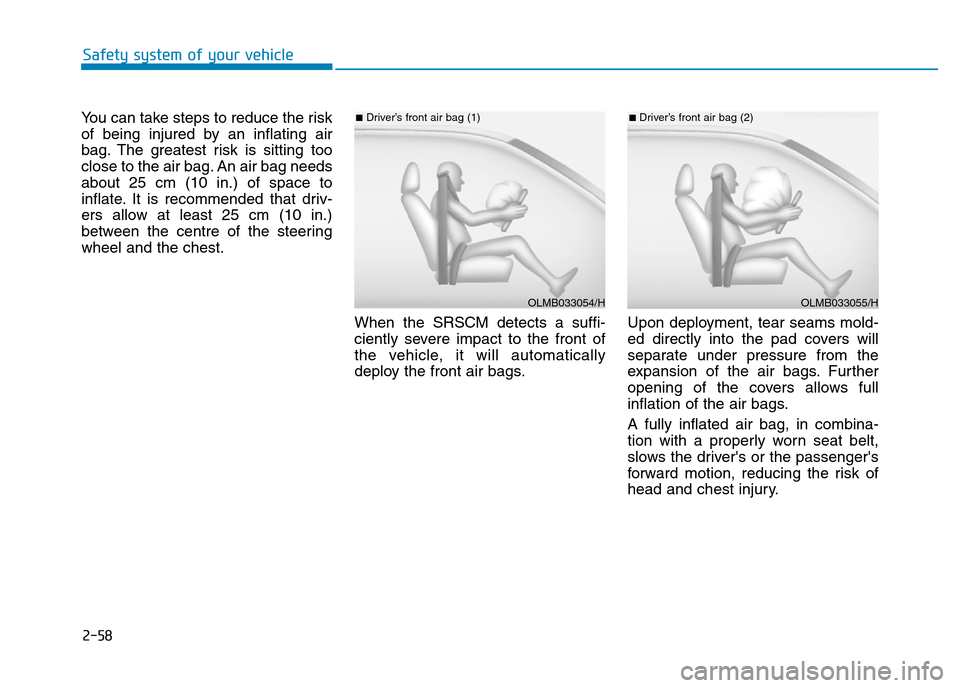
You can take steps to reduce the risk
of being injured by an inflating air
bag. The greatest risk is sitting too
close to the air bag. An air bag needs
about 25 cm (10 in.) of space to
inflate. It is recommended that driv-
ers allow at least 25 cm (10 in.)
between the centre of the steering
wheel and the chest.
When the SRSCM detects a suffi-
ciently severe impact to the front of
the vehicle, it will automatically
deploy the front air bags.Upon deployment, tear seams mold-
ed directly into the pad covers will
separate under pressure from the
expansion of the air bags. Further
opening of the covers allows full
inflation of the air bags.
A fully inflated air bag, in combina-
tion with a properly worn seat belt,
slows the driver's or the passenger's
forward motion, reducing the risk of
head and chest injury.
OLMB033054/H
■Driver’s front air bag (1)
OLMB033055/H
■Driver’s front air bag (2)
Page 368 of 502
5-95
Driving your vehicle
5
If you mount snow tyres on your vehi-
cle, make sure to use the same infla-
tion pressure as the original tyres.
However, if you mount 245/40R19
size tyre on the rear, the tyre inflation
pressure should maintain 35psi.
Mount snow tyres on all four wheels
to balance your vehicle's handling in
all weather conditions. The traction
provided by snow tyres on dry road
may not be as high as your vehicle's
original equipment tyres. Check with
the tyre dealer for maximum speed
recommendations.
✽NOTICE
Do not install studded tyres without
first checking local and municipal
regulations for possible restrictions
against their use.
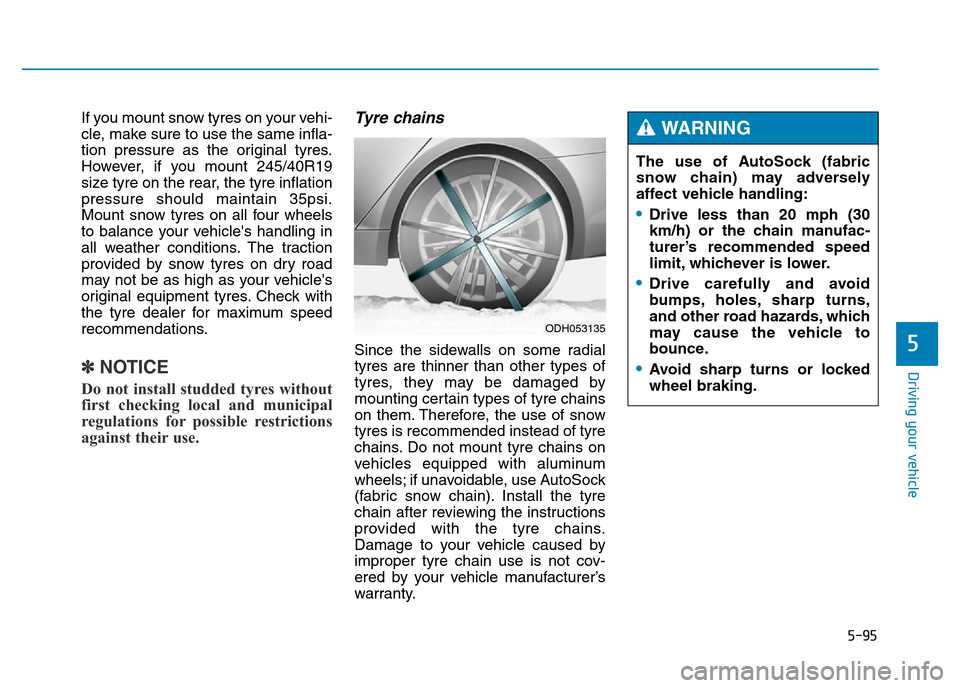
Tyre chains
Since the sidewalls on some radial
tyres are thinner than other types of
tyres, they may be damaged by
mounting certain types of tyre chains
on them. Therefore, the use of snow
tyres is recommended instead of tyre
chains. Do not mount tyre chains on
vehicles equipped with aluminum
wheels; if unavoidable, use AutoSock
(fabric snow chain). Install the tyre
chain after reviewing the instructions
provided with the tyre chains.
Damage to your vehicle caused by
improper tyre chain use is not cov-
ered by your vehicle manufacturer’s
warranty.The use of AutoSock (fabric
snow chain) may adversely
affect vehicle handling:
•Drive less than 20 mph (30
km/h) or the chain manufac-
turer’s recommended speed
limit, whichever is lower.
•Drive carefully and avoid
bumps, holes, sharp turns,
and other road hazards, which
may cause the vehicle to
bounce.
•Avoid sharp turns or locked
wheel braking.
WARNING
ODH053135
Page 385 of 502
6-12
What to do in an emergency
Tyre pressure monitoring sys-
tem
Each tyre, including the spare (if pro-
vided), should be checked monthly
when cold and inflated to the inflation
pressure recommended by the vehi-
cle manufacturer on the vehicle plac-
ard or tyre inflation pressure label. (If
your vehicle has tyres of a different
size than the size indicated on the
vehicle placard or tyre inflation pres-
sure label, you should determine the
proper tyre inflation pressure for
those tyres.)As an added safety feature, your
vehicle has been equipped with a
tyre pressure monitoring system
(TPMS) that illuminates a low tyre
pressure telltale when one or more
of your tyres is significantly under-
inflated. Accordingly, when the low
tyre pressure telltale illuminates, you
should stop and check your tyres as
soon as possible, and inflate them to
the proper pressure. Driving on a sig-
nificantly under-inflated tyre causes
the tyre to overheat and can lead to
tyre failure. Under-inflation also
reduces fuel efficiency and tyre tread
life, and may affect the vehicle’s han-
dling and stopping ability.
Please note that the TPMS is not a
substitute for proper tyre mainte-
nance, and it is the driver’s responsi-
bility to maintain correct tyre pres-
sure, even if under-inflation has not
reached the level to trigger illumina-
tion of the TPMS low tyre pressure
telltale.Your vehicle has also been equipped
with a TPMS malfunction indicator to
indicate when the system is not
operating properly. The TPMS mal-
function indicator is combined with
the low tyre pressure telltale. When
the system detects a malfunction,
the telltale will flash for approximate-
ly one minute and then remain con-
tinuously illuminated. This sequence
will continue upon subsequent vehi-
cle start-ups as long as the malfunc-
tion exists. When the malfunction
indicator is illuminated, the system
may not be able to detect or signal
low tyre pressure as intended.
TPMS malfunctions may occur for a
variety of reasons, including the
installation of replacement or alter-
nate tyres or wheels on the vehicle
that prevent the TPMS from function-
ing properly. Always check the TPMS
malfunction telltale after replacing
one or more tyres or wheels on your
vehicle to ensure that the replace-
ment or alternate tyres and wheels
allow the TPMS to continue to func-
tion properly. Over-inflation or under-inflation
can reduce tyre life, adversely
affect vehicle handling, and
lead to sudden tyre failure that
may cause loss of vehicle con-
trol resulting in an accident.
WARNING
Page 386 of 502
6-13
What to do in an emergency
6
✽NOTICE
If any of the below happens, we rec-
ommend that the system be checked
by a HYUNDAI authorised repairer.
1.The low tyre pressure telltale/
TPMS malfunction indicator does
not illuminate for 3 seconds when
Engine Start/Stop button is turned
to the ON or engine is running.
2. The TPMS malfunction indicator
remains illuminated after blinking
for approximately 1 minute.
3. The low tyre pressure position tell-
tale remains illuminated.
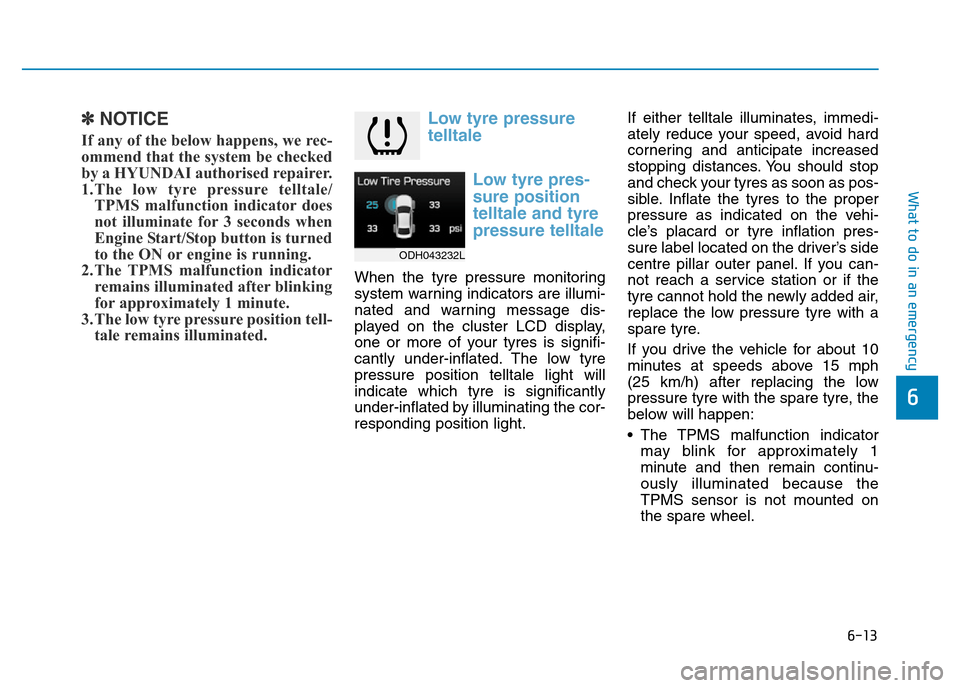
Low tyre pressure
telltale
Low tyre pres-
sure position
telltale and tyre
pressure telltale
When the tyre pressure monitoring
system warning indicators are illumi-
nated and warning message dis-
played on the cluster LCD display,
one or more of your tyres is signifi-
cantly under-inflated. The low tyre
pressure position telltale light will
indicate which tyre is significantly
under-inflated by illuminating the cor-
responding position light.If either telltale illuminates, immedi-
ately reduce your speed, avoid hard
cornering and anticipate increased
stopping distances. You should stop
and check your tyres as soon as pos-
sible. Inflate the tyres to the proper
pressure as indicated on the vehi-
cle’s placard or tyre inflation pres-
sure label located on the driver’s side
centre pillar outer panel. If you can-
not reach a service station or if the
tyre cannot hold the newly added air,
replace the low pressure tyre with a
spare tyre.
If you drive the vehicle for about 10
minutes at speeds above 15 mph
(25 km/h) after replacing the low
pressure tyre with the spare tyre, the
below will happen:
• The TPMS malfunction indicator
may blink for approximately 1
minute and then remain continu-
ously illuminated because the
TPMS sensor is not mounted on
the spare wheel.
ODH043232L
Page 387 of 502
6-14
What to do in an emergency
✽NOTICE
The spare tyre is not equipped with
a tyre pressure sensor.
TPMS (Tyre Pressure
Monitoring System)
malfunction indicator
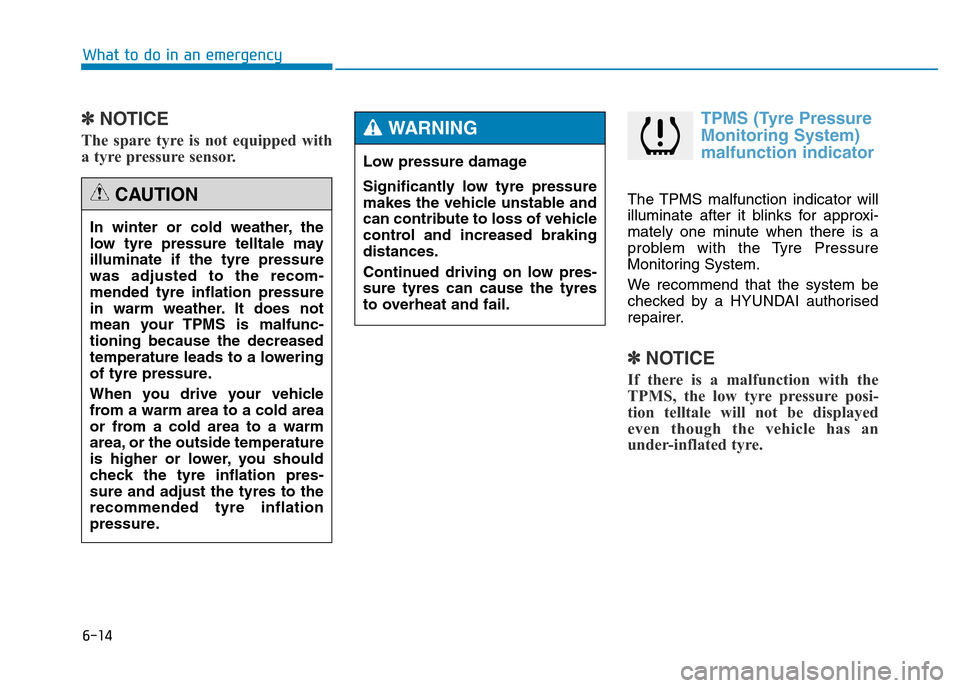
The TPMS malfunction indicator will
illuminate after it blinks for approxi-
mately one minute when there is a
problem with the Tyre Pressure
Monitoring System.
We recommend that the system be
checked by a HYUNDAI authorised
repairer.
✽NOTICE
If there is a malfunction with the
TPMS, the low tyre pressure posi-
tion telltale will not be displayed
even though the vehicle has an
under-inflated tyre.
In winter or cold weather, the
low tyre pressure telltale may
illuminate if the tyre pressure
was adjusted to the recom-
mended tyre inflation pressure
in warm weather. It does not
mean your TPMS is malfunc-
tioning because the decreased
temperature leads to a lowering
of tyre pressure.
When you drive your vehicle
from a warm area to a cold area
or from a cold area to a warm
area, or the outside temperature
is higher or lower, you should
check the tyre inflation pres-
sure and adjust the tyres to the
recommended tyre inflation
pressure.
CAUTION
Low pressure damage
Significantly low tyre pressure
makes the vehicle unstable and
can contribute to loss of vehicle
control and increased braking
distances.
Continued driving on low pres-
sure tyres can cause the tyres
to overheat and fail.
WARNING
Page 389 of 502
6-16
What to do in an emergency
If you drive the vehicle for about 10
minutes at speeds above 15 mph (25
km/h) after replacing the low pres-
sure tyre with the spare tyre, the
below will happen:
• The TPMS malfunction indicator
may blink for approximately 1
minute and then remain continu-
ously illuminated because the
TPMS sensor is not mounted on
the spare wheel.You may not be able to identify a low
tyre by simply looking at it. Always
use a good quality tyre pressure
gauge to measure the tyre's inflation
pressure. Please note that a tyre that
is hot (from being driven) will have a
higher pressure measurement than a
tyre that is cold (from sitting station-
ary for at least 3 hours and driven
less than 1 mile (1.6 km) during that
3 hour period).
Allow the tyre to cool before measur-
ing the inflation pressure. Always be
sure the tyre is cold before inflating
to the recommended pressure.
A cold tyre means the vehicle has
been sitting for 3 hours and driven for
less than 1 mile (1.6 km) in that 3
hour period.TPMS
•The TPMS cannot alert you to
severe and sudden tyre dam-
age caused by external fac-
tors such as nails or road
debris.
•If you feel any vehicle instabil-
ity, immediately take your foot
off the accelerator, apply the
brakes gradually and with
light force, and slowly move to
a safe position off the road.
WARNING
Page 406 of 502
6-33
What to do in an emergency
6
Tyre pressure gauge
(if equipped)
Tyres normally lose some air in day-
to-day use, and you may have to add
a air periodically and usually it is not
a sign of a leaking tyre, but of normal
wear. Always check tyre pressure
when the tyres are cold because tyre
pressure increases with tempera-
ture.To check the tyre pressure, take the
following steps:
1.Unscrew the inflation valve cap
that is located on the rim of the
tyre.
2.Press and hold the gauge against
the tyre valve. Some air will leak as
you begin and more will leak if you
don't press the gauge in firmly.
3.A firm non-leaking push will acti-
vate the gauge.
4.Read the tyre pressure on the
gauge to see whether the tyre
pressure is low or high.
5.Adjust the tyre pressure to the
specified pressure. Refer to “Tyres
and Wheels” in chapter 8.
6.Reinstall the inflation valve cap.
Page 407 of 502
7
Maintenance
7
Maintenance
Engine compartment .............................................7-3
Maintenance services ...........................................7-5
Owner's responsibility ......................................................7-5
Owner maintenance precautions ..................................7-5
Owner maintenance ...............................................7-7
Owner maintenance schedule ........................................7-7
Scheduled maintenance service ..........................7-9
Explanation of scheduled maintenance items..7-10
Engine oil ..............................................................7-14
Checking the engine oil level .......................................7-14
Changing the engine oil and filter ..............................7-15
Engine coolant......................................................7-16
Checking the coolant level ...........................................7-16
Changing the coolant .....................................................7-18
Brake fluid ............................................................7-19
Checking the brake fluid level .....................................7-19
Washer fluid .........................................................7-21
Checking the washer fluid level ..................................7-21
Parking brake .......................................................7-21
Checking the parking brake .........................................7-21
Air cleaner ............................................................7-22
Filter replacement ...........................................................7-22
Climate control air filter .....................................7-23
Filter inspection ...............................................................7-23
Filter replacement ...........................................................7-23
Wiper blades .........................................................7-24
Blade inspection ..............................................................7-24
Blade replacement ..........................................................7-24
Battery...................................................................7-26
For best battery service................................................7-26
Battery capacity label ....................................................7-28
Battery recharging .........................................................7-28
Reset items .......................................................................7-29
Tyres and wheels .................................................7-30
Tyre care ...........................................................................7-30
Recommended cold tyre inflation pressures ...........7-30
Checking tyre inflation pressure.................................7-32
Tyre rotation ....................................................................7-33
Wheel alignment and tyre balance.............................7-34
Tyre replacement ............................................................7-34
Wheel replacement ........................................................7-36
Tyre traction ....................................................................7-36
Tyre maintenance ..........................................................7-36
Tyre sidewall labelling....................................................7-36
Low aspect ratio tyre.....................................................7-41
7
Page 414 of 502
7-8
Maintenance
At least monthly:
• Check coolant level in the engine
coolant reservoir.
• Check the operation of all exterior
lights, including the stop lamps,
turn signals and hazard warning
flashers.
• Check the inflation pressures of all
tyres including the spare.
At least twice a year
(i.e., every Spring and Fall):
• Check radiator, heater and air con-
ditioning hoses for leaks or dam-
age.
• Check windscreen washer spray
and wiper operation. Clean wiper
blades with a clean cloth damp-
ened with washer fluid.
• Check headlamp alignment.
• Check muffler, exhaust pipes,
shields and clamps.
• Check the lap/shoulder belts for
wear and function.
• Check for worn tyres and loose
wheel lug nuts.
At least once a year:
• Clean body and door drain holes.
• Lubricate door hinges and checks,
and bonnet hinges.
• Lubricate door and bonnet locks
and latches.
• Lubricate door rubber weather-
strips.
• Check the air conditioning system.
• Inspect and lubricate automatic
transmission linkage and controls.
• Clean battery and terminals.
• Check the brake fluid level.
Page 436 of 502
7-30
Maintenance
TYRES AND WHEELS
Tyre care
For proper maintenance, safety, and
maximum fuel economy, you must
always maintain recommended tyre
inflation pressures and stay within
the load limits and weight distribution
recommended for your vehicle.
Recommended cold tyre infla-
tion pressures
All tyre pressures (including the
spare) should be checked when the
tyres are cold. “Cold Tyres” means
the vehicle has not been driven for at
least three hours or driven less than
1 mile (1.6 km).
Recommended pressures must be
maintained for the best ride, top vehi-
cle handling, and minimum tyre wear.
For recommended inflation pressure
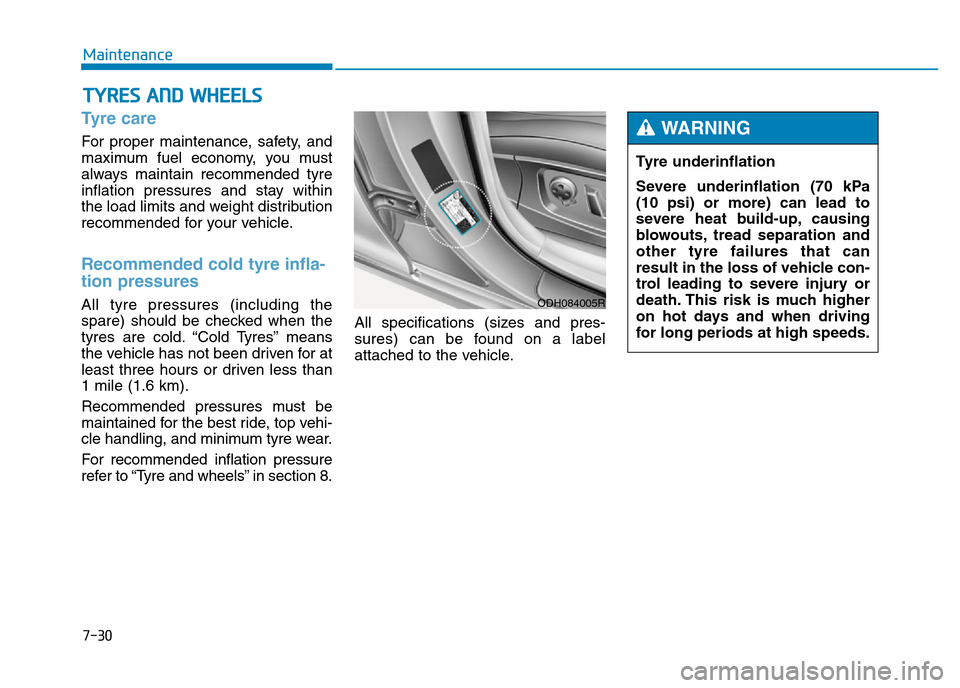
refer to “Tyre and wheels” in section 8.All specifications (sizes and pres-
sures) can be found on a label
attached to the vehicle.Tyre underinflation
Severe underinflation (70 kPa
(10 psi) or more) can lead to
severe heat build-up, causing
blowouts, tread separation and
other tyre failures that can
result in the loss of vehicle con-
trol leading to severe injury or
death. This risk is much higher
on hot days and when driving
for long periods at high speeds.
WARNING
ODH084005R