light Hyundai Genesis Coupe 2013 Owner's Manual
[x] Cancel search | Manufacturer: HYUNDAI, Model Year: 2013, Model line: Genesis Coupe, Model: Hyundai Genesis Coupe 2013Pages: 414, PDF Size: 38.89 MB
Page 308 of 414
7
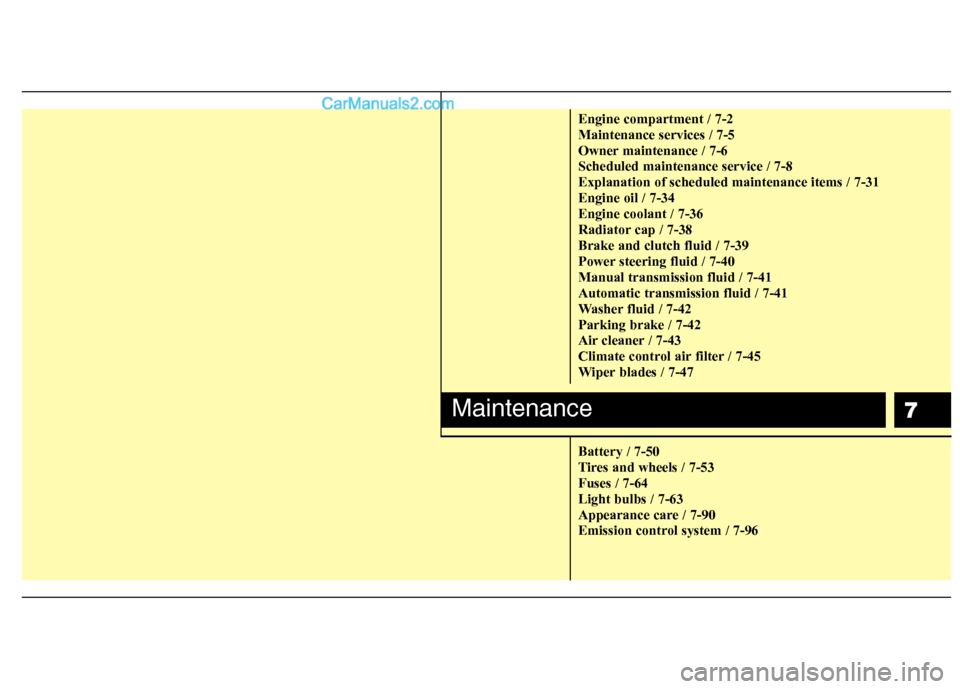
Engine compartment / 7-2 Maintenance services / 7-5
Owner maintenance / 7-6Scheduled maintenance service / 7-8Explanation of scheduled maintenance items / 7-31Engine oil / 7-34Engine coolant / 7-36
Radiator cap / 7-38Brake and clutch fluid / 7-39
Power steering fluid / 7-40Manual transmission fluid / 7-41Automatic transmission fluid / 7-41
Washer fluid / 7-42Parking brake / 7-42
Air cleaner / 7-43
Climate control air filter / 7-45
Wiper blades / 7-47 Battery / 7-50
Tires and wheels / 7-53Fuses / 7-64Light bulbs / 7-63
Appearance care / 7-90
Emission control system / 7-96
Maintenance
Page 314 of 414
77
Maintenance
While operating your vehicle:
Note any changes in the sound of theexhaust or any smell of exhaust fumes
in the vehicle.
Check for vibrations in the steering wheel. Notice any increased steering
effort or looseness in the steering
wheel, or change in its straight-aheadposition.
Notice if your vehicle constantly turns slightly or “pulls” to one side when trav-
eling on smooth, level road.
When stopping, listen and check for unusual sounds, pulling to one side,
increased brake pedal travel or “hard-
to-push” brake pedal.
If any slipping or changes in the oper- ation of your transmission occurs,
check the transmission fluid level.
Check automatic transmission P (Park) function.
Check parking brake.
Check for fluid leaks under your vehicle (water dripping from the air condition-
ing system during or after use is nor-mal).
At least monthly:
Check the coolant level in the enginecoolant reservoir.
Check the operation of all exterior lights, including the stoplights, turn sig-
nals and hazard warning flashers.
Check the inflation pressures of all tires including the spare.
At least twice a year
(i.e., every Spring and Fall):
Check the radiator, heater and air con- ditioning hoses for leaks or damage.
Check the windshield washer spray and wiper operation. Clean the wiper
blades with clean cloth dampened with
washer fluid.
Check the headlight alignment.
Check the muffler, exhaust pipes, shields and clamps.
Check the lap/shoulder belts for wear and function.
Check for worn tires and loose wheel lug nuts.
Page 357 of 414
Maintenance
50
7
BATTERY
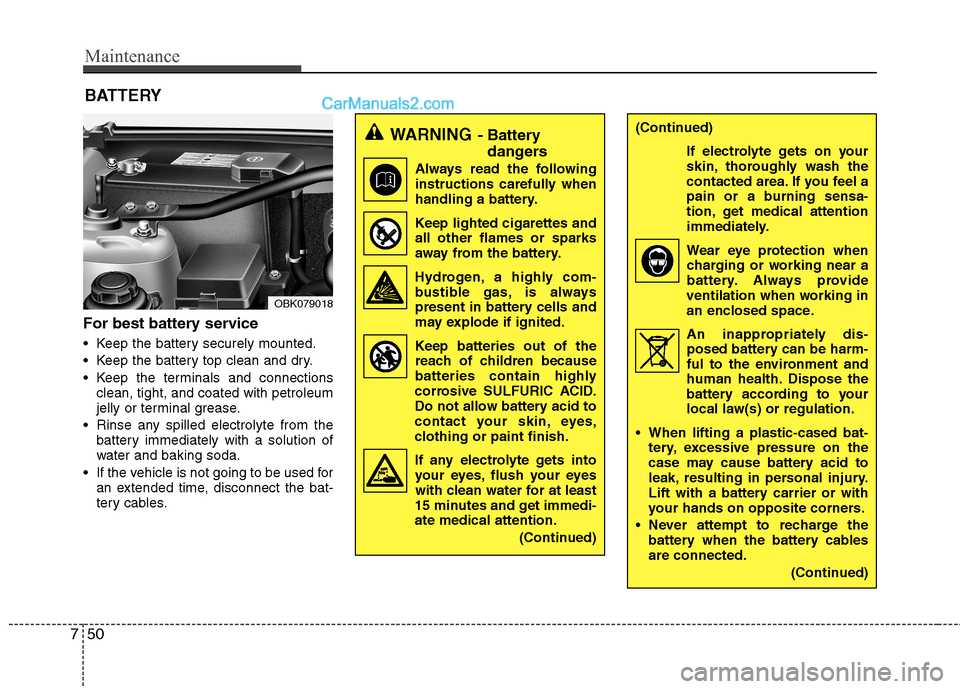
For best battery service
Keep the battery securely mounted.
Keep the battery top clean and dry.
Keep the terminals and connections clean, tight, and coated with petroleum
jelly or terminal grease.
Rinse any spilled electrolyte from the battery immediately with a solution of
water and baking soda.
If the vehicle is not going to be used for an extended time, disconnect the bat-
tery cables.
OBK079018
WARNING - Battery
dangers
Always read the following
instructions carefully when
handling a battery.
Keep lighted cigarettes and all other flames or sparks
away from the battery.
Hydrogen, a highly com- bustible gas, is always
present in battery cells and
may explode if ignited.
Keep batteries out of the reach of children because
batteries contain highly
corrosive SULFURIC ACID.
Do not allow battery acid to
contact your skin, eyes,
clothing or paint finish.
If any electrolyte gets into your eyes, flush your eyes
with clean water for at least
15 minutes and get immedi-ate medical attention.
(Continued)(Continued)
If electrolyte gets on your
skin, thoroughly wash the
contacted area. If you feel a
pain or a burning sensa-
tion, get medical attention
immediately.
Wear eye protection whencharging or working near a
battery. Always provide
ventilation when working in
an enclosed space.
An inappropriately dis- posed battery can be harm-
ful to the environment and
human health. Dispose the
battery according to your
local law(s) or regulation.
When lifting a plastic-cased bat- tery, excessive pressure on the
case may cause battery acid to
leak, resulting in personal injury.
Lift with a battery carrier or with
your hands on opposite corners.
Never attempt to recharge the battery when the battery cablesare connected.
(Continued)
Page 358 of 414
751
Maintenance
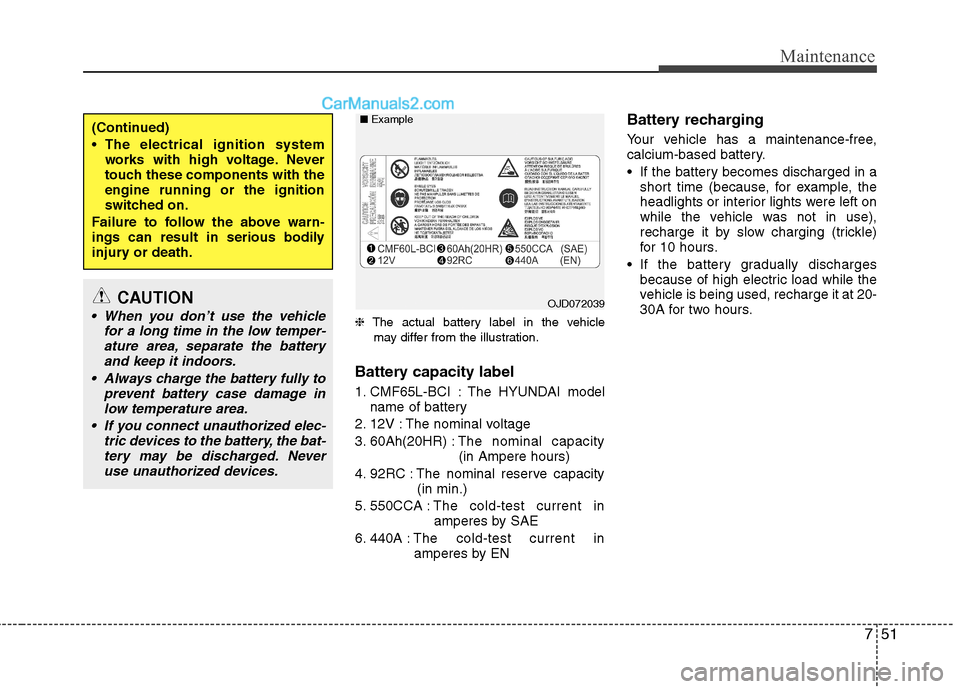
❈The actual battery label in the vehicle
may differ from the illustration.
Battery capacity label
1. CMF65L-BCI : The HYUNDAI model name of battery
2. 12V : The nominal voltage
3. 60Ah(20HR) : The nominal capacity
(in Ampere hours)
4. 92RC : The nominal reserve capacity (in min.)
5. 550CCA : The cold-test current in
amperes by SAE
6. 440A : The cold-test current in
amperes by EN Battery recharging
Your vehicle has a maintenance-free,
calcium-based battery.
If the battery becomes discharged in a
short time (because, for example, the
headlights or interior lights were left on
while the vehicle was not in use),
recharge it by slow charging (trickle)
for 10 hours.
If the battery gradually discharges because of high electric load while the
vehicle is being used, recharge it at 20-
30A for two hours.
(Continued)
The electrical ignition systemworks with high voltage. Never
touch these components with theengine running or the ignition
switched on.
Failure to follow the above warn-
ings can result in serious bodily
injury or death.
CAUTION
When you don’t use the vehicle for a long time in the low temper-ature area, separate the batteryand keep it indoors.
Always charge the battery fully to prevent battery case damage in
low temperature area.
If you connect unauthorized elec- tric devices to the battery, the bat-tery may be discharged. Neveruse unauthorized devices.OJD072039
■
Example
Page 365 of 414
Maintenance
58
7
Compact spare tire replacement
(if equipped)
A compact spare tire has a shorter
tread life than a regular size tire.
Replace it when you can see the
tread wear indicator bars on the tire.The replacement compact spare tire
should be the same size and design
tire as the one provided with your
new vehicle and should be mountedon the same compact spare tire
wheel. The compact spare tire is notdesigned to be mounted on a regular
size wheel, and the compact spare
tire wheel is not designed for mount-
ing a regular size tire. Wheel replacement
When replacing the metal wheels for
any reason, make sure the new
wheels are equivalent to the original
factory units in diameter, rim widthand offset.
✽✽
NOTICE
The front tire size is different from
the rear tire size. So when you rotate
tires, check the tire and wheel size.
(Continued)
Using tires and wheel other than the recommended sizes
could cause unusual handling
characteristics and poor vehi-
cle control, resulting in a seri-ous accident.
Wheels that do not meet HYUNDAI’s specifications
may fit poorly and result in
damage to the vehicle or
unusual handling and poor
vehicle control.
The ABS works by comparing the speed of the wheels. Tire
size can affect wheel speed.
When replacing tires, all 4
tires must use the size origi-
nally supplied with the vehi-
cle. Using tires of a different
size can cause the ABS (Anti-
lock Brake System) and ESP
(Electronic Stability Program)
to work irregularly.
WARNING
A wheel that is not the correct
size may adversely affect wheel
and bearing life, braking and
stopping abilities, handling
characteristics, ground clear-
ance, body-to-tire clearance,
snow chain clearance,speedometer and odometer cal-
ibration, headlight aim and
bumper height.
Page 370 of 414
763
Maintenance
FUSESA vehicle’s electrical system is protected
from electrical overload damage by
fuses.
This vehicle has 3 fuse panels, one locat-
ed in the driver’s side panel bolster, the
others in the engine compartment.
If any of your vehicle’s lights, acces-
sories, or controls do not work, check the
appropriate circuit fuse. If a fuse has
blown, the element inside the fuse will bemelted.
If the electrical system does not work,
first check the driver’s side fuse panel.
Before replacing a blown fuse, discon-
nect the negative battery cable.
Always replace a blown fuse with one of
the same rating.
If the replacement fuse blows, this indi-
cates an electrical problem. Avoid using
the system involved and we recommend
that you consult an authorized HYUNDAI
dealer.
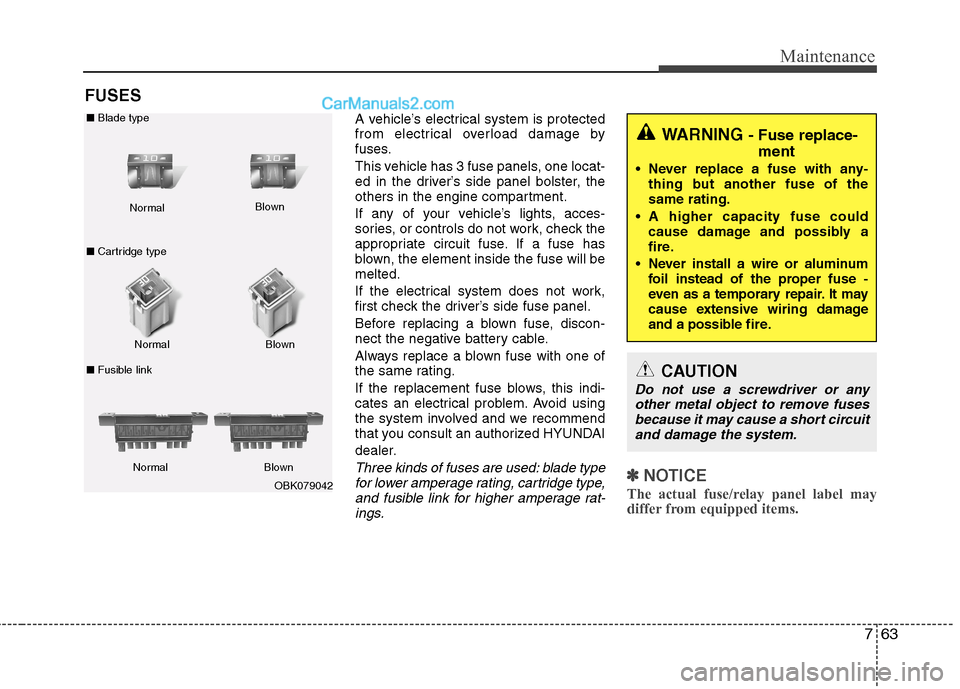
Three kinds of fuses are used: blade typefor lower amperage rating, cartridge type,and fusible link for higher amperage rat-
ings.✽✽ NOTICE
The actual fuse/relay panel label may
differ from equipped items.OBK079042
Normal
Normal
■
Blade type
■ Cartridge type
■ Fusible link Blown
Blown
Normal Blown
WARNING - Fuse replace-
ment
Never replace a fuse with any- thing but another fuse of the same rating.
A higher capacity fuse could cause damage and possibly a
fire.
Never install a wire or aluminum foil instead of the proper fuse -
even as a temporary repair. It may
cause extensive wiring damage
and a possible fire.
CAUTION
Do not use a screwdriver or any
other metal object to remove fusesbecause it may cause a short circuit and damage the system.
Page 371 of 414
Maintenance
64
7
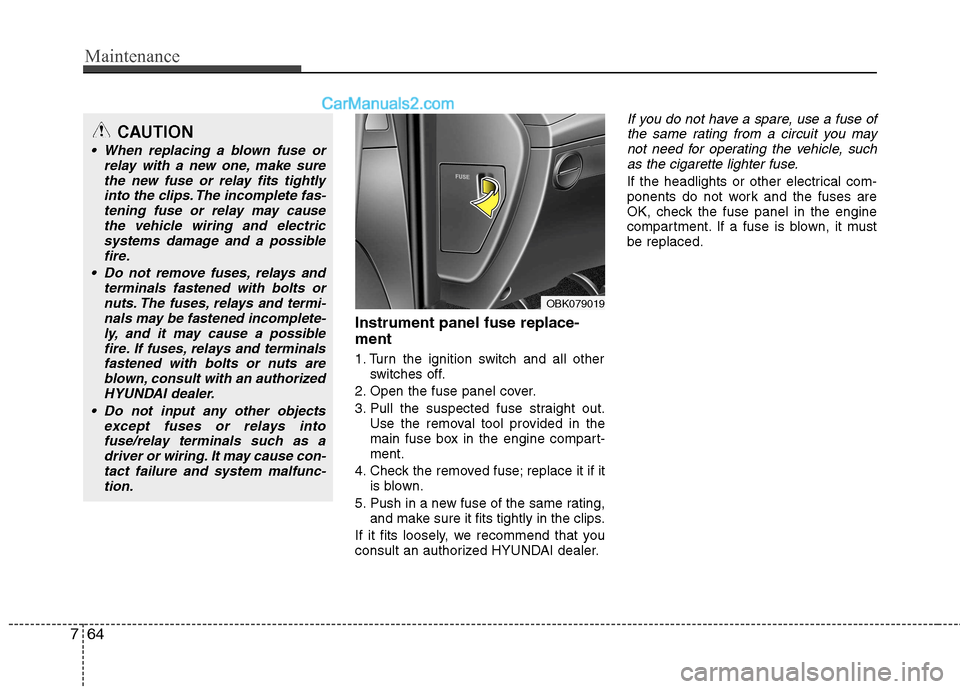
Instrument panel fuse replace- ment
1. Turn the ignition switch and all other
switches off.
2. Open the fuse panel cover.
3. Pull the suspected fuse straight out. Use the removal tool provided in the
main fuse box in the engine compart-ment.
4. Check the removed fuse; replace it if it is blown.
5. Push in a new fuse of the same rating, and make sure it fits tightly in the clips.
If it fits loosely, we recommend that you
consult an authorized HYUNDAI dealer.
If you do not have a spare, use a fuse of the same rating from a circuit you may not need for operating the vehicle, suchas the cigarette lighter fuse.
If the headlights or other electrical com-
ponents do not work and the fuses are
OK, check the fuse panel in the engine
compartment. If a fuse is blown, it mustbe replaced.
OBK079019
CAUTION
When replacing a blown fuse or relay with a new one, make sure
the new fuse or relay fits tightlyinto the clips. The incomplete fas-tening fuse or relay may cause the vehicle wiring and electric
systems damage and a possiblefire.
Do not remove fuses, relays and terminals fastened with bolts or
nuts. The fuses, relays and termi-nals may be fastened incomplete-ly, and it may cause a possiblefire. If fuses, relays and terminals
fastened with bolts or nuts are blown, consult with an authorizedHYUNDAI dealer.
Do not input any other objects except fuses or relays into
fuse/relay terminals such as adriver or wiring. It may cause con-tact failure and system malfunc-tion.
Page 377 of 414
Maintenance
70
7
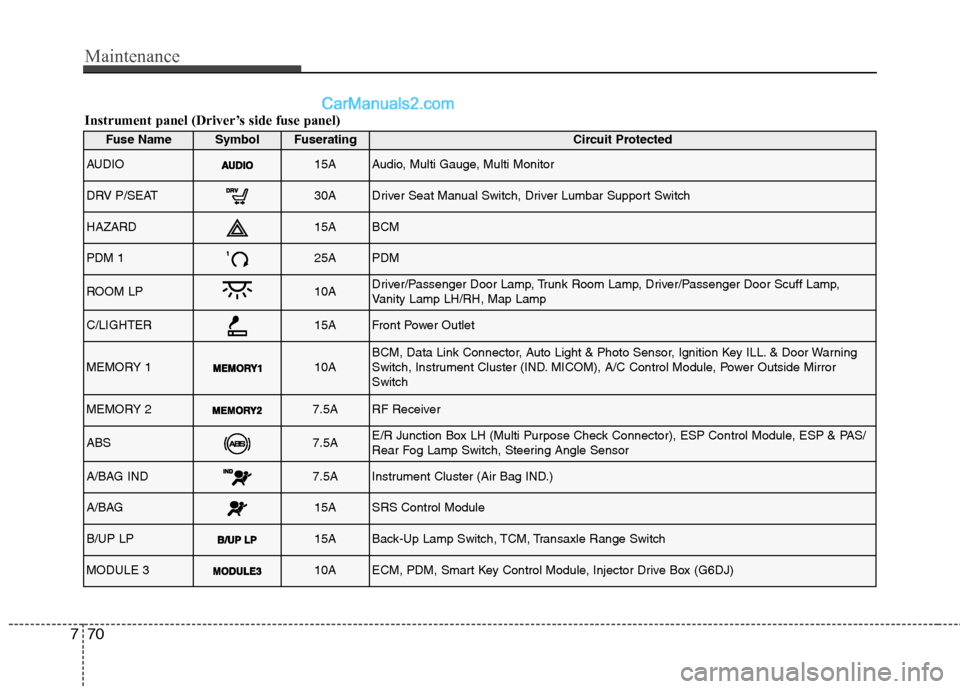
Instrument panel (Driver’s side fuse panel)
Fuse NameSymbolFuseratingCircuit Protected
AUDIO15AAudio, Multi Gauge, Multi Monitor
DRV P/SEAT30ADriver Seat Manual Switch, Driver Lumbar Support Switch
HAZARD15ABCM
PDM 125APDM
ROOM LP10ADriver/Passenger Door Lamp, Trunk Room Lamp, Driver/Passenger Door Scuff Lamp,
Vanity Lamp LH/RH, Map Lamp
C/LIGHTER15AFront Power Outlet
MEMORY 110ABCM, Data Link Connector, Auto Light & Photo Sensor, Ignition Key ILL. & Door Warning
Switch, Instrument Cluster (IND. MICOM), A/C Control Module, Power Outside MirrorSwitch
MEMORY 27.5ARF Receiver
ABS7.5AE/R Junction Box LH (Multi Purpose Check Connector), ESP Control Module, ESP & PAS/
Rear Fog Lamp Switch, Steering Angle Sensor
A/BAG IND7.5AInstrument Cluster (Air Bag IND.)
A/BAG15ASRS Control Module
B/UP LP15ABack-Up Lamp Switch, TCM, Transaxle Range Switch
MODULE 310AECM, PDM, Smart Key Control Module, Injector Drive Box (G6DJ)
Page 383 of 414
Maintenance
76
7
LIGHT BULBS
Use only the bulbs of the specified
wattage.
✽✽ NOTICE
After heavy, driving rain or washing, headlight and taillight lenses could
appear frosty. This condition is caused
by the temperature difference between
the lamp inside and outside. This is sim-
ilar to the condensation on your win-
dows inside your vehicle during the rain
and doesn’t indicate a problem with
your vehicle. If the water leaks into the
lamp bulb circuitry, we recommend thatthe system be checked by an authorized
HYUNDAI dealer.
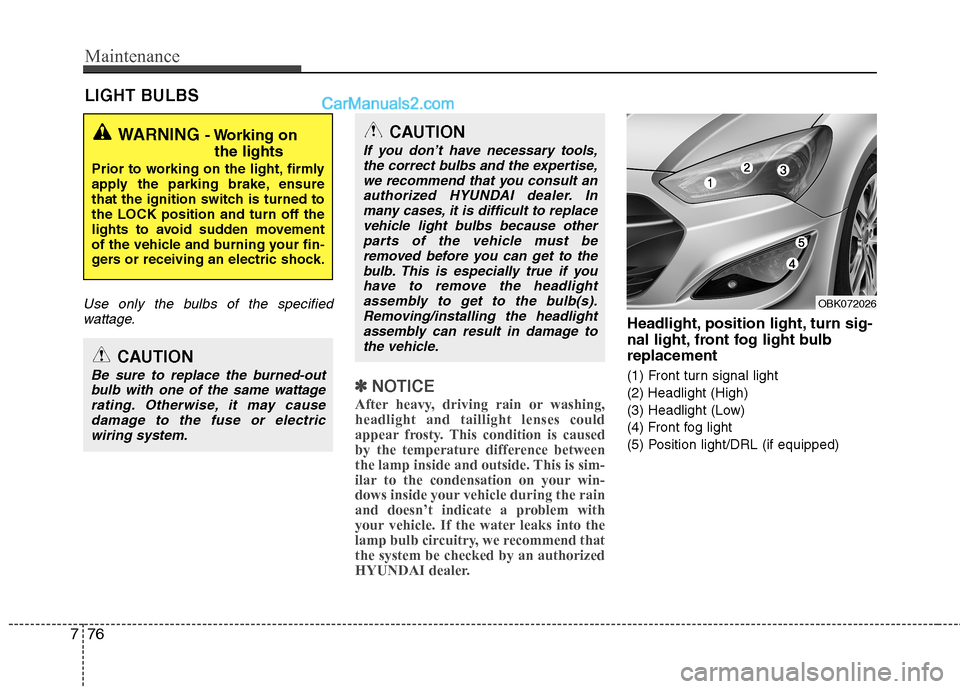
Headlight, position light, turn sig-
nal light, front fog light bulbreplacement
(1) Front turn signal light
(2) Headlight (High)
(3) Headlight (Low)
(4) Front fog light
(5) Position light/DRL (if equipped)
WARNING - Working on
the lights
Prior to working on the light, firmly
apply the parking brake, ensure
that the ignition switch is turned tothe LOCK position and turn off the
lights to avoid sudden movement
of the vehicle and burning your fin-
gers or receiving an electric shock.
CAUTION
Be sure to replace the burned-out bulb with one of the same wattagerating. Otherwise, it may causedamage to the fuse or electric wiring system.
CAUTION
If you don’t have necessary tools,the correct bulbs and the expertise,
we recommend that you consult anauthorized HYUNDAI dealer. Inmany cases, it is difficult to replace vehicle light bulbs because other
parts of the vehicle must beremoved before you can get to thebulb. This is especially true if you
have to remove the headlightassembly to get to the bulb(s).Removing/installing the headlightassembly can result in damage to
the vehicle.
OBK072026
Page 384 of 414
777
Maintenance
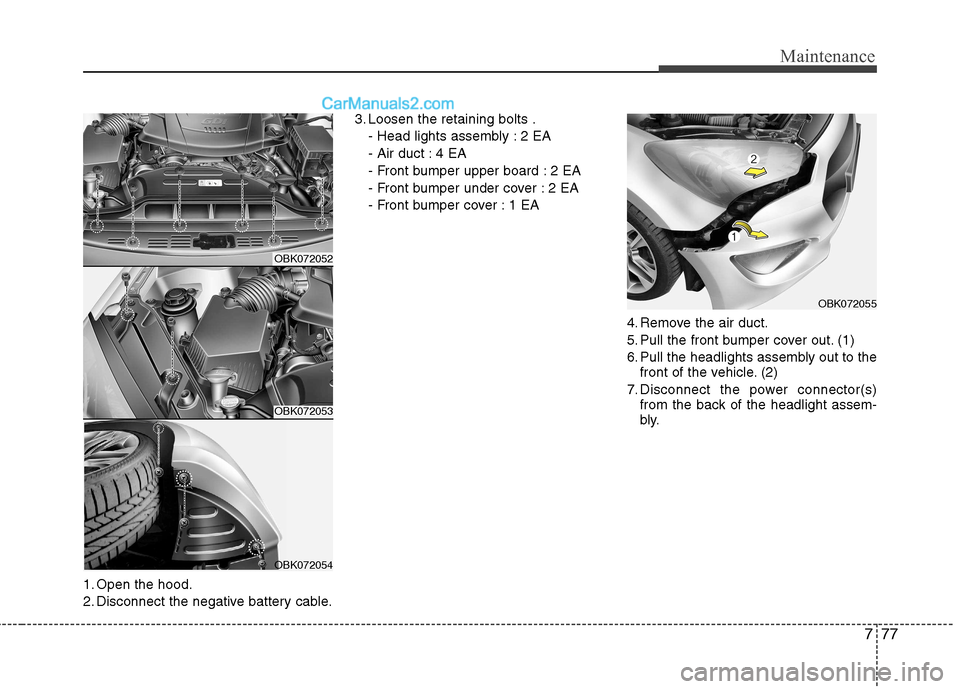
1. Open the hood.
2. Disconnect the negative battery cable.3. Loosen the retaining bolts .
- Head lights assembly : 2 EA
- Air duct : 4 EA
- Front bumper upper board : 2 EA
- Front bumper under cover : 2 EA
- Front bumper cover : 1 EA
4. Remove the air duct.
5. Pull the front bumper cover out. (1)
6. Pull the headlights assembly out to thefront of the vehicle. (2)
7. Disconnect the power connector(s) from the back of the headlight assem-
bly.
OBK072052
OBK072053
OBK072054
OBK072055