engine Hyundai Genesis Coupe 2013 Owner's Guide
[x] Cancel search | Manufacturer: HYUNDAI, Model Year: 2013, Model line: Genesis Coupe, Model: Hyundai Genesis Coupe 2013Pages: 414, PDF Size: 38.89 MB
Page 90 of 414
Features of your vehicle
24
4
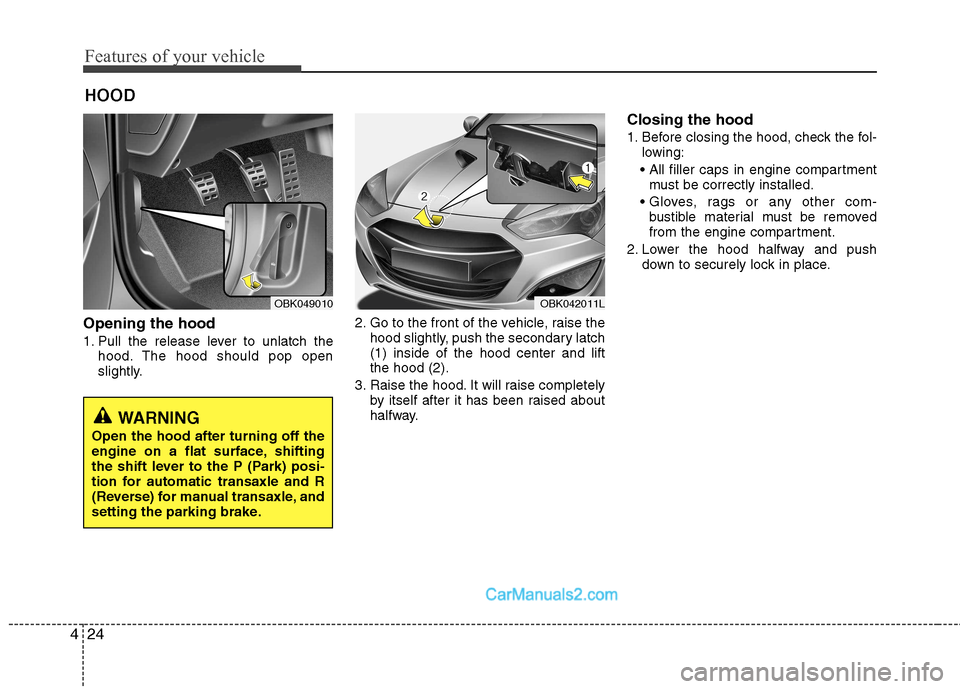
Opening the hood
1. Pull the release lever to unlatch the
hood. The hood should pop open
slightly. 2. Go to the front of the vehicle, raise the
hood slightly, push the secondary latch(1) inside of the hood center and liftthe hood (2).
3. Raise the hood. It will raise completely by itself after it has been raised about
halfway. Closing the hood
1. Before closing the hood, check the fol-
lowing:
must be correctly installed.
bustible material must be removed
from the engine compartment.
2. Lower the hood halfway and push down to securely lock in place.
HOOD
OBK049010OBK042011L
WARNING
Open the hood after turning off the
engine on a flat surface, shifting
the shift lever to the P (Park) posi-
tion for automatic transaxle and R
(Reverse) for manual transaxle, and
setting the parking brake.
Page 91 of 414
425
Features of your vehicle
WARNING
Before closing the hood, ensure that all obstructions are removed
from the hood opening. Closingthe hood with an obstruction
present in the hood opening may
result in property damage or
severe personal injury.
Do not leave gloves, rags or any other combustible material in the
engine compartment. Doing so
may cause a heat-induced fire.WARNING
Always double check to be sure that the hood is firmly latched
before driving away. If it is not
latched, the hood could open
while the vehicle is being driven,
causing a total loss of visibility,
which might result in an accident.
Do not move the vehicle with the hood in the raised position, asvision is obstructed and the hood
could fall or be damaged.
Page 92 of 414
Features of your vehicle
26
4
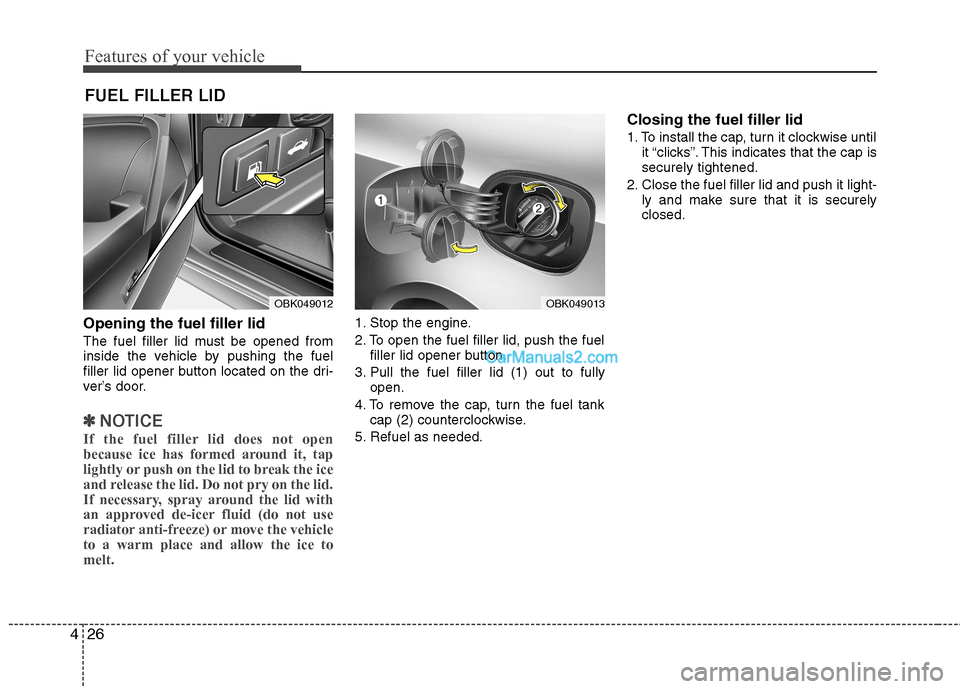
Opening the fuel filler lid
The fuel filler lid must be opened from
inside the vehicle by pushing the fuel
filler lid opener button located on the dri-
ver’s door.
✽✽
NOTICE
If the fuel filler lid does not open
because ice has formed around it, tap
lightly or push on the lid to break the ice
and release the lid. Do not pry on the lid.
If necessary, spray around the lid with
an approved de-icer fluid (do not use
radiator anti-freeze) or move the vehicleto a warm place and allow the ice tomelt.
1. Stop the engine.
2. To open the fuel filler lid, push the fuel filler lid opener button.
3. Pull the fuel filler lid (1) out to fully open.
4. To remove the cap, turn the fuel tank cap (2) counterclockwise.
5. Refuel as needed. Closing the fuel filler lid
1. To install the cap, turn it clockwise until
it “clicks”. This indicates that the cap is securely tightened.
2. Close the fuel filler lid and push it light- ly and make sure that it is securelyclosed.
FUEL FILLER LID
OBK049012OBK049013
Page 94 of 414
Features of your vehicle
28
4
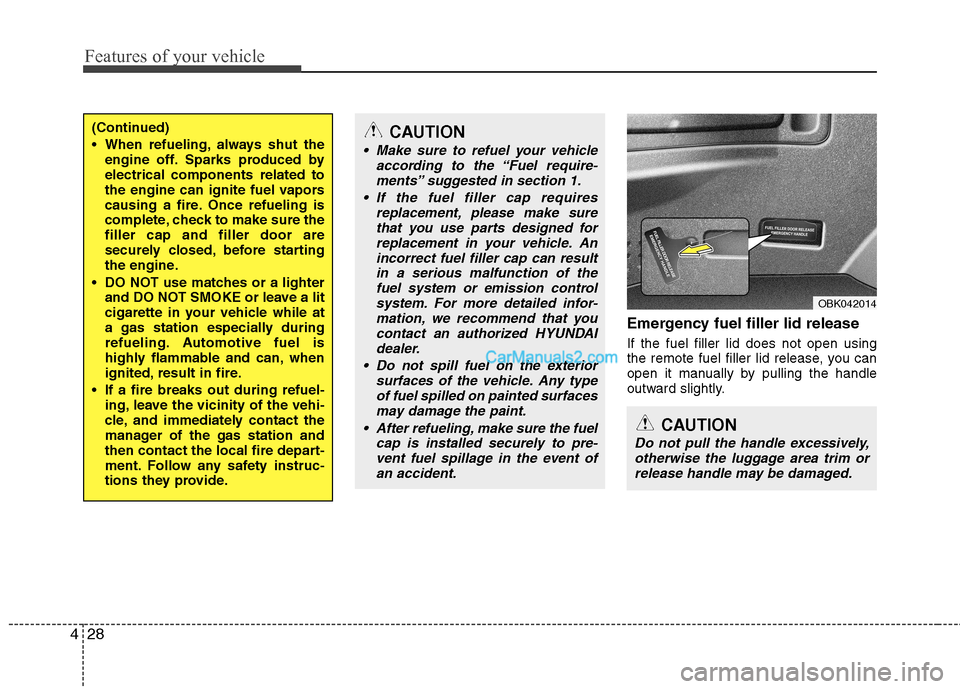
Emergency fuel filler lid release If the fuel filler lid does not open using
the remote fuel filler lid release, you can
open it manually by pulling the handle
outward slightly.
(Continued)
When refueling, always shut the
engine off. Sparks produced by electrical components related to
the engine can ignite fuel vapors
causing a fire. Once refueling is
complete, check to make sure thefiller cap and filler door are
securely closed, before starting
the engine.
DO NOT use matches or a lighter and DO NOT SMOKE or leave a lit
cigarette in your vehicle while at
a gas station especially during
refueling. Automotive fuel is
highly flammable and can, when
ignited, result in fire.
If a fire breaks out during refuel- ing, leave the vicinity of the vehi-
cle, and immediately contact the
manager of the gas station and
then contact the local fire depart-
ment. Follow any safety instruc-
tions they provide.CAUTION
Make sure to refuel your vehicle
according to the “Fuel require-
ments” suggested in section 1.
If the fuel filler cap requires replacement, please make surethat you use parts designed for
replacement in your vehicle. An incorrect fuel filler cap can resultin a serious malfunction of thefuel system or emission control
system. For more detailed infor-mation, we recommend that you contact an authorized HYUNDAIdealer.
Do not spill fuel on the exterior surfaces of the vehicle. Any typeof fuel spilled on painted surfacesmay damage the paint.
After refueling, make sure the fuel cap is installed securely to pre-
vent fuel spillage in the event ofan accident.
CAUTION
Do not pull the handle excessively,otherwise the luggage area trim or release handle may be damaged.
OBK042014
Page 99 of 414
433
Features of your vehicle
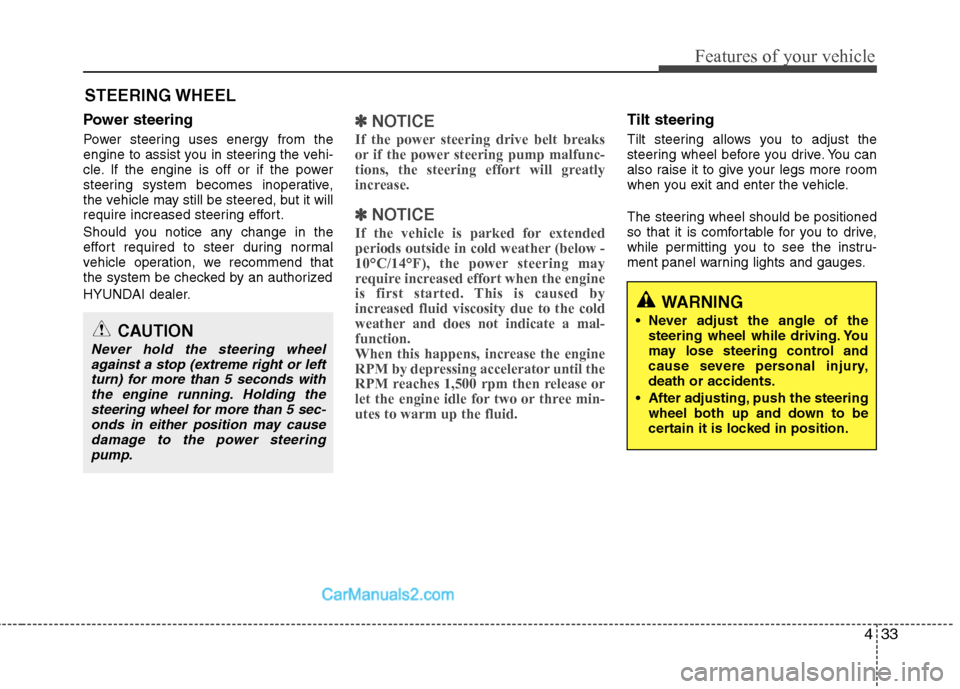
Power steering
Power steering uses energy from the
engine to assist you in steering the vehi-
cle. If the engine is off or if the power
steering system becomes inoperative,
the vehicle may still be steered, but it will
require increased steering effort.
Should you notice any change in the
effort required to steer during normal
vehicle operation, we recommend that
the system be checked by an authorized
HYUNDAI dealer.✽✽NOTICE
If the power steering drive belt breaks
or if the power steering pump malfunc-
tions, the steering effort will greatly
increase.
✽
✽ NOTICE
If the vehicle is parked for extended
periods outside in cold weather (below -
10°C/14°F), the power steering may
require increased effort when the engine
is first started. This is caused by
increased fluid viscosity due to the cold
weather and does not indicate a mal-function.
When this happens, increase the engine
RPM by depressing accelerator until the
RPM reaches 1,500 rpm then release or
let the engine idle for two or three min-utes to warm up the fluid.
Tilt steering
Tilt steering allows you to adjust the
steering wheel before you drive. You can
also raise it to give your legs more room
when you exit and enter the vehicle.
The steering wheel should be positioned
so that it is comfortable for you to drive,
while permitting you to see the instru-
ment panel warning lights and gauges.
STEERING WHEEL
CAUTION
Never hold the steering wheel
against a stop (extreme right or leftturn) for more than 5 seconds withthe engine running. Holding the
steering wheel for more than 5 sec-onds in either position may causedamage to the power steering pump.
WARNING
Never adjust the angle of the steering wheel while driving. You
may lose steering control and
cause severe personal injury,death or accidents.
After adjusting, push the steering wheel both up and down to be
certain it is locked in position.
Page 101 of 414
435
Features of your vehicle
MIRRORS
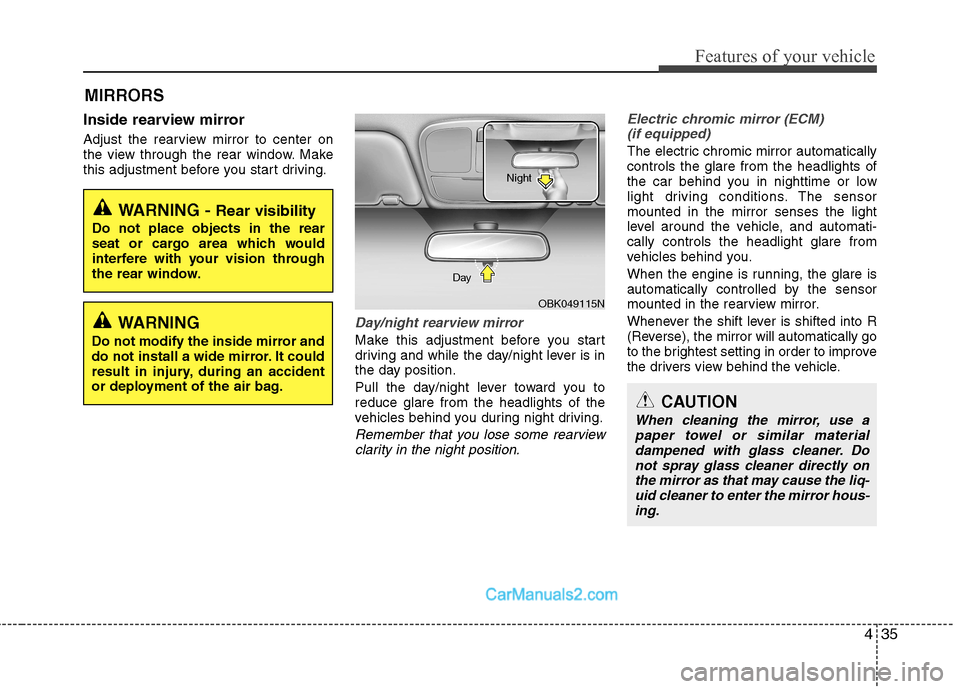
Inside rearview mirror
Adjust the rearview mirror to center on
the view through the rear window. Make
this adjustment before you start driving.
Day/night rearview mirror
Make this adjustment before you start
driving and while the day/night lever is in
the day position.
Pull the day/night lever toward you to reduce glare from the headlights of the
vehicles behind you during night driving.
Remember that you lose some rearviewclarity in the night position.
Electric chromic mirror (ECM) (if equipped)
The electric chromic mirror automatically controls the glare from the headlights of
the car behind you in nighttime or low
light driving conditions. The sensormounted in the mirror senses the light
level around the vehicle, and automati-cally controls the headlight glare from
vehicles behind you.
When the engine is running, the glare is
automatically controlled by the sensor
mounted in the rearview mirror.
Whenever the shift lever is shifted into R
(Reverse), the mirror will automatically go
to the brightest setting in order to improve
the drivers view behind the vehicle.
WARNING - Rear visibility
Do not place objects in the rear
seat or cargo area which would
interfere with your vision through
the rear window.
OBK049115N
Day Night
WARNING
Do not modify the inside mirror and
do not install a wide mirror. It could
result in injury, during an accident
or deployment of the air bag.
CAUTION
When cleaning the mirror, use a paper towel or similar material dampened with glass cleaner. Donot spray glass cleaner directly on
the mirror as that may cause the liq-uid cleaner to enter the mirror hous-ing.
Page 105 of 414
439
Features of your vehicle
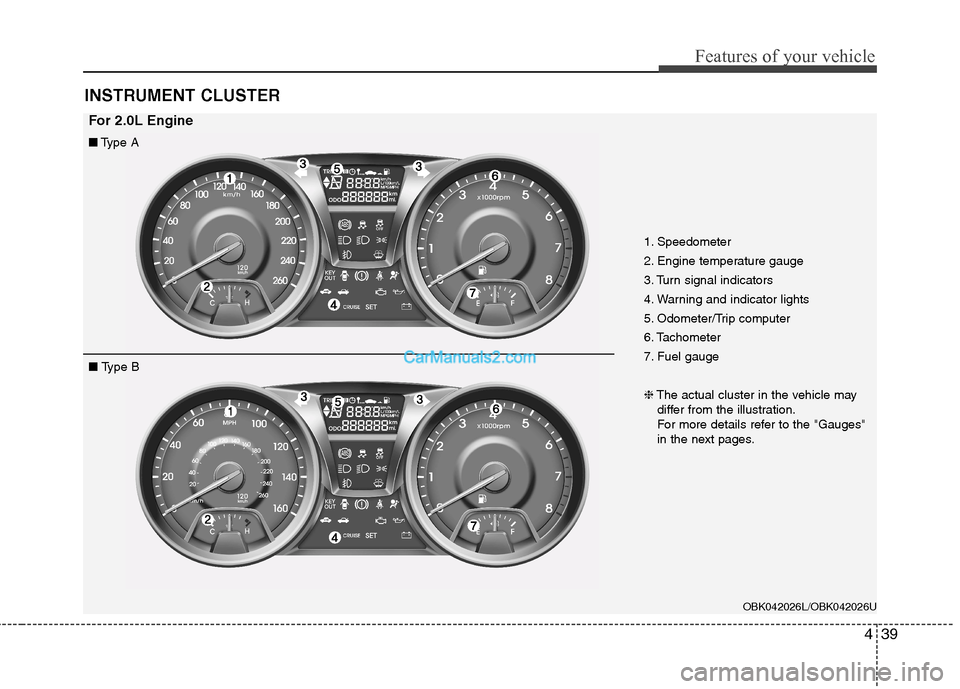
INSTRUMENT CLUSTER
OBK042026L/OBK042026U
■Type A
■ Type B 1. Speedometer
2. Engine temperature gauge
3. Turn signal indicators
4. Warning and indicator lights
5. Odometer/Trip computer
6. Tachometer
7. Fuel gauge ❈
The actual cluster in the vehicle may
differ from the illustration.
For more details refer to the "Gauges"
in the next pages.
For 2.0L Engine
Page 106 of 414
Features of your vehicle
40
4
OBK042027L/OBK042027U
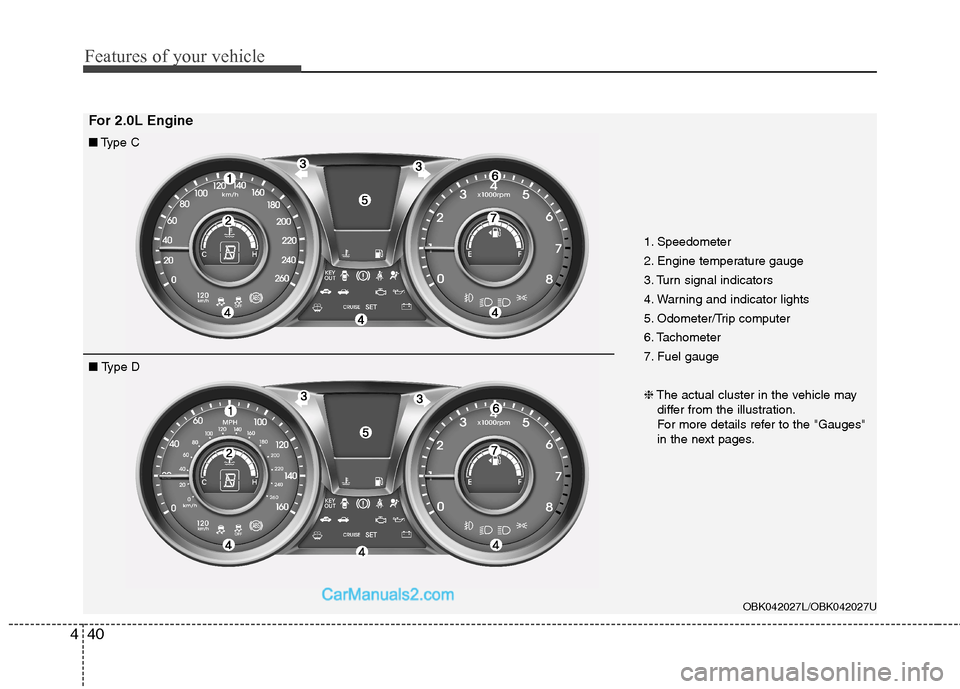
■ Type C
■ Type D 1. Speedometer
2. Engine temperature gauge
3. Turn signal indicators
4. Warning and indicator lights
5. Odometer/Trip computer
6. Tachometer
7. Fuel gauge ❈
The actual cluster in the vehicle may
differ from the illustration.
For more details refer to the "Gauges"
in the next pages.
For 2.0L Engine
Page 107 of 414
441
Features of your vehicle
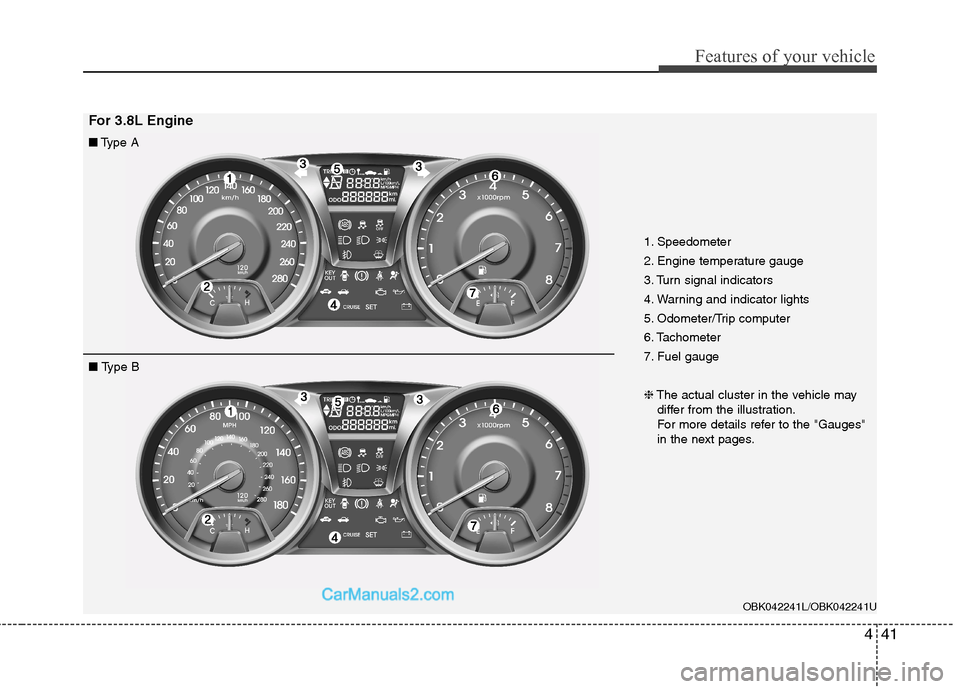
OBK042241L/OBK042241U
■Type A
■ Type B 1. Speedometer
2. Engine temperature gauge
3. Turn signal indicators
4. Warning and indicator lights
5. Odometer/Trip computer
6. Tachometer
7. Fuel gauge ❈
The actual cluster in the vehicle may
differ from the illustration.
For more details refer to the "Gauges"
in the next pages.
For 3.8L Engine
Page 108 of 414
Features of your vehicle
42
4
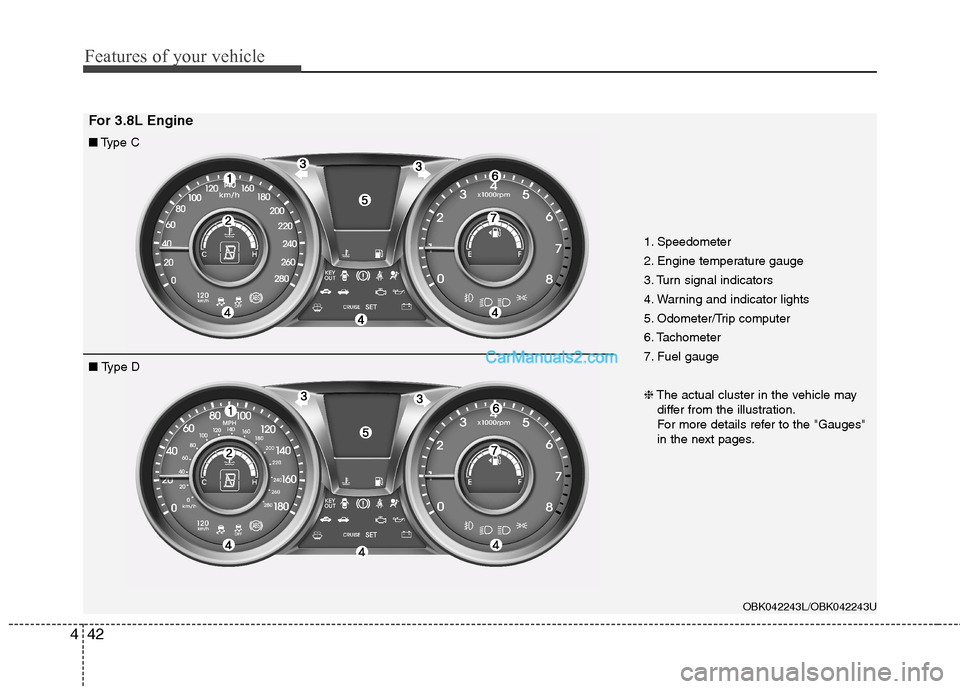
OBK042243L/OBK042243U
■ Type C
■ Type D 1. Speedometer
2. Engine temperature gauge
3. Turn signal indicators
4. Warning and indicator lights
5. Odometer/Trip computer
6. Tachometer
7. Fuel gauge ❈
The actual cluster in the vehicle may
differ from the illustration.
For more details refer to the "Gauges"
in the next pages.
For 3.8L Engine