service Hyundai Genesis Coupe 2013 Owner's Guide
[x] Cancel search | Manufacturer: HYUNDAI, Model Year: 2013, Model line: Genesis Coupe, Model: Hyundai Genesis Coupe 2013Pages: 414, PDF Size: 38.89 MB
Page 315 of 414
Maintenance
8
7
SCHEDULED MAINTENANCE SERVICE
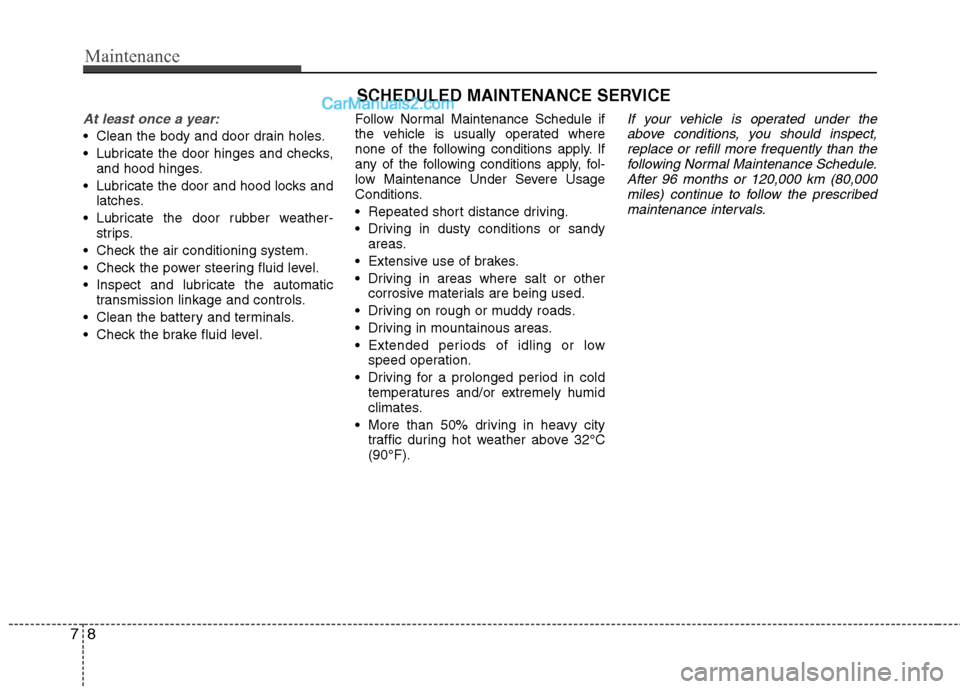
At least once a year:
Clean the body and door drain holes.
Lubricate the door hinges and checks,
and hood hinges.
Lubricate the door and hood locks and latches.
Lubricate the door rubber weather- strips.
Check the air conditioning system.
Check the power steering fluid level.
Inspect and lubricate the automatic transmission linkage and controls.
Clean the battery and terminals.
Check the brake fluid level. Follow Normal Maintenance Schedule if
the vehicle is usually operated where
none of the following conditions apply. If
any of the following conditions apply, fol-
low Maintenance Under Severe Usage
Conditions.
Repeated short distance driving.
Driving in dusty conditions or sandy
areas.
Extensive use of brakes.
Driving in areas where salt or other corrosive materials are being used.
Driving on rough or muddy roads.
Driving in mountainous areas.
Extended periods of idling or low speed operation.
Driving for a prolonged period in cold temperatures and/or extremely humid
climates.
More than 50% driving in heavy city traffic during hot weather above 32°C(90°F).
If your vehicle is operated under the
above conditions, you should inspect, replace or refill more frequently than thefollowing Normal Maintenance Schedule.
After 96 months or 120,000 km (80,000miles) continue to follow the prescribedmaintenance intervals.
Page 316 of 414
79
Maintenance
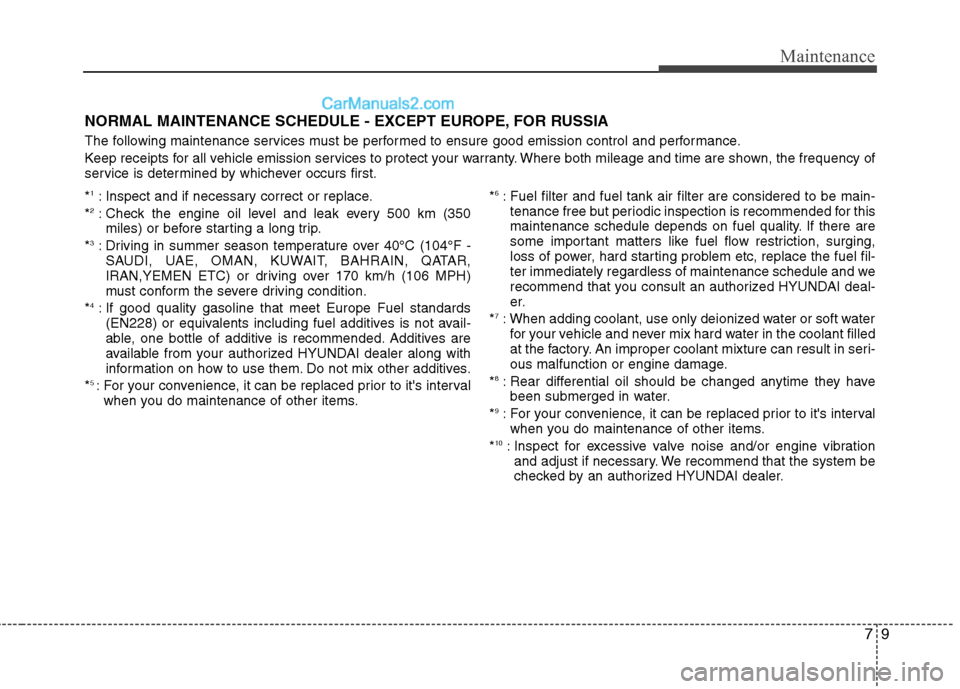
NORMAL MAINTENANCE SCHEDULE - EXCEPT EUROPE, FOR RUSSIA
The following maintenance services must be performed to ensure good emission control and performance.
Keep receipts for all vehicle emission services to protect your warranty. Where both mileage and time are shown, the frequency of
service is determined by whichever occurs first. * 1
: Inspect and if necessary correct or replace.
* 2
: Check the engine oil level and leak every 500 km (350
miles) or before starting a long trip.
* 3
: Driving in summer season temperature over 40°C (104°F -
SAUDI, UAE, OMAN, KUWAIT, BAHRAIN, QATAR,
IRAN,YEMEN ETC) or driving over 170 km/h (106 MPH)
must conform the severe driving condition.
* 4
: If good quality gasoline that meet Europe Fuel standards
(EN228) or equivalents including fuel additives is not avail-
able, one bottle of additive is recommended. Additives are
available from your authorized HYUNDAI dealer along with
information on how to use them. Do not mix other additives.
* 5
: For your convenience, it can be replaced prior to it's interval
when you do maintenance of other items. *
6
: Fuel filter and fuel tank air filter are considered to be main-
tenance free but periodic inspection is recommended for this
maintenance schedule depends on fuel quality. If there are
some important matters like fuel flow restriction, surging,
loss of power, hard starting problem etc, replace the fuel fil-
ter immediately regardless of maintenance schedule and we
recommend that you consult an authorized HYUNDAI deal-
er.
* 7
: When adding coolant, use only deionized water or soft water
for your vehicle and never mix hard water in the coolant filled
at the factory. An improper coolant mixture can result in seri-
ous malfunction or engine damage.
* 8
: Rear differential oil should be changed anytime they have
been submerged in water.
* 9
: For your convenience, it can be replaced prior to it's interval
when you do maintenance of other items.
* 10
: Inspect for excessive valve noise and/or engine vibration
and adjust if necessary. We recommend that the system be
checked by an authorized HYUNDAI dealer.
Page 325 of 414
Maintenance
18
7
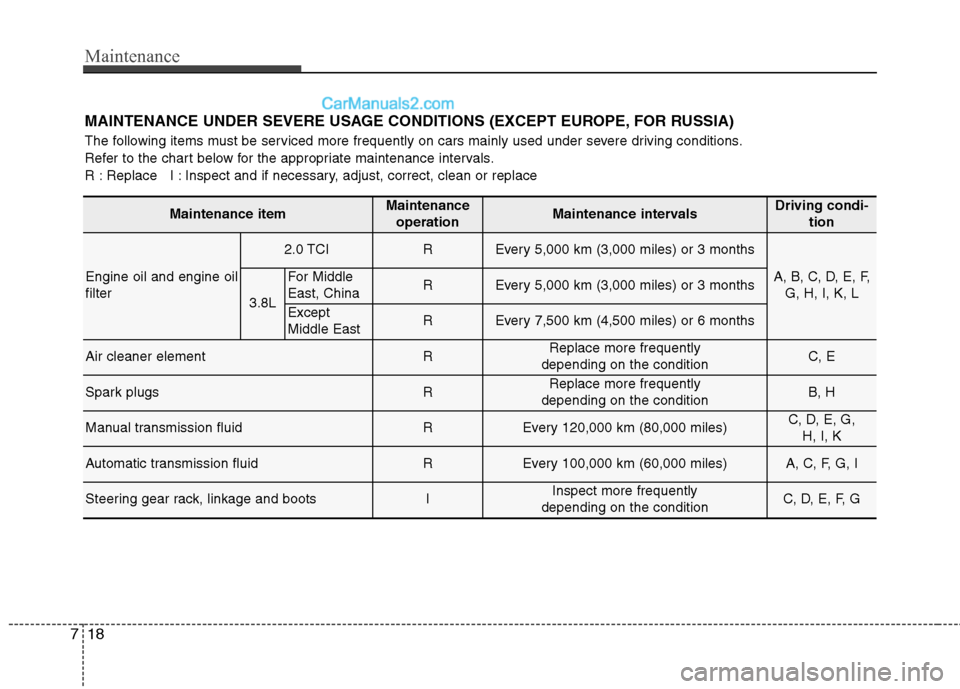
MAINTENANCE UNDER SEVERE USAGE CONDITIONS (EXCEPT EUROPE, FOR RUSSIA)
The following items must be serviced more frequently on cars mainly used under severe driving conditions.
Refer to the chart below for the appropriate maintenance intervals.
R : Replace I : Inspect and if necessary, adjust, correct, clean or replace
Maintenance itemMaintenance
operationMaintenance intervalsDriving condi- tion
Engine oil and engine oil filter
2.0 TCIREvery 5,000 km (3,000 miles) or 3 months
A, B, C, D, E, F,G, H, I, K, L
3.8L
For Middle East, ChinaREvery 5,000 km (3,000 miles) or 3 months
Except Middle EastREvery 7,500 km (4,500 miles) or 6 months
Air cleaner elementRReplace more frequently
depending on the conditionC, E
Spark plugs RReplace more frequently
depending on the conditionB, H
Manual transmission fluid REvery 120,000 km (80,000 miles)C, D, E, G, H, I, K
Automatic transmission fluidREvery 100,000 km (60,000 miles)A, C, F, G, I
Steering gear rack, linkage and bootsIInspect more frequently
depending on the conditionC, D, E, F, G
Page 327 of 414
Maintenance
20
7
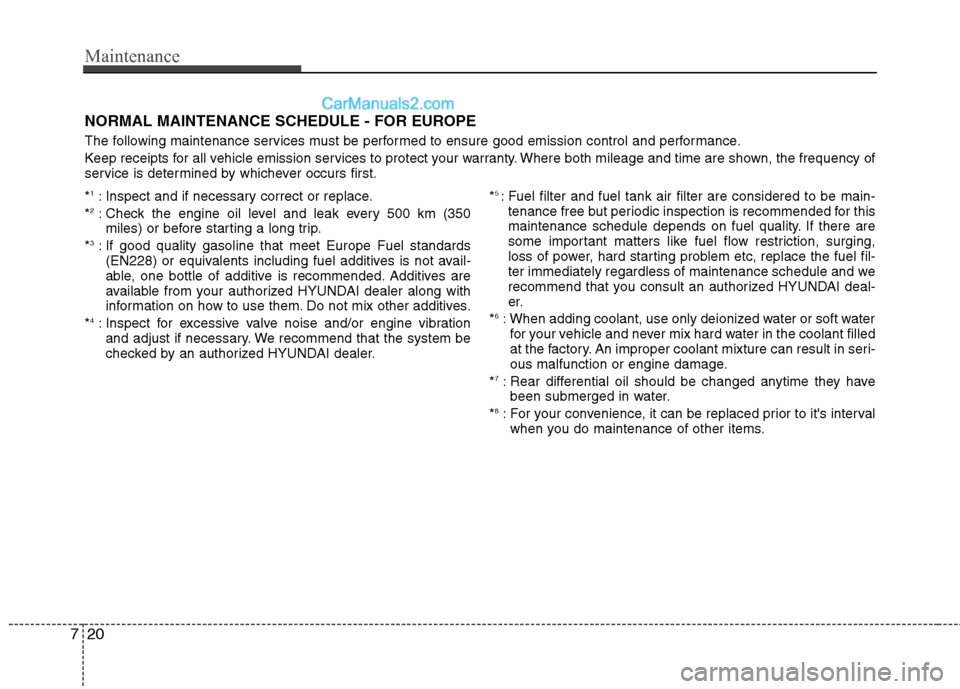
NORMAL MAINTENANCE SCHEDULE - FOR EUROPE
The following maintenance services must be performed to ensure good emission control and performance.
Keep receipts for all vehicle emission services to protect your warranty. Where both mileage and time are shown, the frequency o f
service is determined by whichever occurs first. * 1
: Inspect and if necessary correct or replace.
* 2
: Check the engine oil level and leak every 500 km (350
miles) or before starting a long trip.
* 3
: If good quality gasoline that meet Europe Fuel standards
(EN228) or equivalents including fuel additives is not avail-
able, one bottle of additive is recommended. Additives are
available from your authorized HYUNDAI dealer along with
information on how to use them. Do not mix other additives.
* 4
: Inspect for excessive valve noise and/or engine vibration
and adjust if necessary. We recommend that the system be
checked by an authorized HYUNDAI dealer. *
5
: Fuel filter and fuel tank air filter are considered to be main-
tenance free but periodic inspection is recommended for this
maintenance schedule depends on fuel quality. If there are
some important matters like fuel flow restriction, surging,
loss of power, hard starting problem etc, replace the fuel fil-
ter immediately regardless of maintenance schedule and we
recommend that you consult an authorized HYUNDAI deal-
er.
* 6
: When adding coolant, use only deionized water or soft water
for your vehicle and never mix hard water in the coolant filled
at the factory. An improper coolant mixture can result in seri-
ous malfunction or engine damage.
* 7
: Rear differential oil should be changed anytime they have
been submerged in water.
* 8
: For your convenience, it can be replaced prior to it's interval
when you do maintenance of other items.
Page 336 of 414
729
Maintenance
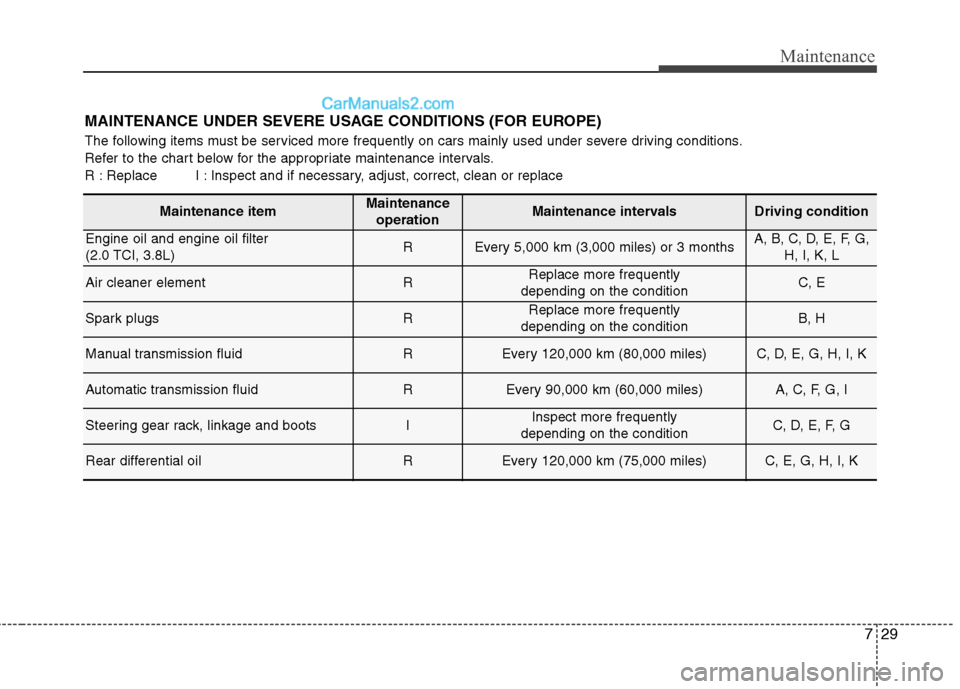
MAINTENANCE UNDER SEVERE USAGE CONDITIONS (FOR EUROPE)
The following items must be serviced more frequently on cars mainly used under severe driving conditions.
Refer to the chart below for the appropriate maintenance intervals.
R : Replace I : Inspect and if necessary, adjust, correct, clean or replace
Maintenance itemMaintenanceoperationMaintenance intervalsDriving condition
Engine oil and engine oil filter
(2.0 TCI, 3.8L)REvery 5,000 km (3,000 miles) or 3 monthsA, B, C, D, E, F, G, H, I, K, L
Air cleaner elementRReplace more frequently
depending on the conditionC, E
Spark plugsRReplace more frequently
depending on the conditionB, H
Manual transmission fluid REvery 120,000 km (80,000 miles)C, D, E, G, H, I, K
Automatic transmission fluidREvery 90,000 km (60,000 miles)A, C, F, G, I
Steering gear rack, linkage and bootsIInspect more frequently
depending on the conditionC, D, E, F, G
Rear differential oilREvery 120,000 km (75,000 miles)C, E, G, H, I, K
Page 349 of 414
Maintenance
42
7
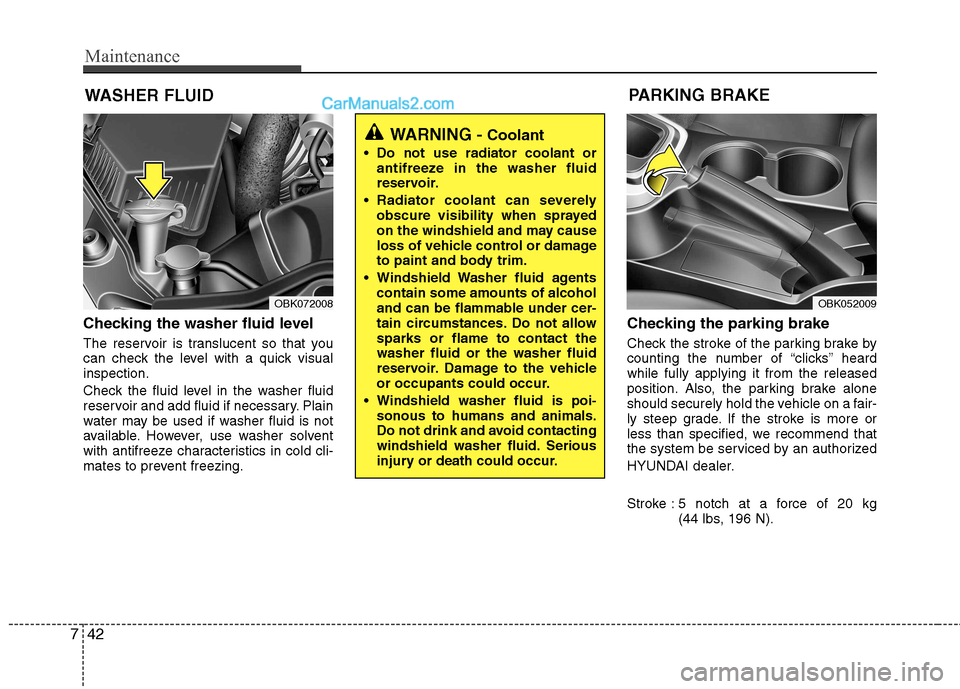
WASHER FLUID
Checking the washer fluid level
The reservoir is translucent so that you
can check the level with a quick visualinspection.
Check the fluid level in the washer fluid
reservoir and add fluid if necessary. Plain
water may be used if washer fluid is not
available. However, use washer solvent
with antifreeze characteristics in cold cli-
mates to prevent freezing. Checking the parking brake
Check the stroke of the parking brake by
counting the number of “clicks’’ heardwhile fully applying it from the released
position. Also, the parking brake alone
should securely hold the vehicle on a fair-
ly steep grade. If the stroke is more or
less than specified, we recommend that
the system be serviced by an authorized
HYUNDAI dealer.
Stroke : 5 notch at a force of 20 kg
(44 lbs, 196 N).
WARNING - Coolant
Do not use radiator coolant or antifreeze in the washer fluid
reservoir.
Radiator coolant can severely obscure visibility when sprayed
on the windshield and may cause
loss of vehicle control or damage
to paint and body trim.
Windshield Washer fluid agents contain some amounts of alcohol
and can be flammable under cer-
tain circumstances. Do not allowsparks or flame to contact thewasher fluid or the washer fluid
reservoir. Damage to the vehicle
or occupants could occur.
Windshield washer fluid is poi- sonous to humans and animals.
Do not drink and avoid contacting
windshield washer fluid. Serious
injury or death could occur.
OBK052009
PARKING BRAKEOBK072008
Page 357 of 414
Maintenance
50
7
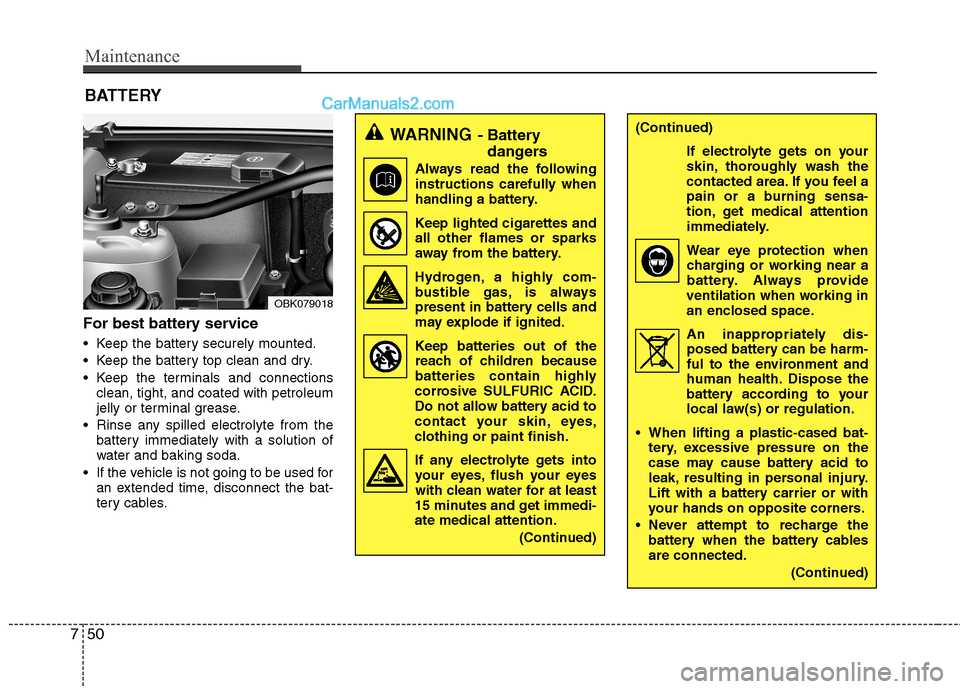
BATTERY
For best battery service
Keep the battery securely mounted.
Keep the battery top clean and dry.
Keep the terminals and connections clean, tight, and coated with petroleum
jelly or terminal grease.
Rinse any spilled electrolyte from the battery immediately with a solution of
water and baking soda.
If the vehicle is not going to be used for an extended time, disconnect the bat-
tery cables.
OBK079018
WARNING - Battery
dangers
Always read the following
instructions carefully when
handling a battery.
Keep lighted cigarettes and all other flames or sparks
away from the battery.
Hydrogen, a highly com- bustible gas, is always
present in battery cells and
may explode if ignited.
Keep batteries out of the reach of children because
batteries contain highly
corrosive SULFURIC ACID.
Do not allow battery acid to
contact your skin, eyes,
clothing or paint finish.
If any electrolyte gets into your eyes, flush your eyes
with clean water for at least
15 minutes and get immedi-ate medical attention.
(Continued)(Continued)
If electrolyte gets on your
skin, thoroughly wash the
contacted area. If you feel a
pain or a burning sensa-
tion, get medical attention
immediately.
Wear eye protection whencharging or working near a
battery. Always provide
ventilation when working in
an enclosed space.
An inappropriately dis- posed battery can be harm-
ful to the environment and
human health. Dispose the
battery according to your
local law(s) or regulation.
When lifting a plastic-cased bat- tery, excessive pressure on the
case may cause battery acid to
leak, resulting in personal injury.
Lift with a battery carrier or with
your hands on opposite corners.
Never attempt to recharge the battery when the battery cablesare connected.
(Continued)
Page 368 of 414
761
Maintenance
4. Tire ply composition and material
The number of layers or plies of rub-
ber-coated fabric in the tire. Tire
manufacturers also must indicate the
materials in the tire, which include
steel, nylon, polyester, and others.
The letter "R" means radial ply con-
struction; the letter "D" means diago-
nal or bias ply construction; and theletter "B" means belted-bias ply con-
struction.
5. Maximum permissible inflationpressure
This number is the greatest amount of air pressure that should be put in
the tire. Do not exceed the maximum
permissible inflation pressure. Refer
to the Tire and Loading Information
label for recommended inflation
pressure.
6. Maximum load rating
This number indicates the maximum
load in kilograms and pounds that
can be carried by the tire. When
replacing the tires on the vehicle,
always use a tire that has the same
load rating as the factory installed
tire.
7. Uniform tire quality grading
Tread wear
The tread wear grade is a compara-
tive rating based on the wear rate ofthe tire when tested under controlled
conditions on a specified govern-
ment test course. For example, a tire
graded 150 would wear one-and-a-
half times (1½) as well on the gov-
ernment course as a tire graded 100.
The relative performance of tires depends upon the actual conditions
of their use, however, and may
depart significantly from the norm
due to variations in driving habits,
service practices and differences in
road characteristics and climate.
These grades are molded on the
side-walls of passenger vehicle tires.
The tires available as standard or
optional equipment on your vehicle
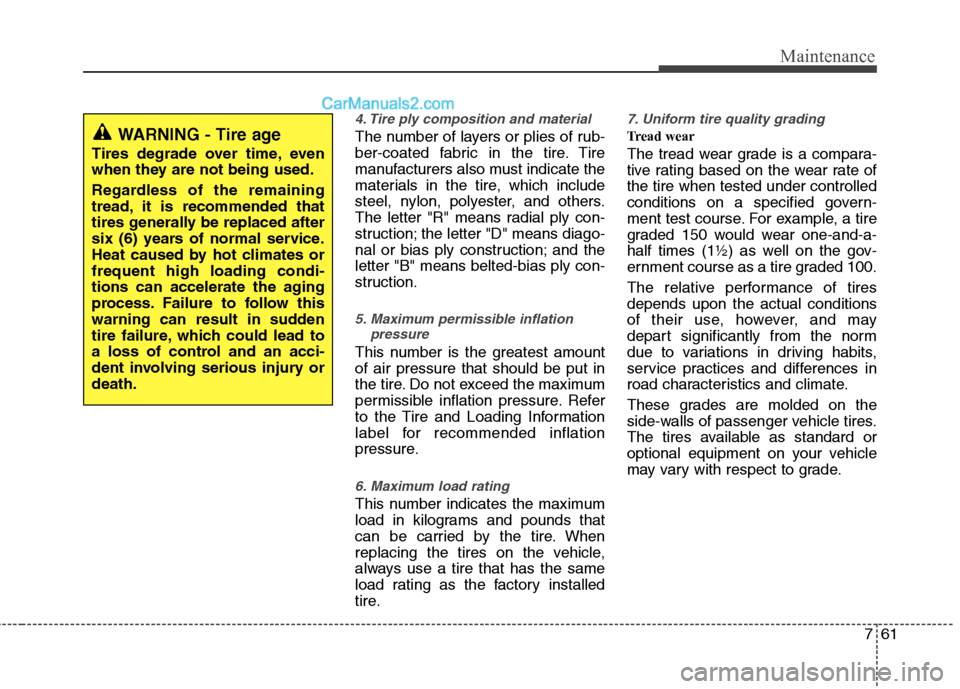
may vary with respect to grade.WARNING - Tire age
Tires degrade over time, even
when they are not being used.
Regardless of the remaining
tread, it is recommended that
tires generally be replaced after
six (6) years of normal service.
Heat caused by hot climates orfrequent high loading condi-
tions can accelerate the aging
process. Failure to follow this
warning can result in sudden
tire failure, which could lead to
a loss of control and an acci-
dent involving serious injury ordeath.
Page 387 of 414
Maintenance
80
7
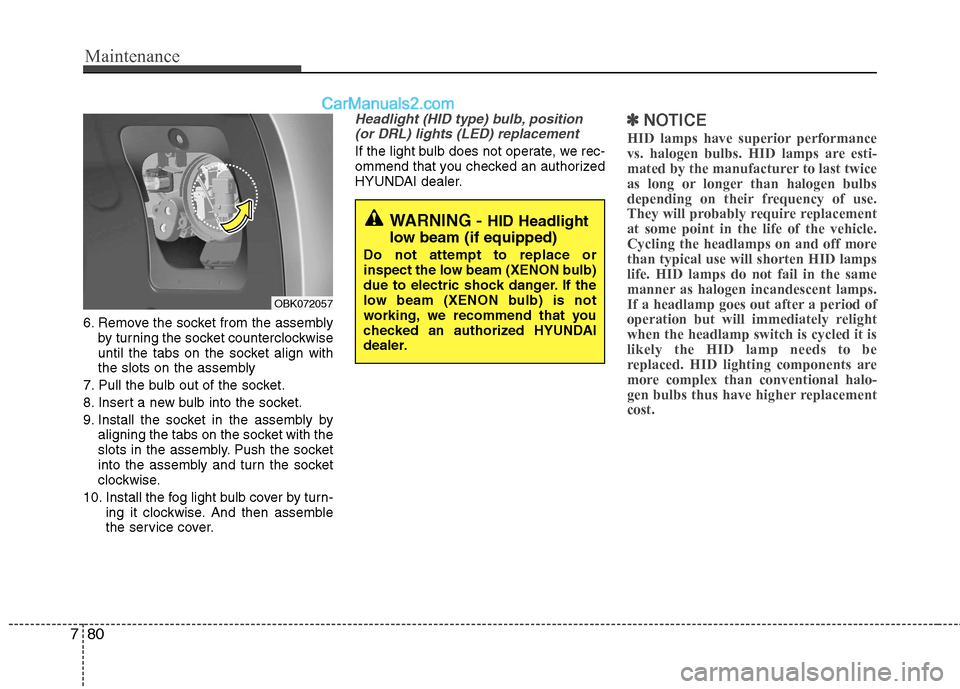
6. Remove the socket from the assembly
by turning the socket counterclockwise
until the tabs on the socket align with
the slots on the assembly
7. Pull the bulb out of the socket.
8. Insert a new bulb into the socket.
9. Install the socket in the assembly by aligning the tabs on the socket with the
slots in the assembly. Push the socket
into the assembly and turn the socket
clockwise.
10. Install the fog light bulb cover by turn- ing it clockwise. And then assemble
the service cover.
Headlight (HID type) bulb, position
(or DRL) lights (LED) replacement
If the light bulb does not operate, we rec-
ommend that you checked an authorized
HYUNDAI dealer.
✽✽ NOTICE
HID lamps have superior performance
vs. halogen bulbs. HID lamps are esti-
mated by the manufacturer to last twice
as long or longer than halogen bulbs
depending on their frequency of use.
They will probably require replacementat some point in the life of the vehicle.
Cycling the headlamps on and off morethan typical use will shorten HID lampslife. HID lamps do not fail in the same
manner as halogen incandescent lamps.
If a headlamp goes out after a period of
operation but will immediately relightwhen the headlamp switch is cycled it islikely the HID lamp needs to be
replaced. HID lighting components are
more complex than conventional halo-
gen bulbs thus have higher replacementcost.
OBK072057
WARNING - HID Headlight
low beam (if equipped)
Do not attempt to replace or
inspect the low beam (XENON bulb)
due to electric shock danger. If the
low beam (XENON bulb) is not
working, we recommend that you
checked an authorized HYUNDAI
dealer.
Page 393 of 414
Maintenance
86
7
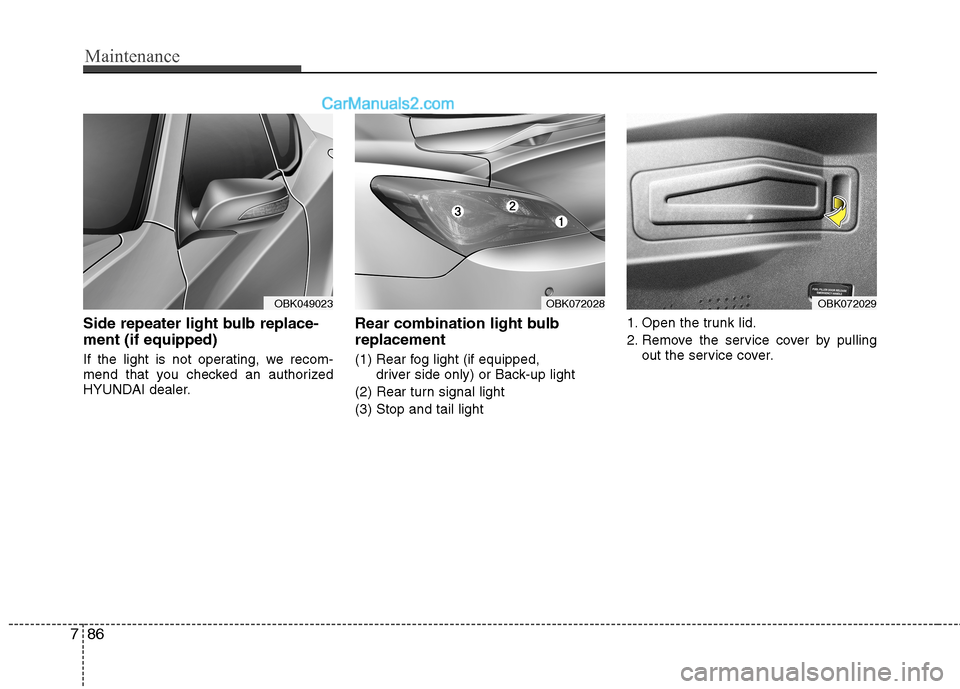
Side repeater light bulb replace- ment (if equipped)
If the light is not operating, we recom-
mend that you checked an authorized
HYUNDAI dealer. Rear combination light bulb replacement
(1) Rear fog light (if equipped,
driver side only) or Back-up light
(2) Rear turn signal light (3) Stop and tail light 1. Open the trunk lid.
2. Remove the service cover by pulling
out the service cover.
OBK049023OBK072028OBK072029