stop start Hyundai Genesis Coupe 2013 Owner's Guide
[x] Cancel search | Manufacturer: HYUNDAI, Model Year: 2013, Model line: Genesis Coupe, Model: Hyundai Genesis Coupe 2013Pages: 414, PDF Size: 38.89 MB
Page 248 of 414
513
Driving your vehicle
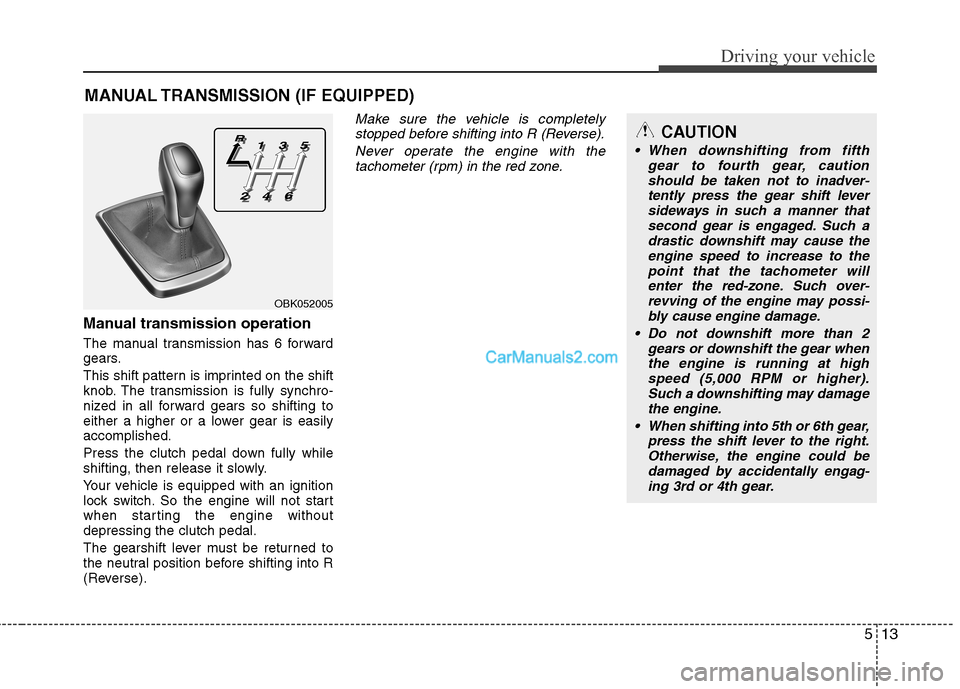
Manual transmission operation
The manual transmission has 6 forward
gears.
This shift pattern is imprinted on the shift
knob. The transmission is fully synchro-
nized in all forward gears so shifting to
either a higher or a lower gear is easilyaccomplished.
Press the clutch pedal down fully while
shifting, then release it slowly.
Your vehicle is equipped with an ignition
lock switch. So the engine will not start
when starting the engine withoutdepressing the clutch pedal.
The gearshift lever must be returned to
the neutral position before shifting into R
(Reverse).
Make sure the vehicle is completelystopped before shifting into R (Reverse).
Never operate the engine with thetachometer (rpm) in the red zone.
MANUAL TRANSMISSION (IF EQUIPPED)
OBK052005
CAUTION
When downshifting from fifth gear to fourth gear, caution
should be taken not to inadver- tently press the gear shift leversideways in such a manner thatsecond gear is engaged. Such a
drastic downshift may cause theengine speed to increase to the point that the tachometer will
enter the red-zone. Such over- revving of the engine may possi-bly cause engine damage.
Do not downshift more than 2 gears or downshift the gear when
the engine is running at highspeed (5,000 RPM or higher). Such a downshifting may damagethe engine.
When shifting into 5th or 6th gear, press the shift lever to the right.Otherwise, the engine could be damaged by accidentally engag-ing 3rd or 4th gear.
Page 263 of 414
Driving your vehicle
28
5
The ABS continuously senses the speed
of the wheels. If the wheels are going to
lock, the ABS system repeatedly modu-
lates the hydraulic brake pressure to the
wheels.
When you apply your brakes under con-
ditions which may lock the wheels, you
may hear a “tik-tik’’ sound from the
brakes, or feel a corresponding sensation
in the brake pedal. This is normal and it
means your ABS is active.
In order to obtain the maximum benefit
from your ABS in an emergency situa-
tion, do not attempt to modulate your
brake pressure and do not try to pump
your brakes. Press your brake pedal as
hard as possible or as hard as the situa-
tion warrants and allow the ABS to con-
trol the force being delivered to the
brakes.✽✽
NOTICE
A click sound may be heard in the engine compartment when the vehicle
begins to move after the engine is start-
ed. These conditions are normal andindicate that the anti-lock brake system
is functioning properly.
Even with the anti-lock brake system, your vehicle still requires sufficient
stopping distance. Always maintain a
safe distance from the vehicle in front
of you.
Always slow down when cornering. The anti-lock brake system cannot pre-
vent accidents resulting from exces-
sive speeds.
On loose or uneven road surfaces, operation of the anti-lock brake system
may result in a longer stopping dis-
tance than for vehicles equipped with a
conventional brake system.
W-78
CAUTION
If the ABS warning light is on and
stays on, you may have a problemwith the ABS. In this case, howev- er, your regular brakes will worknormally.
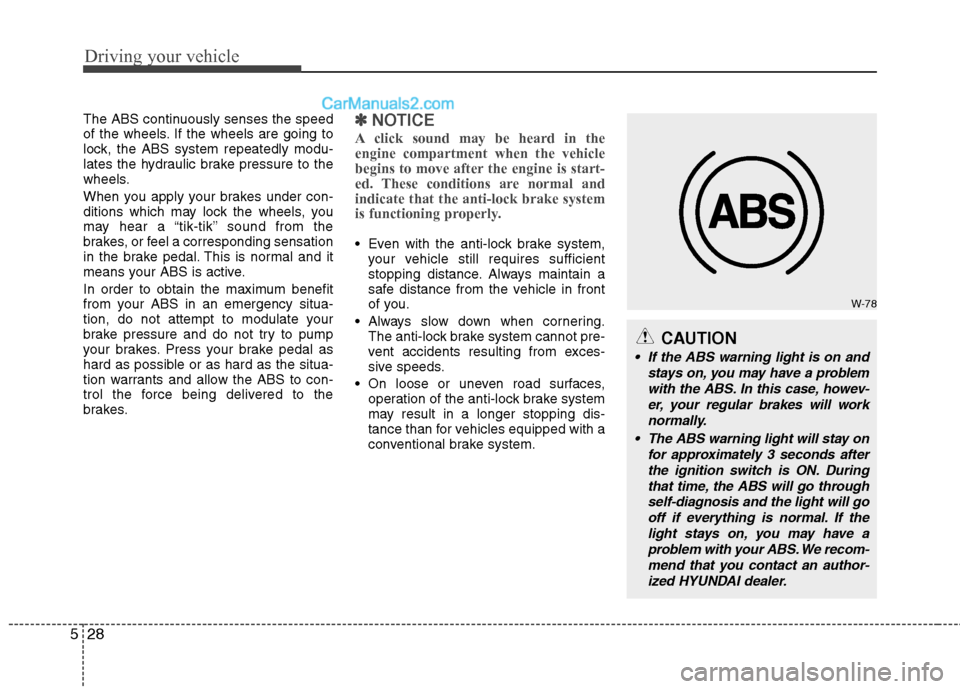
The ABS warning light will stay on for approximately 3 seconds afterthe ignition switch is ON. During that time, the ABS will go throughself-diagnosis and the light will gooff if everything is normal. If thelight stays on, you may have aproblem with your ABS. We recom-mend that you contact an author- ized HYUNDAI dealer.
Page 266 of 414
531
Driving your vehicle
ESP operation off
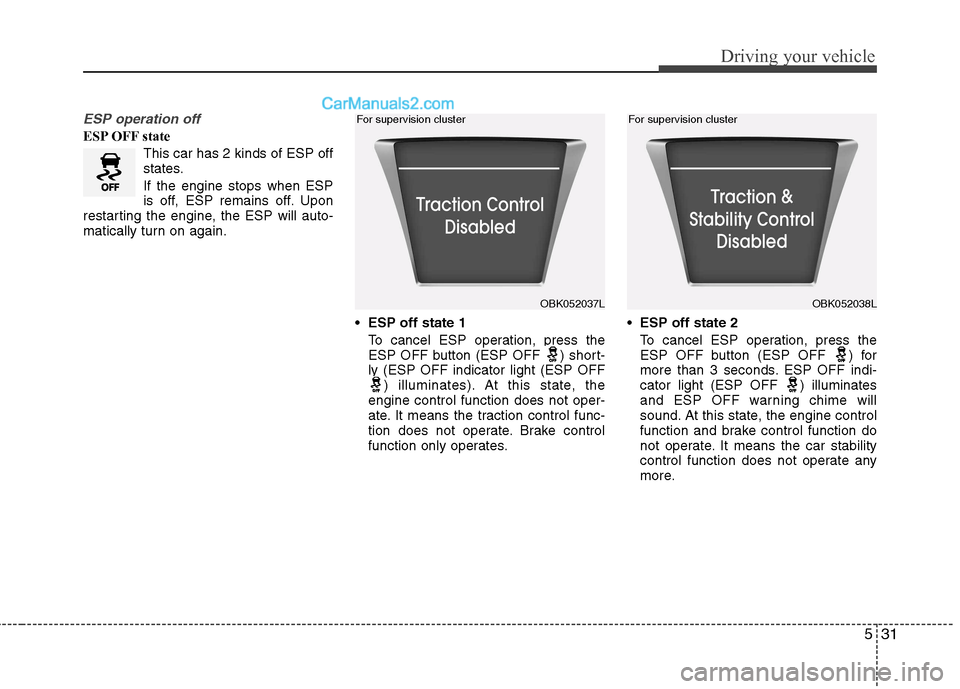
ESP OFF stateThis car has 2 kinds of ESP offstates. If the engine stops when ESP
is off, ESP remains off. Upon
restarting the engine, the ESP will auto-
matically turn on again.
ESP off state 1
To cancel ESP operation, press the ESP OFF button (ESP OFF ) short-ly (ESP OFF indicator light (ESP OFF
) illuminates). At this state, the
engine control function does not oper-
ate. It means the traction control func-
tion does not operate. Brake control
function only operates.
ESP off state 2
To cancel ESP operation, press the
ESP OFF button (ESP OFF ) for
more than 3 seconds. ESP OFF indi-
cator light (ESP OFF ) illuminates
and ESP OFF warning chime will
sound. At this state, the engine control
function and brake control function do
not operate. It means the car stability
control function does not operate any
more.
OBK052037LOBK052038L
For supervision cluster For supervision cluster
Page 274 of 414
539
Driving your vehicle
Your vehicle's fuel economy depends
mainly on your style of driving, where you
drive and when you drive.
Each of these factors affects how many
miles (kilometers) you can get from a gal-
lon (liter) of fuel. To operate your vehicle
as economically as possible, use the fol-
lowing driving suggestions to help save
money in both fuel and repairs:
Drive smoothly. Accelerate at a moder-ate rate. Don't make "jack-rabbit" starts or full-throttle shifts and maintain a
steady cruising speed. Don't race
between stoplights. Try to adjust your
speed to that of the other traffic so you
don't have to change speeds unneces-
sarily. Avoid heavy traffic whenever
possible. Always maintain a safe dis-
tance from other vehicles so you can
avoid unnecessary braking. This also
reduces brake wear.
Drive at a moderate speed. The faster you drive, the more fuel your car uses.
Driving at a moderate speed, especial-
ly on the highway, is one of the most
effective ways to reduce fuel consump-tion. Don't "ride" the brake or clutch pedal.
This can increase fuel consumption
and also increase wear on these com-
ponents. In addition, driving with your
foot resting on the brake pedal may
cause the brakes to overheat, which
reduces their effectiveness and may
lead to more serious consequences.
Take care of your tires. Keep them inflated to the recommended pressure.
Incorrect inflation, either too much or
too little, results in unnecessary tire
wear. Check the tire pressures at leastonce a month.
Be sure that the wheels are aligned correctly. Improper alignment can
result from hitting curbs or driving too
fast over irregular surfaces. Poor align-
ment causes faster tire wear and may
also result in other problems as well as
greater fuel consumption. Keep your car in good condition. For
better fuel economy and reduced
maintenance costs, maintain your carin accordance with the maintenance
schedule in section 7. If you drive your
car in severe conditions, more frequentmaintenance is required (see section 7
for details).
Keep your car clean. For maximum service, your vehicle should be kept
clean and free of corrosive materials. It
is especially important that mud, dirt,
ice, etc. not be allowed to accumulate
on the underside of the car. This extra
weight can result in increased fuel con-
sumption and also contribute to corro-sion.
Travel lightly. Don't carry unnecessary weight in your car. Weight reduces fuel
economy.
Don't let the engine idle longer than necessary. If you are waiting (and not
in traffic), turn off your engine and
restart only when you're ready to go.
ECONOMICAL OPERATION
Page 289 of 414
63
What to do in an emergency
IN CASE OF AN EMERGENCY WHILE DRIVING
If the engine stalls at a crossroad
or crossing If the engine stalls at a crossroad or
crossing, set the shift lever in the N
(Neutral) position and then push the vehi-
cle to a safe place. If you have a flat tire while driving
If a tire goes flat while you are driving:
1. Take your foot off the accelerator pedal
and let the car slow down while driving
straight ahead. Do not apply the brakesimmediately or attempt to pull off the
road as this may cause a loss of con-
trol. When the car has slowed to such
a speed that it is safe to do so, brake
carefully and pull off the road. Drive off
the road as far as possible and park on
firm, level ground. If you are on a divid-
ed highway, do not park in the median
area between the two traffic lanes.
2. When the car is stopped, turn on your emergency hazard flashers, set the
parking brake and put the transmission
in P (automatic transmission) or
reverse (manual transmission).
3. Have all passengers get out of the car. Be sure they all get out on the side of
the car that is away from traffic.
4. When changing a flat tire, follow the instruction provided later in this sec-tion. If engine stalls while driving
1. Reduce your speed gradually, keeping
a straight line. Move cautiously off the
road to a safe place.
2. Turn on your emergency flashers.
3. Try to start the engine again. If your vehicle will not start, we recommend
that you consult an authorized
HYUNDAI dealer.
Page 378 of 414
771
Maintenance
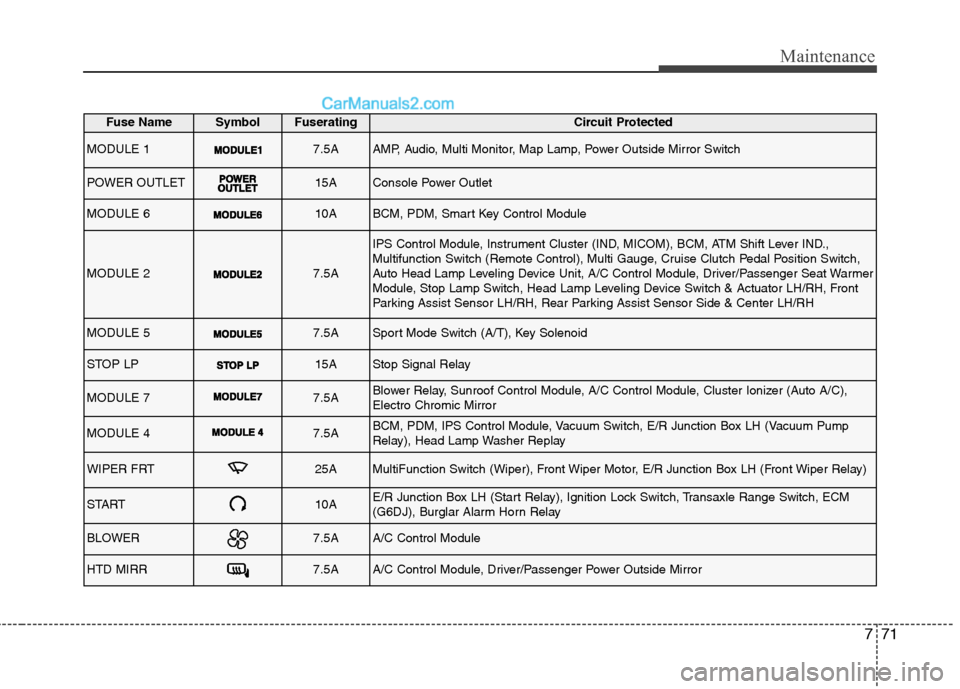
Fuse NameSymbolFuseratingCircuit Protected
MODULE 17.5AAMP, Audio, Multi Monitor, Map Lamp, Power Outside Mirror Switch
POWER OUTLET15AConsole Power Outlet
MODULE 610ABCM, PDM, Smart Key Control Module
MODULE 27.5A
IPS Control Module, Instrument Cluster (IND, MICOM), BCM, ATM Shift Lever IND.,
Multifunction Switch (Remote Control), Multi Gauge, Cruise Clutch Pedal Position Switch,
Auto Head Lamp Leveling Device Unit, A/C Control Module, Driver/Passenger Seat Warmer
Module, Stop Lamp Switch, Head Lamp Leveling Device Switch & Actuator LH/RH, Front
Parking Assist Sensor LH/RH, Rear Parking Assist Sensor Side & Center LH/RH
MODULE 57.5ASport Mode Switch (A/T), Key Solenoid
STOP LP15AStop Signal Relay
MODULE 77.5ABlower Relay, Sunroof Control Module, A/C Control Module, Cluster Ionizer (Auto A/C), Electro Chromic Mirror
MODULE 47.5ABCM, PDM, IPS Control Module, Vacuum Switch, E/R Junction Box LH (Vacuum Pump
Relay), Head Lamp Washer Replay
WIPER FRT25AMultiFunction Switch (Wiper), Front Wiper Motor, E/R Junction Box LH (Front Wiper Relay)
START10AE/R Junction Box LH (Start Relay), Ignition Lock Switch, Transaxle Range Switch, ECM
(G6DJ), Burglar Alarm Horn Relay
BLOWER7.5AA/C Control Module
HTD MIRR7.5AA/C Control Module, Driver/Passenger Power Outside Mirror
Page 379 of 414
Maintenance
72
7
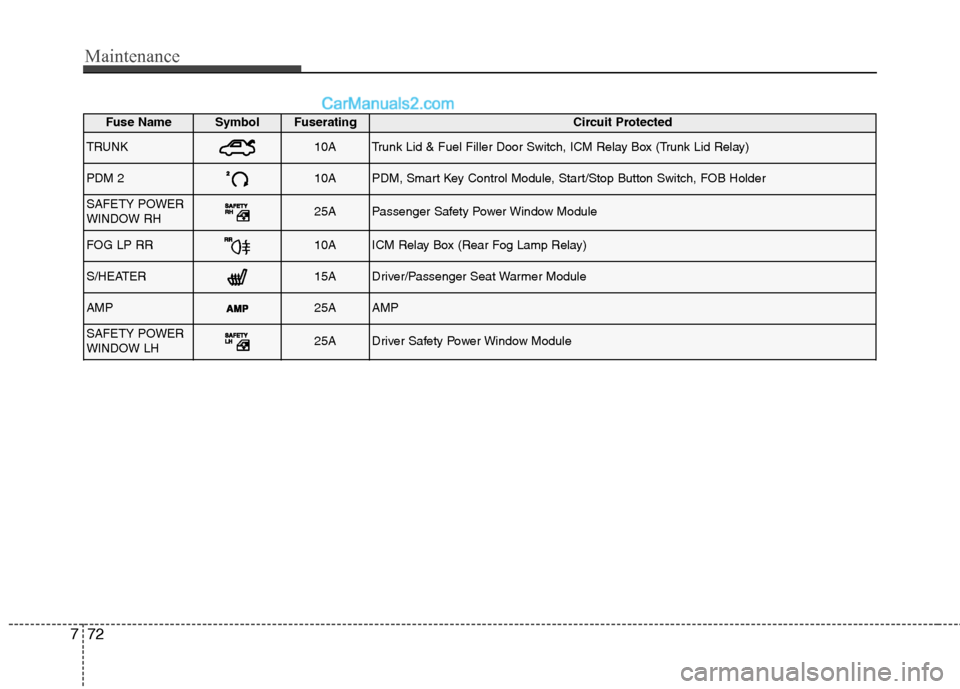
Fuse NameSymbolFuseratingCircuit Protected
TRUNK10ATrunk Lid & Fuel Filler Door Switch, ICM Relay Box (Trunk Lid Relay)
PDM 210APDM, Smart Key Control Module, Start/Stop Button Switch, FOB Holder
SAFETY POWER
WINDOW RH25APassenger Safety Power Window Module
FOG LP RR10AICM Relay Box (Rear Fog Lamp Relay)
S/HEATER15ADriver/Passenger Seat Warmer Module
AMP25AAMP
SAFETY POWER
WINDOW LH25ADriver Safety Power Window Module
Page 405 of 414
Maintenance
98
7
Do not operate the engine in confined
or closed areas (such as garages) any
more than what is necessary to move
the vehicle in or out of the area.
When the vehicle is stopped in an open area for more than a short time
with the engine running, adjust the
ventilation system (as needed) to draw
outside air into the vehicle.
Never sit in a parked or stopped vehi- cle for any extended time with the
engine running.
When the engine stalls or fails to start, excessive attempts to restart the
engine may cause damage to theemission control system.Operating precautions for catalytic
converters (if equipped)Your vehicle is equipped with a catalytic
converter emission control device.
Therefore, the following precautions
must be observed:
Make sure to refuel your vehicle according to the “Fuel requirements”suggested in section 1.
Do not operate the vehicle when there are signs of engine malfunction, such
as misfire or a noticeable loss of per-
formance.
Do not misuse or abuse the engine. Examples of misuse are coasting withthe ignition off and descending steep
grades in gear with the ignition off.
Do not operate the engine at high idle speed for extended periods (5 minutesor more).
Do not modify or tamper with any part of the engine or emission control sys-
tem. We recommend that the system
be inspected by an authorized
HYUNDAI dealer.
Avoid driving with a very low fuel level. If you run out of gasoline, it couldcause the engine to misfire and result
in excessive loading of the catalytic
converter.
Failure to observe these precautionscould result in damage to the catalytic
converter and to your vehicle.
Additionally, such actions could void your
warranties.
WARNING - Fire
A hot exhaust system can ignite flammable items under your vehi-
cle. Do not park, idle, or drive the
vehicle over or near flammable
objects, such as grass, vegeta-
tion, paper, leaves, etc.
The exhaust system and catalytic system are very hot while the
engine is running or immediately
after the engine is turned off.
Keep away from the exhaust sys-
tem and catalytic, you may get
burned.
Also, do not remove the heat sink
around the exhaust system, do
not seal the bottom of the vehicle
or do not coat the vehicle for cor-
rosion control. It may present a
fire risk under certain conditions.